
Plastic and rubber are two of the most notoriously difficult materials to bond together. Their wildly different surface energies, flexibility, and chemical resistance mean most household glues fail almost immediately under stress, leaving you with a joint that separates at the first sign of movement or temperature change. The right bonding agent needs to bridge this gap without becoming brittle or dissolving the plastic itself.
I’m Min — the co-founder and writer behind Gadgets Feed. I have spent countless hours analyzing manufacturer data sheets, chemical formulations, and real-world performance reports to narrow down the adhesives that genuinely solve the plastic-to-rubber bonding problem, sorting through the marketing hype to find what actually works.
This guide is built around the best adhesive for plastic to rubber, featuring seven carefully selected formulas that range from industrial-grade instant adhesives to heavy-duty spray-on solutions for large surface work.
How To Choose The Best Adhesive For Plastic To Rubber
Bonding plastic to rubber is chemically challenging because these materials expand and flex at different rates. A rigid glue will crack, while a weak one will peel. You need an adhesive formulated to handle the specific type of plastic and rubber in your project, considering factors like flexibility, temperature exposure, and whether the bond needs to withstand moisture or constant movement.
Viscosity and Application Method
The thickness of the adhesive determines how it interacts with your materials. Water-thin formulas (like the Berkland Acrylic Cement or 3M PR100) use capillary action to wick into tight seams and hairline cracks, making them ideal for flush repairs on smooth surfaces. Thicker gels and pastes, such as the Titebond PVC Joint Adhesive, fill gaps between uneven parts and prevent the glue from running off vertical surfaces. Spray adhesives like the 3M Hi-Strength 90 cover large areas evenly, which is useful for bonding sheets of plastic and rubber together.
Flexibility and Impact Resistance
A plastic-to-rubber bond will almost certainly encounter twisting, bending, or thermal expansion. Cyanoacrylate adhesives (CA glues) like the Leenexus 40ml and 3M PR100 offer high strength but vary in brittleness. The RH Adhesives S-18, a neoprene-based contact cement, dries into a flexible film that moves with the materials, making it better for applications like gasket attachment or automotive interior repairs where vibration is a factor.
Cure Time and Working Window
Some repairs require immediate clamping, while others benefit from a slower set to allow for repositioning. Fast-setting adhesives like the Loctite Plastics Bonding System cure in under a minute but give you almost no time to adjust. The 3M PR100 offers handling strength in under 20 seconds, which is excellent for production work but demanding for beginners. The S-18 All-Purpose Adhesive allows for a longer assembly window, letting you align parts before the bond sets.
Quick Comparison
On smaller screens, swipe sideways to see the full table.
| Model | Category | Best For | Key Spec | Amazon |
|---|---|---|---|---|
| 3M Scotch-Weld PR100 | Premium Instant Adhesive | Tough plastics and silicone rubber | Handling time under 20 seconds | Amazon |
| Loctite Plastics Bonding System | Activator-Based CA | Polypropylene and polyethylene | Activator + adhesive for low-energy plastics | Amazon |
| RH Adhesives S-18 | Flexible Contact Cement | Rubber-to-metal and neoprene jobs | Water-resistant neoprene formula | Amazon |
| Leenexus Super Glue | Water-Thin CA | 3D prints and model kits | Micro-Anchor grip up to 3580 lbs | Amazon |
| Berkland Acrylic Cement | Solvent Cement | Acrylic and plexiglass repairs | Capillary action for tight joints | Amazon |
| Titebond PVC Joint Adhesive | Gap-Filling CA | PVC trim and column wrap | 100% waterproof bond | Amazon |
| 3M Hi-Strength 90 Spray | High-Performance Spray | Large surface laminating | Low VOC, bonds polypropylene | Amazon |
In‑Depth Reviews
1. 3M Scotch-Weld Plastic & Rubber Instant Adhesive PR100

The 3M Scotch-Weld PR100 is a clear, low-viscosity cyanoacrylate that has been specifically formulated to tackle difficult substrates like silicone rubber, EPDM, heavily plasticized PVC, and Santoprene. Its fast handling time of under 20 seconds makes it ideal for production environments and critical repairs where you need immediate strength. The flexible container allows you to pinch out a precise drop or squeeze a steady bead for larger joints.
Users report that this adhesive significantly outperforms standard super glues on rubber components, successfully bonding silicone to silicone when paired with the recommended 3M primer. It also shows strong results on ABS, Nylon, and various plastic compounds, with the bond line remaining thin and unobtrusive. The 20-gram bottle is small but highly concentrated, and a single bottle goes a long way for targeted repairs.
One reality check: the PR100 is designed for industrial and occupational use, not general retail. The price per ounce is higher than commodity glues, but the chemistry is purpose-built for the plastic-to-rubber interface. Proper ventilation is strongly advised, and storing the adhesive in a refrigerator between uses extends its shelf life. The absence of a precision tip on the bottle can be a minor hassle for extremely tight spaces.
Why it’s great
- Specially engineered for silicone rubber and EPDM, two materials most glues cannot bond
- Extremely fast set time — reaches handling strength in under 20 seconds
- Low viscosity wicks into tight joints for a clean, invisible bond line
Good to know
- Expensive per ounce compared to general-purpose CA glues
- Not sold as a consumer product; intended for professional/industrial use
- Bottle lacks a fine-tip applicator for micro repairs
2. Loctite Super Glue Plastics Bonding System with Activator
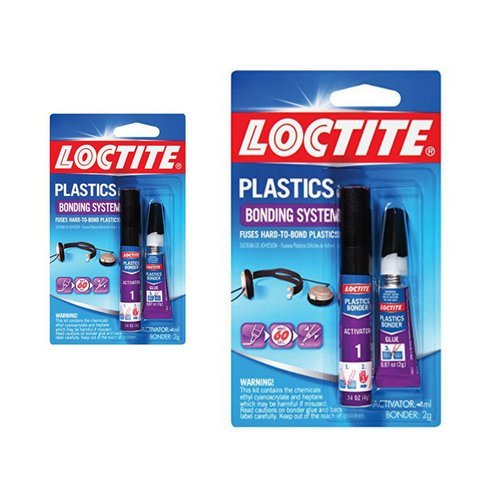
The Loctite Plastics Bonding System is a two-part solution that addresses the core challenge of adhesive-for-plastic-to-rubber applications: low surface energy. It includes a dedicated activator that prepares the substrate, followed by a cyanoacrylate adhesive designed to fuse with difficult plastics like polypropylene and polyethylene. This dual-component approach creates a chemical reaction that forms a bond significantly stronger than single-step glues.
Customer feedback highlights that this is often the only glue that successfully repairs polypropylene items, such as complex cracks in airline cat carriers and structural splits in automotive interior parts that see high heat. The 2-gram tubes are small but effective; users note that a choreographed dry-run is essential because the activator dries quickly and the adhesive sets in about one minute, leaving little room for error after application.
However, this product is quite specialized and its two-part process adds steps that some users find cumbersome for simple repairs. The small tube size means it is best suited for precise, small-area fixes rather than large surface bonds. The Loctite system is also more expensive per gram than standard super glues, but for polypropylene and polyethylene repairs, it delivers results that other adhesives simply cannot match.
Why it’s great
- The only consumer-available system that reliably bonds polypropylene and polyethylene
- Invisible repair line — dries crystal clear with minimal residue
- Fast 1-minute cure time for quick assembly
Good to know
- Requires a choreographed dry-run; no time for repositioning
- Small 2-gram tubes are not economical for large repairs
- Activator and adhesive must be used together; cannot substitute one part
3. RH Adhesives S-18 All-Purpose Adhesive
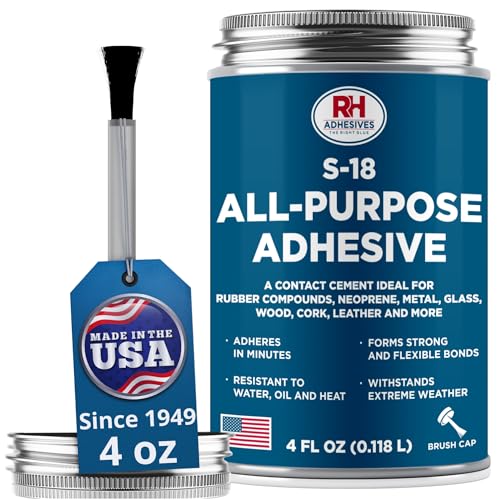
The RH Adhesives S-18 is a neoprene-based contact cement that approaches the plastic-to-rubber bonding problem from a different angle than CA glues. Rather than creating a rigid bond, it forms a flexible, water-resistant film that delivers excellent peel strength and outstanding resistance to oil and heat. This makes it particularly effective for affixing SBR rubber and neoprene to metal, as well as bonding various plastics to other materials without becoming brittle over time.
Users report excellent results on leather boot repairs, neoprene yoga mat applications, and general rubber-to-metal bonding tasks. The adhesive requires thorough cleaning and sanding of both surfaces for optimal performance, and it performs best when applied as a thin, even coat. The 4-ounce can provides generous coverage, and the formula has been manufactured in the USA since 1949, indicating a long track record of reliability.
The primary downside is the 24-hour full cure time, which demands patience and proper clamping. The solvent has a strong chemical odor, requiring use in a well-ventilated area. Some users report that the adhesive nozzle can gum up if not cleaned promptly, and the bond can fail in extreme outdoor heat and rain if not fully protected. It is best suited for indoor, low-stress applications where flexibility is more important than instant strength.
Why it’s great
- Flexible neoprene film that moves with rubber and plastic without cracking
- Excellent water and oil resistance for marine and automotive use
- Long working time allows for precise alignment before the bond sets
Good to know
- Full cure takes 24 hours, significantly slower than instant adhesives
- Strong solvent fumes require good ventilation
- Not recommended for outdoor applications exposed to heavy rain and heat without additional sealing
4. Leenexus Super Glue for Plastic
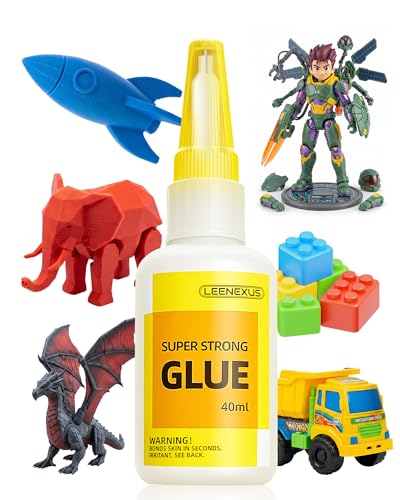
The Leenexus Super Glue is a water-thin cyanoacrylate that prioritizes deep penetration into hairline cracks and porous surfaces using what the manufacturer calls Micro-Anchor Technology. Its ultra-low viscosity allows it to flow instantly via capillary action, making it a strong candidate for bonding 3D printed parts (PLA, ABS, PETG, PC, ASA, Acrylic, PVC) and repairing model kits, RC parts, and detailed household repairs where a thick gel would be too messy.
The 40ml bottle offers more glue than most premium options, and the triple-protection anti-clog system — a built-in precision cleaning needle, dual-threaded cap, and moisture-proof seal — is a well-engineered solution to the common problem of CA glue drying in the nozzle. Users describe the bond as exceptionally strong on plastic and ceramic, with a slightly thicker viscosity than ultra-thin super glues, which provides a small “bump” of drop control. It dries clear with zero white residue.
However, this glue explicitly does not work on polyethylene, polypropylene, silicone, or wet surfaces, which limits its utility for some plastic-to-rubber applications. The water-thin consistency can be difficult to control on vertical surfaces, causing drips and runs if applied too liberally. One user reported receiving an empty bottle, which raises a quality control concern, though the manufacturer offers a satisfaction guarantee and replacement policy.
Why it’s great
- Water-thin formula wicks deep into hairline cracks for invisible repairs
- Anti-clog system extends bottle life significantly beyond standard CA glues
- High impact resistance — bond holds under bending stress
Good to know
- Not compatible with polyethylene, polypropylene, or silicone rubber
- Very runny on vertical surfaces; requires light application to avoid drips
- Isolated reports of empty bottles on delivery
5. Berkland Acrylic Bonding Cement
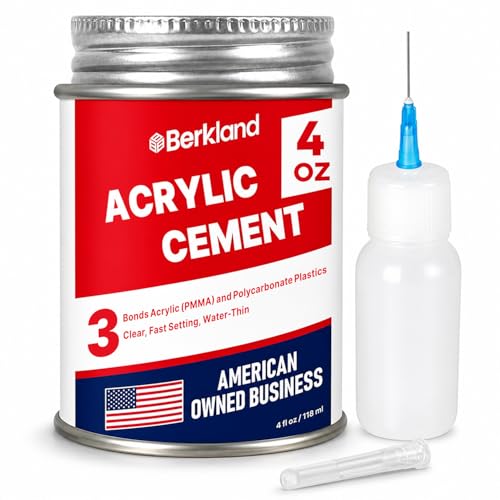
The Berkland Acrylic Bonding Cement is a solvent-based product specifically engineered for bonding acrylic and plexiglass sheets. Its water-thin consistency is designed to flow into tight joints via capillary action, creating a clean, strong, and virtually invisible bond. Unlike cyanoacrylate adhesives, this cement works by chemically fusing the plastic together, resulting in a bond that is often stronger than the parent material itself.
Users confirm that this cement is chemically equivalent to professional-grade products like Weld-On or SciGrip 3, making it an excellent value for anyone working with acrylic displays, signs, or models. The applicator bottle with a needle tip allows for controlled, mess-free application on detailed projects. Reviews note that the bond is stronger than PLA layer lines, meaning it can exceed the structural integrity of 3D printed parts when applied correctly. It sets in minutes and dries crystal clear.
The formula’s extreme thinness can be a double-edged sword: it crawls across surfaces easily, making it difficult to apply precisely without practicing. The included applicator needle is gauged at 25, which some users consider too large, causing droplets to form. Bubbles are nearly impossible to avoid in the bond line, though they do not compromise structural strength. This cement is not suitable for rubber or non-thermoplastic materials, so it is exclusively a plastic-to-plastic solution.
Why it’s great
- Chemically welds acrylic for a bond stronger than the base material
- Crystal clear finish with no visible glue residue
- Excellent value compared to professional Weld-On brands
Good to know
- Only works on thermoplastic materials like acrylic and PLA; no rubber bonding
- Very runny consistency makes precise application challenging without practice
- Bubbles in the bond line are common and difficult to eliminate
6. Titebond 4 Oz PVC Trim Joint Adhesive

The Titebond PVC Trim Joint Adhesive is a thick, gap-filling cyanoacrylate designed for PVC joints, miter cuts, shiplap, and column wrap installation. While its primary use case is in construction and trim work, its formula — a single-component, permanently curing bond that is 100% waterproof — makes it relevant for plastic-to-rubber jobs where one of the materials is PVC and the joint experiences moisture or outdoor exposure.
Users highlight the adhesive’s gap-filling ability, which allows it to bridge uneven surfaces and provide structural support. The thick consistency prevents dripping and run-off, making it much easier to control on vertical applications compared to water-thin glues. The recommended application method is to apply the adhesive to both surfaces, which provides approximately 10 seconds of working time before the initial grab sets. Clamping for 60 seconds yields a bond that holds immediately.
The main drawback is that this is essentially a specialized cyanoacrylate glue, and some users criticize it as being overpriced standard CA glue with a different label. The bottle tends to dry out after opening, which significantly reduces its usable lifespan for infrequent users. The thickener can separate during storage, requiring vigorous shaking before each use. It is not formulated for flexible rubber bonding, but it excels at rigid plastic-to-rigid plastic joints.
Why it’s great
- Thick viscosity fills gaps between uneven materials for a strong structural bond
- 100% waterproof and resistant to moisture exposure
- Short 60-second clamp time for fast assembly
Good to know
- Bottle can dry out after opening, reducing usable product
- Primarily designed for PVC trim work, not general plastic-to-rubber
- Thickener may separate; requires thorough shaking before use
7. 3M Hi-Strength 90 CA Spray Adhesive

The 3M Hi-Strength 90 is a high-performance contact spray adhesive that offers a completely different approach to plastic-to-rubber bonding compared to liquid glues. It is a low-VOC, permanent-bond formula that handles a wide array of difficult substrates including polyethylene, polypropylene, SBR rubber, and various plastics. The adjustable nozzle lets you choose the spray pattern width, making it ideal for large surface area bonding such as laminating countertops, installing insulation, or attaching rubber sheets to plastic panels.
Users report that this spray adhesive holds extremely well for applications like bonding foam pads, installing self-adhesive floor tiles over old tile, and attaching wood in RV modifications. Its permanent bond and high-temperature resistance make it suitable for both indoor construction and exterior repair work. The fast-tacking nature of the contact cement means parts bond on contact, so careful alignment is critical. The low-VOC formula is CARB and SCAQMD compliant and GREENGUARD certified, contributing to LEED credits for commercial projects.
The spray application introduces overspray that can be difficult to contain, requiring extensive masking and excellent ventilation. The adhesive can come out of the nozzle in a lumpy, string-like consistency if the can is not shaken thoroughly or if it is stored at incorrect temperatures. Users note that while the bond is extremely strong on porous materials and rigid plastics, the spray pattern can be problematic for delicate vinyl wrap applications where a smooth, even coat is essential. The can is large (19 oz) and provides extensive coverage for big jobs.
Why it’s great
- Spray-on application covers large surface areas quickly and evenly
- Bonds difficult substrates including polypropylene and polyethylene
- Low VOC formula with GREENGUARD certification for indoor use
Good to know
- Requires extensive masking to control overspray
- Spray can produce lumpy texture if not shaken properly
- Not suitable for delicate or precision vinyl wrap applications
FAQ
Can I use standard super glue for plastic to rubber bonding?
What is the best adhesive for bonding polypropylene to rubber?
How long does plastic to rubber adhesive take to fully cure?
Final Thoughts: The Verdict
For most users, the best adhesive for plastic to rubber winner is the 3M Scotch-Weld PR100 because it is one of the only consumer-accessible adhesives specifically engineered for difficult plastics, silicone rubber, and EPDM with a fast, reliable bond. If you need a flexible, waterproof bond for larger repairs, grab the RH Adhesives S-18 All-Purpose Adhesive. And for bonding polypropylene and other low-energy plastics to rubber, nothing beats the Loctite Plastics Bonding System.