
Plastic repairs are a special kind of frustration. You clean the surface, apply the glue, hold it together, and then watch the bond fail the moment you put any real stress on it. The problem isn’t your technique — it’s that most household adhesives simply don’t have the chemical grip to bond to slick, non-porous plastic surfaces. Finding the right adhesive for plastic means decoding a maze of specialized formulations, each designed for a specific polymer.
I’m Min — the co-founder and writer behind Gadgets Feed. I’ve spent hundreds of hours analyzing adhesive specifications and cross-referencing real-world repair results to separate the plastic glues that actually bond long-term from the ones that only create temporary frustration.
Whether you’re fixing a cracked car bumper, repairing a pool liner underwater, or reattaching a broken plastic bracket on a machine, this guide to the best adhesive for plastic will help you find the exact formula for a bond that holds under real stress.
How To Choose The Best Adhesive For Plastic
Not all plastic is the same, and not all adhesives are formulated to bond every type. The first step to a successful repair is identifying the specific polymer your plastic item is made from — look for a recycling triangle symbol (like a 2 for HDPE, 5 for PP, or 7 for miscellaneous). The second factor is the mechanical stress the bond will endure: a rigid epoxy works for a stationary bracket, but a flexible solvent-based glue is needed for an inflatable kayak that bends and folds repeatedly.
Plastic Type Determines Everything
Low-surface-energy plastics like polypropylene (PP) and polyethylene (PE) are notoriously difficult to bond because standard cyanoacrylate and epoxy simply bead up and release. For these materials you need a specialized formula — typically a primer-and-adhesive system like the Loctite Plastics Bonding System or a rubber-based instant adhesive like the 3M Scotch-Weld PR1500. For higher-energy plastics like ABS, PVC, acrylic, and polycarbonate, solvent-based adhesives that chemically soften and fuse the plastic create the strongest possible bond, often stronger than the surrounding material.
Flexibility vs. Rigidity: The Mechanical Conflict
An adhesive that hardens into a rigid glass-like state will snap under the vibration of a power tool handle or the flex of a car bumper. Conversely, a flexible adhesive applied to a load-bearing plastic bracket that must hold static weight will eventually deform and creep. J-B Weld Plastic Bonder delivers 3770 PSI of tensile strength in a rigid bond ideal for structural repairs, while solvent-based cements like the Bondtech Vinyl Cement maintain elasticity to stretch and compress with inflatables and pool liners. Choose based on the real motion the part experiences, not just the label’s claim of “strong.”
Quick Comparison
On smaller screens, swipe sideways to see the full table.
| Model | Category | Best For | Key Spec | Amazon |
|---|---|---|---|---|
| Loctite Super Glue Plastics Bonding System | Primer + CA | Polypropylene & Polyethylene | Cure time 1 minute | Amazon |
| J-B Weld Plastic Bonder Black | Two-part epoxy | Structural rigid repairs | Tensile strength 3770 PSI | Amazon |
| Bondtech Vinyl Cement with Brush | Solvent weld | Flexible PVC & inflatables | Full cure 24 hours | Amazon |
| J-B Weld Light-Activated Superglue | UV/light cure | Precision clear repairs | 10-second light cure | Amazon |
| STARBOND 5 Minute Epoxy Pro Kit | Flexible epoxy | Vibration-resistant bonding | Shear strength 2600 lb | Amazon |
| 3M Scotch-Weld PR1500 | Rubber-based CA | Low-energy plastics | Medium viscosity gel | Amazon |
| Loctite Vinyl, Plastic, Fabric Adhesive | Flexible paste | Fabric-to-vinyl bonding | Dries clear | Amazon |
In‑Depth Reviews
1. Loctite Super Glue Plastics Bonding System with Activator 2-Gram (2 Pack)
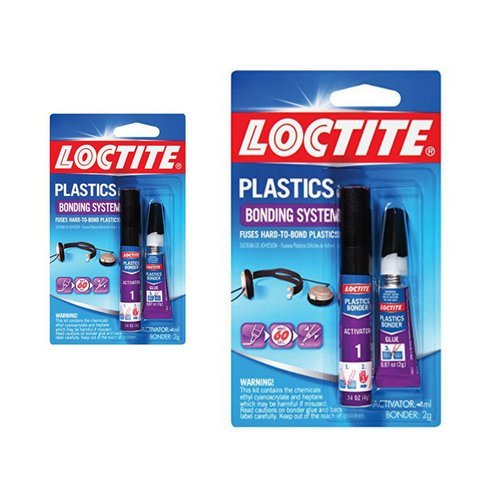
The Loctite Plastics Bonding System solves the single most frustrating problem in plastic repair: bonding low-surface-energy plastics like polypropylene and polyethylene that virtually every other glue slides right off of. The system includes a primer pen that you apply first to etch the surface chemically, followed by a cyanoacrylate adhesive that cures in just one minute. Real-world reports confirm it permanently fused a curved structural crack on an airline cat carrier made of complex polypropylene — a repair that had failed with multiple other adhesives.
Each pack contains two 2-gram bottles of adhesive plus two activator pens, giving you multiple chances to get the application right. The liquid consistency means you need to choreograph the repair carefully — tape won’t stick to polypropylene, so using disposable gloves to hold parts in alignment during the minute-long cure is essential. Once cured, the bond is exceptionally strong, and users report it withstanding temperature extremes inside a hot car without failing.
This system is not economical for large surface-area repairs or gap-filling; the thin liquid is designed for close-fitting cracks and broken tabs. For those who have tried every household glue on polypropylene only to watch them fail, this is the only solution that delivers a permanent, invisible bond. The two-part primer-and-adhesive approach is the defining characteristic that separates this from every other entry on the list.
Why it’s great
- Bonds the notoriously difficult polypropylene and polyethylene plastics
- Full cure in 1 minute with activator — fastest in this roundup
- Invisible repair line on smooth plastic surfaces
Good to know
- Thin liquid formula unsuitable for filling gaps or porous surfaces
- Requires careful dry-run choreography due to fast set time
2. Bondtech Vinyl Cement with Brush, PVC Cement High Strength (2.02 OZ)
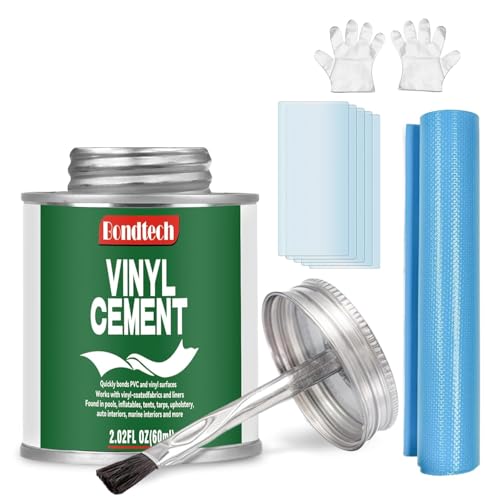
Bondtech’s Vinyl Cement operates on a solvent-weld principle: the high-density formula chemically softens PVC, vinyl, and ABS surfaces, fusing them into a single solid piece rather than merely adhering one layer onto another. This creates a bond that is both airtight and waterproof, making it the top choice for repairing pool liners, inflatable boats, air mattresses, and tarpaulins. The kit includes two types of patch sheets — blue PVC, which resists scratches and deformation for pool liners, and transparent sheets that resist UV yellowing for visible repairs.
The integrated brush applicator makes spreading the solvent glue smooth and even, which is critical because over-application on lightweight patches can soften the material and cause curling. The user review that confirmed this adhesive patched two holes in a swimming pool without draining the water — and held for an entire season — demonstrates real-world performance beyond what a spec sheet can convey. The screw-on cap seals tightly to prevent the solvent from drying out between uses.
One important usage tip: this is a solvent-based adhesive, so applying excessively thick layers to a thin patch will degrade the repair material. The recommended technique is to apply a moderate, even coat to the patch, press firmly, and allow the full 24-hour cure to reach maximum strength. For anyone repairing flexible plastics that experience repeated bending, this solvent weld provides the flexibility and durability that a rigid epoxy cannot match.
Why it’s great
- Chemically fuses PVC and vinyl for a waterproof, airtight bond
- Includes both scratch-resistant blue and UV-resistant clear patch sheets
- Brush applicator ensures even coverage and controlled application
Good to know
- Full strength requires a 24-hour cure — not a quick fix
- Solvent can soften thin patches if applied too liberally
3. J-B Weld Plastic Bonder Black 25ml Syringe – 2 Pack
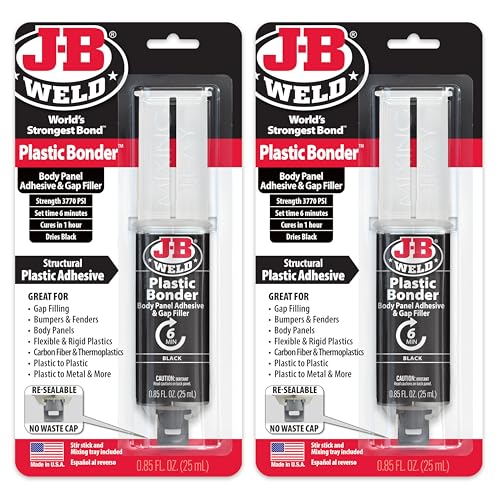
J-B Weld Plastic Bonder is a two-part urethane adhesive designed specifically for rigid, high-stress plastic repairs where the bond must withstand direct force without flexing. With a tensile strength of 3770 PSI, this epoxy fills gaps and actually becomes stronger than many of the thermoplastics it repairs. The dual-syringe delivers a precise 1:1 mixing ratio, and the included mixing tray and stir stick allow for controlled application. Real-world testing shows it successfully repaired a scooter steering component and a cracked intake manifold — both scenarios where bond failure would be dangerous.
The 15-minute set time provides enough working window to position parts, followed by 30 hours to full cure. The black color is ideal for automotive bumper repairs and dark plastic components where a clear glue line would be visible. Users report that the cured material sands smoothly, allowing you to shape the repair flush with the original surface. The resealable cap on the syringe prevents the remaining adhesive from drying out, making this a multi-use product rather than a single-application tube.
A critical limitation: this adhesive will not bond to polypropylene or polyethylene, and the syringe mechanism can occasionally dispense unevenly if air pockets are present. Wearing gloves is mandatory because the exothermic reaction generates noticeable heat during cure. For structural, rigid plastic repairs that must hold under sustained load, this epoxy outperforms every other consumer-grade option in this category.
Why it’s great
- Extreme tensile strength of 3770 PSI for load-bearing repairs
- 15-minute set time allows positioning before curing
- Sands and shapes like solid plastic after full cure
Good to know
- Does not bond to polypropylene or polyethylene plastics
- Syringe can dispense unevenly; exothermic reaction gets hot
4. J-B Weld Light-Activated Superglue, Clear, 5g, 2-Pack

J-B Weld SuperWeld uses a photoinitiator chemistry that cures fully in 10 seconds when exposed to the included UV light — a breakthrough for precision plastic repairs where clamping or holding is impractical. The light is built into the cap, and once the beam hits the adhesive, it solidifies into a glass-clear, rock-hard material with a tensile strength of 2800 PSI. Users have used it to repair jewelry clasps, ceramic pieces, and delicate 3D-printed parts that would collapse under clamping pressure.
The precision tip applicator controls flow to a single drop, making this the cleanest-working adhesive in the list for small, detailed work. Without the UV light, the glue will set in one minute and fully cure in 24 hours, but the light activation is the defining feature. The cured resin is as clear as optical glass and nearly as hard, which makes it ideal for transparent plastic repairs where aesthetics matter. One user even cautions that the UV light can burn skin within seconds, which underscores the intensity of the curing system.
A notable and consistent complaint: the cap tends to permanently adhere to the tube if any residue remains on the threads, so cleaning the tip thoroughly after each use is mandatory. This adhesive also produces a slight shrinkage and vapor during curing, which can affect ultra-precise flush fits. For anyone who needs an instantly hard, strong, and invisible bond on a non-porous surface without waiting hours, this system is unmatched.
Why it’s great
- Full cure in 10 seconds with the built-in UV light
- Dries perfectly clear and as hard as glass
- Precision tip applicator enables zero-mess drop placement
Good to know
- Cap frequently glues itself to the tube — clean threads thoroughly
- UV light can burn exposed skin; slight shrinkage during cure
5. 3M Scotch-Weld Plastic & Rubber Instant Adhesive PR1500, Clear, 20 Gram Bottle

3M’s Scotch-Weld PR1500 is a rubber-toughened cyanoacrylate instant adhesive formulated with a medium-viscosity gel that stays exactly where you place it — no running, no dripping, no stringing down vertical surfaces. The rubber-based formulation gives the cured bond a unique combination of high strength and impact resistance that standard brittle CA glues lack. Users have successfully bonded a polypropylene tank drain fitting — a material that rejects nearly every adhesive — and even temporarily repaired a slashed tire sidewall to drive home.
The pinch-container bottle design allows precise control from a single drop to a steady bead, and the gel viscosity fills small gaps that thin cyanoacrylates would run through. Proper surface preparation with 99% isopropyl alcohol is essential; the bond strength drops significantly on greasy or contaminated plastic surfaces. The fast cure keeps projects moving, though the manufacturer specifies 24 hours for full strength on challenging substrates like polypropylene.
At the premium end of the price spectrum, this 20-gram bottle is small by design — 3M recommends using it quickly to avoid the adhesive thickening in the bottle over time. It is not formulated for silicone rubber, which it will make brittle rather than bond. For anyone repairing rubber gaskets, vinyl pool liners, automotive interior plastic clips, or low-energy plastics that stumped every other glue, this is the industrial-grade solution that actually works.
Why it’s great
- Bonds difficult polypropylene and polyethylene plastics
- Gel consistency stays in place — no dripping on vertical surfaces
- Rubber-toughened for impact resistance, not brittle
Good to know
- Small 20g bottle is expensive per ounce compared to other options
- Requires rigorous surface prep with isopropyl alcohol
6. STARBOND 5 Minute Epoxy Pro Kit, 8 oz.

Starbond’s 5 Minute Epoxy Pro Kit takes a fundamentally different approach from the rigid epoxies on this list — its toughened formula is engineered to absorb vibration and stress without brittle cracking, making it the ideal choice for repairing plastic components on power tools, lawn equipment, and automotive interior parts that experience constant motion. The kit includes screw-cap 8-ounce bottles rather than syringes, plus reusable mixing trays, spatulas, and applicator tools. The 1:1 mix ratio by volume eliminates guesswork.
The 5-minute handling strength is accurate: you have enough working time to adjust positioning, but the exothermic reaction sets firmly enough to hold light stress within about five minutes. The epoxy cures transparent, so it blends into clear plastics, and users report successful repairs on crown molding, basement cracks, and UV resin overlays. The flexibility is the differentiator here — while J-B Weld Plastic Bonder creates a rigid structural bond, Starbond’s formula maintains a slight elasticity that prevents micro-cracking under repeated stress.
This epoxy works on wood, metal, glass, ceramic, and many plastics like ABS and PVC, but it will not bond to polypropylene or polyethylene. The large 8-ounce volume is economical for multiple projects, but the two-part system means you must mix only what you need and reseal the bottles immediately. For general household repairs where the plastic part experiences vibration or thermal cycling, the Starbond Pro Kit delivers a reliable, flexible bond that rigid epoxies cannot match.
Why it’s great
- Toughened formula absorbs vibration without brittle cracking
- Large 8-oz screw-cap bottles with full kit of mixing tools
- 5-minute handling strength with clear cure
Good to know
- Does not bond to polypropylene or polyethylene plastics
- Must mix only what you need — no single-syringe precision
7. Loctite Vinyl, Plastic, and Fabric Adhesive, Pack of 2 Clear

Loctite’s Vinyl, Plastic, and Fabric Adhesive is a flexible, clear, paste-formula adhesive designed specifically for repairs that involve two different material types — like reattaching fabric padding to a vinyl lawn mower seat or bonding fabric blinds to vinyl window coverings. It dries transparent and remains flexible after cure, which prevents the brittle cracking that standard super glues exhibit when the bonded materials flex at different rates. The tube applicator with a precision nozzle allows controlled bead placement.
The 24-hour full cure time is standard for this type of flexible adhesive, but the paste consistency means it won’t run or drip on vertical surfaces. Users confirm it held lawn mower seat padding through an entire mowing season with proper surface prep. The flexibility is both the strength and the limitation: this adhesive is not suitable for structural or load-bearing plastic repairs where rigid strength is required, as the bond can deform under heavy sustained weight.
One quirk: the adhesive tends to “string” if the user pulls the nozzle away too quickly, leaving thin threads of glue that need to be wiped or trimmed before they cure. It is also not formulated for sheer-strength applications. For the specific use case of bonding fabric, leather, or foam to vinyl or plastic surfaces where the joint must flex repeatedly, this two-pack delivers excellent value and reliable performance.
Why it’s great
- Excellent for fabric-to-vinyl and foam-to-plastic bonds
- Dries transparent and remains flexible after full cure
- Paste consistency stays put on vertical surfaces
Good to know
- Not suitable for structural or load-bearing plastic repairs
- Tends to string if nozzle is pulled away too quickly
FAQ
How do I know which plastic I’m trying to bond?
Can I use the same adhesive for flexible and rigid plastic repairs?
Why does my plastic glue always fail after a few days?
Final Thoughts: The Verdict
For most users, the best adhesive for plastic winner is the Loctite Super Glue Plastics Bonding System because it solves the universal problem of bonding polypropylene and polyethylene — the two plastics that reject virtually everything else — and cures in just one minute. If you need a flexible, waterproof bond for inflatables and pool liners, grab the Bondtech Vinyl Cement with Brush. And for structural, load-bearing repairs that demand extreme tensile strength, nothing beats the J-B Weld Plastic Bonder.