
Our readers keep the lights on and my morning glass full of iced black tea. As an Amazon Associate, I earn from qualifying purchases.
Specs are compiled from manufacturer listings and verified buyer reviews and can change over time — please confirm the key details on the product page before buying.
The real challenge with resin is finding a bond that matches the material’s own strength—most glues fail at the surface, not because they aren’t sticky, but because they aren’t chemically compatible. You need an adhesive that forms a permanent, structural link with the resin itself, not just a superficial skin. This guide breaks down the top performers across every use case, from delicate jewelry repairs to heavy-duty tabletop coatings.
I’m Min — the founder and writer behind Gadgets Feed. This guide is built by comparing the manufacturers’ published specifications and the patterns across verified customer reviews, so you get each pick’s real strengths and trade-offs instead of marketing spin.
Your project’s lifespan hinges on the adhesive for resin you pick—the wrong one can fail within a week, while the right one lasts for decades. We focused on proven formulas that deliver on their promises, so you can trust the bond.
Our Picks at a Glance

How To Choose The Best Adhesive For Resin
Before you buy, ask yourself three questions: what materials are you bonding, how much time do you need to position the parts, and does the joint need to stay crisp? A fast-setting glue is useless if you cannot align the pieces before it hardens, and a clear formula is pointless if you need to fill a structural void.
Match the cure speed to your skill level
A 5-minute epoxy gives you almost no room to adjust—you mix, apply, and commit. If you are a beginner or working on a multi-part assembly, look for a longer working time, often listed as “open time” or “pot life,” so you can clamp and reposition without panic.
Check the tensile strength for load-bearing repairs
Tensile strength, measured in PSI or megapascals, tells you how much pulling force the cured bond can resist before failing. For structural repairs like furniture joints or load-bearing brackets, you want a high number—anything above 3,000 PSI is a serious bond. For decorative or non-load-bearing crafts, clarity and ease of use matter more than raw strength.
Quick Comparison
| Model | Best For | Cure Time | Working Time | Strength | Amazon |
|---|---|---|---|---|---|
| Araldite Clear★ Best Overall | Invisible jewelry repairs | 3 hours | 5 minutes | High | Amazon |
| GREEGEL Black SyringeIndustrial Strength | Industrial-strength fixes | 24 hours | 30 minutes | 3900 PSI | Amazon |
| LET’S RESIN 3.4ozBest Value Kit | All-in-one home repair | 1 hour | 5 minutes | High | Amazon |
| COHUI 0.81 oz | Precise no-mix bonding | 24 hours | 5 minutes | 15 MPa | Amazon |
| HeyClear UV Kit | Glass and craft repairs | Seconds | Unlimited | High | Amazon |
| 1DFAUL UV Putty | 3D modeling and filling | 2 minutes | Unlimited | Medium | Amazon |
| System Three T-88 | Marine and wood structure | 72 hours | 45 minutes | Exceptional | Amazon |
| Promise Table Top | Bar tops and coatings | 72 hours | Long | High | Amazon |
| East Coast Resin 1:1 | Casting and sealing | 24 hours | Long | High | Amazon |
In‑Depth Reviews
1. Araldite Clear Epoxy Adhesive
Our pick — over 4.5★ from 2,000+ verified ratings; the strongest balance of quality and price.
The crafters’ choice for invisible joins that stay crisp and never yellow.
Araldite wins the top spot because it delivers exactly what resin crafters need most: a bond that disappears. The two-part epoxy sets in 5 minutes, giving you just enough time to align a broken porcelain saucer or a jewelry inlay before it locks in place, and it reaches full strength in 3 hours. The 53-gram pack is small, but the solvent-free formula is a professional-grade adhesive that bonds to metal, wood, ceramics, glass, and most plastics.
The clarity is the standout feature here—owners repeatedly highlight that it dries clear and does not yellow, which is critical for jewelry where a dark glue line would ruin the piece. It fixed a china saucer beautifully, as buyers report, and held a melamine bowl through washing and stirring. It is water, oil, chemical, and impact resistant, and it handles temperatures from -30 to 80 degrees Celsius.
The recurring gripe is durability on tiny jewelry repairs—a pearl ring fix worked well initially but did not last long-term. For high-stress, load-bearing repairs on larger items, this performs admirably, but for delicate pieces that flex, a different formula might serve you better.
What wins people over
- Dries crisp with no yellowing, essential for visible repairs
- 5-minute set time with full strength in 3 hours
- Bonds a wide range of materials from glass to leather
The honest trade-offs
- Small repairs on flexible jewelry may not hold long-term
- 15ml per tube is better for precise tasks than large projects
The clear winner: Reach for this when you need an invisible, non-yellowing bond on china, glass, or jewelry.
Think twice if: Your repair involves heavy flexing or load—this is not a structural epoxy.
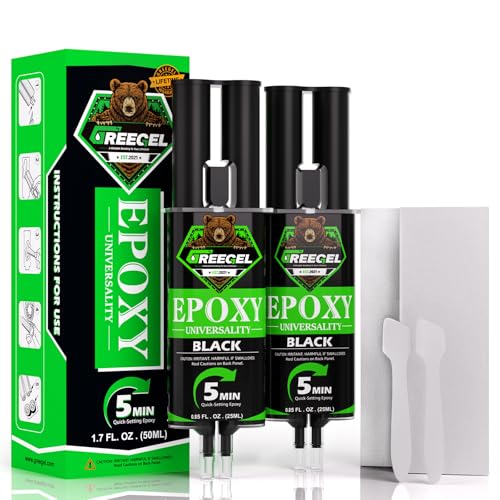
2. GREEGEL 2 Part Black Epoxy Glue
A black syringe epoxy with extreme holding power for repairs where strength beats appearance.
When a repair needs muscle, this GREEGEL formula delivers an extreme 3900 PSI tensile strength—that is the pulling force it can resist before failing, and it is more than enough for plastic, metal, wood, ceramic, tile, glass, concrete, and fiberglass. Unlike the Araldite Clear, this one sets in 5 minutes but gives you a generous 30 minutes of adjustable positioning time, then fully cures in 24 hours for maximum bond strength.
The black color makes it ideal for dark plastics, 3D printing models in PLA, ABS, or PETG, and any repair where a dark glue line blends in. It is water-resistant and works for indoor and outdoor repairs, though it is not for permanent underwater use. The syringe format with 2 mixing kits makes it easy to dispense without measuring cups.
The honest trade-off is the packaging—several owners mention the glue leaked inside the package during shipping, making a mess and throwing off the 1:1 ratio. When it works, it is “very strong and durable once dried” with no smell, but opening the tubes can be a fight. Handle delivery carefully and test the flow before starting a critical job.
Why it earns its spot
- 3900 PSI tensile strength for heavy-duty bonds
- 30-minute adjustment window is forgiving for alignment
- Black finish suits dark materials and 3D prints
Approach with caution
- Syringes can leak in transit, wasting product
- Not for polyethylene or polypropylene plastics
Built for the tough jobs: Choose this when you need serious tensile strength on plastics, metal, or 3D prints.
Look elsewhere if: You need a clear finish—this one only comes in black.
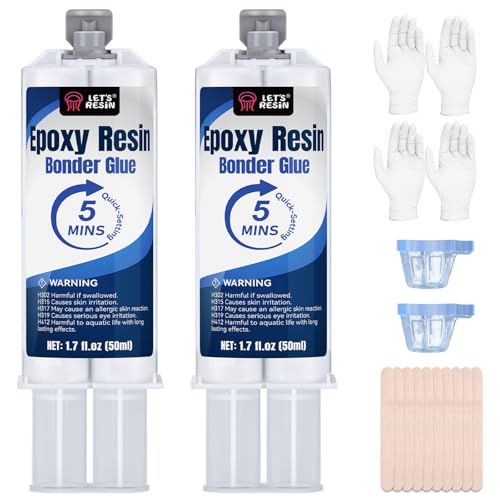
3. LET’S RESIN 5 Minute Epoxy Glue
The all-in-one rescue kit that comes with every tool you need to start repairing immediately.
This 3.4-ounce kit is the easiest recommendation for a beginner because it removes every obstacle to getting started. It includes 2 epoxy bottles, 20 disposable mixing cups, 10 stirrers, 2 push rods for a precise 1:1 ratio, and 4 gloves—no extra purchases needed. The full cure time is just 1 hour, which is dramatically faster than the 24 hours of the GREEGEL syringe above.
The 5-minute working window means you mix small batches and apply quickly, and the high-viscosity bond is strong enough to glue a resin gnome to a slab of wood where other “industrial” glues failed. Once cured, it hardens significantly, so you can drill, sand, or paint over it to restore an item to its original look. It works on wood, ceramics, glass, metal, and plastic.
Owners note it has a smell during application, but the results speak for themselves—it dries clear and holds an outdoor fountain together. The only real catch is the speed: if you need more than 5 minutes to position parts, this will set before you are ready.
The complete package: With mixing tools and a 1-hour cure, this is the fastest path from broken to fixed for everyday household repairs.
The speed limit: A 5-minute working window demands quick hands—not ideal for complex multi-part assemblies.
4. COHUI 5 Minute Epoxy Glue
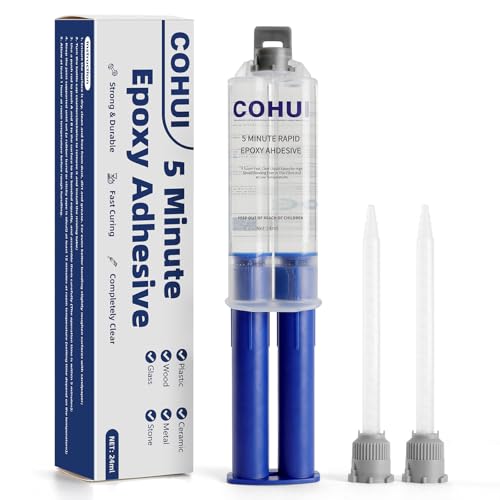
A self-mixing syringe that takes the guesswork out of measuring, perfect for fuss-free bonding.
This small 0.81-ounce (24ml) kit solves the messiest part of two-part epoxy: the measuring. The push-rod syringe design mixes components A and B automatically in a 1:1 ratio as you dispense, so you never eyeball proportions. It sets firmly in 5 minutes at room temperature and fully cures in 24 hours, delivering a peel strength of 15 MPa and shear strength of 10 MPa.
The crisp, yellowing-resistant formula is a standout for visible repairs—customers note it saved a shattered mug, a chair, and a phone case, surviving the dishwasher and humidity. It is eco-friendly and SGS certified as non-toxic, making it safe for indoor use, and it bonds to metal, glass, wood, concrete, tiles, ceramics, and most plastics.
The catch is the nozzle system: each mixing tube works only once, and the package includes just 2 nozzles. After that, the syringe can dry out if not sealed well. Buyers find it pricey for the small volume, but for precise one-off repairs, the convenience justifies the cost.
The precision edge
- No manual measuring—the syringe mixes at a perfect 1:1
- 15 MPa peel strength is genuinely strong
- Non-toxic and yellowing-resistant formula
The limitations
- Each nozzle is single-use and only 2 are included
- Small 24ml volume is gone fast on bigger jobs
For the precise repair: Grab this when you want a flawless clear bond without the measuring mess.
Not for volumes: The small syringe size makes it a poor fit for large surface-area jobs.
5. HeyClear 60g UV Resin Kit

A UV-activated adhesive that stays liquid until you shine the light, giving you unlimited positioning time.
This is a completely different approach to bonding—instead of a chemical reaction starting the moment you mix, this resin stays liquid until you hit it with the included UV flashlight. You get unlimited working time to position broken sunglass arms or dashboard trim precisely, then a few seconds of UV light locks it in place. The kit includes 2 x 30ml bottles, a USB rechargeable UV light, tweezers, and a storage bag.
The thick texture resists dripping, making it ideal for filling cracks and holes in glass and plastic, and it bonds heavier objects like jewelry inlays. It is remarkably transparent once cured, with owners using it everywhere from 3D printing to eyeglass repairs. The tweezers help place tiny components without leaving fingerprints.
The key limitation is that at least one of the materials must be transparent so the UV light can reach the joint. It also cures prematurely in direct sunlight, and the resin has a strong smell—gloves are essential since it is hard to remove from skin once cured. The UV light has a bonus use: it reveals insects and lichen outdoors.
Unlimited adjustment: The UV-cure system means you can take your time positioning before committing the bond.
The transparency catch: This only works when light can pass through at least one of the bonded materials.
6. 1DFAUL 100g UV Light Curing Putty
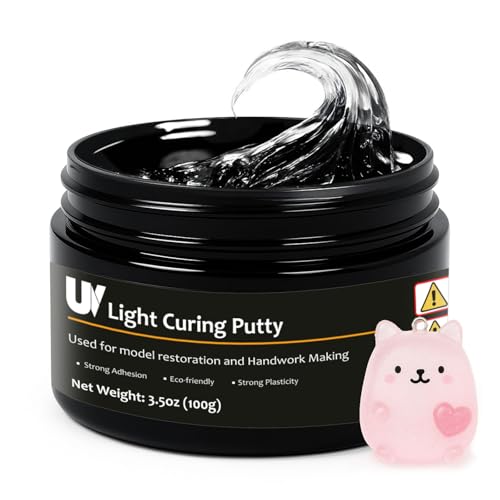
A moldable putty that you shape by hand, then harden in minutes under any UV lamp.
This is not a glue at all—it is a solid resin putty you can sculpt, carve, and shape before curing. It only needs 1-2 minutes of UV exposure to harden, so you can build up damaged wood, plastic, ceramic, or metal, filling gaps and rebuilding edges with your hands. Once cured, it sands to a smooth, paintable finish, making it a favorite for 3D modeling, miniature figurines, and jewelry.
The stretchy texture is easy to work with, and it stays clear after setting, which is useful for repairs where appearance matters. It holds up well on resin projects, and owners find it useful for fixing resin messes. The curing is quickly done with a nail lamp in about 30 seconds, though a slight tacky top coat can remain.
The honest reality is mixed: while some find it works perfectly, others report it stays sticky and fails to fully cure even after extended UV exposure. The stickiness is the most common complaint, and it can bond to silicone tools you do not want to sacrifice. Strong odor requires ventilation, and some units arrive with broken packaging.
The creative advantage
- Hand-sculptable putty for filling, shaping, and rebuilding
- Cures in 1-2 minutes under standard UV light
- Sands and paints to a professional finish
The consistency gamble
- Stickiness is a recurring issue—some batches stay tacky
- Strong smell means you need good ventilation
For the hands-on maker: Choose this when you need to sculpt and rebuild, not just bond two flat surfaces.
skip it if: You want a reliable, predictable bond—this demands patience and good UV equipment.
7. System Three T-88 Epoxy Adhesive

The woodworker’s and boat-builder’s structural epoxy that bridges gaps without shrinking.
This is a premium structural epoxy engineered for wood and marine applications, and it is the slow-cure alternative that solves the biggest problem with 5-minute epoxies: time. It gives you a 45-minute working time to clamp, align, and adjust complex assemblies—think cherry cabinet door repairs or table glue-ups. At 70°F, it develops good properties within 16 hours and fully cures to a clear amber appearance in 72 hours.
T-88 is waterproof with outstanding adhesion on metal, wood, and composites, and it bridges gaps without shrinking as it sets. The slow cure is a feature, not a flaw: owners describe it as industrial-grade, strong, and stable, with one table project holding together perfectly. It mixes easily and cleans up with acetone.
This is not a quick fix—it takes a couple of days before it is fully hard, so you need the patience to set it aside. It is also the priciest per-ounce pick here. But for load-bearing wood joints and marine repairs where failure is not an option, the strength and reliability justify the premium.
The structural anchor: For furniture and marine repairs where the joint carries real weight, this is the dependable choice.
Plan ahead: The 72-hour full cure demands patience—do not expect quick turnarounds.
8. Promise Epoxy Table Top Resin Kit
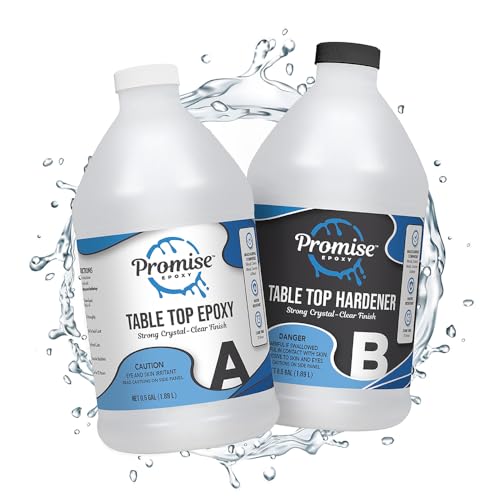
A 1-gallon pouring resin that self-levels to a glass-like, food-safe finish for bar tops and countertops.
This is a different tool entirely: a 1:1 mixing-ratio epoxy made for coating surfaces, not just bonding pieces. The self-leveling formula spreads itself to a sleek, high-gloss finish, ideal for bar tops, craft tables, and countertops. It is food-safe when fully cured, so you can eat off the finished surface, and it is water-resistant and durable for daily use.
The 1-gallon size covers substantial projects, and owners find the application forgiving—it stays fluid long enough to work with, and a heat gun pops any bubbles for a flawless result. With over 40 years of American-made experience behind it, this is the pick for decorative wood art, resin crafts, and jewelry making with mica powder or alcohol ink.
The nuance is temperature sensitivity: it needs 75-85°F for 24 hours or it will not set properly, and it can take up to 3 days to fully cure. Stirring thoroughly is essential—rushing the mix causes sticky spots. It is a project resin that demands patience and a warm room, not a quick repair adhesive.
The finishing touch
- Self-leveling formula delivers a crisp, high-gloss coat
- Food-safe when fully cured for kitchen surfaces
- 1-gallon size handles real furniture projects
The learning curve
- Temperature-sensitive—needs 75-85°F to cure properly
- Full cure takes up to 3 days; air bubbles need a heat gun
For the surface project: Choose this when you are coating a tabletop or bar top and want a flawless, edible-safe gloss.
Not a repair glue: This is for pouring and coating, not for bonding broken pieces together.
9. East Coast Resin 1:1 Epoxy Resin
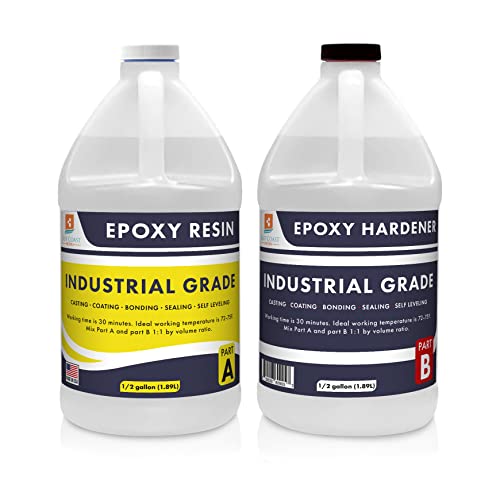
An industrial-grade 1:1 casting resin with minimal odor for comfortable all-day projects.
This 1-gallon kit (split into 2 half-gallon bottles) is built for creators who want a clear, glossy, water-resistant epoxy without the overpowering fumes that make many resins unpleasant to use. The minimal-odor formula means you can work comfortably without a mask, which is rare in this category. It fully cures in 24 hours, making it a solid midpoint between the fast 5-minute epoxies and the slow 72-hour systems.
The 1:1 mixing ratio is beginner-friendly, and owners find it seals plywood beautifully with a perfect color and consistency. It works for bonding, sealing, casting, coating, filling, and gluing across countertops, tabletops, river tables, jewelry, and coffee tables. It adds UV-resistance, scratch-resistance, and moisture-resistance compared to other industry brands, and surfaces coated with it are safe for food to touch.
The feedback is slightly mixed on curing—some find it dries fast and works better than expected, while others report it does not cure properly in cooler conditions. It can also develop a yellow tint over time. For a first-time novice, the simple equal-part mixing and mild smell make it an approachable introduction to casting, but precise temperature control is key.
Comfortable casting: The minimal-odor formula and slow set make this ideal for long creative sessions indoors.
Patience required: Full strength comes at 24 hours, and cool rooms can disrupt the cure entirely.
Understanding the Specs
Working Time vs. Cure Time
Working time (or pot life) is how long you can keep positioning your parts before the adhesive starts to harden. Cure time is the full duration until the bond reaches maximum strength. A 5-minute epoxy gives a tiny working window, while a slow-cure adhesive like the System Three offers 45 minutes—a comfort for complex assemblies but a longer wait for the final result.
Tensile Strength and Why It Matters
Tensile strength, measured in PSI or megapascals, describes how much pulling force the cured bond can withstand before snapping. A 3900 PSI rating means serious structural holding power, while a 15 MPa rating is strong enough to replace welding on many household items. For load-bearing repairs, higher is always better; for decorative crafts, clarity and ease of use matter more.
Clarity and Yellowing Resistance
For visible repairs on glass, jewelry, or porcelain, a glue line that dries yellow is a disaster. Look for formulas that specify “crisp” or “yellowing-resistant” if the joint will be visible. The Araldite and COHUI both dry clear without the amber tint that cheaper epoxies develop over time.
UV Cure vs. Chemical Cure
UV-curing resins harden only when exposed to ultraviolet light, which means they stay liquid forever until you shine the lamp. This gives unlimited positioning time but requires light to reach the joint—at least one surface must be transparent. Chemical-cure epoxies harden on their own but force you to work within a fixed time window.
FAQ
What is the strongest adhesive for bonding resin to resin?
Will 5-minute epoxy work for large surface repairs?
Can I use regular super glue on resin?
Why does my epoxy stay sticky after curing?
Is epoxy adhesive food-safe?
How long does epoxy take to fully harden?
Can I paint or sand over cured epoxy?
What materials will 2-part epoxy not bond?
Why does my UV resin not harden completely?
What is the difference between epoxy glue and casting resin?
Final Thoughts: The Verdict
For the majority of shoppers, the adhesive for resin winner is the Araldite Clear because it nails the two things every crafter needs: a crisp, non-yellowing bond and professional-grade strength in a fast 5-minute set. If you want a complete kit with mixing tools and a 1-hour cure, grab the LET’S RESIN 3.4oz. And for heavy structural repairs on wood, the System Three T-88 is the one to reach for—its 45-minute working time and 72-hour cure are the price of a truly permanent bond.
How We Picked
We do not accept paid placement. Every pick is matched to a real buyer and a real use-case; we do not hands-on test units.
Sources & Methodology
Specifications: manufacturer listings and product documentation. Review insights: verified customer reviews, as of August 2026. Pricing: not shown on this page (it changes often); check the current price via the retailer link.
As an Amazon Associate, Gadgets Feed earns from qualifying purchases. This does not affect which products we feature.