
Our readers keep the lights on and my morning glass full of iced black tea. As an Amazon Associate, I earn from qualifying purchases.
Specs are compiled from manufacturer listings and verified buyer reviews and can change over time — please confirm the key details on the product page before buying.
That flapping sole is a tragedy waiting to happen — one wrong step and your favorite pair is done. Finding the right glue means the difference between a fresh start and a sticky mess that fails in a week. This guide breaks down the top repair adhesives by real-world hold, cure time, and material compatibility, so you grab the one that actually works for your shoes.
I’m Min, founder of Gadgets Feed. This guide compares manufacturer specs and verified customer reviews to highlight each glue’s real strengths and trade-offs.
Whether you are fixing a pair of leather dress shoes, rubber-soled sneakers, or heavy work boots, knowing the right adhesive for shoe sole repairs starts with understanding the cure time, flexibility, and waterproofing each glue offers.
Our Picks at a Glance

How To Choose The Best Adhesive For Shoe Sole
Not every glue withstands a shoe’s constant flexing and moisture. Focus on the specs that predict whether a repair lasts or peels apart in a month.
Cure Time vs. Set Time
The “set time” is how quickly the glue grabs — usually a few seconds to an hour. The “full cure time” is when the bond reaches its maximum strength and flexibility. A glue that sets in 45 seconds may need 12+ hours to fully cure. For shoe sole repairs, full cure time matters most because the bond must handle constant bending.
Material Compatibility
Shoes are made from leather, rubber, vinyl, canvas, or synthetic blends — sometimes all in one. A urethane adhesive bonds well to leather and rubber, a cyanoacrylate (super glue type) works best on rubber and vinyl, and a contact cement is ideal for leather-to-leather repairs. Check the “compatible material” list on the tube before you buy.
Flexibility and Water Resistance
A rigid glue cracks under the flex of a walking sole. You need an adhesive that dries into a flexible rubber-like layer — that way it bends with your foot instead of snapping. Water resistance is also key if you wear your shoes in rain, snow, or at the gym. Some glues are labeled “waterproof,” while others degrade quickly when wet.
Quick Comparison
| Model | Best For | Full Cure Time | Bond Type | Key Material | Amazon |
|---|---|---|---|---|---|
| GEAR AID Aquaseal SR★ Best Overall | Heavy-duty / boots | 12 Hours | Urethane | Leather, Rubber, Canvas | Amazon |
| Shoe GOOFast Fix | Quick repair / kids shoes | 8 Hours | Rubber-based | Rubber | Amazon |
| KRAFTPROTZ Shoe Glue | Thin cracks & seams | Overnight | Cyanoacrylate | Rubber, Vinyl, Leather | Amazon |
| PHIXBEAR Shoe Glue | Flexible everyday repair | 12 Hours | Flexible polymer | Leather, Rubber, Fabric | Amazon |
| Shoe-Fix Glue | Instant bond / every shoe | 45-second set | Gel adhesive | Rubber, Vinyl | Amazon |
| Eagle Shoe Cement | Cobbler-grade repair | Several hours | Paste cement | Leather, Rubber, Faux Leather | Amazon |
| Pliobond Adhesive | Multi-material / classic bond | Fast set | Contact cement | Leather, Wood, Plastic, Rubber | Amazon |
In‑Depth Reviews
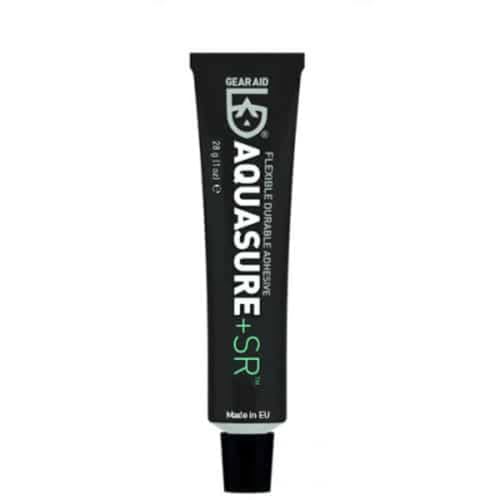
1. GEAR AID Aquaseal SR Shoe Repair Adhesive
Our pick — over 4.5★ from 750+ verified ratings; the strongest balance of quality and price.
The bench-press of shoe glues — it handles hiking boots and rain boots without flinching.
This is a urethane-based adhesive — a type of glue that cures into a clear, flexible rubber that won’t peel or crack under repeated bending. It works on leather, suede, rubber, neoprene, canvas, and even GORE-TEX, so it is essentially a universal fix for most footwear. The full cure takes 12 hours (the longest on this list), which is the trade-off for that industrial-strength hold. Buyers report it “successfully reattached almost-separated boot soles” and that it “holds well after a month” — and that is exactly the real-world durability you want from a boot glue.
The two-pack gives you two 1-ounce tubes, enough for multiple repairs. A builder using these in Florida heat says it holds up great, though the tube is small and takes care to direct the flow. The flip side: a few owners note the bond is not perfect for every sole shape — adhesion is a mixed area in the feedback, so be generous with the glue and let it cure the full 12 hours undisturbed. That 12-hour cure means it is a weekend project, not a lunch-break fix.
What wins people over
- Forms a waterproof, abrasion-resistant rubber bond
- Works on leather, rubber, canvas, suede, and GORE-TEX
- Two-tube pack gives you flexibility for multiple repairs
- Clear finish blends into the sole edge invisibly
The honest trade-off
- 12-hour full cure requires patience — not for a same-day fix
- Mixed adhesion results mean prep and curing are critical
- Small tube opening makes it hard to pour onto large surfaces
Reach for it if: you are repairing heavy boots, work shoes, or rain boots and can wait 12 hours for a permanent, waterproof fix.
Look elsewhere if: you need a quick 30-minute bond or are fixing a thin, flexible dress shoe where you don’t want the extra thickness.
2. Shoe GOO Shoe Repair Adhesive
The go-to for small jobs and kids’ shoes when you need a fast, cheap bond.
Shoe GOO cures in 8 hours — a full 4 hours faster than the GEAR AID above — making it a better choice when you cannot wait overnight. It is a rubber-based adhesive designed primarily for rubber shoe repair, and it dries clear. Owners note that a 3/8-inch layer applied to worn boot soles and flapping athletic shoe soles holds well and compresses flat after days of wear. The strong fumes are a real thing — the advice is to use it outdoors or in a well-ventilated room.
The honest catch: after 2-3 months of light wear, some owners mention the bond starts to peel off. That is shorter than a urethane glue would last, but for a budget-friendly quick fix on kids’ sneakers or a pair you only wear occasionally, it may be exactly what you need. The tube is messy to squeeze, and the cap threads benefit from a little Vaseline to keep it reusable.
What works well
- 8-hour cure is noticeably faster than the 12-hour urethane options
- Dries clear and flexible — no white residue on dark soles
- Effective for small repairs on hiking boots and kids’ shoes
What to know
- Can start peeling after 2-3 months of regular wear
- Strong fumes require outdoor or ventilated application
- Messy to apply — tube is stiff and hard to squeeze
Best for: a quick, low-cost repair on rubber-soled shoes you do not wear daily — especially kids’ shoes that get outgrown anyway.
Think twice if: you need a bond that lasts years or are fixing expensive work boots that take daily abuse.
3. Shoe-Fix Glue Professional Grade Repair Adhesive
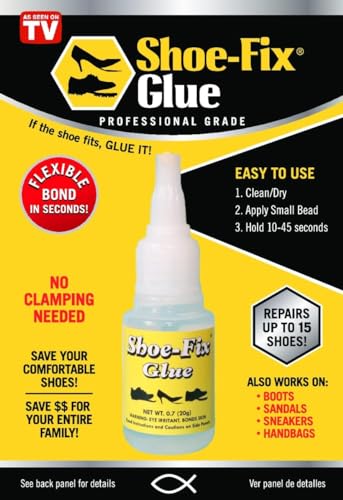
Sets in under a minute — the kind of glue you grab when you need to walk out the door soon.
This is a gel adhesive that forms a strong bond in about 45 seconds — no clamping, no waiting. It dries clear and stays flexible, so it bends with the sole rather than cracking. The tube is 20 grams, which is small, but the gel consistency means you use less per repair than a watery liquid. Customers note it reattaches detached shoe fronts and loose soles like new, with the bond holding well for about 2 years on a typical pair of sneakers before needing a redo.
The real-world feedback is overwhelmingly positive — with thousands of ratings, effectiveness and strength are the top praises by a massive margin. Gel formula makes it less messy than a liquid super glue, though if you need the glue to wick into a thin crack (rather than sit on top), this is not the right tool. It works on rubber and vinyl, so it is best for athletic shoes, sandals, and rubber-soled boots.
Why it stands out
- 45-second set time — no clamping, no waiting around
- Dries clear and flexible — no white glaze on dark shoes
- Gel formula is less messy than liquid super glue
One honest note
- Small 20g tube — not enough for multiple large repairs
- Gel does not wick into thin cracks like a liquid would
- Bond may weaken after a couple of years of regular use
Reach for it if: you need a near-instant, clean fix for rubber or vinyl soles — ideal for sneakers and sandals when you cannot wait hours.
skip it if: you are repairing a deep delamination crack that needs a thin liquid to seep into the gap, or need to fix multiple pairs at once.
4. KRAFTPROTZ Shoe Glue Liquid 1.76 oz XXL
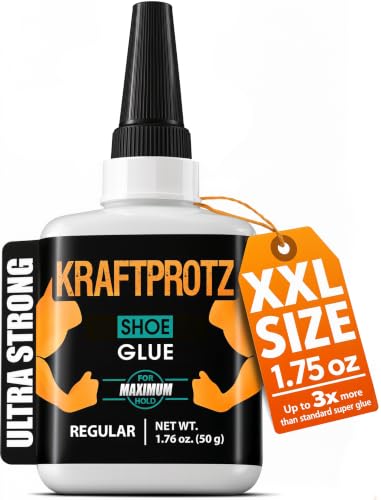
The liquid so thin it creeps into cracks you cannot even see — a capillary-action sole saver.
Unlike the gel adhesives above, this is a thin cyanoacrylate formula (the same family as super glue, but purpose-built for shoes) that wicks into delaminating soles and tight seams by capillary action. That means it rebonds the layers from the inside out rather than just gluing the surface. It bonds leather, rubber, vinyl, fabric, and plastic, and dries transparent with no yellowing. The 1.76 oz (50g) bottle is advertised to handle 10+ shoe repairs, making it the most economical single-bottle option on this list.
Reviewers point out using it on a shoe sole and a vacuum handle — the glue initially seems loose but after overnight drying, the bond is solid. It is also heat resistant up to 230°F (110°C), so it can handle hot car floors or summer pavement. The anti-clog nozzle is a nice touch — you can come back months later and the tip is still usable. The trade-off: because it is thin, it works best on tight cracks rather than large gaps where you need to fill space.
What makes it different
- Thin formula wicks into deep cracks for an internal bond
- 1.76 oz bottle handles 10+ repairs — best value per repair
- Heat resistant up to 230°F for hot-weather wearers
Know before you buy
- Not for filling wide gaps — use a paste or gel for that
- Requires overnight drying for full strength
- Cyanoacrylate can be brittle if applied too thick
Best for: delaminated soles with thin cracks that need a deep, penetrating bond — especially on leather dress shoes and vinyl trainers.
Consider another if: you are filling a large gap or rebuilding a worn heel where you need a thicker, gap-filling adhesive.
5. PHIXBEAR Professional Grade Shoe Glue Repair Adhesive
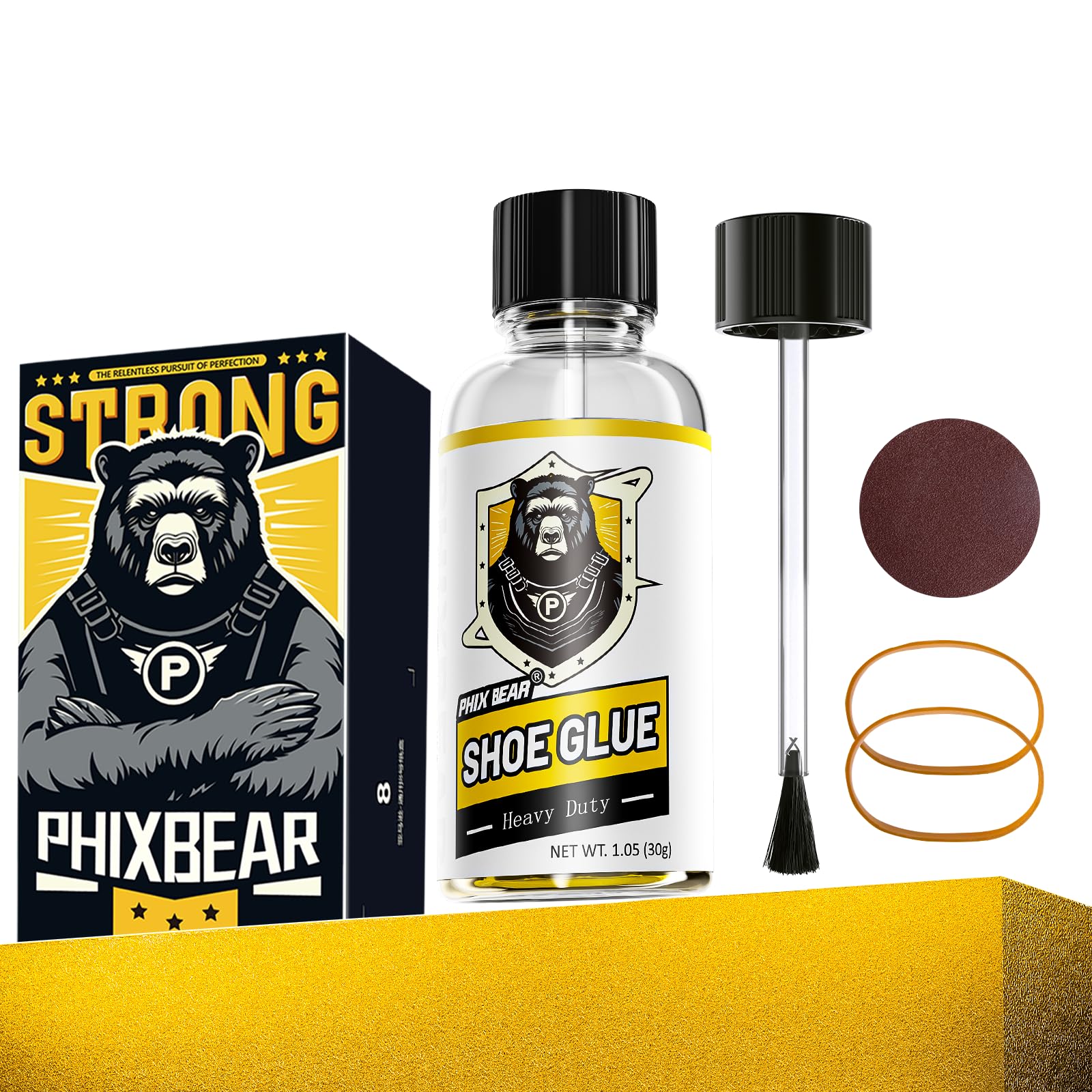
Combines super-glue strength with rubber-cement flexibility — and a brush applicator for precision.
This adhesive is designed to solve the two biggest shoe-glue frustrations: brittleness and odor. It dries flexible (no cracking under the sole’s constant bend) and has a low odor compared to typical cyanoacrylate glues. Owners who tested it against Shoe Goo and standard super glue say it outperforms both for sole-to-upper repairs. The included brush applicator makes it easy to spread a thin, even layer, and the set comes with rubber bands and sandpaper for prep. The recommended cure is 30 minutes to 1 hour for a set, with a full cure overnight.
The honest reality: feedback is split. Some shoppers say an impressively strong bond that holds up to heavy daily use, while others say it fails to stick even on clean surfaces — effectiveness is the most discussed aspect and it is mixed. A few note that the glue is not perfectly clear after drying (it may pick up the color of the leather underneath). The 1.05 oz bottle is enough for one full men’s shoe resoling job, so plan accordingly.
What works
- Flexible bond — won’t crack under the sole’s daily flexing
- Low odor compared to traditional shoe glues
- Brush applicator + included sandpaper and bands
What to watch
- Mixed effectiveness — some buyers report poor adhesion
- Dries slightly cloudy, may pick up leather color
- Small bottle — one bottle is about right for one pair of shoes
Reach for it if: you value a flexible, low-odor bond and want a brush applicator for precise application on leather shoes or sandals.
Look elsewhere if: you cannot afford any risk of poor adhesion — choose the GEAR AID or Shoe-Fix if you need a near-guaranteed bond on the first try.
6. Eagle Shoe Cement – Heavy Duty Shoe Sole Glue

A professional cement that feels like a shoe-repair shop in a bottle — thick, strong, and waterproof.
This is a paste cement (medium viscosity) designed for the kind of heavy repairs a cobbler tackles: detached soles, separated midsoles, and torn uppers. It works on leather, rubber, vinyl, and faux leather, making it versatile for sneakers, work boots, dress shoes, and even pointe shoes. A verified owner who had both front soles badly detached from the leather says the glue stuck them back in place and “they have not re-separated” after months of wear — that is exactly the kind of long-term bond you want from a premium cement.
The 4 oz bottle is the largest single-bottle offering on this list, so it is ideal if you have several repairs lined up or plan to maintain a whole family’s shoes. The paste consistency means it stays where you put it — no dripping or running into unwanted areas. A notable minority of buyers received bottles where the lid was not sealed properly, causing leakage and dried glue. That is a packaging inconsistency to watch for, not a formula problem.
The strengths
- Thick paste stays put — no drips on the shoe upper
- 4 oz bottle handles multiple large repairs
- Waterproof bond holds up to months of daily wear
The caveats
- Some units arrive with lid not properly sealed — inspect on arrival
- Not a quick fix — requires clamping time for full cure
- Paste formula is harder to apply into thin cracks
Best for: anyone who needs a cobbler-strength cement for multiple shoe repairs — especially work boots and sneakers with large detached sole sections.
Think twice if: you are fixing only a single small crack and don’t want to risk a leaky bottle wasting your glue.
7. 1OZ PLIOBOND ADHESIVE by Pliobond

A 50-year-old formula that still earns reorders — the vintage bond that refuses to quit.
Pliobond is a flexible contact cement that bonds metals, wood, plastics, ceramics, glass, vulcanized rubber, and leather — far more materials than any other adhesive on this list. It sets fast and is permanent once cured. One owner reports a single tube lasted 10 years in storage and still worked when they finally needed it. That is proof of the sealant’s shelf life, not something you can expect from typical shoe glues. Another owner has used it for 50 years and swears it “sticks and seals anything.”
For shoe repair specifically, it works well on leather and rubber — particularly for gluing leather to rubber soles. The catch: it is a contact cement, meaning you apply it to both surfaces, let it dry, then press them together. That takes more prep than a simple squeeze-and-press tube. Also, the manufacturer explicitly states it is “not water resistant,” so this is for dry-condition shoes or occasional wear, not daily rain boots. The 1 oz bottle is small, but a little goes a long way with contact cement.
what separates it
- Bonds nearly any material — not just shoe materials
- Extremely long shelf life — years in storage and still usable
- Flexible bond that moves with the shoe
Be aware
- Not water resistant — avoid for wet-weather shoes
- Requires two-surface application (contact cement method)
- 1 oz bottle is small — better for touch-ups than full resoling
Reach for it if: you need a multi-purpose adhesive that bonds leather to rubber for dry-condition shoes, and you trust a proven, old-school contact cement.
pass on it if: you need a waterproof bond or want a simple squeeze-and-press application without the extra prep steps.
Understanding the Specs
Full Cure Time
The full cure time is the number of hours the glue needs to reach its maximum strength. A glue might “set” (grab the surface) in minutes, but it does not reach peak bond strength until fully cured. For shoe soles, which undergo constant bending and pressure, waiting the full cure time is critical — skimping on cure time is the #1 reason shoe glue repairs fail. A 12-hour cure means you glue them at night and wear them the next afternoon.
Urethane vs. Cyanoacrylate vs. Contact Cement
Urethane adhesives (like GEAR AID) dry into a flexible rubber layer that resists water and abrasion — ideal for boots. Cyanoacrylate (like the KRAFTPROTZ and Shoe-Fix glues) is a super-glue type that bonds fast but can be brittle if applied too thick. Contact cement (like Pliobond) requires coating both surfaces, letting them dry, then pressing together — it gives a strong, flexible bond but takes more prep work. Your choice depends on material type and how much time you can spend on the repair.
FAQ
Can I use regular super glue on shoe soles?
How long should I wait before wearing shoes after gluing?
Does shoe glue work on leather soles?
How do I prep the sole before applying glue?
Can shoe glue be used on sneakers with mesh or fabric uppers?
What is the difference between set time and cure time?
How do I remove excess shoe glue that has dried?
Is clear-drying shoe glue better than colored glue?
Can I glue a sole that is separating along the entire edge?
Is there a shoe glue that works on wet or damp shoes?
Final Thoughts: The Verdict
If you want one dependable pick, the best adhesive for shoe sole repairs is the adhesive for shoe sole from GEAR AID — it handles everything from hiking boots to rain boots with a waterproof, flexible bond that owners trust for months of wear. If you need a near-instant fix you can wear within an hour, the Shoe-Fix Glue gives you a 45-second set time and a flexible, clear finish. And for deep cracks that need a penetrating bond, the KRAFTPROTZ Shoe Glue Liquid wicks into delaminated seams with its thin cyanoacrylate formula and handles 10+ repairs from a single bottle. The crowd favorite across thousands of owners is the Shoe-Fix — it has the widest approval and the quickest turnaround for everyday sneaker fixes.
How We Picked
We do not accept paid placement. Every pick is matched to a real buyer and a real use-case; we do not hands-on test units.
Sources & Methodology
Specifications: manufacturer listings and product documentation. Review insights: verified customer reviews, as of July 2026. Pricing: not shown on this page (it changes often); check the current price via the retailer link.
As an Amazon Associate, Gadgets Feed earns from qualifying purchases. This does not affect which products we feature.