
Our readers keep the lights on and my morning glass full of iced black tea. As an Amazon Associate, I earn from qualifying purchases.
Specs are compiled from manufacturer listings and verified buyer reviews and can change over time — please confirm the key details on the product page before buying.
You have two clean stainless pieces, a cracked bracket, or a stripped bolt hole, and you want a joint that holds instead of peeling off in a week. For most people the answer is a two-part metal-filled epoxy — a resin and a hardener you mix together, so it cures into a hard structural filler instead of staying soft like a glue stick. The catch: the shelf is crowded with metal epoxies that all promise “strong as steel.” What separates a bond that survives vibration from one that lets go depends on a few specs: strength in PSI (pounds per square inch, a measure of how much pull the cured bond resists), working time before it sets, and heat resistance.
I’m Min — the founder and writer behind Gadgets Feed. This guide is built by comparing the manufacturers’ published specifications and the patterns across verified customer reviews, so you get each pick’s real strengths and trade-offs instead of marketing spin.
Below you’ll find the formulas that handle stainless, aluminum, cast iron and dissimilar metals, ranked so you can match one to your repair. Read on for a straight breakdown of the best adhesive for stainless steel.
Our Picks at a Glance

How To Choose The Best Adhesive For Stainless Steel
Stainless steel is a hard, smooth, non-porous surface, and that combination is exactly why ordinary glue struggles with it. A good metal epoxy solves that by curing into a rigid, metal-filled body that grips the surface mechanically and holds under load. Here are the factors that actually separate one formula from another.
Match the formula to the job, not the label
A structural metal epoxy is built to carry a load and resist heat, oil, and vibration, while a fast-setting generic epoxy is built for quick household fixes. If you are repairing a stainless bracket, a stripped thread, or a cast-metal housing, you want the structural type. For a small trim piece or a cosmetic join, a quicker-setting formula is easier to live with. Decide the job first, then pick the spec sheet that fits it.
Know your strength, working time, and cure time
Tensile strength in PSI tells you how much pull the cured bond resists — the higher the number, the more load it can carry before it fails. Working time is how long you have to position and clamp the parts before the mix starts to harden. Full cure time is how long before you can load or finish the repair. A fast formula is convenient but leaves you less room to align; a slower one is forgiving on complex repairs. Keep all three in view rather than chasing strength alone.
Prep and ratio decide the outcome
Stainless needs to be clean, degreased, and roughened before any epoxy will hold — a glossy, oily surface is the number one reason a joint fails. Mix the two parts at the exact ratio the maker states; an off-ratio mix cures soft or sticky. Clamp the parts and leave them undisturbed for the full cure window, not just until they feel set. Get these three right and a mid-range epoxy will hold where a premium one applied carelessly fails.
Quick Comparison
| Model | Best For | Tensile / Strength | Full Cure | Form | Amazon |
|---|---|---|---|---|---|
| J-B Weld 8281 Professional Steel Reinforced Epoxy★ Best Overall | All-round metal repairs | 5020 PSI | 15 hours | Paste, 10 oz | Amazon |
| West System G/Flex 655-1 SyringePrecision Pick | Small precise repairs | — | 24 hours | Syringe, 1 oz | Amazon |
| PEGATANKE Steel 2 Part EpoxyHigh-Heat Pick | High-heat industrial jobs | Holds 882 lb dead weight | 10 hours | Paste, 1.15 oz | Amazon |
| AOJEL S300 Structural Metal Epoxy | Load-bearing rigid rebuilds | — | 12–24 hours | Syringe, 1.69 oz | Amazon |
| KEWEIYOW Metal Repair Glue | Car and marine crack repair | 4680 PSI | 24 hours | Syringe, 1.76 oz | Amazon |
| Starbond 5 Minute Epoxy Pro Kit | Fast multi-material fixes | 2,600 lb shear strength | 24 hours | Kit, 8 oz | Amazon |
| 3M Scotch-Weld DP100 Plus | Thermal cycling / dissimilar metals | — | 1 hour | Cartridge, 48.5 mL | Amazon |
| 3M Scotch-Weld DP420 | Impact and fatigue resistance | — | 24 hours | Cartridge, 50 mL | Amazon |
| West System 655-8 G/Flex Epoxy | Flexible marine-grade bonding | 150,000 PSI modulus | 24 hours | Kit, 2 x 4.5 oz | Amazon |
In‑Depth Reviews
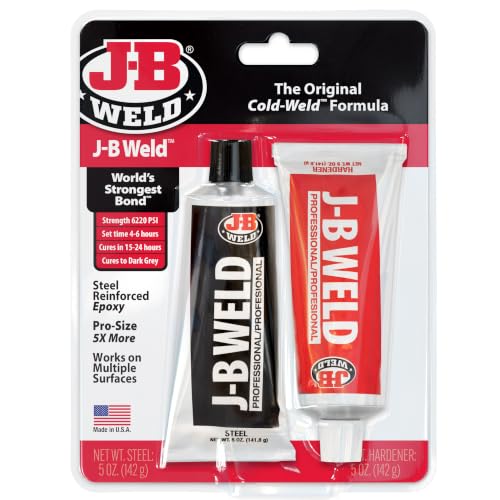
1. J-B Weld 8281 Professional Size Steel Reinforced Epoxy
Our pick — 4.5+★ from 10,500+ verified ratings; the strongest balance of quality and price.
Two steel-reinforced tubes that turn stainless repairs into a job you can tap, drill, and sand.
The number that earns this the top spot is 5020 PSI — the tensile strength, meaning how much pull the cured bond resists before it gives. That is the figure you want for a stainless bracket, a car bumper, or a marine fitting that takes real load. It cures to a dark grey that you can tap, fill, sand, mold, and drill, so the repair becomes part of the metal rather than a coating sitting on top of it. It holds 4.5+ stars across 10,000+ owners, and the professional-size 10 oz kit gives you two 5 oz tubes mixed at a simple 1:1 ratio.
Quality is the single most-praised trait in the feedback, running well ahead of everything else. Effectiveness and raw strength follow close behind. Owners repeatedly describe permanent bonds that hold where ordinary glue quit, and the working window of 4-6 hours to set and 15-24 hours to full cure gives you room to line up a tricky repair before it locks. The cured epoxy stands up to temperatures up to 550°F and resists water, petroleum, chemicals, and acid once fully set.
The honest limit: 15 hours to full cure is not a lunch-break fix, so plan to clamp and walk away. The 1:1 ratio also rewards careful measuring — eyeballing it is where these epoxies go soft. And it bonds metal, plastic, PVC, wood, concrete, ceramic, tile, and fiberglass, but not soft or flexible plastics.
Where It Pulls Ahead
- 5020 PSI tensile strength carries real load on stainless and cast metal
- 550°F heat tolerance suits engine-bay and exhaust-adjacent repairs
- Drillable, sandable, paintable finish blends into the repair
- Generous 10 oz pro-size supply for multiple jobs
What To Plan Around
- 15-hour full cure means a clamp-and-wait repair, not a quick fix
- 1:1 ratio must be measured carefully to cure hard
Reach for this if: you want a proven, high-strength structural epoxy for a stainless or metal repair that takes genuine load.
Hold off if: you need a joint set in minutes — this is a same-day, let-it-cure formula.
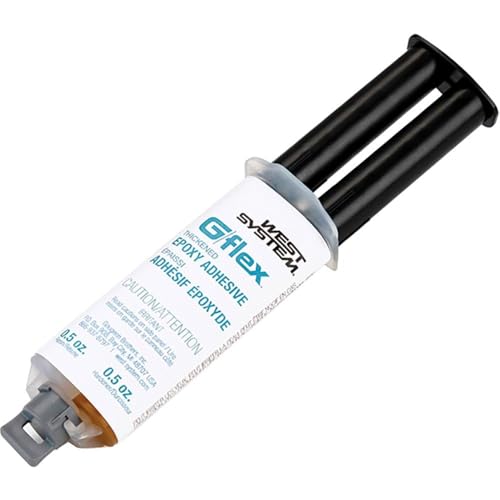
2. West System G/Flex 655-1 Epoxy Adhesive Syringe, 1 oz
A toughened syringe epoxy built for the joints that shift, flex, and take a knock.
If your stainless repair is on something that vibrates — a marine fitting, a metal-to-plastic join, a damp-wood bond — this is the formula that bends instead of cracking. It is a thickened, toughened two-part epoxy that absorbs expansion, contraction, shock, and vibration, and it bonds reliably to dissimilar materials where traditional epoxies struggle. The 1 oz syringe mixes and dispenses in one motion with dual plungers, so there is no guesswork on ratio — a small, controlled application rather than a messy two-tube pour.
Here is the direct contrast that matters: it needs a 24-hour full cure, while the PEGATANKE formula cures in 10 hours. That is a real difference if you are racing a job. But the trade is flexibility and gap-filling — this pre-thickened mix stays put without sagging, so it fills uneven surfaces and forms structural fillets that a runnier epoxy would leave hollow. Effectiveness is what owners single out most, followed by durability.
The straightforward caveat is the 1 oz volume — it is sized for small, precise repairs, not for rebuilding a large bracket. The other note: drying time draws mixed feedback, so expect to give it the full 24 hours rather than trusting feel. For a small, tight, flexible repair on stainless or a dissimilar-metal join, this is the tidy option.
Best for precision: the self-contained syringe dispenses an accurate mix straight into a gap or fillet, which makes it the cleanest choice for small stainless hardware and dissimilar-metal joins.
Size it right: 1 oz covers small repairs only — a large rebuild will need more than one syringe.
Suits: small, flexible, or dissimilar-material repairs where controlled mixing and a tough bond matter more than speed.
Not the one for: big load-bearing rebuilds or anyone who needs the job cured in a couple of hours.
3. PEGATANKE Steel 2 Part Epoxy Resin
A cold-weld paste meant for engines, anchors, and machinery that run hot and under pressure.
This one is built for the rough side of stainless work — the maker lists it holding up to 882 pounds of dead weight per 1.15 oz, and resisting up to 120 PSI of pressure. That is the sort of spec sheet you reach for when the repair sits on machinery that sees extreme temperatures and high-pressure conditions. It is a professional-grade resin aimed at longer-lifespan jobs, and the cured mix resists physical and chemical stress in industrial, automotive, naval, electrical, and construction settings.
This is the pick that cures fastest of the group — 10 hours to full cure, versus the 24 hours a toughened syringe epoxy needs. For a job where you want the parts back in service sooner, that matters. The application is a six-step process: clean the area, mix parts 1 and 2 equally, stir with the supplied spatula for 3 minutes, apply, join the parts, then let it dry. It is dry in 30 minutes in the sun or 90 to 120 minutes in shade before the full cure sets in.
The caveat is worth knowing before you buy: it is a thick paste, and the maker states it is not as effective on acrylic. Quality leads the feedback, with durability right behind it, and owners describe it holding up where heat and coolant are in play. Lower review volume than the leaders means less of a track record, but the ones who use it for hard industrial repairs rate it well. Coat the whole surface, and it works on metal, steel, aluminum, copper, ceramic, stone, wood, glass, PVC, plastic, tile, and fiberglass.
Standout Strengths
- 882 lb dead-weight hold and 120 PSI pressure resistance for hard jobs
- Fastest 10-hour full cure of the structural picks
- Formula built for extreme heat and pressure conditions
Worth Knowing
- Not as effective on acrylic surfaces
- Thick paste needs deliberate spreading and clamping
- Smaller review base than the top picks
Pick this for: engine, machinery, anchor, and high-heat stainless repairs that need pressure resistance and a quicker cure.
Look elsewhere for: acrylic bonding or delicate cosmetic work, where a thinner formula behaves better.
4. AOJEL S300 Structural Metal Epoxy
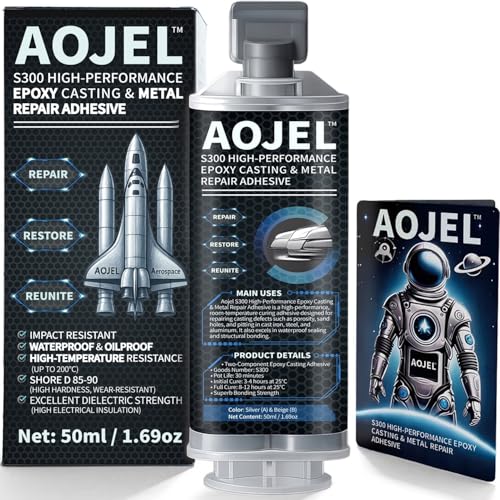
For the stripped bolt hole or cracked casting where you need time to get the alignment exactly right.
This one wins on time: the AOJEL 30 / 3-4 / 24 system gives you up to 30 minutes of working time at 77°F to fill, build, position, align, and clamp before the mix starts to go off. After that it needs 3 to 4 hours to initial set, and at least 24 hours before you load or finish it. Compare that to the 2-5 minute open window on a fast pro cartridge, and you can see why this suits a repair you cannot afford to rush. It rebuilds rigid brackets, housings, and castings on prepared aluminum, steel, stainless steel, cast iron, and cast aluminum.
Owners praise its strength and quality above all else. It cures into a hard body you can drill, sand, file, shape, and paint, standing up to heat up to 392°F, and once cured it resists water and oil. The prep is a deliberate seven-step routine — prepare, purge, mix, build, align, clamp, cure — and purging until both parts flow evenly before you discard the first bead is the detail that keeps the mix true. The kit includes the 1.69 oz dual cartridge, push rod, and spatula.
The main trade-off is the wait: 24 hours before load, and it is strictly for rigid metal repairs. The maker is candid that it is not for PE, PP, PTFE, silicone, soft plastics, flexible or moving parts, torsion loads, fuel or brake lines, exhaust manifolds, internal engine cracks, or pressure-critical systems. Value for money is the one aspect drawing mixed views, so weigh the price against how critical the repair is. For a load-bearing metal rebuild that needs precision, the long setup is the whole point.
The case for it: 30 minutes of work time plus a drillable, paintable, 392°F-resistant cure makes it the most forgiving structural option for cast-metal and bracket repairs that carry weight.
The catch: it is rigid-metal only — soft plastics, flexible parts, and pressure-critical lines are off the table.
Made for: cracked castings, worn rigid parts, and stripped thread holes where positioning time and load-bearing strength matter most.
Steer clear if: you are bonding soft plastic or a flexible, moving joint that needs to give.
5. KEWEIYOW Metal Repair Glue
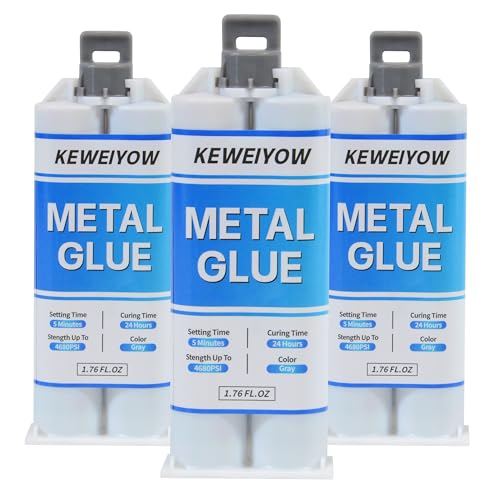
A syringe of liquid-metal epoxy that sets in 5 minutes and claims 4680 PSI of bite.
On paper, this is the strongest number in the lineup — strength up to 4680 PSI, reaching a durable, metallic-tough bond across metal, plastic, rubber, wood, ceramics, PVC, glass, aluminum, and stainless steel. It comes as a 1.76 oz syringe with a pusher and scraper, and the 1:1 mix sets in 5 minutes before fully curing in 24 hours. The liquid formula flows into cracks and porous castings, and once cured it can be drilled, filed, sanded, and painted. It is stable from -65°C to 287°C and resists corrosion, abrasion, and impact.
The honest read on the feedback: effectiveness is what owners value most, and it works well on metal trim and car parts. But strength and drying time both draw mixed views — some say it holds like soldering, others find it not as strong as hoped, and a few report tubes that arrive dried out. Ease of use is the weakest aspect in the feedback, and the maker’s own instruction to stir for a full 5 minutes hints at why. For a fast repair on trim, cracks, water pipes, or fence welding, the quick set is genuinely useful.
The takeaway for a stainless job: this is a convenient, fast-setting syringe for lighter-duty repairs, not the pick for a load-bearing structural rebuild. Do your prep, mix it evenly, and give it the full 24 hours before loading a pressurized part. The 1.76 oz volume suits one or two jobs, and the mixed-ratio design keeps the ratio honest as long as you extrude evenly.
Why It Works For Quick Jobs
- 5-minute set means a fast, low-fuss repair on trim and cracks
- 4680 PSI rating on the spec sheet for confident general bonding
- Liquid form flows into porous castings and narrow cracks
- Wide material range from stainless to glass and PVC
Where It Falls Short
- Strength draws mixed feedback — lighter-duty repairs suit it best
- Some tubes arrive dried out; check yours before the job
- Ease of use is the weakest point in the feedback
Reach for it when: you want a fast-setting syringe for lighter metal trim, cracks, and general household repairs.
Skip it for: heavy structural or load-bearing stainless joints, where a slower, higher-confidence epoxy earns its cure time.
6. Starbond 5 Minute Epoxy Pro Kit

Handling strength in about 5 minutes, with a flexible formula that shrugs off vibration and stress.
Two numbers frame this kit: it reaches handling strength in about 5 minutes and offers 2,600 lb of shear strength — the amount of force it resists when the bonded surfaces slide against each other. The flexible toughened formula is engineered to absorb vibration and stress without brittle cracking, so it suits stainless joins that see movement rather than dead weight. It bonds wood, metal, glass, ceramic, and many plastics like ABS and PVC, and it cures clear, which keeps a repair looking clean on exposed stainless.
Owners praise its quality and ease of use, helped by the 1:1 mix-by-volume and reusable mixing trays. The pro kit swaps leaky syringes for screw-cap bottles with trays and tools, giving cleaner mixing, less waste, and better shelf life between jobs. Full cure lands at 24 hours, so handling strength comes fast but the permanent bond still needs a day. It is also the larger-volume pick here at 8 oz, so a single kit covers several repairs.
The trade-off is honest: bonding strength and drying time both draw mixed feedback — many find it strong and fast, while some report adhesion issues, usually on surfaces that were not properly prepped. Mix it 1:1 exactly, rough up the stainless first, and clamp it, and it performs. For diverse household and multi-material jobs where you do not want to buy a different epoxy for each surface, the clear, flexible, big-kit format is hard to argue with.
Best all-rounder: a flexible, clear-curing 5-minute epoxy in an 8 oz pro kit suits mixed-material repairs where speed and a clean finish matter.
Watch the strength claim: bonding feedback is mixed, so treat it as a strong general-purpose epoxy rather than a substitute for a dedicated structural formula.
Great for: fast, clear, flexible joins across wood, metal, glass, and PVC when you want one kit to handle varied repairs.
Not ideal for: a max-load structural stainless repair where you want the highest tensile confidence.
7. 3M Scotch-Weld Epoxy Adhesive DP100 Plus
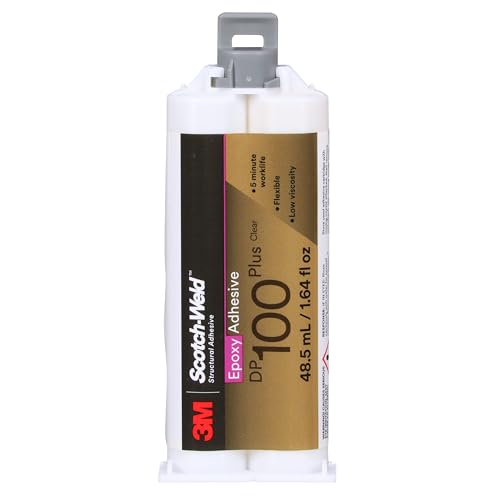
The one for metal-to-metal stainless joins that heat up, cool down, and flex through it all.
This is a professional-grade structural adhesive built for thermal cycling — meaning the joint heats up and cools down repeatedly — and it is designed to bond metals, ceramics, glass, and many plastics while holding through that flexing. You get 2-5 minutes of open working time to position the parts, then a full cure in just 1 hour, the quickest full cure in this lineup after the fast cartridges. It is UL 94 HB certified (a standard rating for how slowly a plastic burns) and secures dissimilar and difficult surfaces, which suits metal-to-metal stainless bonding where a general epoxy gives up.
The spec worth flagging: it comes in a 48.5 mL Duo-Pak cartridge that needs an applicator to dispense — the listing states “Applicator Needed,” so budget for the dispensing gun if you do not own one. The plus side is clean, accurate dispensing of a precise mix, which is exactly what a pro-grade adhesive wants. Owners consistently praise its quality and curing performance, and it holds up well in cold weather. Adhesive quality and pull are the strong points.
The caveat to note: it is marked for industrial and occupational use only, not for consumer sale or use, so it is aimed at people who will use it professionally or carefully. This is also the priciest per-ounce route into the lineup thanks to the cartridge system. For a demanding stainless or dissimilar-metal joint that sees temperature swings, the 1-hour full cure and thermal-cycling build justify going pro-grade. Application is the easy part once the gun is on the cartridge.
The Pro Case
- 1-hour full cure is the fastest in the group
- Built for thermal cycling — holds when a joint heats and cools
- UL 94 HB certified and proven on metal-to-metal bonding
- Precise Duo-Pak dispensing for a clean mix
The Trade-Offs
- Needs a separate applicator gun to dispense
- Marked for industrial/occupational use only
- Short 2-5 minute working window leaves little repositioning time
Choose it for: demanding stainless and dissimilar-metal joints under thermal cycling where a 1-hour cure and certified performance matter.
Think twice if: you do not have an applicator gun or you need a long window to align a fiddly repair.
8. 3M Scotch-Weld Epoxy Adhesive DP420
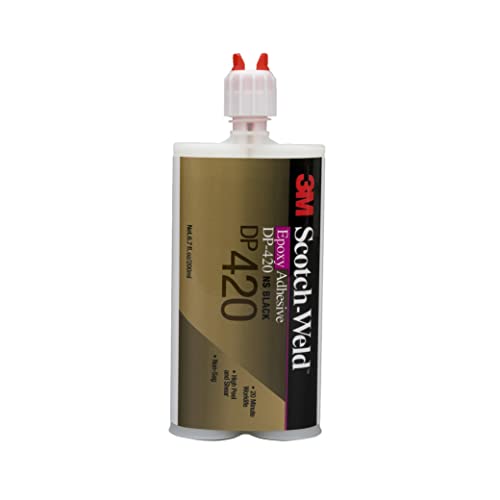
For stainless that gets knocked around — high impact and fatigue resistance with 20 minutes to line it up.
Where the DP100 rushes you, this one gives room. It offers up to 20 minutes of open working time to adjust and reposition before it sets, then a full cure in 24 hours at 73°F. That combination suits a structural stainless joint you need to align carefully and then trust under impact. It carries high shear strength for durable bonds, plus high impact and fatigue resistance — the two qualities that decide whether a repair survives repeated knocks and vibration rather than failing in a brittle snap.
It bonds a broad spread of substrates: metals, ceramics, wood, glass, many composites and plastics, which makes it useful for joining dissimilar materials like stainless to a composite panel. It is UL 94 HB certified and can be used for joining, gluing, potting, panel and structural bonding across sporting goods, metalworking, industrial, and transportation work. What owners praise most is adhesive quality and pull, and it holds up to daily abuse. The black cure suits a repair you are not trying to hide.
The clear downside is the value question — cost is the one aspect drawing negative feedback, and like the DP100 it is marked for industrial and occupational use only and needs a Duo-Pak dispensing setup. If your stainless joint takes impact and you want a longer window to get it right, this is the pick; if you want the cheapest strong bond, look at the leaders above.
Where it shines: a 20-minute work time plus high impact and fatigue resistance make it the best choice for a stainless structure that gets bumped and vibrated daily.
Where it stings: cost is the weak spot in the feedback — this is a pro-grade cartridge that asks you to pay for the impact rating.
Best for: impact- and fatigue-heavy stainless joints on sporting goods, metalwork, or transport repairs that need a long alignment window.
Weigh the cost if: you only need a simple, low-impact bond — a budget epoxy will do the job for less.
9. West System 655-8 G/Flex Epoxy Adhesive, 2 x 4.5 oz
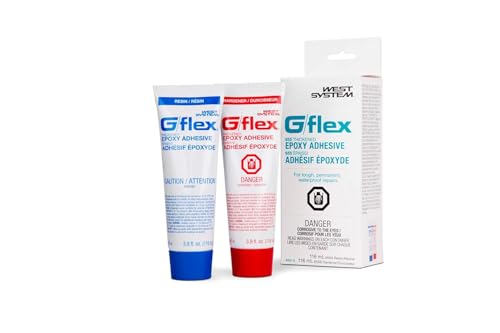
A marine-grade toughened epoxy that bends with shock and holds even on damp stainless.
For stainless on a boat, a wet dock fitting, or any joint that takes shock and vibration, the relevant figure is the modulus of elasticity — 150,000 PSI — which describes how a bond balances stiffness with give. It is more flexible than standard epoxy resins yet stiffer than a sealant, so it absorbs shock without turning brittle. The 1:1 mix provides a 46-minute pot life at 72°F and 60 to 75 minutes of open working time, giving you a generous window to align and assemble a complex repair. It bonds tenaciously to fiberglass, metals, ceramics, many plastics, and hard-to-bond woods, including damp or wet surfaces.
This is the highest-confidence formula for demanding, awkward jobs, and the feedback bears it out — adhesiveness and adhesion are the two most-praised traits, way ahead of the rest. Owners describe it bonding rotomolded polyethylene kayaks, super-thick consistency, and leak-proof performance. Cure comes in stages: 3 to 4 hours to initial cure, 7 to 10 hours to a workable cure, and a full 24 hours to final strength. The 2 x 4.5 oz kit gives you far more volume than the small syringe version, so it handles bigger or multiple jobs.
The honest note: value for money and drying time both draw mixed feedback, and this is the priciest, largest kit here — justified only if you need the marine-grade flex and volume. The full 24-hour cure is not a same-day fix. But for a damp, flexible, or dissimilar-material stainless repair that has to withstand shock and vibration, this is the formula that keeps its grip. Prep the stainless, clamp it, and let the stages complete.
What Makes It Stand Out
- Bonds damp and wet surfaces — rare in a structural epoxy
- 150,000 PSI modulus balances flex and stiffness for shock loads
- Generous 60-75 minute open working time for complex assembly
- Large 2 x 4.5 oz volume for bigger or multiple repairs
Points To Consider
- Priciest kit in the lineup — flex and volume come at a cost
- Full 24-hour cure is not a same-day repair
- Value and drying time draw mixed feedback
The one to beat for: wet, flexible, marine, or shock-loaded stainless joints where you want maximum adhesion confidence and working time.
Overkill if: your repair is a dry, static bond — a simpler formula will hold just as well for less.
Understanding the Specs
Tensile strength in PSI
Tensile strength measures how much pulling force a cured bond resists before it fails, written in PSI (pounds per square inch). A higher PSI means the joint can carry more load — useful for a stainless bracket or a fitting under strain. But PSI is only meaningful when the surface is clean and the mix ratio is exact; a high-PSI epoxy applied to an oily surface will still peel. Use the number to compare formulas, then trust your prep to deliver it.
Working time versus full cure
Working time is how long you have to position, align, and clamp the parts before the mix starts to harden. A fast 2-5 minute window suits a simple join, while a 20-30 minute or even 60-75 minute window suits a repair you need to line up carefully. Full cure is how long before you can load or finish the repair, ranging here from 1 hour up to 24 hours. Pick a shorter working time only when you are confident in the fit; otherwise take the longer window and accept the longer cure wait.
FAQ
Will metal epoxy actually bond stainless steel?
Do I need to roughen stainless steel before gluing it?
How long does a stainless steel epoxy bond last?
Can I use metal epoxy on stainless that gets hot, like an engine part?
Is 5-minute epoxy strong enough for stainless?
What is the difference between metal epoxy and regular glue?
Can I use metal epoxy to repair a stripped thread hole in stainless?
Does metal epoxy work on wet or damp stainless?
How much epoxy do I need for one stainless repair?
Why did my epoxy repair fail on stainless?
Final Thoughts: The Verdict
For most stainless repairs, the adhesive for stainless steel that earns the top spot is the J-B Weld 8281. Its 5020 PSI tensile strength (how much pull the cured bond resists) carries real load, it tolerates heat up to 550°F, and it cures into a body you can drill and sand. If your joint sits on machinery that runs hot under pressure, the PEGATANKE Steel Epoxy holds 882 pounds of dead weight and cures faster at 10 hours. And for a damp, flexible, shock-loaded stainless bond, the West System 655-8 G/Flex is the one to reach for. Whichever you pick, degrease and roughen the stainless and measure the 1:1 mix exactly — that is what turns a good epoxy into a permanent bond.
How We Picked
We do not accept paid placement. Every pick is matched to a real buyer and a real use-case; we do not hands-on test units.
Sources & Methodology
Specifications: manufacturer listings and product documentation. Review insights: verified customer reviews, as of November 2026. Pricing: not shown on this page (it changes often); check the current price via the retailer link.
As an Amazon Associate, Gadgets Feed earns from qualifying purchases. This does not affect which products we feature.