
Our readers keep the lights on and my morning glass full of iced black tea. As an Amazon Associate, I earn from qualifying purchases.
Specs are compiled from manufacturer listings and verified buyer reviews and can change over time — please confirm the key details on the product page before buying.
Vinyl fabric is stubborn. It shrugs off water, sun, and chlorine, so when a seam splits or a pool liner springs a leak, the glue you reach for has to be just as stubborn. The problem is that most adhesives sold as “vinyl glue” do not actually melt into the vinyl surface — they sit on top, go brittle, and peel away the first time the material flexes. The picks below are the ones that bond into the vinyl itself, so the repair moves with the fabric instead of cracking off it.
I’m Min — the founder and writer behind Gadgets Feed. This guide is built by comparing the manufacturers’ published specifications and the patterns across verified customer reviews, so you get each pick’s real strengths and trade-offs instead of marketing spin.
Below you will find the strongest options for pools, inflatables, boat upholstery, and outdoor vinyl, ranked by how they hold up once they cure — a practical shortlist of the best adhesive for vinyl fabric.
Our Picks at a Glance

How To Choose The Best Adhesive For Vinyl Fabric
Vinyl is not one material. The thick, plasticized vinyl on a pool liner behaves nothing like the vinyl-coated fabric on a boat seat or the thin PVC film on a decal. That is why the tube that saved one person’s above-ground pool may fail completely on somebody else’s work — the adhesive has to match the vinyl, not the other way around.
Solvent-Based Versus Water-Based
Solvent-based vinyl cement softens the top layer of the vinyl so the two surfaces fuse into one piece. That is what gives it the peel-proof grip on pool liners and inflatable boats. Water-based and multipurpose craft adhesives skip that step, so they rely on surface stickiness alone — fine for a bar stool cushion, less reliable on a seam that lives underwater.
Working Temperature And Cure Time
Cold slows the chemical reaction that sets vinyl cement. Most of these adhesives want a warm surface to cure properly, and a few will not set at all in low temperatures. Full cure time matters just as much: a fast tack measured in minutes gets the patch stuck down, but the joint usually needs a full day before it can take real stress.
Getting the Surface Ready
Almost every failure story traces back to a dirty or damp surface. Vinyl carries mold-release residue, sunscreen, and pool chemicals that block adhesion. Wiping the area with alcohol and letting it dry completely is the single step that separates a repair that lasts years from one that peels in a week.
Quick Comparison
| Model | Best For | Form | Full Cure Time | Underwater Use | Amazon |
|---|---|---|---|---|---|
| HH-66 Vinyl Cement 4 oz★ Best Overall | Pool liners, tarps, marine vinyl | Liquid in brush-cap can | 24 hours | Yes | Amazon |
| Christy’s Red Hot Vinyl AdhesiveFastest Setting | PVC railings, fencing, trim joints | Gel in squeeze tube | 5 minutes | No | Amazon |
| Berkland Vinyl Cement 8 ozMost Versatile | Inflatable rafts, paddleboards, RVs | Liquid in under-lid-brush jar | 24 hours | Yes | Amazon |
| Loctite Vinyl, Plastic, and Fabric Adhesive | Fabric-to-vinyl, indoor furniture | Paste in tube | 24 hours | No | Amazon |
| Bellisinno Vinyl Cement 4.4 oz | Pool patches, hot tubs, air mattresses | Liquid in brush-cap can | 24 hours | Yes | Amazon |
| Barge Contact Cement 2 oz with Spreaders | Shoe soles, leather, small vinyl jobs | Paste in bottle | 1 day | No | Amazon |
| DAP Weldwood Landau Top & Trim | Headliners, large upholstery panels | Aerosol spray | 24 hours | No | Amazon |
| HOOK UP Vinyl Cement 16 oz | Repeat pool-season repairs, contractor jobs | Liquid in brush-cap can | 2 hours | Yes | Amazon |
In‑Depth Reviews
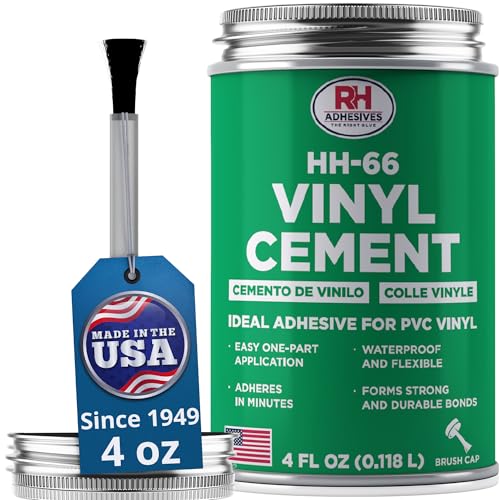
1. HH-66 Vinyl Cement 4 oz
Our pick — 4.5★ from 9,500+ verified ratings; the strongest balance of quality and price.
The industrial vinyl cement that keeps gripping even after a pool tarp goes under for the winter
HH-66 is a solvent-based contact cement, which means it softens the surface of the vinyl itself so the two pieces fuse rather than just stick. It goes on in temperatures from 35 °F to 95 °F, and once cured the joint stays serviceable from -30 °F to 150 °F — so a repaired pool cover does not turn stiff and crack when January hits. You can even apply it underwater, which matters when the leak is below the waterline and draining the whole pool is not an option.
It also grips vinyl-coated fabrics, canvas, fiberglass, neoprene, leather, EVA and nitrile foams, cork, wood, and rigid plastics. It also grips vinyl-coated fabrics, canvas, fiberglass, neoprene, leather, EVA and nitrile foams, cork, wood, and rigid plastics. That breadth is why it turns up in so many repair kits — pool liners, inflatable boats, awnings, bounce houses, upholstery, even roofing membranes. One caveat worth knowing up front: it is not compatible with polyethylene tarps, the thin blue ones often called poly tarps, and it is not for extremely thin vinyl like lettering or wraps.
The built-in brush cap spreads a controlled, even coat without a separate applicator, and the manufacturer has made this in Acton, Massachusetts since 1949. As owners put it: “This has worked great for patching our pool under water!” That said, HH-66 is a serious solvent adhesive and the smell is noticeable — plenty of ventilation is the price of admission here, and getting the surface clean first is not optional.
What actually sells it: effectiveness is the quality owners bring up more than anything else, with the strength of the cured bond close behind. When a repair survives a full winter underwater and comes up holding, that is the whole pitch.
The trade-off to plan for: the included brush has a habit of shedding and applying the cement too thick, so a separate applicator brush usually gives a cleaner, thinner coat.
Reach for this if: you are repairing anything that lives outdoors and gets wet — pool liners, tarp seams, marine vinyl, boat seats.
Look elsewhere if: your job is a clean indoor PVC furniture joint, where a fast-setting tube gel will do the work without the fumes.
2. Christy’s Red Hot Vinyl Adhesive, White, 1.5 oz Tube
The pocket-sized PVC joint filler that sets in five minutes flat
Christy’s goes after a completely different job than the pool cements above. This one is built for PVC and vinyl railings, fencing, siding, decks, windows, and furniture — the rigid, structural kind of vinyl rather than the flexible fabric on a raft. It cures in 5 minutes, which is by far the quickest setting time in this group, so a fence post cap or a trim joint is locked before you have finished cleaning up the squeeze-out.
Because it is a white gel that dries to a white waterproof bond, it blends into white railings and trim instead of leaving a clear smear you then have to paint over. The formula is UV-stable and handles extreme weather and temperature swings, and it resists oil, fuel, grease, and other chemicals. Owners put the thermal expand-and-contract performance to work on scarf joints, where the joint stays exactly where you cut it through hot days and cold nights.
What you do need to know is that this is a small tube with a big job description. Clamping the parts together and giving the glue time to do its work is the step people skip and regret — it is what makes the difference on a decorative vinyl fence repair. The other honest note is consistency: the gel can thicken in the tube within months even with the cap closed properly, and a couple of buyers have opened the box to find evidence of prior handling and a hardened, curled tube bottom.
Where it earns its place
- 5-minute full cure beats every other adhesive here for speed
- White-on-white finish hides into railings and trim
- Holds through wind, snow, rain, and ice on outdoor fence work
- 1.6 ounces is light enough to keep in a tool bag for years
Worth knowing before you buy
- Not a flexible-fabric adhesive — this is for rigid PVC and vinyl surfaces only
- Buy a small tube if you are only doing repairs, since the gel can thicken over months
- Clamping is effectively mandatory on butt joints
Who it wins for: anyone joining rigid PVC and vinyl trim who wants the joint set before lunch.
Where it runs short: sealing flexible vinyl fabric that has to flex and stretch — that calls for a cement, not this gel.
3. Berkland Vinyl Cement 8 oz
A family-shop cement that takes on torn pool liners, paddleboard seams, and popped inflatables alike
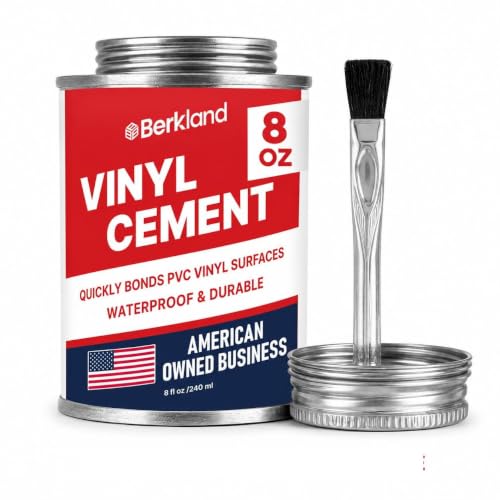
Berkland’s jar earns its keep through the sheer spread of jobs it covers. It works in temperatures from 35-95°F and underwater, which puts it in the same working window as HH-66 — so torn above-ground pool liners, popped inflatable rafts, and paddleboard damage are all fair game, plus RV roof repairs and popped pop-up camper canvas.
Two things set it apart from the other pool cements. First, the compatibility list explicitly includes the typical blue poly tarps that HH-66 warns against, so if your leak is in a blue tarp rather than a pool liner, this is the one that will actually grab. Second, it’s tacky within minutes and reaches full strength in 24 hours, with a brush mounted under the lid so there’s no separate tool to lose.
Then there is the lid. The manufacturer deliberately torques it down hard to prevent leaks, and they joke in the listing that your strongest friend or a pair of pliers may be needed on the first open. It’s a genuine quirk — the jar seals so tight that owners have mentioned they can’t open it. Budget for the fight on day one and it’s smooth sailing after.
The application story: owners repeatedly point to how it handles the awkward repairs — a 55-year-old amplifier’s Tuck & Roll upholstery being restored seam-by-seam, an air mattress patched with a bond that partially dissolves the plastic for a strong join, clear plastic on a golf cart weather curtain.
The caution worth respecting: this is a real solvent cement, and one owner found that on a thin, fragile vinyl surface the chemicals were strong enough to melt the material rather than adhere to it. Test on a hidden corner first if you are working with soft or lightweight vinyl.
Best fit: the DIYer with a running list of vinyl repairs who wants one jar that handles the whole lot, blue tarps included.
Skip if: you are working with delicate decorative vinyl where a strong solvent could eat through the surface before it cures.
4. Loctite Vinyl, Plastic, and Fabric Adhesive, Pack of 2 Clear

The two-tube pack you grab when vinyl meets fabric and there is no room for a stiff bond
Where the cement cans are built for underwater vinyl, Loctite’s two-tube pack goes after the indoor mix: vinyl bar stools, lawn mower seat padding, fabric blinds against vinyl blinds, and even bathing suits. It spreads as a clear paste and cures in 24 hours. The important difference is that it sets flexible rather than stiff, so whatever you glue can still bend without the joint cracking — the reason it works where a brittle rigid bond would not.
Owners put it on some genuinely odd jobs — bonding epoxy and cloth to build a flexible mask for a custom action figure, reattaching padding that spent an entire mowing season glued down. It also wipes off skin easily, which sounds trivial until you’re the one peeling dried glue off your fingers for an hour.
The recurring handling note is stringing. This paste pulls thin threads if you work it too quickly, so slow, deliberate application beats a fast smear every time. The other honest limitation: a small number of buyers found it too aggressive for softer vinyl, reporting it melted the surface rather than sticking to it — so the same rule applies here as everywhere else on this list, test on a hidden spot first.
The one-two punch: drying speed and overall effectiveness are the two qualities owners bring up most, and the two-tube pack means you have a spare before you need one.
The honest caveat: stringing and a strict “test first” rule on thin vinyl are the small price for a bond that stays flexible.
Pick this when: your repair is indoors and needs to flex — furniture, upholstery edges, a 3D print crack.
Pass on it when: the joint is going underwater or taking heavy structural load, where a purpose-built vinyl cement wins.
5. Bellisinno Vinyl Cement 4.4 oz

The medium-viscosity cement that stays put long enough to patch a leaky liner without draining the pool
Bellisinno’s cement is a medium-to-high viscosity liquid, which is the technical way of saying it clings to vertical surfaces without running off before you can lay the patch on it. A leak on the wall of an above-ground pool is the worst case for a thin glue, and you can patch one without draining a drop. It cures in 24 hours and finishes transparent, plus the maker coats the formula to resist yellowing from UV rays so the repair doesn’t turn amber in the sun.
The materials list runs wide — PVC, ABS, EVA, and rubber, plus fiberglass and foam, which covers inflatable beds, hot tubs, boats, kayaks, and canvas. The included brush smooths an even coat, and owners single out how little product it takes to seal a pinhole. One underwater repair story here is worth repeating: a submerged pinhole in a three-season-old Coleman pool was sealed without draining, using two thin layers applied by finger, pressed for a minute, patched, edges sealed, and refilled an hour or so later at 75-80°F.
The lid is torqued down hard to stop the cement from hardening in the can, and the listing itself suggests a strong friend or pliers the first time. Fair warning that this is a solvent cement — on a squishy, air-filled stress toy the chemicals ate away the outer material and made the hole bigger, so this is not a universal vinyl fix. It is built for real vinyl and PVC surfaces, not soft foam toys.
Why pool owners like it
- Medium-to-high viscosity stays put on vertical liners
- Included brush applies evenly; very little product required
- Dries clear and resists UV yellowing
- Works on PVC, ABS, EVA, rubber, fiberglass, and foam
The fine print
- Solvent formula melts soft foam and air-filled novelty vinyl
- Over-application can soften or curl the patch — go thin
- Lid needs real effort to open the first time
Ideal for: patching pool liners, inflatable boats, and hot tub covers where the repair has to happen on a vertical, wet wall.
Not the one for: squishy foam toys, where the chemistry bites through instead of bonding.
6. Barge Contact Cement 2 oz with Pixiss Spreaders

The cobbler-grade cement that keeps a sole attached through a full summer of playground abuse
Barge cement has a long-standing reputation in shoe repair, and this bundle pairs a 2-ounce bottle with five Pixiss paste spreaders. The spreaders are not a throwaway freebie — they are the whole reason this kit works. A spreader lays an even, controlled film of cement on both surfaces, which is exactly what a contact bond needs to grab, and owners describe them as making it far easier to control where the glue goes. Cure time is listed at 1 day, and it is a water-resistant, toluene-free formula, so the strong solvent smell you expect from contact cement is toned down.
The surfaces it covers stretch well past footwear: rubber, leather, vinyl, wood, PVC, paper, fabric, aluminum, fiberglass, marble, faux leather, stone, concrete, and granite. On a New Balance sole separation, owners describe a smooth application with the spreader giving an even coat, a fast dry that needs minimal clamping, and a solid bond that held through long walks.
The catch with Barge is the container size. Two ounces is small-job territory — great for a pair of sandals, tight for a full pair of boots or an upholstery repair. The other consistent note is the color shift: it dries toward a yellowish tone rather than fully clear, so keep it off light-colored visible surfaces. And because it is a contact cement, you let it get tacky before you press the leather together, not after.
Why it earns a spot: the included spreading tools are what owners praise most, and they are also what makes a 2-ounce tube stretch further than the size suggests.
The limit to respect: small tube, small jobs — and the yellowish dried color means light-colored fabric is not the place for it.
Made for: shoe repairs, leatherwork, and small vinyl patches where an even film of cement matters.
Think twice if: you need to cover a large area of light-colored material — 2 ounces won’t go the distance and the dried color will show.
7. DAP Weldwood Landau Top & Trim Adhesive
The aerosol that turns a whole car headliner into a spray-and-press job in under a minute
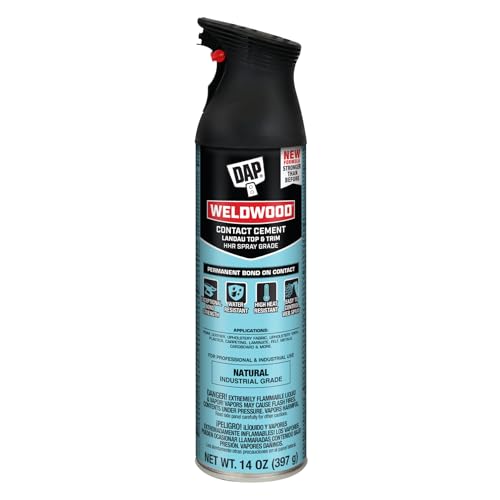
Every other adhesive here is applied by brush, finger, or spreader, one section at a time. The DAP Weldwood is a spray, and that single difference changes what you can realistically attempt. A synthetic-rubber contact cement in an aerosol can, it covers up to 79 square feet per can at 1 gram per square foot on a single surface. A car headliner or a full upholstery panel that would take half an hour with a brush is done in minutes.
It goes after automotive interiors, laminate work, car roof liners, and headliners specifically, but the surface list is broader than the label suggests: foams, upholstery fabric, vinyl, plastics, metals, carpeting, and laminate. After full cure it’s both high heat and water resistant, and it works inside or outside. It sets ready in 1-3 minutes, and full cure runs about 24 hours. The nozzle is worth calling out — owners describe a surgical spray pattern with near-zero cleanup, which is unusual for aerosol contact cement.
Two real caveats. The spray pattern is the weak point on some cans, and a few buyers report it squirting rather than spraying. And there’s a warning on the label about cancer and reproductive harm from the solvent content, so ventilation and a properly fitted respirator are non-negotiable on a big job.
Why it stands out
- 79 square feet of coverage per can — by far the fastest way to cover a large panel
- Ready to bond in 1-3 minutes; full cure in about 24 hours
- High heat and water resistant once cured, for interior or exterior use
- No brush, no spreader, no cleanup tools to wash
Where it will frustrate you
- Aerosol solvent needs real ventilation and respiratory protection
- Spray nozzle quality can be inconsistent — some cans squirt rather than spray
- Over-spraying one spot causes pooling that shows through fabric
The right tool for: headliners, large upholstery panels, and laminate jobs where brush-on application would take all afternoon.
Wrong tool for: small spot repairs, where a can of aerosol is overkill and a tube gives better control.
8. HOOK UP Vinyl Cement 16 oz
The big-can option for anyone who patches the same pool every single season
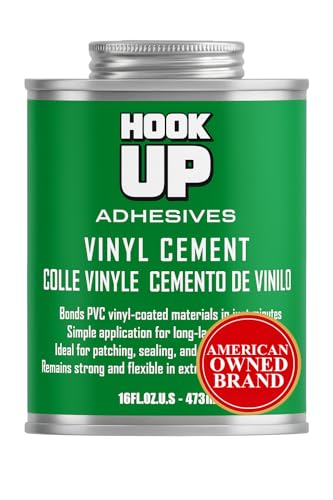
HOOK UP’s selling point is volume and sizing options. The manufacturer lists container sizes from 1 ounce up to a full gallon, and this one is the 16-ounce can — the tier they position for repeated repairs across a pool season. Customers describe it as working on a variety of vinyl and PVC surfaces — pool liners, inflatable boats, rafts, air mattresses, hot tub covers, tarps, canopies, bounce houses, vinyl upholstery, waders — making it a single-can answer for a whole garage shelf of repairs.
Full cure is listed at 2 hours, the fastest in this group for underwater applications, which is a real advantage if you are patching a pool and want to be back in the water the same afternoon. Application is a built-in brush; apply a thin coat, let it go tacky, press firmly. It finishes clear, so the repair does not announce itself on the vinyl.
The honest story with HOOK UP is variance. Owners describe both wonders and failures — a large hole in a heavy-duty air mattress held after 24 hours, an old vinyl boat’s oar-holding pads reattached following the cleaning and drying instructions to the letter. At the same time, some owners mention that vinyl-to-vinyl joints let go within 30 seconds of setup on tiny pool leaks, and one found it did not stick a vinyl decal to glass. The pattern points to surface prep and material type being decisive here. Skip it on glossy non-porous surfaces like glass and clean vinyl thoroughly before you start; on real vinyl with a proper tack time, it earns its keep.
What it does well: delivers a genuine underwater vinyl bond in a 16-ounce can, with the fastest full cure in the round, so seasonal pool repairs are done in an afternoon.
Where it comes up short: success depends heavily on the exact vinyl surface and a rigid application routine — glossy or non-porous surfaces are not its territory.
Go with it if: you repair the same pool, hot tub, or inflatable set year after year and want one big can that keeps up.
Better to skip if: you only need a spot fix here and there, or you are bonding vinyl to a smooth non-porous surface like glass.
Understanding the Specs
Solvent-Based vs Water-Based Formula
The “solvent-based” line on a vinyl cement label is the biggest thing that separates a lasting repair from one that peels off. Solvent cement softens the surface of the vinyl, so the two pieces essentially melt into one. Water-based and general-purpose craft adhesives stick to the surface only, which works fine indoors but tends to fail on anything wet, flexing, or exposed to sun and chlorine. If the label does not say solvent-based or contact cement, treat it as an indoor-only option.
Viscosity and Why It Matters
Viscosity is how thick and syrupy the glue is. A medium-to-high viscosity cement clings to a vertical surface without running off, which is what you need when you are patching the side wall of a pool instead of the flat bottom. A thin liquid runs everywhere and leaves the patch dry where you needed glue. Brands that list viscosity — like the Bellisinno cement, rated medium to high — are telling you how it will behave on a wall rather than just how it bonds.
Temperature Range and Cure Time
Vinyl cement is a chemical reaction, and cold slows it down. A cement rated from 35 °F to 95 °F has a wide safety window, but you should still work on a warm, dry surface in the middle of that range. Fast tack — the moment the glue grabs — is usually measured in minutes, while full cure is measured in hours. Plan on the full cure window before the repair goes underwater or takes real load, even if the glue already feels solid.
Container Format and Applicator
Brush-cap cans, squeeze tubes, and aerosol sprays each suit a different job. Brush-cap cans give the most control for pool liners and inflatables, and the brush is attached so you never lose it. Tubes are best for small, precise work like fence joints and shoe soles. Aerosols are the only practical choice when you need to cover a large panel like a car headliner — a brush would take all afternoon for the same area.
FAQ
Can vinyl cement really bond underwater?
Will vinyl cement work on a blue poly tarp?
How long should I wait before the repair gets wet?
Why does my vinyl cement fail when the surface is not clean?
Can I use vinyl cement on a swimming pool liner I have not drained?
Does vinyl cement work on thin decorative vinyl like lettering or wraps?
How much vinyl cement do I need for a pool season?
Is vinyl cement the same as PVC pipe cement?
Do I have to clamp the vinyl while the cement cures?
Can vinyl cement be used on vinyl upholstery and boat seats?
Final Thoughts: The Verdict
For most vinyl fabric repairs, the HH-66 4 oz is the most dependable option in this shortlist. It bonds underwater, holds flexibility from -30 °F to 150 °F, and covers a wide enough range of surfaces to handle pool liners, marine vinyl, tarp seams, and inflatable boats with one can. If you need the same reliability in a bigger can and a faster full cure for recurring pool-season repairs, the HOOK UP 16 oz is the natural step up. For rigid PVC and vinyl trim joints that need to set in minutes, the Christy’s Red Hot tube has no equal here. Whichever you pick, clean the surface with alcohol first and give it the full cure time — that is where most vinyl repairs either hold for years or fail in a day.
How We Picked
We do not accept paid placement. Every pick is matched to a real buyer and a real use-case; we do not hands-on test units.
Sources & Methodology
Specifications: manufacturer listings and product documentation. Review insights: verified customer reviews, as of September 2026. Pricing: not shown on this page (it changes often); check the current price via the retailer link.
As an Amazon Associate, Gadgets Feed earns from qualifying purchases. This does not affect which products we feature.