
Nowhere is the gap between a pro-grade floor installation and a weekend-warrior disaster wider than the moment the adhesive goes down. One pass with the wrong compound and your vinyl plank starts tenting, edges curl, and the entire room feels like a wavy discard. The chemistry between the adhesive and the vinyl backing is not negotiable — an aggressive solvent can warp the plank while a weak tack leaves it floating.
I’m Min — the co-founder and writer behind Gadgets Feed. I spend hundreds of hours each quarter pulling technical data sheets, comparing VOC levels and open-time windows, and cross-referencing customer performance reports to separate the adhesives that actually lock down vinyl from the ones that only promise it.
Whether you are tiling a kitchen, a commercial lobby, or an RV conversion, selecting the right formula starts here. This guide breaks down the physical chemistry, the working times, and the real-world hold strength across the best adhesive for vinyl options available today.
How To Choose The Best Adhesive For Vinyl
Vinyl flooring and sheeting are plastic-based materials that resist absorbing moisture the way wood or concrete does. This means the adhesive cannot rely on simple evaporation to cure — it must either react chemically with humidity (polyurethane) or form a pressure-sensitive mechanical bond (acrylic latex). Pick the wrong curing mechanism, and the adhesive either stays wet forever or dries brittle and cracks under foot traffic.
Solvent-Free vs. Solvent-Based
Solvent-free acrylic latex adhesives are the standard for indoor vinyl flooring because they emit no harsh fumes and cure by water evaporation. However, they bond best when the subfloor is porous enough to wick away the moisture. Solvent-based adhesives, like certain spray-contact formulations, deliver aggressive initial tack and can bond to non-porous surfaces, but the smell and the risk of chemically attacking thin vinyl backing makes them a specialized choice rather than an everyday one.
Open Time and Working Window
Open time is the interval after spreading the adhesive during which you can lay the vinyl and still get a full bond. Short open times (under 15 minutes) are for experienced installers working on single-room floors. Long open times — anything above 30 minutes — give you room to align planks, adjust positioning, and handle complex cuts. Adhesives with 60-minute open windows reduce rework risk significantly when your subfloor is uneven or your layout has tight curves.
Pressure-Sensitive vs. Wet-Lay Bond
Wet-lay installation means you install the vinyl directly into the wet adhesive and let it cure into a permanent bond. Pressure-sensitive adhesives allow you to let the glue dry completely until it becomes tacky to the touch, then lay the vinyl on top with firm pressure. The pressure-sensitive method lets you lift and reposition planks later, which is ideal for sheet goods or floating installations that need future service access. The permanent bond is stronger but leaves zero tolerance for mistakes.
Quick Comparison
On smaller screens, swipe sideways to see the full table.
| Model | Category | Best For | Key Spec | Amazon |
|---|---|---|---|---|
| Henry 695 | Premium | Roll sheet vinyl | 4-hour full cure, water-resistant | Amazon |
| ROMAN PRO-690 | Premium | Releasable LVT installs | Zero VOC, pressure-sensitive | Amazon |
| Loctite PL Premium | Premium | Trim, baseboard, outdoor | 3X stronger, waterproof | Amazon |
| Roberts 7350 | Mid-Range | Commercial LVP/LVT | Microban protection, 8.4 lb pail | Amazon |
| Roberts 3085 | Mid-Range | Felt-back sheet vinyl | Solvent-free SBR latex, 9.9 lb | Amazon |
| 3M Hi-Strength 94 ET | Mid-Range | Foam and fabric to vinyl | 60-minute open time, spray | Amazon |
| Lucida CoreBond | Mid-Range | LVT on porous subfloors | Solvent-free, 1 hr working time | Amazon |
In‑Depth Reviews
1. Henry 695 Vinyl Flooring Adhesive
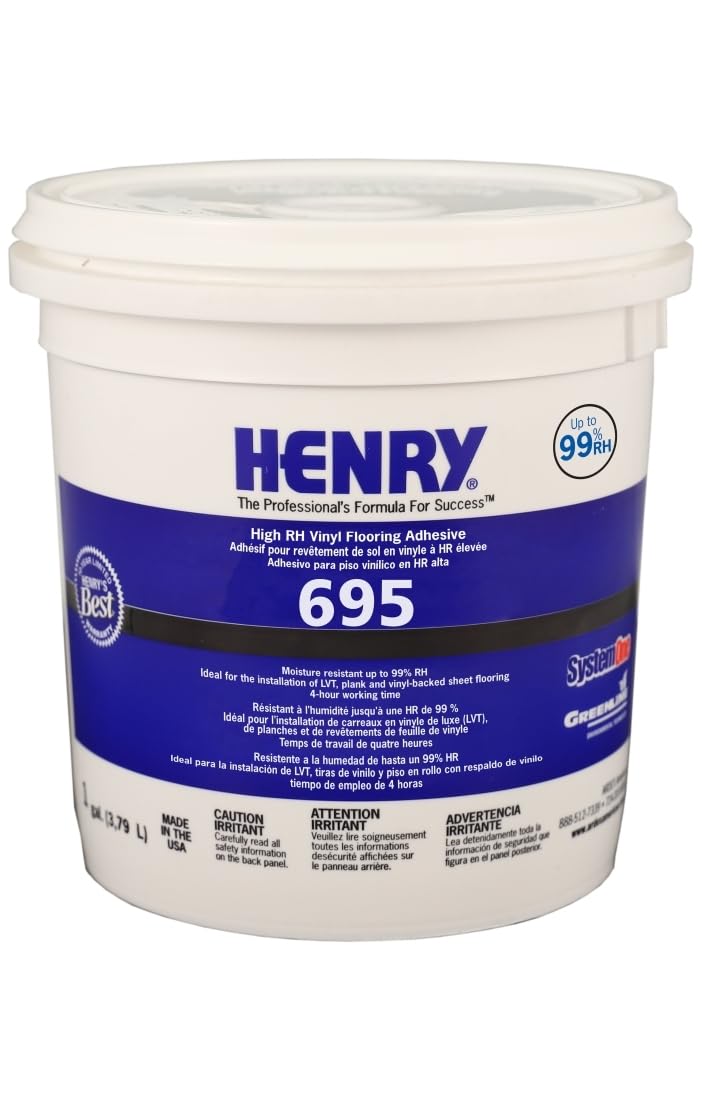
The Henry 695 is formulated specifically for full-spread installation of sheet vinyl, and that narrow specialization shows in its performance. It fills small subfloor cracks and gaps during application, which smooths the surface before you roll the vinyl down — a critical step because any debris or void under sheet vinyl telegraphs straight to the surface. The paste consistency spreads cleanly with a 1/16-inch trowel and stays workable long enough to make final positioning adjustments before it grabs.
With a full cure time of 4 hours, it sits in the sweet spot between fast-drying pressure-sensitive formulas and slow-curing polyurethane options. Customers consistently report that the initial grab is just right — enough to stop the vinyl from shifting during rolling but not so aggressive that you lose the ability to adjust overlaps on a long seam. The water-resistant property also means it can handle kitchen and laundry room subfloors that see occasional moisture from spills or cleaning.
One real-world trade-off is the container size relative to coverage. At a 1-gallon pail weighing 9.5 pounds, you get roughly 50 to 60 square feet per gallon depending on trowel notch depth. That is a bit less coverage per dollar than some acrylic latex options, but the reliability on sheet goods makes it the right call for single-room renovations where every inch of the vinyl matters.
Why it’s great
- Water-resistant formulation protects against kitchen and laundry room moisture
- Paste consistency fills minor cracks in subfloor during application
- 4-hour cure allows repositioning without rushing
Good to know
- Coverage is lower than some latex options — plan for about 50 sq ft per gallon
- Specifically for sheet vinyl, not ideal for thin vinyl plank
2. ROMAN PRO-690 Pressure Sensitive Adhesive
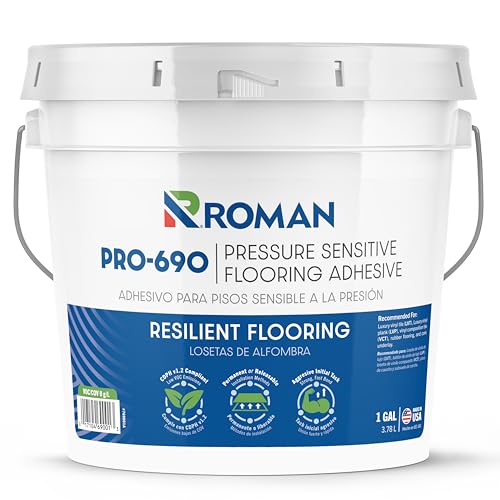
The ROMAN PRO-690 is built for modern resilient flooring stacks — LVT, LVP, and VCT — and its dual-mode installation method gives installers a rare flexibility. You can apply it wet for a permanent bond or let it dry tacky for a pressure-sensitive, releasable installation. The water-based formula registers zero g/L VOC, which makes it CDPH v1.2 compliant and usable in occupied indoor spaces without forcing the occupants to vacate during cure.
The paste spreads easily with a 1/16-inch notched trowel, and customer reports consistently mention the strong initial tack. Even when you let it dry for the pressure-sensitive route, the grab feels aggressive enough that planks stay put the moment they touch the subfloor. The 8-hour full cure time means you should plan overnight before heavy foot traffic, but the practical return-to-service is faster — light foot traffic is permissible once the adhesive reaches its touch-dry state.
One factor to weigh is that the white paste dries clear, which eliminates the risk of white adhesive bleeding up through grout lines or light-colored vinyl seams. The 1-gallon pail covers roughly 40 to 50 square feet, slightly less than some comparable options, but the dual-mode capability justifies the premium for remodelers who need service access later.
Why it’s great
- Dual-mode installation — wet bond or repositionable pressure-sensitive
- Zero VOC and low odor for occupied indoor spaces
- Dries clear so it won’t show through thin or light vinyl
Good to know
- 8-hour full cure time requires overnight wait before heavy traffic
- Coverage is lower — roughly 40-50 sq ft per gallon
3. Loctite PL Premium Polyurethane Construction Adhesive

The Loctite PL Premium is not a floor-spread adhesive — it comes in a 10 fl oz cartridge designed for a caulk gun — so its role in a vinyl installation is complementary rather than primary. Use it for bonding vinyl trim, cove bases, stair nosing, or for gluing the vinyl surface down on outdoor-grade applications where a construction-grade bond is needed. The polyurethane formulation expands slightly as it cures, filling gaps up to 1/2 inch in joints, and it bonds to wet or frozen surfaces without shrinking.
The manufacturer claims three times the strength of standard construction adhesives, and that is consistent with the real-world experience of users who have used it to glue vinyl-backed accessories to concrete, wood, and even metal surfaces. It sets in 30 minutes and hits full cure in 24 hours, so you can tape or brace pieces in the morning and have a load-bearing joint by the next day. The waterproof nature makes it suitable for outdoor vinyl skirting or marine vinyl projects exposed to rain.
The trade-off is that this product is not designed for full-coverage vinyl flooring installation. Trying to spread it over a large area would leave an uneven layer and waste material. Keep it in your toolbox for the edges, the transitions, and the spots where mechanical fasteners are not an option.
Why it’s great
- Three times stronger than standard construction adhesives
- Waterproof and bonds to wet or frozen surfaces
- Expands to fill gaps up to 1/2 inch
Good to know
- Cartridge format is for spot bonding, not full-floor coverage
- Polyurethane expands — clamp pieces during 30-min set time
4. ROBERTS 7350 Universal Resilient Flooring Adhesive

The Roberts 7350 leverages an acrylic latex, solvent-free formula that delivers high initial strength across a broad range of resilient surfaces — LVT, LVP, VCT, sheet vinyl, and vinyl-backed carpet tile. What separates it from the mid-range crowd is the integration of Microban antimicrobial protection, which fights the growth of stain-causing bacteria within the adhesive layer. For commercial installations where hygiene matters, that is a differentiator that no other adhesive on this list offers.
Real-world installers report an exceptionally long working time — one user noted that low spots remained wet for over 6 hours before drying clear. That is a massive window for aligning complex patterns or adjusting planks across large areas. The pressure-sensitive nature means you can walk on the adhesive within minutes after troweling, lay the vinyl immediately, and still have time to adjust. And the bond holds up under extreme conditions: one customer reported zero lifting in a motorcycle trailer exposed to snow, mud, rain, and sand over six months.
The 8.4-pound pail covers roughly 65 square feet with a 1/16-inch notch, making it one of the more economical coverage options per pail. The only recurring complaint is related to packaging — some pail lids seal poorly in transit, so inspect the seal on arrival.
Why it’s great
- Microban protection resists bacteria growth in the adhesive layer
- Extremely long working time — up to 6 hours in low spots
- Bonds to concrete, plywood, steel, and marble substrates
Good to know
- Initial odor is noticeable during application
- Package lid seals can be vulnerable during shipping
5. Roberts 3085 Multipurpose Adhesive
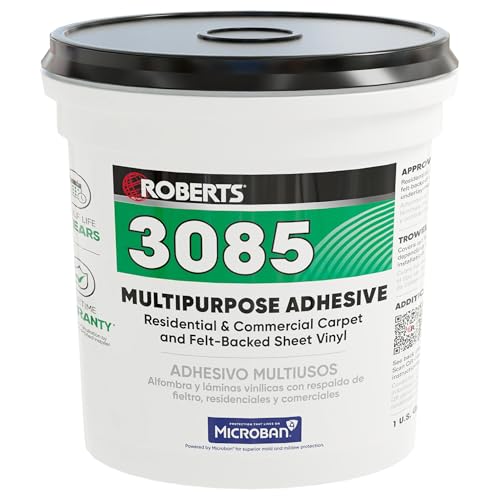
The Roberts 3085 is a solvent-free SBR latex adhesive positioned at a price point that makes it the go-to for large-area budget installations. It is designed for commercial and residential carpet and felt-back sheet vinyl, and it also works with acoustical cork underlayment. The fast-setting formula means you can lay the vinyl in about 30 minutes after spreading a thin layer, which accelerates the workflow on projects where waiting time is the bottleneck.
Customer data shows that one gallon covers about 92 square feet at a thin trowel setting, which is the best coverage-per-dollar in this list. The SBR latex bonds well to concrete, APA-rated plywood, and properly prepared VCT, making it a solid match for basement slab or garage subfloor conversions. Users who applied it for roll vinyl flooring report that it still holds strong years later with no edge lifting or adhesive breakdown.
The caveats are twofold: the SBR formula has a noticeable rubbery smell during application, and it is strictly for interior, moderate-traffic areas. High-traffic commercial corridors or spaces that see rolling loads — like office chairs or pallet jacks — may exceed the bond ceiling of this adhesive. Reserve it for medium-duty residential or commercial spaces where the budget is the primary constraint.
Why it’s great
- Excellent coverage — roughly 92 sq ft per gallon
- Solvent-free with low odor compared to solvent-based competitors
- Fast 30-minute set time accelerates installation pace
Good to know
- Best for residential or moderate commercial traffic only
- Not designed for luxury vinyl plank (LVP) installations
6. 3M Hi-Strength 94 ET Spray Adhesive
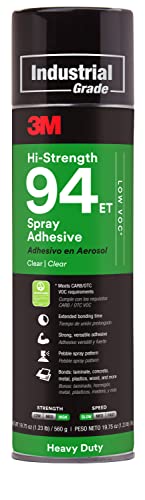
The 3M Hi-Strength 94 ET departs from the trowel-applied floor adhesives. It is a contact spray adhesive formulated for bonding non-porous materials and is effective for attaching vinyl to metal, plastic, wood, and closed-cell foam. The 19.75 oz aerosol delivers aggressive tack with an open time of up to 60 minutes — an unusually long window for a spray adhesive — which lets you coat both surfaces, let them flash off, and then press them together for an instant bond.
For vinyl applications, this product shines when you are lining pickup truck beds, attaching vinyl upholstery to seat foam, or bonding soundproofing foam to plastic interior panels. It carries GREENGUARD certification and LEED credit eligibility, meaning it meets low-emission standards for indoor air quality. The low VOC formulation is a clear step above the solvent-heavy spray adhesives from a decade ago, though you still need ventilation during application.
The main limitation for floor work is coverage and cost — the 19.75 oz can covers roughly 8 to 10 square feet per surface at a moderate spray pattern. That makes it impractical for full room flooring, but unmatched for edge laminations, detail work, or repair patches where a trowel adhesive would be messy or imprecise.
Why it’s great
- 60-minute open time for precise contact alignment
- GREENGUARD certified and low VOC for indoor use
- Bonds vinyl to non-porous surfaces like metal and plastic
Good to know
- Coverage is limited — roughly 8-10 sq ft per can
- Requires both surfaces to be coated and allowed to dry before pressing
7. Lucida Surfaces CoreBond Pro-Grade Adhesive
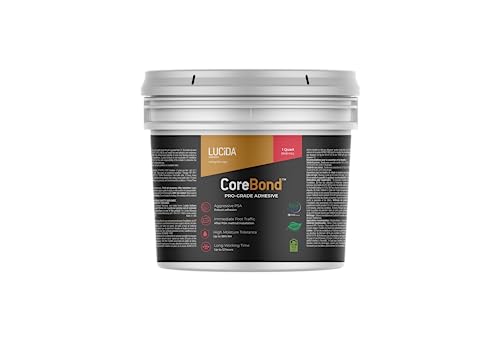
The Lucida CoreBond is a solvent-free pressure-sensitive adhesive targeted at LVT, vinyl plank without attached backing, PVC, carpet tile, and VCT. Its defining characteristic is the ease of cleanup — wet adhesive wipes off surfaces and tools with a damp cloth, while dried adhesive can be removed with mineral spirits. That is a real time-saver when you are working around baseboards, cabinets, or pre-installed trim where excess glue is unavoidable.
The 1-quart container covers roughly 40 square feet, making it a good fit for small rooms or repair patches rather than whole-house installations. Customers using it for RV and motorhome vinyl repair noted that it holds up well despite the temperature swings and flexing of the vehicle chassis. The working time of 30 minutes to 1 hour gives enough room to lay planks in a small room without feeling rushed, and the adhesive remains tacky for pressure-sensitive placement rather than requiring immediate pressing.
Because it is a pressure-sensitive adhesive, the bond is not as immediately aggressive as a wet-lay polyurethane adhesive. If your subfloor has uneven patches or your vinyl is rigid, you will want to make sure the entire plank surface contacts the adhesive during rolling — any gap reduces the bond strength noticeably.
Why it’s great
- Easy wet cleanup with a damp cloth
- Solvent-free with low odor suitable for enclosed spaces
- 60-minute working window for flexible placement
Good to know
- 1-quart container covers only about 40 sq ft
- Pressure-sensitive bond requires full contact during install
FAQ
Can I use a general construction adhesive like Loctite PL Premium for full-floor vinyl installation?
How long should I wait before walking on a freshly glued vinyl floor?
What subfloor types require a specific adhesive for vinyl?
Final Thoughts: The Verdict
For most users, the best adhesive for vinyl winner is the Henry 695 because it combines a water-resistant formulation with a 4-hour cure time that fits sheet vinyl installations perfectly. If you need a zero-VOC, dual-mode adhesive for LVT installations where future service access matters, grab the ROMAN PRO-690. And for heavy-duty spot bonding of vinyl trim or outdoor accessories, nothing beats the Loctite PL Premium triple-strength polyurethane.