
Our readers keep the lights on and my morning glass full of iced black tea. As an Amazon Associate, I earn from qualifying purchases.
Specs are compiled from manufacturer listings and verified buyer reviews and can change over time — please confirm the key details on the product page before buying.
Gluing wood to glass is one of the trickiest joins in the workshop. One surface drinks up moisture, the other refuses to absorb anything at all — so a glue that grips wood perfectly can slide right off the glass. This guide is built around eight glues that genuinely handle both, so you can pick one with confidence and stop guessing. A quick note up front: these picks use flexible, human-like matching for adhesives suitable for bonding wood to glass, so not every tube is the exact product number you typed into the search bar. The nearest same-type formula serves the same purpose, and we tell you plainly which is which.
I’m Min — the founder and writer behind Gadgets Feed. This guide is built by comparing the manufacturers’ published specifications and the patterns across verified customer reviews, so you get each pick’s real strengths and trade-offs instead of marketing spin.
On a vertical join, work time matters more than most people realize. You’ll see what separates an instant glue from a slow-curing construction adhesive. The right tube depends on whether you can clamp the piece, how much slip you need before the bond grabs, and whether the finished job will sit indoors or outside in the weather. If you want a straight answer rather than a chemistry lecture, this is the practical adhesive for wood to glass shopping list you can actually lean on.
Our Picks at a Glance

How To Choose The Best Adhesive For Wood To Glass
The single hardest part of a wood-to-glass bond is that the two materials behave nothing alike. Wood is porous and soaks up a wet adhesive; glass is smooth and non-porous, so the glue has to sit on the surface and grip it rather than sink in. Get that mismatch wrong and you get a join that feels solid for a week and then lets go.
Match the cure speed to whether you can clamp
An instant glue that grabs in seconds leaves you no room to slide a frame square or shift a shelf into level. If your piece needs adjusting, a longer working time is worth more than a faster set. A construction adhesive with up to 30 minutes of working time lets you reposition and still get a strong hold; a 5-minute epoxy gives you about 5 minutes of movement before it starts to firm up.
Think about the finish before you open the tube
A clear or crisp glue disappears on glass, which is what you want for a display frame, a mirror edge, or a mosaic. An amber or cream-colored adhesive can show through a transparent panel. If the join will be visible, factor the dried color into the decision as heavily as the strength.
Decide honestly whether it lives indoors or outside
A window frame or an outdoor planter box needs a waterproof, weather-resistant formula. A purely indoor decorative piece on a shelf can get away with a simpler glue. If water, frost, or sun will reach the joint, don’t gamble on a glue that isn’t rated for a wet or changing environment.
Quick Comparison
| Model | Best For | Full Cure Time | Form | Bond Character | Amazon |
|---|---|---|---|---|---|
| Starbond Medium Super Glue Pro Kit★ Best Overall | Fast, precision small joins | 10-15 sec set | Liquid (cyanoacrylate) | Quick, strong, repositionable | Amazon |
| Loctite Power Grab Ultimate crispcrisp Pick | crisp interior/exterior | 24 hours | Liquid (cartridge) | Clear, tacky, gap-filling | Amazon |
| Gorilla Max Strength Construction AdhesiveTop Performer | Waterproof, gap-filling jobs | 24 hours | Paste (tube) | Strong, clear, workable | Amazon |
| Brampton Extra Strength Epoxy | Large, slow, adjustable projects | 15 hours | Liquid (epoxy 1:1) | Waterproof, sandable | Amazon |
| Weldbond Multi-Surface Glue | Mosaics and odor-free craft | 20 minutes | Liquid (PVA) | Clear, no-fume, water resistant | Amazon |
| CAMALEAO Thin Super Glue | Fast wicking into tight grain | 20 seconds | Liquid (cyanoacrylate) | Thin, fast, penetrating | Amazon |
| CAMALEAO Medium Super CA Glue Kit | Controlled precision bonding | 30 seconds | Liquid (cyanoacrylate) | Medium-thick, balanced | Amazon |
| GDDP 5 Minute Epoxy Glue | Fast adjustable repairs | 24 hours | Liquid (epoxy 1:1) | Quick-set, heat resistant | Amazon |
| Starbond 5 Minute Epoxy Pro Kit | Flexible, vibration-tolerant joins | 24 hours | Paste (epoxy 1:1) | Toughened, clear, flexible | Amazon |
In‑Depth Reviews
1. Starbond Medium Super Glue Pro Kit (2 oz)
Our pick — 4.5+★ from 10,000+ verified ratings; the strongest balance of quality and price.
The featherweight that grabs in seconds and still lets you nudge the piece square.
The number that earns this kit the top slot is its 10-15 second set time — fast enough that a small wood-to-glass join doesn’t need clamping for long, slow enough that you can still slide the piece a hair before it locks. It’s a medium-thickness cyanoacrylate (cyanoacrylate is the chemical name for instant “super glue” — it hardens when it meets trace moisture on a surface). That medium body sits between watery and syrupy, so it holds its place on a smooth glass face instead of running straight off the way a thin glue would.
What wins people over is the sheer repeatable quality of the stuff — it’s the most-praised trait in its own listing by a wide margin, and the extras are the reason. The kit ships with two applicator nozzles, a pin cap for clog prevention, and eight precision microtips, so you can lay a fine bead into a tight seam rather than flooding the joint. Buyers report the balance directly: “With a 10-15 second set time, it strikes a strong balance—fast enough to keep projects moving, yet slow enough to allow repositioning and precise adjustments.”
Here’s the catch worth knowing before you buy. Instant glues are brittle by nature, and the listing’s own adhesion feedback splits — some owners find it grips beautifully, some find it lets go on hard-to-bond surfaces. On bare, glossy glass a quick surface prep is smart, and this kit is at its best on smaller decorative joins, trim, inlay, and hobby work rather than a load-bearing shelf under a heavy mirror. It’s the crowd favorite at 4.5+ stars across 10,000+ ratings for a reason.
Why it earns the top spot
- 10-15 second set time keeps small projects moving without long clamping
- Medium viscosity holds on a vertical glass face instead of running
- Eight microtips plus a pin cap make fine application easy
- Compatible with wood, glass, ceramic, metal, rubber and more
Where it asks for care
- Instant glue is brittle, so it suits small decorative joins over heavy loads
- Adhesion on bare glossy glass benefits from surface prep
Go for this if: you want fast, precise control on smaller wood-to-glass craft and repair work.
Think twice if: you need a gap-filling, load-bearing bond — a construction adhesive or epoxy serves that better.
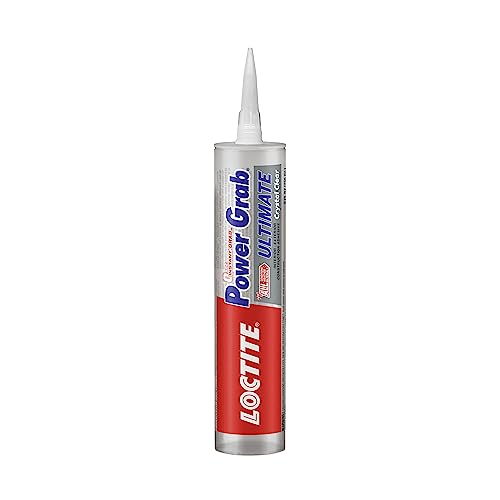
2. Loctite Power Grab Ultimate crisp Construction Adhesive
Built to vanish — a construction adhesive that stays invisible on a glass face.
If the finished join will be seen, clarity becomes the whole game, and that’s exactly where this Loctite tube shines. It’s formulated to stay crisp both during application and after it cures, so a wood-to-glass seam on a frame or a display shelf reads as invisible rather than showing a milky line. It also does something a lot of glues won’t: it grips two non-porous surfaces and handles wet ones, which takes a lot of the fear out of bonding smooth glass where nothing wants to soak in.
The trade-off is honest and worth saying plainly. The clarity draws the most positive remarks, but durability, grab, and ease of use all land as mixed in the listing’s own feedback — it wants a little patience and clean prep to perform its best. On a brightly lit, visible join where looks matter, that’s a fair trade. On a heavily loaded structural repair, an epoxy would give you more confidence. It holds a 4.0+ rating and gives you a 9 fl oz cartridge that covers a good run of small projects.
Where it wins: a truly see-through finish plus the ability to bond wet and non-porous surfaces, with a quick initial tack that trims your bracing time.
Give it a fair shot: clean and prep both faces, allow the full 24-hour cure before loading the joint, and expect to work a little slower than with an instant glue.
The clear-finish answer: for visible wood-to-glass joins where an invisible seam matters more than brute strength.
Not the heavy-lift choice: for a structural, load-bearing repair, reach for an epoxy instead.
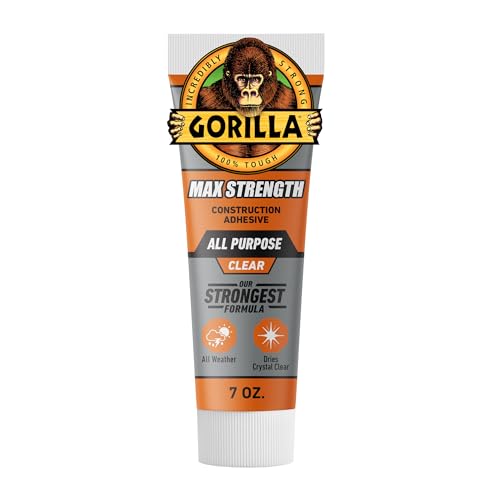
3. Gorilla Max Strength Construction Adhesive, Clear, 7 oz Tube
The workhorse that gives you room to reposition before it commits.
A wood-to-glass join usually needs a little wiggle room, and this tube’s defining asset is time — up to 30 minutes of working time so you can slide the glass into square before the bond locks. It’s a hybrid paste formula that fills gaps, which is exactly what you want when a frame isn’t perfectly flush against a pane. It also dries crisp and non-foaming, so the seam stays clean, and it’s paintable in 2 hours and sandable once cured for a smooth finish.
Where it pulls ahead of the quicker super glues is durability under tough conditions. It’s 100% waterproof and works under water and on wet surfaces, so a bathroom mirror, a shower surround, or an outdoor job is fully in scope. It bonds wood, metal, ceramic, tile, stone, glass, mirrors, concrete, granite, marble, and laminate. The strength is what people praise most here — it’s the second most-mentioned positive in the listing — with a solid 4.5+ rating behind it. Note the timeline: full cure runs 24 hours, versus the Brampton epoxy’s 15 hours, so the epoxy firms up faster if a quicker cure matters to you.
The honest caveat is that adhesion and drying time split down the middle in owner feedback — some find it grabs fast and strong, some find it slow to dry and less sticky than hoped. A lot of that depends on prep and clamping on a non-porous surface, so don’t skip them. Treat it as your waterproof, gap-filling workhorse for bathrooms and outdoor jobs, not a cure-all for every wood-to-glass seam.
Made for wet and tough jobs: bathrooms, kitchens, and outdoor wood-to-glass projects that need a waterproof, gap-filling hold.
Prep is the price of admission: rough up or clean the glass and brace the piece — skip that and even a strong formula can disappoint.
4. Brampton Extra Strength Epoxy, 20-Minute Work Life

Twenty minutes of open time — the epoxy that forgives a big, fiddly assembly.
When the project is large and the fit is fussy, a two-part epoxy gives you the working window instant glues simply can’t. This one runs a 20-minute work life and a 5-hour set time, so you can position a whole run of glass into a wood frame without racing the clock. It cures fully in 15 hours and turns sandable and paintable after 20 hours, which is a big deal if you plan to finish the surrounding wood afterward. Mixing is a clean 1:1 by volume, and it’s 100% waterproof for indoor and outdoor use.
Comparing cure speeds is telling: this epoxy reaches full cure in 15 hours, quicker than the Gorilla construction adhesive at 24 hours. Owners gravitate toward how effective the bond is — it’s the most-praised trait in the listing — and the versatility lands too, since it grabs metal, wood, stone, glass, tile, concrete, ceramic, porcelain, and most plastics. Buyers also note the working window matches the marketing: “With a 20-minute work life and a 5-hour set time, our epoxy glue kit allows flexibility for large-scale projects.”
The one thing to plan around is drying. Owner feedback on cure time is mixed — it’s strong, but it takes hours and can need a couple of days to reach maximum strength. So schedule the job when the piece can sit undisturbed. Treat the stated 72°F for best bonding as your real-world target rather than an afterthought.
Why it suits the big job: a 20-minute work life plus a fully waterproof, impact-resistant, sandable finish that bonds glass, wood, stone, and metal.
Plan around the cure: full strength is a next-day result, so don’t move a loaded piece early — set it aside and let the epoxy do its quiet work.
Best for the ambitious build: large wood-to-glass assemblies where you need time to line everything up and a waterproof, paintable result.
Skip if you need it done in an hour: the multi-hour cure means this is a plan-ahead glue, not a same-minute fix.
5. Weldbond Multi-Surface Glue Non-Toxic 14.2 oz

No fumes, no fuss — a kitchen-table glue that dries invisible on glass.
Here’s a pick for the crafter who works with the windows shut. This PVA-based glue (a water-based adhesive that cures as the water evaporates) is non-toxic with no solvents and no harsh fumes, so it’s at home on the kitchen table or in a classroom. It bonds wood, ceramic, glass, tile, pottery, porcelain, fabric, and carpet, and it dries crisp with no yellowing or cloudy halo — which is exactly what a mosaic or a light-toned wood-and-glass piece needs.
It sets in about 20 minutes with no clamping, which is unusually quick for a PVA glue, and it sands and paints like the wood around it. If a project needs a thinner coat for porous work, you can add a little water and brush it on. What people praise most is how effectively it does its job, with the hold right behind it, and it carries a 4.5+ rating. The precision tip lays a neat bead rather than flooding the seam, and water resistance means covered outdoor pieces can hold up too.
The realistic limit: it’s a bonding adhesive, not an instant glue, so a repair needs to sit undisturbed while it sets. It also won’t bond every pair — the maker calls out that it does not bond metal to ceramic. For decorative wood-to-glass work where a clean, fume-free finish is the priority, that’s a small ask.
Reach for this if: you’re doing mosaics, pottery, or decorative wood-and-glass craft and want a clear, odor-free hold.
Look elsewhere if: you’re bonding metal to ceramic or need an instant grab — this needs a short, undisturbed set.
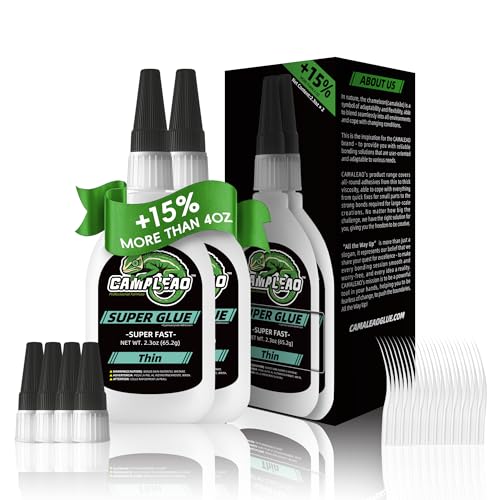
6. CAMALEAO Thin Super Glue Liquid 4.6 oz
Watery enough to wick deep into wood grain under a mounted glass piece.
Thin glue solves a specific problem: when the glass is already in place and you need adhesive to creep into a tight seam and reach the wood beneath. This formula runs a viscosity of 100 CPS — that’s a consistency close to vegetable oil — and a stated permeability of 0.004 of an inch, so it flows into fine gaps rather than sitting on top of them. It cures in 15-20 seconds and is rated at 2610 PSI for strength.
The speed and thin body are the whole point. Owners praise its effectiveness above all, with bonding strength close behind, and the heavy-duty bottle with an anti-clogging cap (a built-in steel pin keeps the tip clear) earns its keep on repeated use. It’s compatible with plastics, metal, leather, wood, ceramics, and pottery, and you get 15% more glue than the 4 oz size, plus a 24-month shelf life when stored cool and dark.
Be clear-eyed about where thin CA glue belongs. Its very runniness is a liability on a vertical glass face — it wants to travel, so it suits wicking into a pre-assembled joint rather than bridging a gap on its own. It’s also brittle once cured, so save it for detail and repair work, not a load-bearing shelf. A few owners find the thin consistency tricky, which is why some pair it with a thicker medium glue for different steps of the same job.
Its specialty: creeping into tight, already-mounted seams with a 100 CPS thin body and a 15-20 second cure.
Know its limits: it runs on vertical surfaces and cures brittle, so use it for penetration and detail, not gap-bridging or heavy loads.
The seam-penetrator: ideal when you need glue to wick into a mounted joint and grab almost instantly.
Not a gap-filler: for a runny-free bead on a sloped glass face, choose the medium CAMALEAO instead.
7. CAMALEAO Medium Super CA Glue Kit 4.6 oz

Syrup-thick and steady — the body that won’t run away on a vertical pane.
This is the sibling of the thin CAMALEAO, and the difference is all in the thickness. It runs a viscosity of 750 CPS — a consistency compared to syrup — with a permeability of 0.008 of an inch. That thicker body gives you control and flow in equal measure, so a bead stays where you place it on an upright wood-to-glass seam instead of sliding off. It cures in 15-30 seconds and carries the same 2610 PSI strength rating.
What makes this one easy to live with is the extras and the hold. Adhesiveness is the most-praised trait — owners find it sticks to almost everything, and its compatibility list runs to metal, plastic, rubber, leather, wood, paper, card, ceramics, glass, and acrylic. The kit also comes loaded with an abundance of tips and straws for clean dispensing, plus the anti-clog cap. Compared with the runnier thin version, this medium body is the safer bet for a vertical join where you can’t afford the glue to travel.
Treat the extra control as its reason to exist rather than a strength upgrade — the PSI rating matches the thin version. It still cures brittle like any instant glue, so it’s best on small and medium detail work rather than a heavy structural load. For a display shelf, a small frame, or a model, the balance is right.
What makes it the control pick
- 750 CPS syrup body stays put on a vertical glass seam
- 15-30 second cure with a 2610 PSI strength rating
- Ships with plenty of extra tips and straws, plus an anti-clog cap
The honest limit
- Same brittle instant-glue cure, so not for load-bearing repairs
- Strength matches the thin version — the gain here is control, not more hold
Choose this when control is king: vertical and detail wood-to-glass joins where a thick, steady bead beats runny glue.
Pass on it for heavy loads: a load-bearing joint calls for an epoxy, not a brittle instant glue.
8. GDDP 5 Minute Epoxy Glue, 8.45 fl oz
A five-minute window and a heat ceiling that suits practical repairs.
When you want the durability of an epoxy but not the long wait, this two-part kit sits in the middle. It gives you about 5 minutes of working time to adjust the piece, then functional curing in one hour and full cure in 24 hours. It’s rated to withstand temperatures up to about 300°F (about 149°C), so it holds up better than many glues when heat is part of the environment. Note the maker’s caveat that higher heat and humidity shorten the working time, so keep that in mind on a warm day.
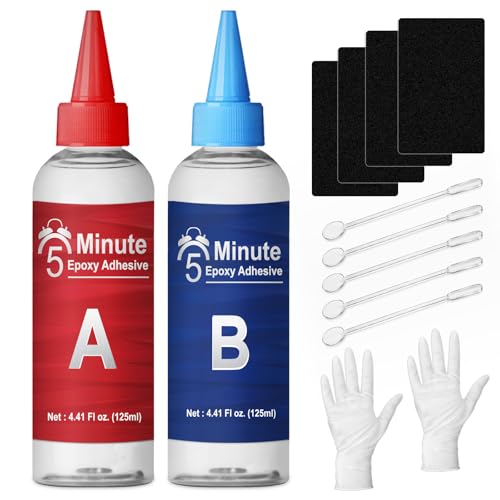
The kit is thoughtfully built for clean mixing: two bottles with color-coded caps to prevent cross-mixing, five small wooden sticks, two gloves, and four mixing trays. Mix 1:1 on a tray and apply. It’s compatible with metal, glass, wood, concrete, tiles, ceramics, porcelain, 3D printed parts, fiberglass, fabrics, and most plastics, so a wood-to-glass bond is comfortably in its lane. The two-color caps also mean no need to cut tips — just unscrew and use.
The trade-off to respect is that 5 minutes goes fast on a multi-piece assembly. If your project is large and needs more open time, the Brampton epoxy’s 20-minute work life is the more forgiving choice. For a quick, heat-tolerant repair, this one does the job with less waiting.
Good for quick, warm-environment fixes: fast repairs that need epoxy durability and heat resistance up to about 300°F.
Think bigger for big builds: a 5-minute window is tight for multi-piece work — a longer-work-life epoxy is gentler on the nerves.
9. Starbond 5 Minute Epoxy Pro Kit, 8 oz

Flexible where it counts — a tough epoxy built to shrug off vibration and stress.
Most wood-to-glass joins that fail don’t fail on raw strength — they fail because a rigid bond cracks under movement. This Starbond epoxy is engineered as a flexible toughened formula that absorbs vibration and stress without brittle cracking, which is exactly what you want on a glass display case, a piece near a door, or anything that gets bumped. It rates at 2,600 lb shear strength (a measure of how much sliding force the cured bond resists) and reaches handling strength in about 5 minutes, with full cure in 24 hours.
The pro kit earns its premium status on practicality. It mixes 1:1 by volume for consistent results and cures clear, and it comes with screw-cap bottles, reusable mixing trays, and tools — no leaky syringes, less waste, and a longer shelf life. It bonds wood, metal, glass, ceramic, and plastics like ABS and PVC, so a wood panel meeting a glass face is well within scope. What people praise most is the overall quality of the result, with ease of use close behind.
The one thing to weigh is the split in owner experience on drying time and bond strength — many find it strong and fast, some hit adhesion issues. That gap usually traces back to surface prep on non-porous glass, so clean both faces and mix a full 1:1 before you apply. Do that, and the flexible, crack-resistant bond is the whole reason to choose this over a rigid epoxy.
The flexibility advantage: a toughened formula with 2,600 lb shear strength designed to absorb stress without brittle cracking, plus a clean 1:1 mix and reusable trays.
Prep decides the outcome: mix a full 1:1 and clean the glass first — a few owners who skipped that hit weaker adhesion than they expected.
Best where movement is a factor: glass and wood joins that will see vibration, bumps, or shifting — the flexible bond takes the stress a rigid glue can’t.
Overkill for a tiny craft fix: for a small decorative join, a fast instant glue handles it with less mixing.
Understanding the Specs
Work Time and Cure Time
Work time is how long you can move and adjust the piece before the adhesive starts to grab — think of it as your adjustment window. Cure time is how long it takes to reach full strength. These are not the same thing: a 5-minute epoxy gives you about 5 minutes of work time but may need a full 24 hours to reach maximum bond. On a vertical wood-to-glass join, a longer work time is often more valuable than a faster set, because it lets you line up the glass square before it locks.
Viscosity and Gap-Filling
Viscosity is simply how thick the glue is — how fast it flows. A thin glue with a low reading like 100 CPS behaves like vegetable oil and wicks deep into grain and tight seams. A thicker medium glue sits where you put it and won’t run off a vertical glass face. A paste construction adhesive fills gaps between imperfect surfaces. Match this to your job: thin to penetrate, medium to control, thick to bridge gaps. Pick the wrong viscosity and the glue either runs off the glass or never reaches the wood grain.
Strength Ratings
Strength numbers like 2610 PSI or 2,600 lb shear tell you how much force the cured bond resists before it fails — higher means a tougher hold. But a high number only matters if the glue is applied to clean, prepped surfaces. On a non-porous face like glass, surface prep and the type of formula matter just as much as the raw figure.
Waterproof and Weather Resistance
If the finished wood-to-glass piece will sit in a bathroom, outdoors, or anywhere water and temperature swings reach it, a waterproof rating is essential. Construction adhesives and epoxies generally handle wet surfaces and weather better than instant glues. For an indoor dust-catcher on a shelf, a simple clear glue is often enough.
FAQ
What kind of glue actually bonds wood to glass?
Can I use super glue to attach wood to glass?
How long should a wood-to-glass bond sit before I load it?
Does the glue need to be waterproof for a bathroom mirror?
Why does my glue show through the glass?
What is the difference between a construction adhesive and an epoxy for this job?
How do I stop a thin glue from running down the glass?
Will an instant glue or a construction adhesive last on wood joined to glass?
Does any of these glues work on outdoor wood-to-glass projects?
Can I mix and match glues on the same project?
Final Thoughts: The Verdict
For small, clampable wood-to-glass joins, the adhesive for wood to glass winner is the Starbond Medium Super Glue Pro Kit — its 10-15 second set time and medium body give you fast, precise control, and the eight microtips make clean application easy. That balance of speed and adjustability, plus a 4.5+ star rating across 10,000+ reviews, is what earns it the top spot.
If the join will be seen and you want it to stay invisible, grab the Loctite Power Grab Ultimate crisp for its clear, non-porous-friendly formula. And for a large or waterproof wood-to-glass build where you need time to line everything up, the Brampton Extra Strength Epoxy and its 20-minute work life are the ones to reach for. Match the glue to your clamping window, whether the seam stays visible, and whether the joint faces weather.
How We Picked
We do not accept paid placement. Every pick is matched to a real buyer and a real use-case; we do not hands-on test units.
Sources & Methodology
Specifications: manufacturer listings and product documentation. Review insights: verified customer reviews, as of November 2026. Pricing: not shown on this page (it changes often); check the current price via the retailer link.
As an Amazon Associate, Gadgets Feed earns from qualifying purchases. This does not affect which products we feature.