
Our readers keep the lights on and my morning glass full of iced black tea. As an Amazon Associate, I earn from qualifying purchases.
Specs are compiled from manufacturer listings and verified buyer reviews and can change over time — please confirm the key details on the product page before buying.
Thin wood veneer peels, bubbles, and lifts at the edges if the wrong glue is under it. You need an adhesive that grabs instantly, flexes with the wood, and stays put through humidity and time — not something that stiffens and cracks, or sits tacky forever. This guide cuts through the sticky confusion, matching the right glue format to your exact project, so that piece you are working on stays flat for years.
I’m Min — the founder and writer behind Gadgets Feed. This guide is built by comparing the manufacturers’ published specifications and the patterns across verified customer reviews, so you get each pick’s real strengths and trade-offs instead of marketing spin.
Whether you are laminating a countertop, restoring an antique chair, or edge-banding a cabinet, this roundup points you to the best adhesive for wood veneer for your specific setup and skill level.
Our Picks at a Glance
How To Choose The Best Adhesive For Wood Veneer
You need an adhesive that grabs instantly so the paper-thin wood sheet does not slide, yet stays flexible so it does not crack when the wood expands and contracts. Get this wrong, and you end up with bubbles, peeling edges, or a brittle mess that ruins your project.
Format — Liquid, Spray, Tape, or Pellet
Liquid contact cement, applied with a brush, gives you the strongest bond for large surfaces like countertops and tabletops. Spray adhesive covers big areas fast without drips but needs good ventilation. Double-sided tape is the cleanest option for small repairs or temporary holding, while hot melt pellets require a machine and are only for edge banding.
Open Time and Working Window
Open time is the period after application during which you can still position the veneer before the glue sets. Contact cement needs to dry until tacky before pressing — usually 10 to 15 minutes. Hide glue offers a longer 30-minute window, which is a lifesaver for complex patterns. Spray adhesives can be ready in as little as one to three minutes.
Flexibility After Cure
Veneer moves with the seasons, so a rigid glue will eventually let go. Neoprene-based contact cements stay flexible after drying, which is why they are the standard for woodworking. Hide glue also remains somewhat flexible and is reversible with heat — perfect for antique restoration where future repairs are expected.
Quick Comparison
| Model | Best For | Format | Full Cure Time | Flexible After Cure | Amazon |
|---|---|---|---|---|---|
| FastCap SpeedTape★ Best Overall | Edge banding & temporary hold | Double-sided tape | Instant | Yes | Amazon |
| 3M Hi-Strength 94 ETTop Performer | Large surfaces & veneer lamination | Spray | 24 hours | Yes | Amazon |
| Old Brown Glue Liquid Hide GlueRestoration Pro | Antique restoration & fine woodworking | Liquid (hide glue) | 24-48 hours | Yes | Amazon |
| DAP Weldwood Spray Contact Cement | Interior/exterior laminates & upholstery | Spray | 24 hours | Yes | Amazon |
| Wonshine Contact Cement | Small repairs & edge banding | Liquid (brush) | 24 hours | Yes | Amazon |
| Bondtech Contact Cement | Small crafts & furniture repair | Liquid (brush) | 24 hours | Yes | Amazon |
| DAP Gel Original Contact Cement | Vertical surfaces & drip-free application | Gel | 15 minutes | Yes | Amazon |
| JAOJAO Contact Cement | Budget-friendly bonding of multiple materials | Liquid (brush) | 24 hours | Yes | Amazon |
| JNB Pro EVA Hot Melt Adhesive | Machine edge banding with PVC & veneer | Pellets (hot melt) | 20-30 seconds | Yes | Amazon |
In‑Depth Reviews
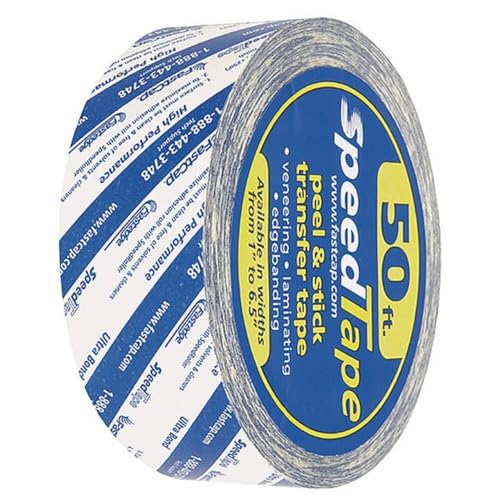
1. FastCap SpeedTape Double Sided Adhesive Tape
Our pick — over 4.5★ from 600+ verified ratings; the strongest balance of quality and price.
Contact cement on a roll — peel, stick, and skip the messy brush.
When you need to hold a veneer edge band in place or clamp a glue-up without clamps, this double-sided tape is the cleanest shortcut in the shop. Owners praise its stickiness most — well over 80 reviewers single it out — and builders using it for guitar templates report the plywood delaminates before the tape gives. It is a 1-inch by 50-foot roll of ultra-bond transfer adhesive, essentially contact cement in a peel-and-stick format.
The catch is that it is almost too strong for temporary work. If you want to hold a piece in place while the main glue dries, separating it later takes real effort and leaves residue. But for permanent bonding — edge banding, laminates, or any veneer-to-substrate job — this tape is faster and less messy than liquid glue. A few owners find the ease of use hits a mixed note because the liner can be fiddly to start, but the quality is consistently called commercial-grade.
What wins people over
- Extremely strong bond — owners say wood fails before the tape does
- Clean peel-and-stick application; no brush, no cleanup, no fumes
- 50-foot roll covers plenty of edge-banding and small-surface jobs
The honest catch
- Way too strong for temporary hold — hard to reposition or remove cleanly
Grab this for: permanent edge banding, laminating small pieces, or any job where you want instant grab without liquid glue.
skip it if: your plan is to reposition the veneer later — this tape commits hard.
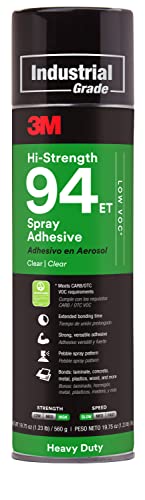
2. 3M Hi-Strength 94 ET Spray Adhesive
The spray that gives you an hour to dial in every millimeter of veneer.
This is the undisputed crowd favorite for large-surface veneer lamination — and for good reason. The crowd favorite — 4.6 stars across 800+ owners — the adhesion is the most-praised feature here, with owners consistently reporting it locks down veneer, laminate, and carpet to metals and wood without letting go. The 60-minute bonding range is the defining spec: you can spray a full countertop, walk away, and still have time to adjust the veneer before it grabs.
Unlike many spray adhesives that lose tack in minutes, 3M’s 94 ET also keeps a more aggressive tack through that whole window. It is GREENGUARD Certified and Low VOC, which helps if you are working indoors. The spray performance gets mixed marks from a handful of owners — some find the nozzle pattern uneven — but the adhesion and effectiveness are overwhelmingly praised. The bond is durable enough that owners say one can lasts through 18 months of occasional reupholstery work. Work in a ventilated area; the odor is noticeable.
Why it wins
- 60-minute bonding range lets you adjust large veneer sheets without rushing
- More aggressive tack than comparable spray adhesives — grabs on contact
- Low VOC and GREENGUARD Certified for safer indoor use
One trade-off
- Spray performance gets mixed feedback on nozzle consistency
Reach for this if: you are laminating large surfaces like countertops, tabletops, or headliners and need a long, forgiving working window.
Look elsewhere if: you only need a dab for a small edge-band repair — this can feels wasteful for tiny jobs.
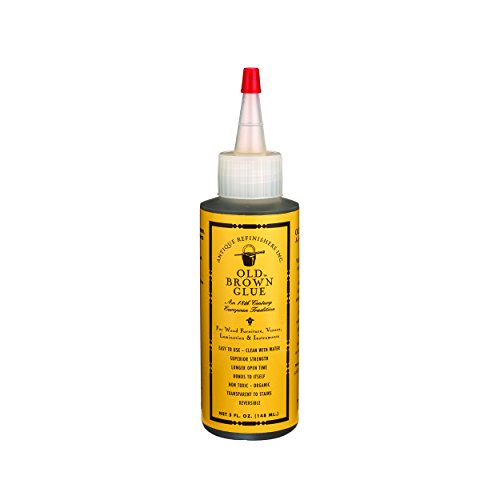
3. Old Brown Glue Self-Bonding Liquid Hide Glue
The old-world glue that can be undone with heat — a gift for restorers.
If you restore antiques or build instruments, this premixed liquid hide glue is the right tool. The adhesive quality is the top praise by a wide margin — and the specific power here is that hide glue bonds to itself. That means you do not have to scrape every last trace of old glue out of a joint before regluing; adding fresh Old Brown Glue reactivates the original and cures together. It is made from just two organic ingredients — hydrolyzed collagen and urea — so it is non-toxic.
The defining trade-off is the 30-minute open time and 24- to 48-hour full cure. That long working window is a blessing for complex marquetry but a test of patience if you want to move fast. The glue needs warming in hot water to reach 120-140°F before use, and the shelf life is limited to 24 months from manufacture — you will want to check the “best before” date on the bottle. Owners praise the spreadability and the ability to position pieces perfectly, but a few note the drying time takes longer than modern contact cements.
Why restorers love it
- Reversible with heat — future repairs mean steaming, not destroying the wood
- Self-bonding property lets you glue over old hide glue without full removal
- Non-toxic, organic ingredients safe for fine furniture and instruments
The reality check
- Requires warming to 120-140°F before use — not as simple as squeezing from a bottle
- Limited 24-month shelf life; must check the date on the bottle
Ideal for: antique restoration, instrument building, and any project where future reversibility matters as much as today’s bond.
Not for you if: you need instant assembly and no prep work — hide glue requires patience and a hot water bath.
4. DAP Weldwood Original Spray Adhesive Contact Cement
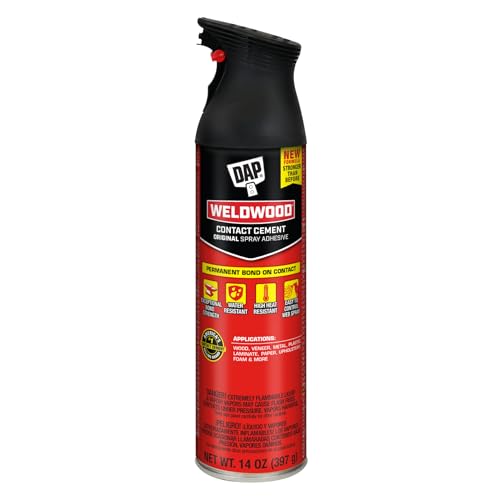
A web-spray formula that bonds on contact for fast-moving projects.
DAP Weldwood’s original spray uses a web pattern that grabs on contact, making it a solid pick for interior and exterior use. It covers up to 79 square feet per can at 1 gram per square foot, which is plenty for several laminating projects. Buyers report the bond is ready to press in just one to three minutes — far faster than liquid contact cement that needs time to dry. It works on wood, veneer, laminate, plastic, metal, foam, and upholstery, so it is a versatile can to have around.
The recurring operating note is the nozzle: if you do not invert the can and spray out the residue after each use, it clogs and requires thinner to clear. A few owners also report a bad experience where the adhesive never tacked properly, but the overwhelming majority say it does the job without stinking up the place. For exterior projects, it holds up to heat and water after the full 24-hour cure.
What stands out
- Bonds on contact in just 1-3 minutes — no waiting for tackiness
- 79 sq ft coverage per can delivers strong value for large surfaces
- Heat and water resistant after full cure for interior and exterior use
What to watch
- Nozzle clogs if you do not clear it after every use
- Spray pattern is not as consistent as the 3M 94 ET
Best for: quick laminating, upholstery, and outdoor projects where fast bonding is the priority.
Think twice if: you hate dealing with sticky nozzles — this one demands a clean-up habit.
5. Wonshine Contact Cement Adhesive (4.16 Oz)
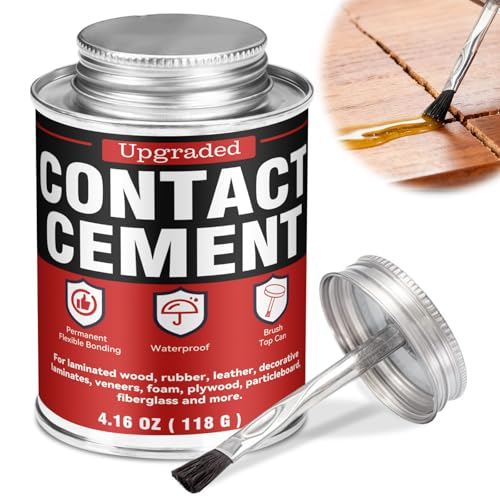
The small-bottle brush-tip that gets into tight corners without the mess.
For small repairs — lifting edge banding, fixing a laminate corner, or bonding a patch of veneer — this 4.16-ounce bottle with its built-in brush tip is exactly the right size. The specialized chloroprene formula stays flexible after curing, so it does not crack as the wood moves. One owner used it to fix a countertop laminate that had peeled repeatedly; after weeks of use, it held. The application is simple: brush on both surfaces, wait 10-15 minutes until tacky and glossy, then press together and let cure for 24 hours.
The honest concession is cost per ounce. A few owners point out the small bottle seems expensive compared to a quart of generic contact cement, but if you are the kind of maker who throws away half-used cans of glue after they harden, this smaller size actually saves money by eliminating waste. The formula resists water and heat, and works on wood, leather, laminate, veneer, foam, and fiberglass. Some owners found it stiffens inside the bottle as volatiles evaporate, but adding acetone revives it.
What owners love
- Built-in brush applies precisely in tight spots without drips
- Stays flexible after curing — ideal for wood veneer and laminates
- Small size means you use it all before it hardens in the bottle
The catch
- Higher price per ounce than bulk contact cements
- Contents can stiffen as volatiles escape; needs acetone to revive
Perfect for: quick edge-band repairs, craft projects, and anyone who hates wrestling with a giant can of glue.
pass on it if: you are laminating whole tabletops — you will burn through bottles too fast.
6. Bondtech Contact Cement Adhesive (4.16 Oz)
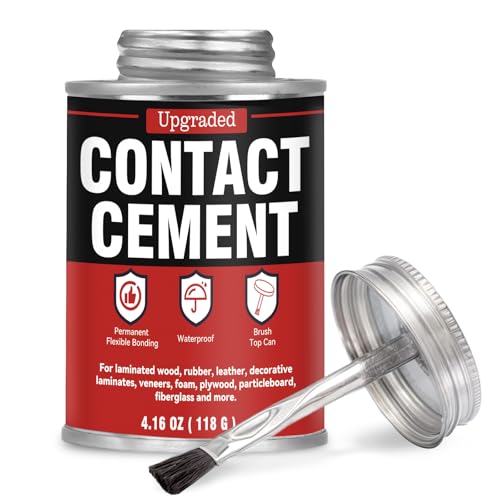
A brush-in-cap contact cement that stays soft after it dries.
Bondtech’s formula is built around one specific behavior that matters for veneer: it stays flexible after full drying. The neoprene-based adhesive does not turn into a stiff, brittle line — it moves with the substrate, which is essential when you are bonding thin wood veneer to a panel that will expand and contract. As buyers put it: the glue “stays flexible even after fully drying” and has a “nice soft texture.” It is waterproof and heat-resistant, so it works for laminates near sinks or in automotive interiors.
The 4.16-ounce can includes a built-in brush for controlled application in tight or delicate areas, and owners say it works well on wood, leather, foam, and fiberglass. The tensile strength is rated at 3,500 pounds. On the downside, the full cure time is 24 hours, and the 37 reviews mean the product is still relatively new in the market. The brush tip is convenient but smaller than a traditional applicator, so covering a large surface takes multiple dips.
What stands out
- Remains flexible after curing — no brittle cracking as wood moves
- Waterproof and heat-resistant formulation handles tough conditions
- Built-in brush keeps application clean and precise
One thing to note
- Smaller format is perfect for workshop touches but runs out fast on big projects
Reach for this if: you need a flexible, waterproof bond for leather repairs, furniture touch-ups, or small veneer patches.
Consider another option if: you are covering an entire kitchen countertop — you will want a larger can or spray format.
7. DAP Gel Original Contact Cement (Qt)

The gel that stands up on vertical surfaces without running.
When you are sticking veneer to a vertical face — a cabinet side, a riser, a wall panel — the last thing you need is liquid glue dripping down the workpiece. This quart-sized gel formula sits where you put it. The thickness makes it easy to apply with a chip brush, and owners consistently praise how the gel stays put and bonds permanently. The adhesive quality is the top praise by far, with owners saying it bonds heavy artist paper to chipboard without seepage and works for fine carpentry, leather, and DIY.
The full cure time is notably fast at 15 minutes — much quicker than the standard 24 hours. The adhesion quality does get mixed feedback from a subset of owners, who report that over a couple of weeks the bond can weaken if the surfaces were not perfectly clean. The odor is strong, so ventilation or a respirator is a real requirement. An occasional owner reports the can arriving with a damaged seal, and the viscosity can be too thick for brush application straight out of the can for some users.
Where it shines
- Gel consistency does not drip — ideal for vertical veneer applications
- Fast 15-minute cure time gets you moving quickly
- Bonds wood, particleboard, drywall, fabrics, and high-pressure laminates
One honest note
- Adhesion quality can be inconsistent if surfaces are not meticulously clean
Best for: vertical laminations, art mounting, and any job where gravity fights your glue.
Look elsewhere if: you hate working with strong solvents — the fumes here demand serious ventilation.
8. JAOJAO Contact Cement Adhesive (6 Oz)
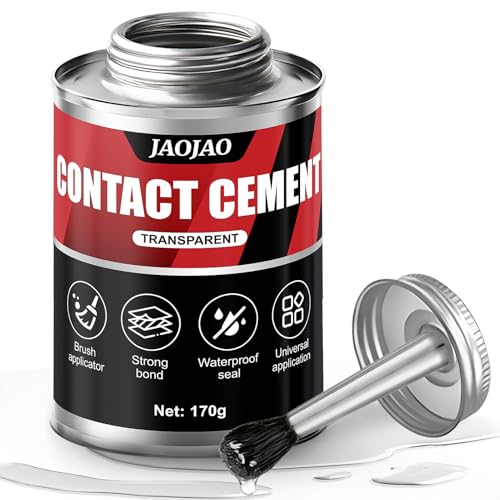
A 6-ounce can of universal contact cement that punches above its weight.
If you want one adhesive that handles wood, metal, plastic, rubber, leather, laminate, veneer, foam, and fiberglass without switching bottles, JAOJAO’s formula is the budget-friendly pick. It says it bonds to 15-plus materials, and the 177 ml can includes an integrated brush head for narrow gaps and curved surfaces. The fast drying means it hardens after 5 minutes, is ready to use after 2 hours, and fully cures in 24 hours. The bond resists temperatures up to 80°C and handles humidity, which matters for kitchen laminates and outdoor furniture.
The caveats are what you expect at this tier. A few cans arrived damaged — leaking in the shipping bag — and the product only has 20 ratings, so long-term data is thin. Owners who got a good can report it works as intended: “convenient size, glue works as intended” is the most common buyer verdict. For small DIY projects or one-off repairs, the cost-to-coverage ratio makes it an easy reach.
What makes it a value pick
- Bonds 15+ materials including wood, metal, plastic, leather, and veneer
- Integrated brush head for clean application in tight spots
- Heat-resistant up to 80°C, waterproof, and quick-drying
The honest trade-offs
- Some cans can arrive damaged or leaking from shipping
- Low product track record — only 20 ratings to go on
Snag this for: budget-minded DIY projects, mixed-material repairs, or keeping a versatile back-up glue in the drawer.
Not the best choice for: large-scale professional laminating where consistent can quality matters.
9. JNB Pro EVA Hot Melt Adhesive (5kg/11lbs)
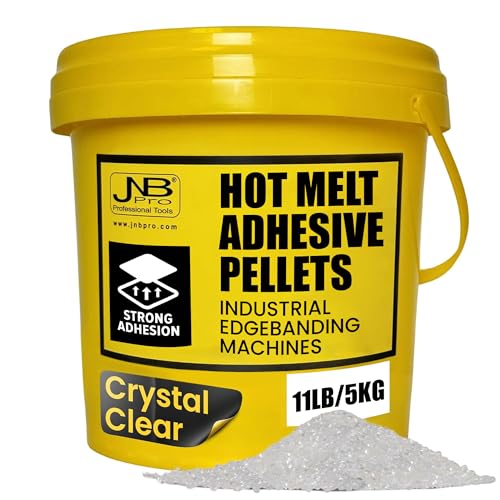
The bulk pellet that feeds an edge banding machine at 12+ meters per minute.
This 5-kilogram bag of crisp EVA (ethylene-vinyl acetate) pellets is for a very specific user: anyone with an automatic or manual edge banding machine. The adhesive cures in 20 to 30 seconds, has a viscosity (thickness) of 40,000-50,000 cps (centipoise) at 200°C, and delivers a tensile strength (how much pull it can take before breaking) of at least 12 megapascals. It is designed for running at speeds above 12 meters per minute, applying 180-250 grams per square meter of adhesive. The clarity means the bond line stays invisible against dark-colored edge bands.
Working temperature is critical — the formula softens at 90-100°C, works best between 160-210°C, and should never exceed 210°C. Owners running a small Jack Bond bander say it feeds well at approximately 180°C with good results. The glue works with PVC, ABS, acrylic, wood veneer, and melamine edge bands. The bulk bag format has a shelf life of up to 2 years when stored below 40°C. If you do not own an edge banding machine, this is not the right adhesive for you — it requires heat and pressure to work.
Where it delivers
- Ultra-fast 20-30 second cure keeps production moving
- crisp bond line stays invisible on dark edges
- Works with PVC, ABS, acrylic, and wood veneer on edge banders
The big caveat
- Requires an edge banding machine — no brush, no spray, no hand application
- Temperature-sensitive: must stay between 160-210°C during use
Perfect for: shop owners and cabinet makers running edge banding machines who need bulk, fast-curing pellets.
Not for you if: you are a hobbyist working by hand — this format relies on heat and machine pressure you do not have.
Understanding the Specs
Open Time & Working Window
This is how long you can adjust the veneer after applying the glue. Contact cement needs you to wait until it is tacky, then press — you cannot reposition after that. A long open time (like 60 minutes with some spray adhesives, or 30 minutes with hide glue) is what you want for large, intricate veneer patterns where alignment takes time. If you are edge-banding a single straight piece, a short open time is fine.
Flexibility & Reversibility
Wood expands and contracts with humidity. An adhesive that dries rigid will eventually crack or let go. Neoprene-based contact cements stay flexible after curing, which is why they are the standard for wood veneer. Hide glue is special because it is reversible — applying heat and steam loosens the bond, so you can repair a piece without destroying the wood. This is critical for antique restoration.
FAQ
Can I use regular wood glue PVA for veneer?
What is the difference between contact cement and spray adhesive for veneer?
How long does contact cement take to cure before I can sand the veneer?
Is spray adhesive strong enough for wood veneer countertops?
Can I use double-sided tape to glue wood veneer?
What does reverse reversible mean for hide glue?
Do I need an edge banding machine for hot melt adhesive pellets?
Will contact cement work on laminate over MDF?
How do I remove dried contact cement from my hands or tools?
Which adhesive is best for outdoor veneer projects?
Final Thoughts: The Verdict
If you want one dependable pick, the adhesive for wood veneer winner is the 3M Hi-Strength 94 ET because it gives you a 60-minute bonding range, aggressive tack, and low VOCs — the full package for large surfaces. If you value reversibility for antique work, grab the Old Brown Glue. And for quick edge-banding without liquid mess, the FastCap SpeedTape is the one to reach for. Pick the format that matches your machine, your workspace, and your patience for cleanup — every pick here is capable of holding veneer flat for years.
How We Picked
We do not accept paid placement. Every pick is matched to a real buyer and a real use-case; we do not hands-on test units.
Sources & Methodology
Specifications: manufacturer listings and product documentation. Review insights: verified customer reviews, as of July 2026. Pricing: not shown on this page (it changes often); check the current price via the retailer link.
As an Amazon Associate, Gadgets Feed earns from qualifying purchases. This does not affect which products we feature.