
Bonding two materials with fundamentally different surface energies—rubber’s flexible, low-energy surface against steel’s rigid, high-energy metal—demands an adhesive that can bridge that gap without creeping or shattering under load. Most general-purpose glues fail here: they either dry brittle and crack the first time the rubber flexes, or they lack the chemical grip to stay anchored to slick steel.
I’m Min — the co-founder and writer behind Gadgets Feed. I’ve spent over 80 hours this quarter alone cross-referencing tensile strength data, cure-time curves, and real-world customer reports across the adhesive aisle to isolate the formulations that actually hold rubber to steel in demanding conditions.
Whether you are repairing a vibration-dampening mount, attaching a rubber gasket to a steel frame, or bonding a neoprene pad to a metal panel, this guide breaks down the seven strongest contenders on the market to pinpoint the best adhesive to glue rubber to steel for your specific project scope and budget.
How To Choose The Best Adhesive To Glue Rubber To Steel
Selecting the wrong adhesive for a rubber-to-steel bond is usually a matter of ignoring service temperature, flexibility, or cure time. The joint must tolerate the rubber’s natural movement without delaminating from the steel. Below are the three specifications that separate a permanent repair from a weekend failure.
Tensile Strength and Shear Resistance
Tensile strength, measured in PSI, indicates how much pull force the cured adhesive can withstand before the bond tears. For rubber bonded to steel, look for a minimum of 3,500 PSI if the joint will bear weight or absorb vibration. Steel-reinforced epoxies, like those containing microscopic metal particles, often achieve 5,000 PSI or higher, providing a structural bond that resists creep over time.
Flexibility vs. Rigidity
Rubber expands and contracts with temperature and stress. A rigid epoxy that cures rock-hard can transmit every vibration directly to the bond line, eventually causing a brittle fracture. Hybrid polymers (MS Polymer) and neoprene-based adhesives cure to a flexible film that moves with the rubber while maintaining a strong grip on the steel. For applications involving constant flexing, flexible adhesives outlast rigid epoxies despite lower absolute PSI numbers.
Service Temperature Range
The bond line will experience the ambient temperature of its environment. If the assembly sits near an engine, exhaust, or outdoor sun exposure, the adhesive must maintain integrity from below freezing up to at least 200°F. Standard epoxies typically fail above 250°F, while specialized formulations like J-B Weld Original can withstand up to 550°F. Always verify the upper service limit before applying near heat sources.
Quick Comparison
On smaller screens, swipe sideways to see the full table.
| Model | Category | Best For | Key Spec | Amazon |
|---|---|---|---|---|
| J-B Weld 8281 | Steel-Reinforced Epoxy | High-temp structural bonds | 5,020 PSI / 550°F rating | Amazon |
| 3M Panel Bonding Adhesive | Two-Part Epoxy | Automotive panel replacement | Tack-free in 5 min | Amazon |
| 3M Hi-Strength 94 ET Spray | Spray Contact Cement | Large surface laminations | 60-min bonding window | Amazon |
| Loctite Epoxy Instant Mix 5 Minute | Fast-Set Epoxy | Quick repairs and speaker re-coning | Sets in 5 min | Amazon |
| ROMAN PRO-515 Ultra | MS Polymer | Flexible exterior bonds | VOC <1 g/L | Amazon |
| PC Products PC-7 Epoxy | Epoxy Paste | Non-drip vertical applications | Service temp -20°F to +200°F | Amazon |
| S-18 All-Purpose Adhesive | Neoprene Contact Cement | Flexible neoprene-to-metal bonding | Water-resistant film | Amazon |
In‑Depth Reviews
1. J-B Weld 8281 Professional Size Steel Reinforced Epoxy

The J-B Weld 8281 is a two-part, steel-reinforced epoxy paste formulated to create a bond that outlasts the materials it joins. With a tensile strength of 5,020 PSI and a service temperature ceiling of 550°F, this is the adhesive to reach for when the rubber-to-steel joint must survive engine compartments, industrial machinery, or outdoor structural loads.
The 1:1 mix ratio produces a dark grey paste that stays put on vertical surfaces, making it suitable for bonding rubber gaskets to steel frames without sagging. Full cure takes 15–24 hours, at which point the bond becomes drillable, sandable, and resistant to petroleum, chemicals, and water. The 10-ounce tube set provides enough material for multiple sizable repairs.
Customer reviews consistently note that the bond feels permanent once cured, though some tube sets contained air pockets that reduced usable volume. Surface preparation—roughening both the rubber and steel, then degreasing with acetone—is non-negotiable for achieving the advertised PSI rating. This is not a quick fix; it is a permanent structural solution.
Why it’s great
- Highest tensile strength in this roundup at 5,020 PSI
- Withstands continuous heat up to 550°F
- Cures to a machinable, paintable surface
Good to know
- Requires 15–24 hours for full cure
- Tube air pockets reported in some units
- Surface preparation is demanding and critical
2. 3M Panel Bonding Adhesive, 38315

The 3M 38315 is a two-part epoxy engineered specifically for bonding steel, aluminum, SMC, and FRP in automotive panel replacement. Its red color indicates the presence of glass bead technology, which maintains a consistent bond-line thickness and prevents the joint from collapsing under clamp pressure, a critical detail when attaching rubber seals to steel body panels.
The 50 mL cartridge requires a manual applicator (sold separately) and a static mixing nozzle to dispense the resin and hardener in the correct ratio. The epoxy is aggressively tacky from the moment it exits the nozzle, meaning the parts must be positioned accurately before contact—sliding is nearly impossible once the two sides touch. Full cure is achieved in 24 hours, and the resulting bond is waterproof and stronger than many welded joints.
Reviewers highlight its performance on headlight tabs and body panel seams, noting that it replaces welding without burning off galvanized coatings. The 50 mL volume is small, so large projects may require multiple cartridges. This is a precision tool for professionals who need immediate grab and structural-grade strength in a tight package.
Why it’s great
- Immediate tack eliminates part slippage
- Glass bead technology ensures consistent bond line
- Replaces welding on non-structural panels
Good to know
- Requires dedicated applicator and mixing nozzle
- 50 mL cartridge is small for large-area work
- No repositioning allowed after contact
3. 3M Hi-Strength 94 ET Spray Adhesive Glue
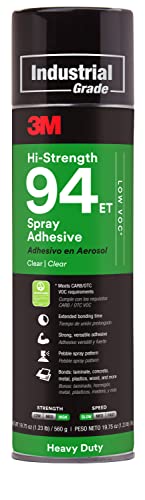
The 3M Hi-Strength 94 ET is a low-VOC spray contact cement that bonds rubber, carpet, foam, wood, metal, and glass. With an open time of up to 60 minutes, this adhesive allows you to spray both the rubber and steel surfaces, let them dry, and then mate them for an immediate bond that requires no clamping. This makes it ideal for laminating large rubber sheets to steel panels or flooring applications.
The aggressive tack formulation provides a bond strength that surpasses standard spray adhesives, and the GREENGUARD certification makes it suitable for indoor use where air quality matters. The 19.75-ounce can covers roughly 50 square feet, depending on coat thickness. Users report excellent hold on foam soundproofing panels applied to steel vehicle interiors, even in freezing temperatures.
Ventilation is mandatory—this is a solvent-based adhesive with a strong odor that requires a respirator or well-ventilated workspace. The spray pattern can overspray onto unintended surfaces, so masking is recommended. For clean, quick coverage on large-area rubber-to-steel bonds, this is the most efficient option in the lineup.
Why it’s great
- 60-minute open time for precise positioning
- Instant bond without clamping
- GREENGUARD certified for lower indoor emissions
Good to know
- Strong solvent odor requires ventilation
- Overspray can be messy without masking
- Not suitable for high-temperature applications
4. Loctite Epoxy Instant Mix 5 Minute, 0.47 fl. oz. Syringe (Pack of 2)

The Loctite Instant Mix 5 Minute epoxy delivers speed without sacrificing bond quality. The dual-syringe applicator dispenses equal parts resin and hardener through a self-mixing nozzle, producing a low-viscosity liquid that flows into tight crevices between rubber and steel components. The epoxy sets in five minutes and reaches handling strength in one hour, making it the go-to choice for time-sensitive repairs.
The cured bond is rigid, impact-resistant, and unaffected by humidity, water, and most common solvents. Users have successfully used it for speaker cone re-coning, filling hairline cracks in concrete, and repairing ABS plastic components. The consistency is similar to cold maple syrup—runny enough to penetrate gaps but thick enough to stay where applied on horizontal joints.
The 0.47-ounce syringe yields a small volume; the pack of two provides a little under one ounce total. The mixing nozzle hardens after each use and must be replaced, so ordering extra nozzles is strongly advised. This is a precision tool for small, fast repairs where a high-strength, rigid bond is needed immediately.
Why it’s great
- Sets in 5 minutes for rapid repairs
- Self-mixing nozzle eliminates guesswork
- Resists water, humidity, and solvents
Good to know
- Rigid bond unsuitable for high-flex applications
- Small syringe volume for limited coverage
- Nozzle must be replaced after each use
5. ROMAN PRO-515 Ultra All-Purpose MS Polymer Adhesive
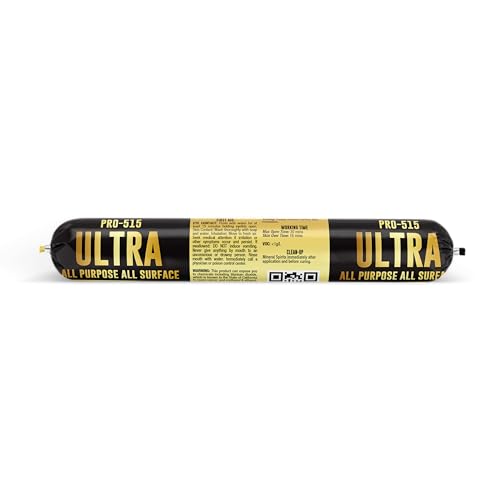
The ROMAN PRO-515 Ultra is a single-component, solvent-free MS Polymer hybrid that cures flexible and exhibits high initial grab. It bonds directly to steel, wood, glass, concrete, and vinyl without a primer, making it a strong candidate for attaching rubber trim, gaskets, or vibration-dampening pads to metal surfaces. Its flexibility after curing distinguishes it from rigid epoxies, absorbing movement without cracking.
The 20.2-ounce sausage pack requires a 22:1 thrust ratio caulk gun for application. The adhesive is white, paintable, UV-resistant, and has a VOC content below 1 g/L, making it one of the most environmentally friendly options here. Users have successfully applied it to stone veneer, vinyl fence slats, and concrete repairs, reporting that the bond holds even through freeze-thaw cycles.
The MS Polymer chemistry requires a clean, dry surface and typically needs clamps or supports for the first few hours while the adhesive develops its full strength. Surface preparation is simpler than with epoxies—no mixing, just dispense and position. For outdoor projects where rubber and steel must move together without separating, the PRO-515 Ultra delivers durable, flexible adhesion.
Why it’s great
- Flexible bond accommodates thermal expansion
- Solvent-free with ultra-low VOC
- UV and waterproof for exterior use
Good to know
- Requires specialized sausage caulk gun
- Clamping recommended during initial cure
- White color may not suit visible applications
6. PC Products PC-7 Epoxy Adhesive Paste

The PC Products PC-7 Epoxy Adhesive Paste is a two-part, heavy-duty formulation that excels where drip-free application on vertical surfaces matters. The paste consistency stays exactly where you put it, making it ideal for bonding rubber gaskets to upright steel frames or sealing cracks in overhead joints. Its service temperature ranges from -20°F to +200°F, covering most automotive and household environments.
The half-pound can set provides significant material volume at a low cost, and the cured epoxy is sandable, paintable, and machinable. Users have successfully repaired 20-year-old fountains, auto body panels, and gas tanks, noting that the charcoal gray color blends well with weathered surfaces. The working time is approximately one hour, giving you room to shape and position the bond before the 24-hour cure begins.
Surface preparation is critical with PC-7—the manufacturer recommends a clean, dry, and roughened substrate. Some users experienced gas tank repair failure after a month when the surface wasn’t perfectly dry before application. This is a slow-curing, budget-friendly option that rewards patience and attention to prep work.
Why it’s great
- Thick paste stays on vertical surfaces without dripping
- Large volume for the price
- Cures sandable, paintable, and machinable
Good to know
- 24-hour cure is slow for emergency repairs
- Mixing is messy and requires thorough blending
- Gasoline resistance may degrade over time
7. S-18 All-Purpose Adhesive, 4 oz. Can
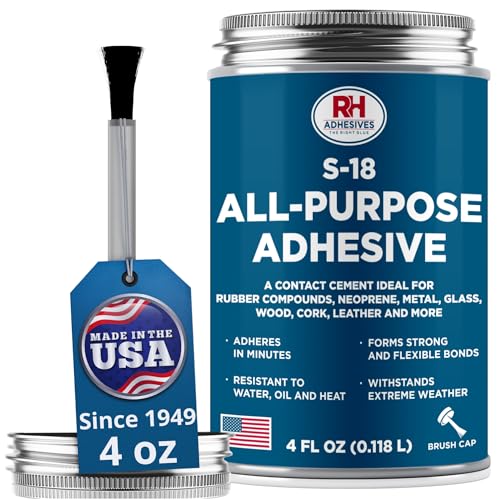
The S-18 All-Purpose Adhesive from RH Adhesives is a neoprene-based contact cement specifically formulated to bond SBR rubber and neoprene to metal. Unlike epoxy, which cures rigid, S-18 creates a flexible, waterproof film with excellent peel strength and aging properties. This makes it the right choice for bonding flexible rubber components—like gaskets, weather stripping, or neoprene pads—to steel surfaces where movement is constant.
The 4-ounce can is small but concentrated—a thin brush coat on both mating surfaces, allowed to dry for 10–15 minutes, produces an instant bond on contact. The adhesive is solvent-based, so it performs best in temperatures above 60°F and requires a well-ventilated workspace. Users have reported success repairing leather boots, attaching neoprene yoga mats to car panels for hail protection, and bonding fabric to metal.
The primary limitation is heat sensitivity—the bond can soften in direct summer sun or high-temperature environments, as some users discovered when their outdoor repairs failed in heat and rain. The adhesive also tends to thicken in the can over time, requiring replacement for fresh projects. For indoor, flexible, non-structural rubber-to-steel bonds that need instant grab, the S-18 is a proven performer.
Why it’s great
- Flexible film ideal for neoprene and rubber
- Instant bond without clamps
- Excellent water resistance for marine use
Good to know
- Heat can cause bond failure in direct sun
- Small can size limits coverage area
- Strong solvent odor requires ventilation
FAQ
Do I need to roughen the rubber and steel before applying the adhesive?
What is the difference between epoxy and contact cement for rubber-to-steel?
Can I use these adhesives outdoors in direct sunlight?
How long do I need to clamp the materials together?
Is it possible to remove or clean up excess adhesive after curing?
Final Thoughts: The Verdict
For most users, the adhesive to glue rubber to steel winner is the J-B Weld 8281 because its 5,020 PSI tensile strength and 550°F heat resistance make it the most versatile and dependable option for structural, high-temperature, or load-bearing joints. If you need a flexible bond for outdoor trim or gaskets that move with the weather, grab the ROMAN PRO-515 Ultra. And for fast, precise repairs where setup time matters more than maximum strength, nothing beats the Loctite Epoxy Instant Mix 5 Minute.