
Our readers keep the lights on and my morning glass full of iced black tea. As an Amazon Associate, I earn from qualifying purchases.
Specs are compiled from manufacturer listings and verified buyer reviews and can change over time — please confirm the key details on the product page before buying.
If your hands go numb twenty minutes into every ride, you do not need a new bike — you need a different stem angle. An adjustable bike stem is the cheapest fix in cycling: it raises and swings your handlebars so you sit more upright, and you can dial the angle yourself with a hex key (an L-shaped tool for turning bolts) instead of buying bars, risers, or a whole new frame. The tricky part is clamping diameter and steerer size (the clamp is the part that grips your handlebar; the steerer is the tube that connects your fork to the frame), because a stem that does not match your bike simply will not bolt on.
I’m Min — the founder and writer behind Gadgets Feed. This guide is built by comparing the manufacturers’ published specifications and the patterns across verified customer reviews, so you get each pick’s real strengths and trade-offs instead of marketing spin.
Below you will find nine stems sorted into value and premium tiers, each with the clamp size, angle range, and length spelled out so you can match your bike before you order. The right pick depends on measuring your bar diameter, your steerer, and how much rise you actually want from the best adjustable bike stem.
Our Picks at a Glance

How To Choose The Best Adjustable Bike Stem
An adjustable stem is the one part on your bike that lets you change your riding posture without touching the frame, the bars, or the fork. Get the fit numbers right and it transforms how the bike feels in an afternoon. Get them wrong and it will not clamp on at all. Three measurements decide everything, and all three are printed on the stem listings you are comparing.
Match the handlebar clamp diameter first
The clamp diameter is the measurement of the tube it wraps around — most modern bikes use 31.8mm, and a 25.4mm bar needs a shim (a thin sleeve that pads the smaller bar up to the clamp size). Order a 31.8mm clamp for a 25.4mm bar and it will rattle; order a 25.4mm clamp for a 31.8mm bar and it will not close. You need to measure the actual bar, not guess from the bike brand.
Then confirm your steerer type
The steerer is the fork tube the stem slides onto. Most bikes built in the last two decades use a threadless 1-1/8″ steerer, where the stem clamps around the outside of the tube. Older and cruiser-style bikes often use a quill stem, which drops down inside the steerer and tightens with a wedge bolt. The two types are not interchangeable, so check which one your bike has before anything else.
Finally, pick your angle range and length
Angle range is how far the stem can swing the bars up or down — a 0–60° stem covers most comfort adjustments, while a 120° stem swings much further for a dramatic upright position. Length is the reach from the steerer to the bar clamp, and it sets how far forward you lean. Shorter lengths bring the bars back toward you for a more upright ride; longer lengths stretch you out for stability at speed.
Quick Comparison
| Model | Best For | Clamp / Steerer | Angle Range | Weight | Amazon |
|---|---|---|---|---|---|
| Ritchey Adjustable 4-Axis★ Best Overall | Everyday road and gravel riding | 31.8mm / 1-1/8″ | +/-55° | 228g | Amazon |
| Wake Bike StemBudget Champion | Trying out bar positions cheaply | 31.8mm / 1-1/8″ | 0-60° | — | Amazon |
| LUNJE XT-A822Most Versatile | Mixed road, MTB, and city bikes | 31.8mm / 28.6mm | +/-120° | 310g | Amazon |
| CYSKY Universal | Bikes with either bar diameter | 31.8mm & 25.4mm / 28.6mm | -90° to +90° | 353g | Amazon |
| FOMTOR 31.8mm | E-bike upright conversions | 31.8mm / 28.6mm | 0-90° | 398g | Amazon |
| GEWAGE 130 Degree | Gravel and commuter comfort | 31.8mm / 28.6mm | -40° to +90° | 320g | Amazon |
| Sunlite Adjustable Quill | Cruisers and older quill-steerer bikes | Quill / 1″ forks | 0-60° | 15.04 oz | Amazon |
| FIFTY-FIFTY 110mm | Hybrid and trail riders | 31.8mm / 28.6mm | 0-60° | — | Amazon |
| Ritchey Comp 4-Axis 30D | Road riders chasing a fit fix | 31.8mm / 1-1/8″ | +/-30° | 136g | Amazon |
In‑Depth Reviews
1. Ritchey Adjustable 4-Axis Bike Stem 31.8mm Clamp 1-1/8″ Steerer Alloy
Our pick — over 4.5★ from 450+ verified ratings; the strongest balance of quality and price.
The forged, two-bolt stem that holds its angle and never creaks — 228g of quiet confidence.
If you ride 10 miles three times a week and want to stop fighting your wrists, this is the one. Ritchey’s 4-Axis uses a forged 6061 alloy shaft (a strong aluminum mix shaped under pressure) with a precision broached clamp (cut to grip your bar tightly), and it weighs 228g in the 105mm length. That weight matters because it puts this stem in the same conversation as fixed stems rather than the chunky adjustable crowd — the LUNJE 31.8mm sits at 310g and the FOMTOR at 398g, so this one saves real grams without giving up the swing.
The +/-55° range (how far the stem can tilt up or down) lets you dial in bar height and riding position without swapping stems or re-stacking spacers (the rings that set handlebar height). Corrosion-resistant stainless bolts and a BB black finish keep it working through all-weather riding, and the two-bolt pivot (the joint that lets the stem swing) is the difference-maker: as the review pages sum it up, “Two-screw adjustable stem prevents wiggle.” Buyers report the stem stays locked on 10-mile rides three times a week over months, and one bought a second 120mm unit for another bike.
The catch is adjustment speed, not stability. The pivot is secured by two hex bolts, and to move the angle you also need to loosen the fork bolts — so this is a set-it-once stem, not something you re-angle at a stoplight. Gravel riders who fixed a pinched nerve with this stem called it “very high quality, secure, and easy to install.” The measured 105mm length also sits 25mm shorter than the LUNJE’s 130mm, so if you want maximum rearward reach, size up.
What Riders Keep Talking About
- Forged 6061 alloy with stainless steel bolts holds up to all-weather riding
- +/-55° angle range fixes bar height without buying new bars or spacers
- Two-bolt pivot clamp stays locked and silent — no wiggle, no creaking
- 228g in the 105mm length keeps it close to fixed-stem weight
Where It Asks For Patience
- Adjusting the angle means loosening fork bolts too — not a quick roadside change
- 105mm length leaves you shorter on rearward reach than a 130mm stem
Ride this if: you want a permanent fit correction on a road, gravel, or mountain bike and value a clamp that never slips.
Set it once: if you like re-angling your bars mid-ride, this is not that stem — the two-bolt setup is built to stay put.
2. Wake Bike Stem 25.4 / 31.8mm 0-60 Degree Adjustable Stem
The rigid, two-arm value pick for finding your bar position before committing to a fixed stem.
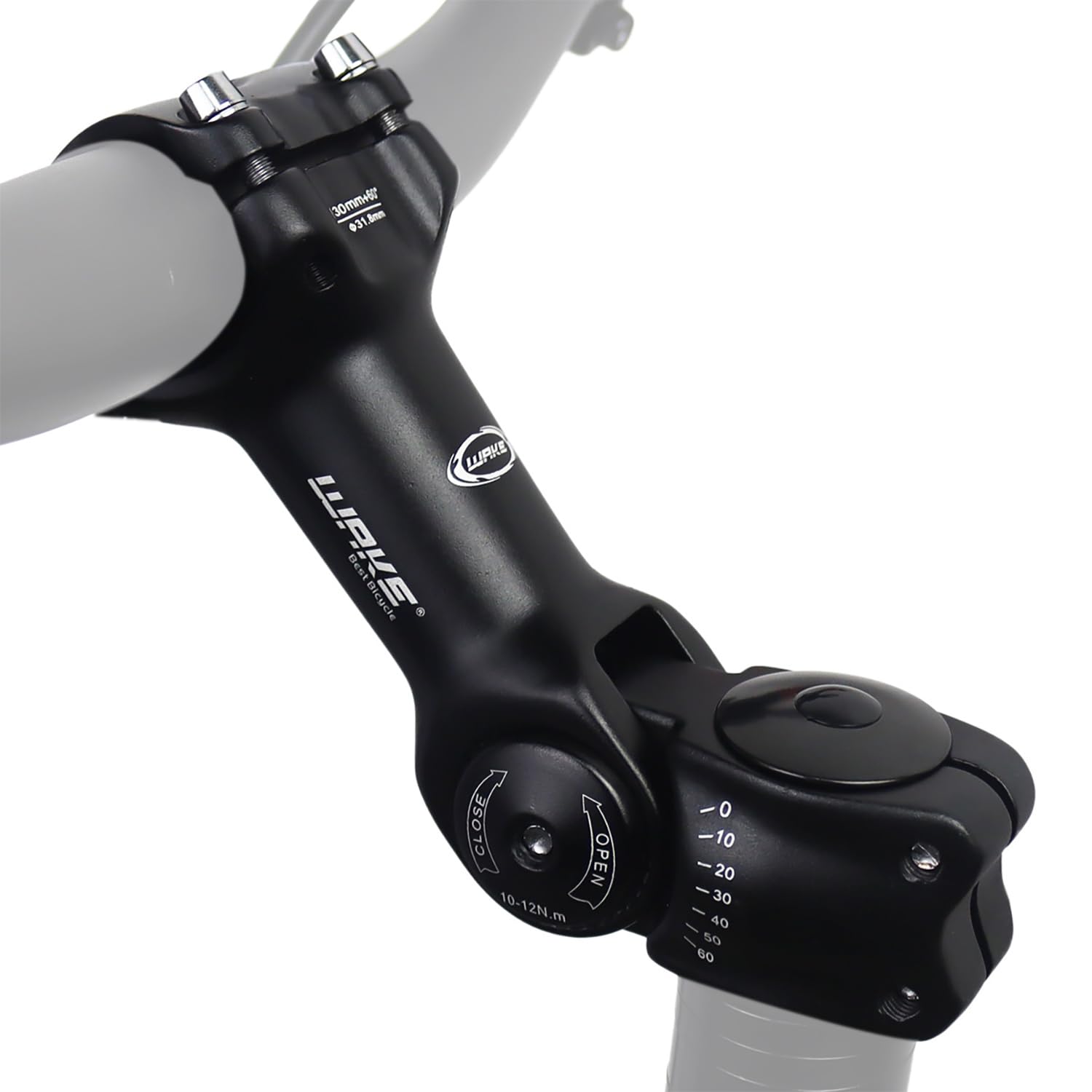
Riders who want to experiment with bar fit without spending much should start here. The Wake stem is CNC machined from 6061 T6 aluminum alloy and offers a 0-60° adjustable angle with a four-screw bar clamp. It fits a range of bikes — mountain, road, MTB, and BMX. What wins people over is the rigidity: the two-arm skeleton design resists the twist and flex that plagues cheaper adjustable stems.
Owners mention it “put my bars in a perfect position to fix shoulder pain for a more upright position.” One rider completed a first half century (a 50-mile ride) the week after installing it with no problems since. Another described it as “much more rigid than the other adjustable stem Wake makes.” The trick to a clean install is to torque the top cap (tighten the bolt that holds the stem to the fork) until it feels stiff, then back off a fraction, use anti-seize on the bolts, and leave a few millimeters of gap between the steerer and the headset cap or add a spacer.
Here is the honest trade-off. This stem is built for dialing in a fit, not for abusing it on descents. A recurring note is that the clamp bolts can loosen over time, so check them periodically and swap to a solid stem once you have found your position. It is also not recommended for downhill or aggressive trail riding. For the money you spend on adjustment ability, this is the value benchmark in the group — it costs well under half of what the Ritchey command.
The fit-lab pick: a cheap way to answer “how upright do I actually want to sit?” before you buy anything permanent.
Then move on: once your position is locked, a fixed stem removes the bolt-loosening variable entirely.
Start here if: you are still figuring out your reach and angle and do not want to commit serious money yet.
Look past it if: you need a stem for downhill or hard trail riding, where the shifting clamp bolts and lighter build are the wrong fit.
3. LUNJE Adjustable Bike Stem 31.8mm, 120° Angle, 130mm
A 120° swing and four length options make this the stem that fits almost any bike you own.
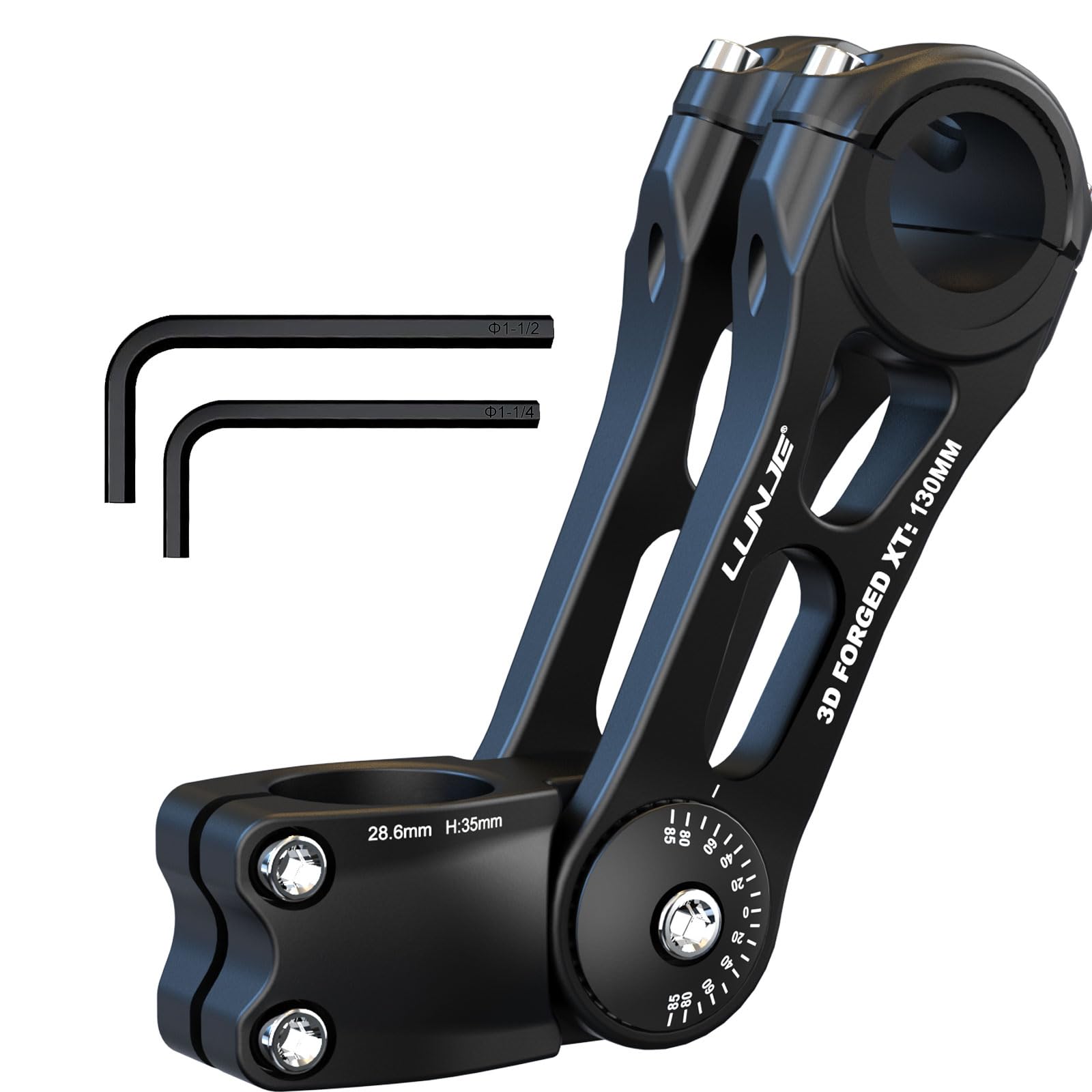
The headline here is range. Where the Ritchey 4-Axis offers +/-55° of adjustment and the GEWAGE 130 Degree spans -40° to +90°, this LUNJE stem swings across +/-120°. That extra travel means you can go from an aggressive, forward MTB position to a fully upright city-bike posture without buying a second stem. The 130mm length gives you a longer reach than the Ritchey’s 105mm — 25mm more — so the bars sit further out for stability at speed.
It is built from 6061-T6 forged CNC aluminum and ships with two hexagonal wrenches. The 31.8mm bar clamp pairs with a 28.6mm (1-1/8″) front fork steerer, and the anti-slip grip is designed to reduce hand fatigue on long rides. Buyers appreciate the easy install — “Work great” is the short version — and the adjustable part earns credit for making rides more comfortable. The quality and adjustability lead the feedback, which is what you want from a stem holding your bars at speed.
The one honest knock is weight. At 310g it is noticeably heavier than the 228g Ritchey, and a weekend rider noted “some cyclists might feel it is on the heavy side” while shrugging it off for casual use. Also worth knowing before you order: more than one rider wished they had chosen the 145mm length instead of a shorter one for a higher handlebar, so think about how much rise you want before you pick a size.
Best for multi-bike households: the huge 120° swing and four length choices make it the easiest stem to move between a city bike, a road bike, and an MTB.
Weigh the trade: if saving grams matters to you more than angle range, the lighter Ritchey is the better call.
4. CYSKY Bike Stem Universal 31.8mm and 25.4mm, ±90 Degree, 145mm

The universal clamp that handles both common bar sizes straight from the start.
Most stems in this group force you to pick a clamp diameter and live with it. This CYSKY does both. The clamp fits a 31.8mm bar directly, and it ships with a built-in shim that also lets it grip a 25.4mm bar, plus a 28.6mm (1-1/8″) front fork steerer. That flexibility matters if you own two bikes with different bar sizes, or if you are not sure what you have. The -90° to +90° angle range is broad enough that customers note it “can be adjusted to nearly vertical.”
The 145mm length and 3D-forged aluminum alloy body (shaped under pressure for strength) resist deformation and rust, and the included shim (a thin sleeve that lets the clamp fit a smaller bar) is the detail that tipped the decision for some riders. As one put it, “The sleeve provided for a smaller diameter handlebar made the extra cost worthwhile.” The quality and adjustability lead the owner feedback by a wide margin, and it clamps cleanly against 25.4mm bars with no squeaks or vibration. It is a direct-fit for road, mountain, downhill, track, and BMX frames.
At 353g it is the heaviest stem in the top half of this list, and that weight is the price of the universal clamp and the wide angle travel. Unlike the LUNJE above, which tops out at 130mm of rearward reach, this one runs a full 145mm, so it swings the bars back furthest for a very upright posture. A couple of riders converting older mountain bikes into cruisers noted they needed extra fork spacers, so pick those up alongside the stem.
Why It Wins For Mixed Stables
- Fits 31.8mm and 25.4mm bars via the included shim — no second stem needed
- -90° to +90° range can swing bars nearly vertical
- 145mm length delivers the longest rearward reach on this list
- 3D-forged alloy resists paint loss, deformation, and rust
What To Expect
- Heavy at 353g compared to forged equivalents around 228g
- Converting a mountain bike to cruiser posture usually needs extra fork spacers
Pick it if: your collection mixes bar diameters, or you simply do not want to buy a shim on top of the stem.
Pass if: you ride competitively and cannot spare the extra grams over a lighter forged stem.
5. FOMTOR 31.8mm Adjustable Stem 0-90 Degree, 110mm

The e-bike comfort converter: a 0-90° stem that stands your handlebars up and lets you stop leaning on your wrists.
If you ride an electric bike with drop-style bars and your back is tired of the racer crouch, this FOMTOR is the known fix. It fits a 31.8mm handlebar and a 28.6mm fork steerer, runs 110mm long, and offers a 0-90° angle with a maximum height extension of 150mm. That upright conversion is what this stem is built for, and reviewers point out it works especially well on FLX Babymaker e-bikes.
The construction is CNC-machined 6061 T6 aluminum alloy at 396g and it installs easily with a hex wrench. One thing owners run into: adjusting the angle means loosening the bottom screws and pulling out the black button first, then loosening the left and right pivot screws. It is a specific sequence, and skipping it is why some first-timers find the pivot stiff at first. Once seated, it raises the handlebars to a comfortable upright position, which is the whole point.
Two honest caveats. At 396g this is the heaviest stem here — a rider noted it feels “extremely heavy” compared to lighter options. And the 90° upright posture often runs into limits: on several e-bike installs, the factory front brake cable was too short once the bars went up, and headlight mounts did not line back up. Budget for a cable swap and a custom bracket if you are doing the full conversion.
The e-bike answer: a proven way to raise the bars on a commuter e-bike and take pressure off your wrists and back.
Plan the install: the upright angle usually needs a longer brake cable and a headlight workaround that the stem itself will not solve.
It suits you if: you want upright comfort on an e-bike or fitness hybrid and you are fine doing a little cable rerouting.
skip it if: you want a no-fuss bolt-on that needs no other parts — the cable length is the snag here.
6. GEWAGE Bike Stem 130 Degree Adjustable, 95mm
A rock-solid forged stem with a deep fore-aft pivot that sits about two inches taller than most.
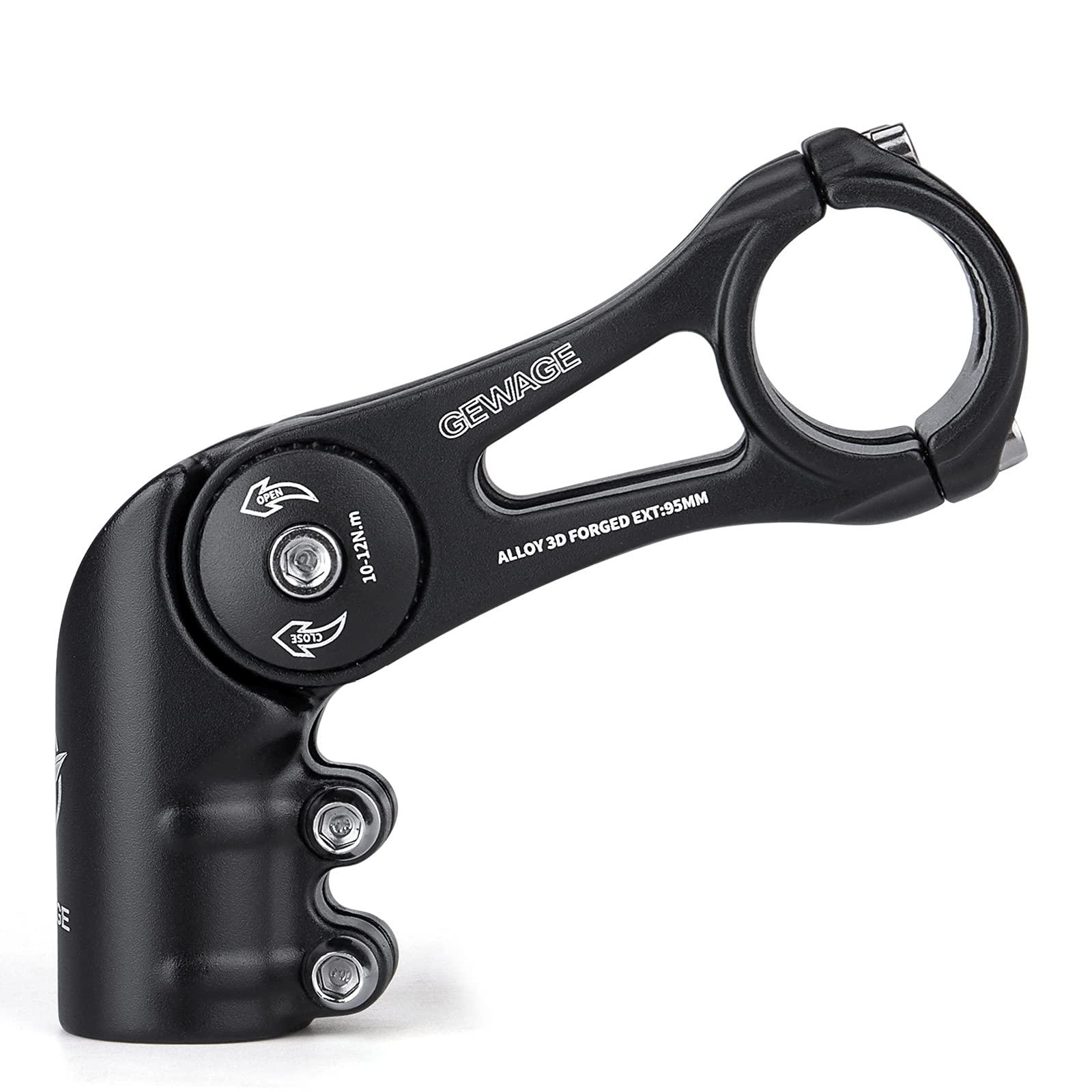
Gravel riders who want a raised, comfortable bar position without giving up a planted front end should look here. The GEWAGE is a 3D forged alloy stem at 320g with a -40° to +90° range and a four-bolt bar clamp. The distinguishing detail is the pivot design: the top pivot gives you more fore-and-aft adjustment than a typical stem, and the middle size sits around two inches taller than common designs. That combination lets you lift your bars without the cheap-stem wobble.
Owners riding it on gravel frames describe it as “very solid” — one kept it installed rather than swapping back to a fixed stem. It fits a 31.8mm bar and a 28.6mm steerer, and the matte black finish wipes clean easily. Owners describe a more upright posture that takes strain off the lower back.
Two things to keep in mind. On a drop-bar setup (curved handlebars for road riding), the two-piece arm can develop slight play when tightened, which riders say is fine on road and gravel but not rigid enough for hard MTB use. And because the stem itself adds about an inch of rise regardless of the adjustment, you may need to measure from the top of your shim stack to your desired bar center before you order so the height lands where you want it.
Reach for this if: you want a gravel or commuter stem with deep fore-aft adjustability and a bar height that sits naturally higher.
Look elsewhere if: you plan hard trail or downhill riding where the two-piece arm’s slight play will show up.
7. Sunlite Adjustable Quill Stem

The one stem here built for old-school quill steerers — and cruisers that need a big lift.
Every other stem on this list is a threadless clamp that slides onto the outside of the fork. This Sunlite is the exception: it is a quill stem, which drops down inside the steerer and tightens with a wedge. That means it only fits bikes with internal-quill steerers, mostly cruisers and older city bikes. It is forged alloy with a 180mm quill length, a 0-60° adjustable angle, and a claimed 15.04 oz weight, and it carries an EN CITY safety certification.
The 180mm quill (the long tube that slides into the fork) is what makes it special: it is the longest adjustable quill in this group, and the adjustability is what owners prize most. Riders report it fits 1″ forks tightly and raises the bars closer for an upright, comfortable posture, with one calling it “well made and I could easily set it up.” Owners have used it to revive 32-year-old mountain bikes and dial in Schwinn cruisers and Electra Townies, where the long quill lifts the bars far higher than a stock stem.
There is a build quirk to know about. Because the pivot sits high on the quill, on some frames you cannot check the main fork bolt once it is raised, and the horizontal pivot bolt is capped so it is not easily torqued. A few riders describe a slight side-to-side wobble under hard pressure on butterfly-style bars. On standard drop and cruiser bars it holds steady — just match it to the right bar shape.
Why Cruiser Owners Love It
- 180mm quill length delivers a big, adjustable lift for old cruisers and city bikes
- Fits 1″ quill steerers tightly and installs simply
- Forged alloy build with EN CITY safety certification
Rolling On Older Frames
- Quill design only fits internal-steerer bikes — not threadless frames
- Some riders note slight side-to-side wobble when paired with butterfly bars
Made for you if: you ride a cruiser, city bike, or vintage frame with a 1″ quill steerer and want a tall, easy bar lift.
Wrong tool if: your bike uses a modern threadless fork — this stem physically will not go in.
8. FIFTY-FIFTY Adjustable Bike Stem 0-60 Degree, 110mm

A simple, sturdy 0-60° riser with pre-lubed bolts that makes an upright ride an easy swap.
Hybrid and trail riders who just want to sit up straighter should consider this FIFTY-FIFTY. It is a CNC-machined 6061 T6 aluminum stem at 110mm, with a 0-60° adjustable angle, a 31.8mm bar clamp, and a 28.6mm steerer fit. It ships with two hex keys, and the bolts come pre-lubricated so installation goes smoothly the first time.
The 0-60° range covers the everyday comfort adjustments — enough to raise the bars and pull them back toward you so you are not reaching so far forward. It works with mountain bikes, road bikes, hybrids, e-bikes, and more. Riders installing it call it “a back saver” and “good quality, nice fit.” The simplicity is the appeal: no shims, no universal clamp, just a clean fit that raises your bars.
The main limitation is at the base. The pivot is fixed at the bottom, so if your main reach problem is front-to-back rather than height, this stem gives you less adjustment room than the GEWAGE or LUNJE. It also has a smaller owner base than the bigger picks here, so you are relying more on the design than on a deep track record. Still, it is a straightforward, well-built riser for riders who want a modest, reliable bar lift.
Good match if: you ride a hybrid or trail bike and want a simple, low-hassle stem to raise your bars for a comfier position.
Not ideal if: your reach problem is horizontal rather than vertical — the fixed base limits how far back you can bring the bars.
9. Ritchey Comp 4-Axis 30D Adjustable Stem, 80mm
The lightweight fit corrector: flip the 30° body to raise or drop your bars in under 15 minutes.
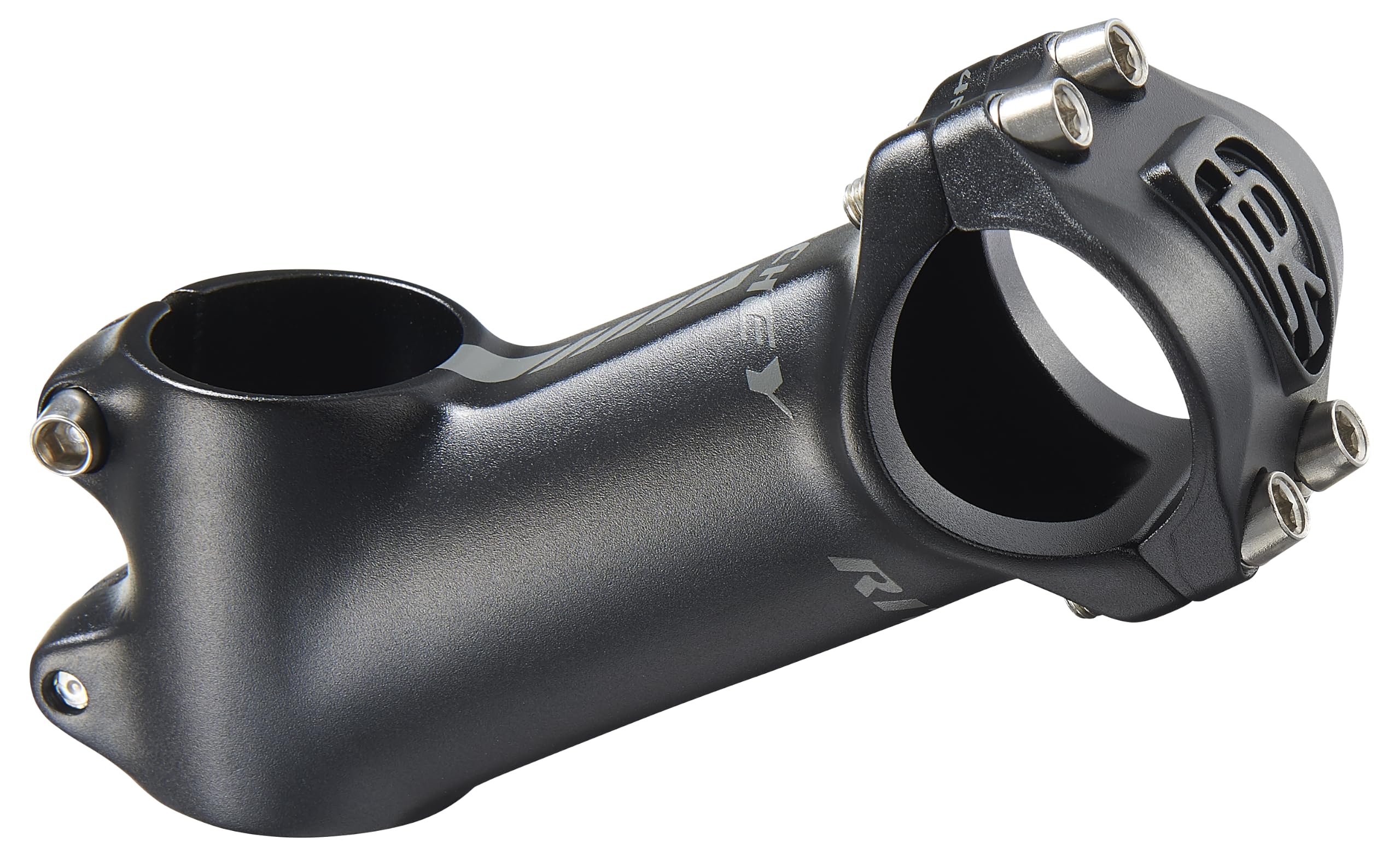
Road riders chasing a small, precise fit change will get the most from this Ritchey Comp. It is the lightest stem in this whole group at a claimed 136g, built from 3D net forged 6061 aluminum with stainless steel bolts. The 80mm reach suits smaller frames or shorter fits, and the +/-30° body flips to raise or lower your bars dramatically without changing spacers or bars. That flip-and-fit approach is why people buy it — it solves neck and shoulder pain from an over-stretched position.
Unlike the standalone Ritchey 4-Axis above with its +/-55° two-bolt pivot, this Comp tier uses a smaller +/-30° range and a lighter build, which is why it weighs so much less. It fits a 31.8mm bar with a 40mm-wide clamp, comes in a BB black finish, and includes a matching top cap. Shoppers say a solid four-axis clamp, improved handling, and an easy install that takes under 15 minutes with a torque wrench.
The honest limit is one of finish and range: a couple of riders note the matte black finish scratches easily, and the +/-30° swing is modest — this is a fit-fixer, not a full upright converter. If you need a dramatic change in bar height, the higher-angle Ritchey 4-Axis or the LUNJE is the better tool. For subtle, permanent tweaks, this is the lightest and cleanest option here.
Made for small corrections: a 136g stem that nudges your bars up or down a modest amount with a clean forged look.
Know your ceiling: at +/-30° it will not turn a race bike into a cruiser — that job belongs to a wider-angle stem.
Choose this if: you want the lightest, cleanest fit correction for a road bike and only need a small bar-height change.
Skip if: you need a big, dramatic lift, where the wider-angle stems in this list do the job better.
Understanding the Specs
Clamp Diameter & Steerer Size
Two numbers decide whether a stem physically fits your bike. The clamp diameter is the measurement around your handlebar — 31.8mm is the modern standard, and a 25.4mm bar needs a shim (a thin sleeve) to pad it up to the clamp. The steerer size is the fork tube the stem grips: most bikes use a threadless 1-1/8″ steerer, while older cruisers use an internal quill steerer that needs a quill stem like the Sunlite. Match both and the stem bolts on; miss either and it will not fit, no matter how good the angle range is.
Angle Range & Length
Angle range is how far the stem can swing your bars up or down — a 0-60° stem covers everyday comfort adjustments, while a +/-120° stem can swing bars nearly vertical for a fully upright ride. Length is the reach from the steerer to the bar clamp: a 145mm stem brings the bars back furthest, while a shorter 80mm or 90mm stem keeps you more stretched out. Together, angle and length set your actual riding posture, so check both before you buy rather than guessing from the bike brand.
FAQ
Will an adjustable stem fit my bike if I do not know my handlebar size?
What angle range do I actually need to sit more upright?
Can I install an adjustable stem myself without a bike shop?
Is an adjustable stem safe compared to a fixed stem?
Do adjustable stem bolts loosen over time?
Will an adjustable stem raise my handlebars high enough?
Do I need a shim or adapter for a smaller handlebar diameter?
How much weight does an adjustable stem add to my bike?
Can an adjustable stem help with wrist or neck pain while riding?
How do I switch an adjustable stem back to a fixed stem later?
Final Thoughts: The Verdict
For most riders, the adjustable bike stem winner is the Ritchey Adjustable 4-Axis because its forged two-bolt pivot stays locked and silent, it weighs just 228g in the 105mm length, and the +/-55° range fixes bar height without new bars or spacers. If you want a stem that swings your bars nearly vertical and fits almost any bike in your garage, grab the LUNJE 31.8mm with its +/-120° range. And for cruiser and vintage frames with a 1″ quill steerer, the Sunlite Adjustable Quill Stem is the one to reach for. Whichever you pick, measure your handlebar clamp diameter and your steerer type before you order — that is the whole game with an adjustable stem.
How We Picked
We do not accept paid placement. Every pick is matched to a real buyer and a real use-case; we do not hands-on test units.
Sources & Methodology
Specifications: manufacturer listings and product documentation. Review insights: verified customer reviews, as of September 2026. Pricing: not shown on this page (it changes often); check the current price via the retailer link.
As an Amazon Associate, Gadgets Feed earns from qualifying purchases. This does not affect which products we feature.