
Our readers keep the lights on and my morning glass full of iced black tea. As an Amazon Associate, I earn from qualifying purchases.
Specs are compiled from manufacturer listings and verified buyer reviews and can change over time — please confirm the key details on the product page before buying.
A wobbly mic stand is the fastest way to ruin a take, a stream, or a live set. Each pick below solves the two problems that matter: holding your mic firmly at the set height and angle, and staying upright when you reach for it. You will find floor tripods, weighted-base booms, and low-profile desk arms that fit everything from heavy broadcast mics to compact USB mics.
I’m Min — the founder and writer behind Gadgets Feed. This guide is built by comparing the manufacturers’ published specifications and the patterns across verified customer reviews, so you get each pick’s real strengths and trade-offs instead of marketing spin.
Whether you sing standing, podcast at a desk, or mic a drum kit, these picks cover every setup. This is your practical rundown of the best adjustable microphone stands for stability, reach, and daily use.
Our Picks at a Glance

How To Choose The Best Adjustable Microphone Stand
Buying a mic stand is about matching its height range and base weight to your actual use case. A desk podcaster needs a completely different stand than someone miking a guitar amp on stage. Start with where it will live, then check the height range and base weight specs.
Height range and boom reach
A floor stand for standing singers needs to reach roughly eye level, while a desk stand only needs a few inches of travel. The maximum height number tells you the ceiling, but the boom arm is what gives you horizontal reach over a drum kit or amp. If you sing sitting down, look for a stand with a low minimum height so the mic can drop to your mouth.
Base style: tripod versus weighted round
Tripod legs fold flat for transport but can get in the way in tight spaces. A weighted round or square base takes up less floor area and usually holds heavier mics without tipping, but it travels less easily. The trade-off is portability versus stability, so decide if the stand stays in one room or travels to gigs.
Thread size and mic clip compatibility
Most mics screw onto a standard 5/8-inch thread, but some USB and compact models use 3/8-inch. Many stands ship with adapters so both fit. Check the included components before you order, because a missing adapter means your mic won’t mount at all. The mic clip itself is often sold separately, so read the package list carefully.
Quick Comparison
| Model | Best For | Max Height | Base Type | Weight | Amazon |
|---|---|---|---|---|---|
| K&M 21090★ Best Overall | Professional floor use | 63 inches | Tripod | 7.2 lbs | Amazon |
| FIFINE BS1Best Value | Desktop stability | 8.26 inches | Flat weighted | 1.3 lbs | Amazon |
| AxcessAbles ShortBest for Drums | Drums and amps | 28.5 inches | Collapsible tripod | 1.47 kg | Amazon |
| InnoGear Gooseneck | Singing and instruments | 70 inches | Weighted round | 6.6 lbs | Amazon |
| InnoGear Desk | Heavy desk mics | 15 inches | Flat weighted | 1.53 kg | Amazon |
| Oimlfus Floor Boom | Broadcast and podcast | 67.7 inches | Weighted square | 4.5 kg | Amazon |
| Hercules MS432B | Studio and stage | 147.5 cm | Die-cast tripod | 5.2 lbs | Amazon |
| Aokeo AK-58i | Low-profile desktop | 30 cm | Flat clamp | — | Amazon |
| Gator GFW-MIC-1201 | Studio and broadcast | 63 inches | Pedestal weighted | 11.3 lbs | Amazon |
In‑Depth Reviews
1. K&M König & Meyer 21090
Our pick — over 4.5★ from 800+ verified ratings; the strongest balance of quality and price.
The German-built floor stand that refuses to sag under heavy mics.
This is the stand people upgrade to after live shows and cheap tripods fail them. Made in Germany with a stainless steel body and zinc and rubber parts, it is the heaviest floor option here at 7.2 pounds, and that weight is what keeps it planted. The telescoping 2-piece boom arm extends to a full 63 inches, which is a 7.6x taller ceiling than the compact FIFINE desk stand that reaches 8.26 inches.
Durability is the trait every owner lands on. Buyers report the boom locks firmly and stays nearly immovable until you loosen it, so a heavy condenser mic or even an iPad on a holder won’t tip the stand over. It is tall enough for choir and band work, and one owner bought three more after the first one impressed them.
A 5-year product warranty and 10-year replacement-parts availability back the build, which explains the premium positioning. The value-for-money feedback is mixed, meaning some find the price steep, but the construction quality is consistently praised. If you need one stand that survives years of gigs and studio sessions, this is it.
What wins people over: durability and build quality are the two most-mentioned strengths, and the stability follows close behind, making this the safest long-term buy.
The honest trade-off: you pay for German engineering, so the upfront cost is higher than most, but the 5-year warranty softens that.
Reach for this if: you want a professional floor stand that holds heavy mics without wobble and will outlast cheaper alternatives.
Look elsewhere if: you only podcast at a desk, where a compact table stand saves far more space.
2. FIFINE BS1 Heavy-Duty Desktop Stand
A tiny desktop stand with tank-like stability for heavy mics.
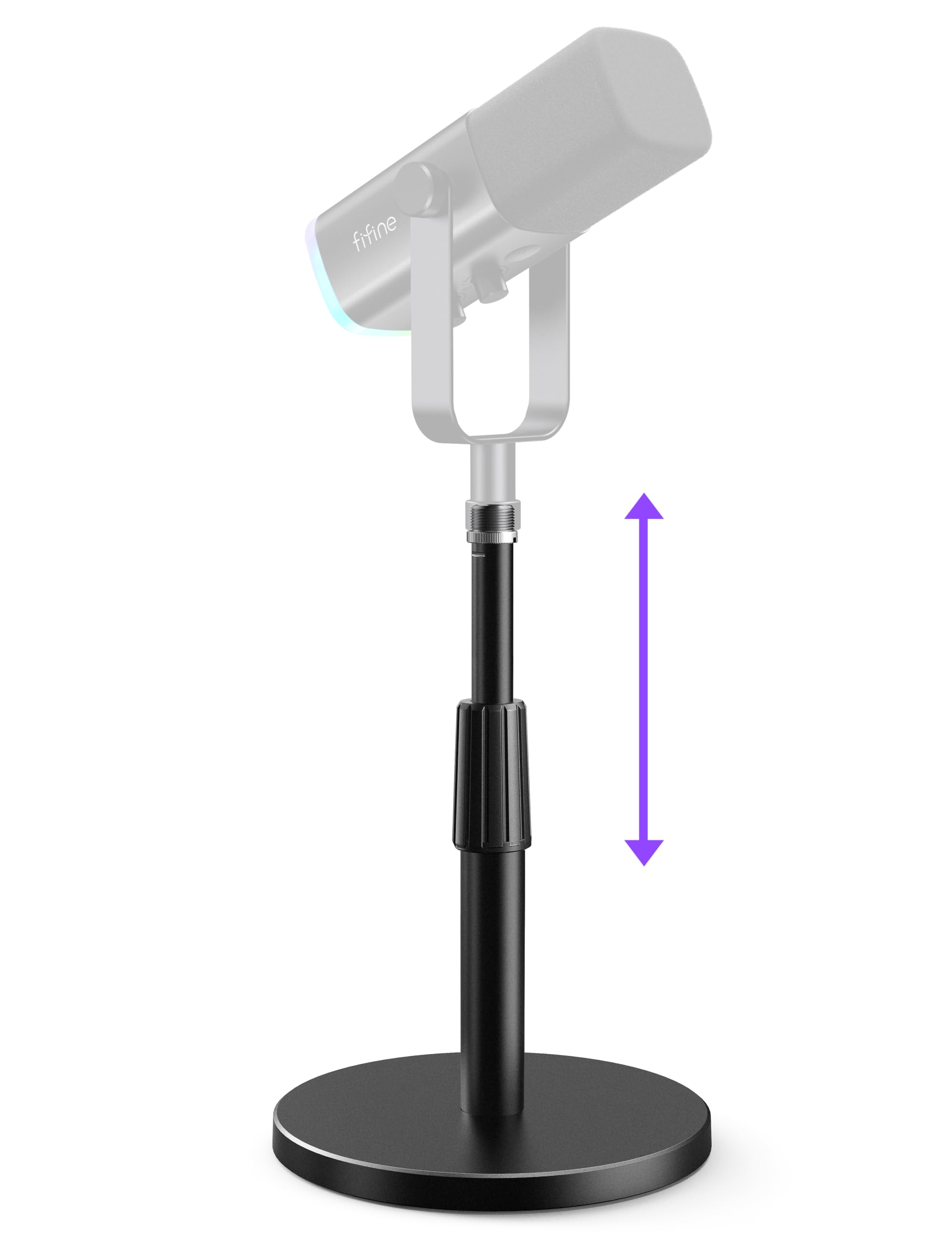
Do not let the small size fool you. The FIFINE BS1 packs a weighted round base that measures 5.12 inches across, and at just 1.3 pounds it is the lightest stand here, but owners mention it holds an XLR dynamic mic firmly without any sagging. The heavy-gauge steel construction and four non-slip pads keep it locked to your desk mat.
Height adjusts from 5.5 inches to 8.26 inches via a twist clutch knob. That is a much shorter range than the 70-inch floor stands on this list, which is exactly right for a desktop setup where your mic sits at mouth level. It handles up to 4.4 pounds, so a heavy studio mic is well within range.
The built-in 3/8-inch thread plus an included 5/8-inch adapter means it works with FIFINE AM8 and K688, Shure, HyperX, and other standard mics. The handheld clip is sold separately, so budget for that. Quality is the aspect owners praise most, and the honest limitation is the height floor: it will not go lower than the default setting, which short users on tall desks may notice.
Why it wins at a desk
- Weighted base holds heavy mics with no wobble
- Twist clutch gives smooth 5.5 to 8.26-inch adjustment
- Includes 5/8-inch adapter for wide mic compatibility
Where it falls short
- Cannot lower below the default setting
- Mic clip must be purchased separately
Grab it for: a space-saving desk stand that quietly holds a heavy dynamic mic in place all day.
skip it if: you sing standing up and need a floor-height stand instead.
3. AxcessAbles Short Mic Stand with 34″ Boom
The low-profile stand that reaches over drums and amps with ease.
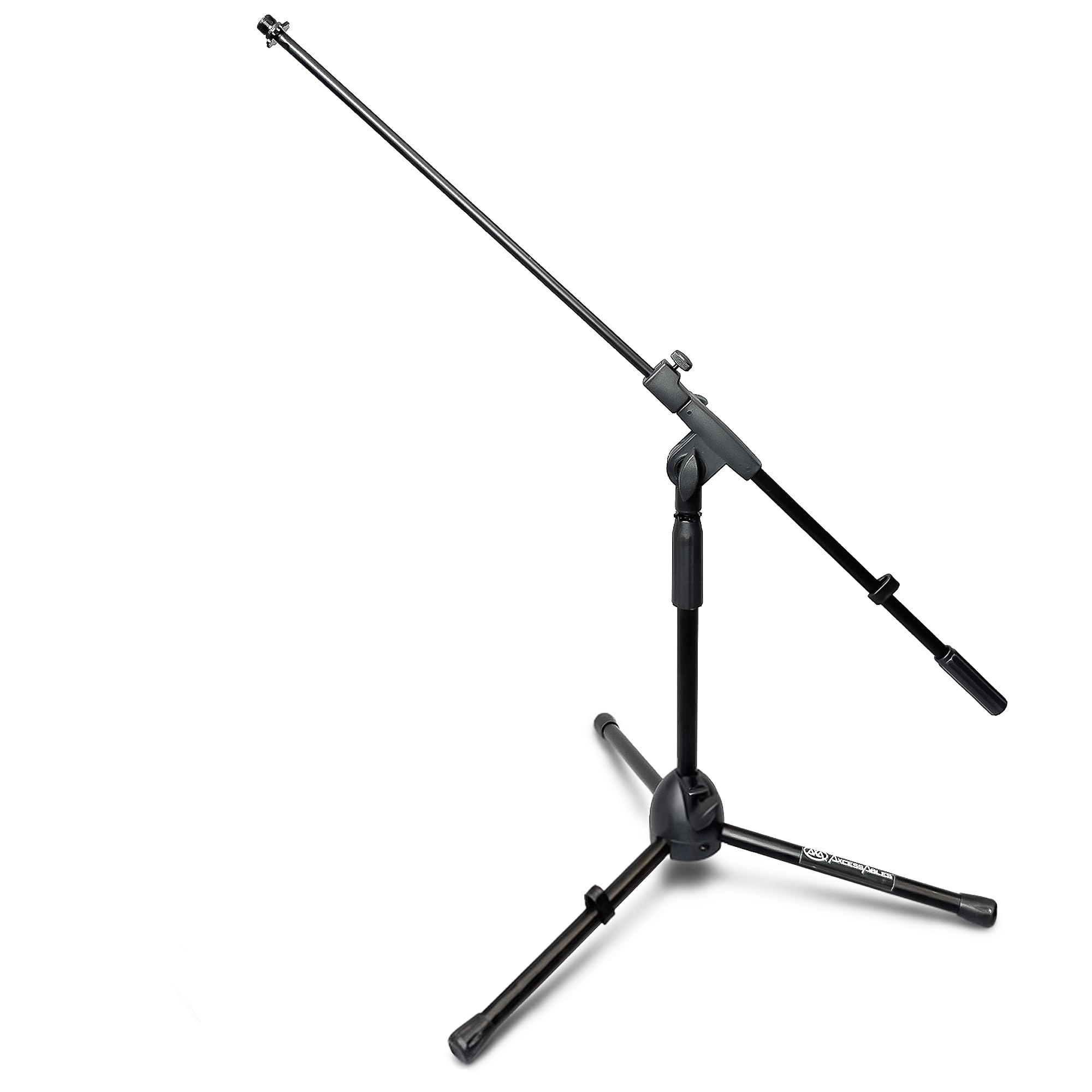
This one exists for tight setups around drums and guitar amps, places a full-size stand cannot fit. The telescoping boom extends from 18.5 inches to 34.5 inches, giving you far more reach than its short tripod base suggests. Stand height adjusts from 19.7 inches to 28.5 inches, which keeps the whole thing low and out of the way.
Buyers use it for snare mics, floor toms, and miking small amplifiers, and they report a large diaphragm condenser with a shock mount works great over floor toms. The 5/8-inch thread plus an included adapter covers both Euro and US mic clip standards, so most mics screw right on.
Stability is the aspect buyers talk about most, and it is genuinely mixed, so treat the adjustment points firmly. As owners put it: “tighten the adjustment points down and be smart about where you place the base when the boom is extended.” The cable management clips keep runs clean and snag-free, and the foldable legs make it easy to toss in a gig bag.
Standout feature: the 34.5-inch boom reach in a stand that tops out at 28.5 inches tall, which no other pick here matches for compact instrument miking.
Handle with care: the adjustment points need a firm tightening, and the boom needs a sensible base placement when fully extended.
Buy it for: drummers and guitarists who need a small stand with real reach over instruments.
Think twice if: you want a stand you never have to re-tighten mid-session.
4. InnoGear Gooseneck Floor Stand

A floor stand that reaches 70 inches and bends a full 360 degrees.
The headline here is the range. Height adjusts from 32 inches to 70 inches, so it serves both standing singers and seated players, and the flexible gooseneck rotates 360 degrees to point the mic wherever you need it. The included mic clip also rotates 180 degrees, which covers instrument and vocal angles.
Unlike tripods that use three height clutches, this stand uses one clutch and a separate extension pole joined by a long screw adapter, which improves stability. The weighted round base weighs 4.5 pounds across a 9.8-inch diameter and sits on six non-slip pads. Buyers have used it to hold an Audio-Technica AT2020 with a shockmount, and it works well for home practice and karaoke.
The stand disassembles into four parts in seconds, so it travels to stage, studio, and outdoor gigs easily. The base is light enough that it tips over more easily than heavier options, so it is best for stationary home use rather than hectic live setups. Compatibility is wide, covering HyperX QuadCast, Blue Snowball iCE, Blue Yeti, and Shure SM58 and SM7B.
What it does best
- 70-inch max height covers standing and seated use
- 360° gooseneck points the mic in any direction
- Breaks into four parts for easy transport
Know before you buy
- Base is light and tips easily if bumped
- Shock mount not included
Choose it for: a do-everything floor stand at home that switches between singing and instruments.
Pass on it if: you need a bulletproof base for chaotic live stages.
5. InnoGear Desk Mic Stand with Boom Arm

A weighted desk stand that supports 2.64 pounds with tight, sag-free hinges.
Stability is the aspect owners praise most on this one, and it is easy to see why. The premium steel build and 2.4-pound weighted base support up to 2.64 pounds, which the maker notes exceeds competitors limited to 1.98 pounds. Customers note the tight hinges prevent sagging entirely, even with a Blue Snowball attached via the extension arm.
Two pivot points and a 270-degree flexible angle adjustment let you position the mic precisely, and the included Allen wrench locks everything securely without overtightening. The wrench stores on the back of the base, a detail owners call clever. The compact base measures 6.7 x 4.7 inches, so it fits small dorm desks.
Universal adapters for 3/8-inch, 5/8-inch, and 1/4-inch threads mean it works with microphones, webcams, and cameras. The one honest limitation is that the main post height is not adjustable, so you get angle flexibility but not vertical travel. Adjustability overall draws mixed feedback, with some finding it easy and others inconvenient.
The headline: stability and quality lead the review counts, and the foldable arm makes it portable for on-the-go creators.
Watch for: fixed post height, and occasional missing-part reports that the company resolves with replacements.
Pick it for: a desk setup with a heavier USB mic that needs a base that will not slide or tip.
Consider another if: you need to raise and lower the main post itself.
6. Oimlfus Floor Boom Arm with 6.6-lb Base

A complete broadcast kit on a weighted square base with a pop filter.
This is the rare stand that arrives as a full kit. The box includes the metal base, three support rods, a folding arm, a mic clip, a double pop filter, two thread adapters, and five cable ties, so you can start recording the day it arrives. The weighted square base weighs 6.6 pounds, which reviewers point out holds the mic securely up to 4 feet in the air.
Height adjusts from 26.7 inches to 67.7 inches, and the sturdy boom arm has extra-strong springs that prevent accidental drops and reduce vibrations. It pairs well with Blue Yeti, Blue Yeti Nano, Blue Snowball, SM7B, MV7, and Razer Seiren mini. The 360-degree rotatable adjustment knobs make positioning easy, and the double pop filter tames the hissing and lisping sounds that plague vocal recordings.
Functionality is the most-praised aspect, and compatibility follows. Stability is the most-discussed aspect overall, but it is mixed, so know the limits: the base can tip when a heavy mic is angled away, and some owners fix it by sliding the base under a desk leg. Setup is straightforward but a few find it time-consuming.
Everything included
- Pop filter, mic clip, and adapters ship in the box
- 6.6-lb base holds mics securely up to 4 feet up
- Folding arm is easy to carry and store
Setup realities
- Base plate can tip with heavy mics at sharp angles
- Pop filter setup takes some trial and error
Reach for this if: you want one box with everything needed to start podcasting or streaming today.
Be mindful if: you use the heaviest mics like a Blue Yeti and angle them aggressively.
7. Hercules MS432B Quick Turn Mic Stand
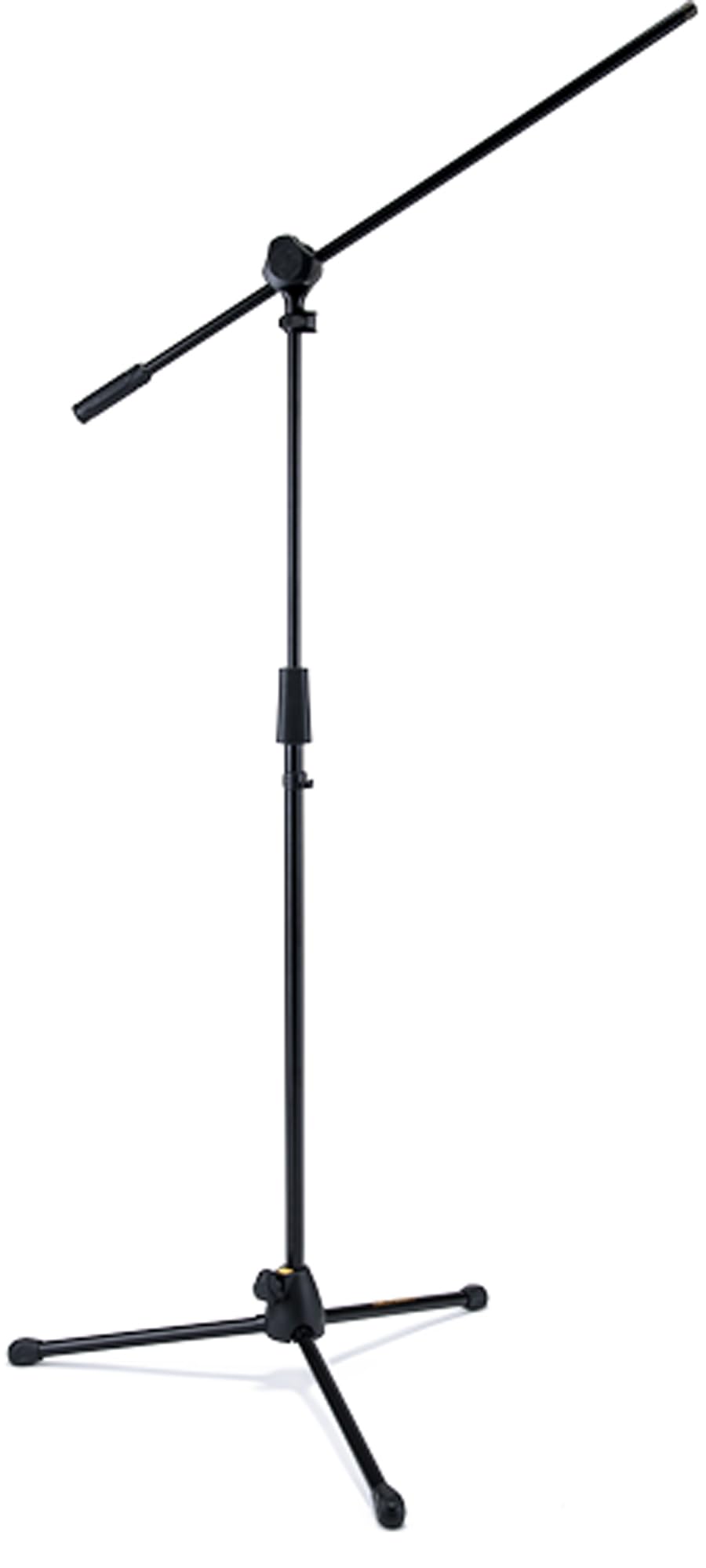
A polished aluminum tripod with a quick-turn clutch for fast height changes.
The defining feature here is the Quick Turn Clutch, which lets you raise or lower the stand faster than a traditional knob. The die-cast aluminum tripod base keeps weight at 5.2 pounds, and the 2-in-1 boom clamp holds both straight and boom configurations. Maximum height reaches 147.5 centimeters, enough for standing vocal work.
Buyers use it in home studios with a Shure SM57 for vocal and amp recording, and they report the boom stays very stable even fully extended with the SM57 attached. Another owner uses it to hold a heavy Rode condenser mic for online teaching, and the Quik-N-EZ boom retainer keeps everything locked.
Quality is the most-praised aspect, but the clutch design draws negative feedback, and a few report the tripod retainer and locking mechanism breaking after months of use. One owner who bought six of these says they never fail catastrophically, just minor part looseness. The mic clip sometimes fails to tighten and lets the mic flop, so budget for a replacement clip if you hit that.
Why it stands out: the quick-turn clutch is genuinely faster than the knob-style adjustment on most other stands.
Fair warning: the clutch and retainer have mixed long-term reliability, so this rewards careful handling.
Buy it for: a lightweight, fast-adjusting tripod that gets the job done in a home studio.
Look elsewhere if: you need a bombproof base for years of heavy touring.
8. Aokeo AK-58i Low Profile Mic Boom
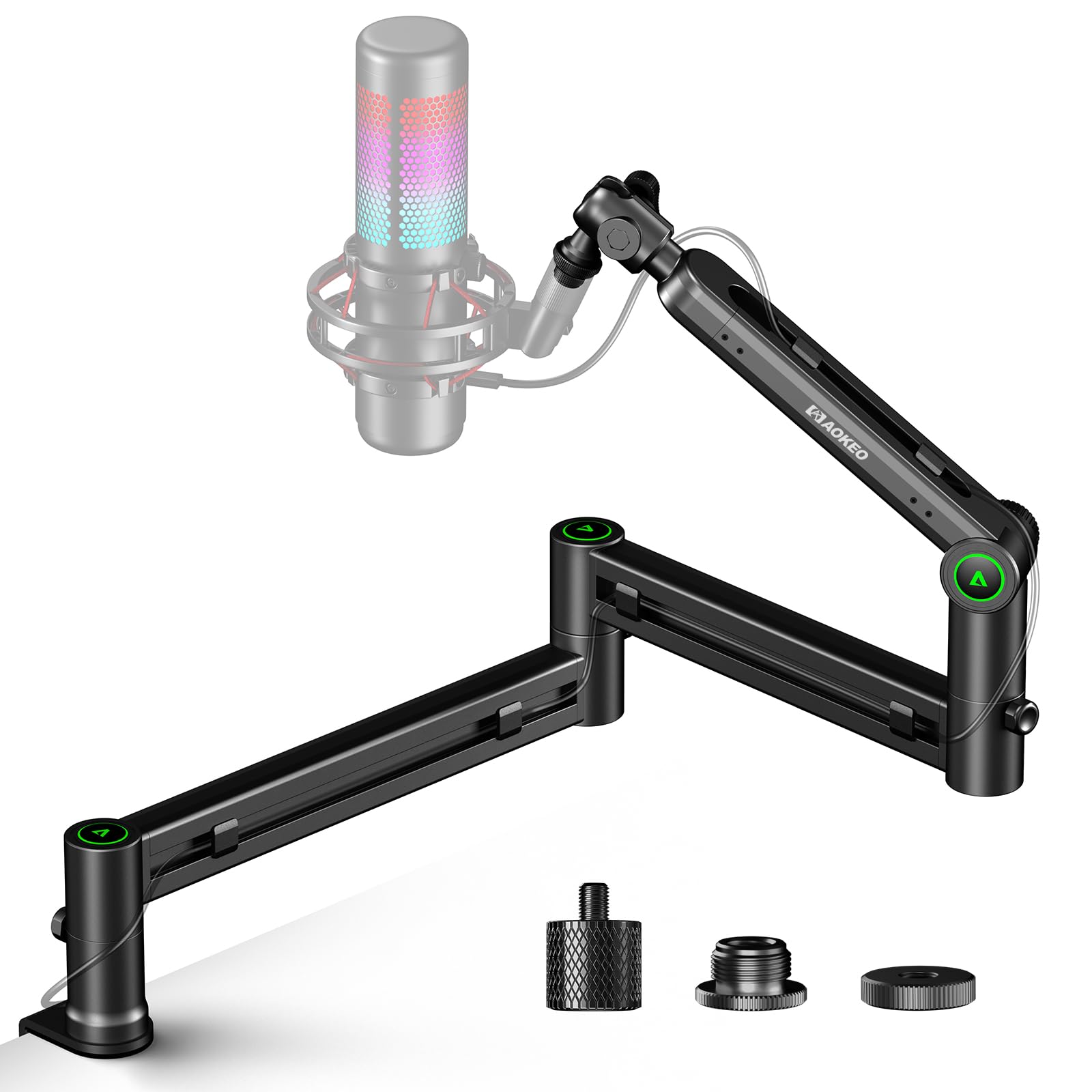
A low-profile mic arm that slides under your monitor and out of sight.
This desk arm is built around a simple idea: keep the mic arm low so it does not block your screen or your face. The low-profile design lowers the center of gravity, which shoppers say means no shaking or shifting even during intense handling. Both arms rotate 360 degrees, and the arm with the mic swings up and down 180 degrees.
The all-metal steel forging supports up to 2 kg, and buyers confirm it holds heavy mics like the Blue Yeti and SM7B without wobble. One owner calls it better than their previous arm, praising the ability to run the cable inside the body and lock it with clips. The arm extends across the bottom of your computer screen and hides the cable, reducing line-of-sight distractions.
It fits tables less than 7cm thick and includes 3/8-inch to 1/4-inch and 3/8-inch to 5/8-inch adapters. Quality is the most-praised aspect, but adjustability is mixed: horizontal movement is limited to one section, and there is no instant vertical adjustment. A one-year after-sales service backs the purchase.
The low-profile advantage
- Holds heavy mics without wobble
- Hidden cable channels clean up your desk
- Fits tables under 7cm thick
The adjustment limits
- No instant vertical height change
- Horizontal reach confined to one arm section
Grab it for: a clean, low-profile desk setup where the mic needs to sit below your monitor line.
pass on it if: you constantly reposition the mic vertically during streams.
9. Gator Frameworks GFW-MIC-1201

An 11.3-pound pedestal base with a one-handed squeeze clutch for instant height changes.
This is the heaviest stand in the lineup, and that weight is the whole point. The 12-inch round base with a no-slip, vibration-reducing gasket means it stays put on concrete, tile, or wood floors, and buyers report rock-solid stability even with heavy mics. The pedestal design takes up a compact footprint without spreading legs across the stage.
The signature feature is the soft-grip squeeze clutch that adjusts height from 40 inches to 63 inches with one hand. Owners call it superior to the knob style, letting you raise or lower the mic in seconds without fumbling. A built-in cable management system keeps cords organized and clutter-free.
Quality and adjustability are the two most-praised aspects, and the heavy base earns consistent praise. The honest caveats: stability draws some negative feedback at the extremes, and it is not built for touring life. As one owner sums it up, this is ideal for home karaoke and local gigs, not for loading in and out of a tour van every night.
The standout spec: at 11.3 pounds, the base alone outweighs several full stands here, which is why it feels glued to the floor.
The trade-off: that heft means it stays put but travels poorly, so it suits a fixed studio spot.
Buy it for: a permanent studio or stage position where you want zero wobble and one-handed height changes.
Pass if: you need to break down and carry a stand to gigs every week.
Understanding the Specs
Maximum Height
This tells you the tallest setting the stand can reach, which decides whether it works for standing singers or only seated desk use. A floor stand for vocals needs roughly 60 inches or more, while a desk stand only needs about 8 inches of travel. Match this number to the height of the person or instrument you are miking.
Base Type and Weight
The base is what keeps your mic from tipping over. A weighted round or square base takes up less floor area and holds heavy mics well, while a tripod folds flat for transport but spreads wider. Heavier bases like 11.3 pounds are more stable but harder to move, so choose based on whether the stand stays put or travels.
FAQ
Will my microphone fit on any of these stands?
What is the difference between a tripod base and a weighted round base?
Can I use a heavy mic like the Blue Yeti on a desk stand?
How do I know if a stand reaches high enough for standing singers?
Why does my mic boom arm sag over time?
What is a gooseneck on a microphone stand?
Is a heavier microphone stand always better?
Can these stands be used for podcasting at a desk?
How long will a quality mic stand last?
What does the thread adapter do on a mic stand?
Final Thoughts: The Verdict
If you want one dependable pick, the adjustable microphone stand winner is the K&M 21090 because it pairs a 63-inch reach with 7.2 pounds of German-built stability that owners trust with heavy mics. If you want a space-saving desk stand, grab the FIFINE BS1. And for a complete broadcast setup with a pop filter included, the Oimlfus floor boom is the one to reach for.
How We Picked
We do not accept paid placement. Every pick is matched to a real buyer and a real use-case; we do not hands-on test units.
Sources & Methodology
Specifications: manufacturer listings and product documentation. Review insights: verified customer reviews, as of August 2026. Pricing: not shown on this page (it changes often); check the current price via the retailer link.
As an Amazon Associate, Gadgets Feed earns from qualifying purchases. This does not affect which products we feature.