
Our readers keep the lights on and my morning glass full of iced black tea. As an Amazon Associate, I earn from qualifying purchases.
Specs are compiled from manufacturer listings and verified buyer reviews and can change over time — please confirm the key details on the product page before buying.
When you shop for an adjustable slant board, the real question is not “which one looks nice” — it is “which one will hold your weight safely and stay put while you stretch.” A board that slips, wobbles, or bows under load is worse than no board at all. Here, you will compare the top options by weight capacity, angle range, surface grip, and footprint, so you can match one to your height, your weight, and your home floor.
I’m Min — the founder and writer behind Gadgets Feed. This guide is built by comparing the manufacturers’ published specifications and the patterns across verified customer reviews, so you get each pick’s real strengths and trade-offs instead of marketing spin.
From the 350-pound wooden workhorse to a 600-pound steel brute, we break down the best adjustable slant board for your rehab, squat depth, and daily calf stretching.
Our Picks at a Glance
How To Choose The Best Adjustable Slant Board
An adjustable slant board is a simple wedge that raises your heels above your toes. The angle forces your calves, Achilles tendons, and ankles into a deep stretch that a flat floor just cannot give you. But “adjustable” means different things on different boards, so the choice depends on a few key numbers.
Weight Capacity Is Your Safety Limit
This is the first spec to check because it is the one that protects you from injury. A board rated for 350 pounds is built for most home users, while a 600-pound steel board suits heavier lifters or those who want zero flex under a loaded barbell squat. Never buy a board whose rating sits close to your body weight plus the weight you hold.
Angle Range Determines Your Progress
The incline angle is what changes the intensity of the stretch. Beginner-friendly boards start around 15° and top out near 35°, which covers most stretching and rehab needs. If you want a steeper challenge for advanced mobility work, look for a board that reaches 40°. More angle steps mean you can progress gradually as your flexibility improves.
Grip and Feet Keep You Planted
Slipping is the most common complaint across all slant boards. A high-friction surface where your feet rest, plus rubber pads underneath, keeps the board locked to the floor and your feet locked to the board. This matters most on smooth hardwood or tile where a board can slide mid-stretch.
Quick Comparison
| Model | Best For | Weight Capacity | Angle Range | Material | Amazon |
|---|---|---|---|---|---|
| StrongTek Wooden★ Best Overall | All-around home stretching | 350 lbs | 15°–35° (5 settings) | Laminated Wood | Amazon |
| KZEBRA Professional WoodenRehab Heavyweight | Heavy rehab duty | 450 lbs | 15°–35° (5 settings) | Lauan Hardwood | Amazon |
| YONKFUL Steel | Heavy lifters | 600 lbs | 15°–40° (5 settings) | Steel | Amazon |
| Woodure 2-in-1 Balance & Slant | Balance training plus stretching | 350 lbs | 4 incline positions | Wood | Amazon |
| Gym Docs Squat Wedge Pair | Lifting with a pair | 1500 lbs | 3 angles | Natural Rubber | Amazon |
| FeelGoodEase Wooden | Plantar fasciitis relief | 500 lbs | 15°–35° (5 settings) | Engineered Wood | Amazon |
| Lifepro InclineX | Nordic curls and hamstrings | 330 lbs | 20°–40° (4 settings) | Iron plate/pipe | Amazon |
In‑Depth Reviews
1. StrongTek Wooden Slant Board, 13-Inch Wide
Our pick — over 4.5★ from 800+ verified ratings; the strongest balance of quality and price.
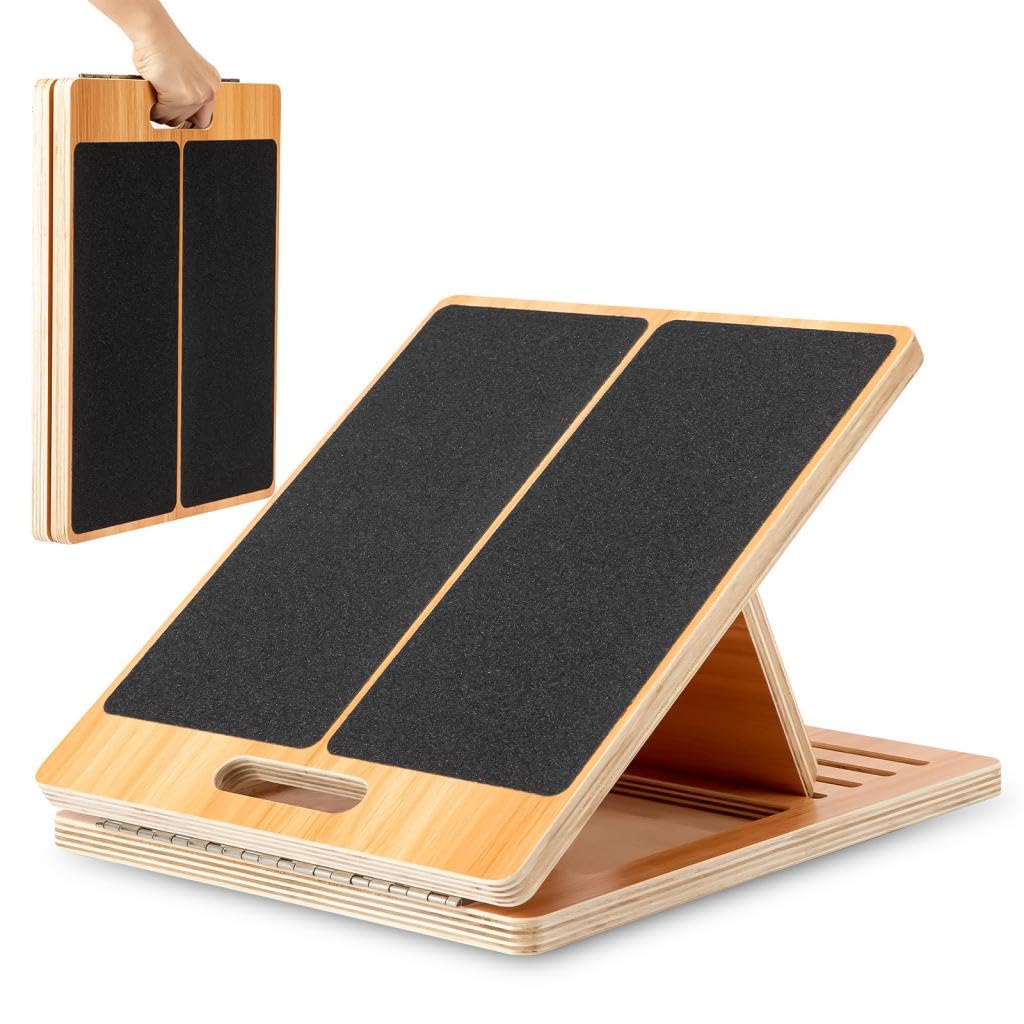
The 13.3-inch wide platform gives your feet room to land naturally.
The StrongTek is the board most people should start with because it solves the two biggest frustrations of cheaper wedges: cramped footing and limited angles. Its 13.3-inch wide surface is a full 6% wider than the KZEBRA’s 12.5-inch deck, which means you can stand with both feet planted shoulder-width without your toes hanging off the edge. You get five incline settings from 15° to 35°, so you can begin gentle and work deeper as your calves loosen up.
At just 5.3 pounds, it is less than half the weight of the 10.82-pound steel YONKFUL board — and it folds flat with a built-in carry handle. That makes it genuinely portable for a home gym, a therapy clinic, or even a suitcase on a work trip. The top surface uses a high-grip abrasive finish and the bottom has rubber anti-slip pads, so it stays put on hardwood while protecting the floor from scuffs.
Reinforced multi-layer laminated wood supports up to 350 pounds, which covers the vast majority of home users. The recurring praise is the quality and sturdiness — the two things owners mention most often — and buyers report it as “a sturdy and well-built slant board, portable, & folds flat for storage.” It is also a genuine stretching tool, not a gimmick; owners note it increases range of motion and stability, and One buyer credits it with helping recover from a hip flexor injury.
What Wins People Over
- Wide 13.3-inch deck fits both feet comfortably
- Folds flat with carry handle for storage and travel
- Five angles from 15° to 35° for gradual progress
- Grip top and rubber feet keep it stable on hard floors
Who Should Think Twice
- 350-pound limit is not for very heavy loaded squats
- Some owners disagree on long-term durability of the wood
Reach for this if: you want one board that handles stretching, squats, and calf raises at home without taking up closet space.
Look elsewhere if: you plan to pile on heavy barbell weight — the 350-pound cap is your ceiling.
2. Professional Wooden Slant Board by KZEBRA
For ACL recovery, this board’s five angles let you build intensity step by step.
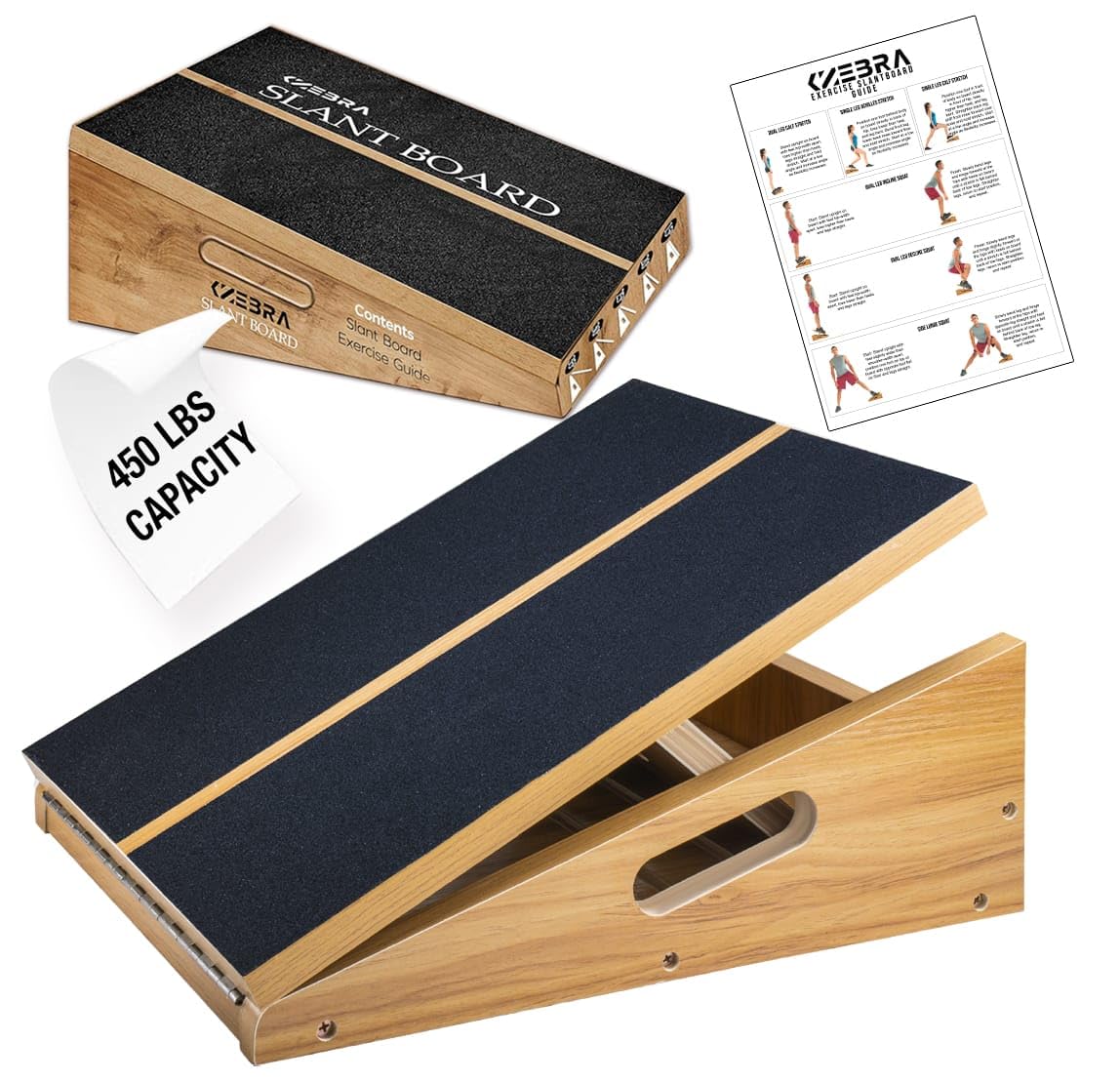
That extra headroom matters if you are rehabbing a knee injury and want total confidence the board will not shift or bow under you during deeper stretches. Owners mention it is “a standout for my ACL recovery.” with the five adjustable angles (15°, 20°, 25°, 30°, 35°) letting them gradually increase intensity as mobility improves.
It measures 16 inches deep by 12.5 inches wide, giving you a solid 12.5-inch stance that is slightly narrower than the StrongTek’s 13.3-inch deck. The trade-off is acceptable for most users because the lauan construction feels denser and more rigid underfoot. Anti-slip treads sit on both the top surface and the bottom, so it grips your shoes and the floor at the same time.
The durability story is the standout here. Owners describe it as incredibly stable, with some noting they never worry about it slipping or tipping even during deeper stretches. It is also described as lightweight and easy to use despite the heavy-duty build — one buyer uses it daily for hamstring and calf work. The only minor gripe from a few owners is the lack of a completely flat position, which is not really what this board is for.
Built for recovery: the 450-pound rating and rigid lauan hardwood make this the board you trust when your knees and ankles need steady support, not just a casual stretch.
Worth noting: the 12.5-inch width is snugger than the StrongTek, so if you have very wide feet, measure before you buy.
3. Steel Slant Board Calf Stretcher, 600 Lbs Capacity

The only board here that reaches 40° — and shrugs off 600 pounds.
If you are a serious lifter, the YONKFUL steel board is the one that will not flinch. It is also the steepest board in this lineup, with five settings that climb from 15° up to 23°, 30°, 35°, and a challenging 40° — deeper than any wooden option here.
The surface is covered with a layer of non-slip sandpaper for traction, and four rubber feet underneath keep the board stable on any floor without scratching it. Owners who swapped from flimsy plywood say this metal board feels like a real upgrade, and one buyer reports doing “2 sets of 10 squats a day on this board and it is a great burn.” Versatility gets frequent praise too, with people using it across many workout routines.
There is one honest trade-off to know: this board weighs 10.82 pounds — more than double the 5.3-pound StrongTek — so it is not a travel companion. It is a home-gym fixture you set up and leave in place. A few owners also note the stance is a little narrow if you want both feet fully planted for squats, and one mentioned the sandpaper grip tape can peel at the edges over time.
Where It Excels
- 600-pound rating handles heavy loaded work
- Steepest 40° setting for advanced stretching
- Steel frame will not crack like wood
- Sandpaper surface plus rubber feet for grip
Honest Limits
- 10.82-pound weight makes it hard to move around
- Some find the stance narrow for both feet
- Grip tape can peel at the edges with heavy use
Pick this if: you lift heavy and want a board that keeps up with barbell squats and steep calf work.
skip it if: you need something portable — at 10.82 pounds, this one stays home.
4. Woodure 2-in-1 Balance Board & Slant Board

One board, two jobs — stretch your calves and train your balance.
The Woodure is the only pick here that pulls double duty. Flip it one way and it is a four-position slant board for calf stretching and squats; flip it over and the rounded base turns it into a balance board that works your core and ankles with a simple weight-shifting motion. That dual purpose is why it is such a strong value — you are effectively getting two pieces of rehab equipment in one compact unit.
It supports up to 350 pounds on the slant side, with a non-slip surface and anti-skid feet that protect your floors. The wood build is described as high quality and sturdy, and the collapsible design stores flat when you are done. Owners use it for shin splints, calf issues, and foot fascia stretching, and several note it works well even with just socks thanks to the grippy surface. One trucker said he felt the stretch in his back legs immediately on the first step.
The balance feature is the thing that separates this from every other board in this list. Most slant boards are a one-trick wedge; this one lets you switch between stretching and stability work without buying a second piece of gear. The only recurring complaint touches the screws — a few owners found they can jam or need tightening over time, though the overall quality and durability ratings stay strong.
Two tools, one footprint: if you want both calf stretching and balance training without cluttering your floor, this is the smart buy.
Minor caveat: the balance-rocking base is less deep than some dedicated wobble boards, so hardcore balance work may want a dedicated tool.
5. Gym Docs Doctor-Designed Squat Wedge Pair

A pair of rubber wedges that fix ankle mobility for deep, pain-free squats.
The Gym Docs take a totally different approach from the wooden boards above: instead of one wide platform, you get a pair of compact wedges — one for each foot. That design is ideal for lifters who struggle with limited ankle mobility. By elevating your heels into plantarflexion, the wedges let you hit full squat depth without the pain, and one tall owner with long femurs reported finally being able to do a barbell back squat to depth.
The material is natural rubber, which the maker says is non-slip on all surfaces — not just rubber gym flooring. It also claims the rubber resists bending under any load under 1500 pounds, making this the strongest weight rating in the entire list by a wide margin. The three adjustable angles let you tune the incline to whatever feels right for each exercise, and the “wavy” stacking system keeps the two pieces from sliding side to side when they are stacked.
Where this pair wins is portability and joint comfort. The wedges stack into a compact block that slides into the included carry bag, so you can take them from home to the gym easily. Customers note less knee pressure during squats and lunges — One reviewer noted it helped with tendinitis. — and the stability is a constant theme, with no slipping during exercises. The catch is the carry bag itself, which a few owners found flimsy with seams that come loose after a few months of use.
Why Lifters Love It
- Pair design lets each foot work independently
- 1500 lb bend-resistance rating is the strongest here
- Compact stack with carry bag for gym travel
- Non-slip on all floor types, not just rubber
What to Watch
- Carry bag seams can tear after a few months
- Only three angles, fewer than the 5-setting boards
Grab this if: deep squats are your goal and ankle mobility is your bottleneck.
Not for you if: you want one wide board for both feet together — this is a two-piece system.
6. FeelGoodEase Wooden Slant Board with Resistance Band
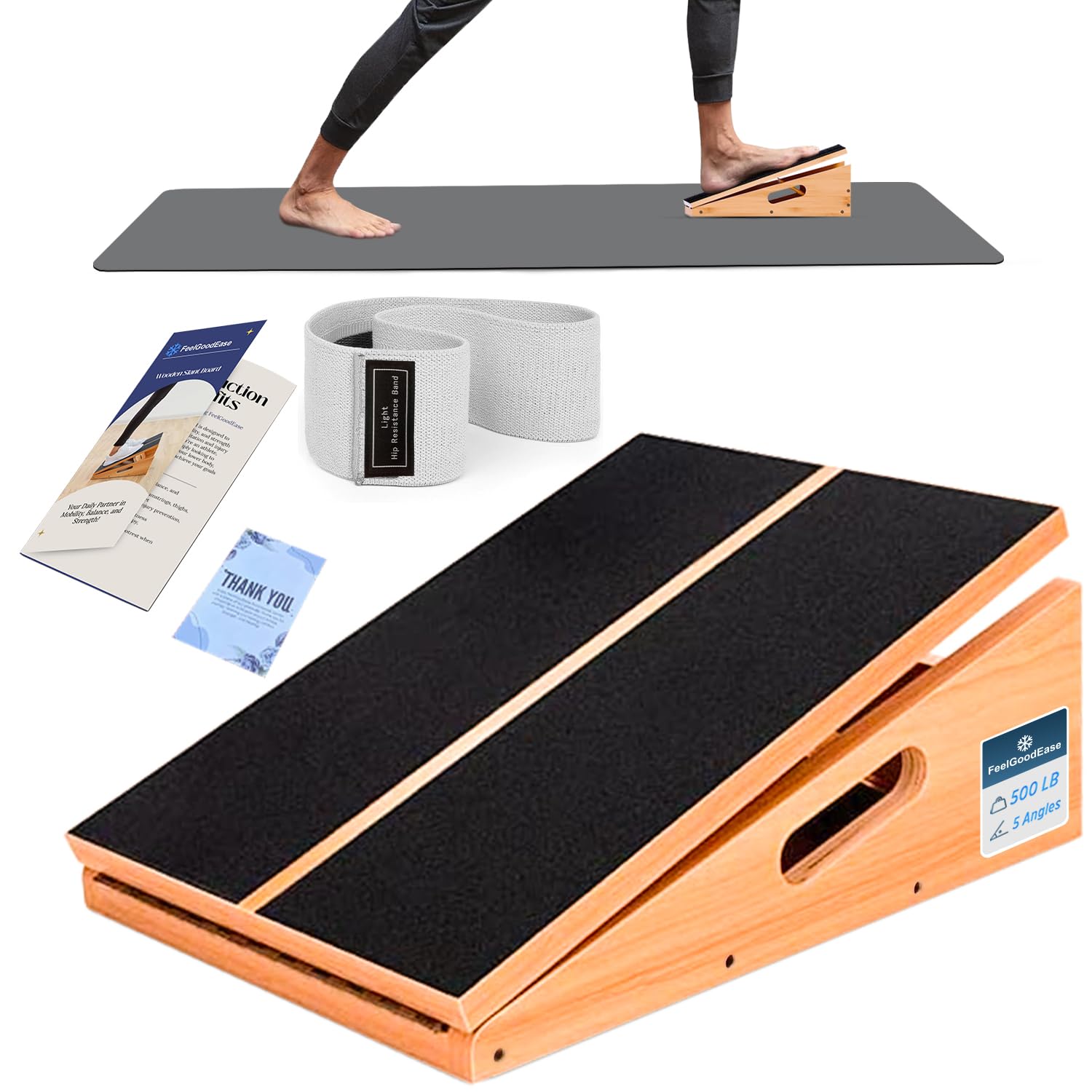
A 500-pound wooden board that arrives with a resistance band and spare grip.
The FeelGoodEase is the most complete package in this lineup. Beyond the board itself, you get a resistance band, four non-slip pads, and extra sandpaper for replacing the grip when it wears down. That spare-grip detail is a thoughtful touch that most competitors skip entirely — it extends the life of the board well past the first few months of daily use.
The five angles (15°, 20°, 25°, 30°, 35°) mirror the StrongTek’s range, giving you the same gradual progression for stretching and squats. The anti-slip top surface provides strong barefoot grip, and the reinforced structure prevents wobbling during deeper stretches.
The real-world feedback centers on relief. Owners with plantar fasciitis and calf tightness report the board helps loosen those stubborn areas, and one buyer mentioned it resembles physical therapy boards. Another owner said the board is helping with leg neuropathy issues. The build quality draws consistent praise as very sturdy and solid, with all the included elements arriving complete.
Complete package: the resistance band and replacement grip make this the best value if you want everything in one box.
Heads up: at 13 by 7 inches, the platform is narrower than the 13.3-inch StrongTek, so wide-stance users should measure first.
7. Lifepro InclineX Slant Board with Nordic Strap
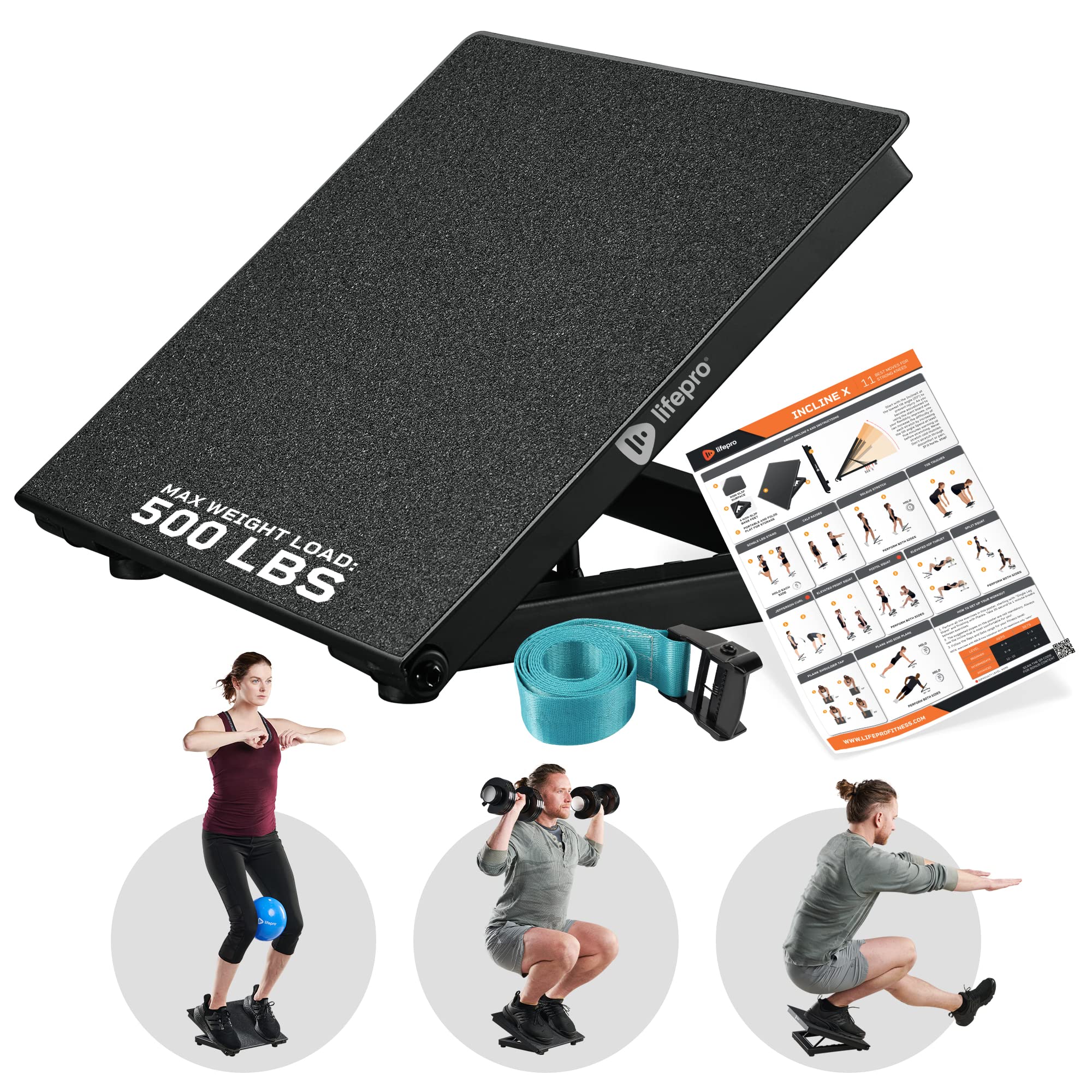
The only board here that ships with a Nordic hamstring curl strap.
The Lifepro InclineX is for the lifter who wants more than just calf stretching. It comes with a Nordic hamstring curl strap and a carrying bag, letting you add tibialis and hamstring curl work to your routine. That makes it a surprisingly versatile piece of kit for lower-body strength, not just a passive stretch wedge.
Its four angles run steeper than most — 20°, 30°, 35°, and 40° — which suits users who already have decent flexibility and want a real challenge. The board measures 14 inches long by 12.6 inches wide, fits US shoe sizes up to 14, and folds flat for storage. Underfoot, the high-traction non-slip surface works barefoot or with shoes, and the iron plate and pipe construction holds up to 330 pounds.
Owners praise the solid build and find it great for deep stretches and knee strengthening, with several using it for deadlifts to improve ankle flexion. The recurring issue, however, is the grip pad’s adhesive. Multiple reviewers point out the non-slip pad sliding off or leaving sticky residue after a few days of use — one called the adhesive “terrible.” The board itself is sturdy, but the grip layer may need a DIY fix like skateboard tape for some users.
Standout Features
- Nordic strap adds hamstring curl exercises
- Steep 40° top angle for advanced stretching
- Folds flat and fits shoe sizes up to 14
- Solid iron build praised for stability
Know Before You Buy
- Grip pad adhesive can fail and leave residue
- 330-pound limit is the lowest in this list
Choose this if: you want Nordic curls plus slant stretching in one foldable unit.
Think twice if: you are over 330 pounds or you do not want to deal with a possibly faulty grip pad.
Understanding the Specs
Angle Range and Settings
The number of incline settings controls how precisely you can progress. A board with five angles from 15° to 35° lets you add a few degrees of stretch at a time as your flexibility improves — ideal for rehab. Boards that start at 20° or reach 40° are better for already-flexible users who want a steeper challenge. More settings generally means more gradual progress, which is safer for recovering joints.
Weight Capacity and Material
This is your safety ceiling. Wooden boards (laminated, lauan, or engineered) typically rate between 350 and 500 pounds and feel warm underfoot, but can theoretically crack under extreme repeated load. Steel boards push past 600 pounds and never flex, but they weigh far more. Natural rubber wedges offer the highest bend-resistance claims (up to 1500 pounds) in a compact form. Match the rating to your body weight plus anything you hold.
FAQ
What is the difference between a slant board and a balance board?
How much weight can an adjustable slant board hold?
What is the best angle to start with on a slant board?
Can I use a slant board for squats and deadlifts?
Will a slant board help with plantar fasciitis or knee pain?
How do I keep my feet from slipping on the board?
Is a wooden or steel slant board better?
Can I travel with a slant board?
Final Thoughts: The Verdict
For most people, the adjustable slant board winner is the StrongTek Wooden because the 13.3-inch wide platform, five angles, and foldable 5.3-pound build cover nearly every home need. If you want maximum load for heavy squats, the Steel YONKFUL holds 600 pounds and reaches 40°. And for ankle-limited lifters chasing deep squats, the Gym Docs pair is the targeted fix.
How We Picked
We do not accept paid placement. Every pick is matched to a real buyer and a real use-case; we do not hands-on test units.
Sources & Methodology
Specifications: manufacturer listings and product documentation. Review insights: verified customer reviews, as of August 2026. Pricing: not shown on this page (it changes often); check the current price via the retailer link.
As an Amazon Associate, Gadgets Feed earns from qualifying purchases. This does not affect which products we feature.