
Our readers keep the lights on and my morning glass full of iced black tea. As an Amazon Associate, I earn from qualifying purchases.
Specs are compiled from manufacturer listings and verified buyer reviews and can change over time — please confirm the key details on the product page before buying.
The lift kit went on fine. Then the alignment shop told you your camber is out of spec and there is nothing left to adjust. That is the moment you start shopping for adjustable upper control arms — and the part that fixes it is the ball joint and the adjustability built into the arm itself. This guide walks you through which arms actually correct geometry after a 2-4 inch lift, which ones just look the part, and where the real weak points show up.
I’m Min — the founder and writer behind Gadgets Feed. This guide is built by comparing the manufacturers’ published specifications and the patterns across verified customer reviews, so you get each pick’s real strengths and trade-offs instead of marketing spin.
Weighing steel against aluminum, greaseable against sealed ball joints, and camber-adjustable against factory-length arms is the whole decision. Every pick below is sorted by what it actually corrects on your truck, giving you a clear read on the adjustable upper control arms that fit your build, your lift, and your alignment goals.
Our Picks at a Glance

How To Choose The Best Adjustable Upper Control Arms
The wrong arm is not just wasteful — it can leave you worse off than the worn factory part you pulled. The right one corrects the geometry your lift kit threw out of whack and gives the alignment tech something to actually work with. Here is what separates the two.
Match the arm to your exact model and lift range
F-150 arms will not fit a Silverado, and a 2-4 inch lift arm will not correct a 6 inch suspension setup properly. Check the year, make, and model range first, then confirm the lift range. Arms built for 2-4 inches of lift are longer and angled differently than stock, and that extra length is what restores your camber and caster. If you run a lift knuckle kit, verify the arm works with it — several models specifically will not.
Look hard at the ball joint and its grease points
The ball joint is the part that fails first and the part that determines how much adjustment range you actually get. A heat-treated alloy steel joint with a large adjustable angle gives the alignment tech room to dial in camber and caster. Greaseable joints with a zerk fitting last far longer than sealed ones — but the zerk itself is a common failure point. Copper or soft-metal zerks snap easily, so a straight brass fitting is a worthwhile swap if yours bends or breaks.
Decide on material: steel, aluminum, or forged aluminum
Steel arms are heavy but nearly indestructible in normal use. Cast aluminum shaves weight off the suspension and resists rust. Forged aluminum combines the low weight with one-piece strength and no weld seams to fail. If you live where roads get salted or you drive in wet conditions year-round, aluminum’s rust resistance is a real long-term advantage over bare steel.
Quick Comparison
| Model | Best For | Material | Lift Range | Adjustability | Amazon |
|---|---|---|---|---|---|
| KSP 2-4″ Upper Control Arm for F150 2004-2020★ Best Overall | All-around F-150 upgrade | Alloy Steel (1.25″ DOM) | 2-4″ | Adjustable ball joint | Amazon |
| SUCOSO 2-4″ Front Upper Control Arms for Ford F150 2006-2020Premium Pick | Rust-free F-150 and Expedition | T6 Forged Aluminum | 2-4″ | Adjustable ball joint | Amazon |
| dynofit Suspension Control Arm Kit Silverado/SierraBest for Trucks | Silverado and Sierra 1500s | Carbon Steel, PU Bushing | 2-4″ | Extended length arms | Amazon |
| F-150 Front Upper Control Arm Aluminum | Weight-conscious F-150 builds | Cast Aluminum | 2-4″ | Adjustable ball joint | Amazon |
| KSP Front Upper Control Arms Silverado Sierra 1999-2006 | Older Chevy and GMC trucks | Copper, Steel | 2-4″ | Adjustable ball joint | Amazon |
| 2-4in F150 Upper Control Arms | Budget F-150 entry | Alloy Steel (cold-drawn) | 2-4″ | Adjustable ball joint | Amazon |
| Godspeed AK-093-C Adjustable Camber Front Control Arms | Chrysler 300C camber correction | Steel Alloy, Spherical Bearing | Not specified | Camberg ±3 degrees | Amazon |
| Specialty Products Company Toyota Tundra Adjustable UCAs | Tundra owners needing alignment | Steel | Not specified | ±2.0° Camber / -1.0° to +3.0° Caster | Amazon |
In‑Depth Reviews
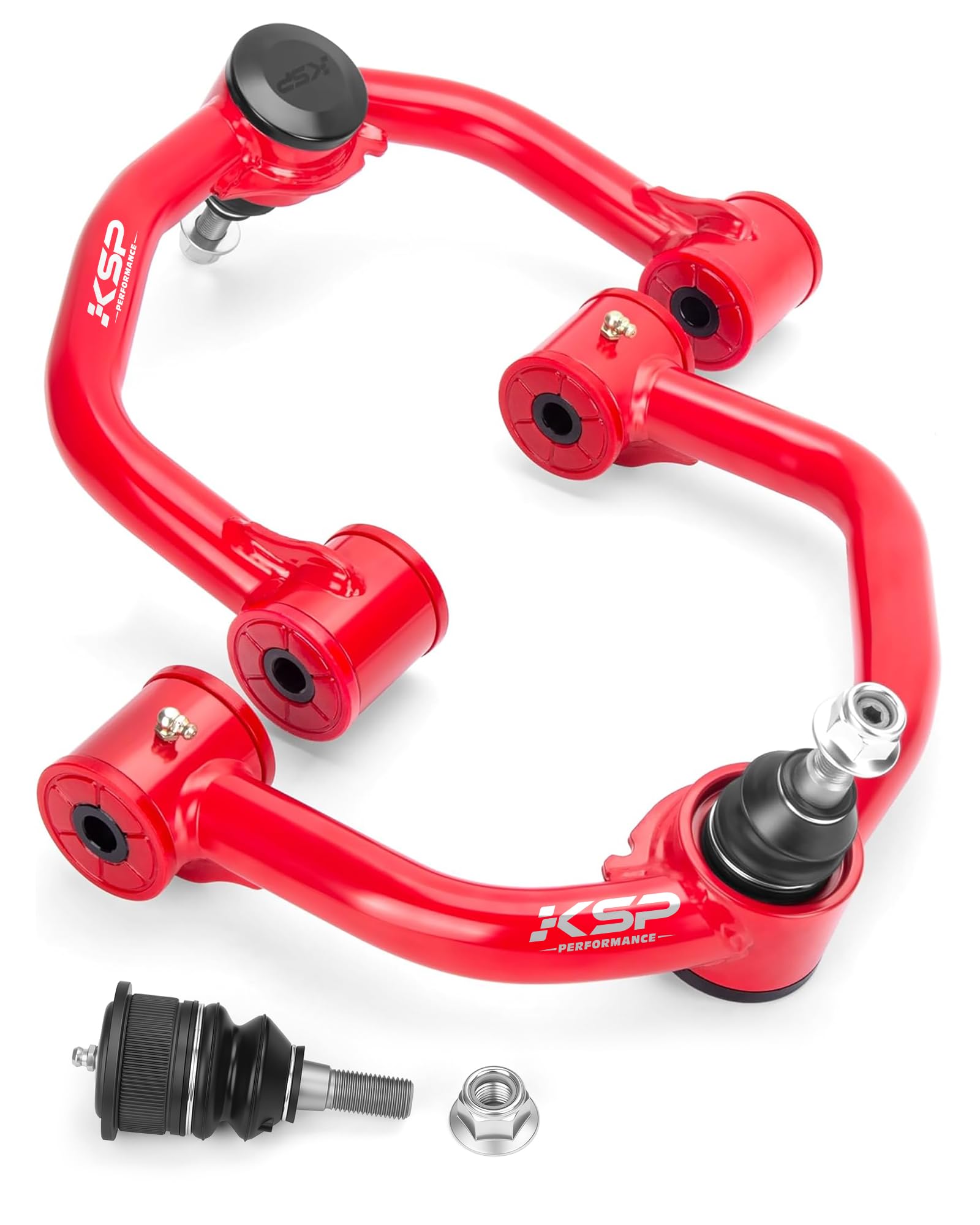
1. KSP 2-4″ Upper Control Arm for F150 2004-2020
Our pick — 4.5★ from 750+ verified ratings; the strongest balance of quality and price.
Built from 1.25″ DOM steel with a PU bushing that shrugs off freezing mornings and August heat alike.
The reason this KSP arm leads the list is simple: it corrects geometry on a lifted F-150 in a way the factory arm simply cannot. Rather than pulling the stock stamped arm to its limits, the 1.25″ DOM tubing gives the alignment tech actual adjustment room. Owners who run a 6″ RC lift plus a 2″ leveling puck report regaining roughly 2″ of up and down travel once these went on. That is the difference between a truck that fights you in the corners and one that tracks straight.
What separates it from the cast aluminum arms in this lineup is durability under load. The MIG-welded steel construction and larger tubular body are more solid than most stock F-150 arms, and the PU bushing handles low temperatures far better than the rubber on the factory piece. For a 2-4″ lift on a 2004-2020 F-150, the fitment is dialed in — though if you swapped to aftermarket rims, the maker wants you to confirm clearance first.
The recurring complaint worth knowing about is the zerk fittings. The 90° copper zerks are easy to snap off if you overtighten them, and once broken, replacing them with a straight brass fitting is the common fix. Note too that the arms ship pre-greased, so you should not need to add additional grease within the first year. Alignment after install is not optional — it is required, and a misaligned truck sits right back at square one.
Bolt-on F150 fitment
- Adjustable ball joint gives real correction range on a 2-4″ lift
- 1.25″ DOM steel and MIG welding build a genuinely stout structure
- PU bushing handles cold and heat better than factory rubber
- Pre-greased — no extra grease needed within the first year
Spring compressor needed
- Copper 90° zerks can snap — swap for brass straight fittings if they do
- Alignment required immediately after install
- Confirm aftermarket rim clearance with the maker before ordering
Stock-height trucks: pick this if you are lifting a 2004-2020 F-150 between 2-4 inches and want the geometry fixed right the first time.
Hard off-road use: if you have swapped to wide aftermarket wheels or run a Raptor, this arm is not the match — verify fitment before you buy.
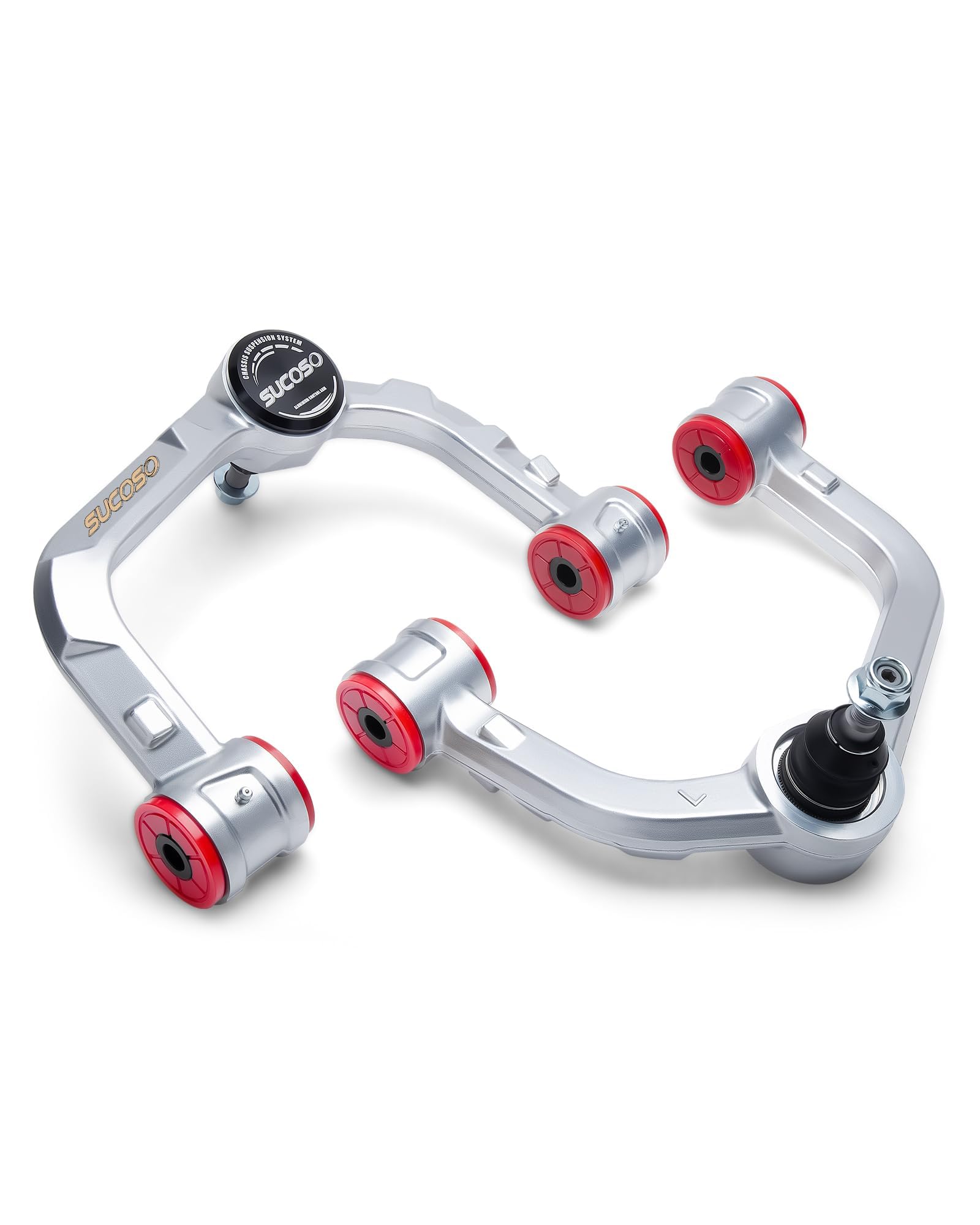
2. SUCOSO 2-4″ Front Upper Control Arms for Ford F150 2006-2020
T6 forged aluminum that refuses to rust — one piece, no weld seams, and noticeably lighter in hand than a steel arm.
If you drive through salted winters or live near the coast, rust is the slow death of a steel control arm. Forged aluminum sidesteps that entirely. Under 30 ratings with a 4.3 rating tells you this is the newer face on the block, but the build story is what moves it up the list: one-piece forged construction means zero weld defects and no weak points along a seam. The 2-4″ front leveling range works with the 2006-2022 Expedition and Lincoln Navigator too, which broadens who can actually use it.
The DTC or hardcore trail crowd will care about the geometry correction here. tune ball joint angles bring camber and caster back into factory spec after a leveled lift, which reduces premature tire wear — the exact wear that eats a set of mud tires before you have gotten your money’s worth. The PU bushing with its surface U-groove handles both hot and cold weather and keeps the arm quieter than a factory rubber unit would.
Truly worth flagging: the fitment is so specific that the maker explicitly does not recommend pairing these with aftermarket steering knuckles. If your truck already runs replacement knuckles, look elsewhere. Also, the greasing convenience people mention most is the easy-to-reach grease fittings — one less wrestling match with a grease gun every service interval. Stickers versus metal name plates is cosmetic and non-structural, but the finish details do matter to some buyers.
Rust-belt coating: for anyone in the salt belt or near the ocean who wants an arm that will not corrode through its service life, forged aluminum is the smarter material choice here over the steel F-150 arms in this lineup.
Aftermarket knuckle clash: the maker’s own guidance is clear — this arm is not recommended for use with replacement steering knuckles, so confirm your setup first.
Snow-salt states: you want the rust-resistance of aluminum with one-piece forged strength on a leveled F-150, Expedition, or Navigator.
Lifted knuckle swaps: your truck runs a non-factory knuckle setup or you specifically want a steel arm for maximum impact resistance.
3. dynofit Suspension Control Arm Kit for Silverado & Sierra 1500
A lifetime-warranted steel arm for the Silverado and Sierra crowd that wants camber correction without the aluminum price tag.
This dynofit kit is the one Chevy and GMC truck owners will gravitate to first, and the fitment list is deep — 2007-2018 Silverado 1500, Sierra 1500, Tahoe, Yukon, Yukon XL, Suburban 1500, and even the Cadillac Escalade from 2007-2018. The heat-treated ball joints with zinc-nickel alloy are the standout claim: dynefit specs them as costing more to make but lasting longer, with a larger range of motion than a stock joint. That extra swing is the whole point of running adjustable arms.
The polyurethane bushings are the argument for going aftermarket at all here. Unlike rubber, they can be replaced on their own when they wear — a rubber bushing forces you to swap the entire arm when it goes. Owners consistently note tighter steering feel and less body roll than the worn originals they pulled, and the PU handles both high and low temperature extremes better. The caveat that matters: the arms are not greased from the start. You will need a grease gun and a good grease to pack the ball joints before install, so plan for that step.
Fitment notes are strict — no stock-height models, no 2007 “Classic” body style, no 3.5″ lifted knuckle kits, and no stock wheels running 275mm or 285mm tires unless you have added spacers. Some owners with small-lift applications have still reported minor rubbing on sharp turns, and this part is designed for a proper 2-4″ lift, not a light leveling job. The lifetime warranty on the arms themselves (with 12 months on ball joints and bushings) is a real backstop for a steel arm of this weight class.
Chevy GMC 1500: grab these if you are lifting a 2007-2018 Silverado, Sierra, Tahoe, or Suburban and want replaceable PU bushings that outlast factory rubber.
Lifted 2500 trucks: your truck is a stock-height model, a 2007 “Classic,” or you run a 3.5″ knuckle lift kit — this arm will not fit those setups.
4. KSP Front Upper Control Arms for Silverado Sierra 1500 1999-2006
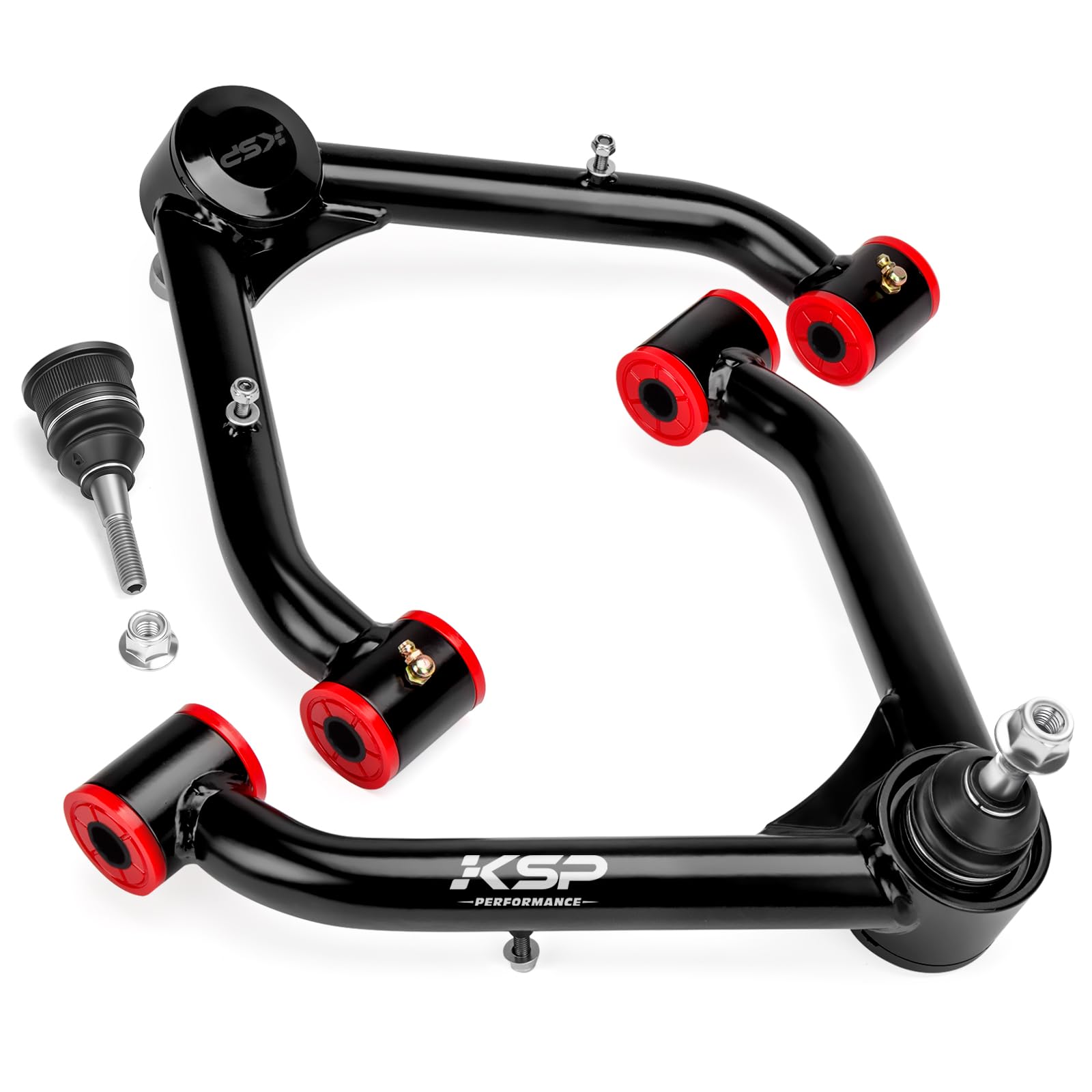
Powder-coated DOM tubing that solves the exact problem older lifted Chevys and GMCs run into — factory arms that will not reach.
This KSP arm is aimed at a very specific group: anyone wheeling a 1999-2006 Silverado 1500, Sierra 1500, Tahoe, Yukon, Escalade, or the Avalanche 1500 from 2002-2006. These older trucks are notorious for running out of alignment adjustment after a lift, and the thickened cold-drawn steel pipe with CNC machined ends is engineered to correct chassis geometry where the factory arm cannot. The high-frequency heat-treated alloy steel ball pin is the load-bearing heart of the design, and the greaseable socket lets fresh lubricant flush contaminants out rather than trapping them.
Cold weather owners should take note of the PU bushing. The whole reason polyurethane beats rubber on a lifted truck is temperature stability — it does not get stiff and brittle the way factory rubber can as the season turns cold. The powder coat adds corrosion resistance for trucks parked outside year-round. Duramax drivers who tow and drive rough roads have logged long-term runs without the arm letting them down, which is the kind of real-world endurance you want from a front-end part.
Two things to sort out before buying. First, the zerk fittings on this arm are on the smaller side and the maker’s own guidance is not to overtighten them — copper snapped zerks are a known issue across several arms in this class. Second, despite the listing’s 2WD fitment language, owners with 2015 2WD Silverados have reported the wheel making contact with the arm at full turn because the arm’s shape differs from OEM. If your truck is genuinely 2WD, verify clearance is not an issue before committing.
Older 4WD fix: for 1999-2006 Chevy and GMC 4WD trucks that cannot get camber back in spec after a lift, this is the targeted fix — fitment, geometry correction, and heat-treated ball joints all point the same direction.
Drivetrain check: owners of 2WD Silverados have hit wheel-to-arm contact at full lock, so confirm the arm clears your wheel and tire combination before ordering.
2007-2018 trucks: the 1999-2006 Silverado and Sierra 4X4 owner who needs geometry correction after a lift will find this arm built for the job.
2WD models: your truck is 2WD — real-world reports of wheel contact at full turn mean you want to double-check clearance first.
5. F-150 Front Upper Control Arm, 2-4″ Adjustable Aluminum
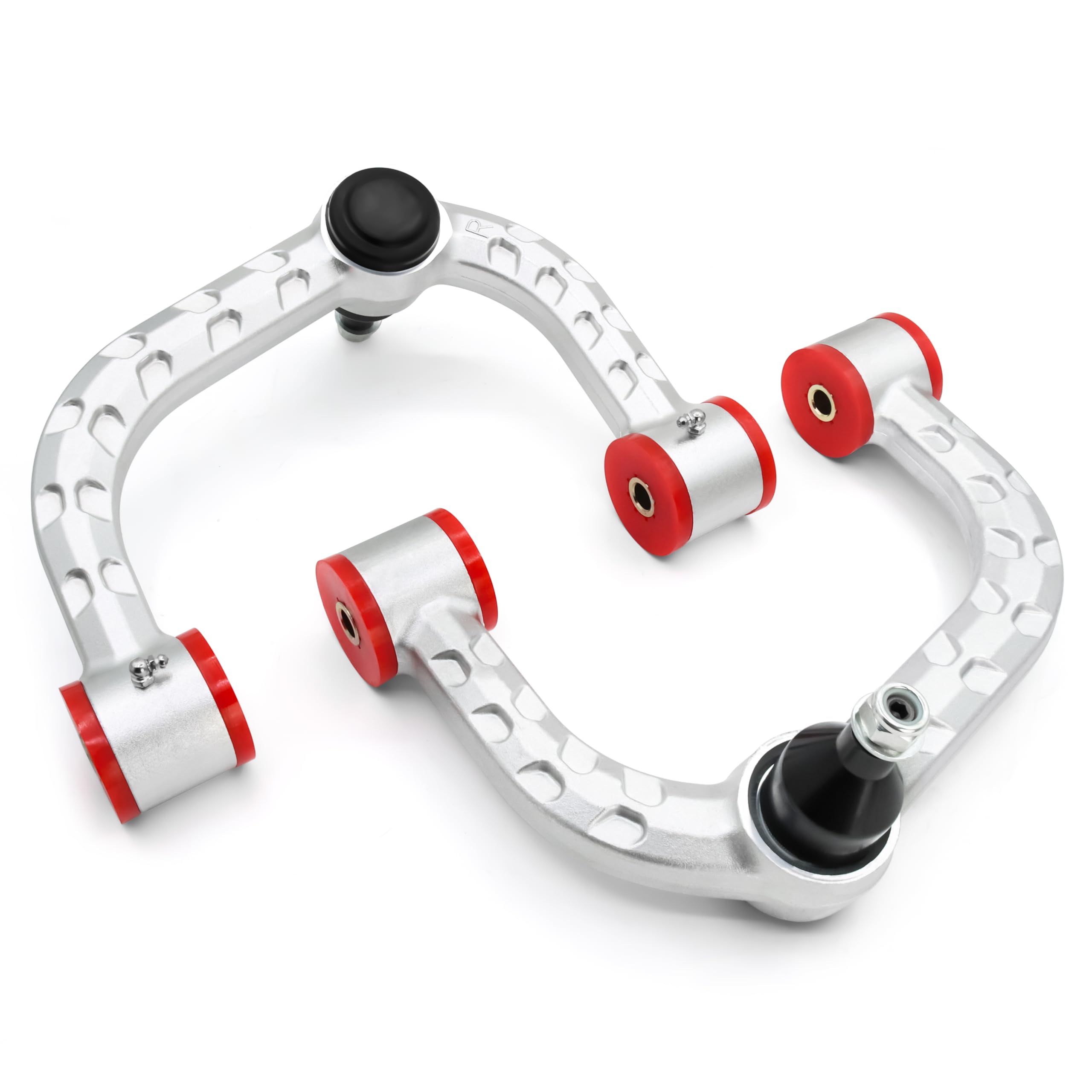
Lightweight cast aluminum for the F-150 that takes weight off the front end without giving up the adjustable ball joint.
Very few buyers have logged time with this F-150 aluminum arm yet — just over 20 ratings at a 4.8 — which is exactly why the spec sheet is worth reading closely. Aluminum’s weight advantage is real: less unsprung mass at the front end translates to quicker acceleration and braking response. The casting or forging process gives it strength to handle high suspension loads without flexing, and aluminum’s heat dissipation means the arm runs cooler under hard use than a comparable steel piece. It is rated for the 2004-2020 F-150 range with the same 2-4″ lift window as the steel arms in this list.
The bushings are the second reason to give this arm a look. Polyurethane delivers tighter feel and less noise and vibration than factory rubber, and it stays elastic across changing conditions rather than hardening with age. For a truck you drive daily, that is a handling and comfort difference you feel in the wheel. Anodizing on the aluminum adds both fade resistance and a cleaner look under the truck than bare cast metal. One F-150 owner who fitted these specifically noted that the ball joints can be replaced when they wear, unlike the factory units that force a full arm swap — that replaceability is a real long-term cost saver.
The known quirk: the grease fittings face inward when tightened, so a straight fitting rather than the supplied 90° one is often the easier greasing solution. That is a minor serviceability fix, not a structural issue. Beyond that, cast aluminum handles normal truck duty well but is not the material for boulder-bashing extreme off-road abuse — steel is the arm for that use case. If your F-150 lives on paved roads and graded trails, the weight savings are worth it.
Weight-conscious builds: buy these if you want a lighter front end and quicker steering response on a daily-driven, level-lifted F-150.
Heavy towing rigs: hard-core rock-crawlers who need the impact resistance of steel over the weight savings of aluminum.
6. 2-4in F150 Upper Control Arms, Front Steel Control Arm

The entry-point F-150 arm — thickened cold-drawn steel, a greaseable ball joint, and a two-year warranty at the lowest tier here.
For budget-conscious F-150 owners, this is a reasonable starting point. Thickened cold-drawn steel with powder coat is a durable build for the price, and the ball joint uses high-frequency heat-treated alloy steel for extra strength. The adjustable angle on the joint gives the alignment tech real room, and the hexagonal hole design makes installation easier. This arm is built for 2004-2020 F-150 FX4 4WD, though it will not fit the 2010-2014 SVT Raptor or the 2017-2018 Raptor.
The dust jacket is worth calling out because it does real work. A high-quality tower dust cover keeps mud and sand out of the ball joint, and keeping grit out is the single biggest factor in joint longevity. The grease zerk at the bottom of the joint has a dust cap to keep the nipple clean, and the arms ship pre-greased so you do not need to add additional grease within the first year. The PU bushing with surface U-groove reduces noise and works across both high and low temperature weather, addressing the weak point of factory rubber.
Two honest cautions here. The durability track record is more mixed than the arms above it in this list — some buyers have reported grease zerks snapping off and parts failing at the bushings over time. And more significantly, several owners have reported alignment shops struggling to get these arms dialed in properly. The two-year warranty covers you on paper, but alignment headaches are the kind of problem you want to avoid before you buy. If you are prepared to grease regularly and your local shop knows lifted F-150 geometry, the value is real; if you want a set-and-forget part, step up to the KSP arm at the top.
Daily driver F150: the right arm if you are lifting a 2004-2020 F-150 FX4 4WD on a tight budget and can keep up with greasing.
Rock crawler builds: you want a straight-through alignment on the first try or you drive a Raptor — this arm will not fit and alignment has been a reported sticking point.
7. Godspeed AK-093-C Adjustable Camber Front Control Arms

A ±3 degree camber range on heavy-duty steel alloy — the widest stated camber correction of anything in this lineup.
Most arms here correct geometry after a lift. This Godspeed arm goes further, giving you ±3 degrees of camber adjustment to dial in handling on a rear-wheel-drive Chrysler 300 from 2005-2023. The spherical bearing and corrosion-resistant finish are built for aggressive alignment work, and the direct-replacement OE arm design means installation is straightforward. It is not a lift arm the way the others in this list are — camber correction is the entire point here, and it does that with more range than any other pick on this page.
Buyers who have fitted them on a 2006 300C SRT8 report the fittage was the surprise of the experience: worry gave way to a clean install once the arm was mounted, and the red pearl gloss finish held up to close inspection. Alignment shops that know the platform have gotten the geometry precisely where the factory could not.
Before you buy, weigh two real compromises. First, this arm is specifically not designed for vehicles with excessive camber or air suspensions, and there are no installation instructions included — the maker strongly recommends an experienced professional. Second, the ball joint is non-greaseable with no zerk fitting, which means you cannot service it the way you can the greaseable joints on the KSP and dynofit arms here. Some buyers have reported the Allen bolts snapping under load and recommended upgrading to stronger hardware. Apparent fitment issues reported by a few owners came down to the joint sitting very close to the tire, requiring trimming to avoid contact.
Camber correction range: this is the arm to reach for when you need to dial camber out on a 300C and want the widest adjustment range available on this list — ±3 degrees versus the ±2 degrees of the SPC Tundra arms.
Shop alignment required: with no installation instructions and a non-greaseable joint, this one rewards experience — and you should inspect the Allen bolts and upgrade them if your build runs hard.
300 RWD cars: pick these if you want ±3 degrees of camber correction and are willing to have a professional do the install.
Air suspension cars: if your 300 runs air suspension or you want a greaseable ball joint you can service yourself, this is not your arm.
8. Specialty Products Company Toyota Tundra Adjustable Upper Control Arms

The alignment-first Tundra arm with a stated camber and caster range and a quoted 0.8 hour per side install time.
Tundras have a specific reputation problem: they can be hard to align after a lift, and not every shop gets them right. This SPC arm is built around solving exactly that. The published spec is ±2.0° of camber and a caster range of -1.0° to +3.0° on the front end — real, quantified correction range that a shop can dial into. The arm is 25 pounds of steel, sold as a set, and the maker quotes an install time of 0.8 hours per side with one kit required per axle. For a 2013 Rock Warrior, a 2021 with a 3″ front lift, or a 2008 with a spindle lift stacked on 5100s, this is the arm built to get the geometry back.
The adjustment design is the standout. Buyers who have run SPC arms on Tundra builds report the ball joint adjustments give the tech more to work with than the factory piece, and alignment shops that have used the system before know to dial the arm as part of the job. That includes trucks carrying a 3.5″ spindle lift plus Bilstein 5100s at the top setting — a stack that pushes the front end well past what a stock arm can correct. When your tires are getting chewed up after a lift, this arm is the fix that keeps a set alive through normal rotation.
Two things to plan for. The arms carry a premium price that some buyers feel is above the value delivered — but the functionality and adjustability outweigh the cost for most. And the recurring frustration is that some alignment shops ignore the UCA adjustment entirely and only dial the lower control arm cam bolts, which leaves the alignment mediocre even after installing these. Find a shop that understands adjustable UCAs, or you will not get the correction you paid for. The 4.6 rating reflects a product that works — how well it works depends on the person with the alignment rack.
Lifted Tundra trucks: buy these if you have gone over 2.5 inches, your stock arms have run out of adjustment, and you want measurable camber and caster correction with a documented install time.
Stock height trucks: confirm your alignment shop knows how to dial adjustable UCAs — if they only touch the lower control arm cam bolts, you will not see the correction you paid for.
Understanding the Specs
What “Adjustable” Actually Means
Not every arm sold as “adjustable” adjusts the same way. Some adjust camber through the ball joint angle — the SPC Tundra arm, for example, gives ±2.0° of camber and -1.0° to +3.0° of caster. Others, like the Godspeed 300C arm, use the ball joint to achieve ±3 degrees of camber correction. The KSP and dynofit arms rely on the longer arm length built for a 2-4″ lift to shift geometry back into spec. Read the specification sheet to understand which adjustment method your truck needs, because they are not interchangeable.
Steel vs. Aluminum vs. Forged Aluminum
Steel arms handle the heaviest punishment and are the choice for rock crawling and off-road abuse. Cast aluminum shaves weight off the front end for better acceleration and braking response, plus rust resistance in wet or salted conditions. Forged aluminum combines the low weight of aluminum with one-piece strength — no weld seams to fail. If you drive in salty winters, aluminum’s rust resistance is not a cosmetic benefit; it is a durability advantage. If you wheel hard terrain, steel is still the material for that use case.
FAQ
Will adjustable upper control arms fix my alignment after a lift?
Do I need spacers with aftermarket upper control arms?
How long do the ball joints last and when do they need grease?
Can I install these myself or do I need a shop?
Will my wheels rub after installing adjustable control arms?
What is the difference between camber and caster adjustment?
Do I need one kit per axle or per side?
Will aluminum control arms rust like steel ones?
Can I use these arms with aftermarket steering knuckles?
Final Thoughts: The Verdict
For most trucks, the adjustable upper control arms winner is the KSP 2-4″ Upper Control Arm for F150 2004-2020 because the 1.25″ DOM steel and PU bushing give you the alignment range and cold-weather durability a lifted F-150 actually needs. If rust resistance matters more than impact resistance, grab the SUCOSO Forged Aluminum F-150 arms. And for Silverado and Sierra 1500 owners who want replaceable PU bushings under a lifetime arm warranty, the dynofit Suspension Control Arm Kit is the one to reach for. Every product here has earned its place, and with new kits arriving with fewer than 30 ratings and established brands like KSP and dynofit holding hundreds, the smart move is to match the arm to your exact truck and lift range rather than chase the newest listing.
How We Picked
We do not accept paid placement. Every pick is matched to a real buyer and a real use-case; we do not hands-on test units.
Sources & Methodology
Specifications: manufacturer listings and product documentation. Review insights: verified customer reviews, as of September 2026. Pricing: not shown on this page (it changes often); check the current price via the retailer link.
As an Amazon Associate, Gadgets Feed earns from qualifying purchases. This does not affect which products we feature.