
Our readers keep the lights on and my morning glass full of iced black tea. As an Amazon Associate, I earn from qualifying purchases.
Specs are compiled from manufacturer listings and verified buyer reviews and can change over time — please confirm the key details on the product page before buying.
You plug a box fan into the wall and it runs at one speed forever. You plug an old tube amplifier in after a repair and hold your breath. A voltage regulator sits between the wall and the device and lets you dial the power up or down by hand — usually anywhere from zero to 130 volts — so you decide how hard that fan spins or how gently that amplifier wakes up. That is the whole job, and it is why people who roast coffee, run lathes, test vintage radios, or fix guitar amps keep one on the bench.
I’m Min — the founder and writer behind Gadgets Feed. This guide is built by comparing the manufacturers’ published specifications and the patterns across verified customer reviews, so you get each pick’s real strengths and trade-offs instead of marketing spin.
Most people walk in confused about one number — the amp rating — and walk out having bought a unit too small for their load. The picks below sort that out, and each one tells you plainly who it fits. If you want the short version of the adjustable voltage regulator hunt, the bench supply below covers the widest range of everyday jobs.
Our Picks at a Glance

How To Choose The Best Adjustable Voltage Regulator
The first fork in the road is not brand or price — it is what kind of electricity comes out the other end. Some of these units pass AC through, meaning the wall current goes in and adjustable wall current comes out. Others convert to DC, giving you a flat, steady output for circuit boards, chargers and bench testing. Pick the wrong one and the device simply will not run.
AC output or DC output — get this wrong and nothing works
If your job is slowing a fan, dimming a heating element, or soft-starting a vintage radio, you need AC output that stays at 60Hz. A variac does that without chopping the waveform, which is why it runs quiet. If your job is powering a laptop, testing a repaired board, or charging a lithium pack, you want DC output with a current limit you can set. Those are two different machines and neither substitutes for the other.
Match the amp rating to the surge, not the label
Motors pull a heavy burst of current the instant they start — far more than the number printed on their nameplate. A 5 amp motor can demand over 10 amps for a split second. If you size your regulator on the running amps alone, you will pop fuses every time you flip the switch. Leave headroom, and check whether the manufacturer states a continuous rating separately from a peak.
Assume the dial lies until you prove otherwise
A recurring theme across every unit here is that the printed scale on the knob drifts from the real output, and the drift gets worse at higher voltages. That is normal for this class of equipment. Budget to check the output with your own meter and mark your true set points with tape before you trust the dial for anything precise.
Quick Comparison
| Model | Best For | Rating / Capacity | Output Range | Type | Amazon |
|---|---|---|---|---|---|
| WANPTEK DPS3010U★ Best Overall | Bench repair and charging | 10 A | 0-30V DC | Bench supply | Amazon |
| DROK 0-24V Buck ConverterBest Value | Fixed-voltage DC projects | 20 A | 0-24V DC | Buck converter | Amazon |
| YaeCCC 500VA Variac | Small motor and fan control | 500 VA | 0-130V AC | Variac | Amazon |
| VEVOR 2000VA Auto Transformer | Heavy tools and shop use | 15.3 A | 0-130V AC | Variac | Amazon |
| LVYUAN 1000VA Variac | Tube gear and workshop isolation | 1000 VA | 0-130V AC | Variac | Amazon |
| YaeCCC 2000VA Variac | Quiet speed control | 20 A | 0-130V AC | Variac | Amazon |
| Beleeb 20Amp Variable Transformer | Long-run wood burning and shop tools | 15.38 A rated | 0-130V AC | Variac | Amazon |
In‑Depth Reviews
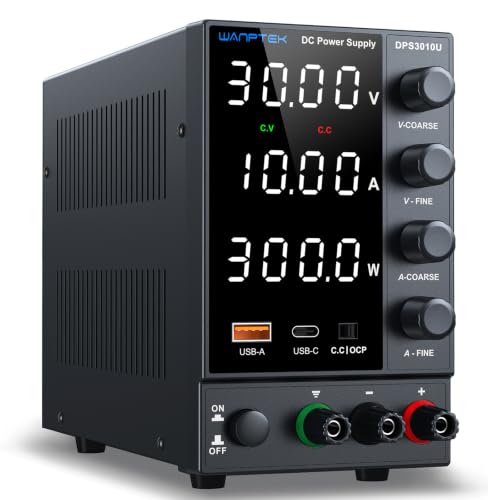
1. WANPTEK DPS3010U DC Power Supply Variable 0-30V 0-10A
Our pick — over 4.5★ from 600+ verified ratings; the strongest balance of quality and price.
Two knobs instead of one, so you set whole volts and decimal volts separately.
Building a bench supply is easy; building one that a beginner can actually dial is not. WANPTEK solves that with a coarse knob that sets the whole-number part of your output and a fine knob that sets the decimal, so hitting exactly 5.0 volts takes two quick twists instead of a dozen tiny nudges. The range runs 0-30V DC at up to 10 A, which covers a laptop, a phone, a tablet, or a repaired circuit board — and there is a Type-C port pushing 5V/3.6A so you can charge a phone on the same box while you work.
Two details earn their keep on a bench. When you short the load, the unit cuts output and sounds a buzzer instead of cooking your work, and it also carries grounding, leakage protection, overheating protection, voltage overload protection and power overload protection. The four-digit display reads clearly, and an intelligent temperature-controlled fan with a heat sink keeps the internals cool during long sessions. Power quality is the most-praised trait here, named by 76 owners, and it is why this unit handles the widest range of bench jobs in the group.
If you compare it to the Beleeb variac further down, you are looking at two different tools: this one outputs DC up to 30V, while the Beleeb outputs AC up to 130V. Buy the wrong one and your project simply will not run. The honest catch here is that a couple of owners have wrestled with the digital controls, and the unit beeps on every change unless you hold the voltage knob down for a few seconds to silence it. Since there is no physical output on/off switch, connecting cables while the unit is live can throw a small spark — power down first.
Where it earns its place
- Coarse and fine knobs let you land on an exact voltage fast
- 30V / 10 A range handles phone, laptop, tablet and bench repair
- Short-circuit buzzer plus overheat, overvoltage and overload protection
- Type-C port at 5V/3.6A charges a phone while you work
What to know before buying
- No physical output switch, so cable changes can spark if it is live
- Buttons beep on every adjustment until you disable the sound
- Purely DC output — no use for fans or heating elements
Reach for this if: your work involves circuit boards, chargers or repair and you want a DC bench supply that a beginner can dial precisely.
Look elsewhere if: you need to slow a fan, dim a heater, or soft-start vintage AC gear — a variac handles that, this one cannot.
2. DROK 24V Power Supply, AC 110V/220V to DC 0-24V 20A 480W Buck Converter
Twice the current of the bench supply above, but it will not go below a whisper on volts.
Here is the trade you need to understand before you buy this one. The WANPTEK bench supply pushes 10 A; the DROK pushes 20 A — a 2.0x gap that matters if you are driving a beefy motor, a diesel heater, or a bank of equipment. What 20 amps buys you is a converter that shrugs off loads the smaller unit would strain at, drawing from 110V or 220V input and spitting out 0-24V DC at up to 480W. A heat sink and a cooling fan kick in automatically when things get warm, and the fan stays quiet enough that most people never notice it running.
Setup is genuinely tool-free — connect your wires, rotate the inset potentiometer, and adjust to taste. Overload, overvoltage and short-circuit protection all sit inside the housing to catch a mistake before it reaches your device. Functionality is the most-praised trait, named by 62 owners, who use it for RV and car wiring, CCTV, and lab power.
Two things to check before you plug in. The factory default input voltage is 220V, so if you are on US mains you must flip the input voltage switch to 110V first — owners who missed this reported a max output around 22.8V and called the regulation poor until they fixed it. Also, the current is fixed at 20A regardless of where you set the voltage; you cannot dial the amps down, so anything you attach must be able to handle the full 20 A. As buyers report about the range: “The voltage displays shows it will go a few volts over 24v and I like the 3 sets of output terminals.”
The real strength: a 20 A ceiling in a compact housing that you can adjust with a single thumbwheel and that protects itself with overload, overvoltage and short-circuit shutoffs.
The catch: fixed 20 A output means it is not a precision current tool, and the input voltage switch must be set correctly or the readings look wrong from the first minute.
Worth it when: you want high current DC at a budget-tier price and your load sits comfortably inside the 0-24V window.
Skip it when: you need to control current as well as voltage — that requires a bench unit, not a buck converter.
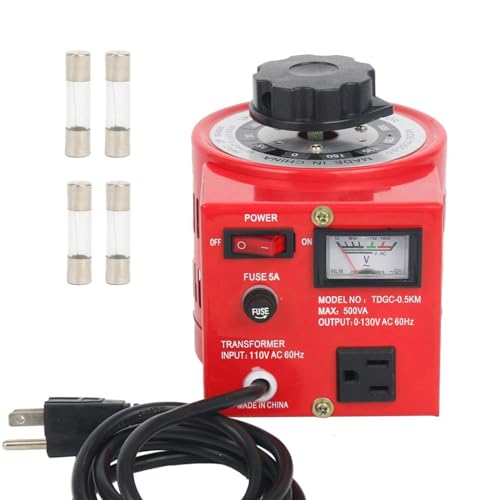
3. YaeCCC Variac, 500VA Variable Voltage Transformer
The entry ticket to AC control — a quarter the capacity, a fraction of the weight.
Compare this to the VEVOR 2000VA further down and the scale difference is the whole story: 500 VA here versus 2000 VA there, and about 8.4 pounds against roughly 15 pounds. That makes this the one to grab when you are slowing a small fan, controlling a modest motor, or doing light lab testing and you do not want a brick on your bench. Output runs 0-130V AC on a 110V input, the enclosed housing carries a lighted on/off switch, and there is a 5A fuse along with a power cord. Built-in copper coil and over-voltage protection round out the package.
The design detail worth knowing is that this is a non-isolated transformer, meaning your output is not electrically separated from the wall. That is normal for this class of variac, but it matters if you assumed it would isolate your test equipment. Functionality is the most-praised trait, named by 44 owners, who use it for fan speed control, coffee roasting, and railroad switching tests.
Now the honest part. The dial and the digital readout do not always agree, and a few owners found the real output drifting above the printed scale — one noted the dial running in 13V increments that added one to two volts each step, so a 130V mark delivered 148V. The lower end has its own quirk: output can sit at zero below roughly 80 VAC. Calibrate with your own meter and tape your real set points before trusting the label. Also leave headroom for motor surge — a 5 amp motor can pull over 10 amps on startup, and this transformer is not built for that.
Right pick for: the hobbyist who needs genuine AC voltage control for small loads and values a unit light enough to move around.
Wrong pick for: anyone running a large motor or heavy tool — the 500 VA ceiling and surge demand of big equipment will not fit.
4. VEVOR Auto Variable Voltage Transformer 2000VA, 15.3 Amp

Fifteen pounds of copper and steel that takes whatever your shop throws at it.
When you need to control something big — an inline ventilation fan, a bench tool, a coffee roaster with real draw — 2000 VA at 15.3 A is the headroom that keeps you out of trouble. Output spans 0-130V AC on a 110V/60Hz input, and the manufacturer recommends picking a transformer rated at least 25% above your combined device power so nothing strains. Protection here is layered: fuses, a thermal control switch and a resettable overload protector work together to shut the unit down before heat becomes a problem.
The digital display is the most-praised feature, named by 12 owners, who find it easy to read at a glance even in a dim workshop. Functionality leads the mentions overall at 41, which lines up with what owners actually do with it — soundproof studio ventilation is a favorite, where slowing an inline fan to near-silent levels is the entire point.
Two honest notes. The top wheel gauge does not account for variation in your incoming wall voltage, so treat the front LCD as the better reference and confirm with your own meter. A handful of owners have opened the case to reflow solder joints, which tells you the electronics inside are budget-grade even though the chassis feels heavy and solid. Treat the top wheel gently — it is the weakest mechanical part on the unit.
What you are buying
- 2000 VA capacity handles genuinely heavy loads
- Fuses, thermal switch and resettable overload protector in one box
- Easy-to-read digital display for quick voltage checks
- Solid all-metal build that feels substantial on the bench
Where it falls short
- Top wheel gauge ignores your incoming voltage variation
- Electronic internals are budget-grade despite the heavy chassis
- Top adjustment wheel is the most fragile component
Buy this one if: you are running a ventilation fan, a heating element, or a large tool and need serious capacity without going to industrial gear.
Consider alternatives if: your loads are small — you would be paying for capacity you never use and hauling fifteen pounds for nothing.
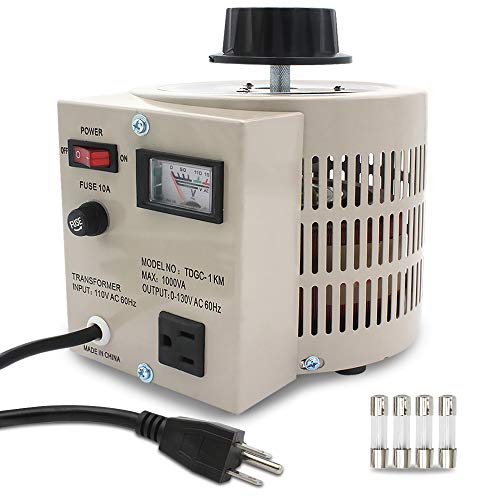
5. LVYUAN Variable Transformer Variable Voltage Regulator, 1000VA
Half the capacity of the heavy units, but built for the amplifier bench.
This is the one people reach for when they are working on vintage tube amplifiers and want a slow, controlled ramp-up. Output runs 0-130V AC on 110V input with a 1000 VA ceiling, so it sits neatly between the compact 500 VA unit and the heavy 2000 VA models. The core components use environmentally friendly materials, the unit runs odorless and noise-free, and it ships with four extra fuses in addition to the replaceable 10A fuse already fitted. Overload protection and an output voltmeter are built in.
For anyone fixing old radio equipment, the workflow is exactly what a variac was made for — start low, walk the voltage up slowly, and catch arcing or smoke before it becomes destruction. Owners use it for powering 110V tube amplifiers, testing medium vintage equipment alongside an isolation transformer, and even boosting voltage on Malibu landscaping lights that were flickering from a long wire run.
The single biggest thing to plan for is that the dial and the built-in analog meter do not tell the truth. Across owner reports, the dial runs low by as much as 20V at full scale, and several found the output hitting 150VAC when the spec caps at 130VAC. The built-in analog meter is small and inaccurate, reading low on its own. Plan on an external voltmeter and tape-mark your real targets. Also note this is designed around a 110V supply — on a 120-125V wall, the disparity between what the dial says and what comes out grows larger.
The natural fit: amplifier and radio restorers who want controlled AC at a mid-range capacity and value that four spare fuses are already in the box.
Not the right tool if: you want to trust a built-in gauge without owning a separate meter, or you need to run a big shop tool at the 1000 VA ceiling.
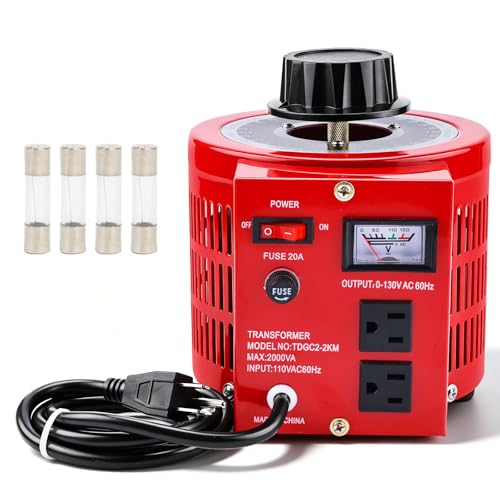
6. YaeCCC Variac, 2000VA Variable Voltage Transformer
Full 2000VA of capacity, and the one variac here that stays silent while it does it.
Quiet matters more than people expect. Electronic speed controllers chop the AC waveform to shed speed, and that chopping produces hum and interference — the reason cheap fan controllers buzz. This variac is a transformer, so it does not chop anything. The manufacturer states it runs with no humming or interference, and the speed is infinitely variable, which is exactly why it works for audio and recording spaces where fan noise ruins a take.
The numbers are serious: 20A maximum current, 110V AC input at 60Hz, 0-130V output and 2000 VA maximum rated power, all controlled by a top-mounted adjustment knob for what the listing describes as infinite precision. Build quality is the most-praised trait, named by 11 owners, and it shows in the copper coil and thermal grid heat dissipation design. Over-voltage protection is included, plus four extra fuses for when one blows unexpectedly. It weighs about 17.11 pounds, so plan a shelf or cart rather than moving it often.
One warning is worth taking seriously. A few owners have reported units that power on — the switch lights red — but whose outlets are energized the moment the transformer is plugged in, regardless of switch position. If you see that behavior, stop using it until you understand it. Separately, the voltage scale drifts increasingly high as you climb: one owner charted 50V reading as 53V, 75V as 86V, 100V as 115V and 125V as 143V. Verify with a meter before trusting the dial.
Why it stands out: transformer-based control means genuinely silent operation with no waveform chopping, and the 2000 VA capacity backs it up for full-size jobs.
What to watch: a handful of units have exhibited a power switch that does not actually cut the outlets, and the printed voltage scale runs increasingly high at the top of its range.
Made for: soundproof studios, recording spaces and anyone who needs smooth AC control without the hum of an electronic controller.
Second-guess it if: you want plug-and-play without verifying the output meter, or you cannot spare the shelf space for a 17-pound unit.
7. Beleeb 20Amp Variable Transformer Auto AC Voltage Regulator Power Supply

Built for the guy who runs it for hours at a time, not the guy who tweaks and walks away.
The spec that tells you what this unit is for is buried in the timing: rated output current of 15.38A, with continuous operation for 2 hours, and under 10A it runs continuously. That is a machine built for long sessions — Fractal wood burning current control, running a shop vac, driving corded tools under load. Input runs 110V at 18A, output spans 0-130V, and it peaks at 2KVA. One detail many buyers get wrong: this is an AC-only device. There is no DC bridge rectifier, so it will not convert AC to DC and it will not change the 60Hz cycle rate coming from the utility.
Build quality and value are the two most-praised traits, named by 10 owners each. The transformer design means no waveform chopping, so there is no hum, no buzz, and no interference — the same reason it works for the fan-controlling crowd. If you plan to push it hard, the manufacturer suggests examining the brushes and adjusting spring pressure on the windings to cut down brush-contact sparking. It is 16.1 pounds, so treat it as bench equipment rather than something you carry around.
The drawback is the housing. Thin sheet metal and a thin power cord without proper strain relief are real, and the durability notes reflect that. It is rated for 110V rather than 120V, which throws the dial scale and voltmeter off on a US wall — one owner reported setting 117V and getting roughly 127V out the other side. It also is not meant for CFL or LED bulbs, computers, or induction motors, so plan your load carefully. Experienced users just verify output with an external meter and carry on.
The case in favor
- 15.38A rated for 2-hour continuous runs, under 10A for true continuous
- Silent, no-hum transformer design with no waveform chopping
- 2000 VA peak handles heavy shop tool loads
- Ships with five spare fuses
The honest drawbacks
- Thin sheet metal housing and thin power cord
- Rated 110V, so the dial reads off on 120V US walls
- AC only — will not convert to DC or change cycle rate
- Not suitable for LED, CFL, computers or induction motors
Pick this if: you need a transformer rated for hours of continuous use under real load and you are comfortable checking output with your own meter.
Pass on this if: you want to plug in a computer, a modern LED fixture, or anything that expects a stable wall-socket feed.
Understanding the Specs
VA and amp ratings — and why peak is not continuous
VA stands for volt-amperes, the capacity of the transformer to move power. If a unit says 2000 VA and your device draws near that, you are pushing it to its limit. Manufacturers typically recommend sizing the transformer at least 25% above the total power of the devices you plan to run, so a 2000 VA unit works best under roughly 1500 VA of load. Amp ratings work the same way — a continuous rating like 15.38A is more honest than a peak claim of 20A, because the unit can only hold the peak briefly. When you see both numbers, trust the continuous one for planning.
AC versus DC output — the choice that decides whether anything works
A transformer-based regulator passes AC straight through at 60Hz and gives you a variable AC output. A DC bench supply or buck converter converts to DC and gives you adjustable DC output with finer control. Fans, heaters, lamps, tube amplifiers and vintage radios need the AC type. Circuit boards, chargers, lithium packs and anything with a chip needs the DC type. There is no crossover — you cannot run a fan from a bench supply or test a circuit board with a variac. Match the output type to the job before you compare anything else.
Why the dial never matches the meter
The printed scale on the adjustment knob is a mechanical approximation, and it drifts most at the high end. Owners of every AC unit here have found the real output exceeding the label as voltage climbs — one reported a 130V mark delivering 148V, another had 125V showing 143V out. The lower end has its own quirk: some transformers drop to zero below roughly 80 VAC. The practical fix is simple. Own an external voltmeter, dial in your real set points once, and mark them with a piece of tape or a paint pen.
Surge current and why fuses blow on startup
Motors and heating elements pull a heavy burst of current the instant power hits them — significantly more than their running rating. A 5 amp motor can draw over 10 amps for a split second on startup. Size a regulator on running amps alone and every power-up pops a fuse. The fix is headroom: pick a unit whose capacity comfortably exceeds the surge, not just the working load. This is why a 500VA transformer cannot run a device that pulls 5 amps on paper, and why the listing copy on several units here explicitly warns about it.
FAQ
Can I use a variac to power a laptop or charge a phone?
What is the difference between a variac and a bench power supply?
Why does my variac output more voltage than the dial says?
How do I size a voltage regulator for a motor or fan?
Do I need an isolation transformer too, or is a variac enough?
Can I run a diesel heater or RV appliance on a DC converter?
Why does my unit beep or hum while I am using it?
Are these regulators safe for circuit boards and small electronics?
Should I buy the 500VA or the 2000VA version of the same brand?
Final Thoughts: The Verdict
For most people hunting an adjustable voltage regulator, the WANPTEK DPS3010U wins on range and usability — a 0-30V DC output with coarse and fine knobs that actually lands on the number you want, backed by the crowd that shops this category. If you need AC voltage control for a fan, ventilation or vintage amplifier, the VEVOR 2000VA Auto Transformer carries the headroom for real loads, and the YaeCCC 2000VA is the one to reach for if silent operation matters more than the extra capacity. Buy your meter first either way — every one of these units reads differently from the number printed on its dial.
How We Picked
We do not accept paid placement. Every pick is matched to a real buyer and a real use-case; we do not hands-on test units.
Sources & Methodology
Specifications: manufacturer listings and product documentation. Review insights: verified customer reviews, as of September 2026. Pricing: not shown on this page (it changes often); check the current price via the retailer link.
As an Amazon Associate, Gadgets Feed earns from qualifying purchases. This does not affect which products we feature.