
Our readers keep the lights on and my morning glass full of iced black tea. As an Amazon Associate, I earn from qualifying purchases.
Specs are compiled from manufacturer listings and verified buyer reviews and can change over time — please confirm the key details on the product page before buying.
Campground water pressure is a gamble — one spike above 80 PSI can burst your RV’s internal plumbing, turning a relaxing trip into a soggy repair nightmare. An adjustable water pressure regulator lets you dial in exactly the right pressure for your rig, protecting your pipes while still giving you a decent shower. The best models combine accuracy, durability, and tool-free handwheel adjustment.
I’m Min — the founder and writer behind Gadgets Feed. This guide is built by comparing the manufacturers’ published specifications and the patterns across verified customer reviews, so you get each pick’s real strengths and trade-offs instead of marketing spin.
Whether you’re a full-time RVer or a weekend camper, picking the right adjustable water pressure regulator means the difference between leak-free seasons and a mid-trip failure you didn’t see coming.
Our Picks at a Glance


How To Choose The Best Adjustable Water Pressure Regulator
Every adjustable water pressure regulator does the same basic job: it steps down high incoming water pressure to a safe level for your RV or home plumbing. But the differences in materials, gauge quality, and adjustability separate the ones that last for years from the ones that fail mid-season. Here is what separates a smart buy from a regret.
Lead-Free Brass vs. Economy Materials
The regulator body material directly affects your drinking water safety. Most quality units use C46500 lead-free brass, tested to contain less than 0.13% lead — well under the NSF requirement of 0.25%. That matters because this regulator sits between the campground water supply and your fresh water tank. Cheaper plastic or unlabeled brass regulators can leach heavy metals over time, especially with hot weather exposure in your exterior compartment.
Oil-Filled Gauge vs. Dry Gauge
The pressure gauge is often the first part to fail on these regulators. A dry gauge has moving metal parts that corrode and wear out from the constant vibration of water flow and pressure spikes. An oil-filled gauge (usually glycerin) cushions those vibrations, keeps the needle steady, and slows corrosion. That is why reviewers who store their regulators through winter often report their oil-filled gauges still reading accurately come spring, while dry gauges can drift by 20 PSI or more after a freeze.
Handwheel Adjustment vs. Screwdriver Adjustment
You want a regulator you can adjust at the spigot without hunting for tools. The best designs use a large handwheel on top — just pull up, turn, and watch the gauge change. Old-style regulators require a flathead screwdriver, which is awkward when you are crouched next to a wet hose bib. If you change campgrounds often (and face wildly different water pressures), the handwheel convenience saves you time and frustration every single setup.
Quick Comparison
| Model | Best For | Material | Gauge Type | Adjustment | Amazon |
|---|---|---|---|---|---|
| Boltigen★ Best Overall | Best Overall | Lead-Free Brass | Dry Gauge | Handwheel | Amazon |
| GickbususBudget Champ | Budget Pick | Leadless Brass | Silicone Oil | Handwheel | Amazon |
| MEASUREMAN | Long-Term Durability | Lead-Free Brass | Glycerin-Filled | Handwheel | Amazon |
| Hourleey | Mid-Range Value | Lead-Free Brass | Dry Gauge | Handwheel | Amazon |
| Kohree | Compact Design | Lead-Free Brass | Dry Gauge | Handwheel | Amazon |
| Oppsiue | Premium Build | Lead-Free Brass | Silicone Oil | Handwheel | Amazon |
| Morvat | Complete Kit | Nickel Plated Brass | Silicone Oil | Screwdriver | Amazon |
In‑Depth Reviews
1. Boltigen RV Water Pressure Regulator with Gauge
Our pick — over 4★ from 650+ verified ratings; the strongest balance of quality and price.
The no-tools handwheel design that replaced the screwdriver fiddling of old-style regulators.
This Boltigen regulator earns the top spot because it gives you three things every RVer actually needs: lead-free brass construction (tested to under 0.13% lead, below the 0.25% NSF requirement), a large handwheel you turn without tools, and a wide 0-160 PSI adjustment range. Unlike the fixed 40-45 PSI regulators many campgrounds sell, you can dial this one up for a forceful shower or down to protect older plumbing — the gauge shows the exact pressure so you are not guessing. Buyers report the handwheel adjustment is “much better than our previous regulator that needed a wrench to adjust.”
The trade-off is that the gauge is a dry type (no oil inside to dampen needle vibration), not oil-filled. One reviewer noted the first unit leaked oil from the gauge area after about 50 nights of camping, though the needle still read pressure — they bought a second one because they liked the design enough to stay with it. At six weeks of use per the same buyer, the replacement was still working fine. If you camp only a few weekends a year, this is unlikely to be an issue for years.
The included extras — two inlet screened filters and a roll of thread sealing tape — mean you can install it right from the start without a hardware store trip. The filter catches debris before it hits the regulator internals, which helps the unit last longer between cleanings. Overall, this is the most balanced pick for the typical camper who wants reliable protection and easy tool-free setup.
Where It Wins
- Handwheel adjustment requires zero tools — pull up and turn
- Lead-free brass is safe for drinking water systems
- Comes with two inlet filters and sealing tape for immediate install
Where It Falls Short
- Dry gauge can lose oil seal over extended use (some buyers reported oil leak after ~50 nights)
- One reviewer found the first unit leaked oil from the gauge area; they replaced with the same model
Best for most campers: If you want a simple, tool-free setup with safe materials and reliable adjustment for weekend to moderate seasonal use, this is the pick.
One real trade-off: The dry gauge may develop an oil weep after heavy use — not a failure, but something full-timers should budget for.
2. Gickbusus RV Water Pressure Regulator Valve
The lightest regulator on this list at 1.3 lbs, with an oil-filled gauge that handles cold better.
This Gickbusus regulator punches above its price tier by including a silicone oil-filled gauge on a budget-friendly unit — a feature you normally have to pay a premium for. The oil protects internal metal parts from oxidation and corrosion, and as one buyer mentioned after an accidental freeze, the gauge survived and still worked (though it read 20 PSI off after thawing). That same reviewer replaced it with the same unit, specifically praising the glycerin in the gauge for handling occasional cold weather better than dry gauges would. The adjustment handwheel works without tools, so you can dial in pressure at the spigot in seconds.
Compared to the Boltigen above, this unit is notably more compact at 4.09 x 1.81 x 4.13 inches versus the Boltigen’s 6.77 x 6.77 x 2.76 inches. That smaller footprint makes it easier to stow in a small compartment or toss in a bag. The leadless brass body still tests under 0.13% lead — well below the 0.25% NSF standard — so drinking water safety is not sacrificed for the lower price.
One thing to note: the included strainer is a single-piece design, not the two-filter setup that pricier units include. And the 30-day warranty is shorter than the 1-year coverage most competitors offer. But for an oil-filled gauge at this entry-level price, the Gickbusus is a smart choice for new RVers or those on a tight budget who still want protective features.
Why It Stands Out
- Silicone oil-filled gauge for better corrosion resistance and vibration dampening
- Compact size (4.09 x 1.81 x 4.13 inches) fits in small storage spaces
- Leadless brass construction safe for drinking water
Watch Out For
- 30-day warranty is much shorter than the 1-year terms on most competitors
- One owner reported gauge drifted by 20 PSI after an overnight freeze (though the unit remained usable)
Perfect for budget-conscious buyers: If you want oil-filled gauge protection at the lowest entry point, this is your unit — just store it indoors during freezing weather.
One real limit: The short 30-day warranty means you will want to test it thoroughly in the first month of ownership.
3. MEASUREMAN Adjustable Lead-Free Brass RV Water Pressure Regulator
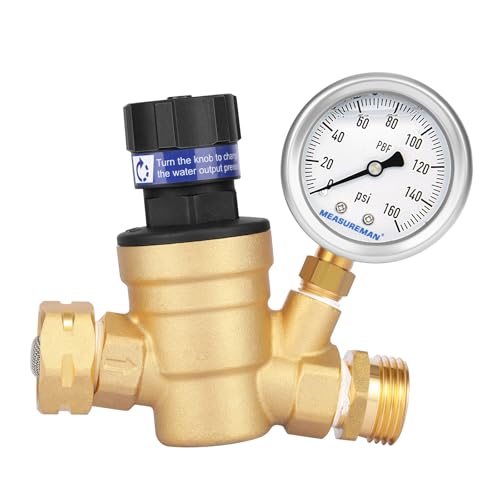
The one that survived four years of RV travel while other regulators failed around it.
This MEASUREMAN regulator is built for the long haul, and the proof is in the reviews — one customer observed using it for over 4 years without issues, stating “I’ve watched RV YouTubers complain their regulators break. Not this one.” The secret is the combination of a 2-inch glycerin-filled pressure gauge (0-160 PSI range) with a 304 stainless steel casing, which cushions vibration and pulsation far better than a dry gauge. The body itself uses lead-free brass with lead-free copper fittings and a lead-free soldering process, fully complying with California AB 1953 and the 2014 U.S. Safe Drinking Water Act.
The included accessories add real value: the unit comes with Teflon seal tape and a full set of installation accessories, all stored in a protective portable canvas bag. That bag makes a difference when you are packing up camp — instead of hunting for the regulator in a bin, it stays in its own case with the Teflon tape right there. The adjustable handwheel lets you set output pressure without tools, and the fan-shaped aluminum pointer on the gauge makes readings clear even in low light. One reviewer using it for an automatic home watering system said it was “fantastic — simply turn the knob and watch the gauge.”
Size is the main consideration here. At 6.77 x 6.77 x 2.76 inches, it is as wide as it is tall, taking up more compartment space than the Gickbusus. And while most reviews are glowing, one buyer had a critical experience — they reported two units that drifted from 60 PSI to 95 PSI within weeks, stating the pressure would not stabilize. That is a small sample of failure complaints, but note if you plan on heavy full-time use. The 1-year manufacturer warranty provides at least some recourse.
Built to Last
- Glycerin-filled gauge with 304 stainless steel casing for long-term durability
- Owners mention 4+ years of reliable use in RV travel
- Comes in a protective portable canvas bag with all accessories
The Catch
- One buyer had two units fail with pressure drift from 60 to 95 PSI within weeks
- Larger footprint (6.77 x 6.77 x 2.76 inches) takes up more storage space
Ideal for full-timers and long-haul travelers: If you want the best chance of a regulator that lasts multiple seasons without replacement, the MEASUREMAN leads on durability.
One real concern: The larger size and occasional stability issues mean you should test the unit on first use and keep the warranty info handy.
4. Hourleey RV Water Pressure Regulator
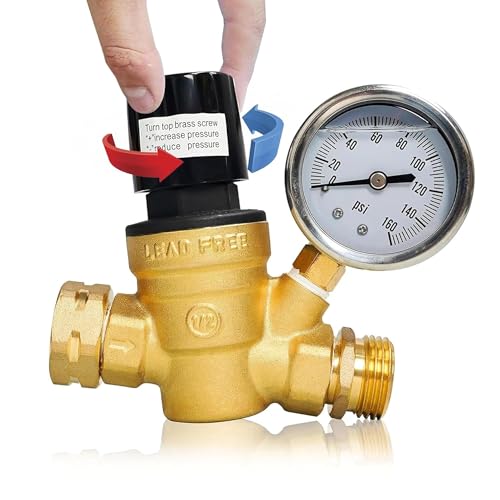
The regulator that arrives pre-set to 43.5-45 PSI — right where most RVs want it.
The Hourleey regulator simplifies setup by coming factory-set at approximately 45 PSI, so if your campground pressure is reasonable, you can just screw it on and go. One reviewer confirmed theirs arrived at exactly 45 PSI, matching the paperwork that stated 43.5 PSI — that kind of consistency from the start saves you from fiddling at the spigot. The enhanced adjustable handwheel requires no tools: just pull up the knob and turn it to adjust pressure up to 160 PSI. The lead-free brass construction (under 0.13% lead, below the NSF 0.25% standard) keeps your drinking water safe.
The 3/4-inch hose female inlet and 3/4-inch male outlet fit standard American water sources and RV hoses. A built-in screened filter catches debris before it can clog the regulator. One buyer using it on their RV said it “took 80 PSI down to 45 PSI” and worked better than the preset 25 PSI regulators they had used before. Another reviewer who owned it for two seasons said it was still working great — a solid sign of mid-term durability.
The durability picture is not perfect, though. One user highlighted replacing this regulator three years in a row, saying it worked through summer, fall, and winter, then leaked water early in spring each time. That buyer lives in South Carolina (not severe cold) and insulates the unit during winter. A separate buyer was also unhappy, claiming the “twist top” adjustment still required a screwdriver in practice — a direct contradiction of the product’s handwheel claim. If you camp in areas with frequent freeze-thaw cycles, the gauge longevity may be a concern.
What Works
- Factory pre-set to ~45 PSI for out-of-box use
- Lead-free brass with under 0.13% lead content
- Customers note two seasons of reliable use
What Doesn’t
- One buyer replaced it three years in a row for spring leaks
- Mixed reports on whether the adjustment knob works as advertised without tools
Good match for seasonal campers: If you camp a few months each year and want a pre-set, no-tools regulator that works right away, this is a fine choice.
One caveat: Frequent cold-weather exposure or full-time use may lead to shorter lifespan — budget for a replacement every year or two.
5. Kohree RV Water Pressure Regulator

The featherweight at 310 grams that does not sacrifice brass build quality.
At 310 grams (about 0.68 lbs), the Kohree is one of the lightest adjustable regulators you can buy — the Gickbusus weighs 1.3 pounds — without going to plastic construction. It uses the same C46500 lead-free brass as the heavier units, with lead content under 0.13%. The factory pressure setting is 45 PSI, and the 0-160 PSI adjustment range covers every reasonable campground scenario.
The 2-layer inlet screened filter is a practical upgrade over single-layer designs. Two layers catch finer particles, reducing the chance of debris reaching and damaging the regulator’s internal diaphragm. The 3/4-inch GHT inlet and outlet fit standard garden hoses and RV water systems. Kohree backs this with a 1-year manufacturer warranty, which matches the premium-tier coverage. The compact 3.94 x 3.15 x 3.15-inch footprint stows easily.
There is a durability gap, though. One shopper added a defective unit that got stuck at 80 PSI and would not lower — after some trial and error they got it down to 30 PSI, but then the knob seized entirely. The vendor refunded them, and the buyer acknowledged they likely received a defective unit rather than a design flaw. Still, the failure mode (knob lockup at high pressure) is worth factoring in if you often deal with very high campground pressures over 100 PSI. Another reviewer praised the “quality piece of brass” that “works flawlessly” with no leaks after long-term use, so your mileage may vary.
Advantages
- Very light at 310 grams — easy to carry and store
- 2-layer inlet filter catches finer debris than single-layer designs
- 1-year manufacturer warranty provides confidence
Disadvantages
- One buyer received a defective unit where the knob seized at high pressure
- Customer support was responsive (refund issued), but failure still required a replacement
Best for travelers who pack light: If every ounce in your RV storage matters, the Kohree gives you brass durability in a featherweight package.
One thing to check: Test the full pressure range immediately upon first connection — a small batch may have knob binding issues at the high end.
6. Oppsiue RV Water Pressure Regulator with Colorful Gauge
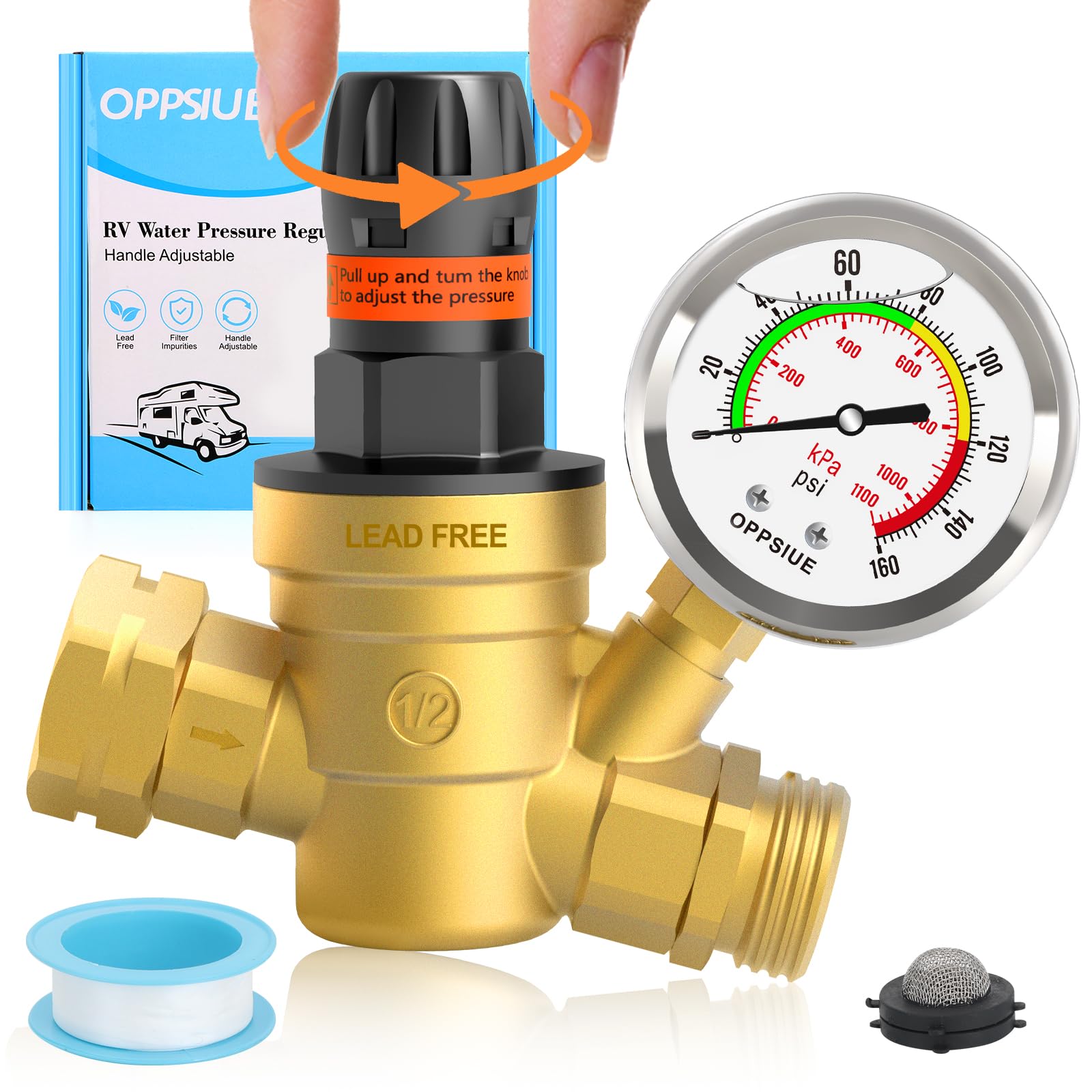
The color-coded gauge that tells you at a glance if your pressure is in the danger zone.
The Oppsiue stands out with a dual-unit digital pressure display that shows both PSI and kPa (kilopascals, another pressure unit), with a “green, yellow, and red” color-coded warning indicator on the gauge face — so you know instantly if your water pressure is in the safe zone, getting high, or dangerous. The factory default is 43.5 PSI (300 kPa), and the unit handles an inlet maximum of 232 PSI (1600 kPa) with an adjustable range from 14.5 PSI (100 kPa) to 87 PSI (600 kPa). Inside the gauge, silicone oil (not glycerin) provides shock resistance and vibration dampening, with a stainless steel casing that resists bursting better than iron gauges without oil. The body uses C46500 lead-free brass with lead content under 0.13%.
Buyers consistently praise the accuracy and ease of use. One reviewer called it “accurate and easy to use,” noting the numbers are easy to see on the gauge and the regulator is easy to dial down pressure. Another buyer said it was “sturdy” and “works like advertised.” The 3/4-inch NH threads fit American standard connections without adapters, and the inlet screen filter catches sand, stones, and leaf debris. Instructions are printed directly on the adjustment knob — a small but thoughtful touch for beginners who might lose a paper manual.
The premium features come with a premium price, putting it near the top of this list. The packaging is a “beautiful and sturdy box” that also serves as storage, though it is larger than the canvas bag that the MEASUREMAN comes with. The 1-year manufacturer warranty matches the industry standard. If you do not need the color-coded gauge or the dual-unit display, you can save money with a simpler unit. But if you want immediate visual feedback on your pressure status — especially helpful if your RV’s interior gauge is in a different spot — the Oppsiue delivers that clarity.
Unique Strengths
- Color-coded gauge (green/yellow/red) for instant pressure status reading at a glance
- Silicone oil-filled stainless steel gauge for shock resistance and vibration dampening
- Dual-unit display (PSI and kPa) accommodates international users
Drawbacks
- Premium price — costs more than most competitors on this list
- Larger storage box may not fit in tight compartments
Great for visual learners and safety-conscious users: If seeing the pressure zone color at a glance gives you confidence, this gauge is worth the extra cost.
One practical note: The gauge is only as durable as its silicone oil — drain it before freezing storage to keep the color bands accurate.
7. Morvat Premium Lead-Free Nickel Plated Brass RV Water Pressure Regulator

The nickel-plated finish that resists corrosion and looks clean on your RV exterior.
The Morvat regulator takes a different approach from most of the list: instead of a handwheel, it uses a screwdriver-based adjustment (and helpfully includes a tiny screwdriver in the box). That means you lose the tool-free convenience of the other picks, but you gain a sleek nickel-plated brass exterior that resists rust and corrosion better than uncoated brass — a real advantage if you leave the regulator connected for long stretches at coastal or humid campgrounds. The silicone oil-filled gauge reduces friction and vibration, and the 0-160 PSI range covers every scenario. It also includes two extra rubber washers and a roll of Teflon tape, so you have everything for a leak-free install.
Reviewers point out accurate pressure readings that match interior RV gauges — one Thor Majestic owner noted the pressure from the outside regulator matched exactly what their inside panel showed. Another reviewer who owns a vintage tow-behind said it “worked perfectly, prevents damage” to older plumbing systems. The first unit someone received worked through one season; after winter storage in its box, an oily substance appeared in the gauge. It still read accurately through the second summer, but the appearance changed. That is a cosmetic rather than functional issue, but worth knowing if you care about pristine gauge clarity.
The premium price is the main sticking point — it is the most expensive unit here, and the screwdriver adjustment feels like a step backward compared to the handwheel regulators that cost less. One reviewer noted “the price could use some adjustment” and called it “a bit too high priced.” You are paying for the nickel plating and the complete kit (screwdriver, washers, Teflon tape), not for innovative adjustability. If corrosion resistance at the connection points is your top priority (coastal camping, frequent rain exposure), the nickel plating solves that problem better than any raw brass unit.
What It Does Best
- Nickel-plated brass resists rust and corrosion better than uncoated brass
- Complete kit includes screwdriver, two rubber washers, and Teflon tape
- Shoppers say accurate gauge that matches interior RV pressure readings
Where It Lags
- Requires a screwdriver for adjustment — no tool-free handwheel here
- Premium price with one buyer noting it is “a bit too high priced”
- One unit developed oily residue in gauge after winter storage, though accuracy remained
Best for coastal or humid environments: If rust resistance at the connection threads matters more than tool-free adjustment, the nickel plating makes this a strong choice.
One caveat: The screwdriver adjustment is less convenient than handwheel competitors at a similar or lower price — be sure you do not mind the extra step.
Understanding the Specs
Lead-Free Brass and NSF Certification
The regulator body material directly affects your drinking water safety. Quality units use C46500 lead-free brass, tested to contain less than 0.13% lead — well under the NSF requirement of 0.25%. That certification means the regulator will not leach heavy metals into your fresh water supply, even with prolonged contact. If a product does not mention lead testing or NSF compliance, assume the brass or alloy could contain higher lead levels that are unsafe for drinking water.
Oil-Filled vs. Dry Pressure Gauges
The gauge is the most common failure point on these regulators. A dry gauge (no oil inside) is cheaper but more susceptible to corrosion and mechanical wear from water-hammer vibration. An oil-filled gauge (usually silicone oil or glycerin) cushions the needle movement, absorbs shock, and prevents the internal metal parts from rusting. That is why oil-filled gauges often last through multiple seasons while dry gauges may start to stick or read inaccurately after a single winter in storage. The trade-off is cost: oil-filled units generally run a few dollars more.
FAQ
What PSI should I set my RV water pressure regulator to?
Can I use an RV water pressure regulator for my home garden hose?
How do I know if my RV water pressure regulator is failing?
Should I leave my water pressure regulator connected all the time?
What is the difference between a fixed pressure regulator and an adjustable one?
Will a water pressure regulator reduce my shower pressure too much?
How often should I replace the inlet screen filter on my regulator?
What does the oil in the gauge do, and does it ever need to be replaced?
Final Thoughts: The Verdict
For most buyers, the adjustable water pressure regulator winner is the Boltigen because it delivers the best balance of lead-free brass safety, tool-free handwheel convenience, and a reliable pressure gauge — all at a competitive price that works for weekend and moderate seasonal RV use. If you want the longest-lasting gauge that survived four years of real-world use, grab the MEASUREMAN with its glycerin-filled gauge and portable storage bag. And for the best value with an oil-filled gauge at the lowest entry price, the Gickbusus punches well above its weight class in features per dollar.
How We Picked
We do not accept paid placement. Every pick is matched to a real buyer and a real use-case; we do not hands-on test units.
Sources & Methodology
Specifications: manufacturer listings and product documentation. Review insights: verified customer reviews, as of July 2026. Pricing: not shown on this page (it changes often); check the current price via the retailer link.
As an Amazon Associate, Gadgets Feed earns from qualifying purchases. This does not affect which products we feature.