
Buying your first telescope is a leap of faith — faith that the blurry spec in the eyepiece will eventually transform into the sharp, cratered face of the Moon or the unmistakable rings of Saturn. The problem is that most “beginner” scopes are marketed as toys, leaving you with a wobbly tripod and a lens that shows you less than your naked eyes. The right scope, however, drops you straight into a genuine celestial experience on your first clear night.
I’m Min — the co-founder and writer behind Gadgets Feed. I’ve spent dozens of hours analyzing the technical specifications, build quality, and real-world user feedback behind this category to separate the genuine instruments from the plastic disappointments.
This guide cuts through the hype to deliver the definitive list of the best adult beginner telescope choices, ranked by optical performance, mount stability, and the accessories that actually matter.
How To Choose The Best Adult Beginner Telescope
The difference between a telescope you use every clear night and one that collects dust in a closet comes down to three things: the light-gathering capability of the objective lens, the stability of the mount, and the quality of the eyepieces. A 90mm aperture scope will always outperform a 60mm one, regardless of the magnification printed on the box. Prioritize the optical tube over the accessories.
Aperture — The Real Power Number
Every beginner fixates on magnification, but aperture (the diameter of the main lens or mirror) is what determines image brightness and detail. A 70mm scope shows the Moon nicely. An 80mm scope reveals the bands of Jupiter and the rings of Saturn. A 90mm or 100mm scope brings out subtle features on Mars and the brighter deep-sky objects like the Orion Nebula. For an adult beginner, 80mm is the minimum; 90mm is the sweet spot.
Mount Stability — The Silent Killjoy
A wobbly mount ruins every observation. An Alt-Azimuth mount with slow-motion control cables provides smooth, precise tracking without the complexity of an equatorial mount. Stainless steel legs are heavier but far more stable than aluminum. The tripod should feel solid at full extension — a shaky base magnifies every breeze into a blurry image.
Focal Length and Eyepiece Quality
Longer focal lengths (700mm to 900mm) deliver higher native magnification and are better for planetary viewing. Shorter focal lengths (400mm to 500mm) offer wider fields of view for star clusters and the Moon. Kellner eyepieces are standard at this price point; they are a solid step above the basic Huygens design and provide a comfortable eye relief for glasses wearers.
Quick Comparison
On smaller screens, swipe sideways to see the full table.
| Model | Category | Best For | Key Spec | Amazon |
|---|---|---|---|---|
| Celestron StarSense Explorer LT 80AZ | Refractor | Guided sky tours | 80mm aperture, 400mm focal length | Amazon |
| Hawkko 90mm | Refractor | High magnification | 90mm aperture, 900mm focal length | Amazon |
| MEEZAA 90mm | Refractor | Optical clarity | 90mm aperture, 800mm focal length | Amazon |
| Dianfan 90mm | Refractor | Solid build quality | 90mm aperture, 800mm focal length | Amazon |
| Koolpte 90mm | Refractor | Smooth tracking mount | 90mm aperture, 700mm focal length | Amazon |
| Celticbird 80mm | Refractor | Long focal length value | 80mm aperture, 900mm focal length | Amazon |
| HUGERSTAR 80mm | Refractor | Entry-level value | 80mm aperture, 600mm focal length | Amazon |
| MEEZAA 80mm | Refractor | Portable kit | 80mm aperture, 500mm focal length | Amazon |
| Dianfan 80mm | Refractor | Family stargazing | 80mm aperture, 500mm focal length | Amazon |
In‑Depth Reviews
1. Celestron StarSense Explorer LT 80AZ

The Celestron StarSense Explorer LT 80AZ changes the game for beginners by using your smartphone’s camera as a celestial navigation system. The patented StarSense technology analyzes the star patterns overhead and guides you to objects with on-screen arrows — no star charts or prior knowledge required. The 80mm aperture with fully coated glass delivers sharp, vivid views of the Moon, Jupiter’s bands, Saturn’s rings, and even the Orion Nebula from suburban skies.
The manual altazimuth mount includes an altitude slow-motion rod for smooth tracking, though the 400mm focal length produces a wider field of view that can make smaller objects appear small at low power. The kit includes 25mm and 10mm eyepieces plus a 2X Barlow lens. The StarPointer red dot finder scope is easy to align for daytime setup. Celestron’s 2-year US warranty and California-based support add genuine confidence to the purchase.
Users consistently report that even complete novices are finding Saturn’s rings and Jupiter’s moons on their first night. The app generates a curated list of the best visible objects based on your exact time and location. For an adult beginner who wants a frictionless path to real discoveries, this is the definitive choice.
Why it’s great
- App-based navigation eliminates the learning curve of finding objects manually
- Backed by Celestron’s 2-year warranty and US-based support team
- Compact 400mm focal length offers wide, forgiving field of view
Good to know
- 80mm aperture limits performance on dim deep-sky objects compared to 90mm scopes
- Short focal length means lower native magnification on planets
2. Hawkko 90mm

The Hawkko 90mm combines the largest aperture in this roundup with a long 900mm focal length (f/10), delivering crisp, high-contrast views of the Moon, Jupiter, and Saturn. The professional-grade full multi-layer coating (FMC) improves light transmittance by approximately 73 percent, producing brighter images than standard single-coated optics. With the included 25mm and 10mm eyepieces plus a 3X Barlow lens, you get a magnification range from 36X to 270X.
The stainless steel AZ mount tripod supports smooth 360-degree rotation and adjusts from 28 to 46 inches, accommodating users of different heights. The built-in accessory tray keeps eyepieces organized and adds structural rigidity. Setup takes roughly 15 minutes with clear instructions. The included smartphone adapter works well for capturing lunar and planetary images, though achieving perfect alignment takes practice.
User feedback highlights excellent lunar crater detail visible at 90X and clear views of Jupiter’s cloud bands. The finder scope is effective for locating targets. At this price point, the Hawkko delivers a combination of aperture, focal length, and build quality that challenges more expensive scopes. It is ideal for the adult beginner who wants room to grow without immediately needing an upgrade.
Why it’s great
- 90mm aperture and 900mm focal length provide excellent planetary and lunar detail
- Fully multi-coated optics for superior light transmission and contrast
- Stainless steel tripod offers outstanding stability for the category
Good to know
- At 5 kilograms, it is heavier than competing 80mm models
- High magnification with the Barlow lens requires very steady conditions to be useful
3. MEEZAA 90mm

The MEEZAA 90mm refractor features an 800mm focal length (f/8.88) with a 90mm fully multi-coated objective lens that captures significantly more light than its 80mm counterparts. The optical glass delivers bright, clean images of the Moon, the planets, and brighter deep-sky objects. The included 10mm and 25mm eyepieces combined with a 3X Barlow lens provide a versatile magnification range from 32X to 240X.
The stainless steel tripod extends from 28 to 46 inches and feels notably rigid under the weight of the optical tube. The accessory tray keeps components organized. The phone adapter attaches securely to the eyepiece for astrophotography. Users praise the straightforward assembly — most are set up within 10 minutes using the detailed manual. The carrying bag protects the telescope during transport without adding excessive bulk.
Customer reviews consistently mention seeing Moon craters clearly, along with Jupiter’s moons and Saturn’s rings. The build quality is described as solid and robust even in light wind conditions. The MEEZAA 90mm hits a sweet spot where optical performance meets a reasonable total kit weight, making it suitable for backyard sessions and trips to darker skies.
Why it’s great
- 90mm aperture with fully multi-coated glass provides bright, high-contrast views
- Stainless steel tripod offers better stability than aluminum alternatives
- Quick tool-free assembly ideal for spontaneous stargazing sessions
Good to know
- Alt-AZ mount lacks slow-motion controls for fine tracking adjustments
- Basic eyepieces are functional but upgrading them would improve the experience
4. Dianfan 90mm

The Dianfan 90mm delivers a fully coated 90mm objective lens paired with an 800mm focal length, offering light-gathering capability that outclasses every 80mm scope in this guide. The high-transmission coatings enhance contrast and color fidelity, making lunar craters pop and revealing the subtle bands of Jupiter. The 45-degree erect-image diagonal keeps terrestrial views correctly oriented — useful for daytime birdwatching or landscape observation.
The stainless steel tripod provides a sturdy foundation with minimal vibration transmission. Setup is genuinely straightforward: users report assembly in 10 to 15 minutes using the clear manual. The kit includes 10mm and 25mm eyepieces, a 3X Barlow lens for magnifications up to 240X, a phone adapter, and a padded carry bag. The straight-through finder scope is basic but functional for locating bright targets.
Real-user reports confirm clear views of Saturn’s rings and detailed moon craters at moderate magnification. The phone adapter is consistently cited as a highlight for sharing images with friends and family. For the adult beginner seeking maximum aperture at a mid-range price, the Dianfan 90mm represents exceptional value without obvious compromises in core optics.
Why it’s great
- 90mm aperture significantly outperforms 70mm and 80mm beginner telescopes
- Stainless steel tripod provides a stable viewing platform
- Quick assembly in under 15 minutes with tool-free design
Good to know
- Straight-through finder scope can be awkward for overhead viewing
- Mount lacks slow-motion cables for precision tracking
5. Koolpte 90mm
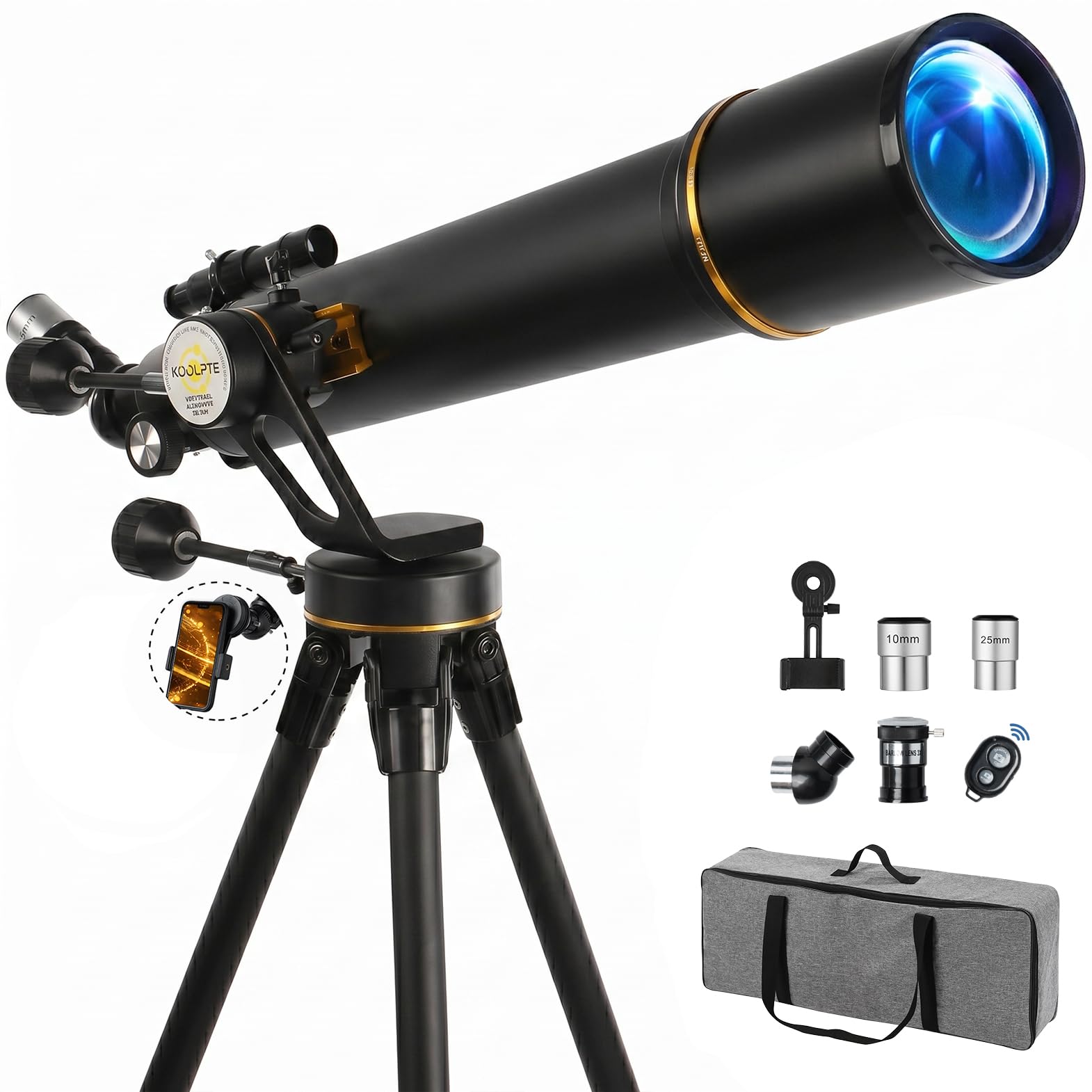
The Koolpte 90mm stands out with its exclusive Vertisteel AZ slow-motion mount, which provides ultra-smooth tracking adjustments that eliminate the frustration of overshooting targets. The 90mm aperture with fully multi-coated (FMC) glass achieves 99 percent light transmission, producing exceptionally bright and high-contrast images across the 700mm focal length. The magnification range spans 28X to 210X with the included 10mm and 25mm eyepieces and a 3X Barlow lens.
The stainless steel tripod is sturdy and the included wireless remote shutter works with the phone adapter for hands-free astrophotography. Assembly takes roughly 10 minutes without tools. The carry bag fits all components for transport. Users consistently praise the image clarity on the Moon and the ability to spot Jupiter’s moons with the 25mm eyepiece. The slow-motion mount is a genuine advantage for tracking objects as they drift across the field of view.
A few users note that the tripod height is limited for tall observers above 6 feet. There is also a single report of a defect, though that is uncommon across the broader feedback. For the beginner who values smooth, precise tracking over raw magnification, the Koolpte’s mount makes it a compelling mid-range premium option.
Why it’s great
- Vertisteel AZ mount with slow-motion controls enables precise object tracking
- 90mm FMC optics deliver excellent light transmission and contrast
- Wireless remote and phone adapter simplify astrophotography
Good to know
- 700mm focal length is shorter than the premium 900mm scopes, reducing native magnification
- Some users report the tripod being short for observers over 6 feet tall
6. Celticbird 80mm

The Celticbird 80mm marries a compact 80mm aperture with an unusually long 900mm focal length (f/11.25), which naturally reduces chromatic aberration and delivers sharp planetary images. The fully multi-coated optics improve light transmission and reduce reflections. The upgraded wide-angle 20mm and 10mm eyepieces provide a wider apparent field of view than standard Kellner designs, making it easier to keep targets centered.
The adjustable aluminum tripod extends from 20 to 45 inches and is stable enough for its class. Assembly is tool-free and takes about five minutes. The included phone adapter and padded carry bag are practical additions. Celticbird backs this scope with a three-year satisfaction service — the longest warranty in this guide. User reviews consistently report seeing Jupiter’s four moons clearly and the rings of Saturn as a distinct feature.
Some users have noted dust inside the main lens tube after shipping, though this does not appear to affect image quality significantly. The tripod, while serviceable, is described as acceptable rather than premium. For the beginner who prioritizes focal length for planetary detail and values a longer warranty period, the Celticbird 80mm is a smart mid-range entry.
Why it’s great
- 900mm focal length provides excellent native magnification for planets and the Moon
- Three-year satisfaction service offers industry-leading peace of mind
- Wide-angle eyepieces improve the viewing experience over standard Kellners
Good to know
- Aluminum tripod is functional but not as rigid as stainless steel alternatives
- Some units arrive with dust inside the lens tube
7. HUGERSTAR 80mm
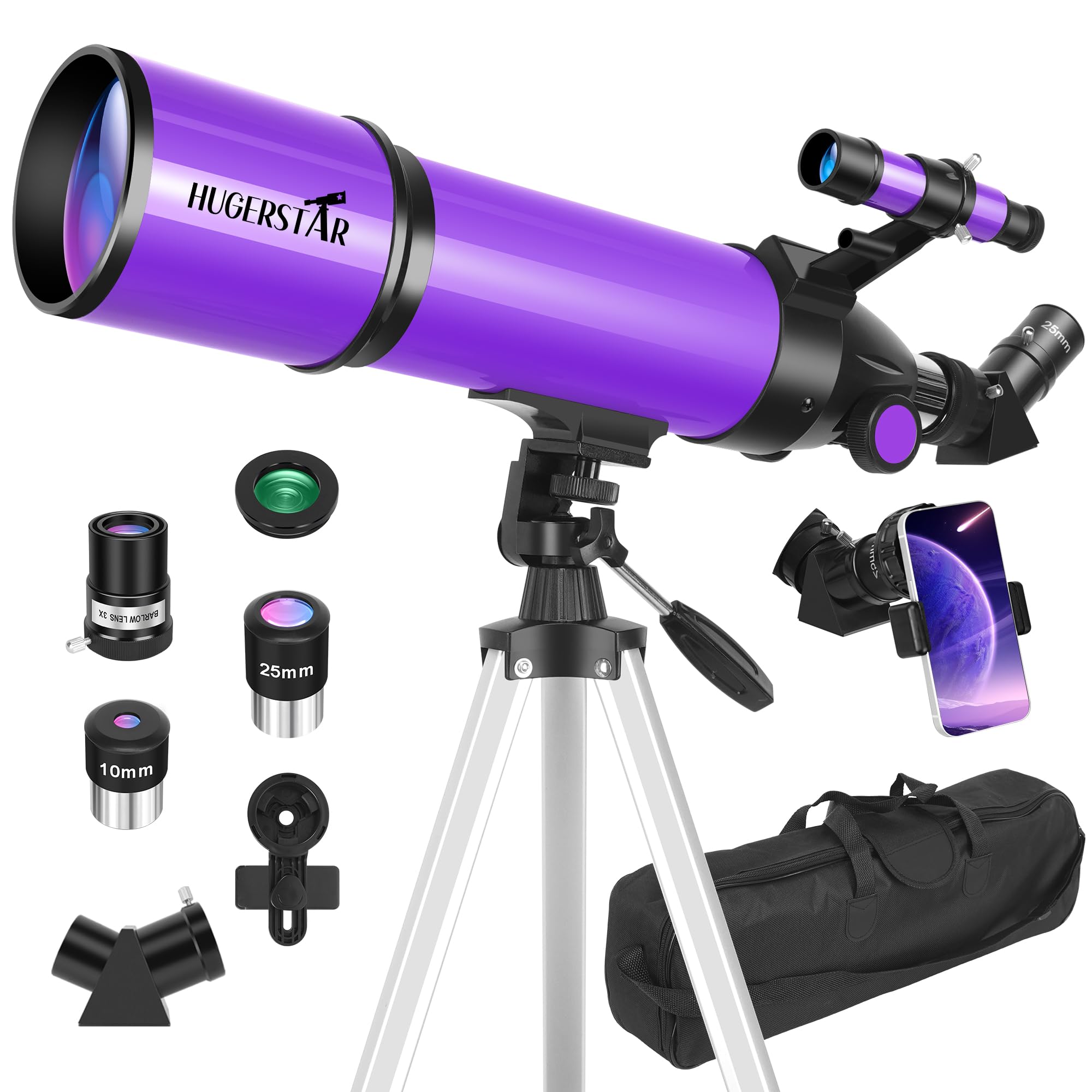
The HUGERSTAR 80mm refractor features an 80mm aperture and 600mm focal length with fully multi-coated lenses that reduce glare and enhance light transmission. The included 25mm and 10mm eyepieces plus a 3X Barlow lens produce magnifications from 24X to 180X. The 5×24 finder scope assists with target acquisition, and the moon filter helps reduce glare during bright lunar observation.
The aluminum tripod adjusts from approximately 21 to 44 inches and includes an accessory tray. Assembly is described as simple — about 90 percent of users complete it in under 10 minutes. The carry bag is compact enough for camping or hiking trips. The phone adapter allows basic astrophotography of the Moon and bright planets. User reviews highlight clear moon views and the ability to see Jupiter’s moons as distinct points of light.
Some users report that the instructions could be more detailed for absolute beginners, and the straight-through finder scope may require patience to align. The mount works well at lower magnifications but can show vibration at 180X with the Barlow lens. For the budget-conscious beginner who wants a genuine 80mm aperture scope with essential accessories, the HUGERSTAR delivers strong fundamental value.
Why it’s great
- 80mm aperture with multi-coated lenses offers genuine light-gathering improvement over toy scopes
- Quick 10-minute tool-free assembly ideal for impatient beginners
- Includes moon filter for comfortable lunar viewing
Good to know
- 600mm focal length limits high-magnification performance for planetary detail
- Aluminum tripod can be shaky at maximum extension and magnification
8. MEEZAA 80mm
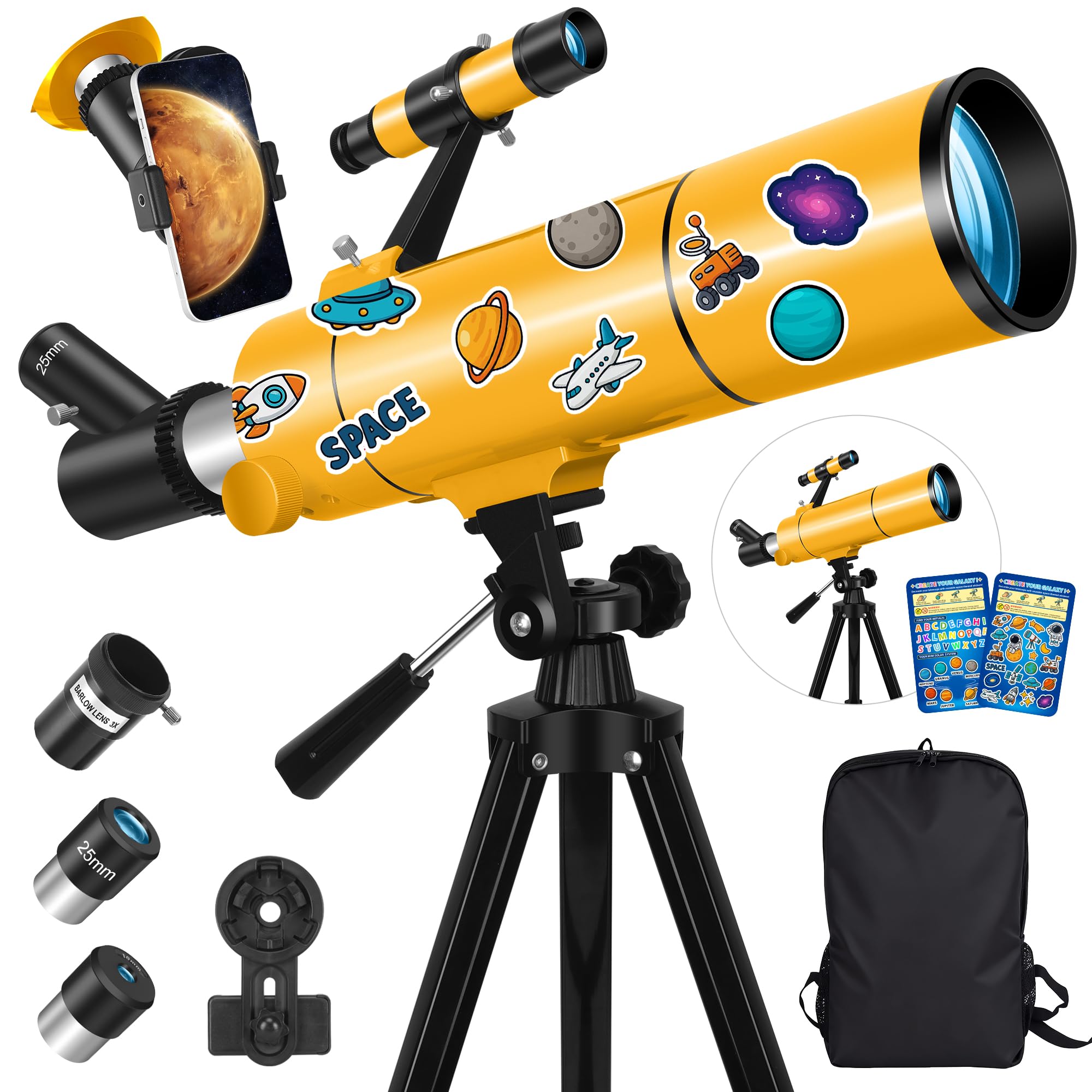
The MEEZAA 80mm is built around an 80mm aperture and a short 500mm focal length, optimized for wide-field views of the Moon, star clusters, and bright planets. The fully multi-coated high-transmission optics are paired with a 45-degree erect-image diagonal, which makes daytime terrestrial observation just as practical as nighttime stargazing. The magnification range covers 20X to 150X with the included 25mm and 10mm eyepieces and a 3X Barlow lens.
The aluminum tripod adjusts from about 17 to 44 inches to accommodate children and adults. The waterproof backpack holds the entire kit securely for hiking or camping. The phone adapter is easy to clip onto the eyepiece. The kit also includes space stickers for personalization, making it a family-friendly option. User feedback emphasizes the tool-free assembly and stable wide-field lunar views.
The shorter 500mm focal length means planets appear smaller at the same eyepiece compared to a 900mm scope, and the maximum useful magnification is lower. The tripod, while functional, benefits from being used at lower height settings for stability. For the beginner who wants portability, daytime versatility, and a stress-free setup, the MEEZAA 80mm is a well-rounded entry-level package.
Why it’s great
- Waterproof backpack makes it genuinely portable for outdoor adventures
- 45-degree erect-image diagonal enables comfortable daytime use
- Tool-free assembly takes minutes, not hours
Good to know
- 500mm focal length limits planetary detail compared to longer-scope alternatives
- Aluminum tripod stability decreases at full height extension
9. Dianfan 80mm
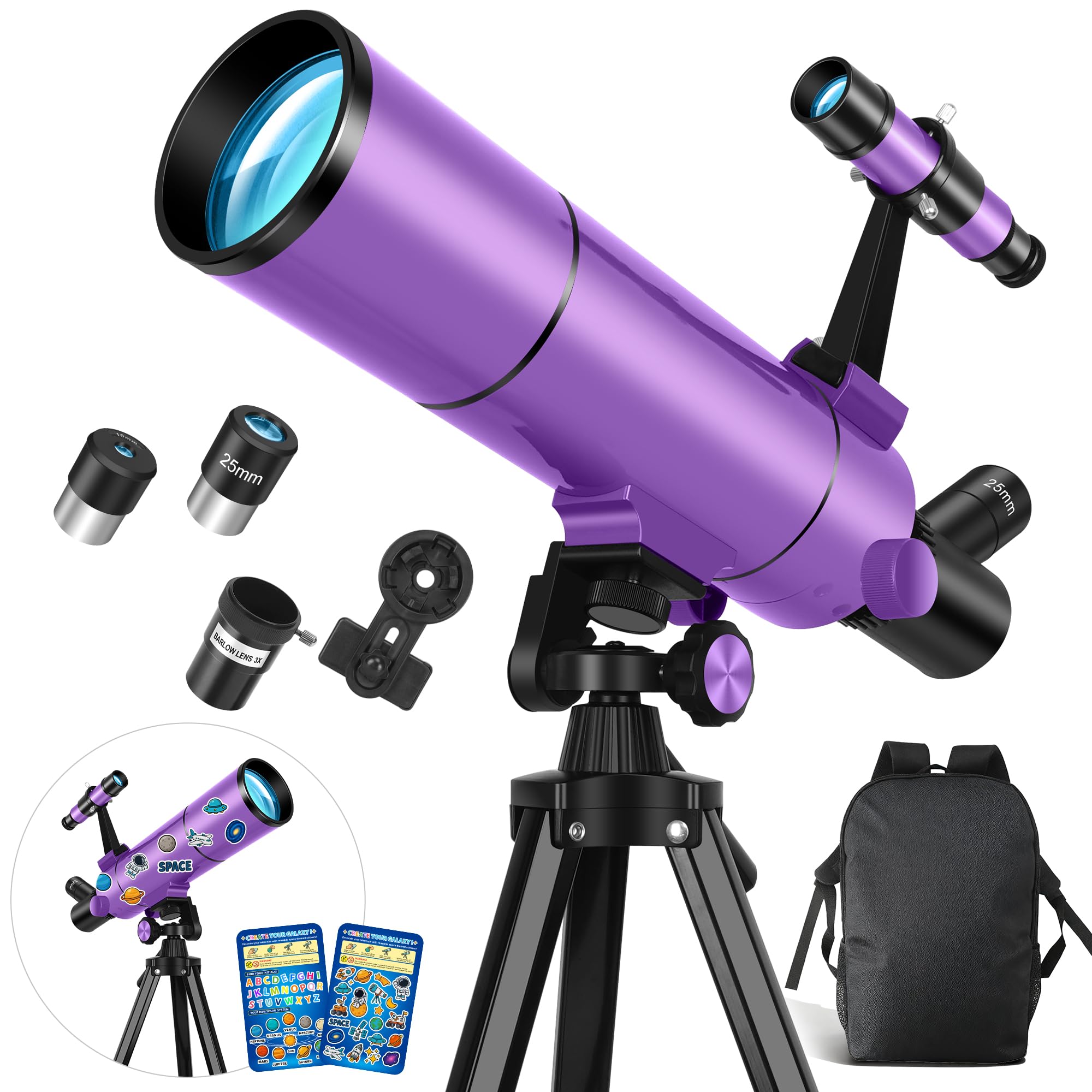
The Dianfan 80mm is a 80mm aperture, 500mm focal length refractor designed with families in mind. The fully multi-coated optics provide bright, clear views of the Moon and brighter planets. The kit includes two eyepieces (10mm and 25mm) and a 3X Barlow lens, offering a magnification range from 20X to 150X. The 5×24 finder scope helps beginners locate objects in the night sky.
The included backpack is water-resistant and custom-fit, making transport and storage straightforward. The phone adapter clips onto the eyepiece for basic astrophotography. A unique touch — the telescope comes with reusable astronomy-themed stickers and a purple color scheme that appeals to younger users. User reviews highlight easy assembly, lightweight construction, and clear moon views that exceed expectations for the price.
Like other short-focal-length 80mm scopes, planetary detail is limited at high magnifications, and the aluminum tripod can show vibration in windy conditions. The finder scope requires careful alignment. For the budget-focused adult beginner or a family with young stargazers, the Dianfan 80mm offers genuine optical performance with a kid-friendly design that makes it a strong entry-level contender.
Why it’s great
- 80mm aperture provides real light-gathering capability at a budget-friendly price
- Water-resistant backpack and phone adapter included for portability and sharing
- Stickers and purple design make it appealing for family use with children
Good to know
- 500mm focal length limits native magnification on planets
- Aluminum tripod can be unstable at higher magnifications and in wind
FAQ
How much magnification do I really need as a beginner?
What is the difference between an Alt-Azimuth mount and an Equatorial mount?
Final Thoughts: The Verdict
For most users, the best adult beginner telescope winner is the Celestron StarSense Explorer LT 80AZ because its app-based navigation removes the single biggest barrier for newcomers — finding objects in the sky. If you want maximum aperture and planetary detail at a mid-range price, grab the Hawkko 90mm. And for the budget-conscious beginner who wants genuine 80mm performance and a portable kit, nothing beats the HUGERSTAR 80mm.