
Our readers keep the lights on and my morning glass full of iced black tea. As an Amazon Associate, I earn from qualifying purchases.
Specs are compiled from manufacturer listings and verified buyer reviews and can change over time — please confirm the key details on the product page before buying.
Buying an adult craft table is really a decision about one thing: whether the table fits the work you actually do. A sewer needs a drop-down platform and fabric storage. A painter needs a surface that tilts. Someone who cuts vinyl needs somewhere to park 36 rolls. Pick wrong and you end up hunched over a kitchen counter with your supplies stacked on the floor. This guide sorts the real options by what each one is built to do, so you can match the table to your craft instead of the other way round.
I’m Min — the founder and writer behind Gadgets Feed. This guide is built by comparing the manufacturers’ published specifications and the patterns across verified customer reviews, so you get each pick’s real strengths and trade-offs instead of marketing spin.
Below you will find eleven desks, carts, and cutting stations, each with the exact measurements that decide whether it fits your room and your machine. Every entry stays inside the plain facts of its own listing. If you sew, paint, trace, or press vinyl, the right adult craft table here is the one whose surface and storage match your project list.
Our Picks at a Glance


How To Choose The Best Adult Craft Table
Start with the machine or tool that will sit on the table most often. A sewing machine, a heat press, and a light box all demand a different surface. Match the surface to that tool and the table stops dictating how you work. Mismatch it and every session starts with a workaround.
Measure the work surface, not the room
The top is where the decision lives. A 60-inch wide by 30-inch deep top gives you room to lay out a full pattern, while a 47-inch by 23-inch top suits drawing and writing. Depth is the spec buyers underestimate, because fabric and canvases run away from you front to back. Check the depth against the longest cut you make.
Decide if you need tilt
A tilting top is the single biggest comfort feature for anyone who draws, paints, or traces. Tables in this list tilt anywhere from 0 to 80 degrees, and each angle has a job. Flat is best for writing, a light tilt helps reading, and a steep angle turns the desk into an easel. If you only sew, you can skip tilt entirely and spend that on storage instead.
Check capacity before you load it up
Storage is not just drawers, it is weight. Some main tabletops in this group hold hundreds of pounds, while side shelves and wire baskets often cap at 15 to 25 pounds each. A 50 lb heat press plus 36 vinyl rolls will exceed a 15 lb wire basket. Match the shelf rating to what you plan to stack, not to what looks tidy in the photo.
Plan for folding and wheels
Craft rooms double as guest rooms, and that changes what you should buy. A table that folds to a narrow profile or rolls on locking casters can live in a corner between projects. If you cut fabric on a big table and then need the floor space back, foldability is worth more than an extra drawer.
Quick Comparison
| Model | Best For | Work Surface | Height | Storage | Amazon |
|---|---|---|---|---|---|
| Sauder Craft Pro Series★ Best Overall | Sewing and scrapbooking | 60″ W x 30″ D | 36.02″ | 3 drawers per side | Amazon |
| Crafit Foldable Heat Press TableVinyl Specialist | Heat press and vinyl | Fits most heat presses | 34.9″ | 36 vinyl rolls plus drawer | Amazon |
| Studio Designs Sew Ready Cutting TableFabric Cutting King | Fabric cutting | 60″ W x 36″ D | 30″ | 2 mesh drawers plus shelf | Amazon |
| Tribesigns Drafting Table | Drawing and diamond art | 0 to 80 degree tilt | — | 1 drawer plus shelves | Amazon |
| Best Choice Products Folding Sewing Table | Small craft rooms | 62″ L x 19″ W | 31.25″ | 2 trays plus cabinet | Amazon |
| Lurinthal Drafting Table with Cabinet | Space-tight studios | 47.2″ W x 23.6″ D | 29.9″ | 3 drawers plus 3 shelves | Amazon |
| Sew Ready Comet Plus | Sewing with a grid | 56.75″ x 23.5″ | Adjustable platform | Shelf plus cloth drawer | Amazon |
| VISWIN Wood Drafting Table | Art studio | 42″ x 30″ | 34″ to 38″ | Top and bottom drawer | Amazon |
| SD Studio Designs Futura | Glass-top drawing | 38″ W x 24″ D | Fixed | Pencil drawer plus 4 trays | Amazon |
| FLEXISPOT Electric Drafting Table | Shared and standing work | 47.2″ x 23.6″ | Electric, 4 presets | Storage drawer | Amazon |
| Studio Designs Fusion Light Table | Tracing and light work | 35.5″ W x 23.5″ D | 27.5″ to 35.5″ | 2 drawers plus side shelf | Amazon |
In‑Depth Reviews
1. Sauder Craft Pro Series Durable Craft Work Table
Our pick — 4.5+★ from 350+ verified ratings; the strongest balance of quality and price.
A full 60-inch top with drawers on both sides, built like furniture rather than a folding stand.
Buy this Sauder craft table if you want a piece that looks like furniture and stands up to years of use. The surface is 60 inches wide by 30 inches deep, so you can lay out a full pattern and still have room for a cutting mat. It stands 36.02 inches tall — measure that against your elbow height, because this is a counter-height standing position, not a sit-down desk. Compare it to the Studio Designs cutting table: the Sauder is 36.02 inches tall versus 30 inches, while the cutting table trades that height for 36 inches of depth versus the Sauder’s 30.00 inches. In plain terms, one is built tall for standing work and the other is built deep for spreading fabric flat.
The top itself is melamine, which is a sealed engineered-wood surface, and it is listed as heat, stain, and scratch resistant. That matters most if you iron near the table or set a hot glue gun down without thinking. Storage is the other half of the pitch: three drawers on either side puts six within reach, and the open shelving underneath is sized to hold a sewing machine or stacked bins. Sauder backs it with a 5-year limited warranty, which is a longer stated term than most of this group carries. Assembly needs two people and a screwdriver according to the listing, so plan an evening for it rather than a quick ten minutes.
What wins people over is how the piece reads once it is built — owners describe it settling into a craft room as proper furniture rather than equipment. The recurring note is that it does not wobble, which is the thing that ruins a cheaper engineered-wood desk over time. The honest catch is the working height. At 36.02 inches it suits standing or a tall stool, and anyone who wants to sit low to sew will find it too tall. It is also the heaviest-furniture option here, so it wants a permanent spot.
Where it earns its place
- A 60″ W x 30″ D top — enough for a full pattern plus a cutting mat without shuffling.
- Six drawers, three per side, plus open shelving sized for a sewing machine.
- Heat, stain, and scratch resistant melamine top that shrugs off glue-gun mishaps.
- A 5-year limited warranty, with assembly stated as two people and a screwdriver.
What to weigh first
- 36.02 inches tall — a standing height, not a seated one.
- Engineered wood construction means it stays put; this is not a table you fold away.
- Two-person assembly, so budget the time.
Made for: the sewer or scrapbooker who wants a permanent craft room centerpiece with drawers that swallow the whole supply stash.
Think again if: you need a table that folds flat between projects, or you prefer to sit low while you work.
2. Crafit Foldable Heat Press Table
Thirty-six rolls of vinyl get their own home, and the whole cart rolls out of the way after.
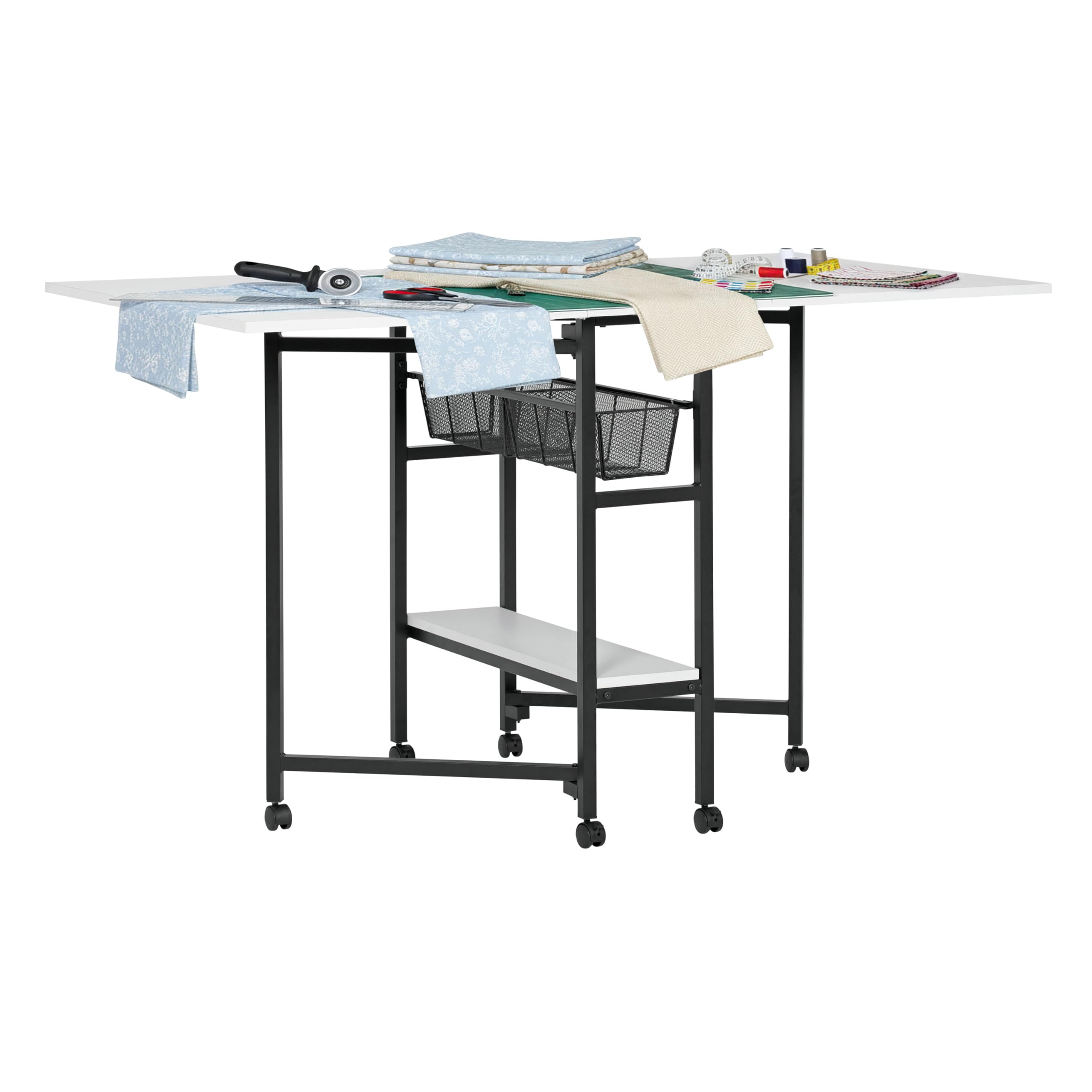
For heat-transfer crafts, this table is built differently from every desk on the list. Dual-side storage bags hold up to 36 regular vinyl rolls or 10 large-diameter rolls, so you can see what you have at a glance instead of hunting. A large drawer takes scissors, tape, and offcuts, and multi-level open shelves keep a heat press, sublimation printer, or cutting machine within arm’s reach. It is rated for heavy equipment — buyers report carrying a 50 lb heat press without complaint — and the upper temperature rating is listed at 350 °F, which tells you the heat level the workbench is specified around.
The structure is thickened wood with a metal frame, and the drawer and side bags are sturdy fabric rather than wood, which keeps the weight down to 18.42 kg. That matters because it rides on heavy-duty industrial-grade casters, two of them with brakes. You can push a loaded cart to the wall, lock it, and press on a stable base. The collapsible side panels fold in when the project is done, so it will tuck into a corner rather than demand a dedicated studio. Assembly is the thing this cart is best known for — it goes together without drama, which is not something you can say about most furniture on this page.
The fold-away panels are what let a small apartment run a vinyl business out of a living room, and the braking casters are what make that safe once it is loaded. The honest limit is the footprint: this is a cart with a compact working top, not a flat-lay cutting surface. The listed dimensions are 22.8 inches by 19.7 inches by 34.9 inches, so if you need to lay out a full yard of fabric flat, look at the Studio Designs cutting table instead. Value for money is the one point buyers split on, which is worth knowing before you commit.
The storage math: 36 vinyl rolls in side bags, 10 if they are large diameter, plus a drawer and open shelves for the press and printer. Nothing else here competes on roll capacity.
Room to grow: the compact top is the trade-off. It is a workbench you press on, not a table you spread a whole quilt across.
Your pick if: heat press, sublimation, and HTV are your daily craft and your supplies have outgrown a desk.
Keep looking if: you need a broad flat surface for cutting large fabric pieces.
3. Studio Designs Sew Ready Fabric Cutting Standing Table
A 36-inch-deep surface that folds to just over a foot wide when the cutting is done.
Depth is the whole story here. The top runs 60 inches wide by 36 inches deep at 30 inches high, and that extra front-to-back room is what lets a bolt of fabric lie flat instead of hanging off the edge. It is the mirror image of the Sauder above: this table trades the Sauder’s 36.02-inch standing height for 36 inches of depth, the direction that matters when you are squaring up a hem. The center panel is 10-5/8 inches wide by 36 inches deep and the two folding panels are 24-5/8 inches wide by 36 inches deep, so the surface can extend for long cuts and collapse for storage.
The folding mechanism is the second reason people buy it. It closes to 12-1/4 inches wide, so a table that is too big for a spare room in use suddenly fits behind a door. Six casters, four of them locking, let you lock it in place to cut, then roll it away. Two slide-out wire mesh drawers and a bottom shelf carry smaller tools, with stated limits of 50 lbs each for the center and bottom panels, 25 lbs for the side panels, and 15 lbs for the wire baskets. The frame is powder coated, and the build is 80% MDF with metal and a little plastic.
What buyers respond to is how the piece looks once assembled — it reads as a real piece of furniture rather than a folding stand, and the height is right for cutting without bending. Setup is reported as straightforward with clear instructions. What comes up as a fair caveat is rigidity: stability and construction quality are the two points owners are split on, so a loaded table can feel less solid than the powder-coated frame suggests. It is a cutting station first — treat it that way and it does its job.
Why quilters pick it
- 36″ of depth — a full width of fabric lies flat for squaring and rotary cutting.
- Folds down to 12-1/4″ wide, so it disappears between projects.
- Four locking casters out of six hold it still while you cut.
- Two wire mesh drawers and a bottom shelf, each with a stated weight limit.
Set your expectations
- Stability is the split point once the table is loaded.
- 30-inch height suits cutting; it is a touch low for standing at length.
- Wire baskets top out at 15 lbs each.
Reach for this if: you cut fabric or vinyl on a large mat and want the table gone the rest of the week.
Look elsewhere if: you need a rock-solid permanent desk for heavy machines.
4. Tribesigns Drafting Table with Storage Drawers

Twelve angle stops from flat to near-vertical, and the top still holds 250 lbs.
The adjustable section on this desk tilts from 0 degrees to 80 degrees across 12 positions, and the other side stays flat. That split is the useful part: you can raise a canvas to a drawing angle and still keep your brushes, water pot, and reference book on a level surface beside it. The board itself is 0.6-inch thick particle board on a metal frame with a stated maximum desktop load of 250 lbs, so a heavy board or a stack of art books is not a concern. It is the most aggressive tilt range in this list, matched only by the Lurinthal below.
Storage is built underneath rather than bolted on. You get an open shelf, one roller-glide drawer, and a bottom shelf, which keeps the desktop clear for the project. The desk works as a drafting table, art desk, craft station, or computer desk, so it earns its space if your creative work shares a room with everything else. Assembly is the variable — every part is labeled and tools are included, but experiences swing hard from painless to painful, so set aside a proper block of time and a second pair of hands.
Owners treat it as an art desk that looks good enough to keep out, and the tilt range is what makes diamond art, sketching, and drafting comfortable instead of a neck workout. The drawer glide is metal on a roller mechanism, which is a better feel than the plastic glides on cheaper desks. The honest note is the assembly lottery, plus an age range listed as teen rather than adult — the desk suits adults fine, but that is what the listing states. It is a sit-down desk, not a standing one.
The angle math: 12 positions between 0 and 80 degrees, with a flat half left over for supplies. That combination is what separates it from a single-tilt drafting desk that forces everything onto the slope.
Set-up reality: labeled parts and included tools help, but the build is the most divisive thing about this desk.
Best matched to: artists and diamond painters who want a steep drawing angle without giving up a flat corner for tools.
Wrong fit if: you want to stand at the table or you dread flat-pack assembly.
5. Best Choice Products Large Folding Sewing Table

A sewing station that folds shut into a side table, so the room comes back when you stop.
This table solves a problem bigger desks ignore: what the room looks like when you are not crafting. The main top holds a stated 330 lbs, the extended table top holds 22 lbs, and the shelves hold 22 lbs each, so the working surface is the strong part. It measures 62 inches long by 19 inches wide by 31.25 inches tall — that narrow 19-inch depth lets it sit in a small room, but it is also the trade-off, because a sewing machine takes up a good share of that front-to-back space. Lockable wheels and magnetic door locks keep supplies from spilling when you roll it away.
The storage design is why people pick it over a plain desk. Two rows of pegs, two attached storage trays, a wide interior shelf, and a three-section cabinet with adjustable shelves give thread, notions, and the machine itself a designated home. When the session ends, you tuck it all inside and close the table into a compact side table. MDF wood with metal hinges makes up the body, and the whole thing weighs 70 lb, which is manageable on casters but not something you carry up stairs alone.
The thing everyone notices first is the storage — it swallows a serious supply stash and still closes into something that looks tidy in a living room. It is also smaller in person than the 62-inch length suggests, which is exactly what buyers with tight rooms want. The recurring gripe is assembly: it is the most-discussed point on this table, and the honest read is that it takes two people and patience with the instructions. Sturdiness draws a mixed response too, so treat it as a folding station rather than a solid wood desk.
The space-saving argument
- Closes from a 62″ x 19″ sewing station into a compact side table.
- Main top holds 330 lbs — more than enough for a machine and a project.
- Pegs, two trays, a wide interior shelf, and a three-section adjustable cabinet.
- Lockable casters and magnetic door locks keep supplies in place while rolling.
The trade-offs baked in
- Assembly is the most-discussed point and needs two people.
- A 19-inch depth leaves limited room behind a sewing machine.
- Sturdiness splits opinion; it is a folding table, not a fixed desk.
Fits best: a small craft room or spare bedroom where the table has to disappear between sessions.
Skip if: you want a wide cutting surface or a desk you never fold.
6. Lurinthal Drafting Table with Storage Cabinet
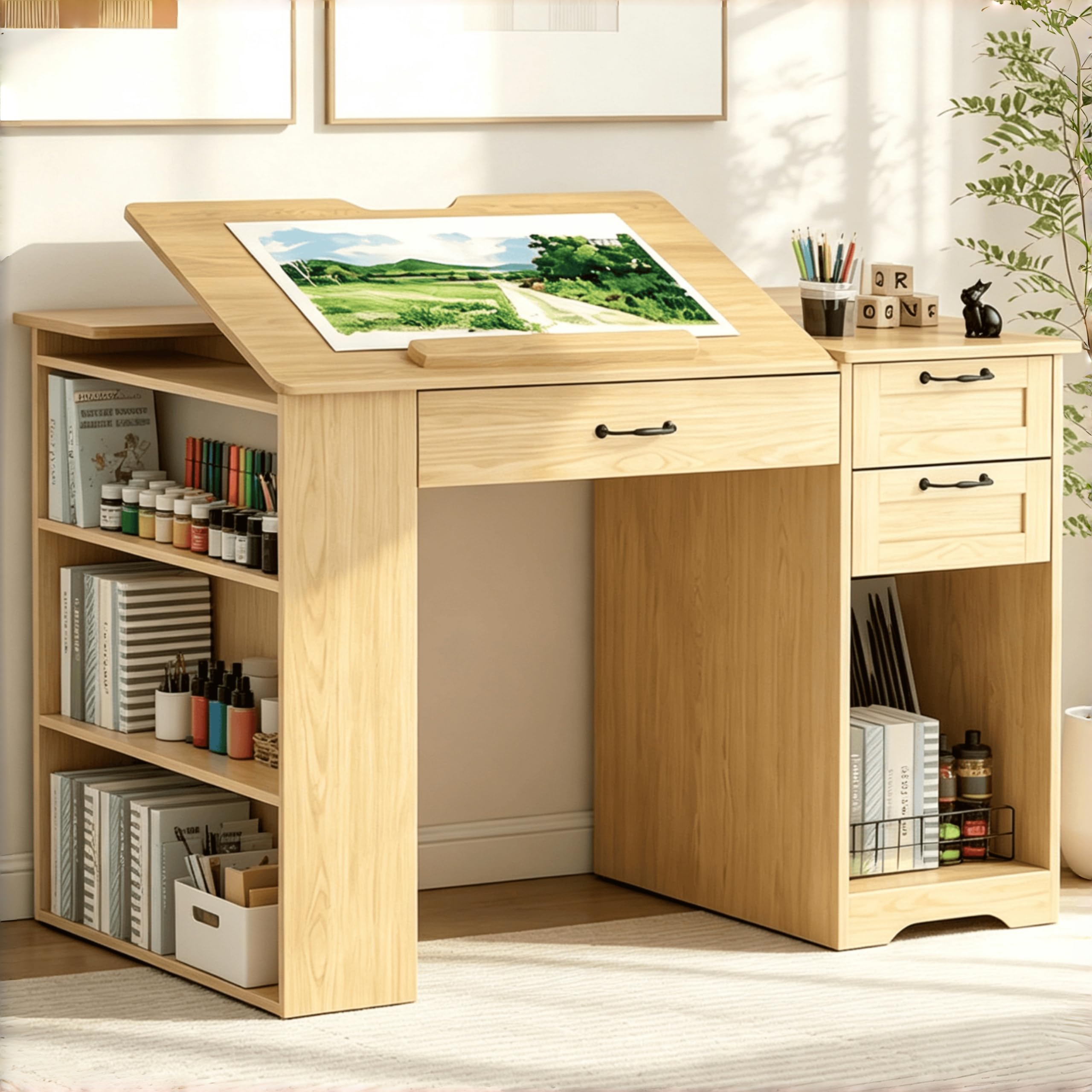
Three drawers, three shelves, and a cabinet packed into a footprint under four feet wide.
Storage density is what this desk sells. Three drawers, three tiers of open shelving, and a built-in storage cabinet all live under a compact top of 23.6 inches deep by 47.2 inches wide by 29.9 inches high. For an art corner or a bedroom studio where every inch is spoken for, that combination keeps paint, sketchbooks, thread, and office supplies off the work surface. The frame is engineered wood with an oak finish, and the cabinet is built in rather than a separate piece, so it stays aligned with the desk.
The top tilts from 0 to 80 degrees, which covers flat writing at one end and an easel angle at the other. Because it is a sit-down height of 29.9 inches, a 47.2-inch width leaves your elbows in a natural position for drawing. The MDF construction is specified around load bearing and a stable, wobble-free surface, and the drawers are box type with a single pedestal. It also converts into a reading, writing, or computer desk, so the piece keeps working when you are not making anything.
Quality is what buyers lead with — it arrives feeling like a solid piece and holds that impression. Sturdiness is the second thing they notice, which is what you want from a desk that is meant to carry a drawing board at an angle. The honest limit is that this is a newer listing with a smaller review history than the established names on this page, so the long-term picture is thinner. It is also MDF, not solid wood, so keep it out of damp rooms.
Storage per inch: three drawers, three shelf tiers, and a cabinet under a 47.2-inch width. That is the densest storage-to-footprint ratio here.
The trade-off: MDF and a short track record mean you are buying on design and current owner feedback rather than years of history.
Worth it for: an artist working in a bedroom or corner who needs supplies stowed inside the desk itself.
Hold off if: you want solid wood or a long proven review history.
7. Sew Ready Comet Plus Craft Sewing Table

A printed cutting grid on the top and a drop-down platform, both aimed at sewers.
Two features do the work here. The tabletop has a built-in fabric cutting grid printed across a 56.75-inch by 23.5-inch surface, so you can square a piece without hauling out a separate mat. And a 27.5-inch wide platform lowers to match your sewing machine bed, which brings the needle plate level with the surrounding table so fabric feeds instead of catching. That same lowered platform doubles as a keyboard tray or laptop shelf if the desk pulls double duty.
The frame is heavy-gauge steel with a thick tabletop and six adjustable floor levelers, which is what keeps the desk steady on an uneven craft room floor. Storage is practical rather than generous: a lower shelf, two side shelves, and a cloth drawer for fabric, supplies, and books. A foldable side shelf extends the surface when you need it and tucks away when you do not. The finish is powder coated and the colorway is black with a white grid top.
The build quality is what stands out on this one — it reads as sturdy and looks right in a sewing room, and the instructions are clear enough that setup is not a battle. The stated caveat applies to the drop-down platform: most owners mention no shaking during use, but one found their machine bouncing during operation on the lowered setting. If you run a heavy or fast machine, that lowered platform is the spot to test first. With no tilt, it suits sewing rather than painting or drawing at an angle.
Built for the machine
- A 27.5″ drop-down platform levels a sewing machine with the tabletop.
- Printed cutting grid across a 56.75″ x 23.5″ top.
- Heavy-gauge steel frame with six adjustable floor levelers.
- Foldable side shelf plus lower shelf, two side shelves, and a cloth drawer.
Worth testing in person
- The lowered platform can allow some machine bounce with heavier units.
- The cloth drawer is a soft-sided compartment, not a solid box drawer.
- No tilt, so it is not the pick for drawing at an angle.
Suits: a sewist who wants the machine flush with the table and a grid for quick measuring without a mat.
Not for you if: you paint or draw and need an angled surface.
8. VISWIN Wood Drafting Table for Adults

Real pine instead of engineered board, with hand-polished corners and an H-frame base.
Material is the case for this one. The frame and base are pine wood rather than MDF, and the H-frame construction is designed to stop the shaking that lighter drafting desks develop. The tabletop measures 42 inches by 30 inches, and the height adjusts from 34 inches to 38 inches while the angle moves from 0 to 70 degrees. That height range is the detail to check against your own chair, because the listed desk height draws negative feedback from some buyers who find it very high. A 30-inch-deep top is generous, though, and it spreads a sketchbook and a reference photo without crowding.
A professional oil finish smooths the surface and makes wiping down after a session easier, and the corners are hand-polished with no burrs or sharp edges. Assembly comes with labeled parts, all necessary tools, and a detailed manual, which is why setup is one of the strongest points on this desk. The 0 to 70 degree tilt and 34 to 38 inch height range are meant to ease neck and back strain, but owners split on the mechanism, so set one angle and leave it.
Design is the aspect owners praise most, and the retro-industrial walnut look is why. The pine frame and oil finish suit an art studio, and the solid wood carries more heft than the MDF desks here. The honest catch is the height. Several buyers find it sits high, so measure before you commit, and plan on a stool or chair that matches. The adjustability mechanism is also the split point rather than a clear win.
What the money buys: solid pine, an H-frame base, a 42″ x 30″ top, and a 34″ to 38″ height range. That is a wood desk instead of a laminated board one.
The measurement that decides it: if 34 inches already sits high for you, the upper end of that range will feel tall.
Made for: the artist who wants wood, weight, and a studio look rather than a laminate desk.
Measure first if: your current chair sits low or you are short in the torso.
9. SD Studio Designs Futura Craft & Drawing Table

A tempered glass top that tilts to 35 degrees and doubles as a light table.
Glass is the defining feature, and it changes what the desk can do. The 38-inch wide by 24-inch deep tempered clear safety glass surface adjusts up to 35 degrees, and the listing states it can also be used as a light table. That matters for tracing, transferring patterns, and anyone who works with translucent paper or fabric. The glossy sage legs and clear top make it the most design-forward desk in this list, which is why appearance is one of the points owners return to.
Storage is thought through for a drawing habit. There is a large pencil drawer measuring 28 inches wide by 10 inches deep, four removable side trays for supplies, and three plastic-molded slide-out drawers that mount on either the left or right side. A 24-inch-wide slide-up pencil ledge slides and locks to stop utensils and canvases from sliding down an angled top — the small detail that makes a tilted glass surface usable instead of annoying. The frame is heavy-gauge steel with four floor levelers, and the tempered glass is the safety type used where breakage resistance matters.
Quality is what buyers praise most — it arrives feeling better than the glass-and-steel look might suggest, and the ledger draws comment for looking more expensive than it is. Versatility earns a mention too, with diamond painting named as a good fit. The honest caveats are two. Assembly splits opinion, with unclear instructions being the common frustration. And sturdiness is mixed, so a glass top at an angle deserves a gentle hand rather than leaning your weight on it.
What glass open up
- A 38″ x 24″ tempered safety glass top that tilts to 35 degrees.
- Can be used as a light table for tracing and transfer work.
- 24″ slide-up pencil ledge locks to stop tools sliding off the slope.
- Pencil drawer plus four removable trays and three side-mountable drawers.
Handle it gently
- Sturdiness feedback is mixed, so avoid resting body weight on the glass.
- Assembly instructions are the weak link for some buyers.
- Fixed table height; only the top angle moves.
Go for it if: tracing, light-table work, and a desk that looks good in a studio both matter to you.
Pass if: you want a heavy-duty surface for pressing or cutting on.
10. FLEXISPOT Electric Drafting Table
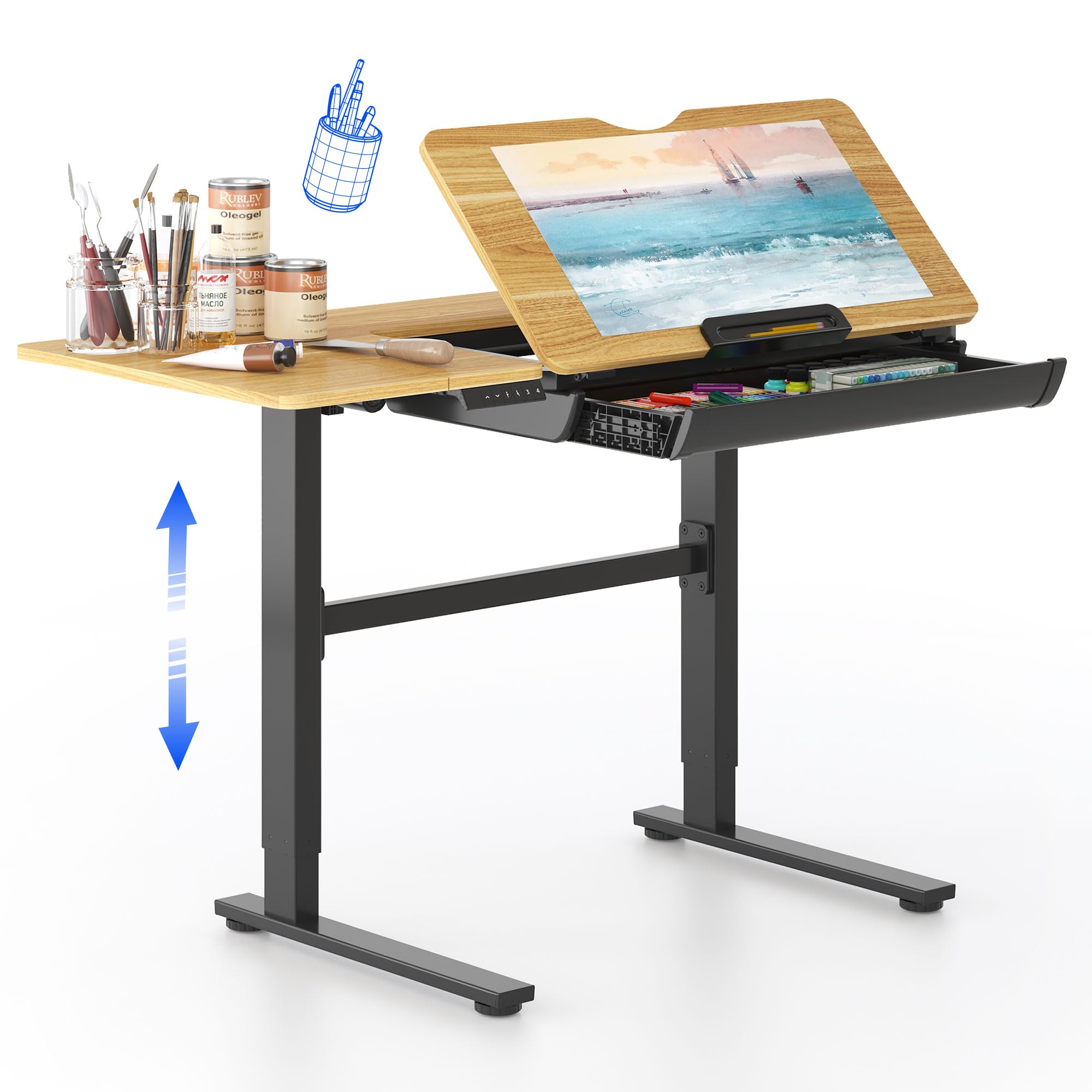
A motor raises the desk at 1.0 inch per second, and four presets remember where everyone likes it.
This is the only electric desk in the group, and that changes the daily routine. A motor moves the top at 1.0 inch per second, and four preset levels store heights so nobody has to fiddle with buttons. The tilting top runs from 0 to 40 degrees, with the listing splitting the range into 0 to 10 degrees for writing, 10 to 20 degrees for reading, and 20 to 40 degrees for drawing. The work surface measures 47.2 inches by 23.6 inches, and a collapsible side table folds away when you want the floor space back.
The frame is alloy steel with a powder-coated finish and a maple colorway, and the base is leg type. There is a storage drawer for stationery, and the desk adapts across writing, reading, drawing, crafting, and painting. That height range is why it suits a household rather than one person — a 4-preset memory means a standing session and a seated session are both one button away. The listing covers adults and children, so it can shift between users without tools.
Quality and adjustability are the two things this desk is known for, and the motor itself draws positive notes for working as intended. Assembly is reported as straightforward with a clear manual. Where it loses ground is ease of use — that is the one point owners rate negatively, so expect a short learning curve on the presets and tilt rather than a plug-and-play first hour. It is also the pick that depends on power, which is worth remembering if your craft corner has no nearby outlet.
The motor advantage: 1.0 inch per second, 4 stored presets, and a 0 to 40 degree tilt. That is the most adjustable desk here by a clear margin.
What to plan for: an outlet near the desk, and a few minutes to learn the controls before the first project.
Right choice when: two people share the desk or you want to alternate sitting and standing through a long session.
Not the one if: you want a table with no cord and no learning curve.
11. Studio Designs Fusion Drafting Table with LED Light Pad
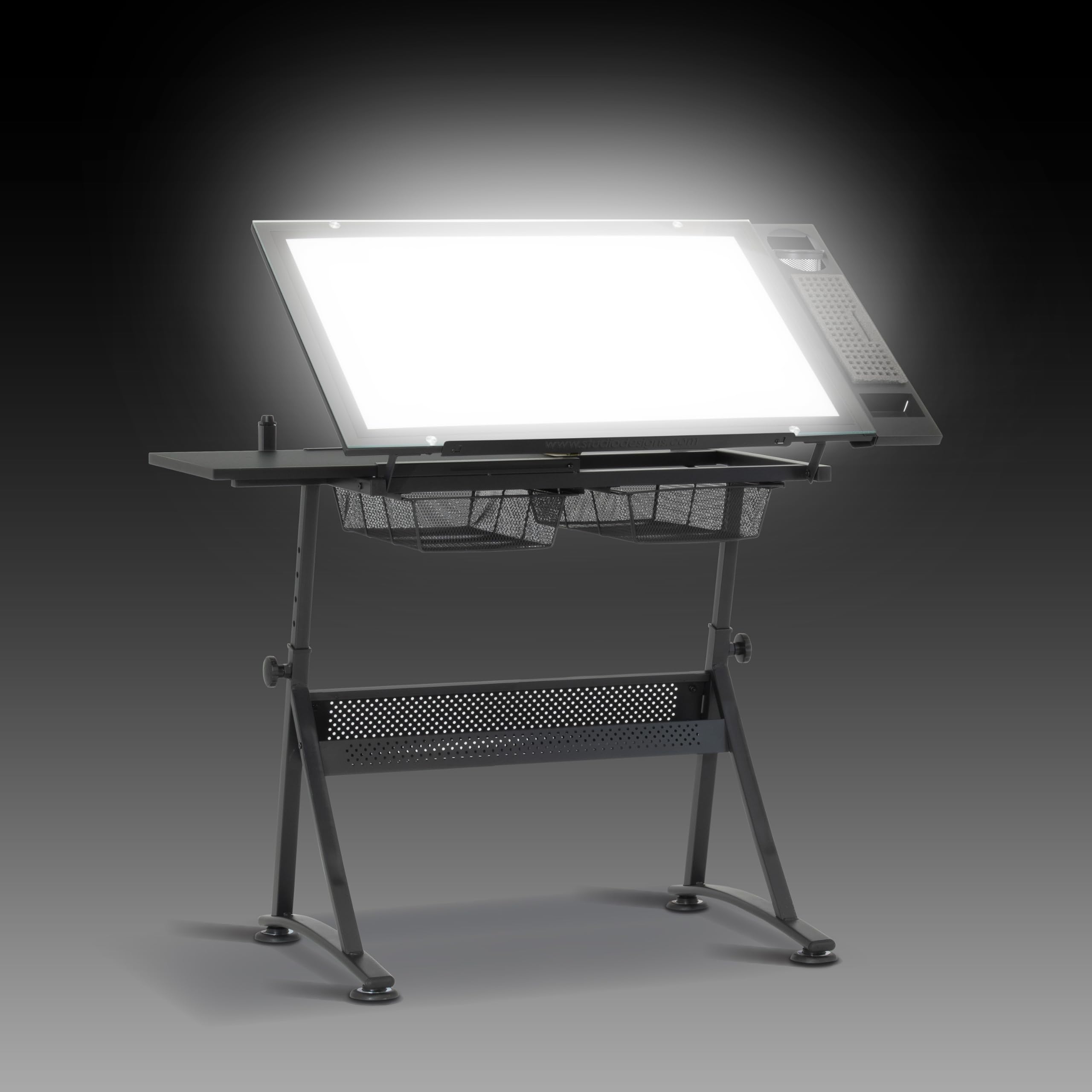
The light box is built into the table, so tracing never needs a second piece of equipment.
This desk replaces a separate light box with one that lives inside the top. The built-in Artograph LED Light Pad gives a 31.75-inch by 20-inch illuminated work area, with adjustable brightness from 0 to 2,600 lux and daylight-balanced 6,000K to 7,000K LEDs. In plain terms, you can dial the glow up for thick fabric and down for thin tracing paper, and the light stays neutral rather than yellow. Those LEDs are rated for 50,000 hours, so the light is not a wear item you plan to replace.
The rest of the desk is a proper drafting station. A 5mm tempered safety glass top (heat-treated glass that resists breaking) adjusts from 0 to 40 degrees, and the whole table moves in height from 27.5 inches to 35.5 inches. The working surface is 35.5 inches wide by 23.5 inches deep, with an overall footprint of 47.75 inches by 23.75 inches by 35.5 inches. Storage runs deep: two wire mesh drawers, a slide-out side shelf, a bottom storage shelf, a slide-up pencil ledge, and a Premier Metal Art Tray with a swivel cup and foam organizer sized for pencils and markers up to 10mm in diameter. Weight limits are stated as 25 lbs on the tabletop, 5 lbs per drawer, and 15 lbs each on the side and bottom shelves — modest numbers, so treat this as a precision desk rather than a heavy press stand.
Setup is the strongest impression this table leaves, with sturdy construction and a look that suits a working studio; buyers use it for painting, drawing, and even as a school desk. The honest caveats are worth knowing up front. Stability draws a split response, durability is the one aspect that skews negative, and the instructions are generally good but confusing to some. Those three points are the ones to weigh against the integrated light pad, which is the feature nothing else here offers.
Why tracers choose it
- A built-in Artograph LED pad with a 31.75″ x 20″ illuminated area.
- Brightness from 0 to 2,600 lux on 6,000K–7,000K daylight-balanced LEDs rated for 50,000 hours.
- 5mm tempered safety glass top tilting from 0 to 40 degrees.
- Metal art tray with swivel cup, plus two drawers, a side shelf, and a bottom shelf.
Know before you buy
- Durability is the aspect that draws the most negative feedback.
- Stability is mixed once the desk is loaded.
- Weight limits are modest: 25 lbs on the top, 5 lbs per drawer.
Built for: illustrators, quilters, and tattoo artists who trace every day and want the light source under the paper instead of beside it.
Think twice if: you need to press heavy equipment on the top or want a desk that will not flex at all.
Understanding the Specs
Work surface width and depth
Width is the side-to-side run of the top, and depth is the front-to-back distance — the number that decides whether a bolt of fabric or a large canvas lies flat instead of hanging off. A 60-inch wide, 30-inch deep top behaves very differently from a 47-inch by 23-inch one once you are squaring a hem. Measure your longest single cut before you pick.
Tilt range in degrees
The tilt range tells you how far the top rotates from flat. Flat at 0 degrees is for writing and typing, a light tilt around 10 to 20 degrees helps reading, and a steep angle up to 70 or 80 degrees turns the desk into an easel. If you only sew, tilt adds cost you may never use.
Weight capacity per surface
Capacity is listed separately for the main top, drawers, side shelves, and wire baskets, and the smaller numbers are the ones that catch people out. Main tops here hold anywhere from 22 lbs on an extended panel to 330 lbs, while baskets and side trays often cap at 15 to 25 lbs each. A heat press and a vinyl stash add up quickly, so match each shelf’s stated limit to the load.
Casters, levelers, and folding
Casters are the small wheels a table rolls on, and locking casters hold it still while you work. Levelers are adjustable feet that keep the desk steady on an uneven floor. Folding mechanisms collapse the table to a narrow profile — one here narrows to 12-1/4 inches wide — which is what makes a large cutting surface possible in a room that needs its floor space back.
FAQ
Will a standard sewing machine sit level with these tables?
How deep does a craft table need to be for cutting fabric?
Can a heat press sit on any of these craft tables?
What tilt angle should I use for drawing versus writing?
Do folding craft tables wobble while you work?
How much weight will the drawers and side shelves hold?
Is a glass-top drafting table strong enough for daily use?
Can I use one of these desks as a standing workstation?
Does a tilting tabletop stop supplies from sliding off?
How long does assembly usually take on these tables?
Final Thoughts: The Verdict
For most crafters, the adult craft table that gets the balance right is the Sauder Craft Pro Series. Its 60-inch by 30-inch top handles a full pattern, six drawers keep the supplies inside the desk, and the heat, stain, and scratch resistant surface survives glue guns and hot tools. If your craft is vinyl and heat press work, the Crafit table holds 36 rolls and rolls on locking casters. And if tracing is the job, the Studio Designs Fusion puts a 31.75-inch by 20-inch LED light pad under the glass, which is the one feature you cannot add to a plain desk later.
How We Picked
We do not accept paid placement. Every pick is matched to a real buyer and a real use-case; we do not hands-on test units.
Sources & Methodology
Specifications: manufacturer listings and product documentation. Review insights: verified customer reviews, as of November 2026. Pricing: not shown on this page (it changes often); check the current price via the retailer link.
As an Amazon Associate, Gadgets Feed earns from qualifying purchases. This does not affect which products we feature.