
Our readers keep the lights on and my morning glass full of iced black tea. As an Amazon Associate, I earn from qualifying purchases.
Specs are compiled from manufacturer listings and verified buyer reviews and can change over time — please confirm the key details on the product page before buying.
You want a helmet that stays put on the lift, keeps your goggles clear on the way down, and does not leave your temples throbbing by lunch. Fit comes first — a helmet that sits too tight on your temples ruins the day no matter how much protection it claims. MIPS (a low-friction layer that lets the helmet slide slightly on impact) and real vent control come next. Everything below is an adult ski helmet worth wearing, sorted by what each does best.
I’m Min — the founder and writer behind Gadgets Feed. This guide is built by comparing the manufacturers’ published specifications and the patterns across verified customer reviews, so you get each pick’s real strengths and trade-offs instead of marketing spin.
Below you’ll find nine adult helmets split by what they actually do well — deep vent control, glove-friendly buckles, MIPS protection, or a low-profile shell. Every pick is sized for adults, and the fit notes tell you which head shapes each one suits best so you can choose the right adult ski helmet without guessing.
Our Picks at a Glance


How To Choose The Best Adult Ski Helmet
Most people buy a ski helmet once every several seasons, so getting the fit right the first time saves returns and headaches on the mountain. Here is what actually decides whether a helmet works for you.
Measure your head before you pick a size letter
Wrap a soft tape around your head just above your ears, level all the way around. That number in centimeters is the only sizing figure that matters. The OutdoorMaster Kelvin II, for example, runs Small at 48-54 cm, Medium at 54-58 cm, and Large at 58-62 cm — so if you measure 57 cm, you are a Medium, full stop. Size letters vary between brands, but circumference does not.
Decide if you need MIPS or not
MIPS (Multi-directional Impact Protection System — a thin low-friction layer inside the helmet that lets the shell rotate slightly during an angled impact) adds cost and a little weight. If you ski fast, ride trees, or just want the extra layer of protection on your head, look at the MIPS-equipped helmets here — the OutdoorMaster ELK, Smith Mission, Giro Trig, Oakley MOD1, Giro Neo, and Smith Descend. If you cruise groomers at moderate speed, a well-fitting non-MIPS shell still protects you well.
Vent control beats vent count
A helmet with 14 vents sounds impressive, but if you cannot close them, you get an ice-cream headache on the lift. The TurboSke lets you open front and rear vents independently — close the front, open the rear, and heat evacuates without freezing your forehead. Giro’s Thermostat Control uses a single low-profile button on the outside of the shell. Look for vents you can actually operate with gloves on.
Goggle compatibility is a real fit issue
The gap between your goggles and helmet brim is called gaper gap, and it is the fastest route to a cold forehead and fogged lenses. Smith’s AirEvac system and Giro’s Stack Vent are both designed to line up with their own goggles — if you already own Smith or Giro eyewear, staying in the same brand family pays off. Otherwise, the goggle strap retainer on the ELK and the rear clip on the POC Obex both hold any strap in place.
Quick Comparison
| Model | Best For | MIPS | Vents | Weight | Amazon |
|---|---|---|---|---|---|
| OutdoorMaster Kelvin II★ Best Overall | First helmet, best all-around value | No | 14 | 0.6 kg | Amazon |
| TurboSke ASTM Snowboard HelmetBest Everyday Fit | Glove-friendly daily driver | No | 10 adjustable | 1.3 lb | Amazon |
| OutdoorMaster ELK MIPSMIPS on a Budget | MIPS on a budget | Yes | 8 | — | Amazon |
| SMITH Mission MIPS | MIPS plus Koroyd in a light shell | Yes | 14 | 1.5 lb | Amazon |
| Giro Trig MIPS | Glove-on dial fit and thermostat vents | Yes | Thermostat Control | 16 oz | Amazon |
| Oakley MOD1 | Low-profile look and BOA 360 fit | No | Fixed | 430 g | Amazon |
| Giro Neo MIPS | In-mold MIPS with adjustable venting | Yes | Thermostat Control | 2.2 lb | Amazon |
| POC Obex Pure | 360° adjust and goggle chimneys | No | Channels | 0.42 kg | Amazon |
| SMITH Descend MIPS | MIPS, Koroyd and full vent control | Yes | 16 | 0.82 kg | Amazon |
In‑Depth Reviews
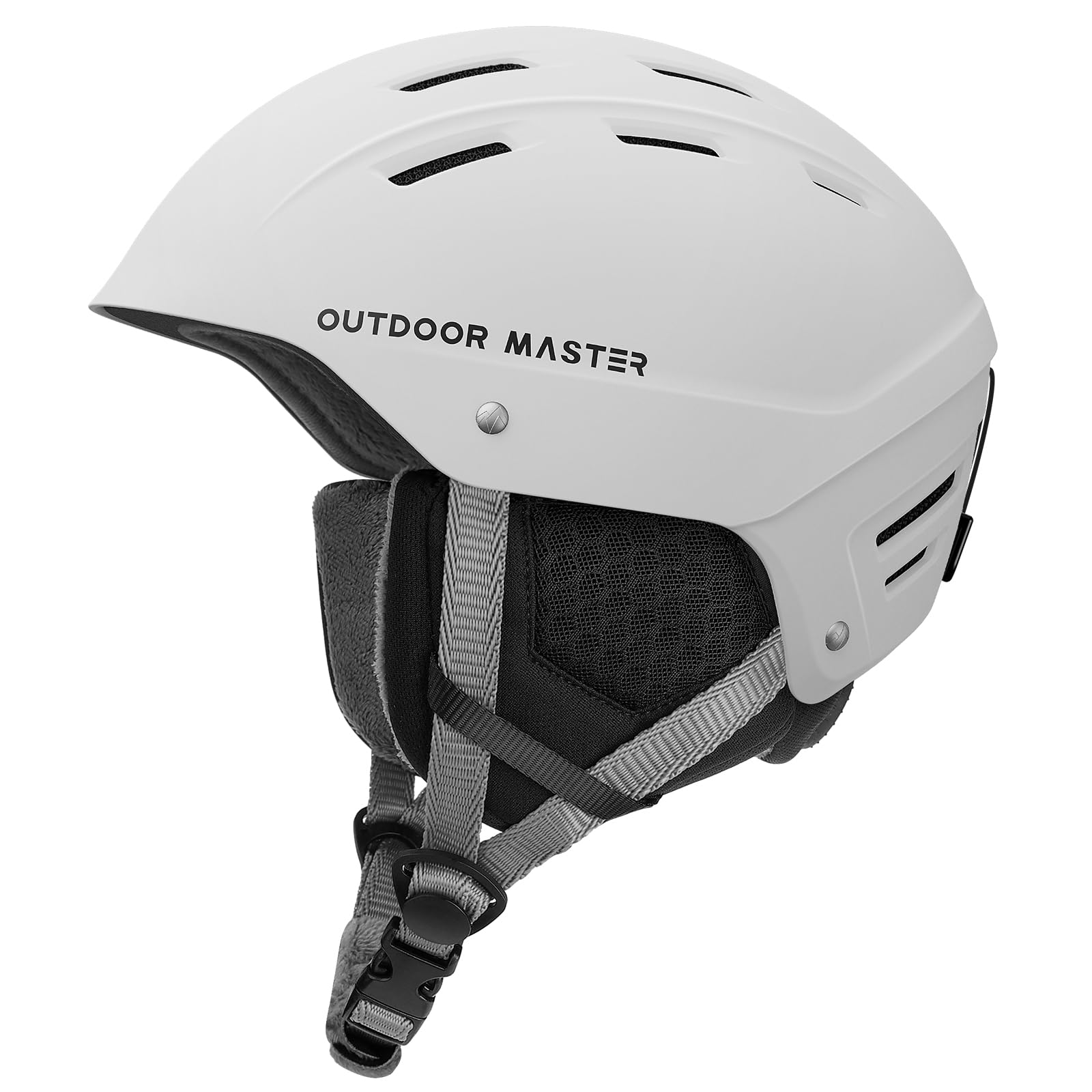
1. OutdoorMaster Kelvin II Ski Snow Sport Helmet
Our pick — 4.5+★ from 600+ verified ratings; the strongest balance of quality and price.
The value pick that punches far above its tier — a full ABS shell, 14 vents, and a dial that actually holds.
A first helmet needs a solid shell, a fit you can dial in, and vents you can feel. The Kelvin II hits all three with a fully formed ABS (a hard plastic outer shell) paired with EPS foam (the crushable liner that soaks up impact). At 0.6 kg it sits light on your head all day. The 14 air vent holes shield you from freezing winds while letting heat bleed off on warmer afternoons — more vents than any other pick in this guide except the Smith Mission at 14 and Smith Descend at 16.
Fit is where the Kelvin II wins. The dial at the back lets you adjust on the fly, and the detachable lining and earmuffs come out for warmer spring days. The sizing runs on real head circumference: Small at 48-54 cm, Medium at 54-58 cm, Large at 58-62 cm. Measure first and you will land in the right shell without a return. The crowd here is the largest on this list — 4.5+ stars across 600+ ratings — and quality is what comes up most, followed closely by fit and value.
The one honest catch: it is not MIPS-equipped. For aggressive tree skiing or high-speed carving, that low-friction layer is worth having. For groomers, the park, and everyday resort laps, a well-fitted shell like this one protects you just fine. Note too that the included components are just the helmet — goggles are sold separately and the fit with OutdoorMaster goggles is what it is designed around.
What earns its keep
- 14 vent holes — the joint-highest count in this guide alongside the Smith Mission
- Dial fit with detachable lining and earmuffs for warmer days
- Full ABS shell and EPS foam at a first-helmet tier
- Sizing by head circumference, not vague letter sizes
Think twice if
- You want MIPS — this one does not have it
- You ski aggressively off-piste at speed and want the extra impact layer
Reach for this if: you want a comfortable, well-vented adult helmet without spending up for MIPS.
Look elsewhere if: MIPS is non-negotiable for how you ski.
2. Ski Helmet ASTM Standard Snowboard Helmet Adjustable Ventilation
The one you can buckle in one gloved hand — and the venting setup that actually keeps goggles clear on the lift.
TurboSke’s hybrid shell mixes a PC (polycarbonate) shell with a hard ABS plastic shell placed in key and high-impact areas. That dual-material trick lets it weigh only 1.3 pounds — lighter than the Smith Mission’s 1.5 pounds — without giving up hard plastic where your head needs it most. It complies with ASTM F2040 safety standards, the benchmark certification for snow helmets.
The magnetic FIDLOCK buckle is the standout: a patented magnetic clasp that closes itself and opens with one hand even with gloves on. The venting is equally thoughtful. The Dual Regulator system lets you open front and rear vents independently — close the front, open the rear, and excess heat leaves without freezing your forehead. Open both and you get maximum airflow to clear fog from your goggles fast.
You dial in fit through a glove-friendly dial, and the removable liner and ear pads let you re-tune warmth — pull the ear pads out and it works in warmer seasons too. The ear pads also have audio storage slots if you want to drop in an aftermarket sound system. Buyers praise quality most here, with fit a close second; the magnetic clasp gets its own fan club. At 4.5+ stars across 800+ ratings, this is the most-reviewed helmet in this guide and it holds the score well. The only real limitation: it is not MIPS-equipped, so if that low-friction layer is on your list, look at the OutdoorMaster ELK below.
Where it shines
- FIDLOCK magnetic buckle opens with one gloved hand
- Dual Regulator vents work front and rear separately
- 1.3 lb — lighter than the Smith Mission’s 1.5 lb
- ASTM F2040 compliant and audio-slot ear pads
Trade-offs to know
- No MIPS layer
- Ear-pad removal is the only warmth control — no adjustable vent doors beyond the dual regulator
Best for: riders who hate fiddling with chin straps in a cold wind.
The honest door closed: no MIPS if that matters to you.
3. OutdoorMaster ELK MIPS Ski Helmet
MIPS inside an in-mold shell — the lowest-entry way to get the extra impact layer on your head.
This is the cheapest helmet in this guide to carry MIPS (Multi-directional Impact Protection System — the low-friction layer that lets the shell rotate slightly under angled impact). The ELK pairs that with a reinforced PC (polycarbonate) shell and shock-absorbing EPS core in an in-mold construction, meaning the outer shell and the foam liner are fused as one piece. That build is lighter and more durable than a two-part shell, and it keeps the MSRP low.
Vent count drops to 8 air vent holes here — half the Kelvin II’s 14 — but the apertures are shaped to shield you from freezing winds, and 8 is plenty for lift rides in cold conditions. Fit runs through a size adjustment dial at the back, plus detachable lining, earmuffs, and a soft chin band. A goggle strap retainer at the rear keeps your strap from wandering mid-run. If your ski day includes ice skating as well as the slopes, it is rated for that too.
Buyers report that this helmet saved them from several concussions. Quality is what they praise most, with fit right behind. The one mixed note is durability — a minority treat it as a beater and find it does not survive seasons of abuse. It is also worth knowing that the liner and pads are removable for warmer-weather use, so the shell stretches into spring skiing. Weigh that durability caveat against the price: as the cheapest way into MIPS on this list, it earns its place.
The case for it
- MIPS at the lowest entry point on this list
- In-mold shell fuses PC and EPS for a lighter, stronger one-piece build
- Goggle strap retainer and size-adjustment dial
- Detachable liner and earmuffs extend it into warm weather
The catch
- 8 vents — the fewest of any helmet here
- A minority of owners mention durability shorter than they expected
Pick this if: MIPS is the priority and you do not want to spend premium money on it.
Look elsewhere if: you want maximum venting on warm spring days.
4. SMITH Mission MIPS

Two impact technologies in one 1.5-pound shell — MIPS plus Koroyd, tuned for Smith goggles.
Smith throws both its safety tools at the Mission. MIPS handles angled impacts through a sliding layer, and Zonal KOROYD — a honeycomb-like structure built into the shell — absorbs energy at key zones. Together they add up to a helmet that is still only 1.5 pounds. That is heavier than the TurboSke’s 1.3 pounds, but the TurboSke carries no MIPS, so the weight buys you real protection tech.
Ventilation here is 14 vents you can open or close with one hand, which is a big step up for warm spring conditions or hike-to terrain. The AirEvac system lines up the helmet’s vent path with Smith goggles, so your lenses stay clear and your forehead does not fog. The dial fit adjusts on the go, and the removable Snapfit SL2 ear pads are audio-chip compatible if you want music on the lift.
Buyers consistently call this one extremely light and comfortable — the emphasis is on how little you notice it on your head. Goggle alignment with Smith frames is a recurring win; one buyer notes it “aligns well with Smith goggles.” Quality leads what buyers praise most, fit close behind. At 4.5+ stars across 200+ ratings, it holds the top score shared with three other picks here. The honest catch: at premium-mid pricing, you are paying for the Smith name and Koroyd — if you already own Giro goggles, the Giro Trig just below is cheaper and also MIPS-equipped.
AirEvac, the quiet win: the vent path is tuned to Smith’s own lens shape — it is the one helmet here built specifically to keep Smith goggles clear.
The Smith ecosystem tax: if you do not own Smith goggles, most of the AirEvac advantage goes unused.
Best fit for: Smith goggle owners who want double protection in a light shell.
Think twice if: you already ride Giro eyewear — you’d be paying for an ecosystem you don’t use.
5. Giro Trig MIPS Adult Snow Helmet
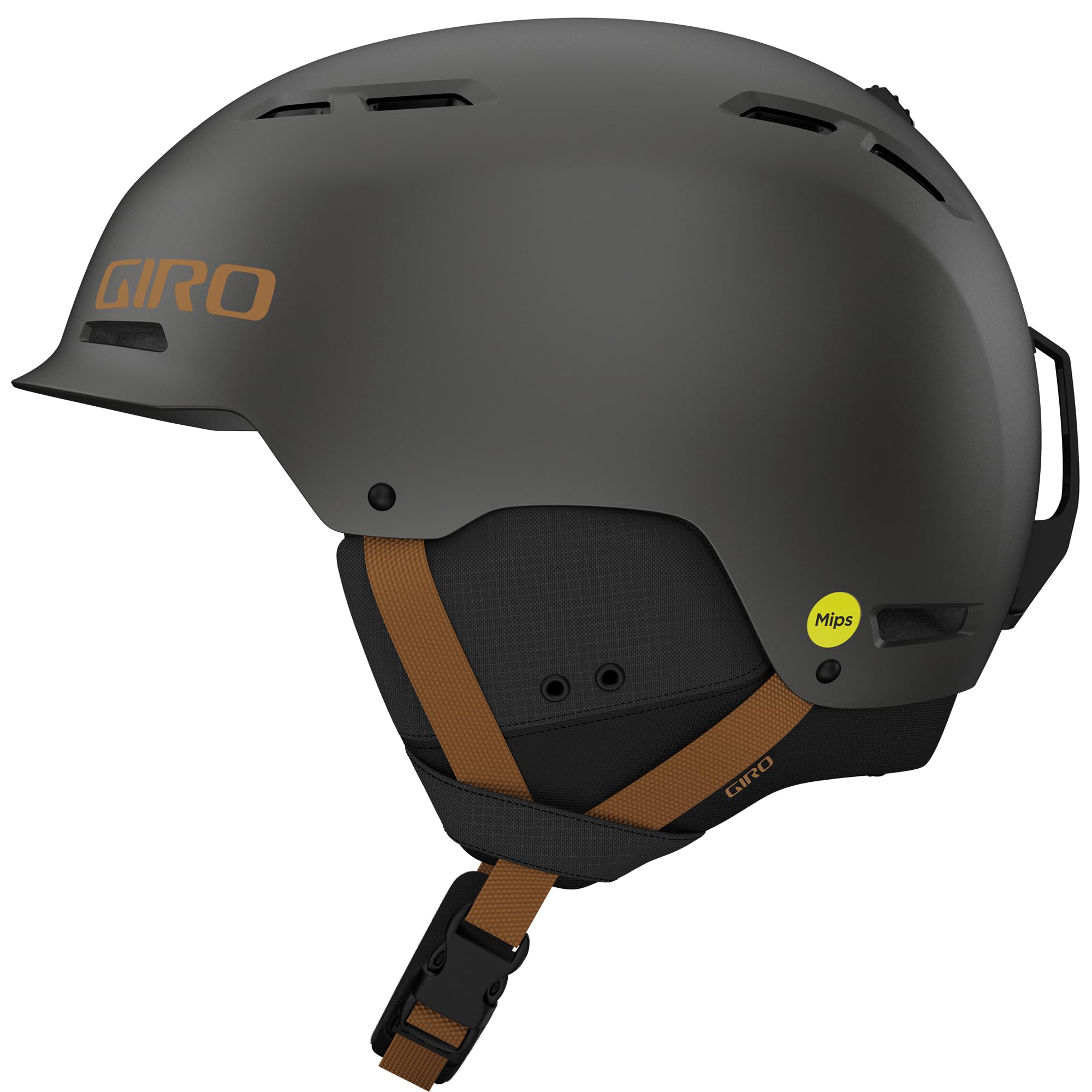
A hard-shell MIPS build with vents you tune from a single button — no fiddling at the lift.
The Trig uses a hard-shell construction: a rugged outer shell formed and then bonded to the EPS foam liner. That is a different build from the in-mold shells above, and it makes for a solid, thick-feeling helmet at 16 ounces. MIPS sits inside for angled-impact protection. The In Form Fit System gives you an ergo-friendly dial at the base of the helmet with up to 6 cm of adjustment, and the vertical tuning feature lets you shift the shell high or low to line up with your goggles.
If you hate stopping to adjust, the venting is the headline: Thermostat Control puts a single low-profile button on the outside of the shell that changes airflow instantly. The Stack Vent at the front aligns with your goggles and helps push warm humid air up and out before it condenses. The shell is smooth-compatible with Giro goggles — Giro recommends its own Axis Goggles — so if you already own a Giro lens, this is the natural pairing.
Fit and quality are the two aspects buyers praise at equal volume here — the helmet gets called snug and secure, with the dial-in system earning direct mention. Warmth is another recurring win; owners feel it in cold conditions. Removable earpads and a removable goggle retainer round out the adaptability, and it is compatible with aftermarket audio systems. At 4.5+ stars across 200+ ratings, this is the right call for Giro loyalists or anyone who values on-the-go vent control over MIPS-plus-Koroyd combos.
Choose this if: you want one-button vent control and a glove-friendly dial fit.
Skip the Giro route if: Smith Koroyd’s dual-layer protection matters more to you — the Mission is the closer match.
6. Oakley MOD1 Snow Helmet

The low-bulk, no-MIPS option for riders who want Oakley’s silhouette and a dial that holds.
Oakley skips MIPS here and keeps the shell lean — 430 g, the second-lightest helmet in this guide behind only the POC Obex Pure at 0.42 kg. The BOA 360 fit system wraps the whole head rather than pinching at the rear, which makes it forgiving of different head shapes. Fixed ventilation lets hot air escape from the top of the shell, and the FIDLOCK magnetic buckle lets you fasten the helmet with gloves on.
The removable liner and earpads are machine washable — a real plus if you ride often — and you can wear the goggle strap underneath the helmet if you prefer that look. The travel bag and Oakley decal come in the box, so it transports without scuffing your shell in a duffel. It is rated for snowboard use and works as a general mountain helmet.
Comfort and how neatly it sits on the head come up most from buyers, along with the magnetic closure being easy to unclip in mittens. What buyers praise most is quality; fit follows closely. One buyer reports it saved them from hitting their head during a fall. Value is the one mixed note — at premium pricing without MIPS, some feel the money goes to the brand badge. That is the honest trade: you buy Oakley for the fit system and the look, not for the extra impact layer.
Fit engineering first: the BOA 360 wrap is the standout here — it is among the most universally adjustable dial systems in this group, and 430 g makes it the lightest premium option.
What you give up at this price: no MIPS, no adjustable vent doors — the fixed vents cannot be closed on a wind-whipped lift.
Right for: skiers who prioritize a clean shell profile and the BOA 360 fit above all else.
Wrong for: anyone shopping specifically for impact-sliding MIPS tech at premium prices.
7. Giro Neo MIPS Ski Helmet
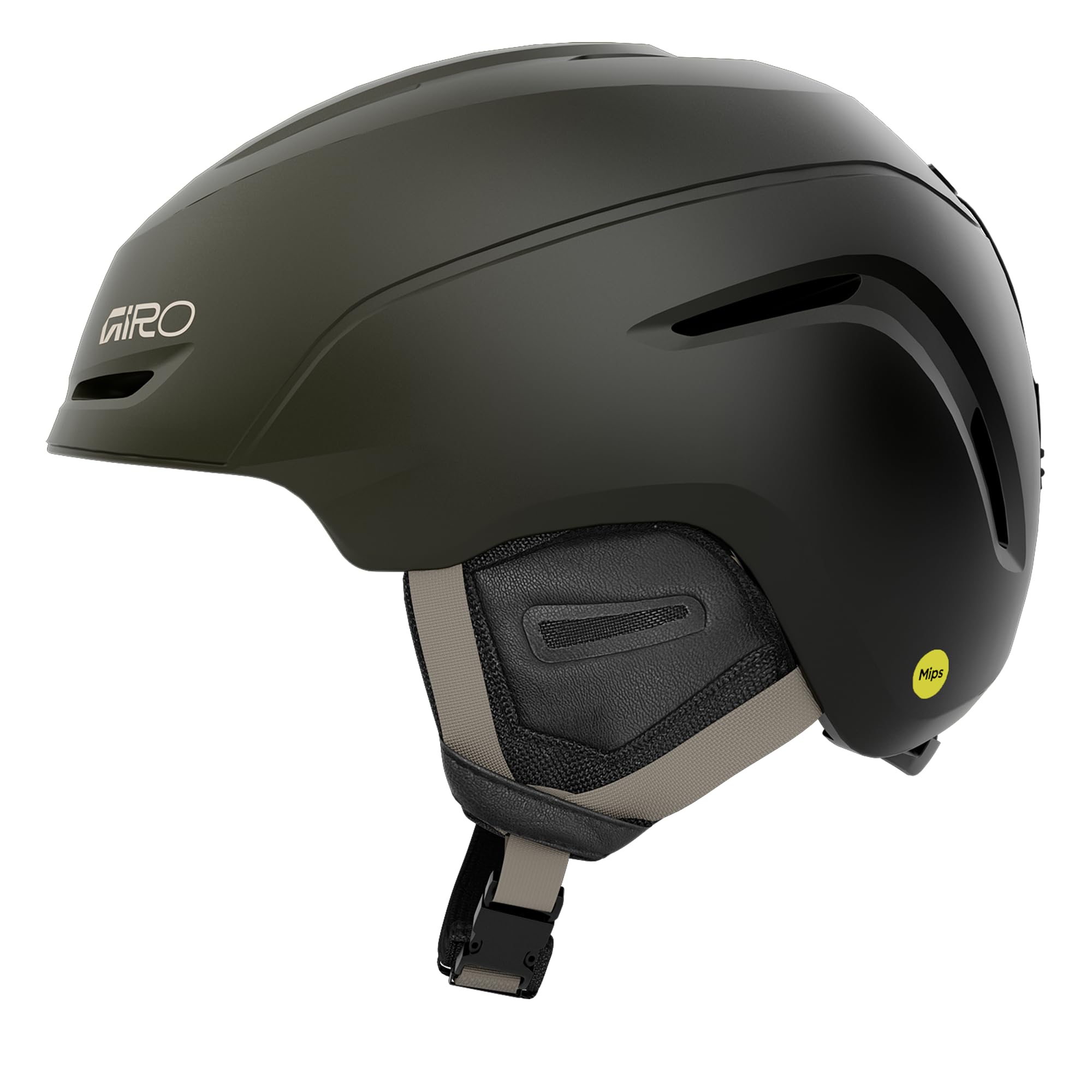
In-mold fusion keeps this MIPS snow helmet cool, and vertical tuning kills the goggle gap.
Giro’s I.M. construction fuses a tough polycarbonate outer shell directly to the impact-absorbing foam liner in one process. That fusion is what lets the vent channels run deeper and cooler than a traditional two-part shell — so the Neo runs cooler than the hard-shell Trig above it, even though both use MIPS. At 2.2 pounds, though, it is noticeably heavier than the 16-ounce Trig.
The same In Form Fit System returns: an ergo dial with up to 6 cm of adjustment and vertical tuning to raise or lower the shell against your goggles. Thermostat Control venting again puts a single button on the outside for instant airflow changes. The Stack Vent at the front pushes moisture up and out before it fogs the lens, and Giro recommends pairing it with its Balance and Scan goggles for a smooth fit. It is audio-system compatible like the rest of the Giro line.
What buyers praise most is fit — with the ability to move the boa dial vertically earning direct mention, which matters for anyone with an awkward head shape. Warmth follows, and the vents help on warmer days. Value for money is a minor but recurring note that this is fairly priced for a MIPS helmet with in-mold construction. At 4.5+ stars across 190+ ratings, the Neo is the solid middle ground in Giro’s range — MIPS and better venting than the Trig, without the Trig’s hard-shell bulk.
What works well
- I.M. construction channels airflow for cooler running
- Vertical tuning fixes the goggle gap
- MIPS protection included
- Compatible with aftermarket audio systems
Where it costs you
- 2.2 pounds — heavier than the Giro Trig’s 16 ounces
- Requires Giro goggles for the best Stack Vent alignment
Go for this if: you want in-mold cooling and MIPS under one shell.
Pass if: you are weight-sensitive and the Trig’s 16 ounces wins for you.
8. POC Obex Pure Ski and Snowboard Helmet
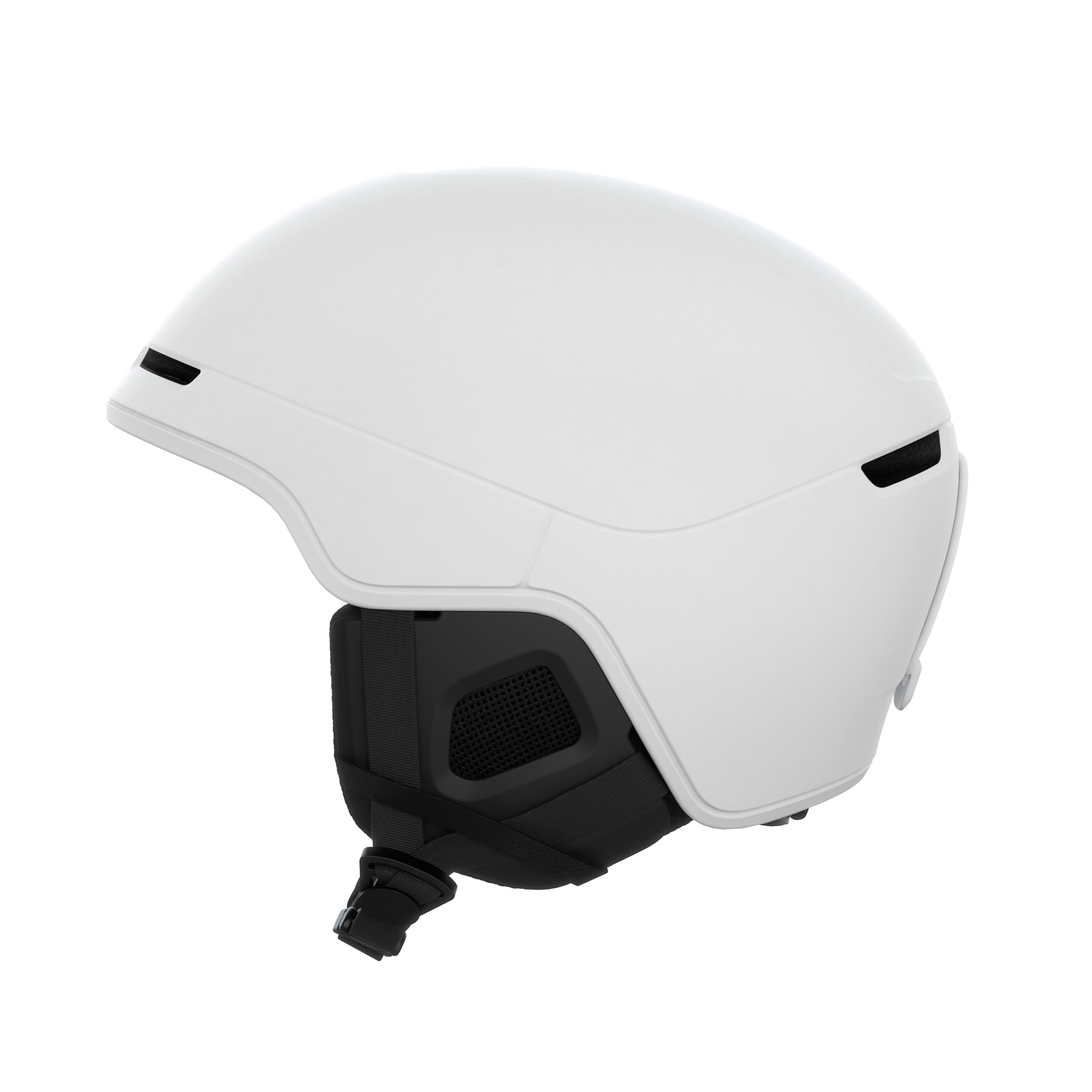
The 420-gram featherweight with a 360° fit wrap — narrow enough for low-volume head shapes.
POC goes light and streamlined. A tough PC shell bonded to the EPS liner gives strong structural stability, and at 0.42 kg (lighter than the Oakley’s 430 g) it barely registers on your head by late afternoon. The 360° adjustment system wraps the entire circumference rather than pinching at one point, so you can find a secure fit without swapping padding. A flexible rear clip keeps your goggle strap locked down.
The vent system uses internal channels rather than open vent holes — airflow runs through the shell for cooling, and goggle chimneys let the heat from your lenses escape through the helmet so they do not steam up. Those chimneys are a genuinely useful feature on cold days when your goggles fog from the inside. Detachable ear pads let you tune warmth for warmer spring conditions. It is rated for both skiing and snowboarding.
The one honest note is fit volume. Some buyers find it runs tight on the temples — the aspect counts here are the only ones in this guide where fit is mixed rather than positive, and the 360° wrap will not suit every head shape. Buyers who match the shape call it excellent quality. If you have a low-volume or narrow head, the POC’s light build and snug wrap are what you want; if you have a wider head, order a size up or look at the Smith Mission instead.
Light to the point of forgettable: 0.42 kg is the lightest in this entire guide, and it is the strongest argument for the Obex Pure.
The fit reality: a snug wrap is the design intent — if your temples run wide, size up.
Best match for: narrower heads and weight-sensitive riders who want a light, streamlined shell.
Reconsider if: you have wide temples or a broad crown — the 360° wrap can bite.
9. SMITH Descend MIPS Helmet
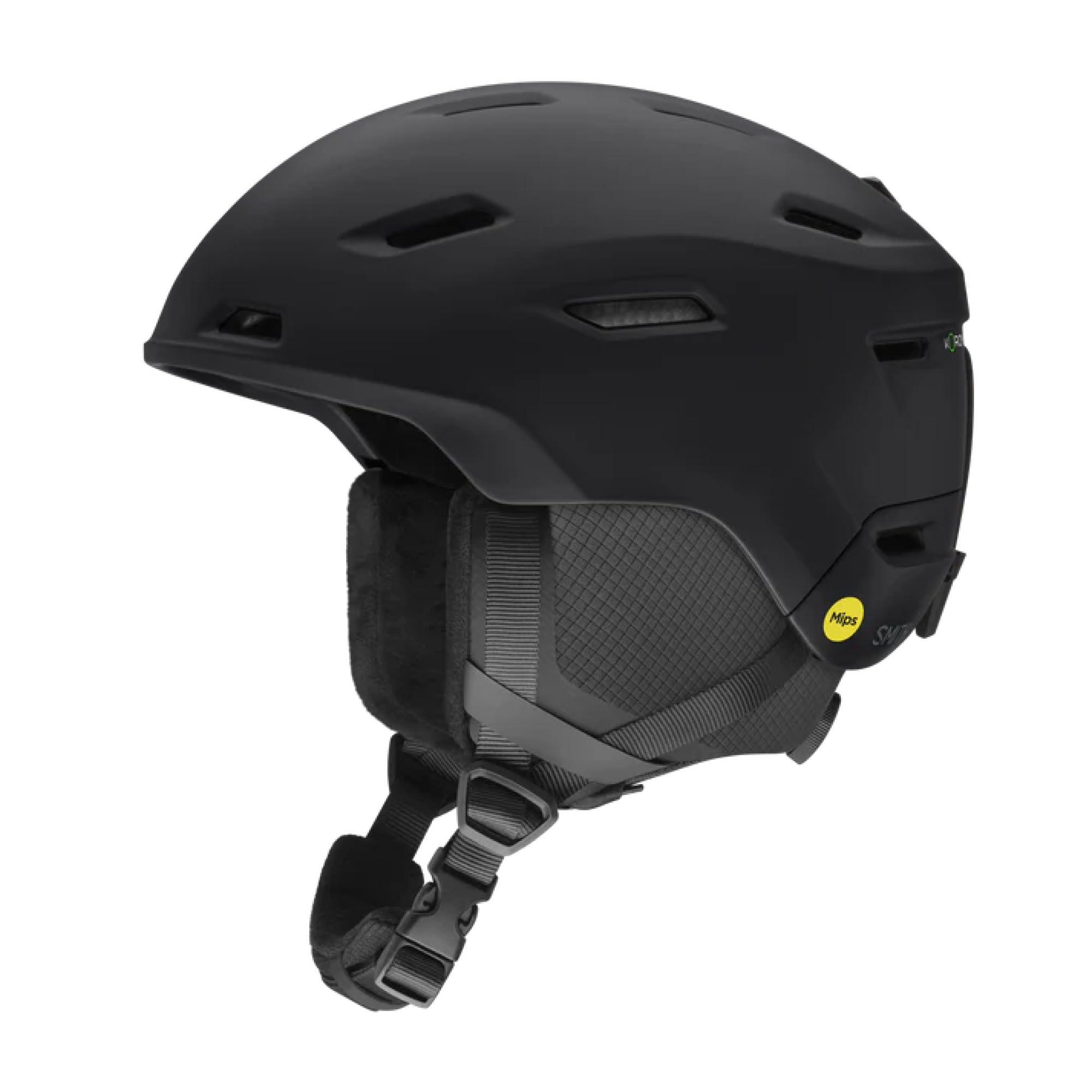
The most vented shell on this list — 16 vents with one-handed front and rear control, plus Koroyd.
Smith’s Descend throws in everything: MIPS, Zonal Koroyd impact coverage, and a light in-mold shell bonded as a single piece. That in-mold construction means the outer shell and the EPS foam become one, which keeps the weight at 0.82 kg and the shell thin. It is certified to ASTM F 2040 and CE EN 1077:2007 — the two standard snow-sport safety standards.
Sixteen vents, the most of any helmet here, driven by a dual regulator climate control that opens front and rear vents independently with one hand. The AirEvac system integrates with Smith eyewear so your lenses stay clear even when you are pushing hard. Ionic+ lining uses sweat-activated odor control — a small detail you will appreciate in week two of a season, not week one. The adjustable dial lets you tune fit on the fly, and the removable Snapfit SL2 ear pads are audio-chip compatible.
Comfort wins buyers over most here — the emphasis is on how the ear pads do not squeeze — and customers note the ear muffs do not block hearing, which matters for safety on a busy slope. It is warm where it needs to be. At 4.8 stars across 70+ ratings, it is the top score in this guide, though it has fewer ratings than the other 4.7 and 4.6 picks — a smaller pool, not a lesser helmet. For the aggressive rider who wants every protection layer Smith makes, this is the pick.
Why aggressive riders want it
- MIPS plus Zonal Koroyd in one in-mold shell
- 16 vents — the most in this guide
- Dual regulator lets you adjust front and rear separately
- ASTM F 2040 and CE EN 1077:2007 certified
What to weigh
- 0.82 kg — heavier than the POC Obex Pure at 0.42 kg
- Fewer total ratings than most picks here
Built for: hard-charging riders who want the fullest protection package Smith offers.
If weight is your priority: the POC Obex Pure is a full pound lighter, though it drops MIPS.
Understanding the Specs
MIPS and Koroyd — what they actually do
MIPS is a thin inner layer that lets the helmet slide a few millimeters relative to your head during an angled hit, reducing the rotational force that reaches your brain. Koroyd is a honeycomb structure built into zones of the shell to absorb energy on impact. Neither is a guarantee — both are extra protection layers. A well-fitted MIPS helmet still needs to fit your head circumference properly to work as designed.
Vent count vs vent control
More vents generally means more airflow and cooler running, but only if you can close them when it gets cold. A 14-vent shell with fixed openings is worse on a freezing lift than a 8-vent shell with adjustable doors. The TurboSke’s Dual Regulator and Giro’s Thermostat Control both let you change airflow mid-run, which matters more than raw vent count on days that swing from cold summit to warm base.
In-mold vs hard-shell construction
In-mold means the polycarbonate shell and the EPS foam liner are fused in one piece — lighter and better-ventilated. Hard-shell means the outer shell is formed separately and bonded to the foam liner — a bit heavier but tougher against surface scuffs. Both are certified the same way, so this is a weight and feel trade-off, not a safety gap.
Magnetic buckles and dial fit
A FIDLOCK buckle closes itself magnetically and opens with one gloved hand — the single best upgrade for anyone who dreads the chin-strap fumble on a windy lift. Dial fit and 360° systems tighten the whole shell to your head; look for one that wraps the full circumference and adjusts vertically so you can line up the brim with your goggles.
FAQ
How do I measure my head for an adult ski helmet?
Is MIPS worth it for a recreational skier?
Can I wear a beanie under my ski helmet?
How do I stop my goggles from fogging under a ski helmet?
Is a hard-shell or in-mold ski helmet better?
Can I use my ski helmet for snowboarding or ice skating too?
What is FIDLOCK and how does it work with gloves on?
How long should a ski helmet last before I replace it?
Can I fit an audio system inside these helmets?
Do removable ear pads mean I can use the helmet in spring?
Final Thoughts: The Verdict
The winner for most people is the OutdoorMaster Kelvin II — 14 vents, a dial fit that holds, and real head-circumference sizing at a first-helmet tier, backed by 4.5+ stars across 600+ ratings. If MIPS is your priority, the OutdoorMaster ELK MIPS is the cheapest route into that extra layer. And if you want the fullest protection package Smith makes, the Smith Descend MIPS gives you MIPS, Koroyd, and 16 vents in one shell. Measure your head in centimeters and pick the size that matches.
How We Picked
We do not accept paid placement. Every pick is matched to a real buyer and a real use-case; we do not hands-on test units.
Sources & Methodology
Specifications: manufacturer listings and product documentation. Review insights: verified customer reviews, as of November 2026. Pricing: not shown on this page (it changes often); check the current price via the retailer link.
As an Amazon Associate, Gadgets Feed earns from qualifying purchases. This does not affect which products we feature.