
Our readers keep the lights on and my morning glass full of iced black tea. As an Amazon Associate, I earn from qualifying purchases.
Specs are compiled from manufacturer listings and verified buyer reviews and can change over time — please confirm the key details on the product page before buying.
You want a telescope that actually shows you the craters on the Moon and the rings of Saturn, not a blurry white dot that leaves you frustrated. The problem is, most “adult telescopes” on Amazon share the same shelf space as toy scopes, making it nearly impossible to tell which one will deliver a sharp, steady view and which one will wobble every time you touch the focus knob. This guide cuts through that confusion by comparing only scopes with real optical specs—aperture, focal length, and mount quality—so you walk away knowing exactly which model is worth your money.
I’m Min — the founder and writer behind Gadgets Feed. This guide is built by comparing the manufacturers’ published specifications and the patterns across verified customer reviews, so you get each pick’s real strengths and trade-offs instead of marketing spin.
Every telescope reviewed here was chosen for its ability to deliver genuine stargazing value, and we explain exactly why each one made the cut for the best adult telescope list.
Quick Picks
- Celestron NexStar 4SE Computerized Telescope — Premium Choice
- Celestron StarSense Explorer LT 80AZ — Best Overall
- Gskyer 130EQ Professional Astronomical Reflector Telescope — Pro Performance
- Hawkko Telescope, 90mm Aperture 900mm Refractor — Value Champion
- MEEZAA Telescope, 90mm Aperture 800mm Refractor — Solid Build
- Dianfan Telescope, 90mm Aperture 800mm Refractor — Great Starter
- Koolpte 90mm Aperture 700mm Telescope (Vertisteel AZ Mount) — Smart Value
- Gskyer Telescope 600x90mm AZ Refractor — Budget Star
- Celticbird Telescope 80mm Aperture 900mm Refractor — Budget Entry
How To Choose The Best Adult Telescope
Picking your first real telescope can feel overwhelming with all the numbers and jargon. To help you decide, focus on these three pillars: the aperture (how much light the scope gathers), the mount (how steady the view stays), and the overall build quality. We break each of these down below so you know what to look for.
Aperture: The Light-Gathering King
The aperture is the diameter of the main lens or mirror, measured in millimeters. This is the single most important spec for a telescope. A larger aperture captures more light, which means you see fainter stars, more detail on planets, and brighter deep-sky objects like nebulae and galaxies. For an adult telescope, look for at least an 80mm aperture to get meaningful views of Jupiter’s cloud bands and Saturn’s rings.
Mount Stability: The Unsung Hero
A great optical tube on a shaky mount is a frustrating experience. The mount is what holds the telescope steady. There are two main types: Altazimuth (AZ) mounts, which move up-down and left-right and are simple to use, and Equatorial (EQ) mounts, which are better for tracking objects as the Earth rotates. For beginners, a sturdy AZ mount with slow-motion controls offers the best balance of ease and stability.
Focal Length and Magnification
Focal length (in mm) determines the magnification power of the telescope when combined with an eyepiece. A longer focal length gives higher magnification for a given eyepiece. However, don’t chase raw magnification numbers. A 90mm aperture scope at 200x will show you more detail than a 60mm scope at 300x. The “maximum useful magnification” is roughly 50x per inch of aperture (2x per mm). Go beyond that, and the image just gets dim and blurry.
Glass Coatings and Build Quality
Look for terms like “fully coated” or “fully multi-coated” on the optics. These coatings reduce light loss and glare, giving you brighter, sharper images. For the mount and tripod, stainless steel or heavy-duty aluminum is preferable to thin plastic. A metal focuser is also a sign of higher build quality, as plastic ones can slip under the weight of a camera or heavy eyepiece.
Quick Comparison
On smaller screens, swipe sideways to see the full table.
| Model | Best For | Aperture | Focal Length | Mount Type | Amazon |
|---|---|---|---|---|---|
| Celestron NexStar 4SE | Automated stargazing | 4 inch (102mm) | 1325mm | Computerized GoTo | Amazon |
| Celestron StarSense Explorer LT 80AZ | App-guided beginners | 80mm | 400mm | Altazimuth | $195.49$249.95Amazon |
| Gskyer 130EQ | Reflector performance | 5.1 inch (130mm) | 650mm | Equatorial | Amazon |
| Gskyer 600x90mm | Budget 90mm refractor | 90mm | 600mm | Altazimuth | Amazon |
| Hawkko Telescope | Versatile 90mm kit | 90mm | 900mm | Altazimuth | $199.99$239.99Amazon |
| MEEZAA Telescope | Stable metal build | 90mm | 800mm | Altazimuth | $169.99$199.99Amazon |
| Dianfan Telescope | Beginner refractor | 90mm | 800mm | Altazimuth | $169.99$199.99Amazon |
| Koolpte 90mm | Value with slow-motion mount | 90mm | 700mm | Vertisteel AZ Slow-Motion | $149.99$199.99Amazon |
| Celticbird 80mm | Budget travel scope | 80mm | 900mm | Altazimuth | $147.99Amazon |
In‑Depth Reviews
1. Celestron NexStar 4SE Computerized Telescope

The push-button telescope that finds objects for you, saving hours of sky-hunting.
For adult stargazers ready to skip the frustration of manual star-hopping, the NexStar 4SE is a real upgrade. Its fully automated GoTo mount comes with a NexStar+ hand control loaded with a 40,000+ object database. You pick a target from a list, and the scope slews to it automatically, then tracks it so it stays centered in your eyepiece. The optics are a 4-inch (102mm) Maksutov-Cassegrain with a long focal length of 1325mm, which delivers sharp, high-contrast views of the Moon and planets.
The SkyAlign technology is designed to make alignment simple: you center any three bright stars or planets you can see—even if you don’t know their names—and the system figures out the rest. This makes it much more accessible for beginners who want an advanced feature set without needing to memorize the night sky. Buyers report great views of Jupiter, the Moon, Saturn, and deep-sky objects, praising the ease of setup and stable tripod.
The stock finderscope is difficult to align, and the mount drains batteries quickly, especially in cold weather. Many users find they need a 12V power adapter for reliable sessions. Also, expect to invest in better eyepieces and a Barlow lens to get the most out of its 1325mm focal length. It is a premium platform that rewards those who plan to grow into its capabilities, not a grab-and-go for casual backyard nights.
Worth the climb: This is the best manual-tracking-free experience for anyone ready to move past a basic scope. It finds and tracks objects for you, making sessions productive and fun.
An honest head-start: The GoTo computer and 40,000-object database eliminate the need to know the night sky, but you will need a 12V power supply to avoid battery drain during longer sessions.
Reach for this if… you want a computerized scope that finds targets automatically and tracks them, perfect for learning the sky without the map. It suits both beginners ready to learn and experienced users wanting a compact, powerful grab-and-go.
Look elsewhere if… your budget is tight and you don’t want to spend extra on a better finderscope and power adapter, which many reviewers found necessary for reliable use.
2. Celestron StarSense Explorer LT 80AZ

Your smartphone becomes a celestial tour guide, making stargazing instantly rewarding.
This is the best entry-level scope for someone who wants results on night one, no experience required. The secret is the patented StarSense Technology dock on the side of the mount. You clip in your phone, launch the free StarSense Explorer app, and the app uses sky recognition to analyze star patterns overhead, telling you exactly where to move the telescope to find planets, nebulae, and galaxies. The app generates a curated list of the top objects to see based on your time and location, so you are never guessing what to look at.
The scope itself is an 80mm refractor with a 400mm focal length, which gives you a nice wide field of view—perfect for sweeping star clusters like the Pleiades and the Andromeda Galaxy. The views are sharp thanks to fully coated glass optics. One reviewer noted “excellent moon views” with craters and mountains, and that Jupiter’s moons were clearly visible with faint bands. The 25mm and 10mm eyepieces plus a 2x Barlow lens give you a good range of magnifications.
The catch is the mount, which is a basic manual altazimuth with altitude slow-motion. It is stable enough, but you have to manually push the scope to follow your target. The scope is lightweight and easy to carry, but some taller users mention the tripod could be a bit short. Success with the StarSense app requires a phone with a good camera and a dark-ish sky away from bright streetlights, which some first-timers might not have. It is a fantastic learning tool, but it works best when your expectations match its 80mm aperture—great for the Moon and planets, less so for faint, fuzzy galaxies.
The smartest first date: The StarSense app is so intuitive that complete novices can find Saturn’s rings and the Orion Nebula without reading a star chart, turning a frustrating first session into a magical one.
A real-world win: Because the optical tube is only an 80mm, it is a lightweight 3-inch scope that packs down small. Owners mention seeing Saturn’s rings clearly and the moons of Jupiter, which is a huge confidence boost for a beginner.
Perfect for: any adult who is completely new to astronomy and wants a no-fuss, guided experience. The app essentially eliminates the learning curve of finding things in the sky.
Not for: experienced stargazers who will outgrow the 80mm aperture quickly, or anyone who wants a stable, slow-motion mount for high-magnification planetary viewing.
3. Gskyer 130EQ Professional Astronomical Reflector Telescope

A 5.1-inch reflector that gathers enough light to reveal galaxies and globular clusters.
For the serious beginner or intermediate stargazer who wants to move past planetary views into deep-sky objects, the Gskyer 130EQ offers the largest aperture in this guide at 130mm. Its 5.1-inch primary mirror collects significantly more light than any 90mm refractor, making it ideal for observing brighter galaxies, nebulae, and star clusters. The 650mm focal length gives it a fast f/5 focal ratio, which is good for wider-field views and astrophotography.
This is a reflector telescope, which means it uses mirrors instead of lenses. It comes with an equatorial mount (EQ-130), which is designed to track objects by following the Earth’s rotation with one simple movement. The kit includes three eyepieces, a 3x Barlow lens, and a wireless Bluetooth remote for capturing images through your phone. Reviewers praise its “exceptional optical performance” and the “sturdy EQ-130 mount,” noting that it delivers “breathtaking clarity” on the Moon, Saturn, and even some galaxies.
EQ mounts are not as intuitive as a simple AZ mount; you need to understand how to polar align the mount to use its tracking effectively. Some users report the mount slips under heavier loads, and the tripod can be a bit wobbly at high magnifications if bumped. The scope itself is also heavy at 30.1 pounds, making it less portable for camping trips. This is a scope for someone ready to invest time in learning how to use an equatorial mount properly, and the reward is the ability to find and follow fainter celestial objects.
Why it punches above its weight
- 130mm (5.1-inch) aperture is the largest in this roundup, revealing deep-sky objects like galaxies and nebulae
- Toothless focusing base provides smooth, precise focus without the common “image shift” of rack-and-pinion focusers
- Wireless remote allows for shake-free photography through your phone
What holds it back
- The equatorial mount has a learning curve and can be unstable with bumps, as noted by multiple reviewers
- At 30.1 pounds, it is the heaviest scope here and less portable
- The instruction manual is reportedly confusing, and the included finderscope may need replacement for reliable star-hopping
Its best trick: The large 130mm mirror gathers enough light to show you the structure of the Andromeda Galaxy and the Orion Nebula, a step up from what any 80mm or 90mm refractor in this list can show.
The real trade-off: You will need to spend time learning polar alignment and equatorial tracking to get the most from its mount, which might frustrate someone who just wants a quick backyard view.
4. Hawkko Telescope, 90mm Aperture 900mm Refractor

A 90mm aperture with a 900mm focal length that out-resolves most scopes in its class.
The Hawkko is a straight-up aperture and focal length champion at its price point. The 90mm aperture captures more light than the 80mm models, and its 900mm focal length is the longest among the 90mm refractors here, giving you higher magnification potential for planetary detail. It uses a professional-grade full multi-layer coating (FMC) on the lens, which the manufacturer claims improves light transmittance, producing brighter, sharper images.
The kit comes with everything you need to get started: 25mm and 10mm eyepieces, a 3x Barlow lens (giving you 36x to 270x magnification), a stainless steel AZ mount tripod, and a phone adapter. Customers note the setup takes under 15 minutes and that they “saw Jupiter and its moons” on the first night, with excellent lunar views. The stainless steel tripod and AZ mount feel more sturdy than the thin aluminum legs on cheaper competitors, and the focal length at 900mm is a real advantage for getting closer to the planets.
The trade-off is that at 900mm, the field of view is narrower, making it harder to find objects compared to a shorter focal length scope like the Celestron LT 80AZ. A few users report the finderscope is misaligned from the factory, requiring a quick re-calibration. Also, while the optics are good, the phone adapter can be fiddly, and achieving perfect focus with a phone attached takes practice. It is a fantastic value for someone who wants a serious 90mm scope without jumping to the price bracket.
Optical bang for your buck: The 900mm focal length paired with a 90mm aperture is a rare find at this price point. It gives you the reach to see Jupiter’s cloud bands and Saturn’s ring separation more clearly than a 700mm scope.
A reviewer’s note: One buyer mentioned the scope is also “good for birdwatching” during the day, thanks to the 90mm aperture and the included erecting diagonal, making it a dual-purpose tool.
Best for: the budget-conscious beginner who wants a 90mm aperture with a long 900mm focal length for serious planetary viewing without spending premium money.
Consider the alternative: If you need a wider field of view for star-hopping and galaxy hunting, a 700mm or 800mm scope will be friendlier, even if this Hawkko offers more raw reach.
5. MEEZAA Telescope, 90mm Aperture 800mm Refractor

The 90mm refractor with a solid metal build that stays steady in the wind.
The MEEZAA telescope stands out in the 90mm bracket for its build quality. While many telescopes at this price use thin plastic and aluminum, reviewers consistently note this scope has a “solid metal build” that is “stable in wind,” a huge advantage during cool, breezy stargazing sessions. The 90mm aperture gathers plenty of light, and the 800mm focal length (f/8.88) is a balance for planetary observing, offering good image brightness at moderate magnifications.
The kit includes 10mm and 25mm Kellner eyepieces and a 3x Barlow lens, giving you magnifications from 32x to 240x. The stainless steel tripod is adjustable from 28 to 46 inches, and all accessories pack into the included carry bag. Reviewers point out it is easy to set up in about 10-20 minutes and delivers “clear, sharp views of the moon and planets.” Its Alt-Az mount is simple to use, making it a great choice for a beginner who wants a no-fuss setup that can withstand a bit of rough handling.
The main downside reported by users is that the included straight-through finderscope is inverted and can be a bit confusing to use initially. The phone adapter, while handy, can introduce wobble when attached, making it hard to take clear pictures at high magnification. Some users also report minor chromatic aberration (a slight purple fringe on bright edges), which is common for an achromatic refractor at this price but not a deal-breaker. If you prioritize a sturdy, stable platform for learning, the MEEZAA is a strong contender.
The metal makes the difference
- Solid metal optical tube and stainless steel tripod provide excellent stability, even in breezy conditions
- 90mm aperture with 800mm focal length offers a great balance of light-gathering and magnification for planetary targets
- Users report assembling the scope in about 10-20 minutes
Minor compromises
- The inverted finderscope can confuse beginners, requiring a learning curve for aiming
- Phone attachment can introduce wobble and affect focus at higher magnifications
- Some shoppers say the 90mm aperture shows chromatic aberration on very bright objects like the Moon
Who it’s for: the buyer who values a rock-solid build over a few extra accessories. If you want a scope that won’t shake in a light breeze and is built to last, this is it.
Who might pass: those who want a super-wide field of view or who plan to do serious astrophotography—the phone mount’s limitations make that tough.
6. Dianfan Telescope, 90mm Aperture 800mm Refractor

A fuss-free 90mm refractor that gets you observing the Moon in under 15 minutes.
The Dianfan telescope is a straightforward, beginner-focused 90mm refractor that emphasizes ease of use. Its 800mm focal length f/8.8 gives crisp views of the Moon’s craters and some detail on Jupiter’s cloud bands. The included 45° zenith mirror ensures images are upright, making it usable for terrestrial viewing of birds or landscapes in between astronomy sessions. The 90mm aperture is fully coated to improve contrast and color, and the Dawes Limit is 1.29 Arc Sec, which is a standard measure of the smallest detail the optics can theoretically resolve.
Assembly is described as a “10-15 minute” process with clear instructions. The kit includes 10mm and 25mm eyepieces, a 3x Barlow lens for up to 240x magnification, a stainless steel tripod, and a carry bag. Reviewers consistently praise the “very clear” views of the Moon, with one noting they could even see Saturn’s rings. The phone adapter is included for sharing your views, and the whole kit packs into a bag for portability.
The catch is that at this price point, the mount is functional but not premium. The tripod legs are stiff to adjust, and some users report the mount has some “slop” or play in the movement, making fine adjustments tricky at high magnification. The finderscope also requires calibration right from the start, a step some beginners might find confusing. For the price, the optical quality is strong, and the mount is serviceable if you do not plan to push the magnification to its limits. It is a classic “get started” scope that does exactly what it promises: show you the Moon and planets clearly.
The beginner’s best friend: Its 90mm aperture with fully coated glass brings in enough light to show you the “lunar seas” and craters in sharp detail, a genuinely rewarding first view for any new astronomer.
Honest observation: Much like the MEEZAA scope it competes with, the Dianfan offers a 90mm aperture and 800mm focal length at the same price, but it leans even more heavily on being the easiest to assemble and use.
Choose this if: you want a 90mm aperture scope with the simplest assembly, dedicated upright images for day/night use, and a strong focus on being a beginner-friendly learning tool.
Trade-off to know: The mount stiffness and finderscope alignment are common user complaints that may require a bit of patience to resolve on your first night out.
7. Koolpte 90mm Aperture 700mm Telescope (Vertisteel AZ Mount)
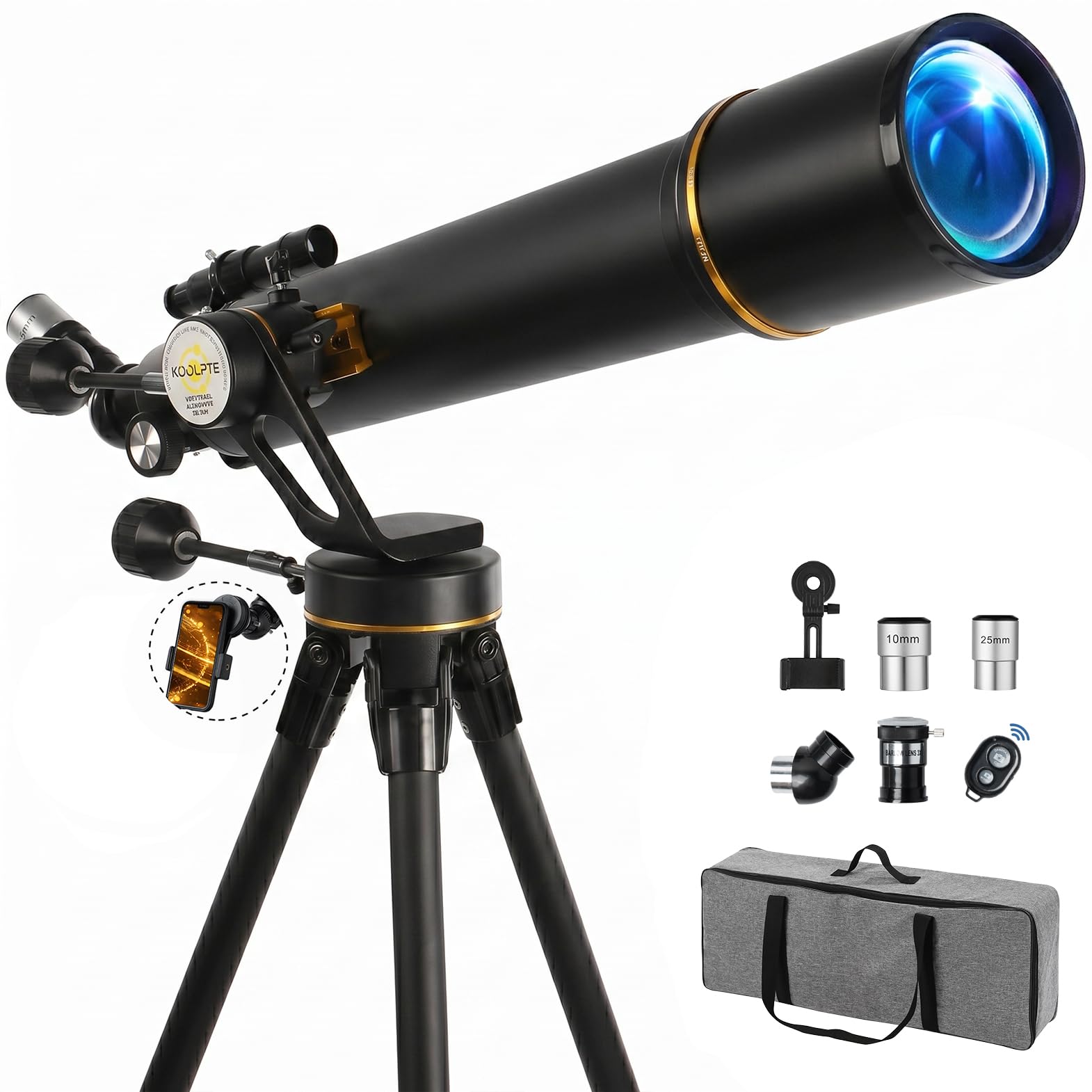
A 90mm scope with a unique slow-motion mount that stops the shakes at high power.
The Koolpte Telescope brings a genuinely useful feature—the “Vertisteel AZ Slow-Motion Mount”—to the 90mm category. Instead of the usual lock-and-push mechanism, this mount uses slow-motion cables that let you make tiny, precise adjustments to track a planet as it drifts across the sky. The “Follow and Stop” design means you can make small moves without overshooting or creating vibrations, a huge benefit when using its 28x-210x magnification range. The 90mm aperture and 700mm focal length are solid specs, delivering good views of Saturn and Jupiter.
The package is generous: two Kellner eyepieces (K10mm and K25mm), a 3x Barlow lens, a wireless remote, a phone adapter, and a carry bag. The tripod is a fully stainless steel model, and the unit weighs 4.8 Kilograms, making it heavy but stable. Setup is listed as under 10 minutes. Users are very satisfied, noting “crisp images” and “smooth focus,” with one buyer calling it a “great beginner telescope with clear views.”
The downsides are that the 700mm focal length is shorter than the 800mm-900mm options from Hawkko and others, meaning you get slightly less magnification for the same eyepiece. The mount, while smooth, has a limited range of motion before you need to re-position the tripod. Also, at 4.8 kg (about 10.5 lbs), it is not the most portable option for hiking to a dark site. The slow-motion controls provide steady high-power views, but they don’t replace a fully automated mount.
The shake killer: The Vertisteel AZ Slow-Motion Mount is the star here. It makes tracking Jupiter at 150x smooth and frustration-free, unlike the bumpy mounts on cheaper scopes.
What it competes with: The Koolpte’s 90mm / 700mm spec is similar to a Gskyer 600x90mm, but the Koolpte wins on mount quality. It has a 700mm focal length versus the Celticbird’s 900mm, giving a wider field of view with the same eyepiece.
Perfect for: the adult who loves planetary observation and wants a rock-steady mount to track targets at high power without the shakes. The slow-motion controls are a real quality-of-life upgrade.
Consider another if: you prioritize portability or need the longest focal length possible for very high magnification. The 700mm here is a bit short compared to some rivals.
8. Gskyer Telescope 600x90mm AZ Refractor

A well-known 90mm refractor that has been a starter scope for thousands.
The Gskyer 600x90mm is among the most popular refractor telescopes on Amazon, and for good reason. Its 90mm aperture with fully coated optics and 600mm focal length strikes a good balance between light-gathering and a moderately wide field of view. This makes it suitable for both close-up lunar and planetary views (using the 3x Barlow lens) and for scanning star clusters. The kit comes with three interchangeable eyepieces providing magnifications of 24x, 60x, and 120x, which can be tripled with the included 3x Barlow lens.
The tripod is an adjustable aluminum model that can extend from about 31.5 inches to 49 inches. Buyers report it is “a great tool for scientific education” and that optics are “excellent for price.” Many users report seeing Jupiter, Saturn, and the Moon in good detail, praising the “easy setup.” The scope also includes a phone adapter and a Bluetooth remote for capturing images.
The most common and consistent complaint is the tripod’s stability. At high magnifications, the tripod is “shaky,” and the mount has some backlash (looseness) that makes fine focusing difficult. The focuser is also a point of frustration for some, feeling “stiff and non-functional.” Some taller users find the tripod too short for comfortable standing viewing. While the optical quality is excellent for the price, the mount and tripod represent the biggest compromises. It is a great scope if you have a steady table or can upgrade the mount later.
Optics over everything
- 90mm fully coated optics deliver very good image quality for the price, easily showing lunar craters and Jupiter’s moons
- Generous accessory kit includes three eyepieces, 3x Barlow, phone adapter, and Bluetooth remote
- Extremely popular model with thousands of reviews, giving you a large user community for tips and support
Mount is the weak link
- Tripod is unstable at higher magnifications, causing shakes with every touch of the focus knob
- Focuser can be stiff and introduces backlash, making fine focusing a chore
- At 17.45 pounds, it is heavy for its size, and the tripod legs are a bit short for tall observers
Good for: the absolute budget buyer who wants the biggest (90mm) aperture for the smallest outlay and is willing to work around a wobbly mount. The glass is the star, not the tripod.
Pass if: you want a steady platform for high-power planetary viewing. You might end up buying a new tripod and mount, which negates the budget advantage.
9. Celticbird Telescope 80mm Aperture 900mm Refractor

The cheap ticket to a 900mm focal length, if you are ready for a basic setup.
The Celticbird is the most affordable telescope in our lineup that still delivers a true astronomical experience. It features an 80mm aperture versus the 90mm models and a long 900mm focal length. The combination of a smaller aperture with a long focal length means it is best suited for bright objects like the Moon and planets, where its 900mm focal length can provide high magnification. The fully coated lens improves transmission and clarity for the price.
The kit is travel-friendly: it comes with a carry bag, an adjustable aluminum tripod that goes from 20 to 45 inches, a phone mount, and two Kellner eyepieces (20mm and 10mm). Setup is tool-free, and the 5×24 finderscope simplifies aiming. One reviewer shared the exciting milestone: “Saw Jupiter’s four moons.” Another said it is a “great affordable starter telescope kit” with a “metal tube, good weight.”
The compromises are the tripod, which is “acceptable but cheap” according to one reviewer, and the finder scope which may require adjustment. Some buyers received the telescope with dust on the main lens or internal parts loose. The 80mm aperture is not as forgiving as a 90mm in light-limited conditions, so faint galaxies and nebulae will be very dim. It is a fantastic budget entry point if your primary goal is to look at the Moon and show your friends Jupiter’s moons, but you will want to budget for an upgraded mount and tripod down the line for a more stable experience.
The bargain binoculars of scopes: An 80mm scope with a 900mm focal length for this price is about the cheapest you can get to a true “Jupiter’s moons” moment. It gives you a 900mm focal length versus 700mm on shorter rivals at a similar price.
One buyer’s reality: A user noted there was “dust on the main lens” upon arrival, which is a risk with budget optics, but the lens design is “high transmission multi-fully coated” to maximize light in spite of the smaller aperture.
Best for: the absolute beginner on a tight budget who wants to see the Moon’s craters and Jupiter’s moons with their own eyes without spending much.
skip it if: you want steady, high-magnification views without a shaky tripod. The 80mm aperture also struggles on dim deep-sky objects.
Understanding the Specs
Aperture: The Light Bucket
The aperture is the diameter of the main lens or mirror, measured in millimeters. This number, more than any other, determines how much light your telescope collects. A 90mm aperture and an 80mm aperture can both show the Moon and planets, but the 90mm scope gathers more light and can reveal fainter stars and more detail on planets. For adult telescopes, 80mm is the minimum we recommend for a rewarding experience with the Moon and planets, while 90mm is the balance for good performance on brighter deep-sky objects like the Orion Nebula.
Focal Length: Your Zoom Factor
Focal length is measured in millimeters and affects the magnification and field of view. A longer focal length (like 900mm) gives you a narrower field of view but higher magnification with any given eyepiece. A shorter focal length (like 400mm) gives you a wider field, making it easier to find objects but limiting your maximum magnification. For planetary observation, longer is better; for scanning star clusters, shorter is better. The ratio of focal length to aperture gives you the focal ratio (f-number), which tells you how “fast” the optical system is.
FAQ
What does a 90mm aperture show me that an 80mm aperture cannot?
Can I use an adult telescope for daytime bird watching?
What is a GoTo mount and do I need one?
How do I align the finderscope on a new telescope?
What is a Barlow lens and should I buy one?
Is a reflector better than a refractor?
How do I take pictures through my telescope?
What is chromatic aberration and should I worry about it?
Can I leave my telescope assembled outside?
How much maintenance does a Dobsonian reflector need compared to a refractor?
Final Thoughts: The Verdict
For most buyers, the best adult telescope winner is the Celestron StarSense Explorer LT 80AZ because its patented app-guided navigation eliminates the single biggest barrier for new stargazers—finding objects in the sky. If you want the most aperture for your money for deep-sky viewing, grab the Gskyer 130EQ. And for a premium, hands-off experience that finds and tracks targets automatically, the Celestron NexStar 4SE is the ultimate upgrade.
How We Picked
We do not accept paid placement, and we did not hands-on test every unit. Instead, we match each pick to a real buyer and use-case by comparing the manufacturers’ published specifications against the patterns in verified customer reviews — so you get each pick’s real strengths and trade-offs instead of marketing copy.
Sources & Methodology
Specifications: manufacturer listings and product documentation. Review insights: verified customer reviews, as of July 2026. Pricing: not shown on this page (it changes often); check the current price via the retailer link.
As an Amazon Associate, Gadgets Feed earns from qualifying purchases. This does not affect which products we feature.
Product prices and availability are accurate as of the date/time indicated and are subject to change. Any price and availability information displayed on Amazon at the time of purchase will apply to the purchase of this product. As an Amazon Associate I earn from qualifying purchases.
CERTAIN CONTENT THAT APPEARS ON THIS SITE COMES FROM AMAZON. THIS CONTENT IS PROVIDED "AS IS" AND IS SUBJECT TO CHANGE OR REMOVAL AT ANY TIME.
Amazon and the Amazon logo are trademarks of Amazon.com, Inc. or its affiliates.