
The gap between a smartphone and a dedicated advanced compact camera has never been wider. Yes, your phone’s computational photography is impressive, but it falls apart the moment you need true optical zoom, a large sensor for genuine depth of field, or manual control over every parameter. An advanced point-and-shoot delivers a sensor that captures more light, a lens that actually extends without quality loss, and a physical shutter you can feel. The choice here isn’t between convenience and quality anymore — it’s about what you genuinely need from a camera system that fits in a bag.
I’m Min — the co-founder and writer behind Gadgets Feed. I’ve spent years analyzing sensor sizes, lens designs, and autofocus systems across the compact camera market, studying how real-world specs translate into usable performance for travel, street, vlogging, and wildlife shooters..
This guide breaks down eleven of the top-performing models currently available, from rugged underwater companions to full-frame powerhouses and ultra-zoom behemoths. Whether you prioritize pocketability, zoom reach, video capability, or sensor size, finding the right advanced point and shoot camera means matching its specific strengths to how and where you actually shoot.
How To Choose The Best Advanced Point And Shoot Camera
Selecting the right advanced compact camera begins with understanding three key pillars: the sensor that captures the image, the lens that shapes it, and the autofocus system that locks it in. These three components define every real-world scenario you’ll shoot, from low-light street scenes to fast-action wildlife.
Sensor Size: The Foundation of Image Quality
The physical size of the imaging sensor is the single most important determinant of image quality. A 1-inch type sensor (like those found in the Sony RX100 series) offers a significant upgrade over a smartphone’s tiny sensor, delivering better dynamic range and less noise. An APS-C sensor (found in the Ricoh GR IIIx and Fujifilm X100VI) provides even more light-gathering area, producing cleaner shadows and more natural depth of field. Full-frame sensors (Canon EOS R8, Leica Q2) represent the top tier, capturing the most detail and light, though they demand larger bodies and lenses.
Optical Zoom vs. Fixed Lens: Reach vs. Versatility
Optical zoom is a defining feature for many in this category. The Nikon P1000’s 125x zoom (24-3000mm equivalent) lets you photograph the moon and distant wildlife, while the Panasonic ZS99’s 30x zoom offers a more balanced 24-720mm range for travel. Conversely, fixed-lens cameras like the Fujifilm X100VI (23mm f/2) and Ricoh GR IIIx (40mm f/2.8) prioritize optical quality, speed, and pocketability over reach. Your choice depends entirely on whether you prefer to zoom into a specific moment or frame a scene as you see it.
Autofocus Performance: Speed and Intelligence
Autofocus technology has become a major differentiator. Contrast-detection systems, while common, can hunt in low light. Phase-detection pixels built into the sensor, like Sony’s 357-point system in the RX100 VII, enable near-instantaneous focus and subject tracking. Hybrid systems, like the Canon PowerShot V1, combine both methods for reliable focus on people, animals, and vehicles. For action, sports, or unpredictable subjects, a camera with stacked CMOS sensor architecture and phase-detection AF is essential.
Quick Comparison
On smaller screens, swipe sideways to see the full table.
| Model | Category | Best For | Key Spec | Amazon |
|---|---|---|---|---|
| Fujifilm X100VI | Premium Fixed-Lens | Street, Travel, JPEG Lovers | 40.2MP APS-C w/ 6-stop IBIS | Amazon |
| Ricoh GR IIIx | Pocket APS-C | Everyday Carry, Street | 24.2MP APS-C, 40mm f/2.8 | Amazon |
| Sony RX100 VII | Premium Zoom Compact | Travel, Vlogging, Versatility | 20.1MP 1-inch, 24-200mm f/2.8-4.5 | Amazon |
| Canon EOS R8 | Full-Frame Hybrid | Photo & 4K Video | 24.2MP Full-Frame, 4K60 | Amazon |
| Canon PowerShot V1 | Content Creator | Vlogging, Streaming | 22.3MP 1.4-type, 16-50mm f/2.8-4.5 | Amazon |
| Nikon COOLPIX P1000 | Superzoom | Astro, Distant Wildlife | 16MP, 24-3000mm (125x) zoom | Amazon |
| Nikon COOLPIX P950 | Superzoom Bridge | Birding, Moon Shots | 16MP, 24-2000mm (83x) zoom | Amazon |
| Sony ZV-1 II | Vlog Compact | Vlogging, Selfie Video | 20.1MP 1-inch, 18-50mm f/1.8-4 | Amazon |
| Panasonic Lumix ZS99 | Travel Zoom | Travel, Concerts | 20.3MP, 24-720mm (30x) Leica zoom | Amazon |
| OM System Tough TG-7 | Rugged Adventure | Underwater, Extreme Conditions | 12MP, 15m waterproof, shockproof | Amazon |
| Leica Q2 | Luxury Full-Frame | High-End Travel, Street | 47MP Full-Frame, 28mm f/1.7 Summilux | Amazon |
In‑Depth Reviews
1. Fujifilm X100VI

The Fujifilm X100VI is the camera that photographers obsess over for good reason. It packs a 40.2-megapixel X-Trans CMOS 5 HR sensor with 6.0 stops of in-body image stabilization into a body that forgoes a zoom lens for a 23mm f/2 optic, equivalent to 35mm in full-frame terms. That fixed lens forces you to compose with your feet, which often results in more intentional and creative images. The hybrid viewfinder, combining a high-resolution EVF with an optical rangefinder-style window, is a rarity in this category and makes shooting a tactile, deliberate process.
Every major spec here is a category highlight. The 40.2MP sensor outclasses every other compact by a wide margin, allowing for serious cropping without losing detail. The IBIS system, a new addition over previous models, transforms handheld low-light shooting, letting you push shutter speeds down to 1/8th of a second for static subjects. The four-stop internal ND filter is built directly into the lens, perfect for using wide apertures in bright daylight or achieving motion blur in video. Fujifilm’s 20 Film Simulation modes, including the new REALA ACE profile, deliver gorgeous JPEGs straight out of camera, reducing time spent in post-processing.
This is not a camera for everyone. The fixed 23mm lens means no optical zoom, so if you need reach for wildlife or sports, look elsewhere. Video at 6.2K is capable but the autofocus system, while improved, can hunt slightly in low contrast scenes, lagging behind Sony’s speed demons. The battery life is modest, especially when using the EVF or IBIS aggressively. For street, travel, and documentary work where image quality, character, and portability rule, the X100VI is the definitive choice.
Why it’s great
- Class-leading 40.2MP APS-C sensor with 6-stop IBIS for exceptional detail and low-light reach.
- In-camera film simulations eliminate post-processing for beautiful color and tones.
- Hybrid optical/electronic viewfinder is unique and immersive.
Good to know
- Fixed 23mm f/2 lens means zero optical zoom; composition must be done physically.
- Autofocus is reliable but not class-leading, especially in low contrast scenarios.
- Average battery life; carrying a spare is recommended for a full day of shooting.
2. Ricoh GR IIIx

The Ricoh GR IIIx is the ultimate exercise in minimalism: an APS-C sensor and a sharp, fixed 40mm f/2.8 lens designed to slip into a jacket pocket. Where the Fujifilm X100VI focuses on retro style and viewfinder heritage, the GR IIIx emphasizes pure discreteness and speed. The 40mm equivalent field of view is more natural than a 35mm, providing a slight compression that makes it excellent for environmental portraits and street photography. The camera boots in about 0.8 seconds, making it one of the fastest compacts to get from pocket to shot.
The 24.2-megapixel APS-C sensor is paired with the GR Engine 6, which delivers sharp output with excellent color science. The 40mm f/2.8 GR lens is the headline act: it is incredibly sharp edge-to-edge, even wide open, and allows you to crop aggressively while retaining detail. The in-body image stabilization (IBIS) is a welcome feature at this size, giving you a solid 3-4 stop advantage in low light. The camera supports 14-bit RAW files and provides extensive in-body customization, letting you configure everything from snap focus distances to the function of the adjacent dials.
The GR IIIx sacrifices a lot in pursuit of size. There is no built-in flash, no viewfinder (an optional optical finder fits into the hotshoe), no 4K video, and the autofocus system uses contrast detection, which is slower than phase-detect systems on competing cameras. Battery life is poor, managing around 200 shots per charge, so at least two spare batteries are necessary for a full day. For photographers who prioritize pocketability and core image quality above all else, the GR IIIx is the most capable camera you can truly forget you are carrying.
Why it’s great
- APS-C sensor in a genuinely pocketable body for uncompromised image quality anywhere.
- 40mm f/2.8 GR lens is exceptionally sharp and offers a natural, versatile field of view.
- IBIS provides a meaningful low-light advantage at this size class.
Good to know
- No built-in viewfinder, no flash, no 4K video — pure stills photography focus.
- Contrast-detect autofocus is slower than phase-detect competition.
- Battery life is very limited; expect to need two or three spare batteries for a full day.
3. Nikon COOLPIX P1000

The Nikon COOLPIX P1000 holds the undeniable crown for zoom range: a 125x optical zoom lens covering 24-3000mm (full-frame equivalent). No other compact camera comes close. This lens lets you photograph the moon’s craters with enough detail to see shadows inside the rims, capture birds hundreds of meters away, or shoot surfing action from the shore. The 16-megapixel CMOS sensor paired with dual-detect optical image stabilization keeps those extreme telephoto shots usable, provided you brace against something solid or use a tripod. The camera shoots 4K Ultra HD video and supports 14-bit RAW files.
The spec sheet is built around that monstrous lens. At 24mm wide, the P1000 is a decent landscape camera; at 3000mm, it is an astronomical tool. The vari-angle 3.2-inch LCD monitor is helpful for composing at high or low angles, and the electronic viewfinder (2.36 million dots) is usable. It includes Raw (NRW) shooting for flexibility in editing, time-lapse and super-lapse functions, and a full suite of manual controls including shutter speed down to 30 seconds in manual mode. The lens features 16 elements in 12 groups, with 5 ED (Extra-low Dispersion) elements to control chromatic aberration at long focal lengths.
The P1000 is enormous, weighing about three pounds, and is not what most people picture as a point-and-shoot. The small 16MP sensor means low-light performance is poor, and the image quality at the extreme end of the zoom is limited by atmospheric shimmer and slight softness. Autofocus can struggle to lock onto fast-moving birds in flight, and the camera benefits significantly from a tripod for any shot beyond 1500mm. For anyone whose primary requirement is getting a stable, recognizable image of a distant subject, the P1000 is the only game in town.
Why it’s great
- Unrivaled 125x optical zoom covers everything from 24mm landscapes to 3000mm super-telephoto.
- Image stabilization makes extreme telephoto shooting feasible handheld in good light.
- Full manual controls with RAW support offer creative flexibility.
Good to know
- Very large and heavy (approx. 3 lbs) for a compact camera.
- Small sensor and narrow aperture at telephoto limit low-light performance.
- Autofocus can struggle to track fast-moving subjects at long distances.
4. Sony RX100 VII
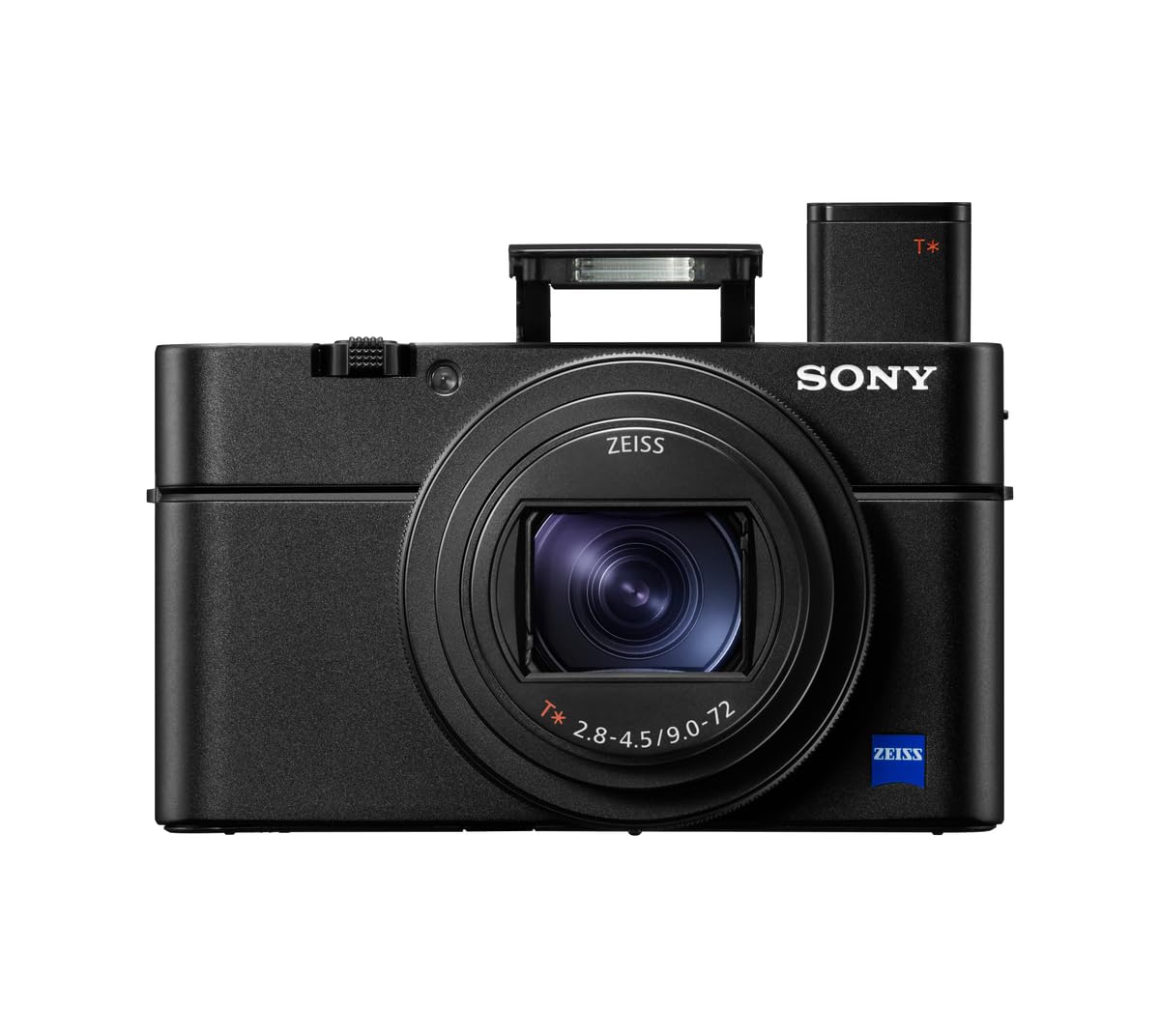
The Sony RX100 VII remains the benchmark for a zoom compact that does almost everything well. Its 20.1-megapixel 1-inch stacked CMOS sensor is coupled with a Zeiss Vario-Sonnar T* 24-200mm f/2.8-4.5 lens, covering a versatile range that handles wide scenes, portraits, and moderate telephoto. The stacked sensor architecture is the key differentiator here: it enables a 0.02-second autofocus lock speed and blackout-free continuous shooting at 20fps with full AF/AE tracking. This is a camera that can genuinely keep up with action, tracking a running child or a dog at a park with 357 phase-detect points and 425 contrast-detect points.
Video performance is equally advanced. The RX100 VII shoots 4K video with full pixel readout, no pixel binning, and supports S-Log3 and HLG gamma profiles for high dynamic range. Real-time Eye AF works in both stills and movies for humans and in stills for animals, a feature set virtually unmatched in this compact zoom category. The pop-up electronic viewfinder (2.36 million dots) and tiltable LCD screen add framing flexibility. The camera includes a microphone jack for external audio, a critical feature for serious vloggers, and active steady shot image stabilization for video.
The RX100 VII has its share of compromises. The controls are small and the menu system is famously complex, though deep customization helps. The body lacks weather sealing and the grip is minimal, requiring a stick-on grip for comfort. The 24-200mm lens is a compromise: it is very versatile but starts at f/2.8 only at the wide end, quickly stopping down. For a premium compact that balances zoom range, speed, and video capability in a true pocketable body, the RX100 VII is the most complete package available.
Why it’s great
- Stacked CMOS sensor enables 0.02s autofocus and 20fps blackout-free bursts.
- 24-200mm Zeiss lens is the versatile sweet spot for travel and everyday shooting.
- Best-in-class video features: 4K with S-Log3, microphone input, and real-time eye tracking.
Good to know
- Small body means crowded controls and a slippery finish without an add-on grip.
- Sony menu system remains deep and non-intuitive without prior experience.
- No in-body image stabilization for stills; stabilization is lens-based only.
5. Canon EOS R8

The Canon EOS R8 is technically a mirrorless interchangeable lens camera, but it belongs in this conversation because it is Canon’s smallest, lightest full-frame body and is often used as a compact powerhouse with the RF 24-50mm f/4.5-6.3 IS STM kit lens. The 24.2-megapixel full-frame sensor combined with the DIGIC X image processor delivers image quality that leaves all 1-inch and APS-C compacts behind. It shoots uncropped 4K 60fps video oversampled from 6K, records Canon Log 3, and supports 10-bit depth for grading. The Dual Pixel CMOS AF II covers 100% of the frame and uses deep learning to track people, animals, and vehicles.
The specs read like a professional camera compressed into a small body. The 0.39-inch OLED EVF has a 2.36 million-dot resolution with a 120fps refresh rate, which is excellent for manual focus. The vari-angle 3-inch touchscreen gives flexibility for vlogging and high-angle shots. The camera can shoot up to 40fps with the electronic shutter (silent mode) or 6fps mechanical. The full-frame sensor provides truly excellent high-ISO performance, allowing clean shots up to ISO 12800, a huge step above smaller sensors. The body weight is just 461 grams, making it one of the lightest full-frame bodies ever made.
The R8 has notable compromises. There is no in-body image stabilization, relying entirely on lens-based IS. The battery is the small LP-E17, rated for only about 300 shots, so spares are mandatory. Overheating can occur at 4K60 during extended recording, and there is only a single UHS-II SD card slot. The body structure is not as robust as the R6 II. For photographers and videographers who demand full-frame image quality, low-light supremacy, and a body that packs small, the EOS R8 is a rare value proposition.
Why it’s great
- Full-frame 24.2MP sensor provides class-leading dynamic range and low-light performance.
- Uncropped 4K60 from 6K oversampling with Canon Log 3 for serious video work.
- Extremely lightweight body (461g) packs full-frame performance into a travel-friendly size.
Good to know
- No in-body image stabilization; relies on lenses for shake reduction.
- Small battery gives around 300 shots per charge; spares are essential.
- Single UHS-II SD slot may be a limitation for professional redundancy needs.
6. Canon PowerShot V1

The Canon PowerShot V1 is a dedicated hybrid camera designed for content creators who need a compact body but demand better image quality than a smartphone. Its standout feature is the 1.4-type sensor, which is significantly larger than a 1-inch sensor and crops the gap to APS-C. The 16-50mm f/2.8-4.5 wide-angle zoom lens (35mm equivalent) is optimized for vlogging and streaming, providing an ultra-wide selfie view at 16mm. The built-in cooling fan allows for longer continuous 4K recording without overheating, a persistent problem in small cameras. The Canon Log 3 gamma curve at 10-bit color depth provides latitude for color grading that is typically only found in much larger cinema cameras.
Spec-wise, this is a specialized tool. The 22.3-megapixel sensor pulls 18.7 megapixels for video, both of which are more than usable for high-quality content. The hybrid autofocus system uses Dual Pixel AF with 100 AF points, providing reliable subject detection for people. The 4K video is sharp and detailed, and the camera supports UVC/UAC protocols, meaning it works as a plug-and-play high-quality webcam for streaming without additional capture cards. The microphone jack and hotshoe provide audio flexibility essential for serious podcasting and live streaming.
This is not the camera for everything. The lens lacks optical image stabilization (OIS), so walking shots will need post-processing stabilization or a gimbal. There is no built-in flash, and the SD slot sits under the battery door, which is annoying when you are on a tripod or using a quick-release plate. The grip is shallow for stills shooting. For its target audience — vloggers, streamers, and home studio creators who want excellent video quality in a compact package — the V1 is an extremely well-designed tool.
Why it’s great
- 1.4-type sensor and f/2.8 zoom deliver excellent video quality in low light.
- Built-in cooling fan enables long 4K recording sessions without overheating.
- UVC/UAC class for plug-and-play 4K streaming; Canon Log 3 for professional color grading.
Good to know
- No optical image stabilization in the lens; electronic IS is weak for walking vlogs.
- No built-in flash and no in-box battery charger (USB-C only).
- SD card slot is under the battery door, making access difficult on a tripod.
7. Nikon COOLPIX P950

The Nikon COOLPIX P950 is the successor to the legendary P900, refining the superzoom formula with 83x optical zoom (24-2000mm equivalent) and better video support. The 16-megapixel CMOS sensor is modest by modern standards, but it is paired with a lens that can bridge the gap from a wide landscape to a distant bird perched on a branch a quarter-mile away. The camera features integrated dual-detect optical vibration reduction (VR), which is crucial for keeping those long telephoto shots steady. The built-in Bird and Moon modes showcase exactly who this camera is for: hobbyists and nature enthusiasts who want reach without carrying a heavy DSLR and telephoto lens.
Key specs include the ability to shoot 4K UHD video at 30fps, which is a significant upgrade over previous models. The vari-angle 3.2-inch LCD and the electronic viewfinder (2.36 million dots) make composing at the extreme end practical. The camera supports RAW (NRW) format for post-processing flexibility. The manual focus wheel on the lens barrel, a direct improvement over the P900, makes fine focus adjustments at 2000mm much easier than using the toggle. The P950 also adds a hotshoe for external flash, giving it a slight edge in flexibility over the P900.
The same sensor-based limitations apply: small 16MP sensor means noise is visible above ISO 800, and the autofocus system is contrast-detect only, which can hunt in low contrast situations and struggles with fast erratic subjects like birds in flight. The camera is not pocketable — it is a bridge camera with a substantial lens barrel. Connectivity via the SnapBridge app is often cited as unreliable. For the dedicated amateur naturalist who values zoom reach above all else and wants a single, all-in-one solution under a premium price point, the P950 remains the best available option after the P1000.
Why it’s great
- 83x optical zoom (24-2000mm) is superb for birding, wildlife, and moon photography.
- Dual-detect optical VR helps get sharp handheld shots at extreme telephoto lengths.
- Dedicated Bird and Moon modes, plus RAW support, make it very user-friendly for nature shooters.
Good to know
- 16MP sensor is small and noisy above ISO 800, limiting low-light use.
- Contrast-detect autofocus is slower than phase-detect; struggles with fast birds.
- SnapBridge connectivity is a frequent source of user frustration.
8. Sony ZV-1 II

The Sony ZV-1 II is a vlogging camera first and foremost, built around a 20.1-megapixel 1-inch stacked CMOS sensor and an ultra-wide 18-50mm f/1.8-4 zoom lens designed to keep the vlogger in the frame while showing more of the background. The 18mm wide end is noticeably broader than the standard 24mm, making this the best option in the list for selfie-style video where context matters. The integrated directional 3-capsule microphone with a supplied wind screen accessory is a major upgrade over action cameras and other compact vloggers, capturing clear audio without an external mic. The Real-time autofocus tracking and Eye-AF ensure the subject stays sharp even when moving within the frame.
Key video specs support its creator-targeted design. It shoots 4K at 30fps (with a slight crop) and offers slow-motion at up to 120fps in HD. The side-opening vari-angle touch screen allows easy framing for solo creators, and the USB-C connection allows for live streaming as a high-quality webcam. The ZV-1 II includes a dedicated “Background Defocus” button, which instantly opens the aperture to f/1.8 for blurring the background, and a “Soft Skin” effect. The product showcase mode transitions focus from a face to a held object near the lens, a clever feature for unboxings or reviews.
The major sacrifice compared to the original ZV-1 is the removal of the Optical SteadyShot active image stabilization, which was replaced with a less effective electronic standard. This means walking vlogs will look shaky unless you use a gimbal or rely on post-stabilization software, which adds a crop. Battery life is short, roughly 60 minutes of 4K video, and neither a wall charger nor a USB cable is included in the box. For creators who shoot mostly static talking-head or desk content, the ZV-1 II is the most thoughtful tool in its class.
Why it’s great
- Ultra-wide 18mm lens keeps the vlogger in frame with plenty of background context.
- Directional 3-capsule mic with wind screen delivers solid audio out of the box.
- Product showcase and background defocus buttons are purpose-built for content creation.
Good to know
- Removed optical active stabilization; video walking shots will be shaky without a gimbal.
- Battery life is limited for a full day of shooting; spare batteries are essential.
- No USB-C cable or wall charger is included in the package.
9. Panasonic Lumix ZS99 / TZ99

The Panasonic Lumix ZS99 (also known as the TZ99 outside North America) is the quintessential travel zoom compact. It packs a 30x optical zoom Leica DC Vario-Elmar lens covering 24-720mm (full-frame equivalent) into a genuinely pocketable body. That zoom range covers everything from a wide cityscape to a distant stage performer at a concert, making it a strong alternative to the Sony RX100 VII for those who prioritize reach over a wide aperture. The 20.3-megapixel 1/2.3-inch sensor is smaller than the 1-inch sensor found in the RX100 and therefore less capable in low light, but the lens’s optical stabilization helps mitigate some of the issue.
The ZS99 is built around value and ease of use. It shoots 4K video at 30fps and can extract 8-megapixel stills from 4K bursts at 30fps, a useful feature for capturing the perfect frame of a moving subject. The 1.84-million-dot tiltable touchscreen is bright and responsive, though it only tilts up and down, not side-to-side for vlogging. Bluetooth 5.0 connectivity with a dedicated “Send Image” button simplifies transferring images to a smartphone, addressing a common frustration with older camera models. The USB Type-C charging is a welcome modern convenience.
Image quality is where the ZS99 shows its budget-tier sensor. Photos are good in bright daylight but noise is apparent at ISO 800 and above, and the small sensor limits dynamic range. The autofocus is decent for single-shot stills but unreliable for tracking moving subjects, especially at the telephoto end. The menu system, while functional, is slower to navigate than competitors. For the traveler who values the 24-720mm range in a jacket pocket and does not plan to shoot after sunset, the ZS99 delivers strong value.
Why it’s great
- 30x Leica optical zoom (24-720mm) fits in a jacket pocket, perfect for travel and concerts.
- 4K video and 4K photo burst mode provide versatile capture options.
- USB-C charging and easy Bluetooth image transfer reduce friction for on-the-go sharing.
Good to know
- Small 1/2.3-inch sensor results in significant noise and lower dynamic range in low light.
- Autofocus can be slow and unreliable at the telephoto end, especially with moving subjects.
- No side-hinge screen; tilt-only display makes vlogging awkward.
10. OM System OM Tough TG-7

The OM System Tough TG-7 is the only fully rugged camera on this list, purpose-built for conditions that would destroy any other camera on this list. It is waterproof to 15 meters (50 feet), shockproof to 2.1 meters (7 feet), freezeproof to -10°C (14°F), and crushproof to 100 kgf (220 lbf). The 12-megapixel back-illuminated CMOS sensor is paired with a high-resolution f/2.0 lens with 4x optical zoom. While the sensor resolution is low by 2025 standards, the camera’s strength lies in its specialized macro modes and ruggedness, not its pixel count. It includes a variable macro system with 4 macro modes, including a microscope mode that allows focus as close as 1 centimeter from the lens.
For underwater shooters, the TG-7 is a revelation. It offers 5 underwater modes, including Underwater Microscope and Underwater HDR, which automatically adjust white balance and exposure for the unique light absorption challenges of underwater environments. The camera shoots 4K Movie at 30fps and 120fps high-speed recording for slow-motion video. The field sensor system captures GPS, temperature, altitude, and direction data directly onto the image metadata, which is excellent for scuba logbooks, hiking, or diving documentation. The anti-fog coating on the lens window is a practical touch that solves a persistent issue in humid environments.
Image quality limitations are real. The 12MP sensor and small 1/2.33-inch size mean noise is obvious above ISO 400, and dynamic range is limited. The camera does not compete with larger-sensor compacts for general-purpose photography in good light. The battery life is average, and the camera feels bulky for its size class due to the reinforced housing. For divers, snorkelers, and adventure enthusiasts who need a camera that will survive drops, dunks, and frost, the TG-7 is the best tool available and a direct upgrade from the TG-6.
Why it’s great
- Ruggedized to 15m waterproof, 2.1m shockproof, -10°C freezeproof, and 100kg crushproof.
- Five underwater modes, including Underwater Microscope and HDR for accurate color.
- Variable macro system with 1cm focus distance is unmatched in this category.
Good to know
- 12MP sensor and small sensor size limit image quality and low-light performance.
- Camera is noticeably larger and heavier than other pocket-sized compacts due to the housing.
- Battery life is adequate but should carry spares for extended underwater shoots.
11. Leica Q2

The Leica Q2 is the pinnacle of the fixed-lens full-frame compact category, a camera that justifies its premium positioning through exceptional optical engineering and a minimalist philosophy. At its core is a 47-megapixel full-frame CMOS sensor paired with an incredible Summilux 28mm f/1.7 ASPH lens. The 28mm lens is a fixed wide-angle designed for environmental portraiture, street photography, and travel documentation. The combination of high resolution and a fast, sharp lens means you can crop the 47MP image heavily to simulate a 35mm, 50mm, or even 75mm field of view while still retaining significant detail. The Q2 is weather-sealed, a rare feature in compacts, making it confident in light rain or dust.
Every specification speaks to Leica’s design priorities. The 47MP full-frame sensor delivers 14-bit RAW files weighing around 140MB each, capturing immense dynamic range and color information. The Maestro II image processor handles the readout and processing without significant lag. The camera offers 4K video at 30fps and does not sacrifice build quality for any feature; the body is milled from an aluminum-magnesium alloy, covered in high-grip synthetic leather, and the entire unit is designed to survive years of use. The hybrid autofocus system uses contrast detection with 49 points, which is not as fast as Sony’s phase-detect arrays but is accurate and quiet. The electronic viewfinder is a 3.68-million dot OLED that is one of the best in class for clarity and color accuracy.
The Q2 makes severe trade-offs. It is a premium camera with a premium-only feature set: no optical zoom, no vari-angle screen, no pop-up flash, no advanced video log profile, and the autofocus system is slow compared to modern mirrorless cameras. The fixed 28mm lens may be too wide for some users and too narrow for others, though the high sensor resolution allows for cropping. For the photographer who values tactile operation, exceptional build, and a lens that belongs in an optics museum over sheer versatility or pixel-counting, the Leica Q2 is the singular consummation of the advanced compact form factor.
Why it’s great
- 47MP full-frame sensor with Summilux 28mm f/1.7 lens delivers exceptional, class-leading optical quality.
- Weather-sealed body provides confidence in adverse conditions rarely found in compacts.
- Minimalist, high-build-quality design with a superb electronic viewfinder and tactile controls.
Good to know
- Fixed 28mm lens with no zoom; framing requires movement or cropping (which the 47MP sensor supports).
- Contrast-detect autofocus is significantly slower than modern phase-detect systems.
- Premium pricing places it far above all other options in this list; requires a serious commitment.
FAQ
What sensor size should I look for in an advanced point and shoot camera?
How does optical zoom affect image quality in a compact camera?
Is phase-detection autofocus necessary for an advanced compact camera?
Final Thoughts: The Verdict
For most users, the winner for the best advanced point and shoot camera is the Fujifilm X100VI because it pairs a class-leading 40.2MP sensor with outstanding in-body stabilization, beautiful film simulations, and an iconic design that makes you want to shoot more. If you need true optical zoom in a pocketable body and care more about versatility than extreme sensor size, the Sony RX100 VII is the most complete all-around compact. For maximum zoom reach at a reasonable price, the Nikon COOLPIX P950 or its bigger sibling the P1000 are unmatched. And for those who want pure, uncompromised portability with an APS-C sensor, the Ricoh GR IIIx is the pocket camera that serious street photographers rely on every day.