
Our readers keep the lights on and my morning glass full of iced black tea. As an Amazon Associate, I earn from qualifying purchases.
Specs are compiled from manufacturer listings and verified buyer reviews and can change over time — please confirm the key details on the product page before buying.
You need a stud finder that tells you the truth the first time you press it against the wall. A wrong reading means a hole in the wrong place, a shelf that pulls out, or a drill bit through a live wire. The good news: a proper multi-sensor detector ends the guessing game, and this list is built to help you pick the right one for your walls and your projects.
I’m Min — the founder and writer behind Gadgets Feed. This guide is built by comparing the manufacturers’ published specifications and the patterns across verified customer reviews, so you get each pick’s real strengths and trade-offs instead of marketing spin.
Some detectors read a full stud width in one pass, others trade that speed for deeper reach through tile and plaster. What matters is matching the sensor array and scan depth to your walls, and that is exactly how this advanced stud finder lineup is sorted.
Our Picks at a Glance


How To Choose The Best Advanced Stud Finder
What separates an advanced stud finder from a basic magnetic one is the sensor array that maps the stud behind the surface. A basic finder hunts for nail heads. An advanced model uses a sensor array or a radar-style scan to map the stud behind the surface, which means you get the center and both edges in a single pass. That is what saves you from drilling three test holes to find out where the wood actually is.
Sensor count and what it does for you
More sensors spread across a wider face means the tool reads a bigger slice of wall at once. The Franklin Sensors models carry 13 sensors, so the LED row lights up across the whole stud width rather than at one point. On a two-stud corner or a doubled-up jack stud, that matters — a single-sensor tool often reports one edge and leaves you guessing about the rest.
The trade-off is size. A 13-sensor body is bigger and heavier than a compact single-mode scanner, and that bulk shows up in the downsides people mention most.
Maximum detection depth in real materials
Depth ratings are usually quoted per material, and they are not interchangeable. Wood and metal studs typically read through standard drywall at a shallower depth than the same tool can reach through thicker surfaces in deep mode. If your walls are standard half-inch drywall, a 3/4-inch wood depth rating is plenty. If you have tile, plaster, or multiple layers of drywall in front of the framing, you want the deep-scan figures in the specs — the Franklin Sensors MAX quotes 2.5 in of max detection depth for exactly this reason.
Calibration and why readings go wrong
Auto-calibration is the feature that decides whether your scan is trustworthy. On a HANMATEK or Zircon unit, you press the power or metal button while the tool is flat against the wall and wait for the calibration tone. You must not calibrate over a stud, a wire, or a nail — the tool will treat that target as the baseline and every reading afterwards will be off. The single most common cause of a “broken” stud finder is a calibration done in the wrong spot.
Reading the display
You have three display families to choose from. Simple LED bars light up over a stud, which is fast and readable in bright rooms. Colour-coded LCDs — like the Zircon A250c’s ColorTrip display — shift color by mode so you instantly know whether you are looking at wood, metal, or AC. Audio alarms add a beep when you hit the center, which helps when you are working above your head on a ceiling.
Quick Comparison
| Model | Best For | Sensor System | Max Depth (Wood / Metal / AC) | Display | Amazon |
|---|---|---|---|---|---|
| Franklin Sensors ProSensor 710+★ Best Overall | Best Overall | 13 sensors | 1 3/5 in max | LED | Amazon |
| HANMATEK Stud Finder 5-in-1Budget Champion | Budget-friendly all-rounder | 5 scan modes | 1.5 in / 4.7 in / 2 in | LCD with audio alarm | Amazon |
| FNIRSI WD-01 6-in-1Rechargeable Pick | Rechargeable pick | 6-in-1 detection | 1.5 in / 4.7 in / 2 in | Digital LCD | Amazon |
| Klein Tools ESF200 | Compact pro-grade body | Multi-scan center and edge | 3/4 in / 1-1/2 in / 2 in | LED | Amazon |
| Zircon MultiScanner A200 | Hanging TVs and shelves | 3 modes | 1 1/2 in deep scan | LCD with SpotLite | Amazon |
| 3-in-1 Stud Finder with Laser Rangefinder | Stud finder plus laser measure | 3-in-1 multi-tool | — | Backlit LCD, voice | Amazon |
| Zircon MultiScanner A250c | Colour-coded readout | 3 modes with ACT | 3/4 in / 3 in / 2 in | ColorTrip backlit LCD | Amazon |
| Bosch GMS 120-27 | Job-site toughness | Multi-material detector | 30 mm / 100 mm / 50 mm | Tri-colour LED ring | Amazon |
| Franklin Sensors ProSensor MAX | Deep scanning through thick walls | 13 larger sensors | 2.5 in max | Precision LED | Amazon |
In‑Depth Reviews
1. Franklin Sensors ProSensor 710+ 13-Sensor Stud Finder Wall Scanner, Blue
Our pick — 4.5+★ from 10,500+ verified ratings; the strongest balance of quality and price.
Thirteen sensors light up the whole stud, not just one edge of it.
The number that decides this one is 13 — the count of sensors spread across the face. Most electronic finders carry one or two, so they poke at a single spot and leave you guessing where the stud ends. With 13 in a row, the LED strip lights across the full width at once, so you see single studs, double studs, and uneven framing in one press. That is the whole reason this sits at the top of an advanced stud finder list.
Reliability is what buyers mention more than any other quality — the tool keeps telling the truth scan after scan. Accuracy follows right behind it, with quality close. It handles drywall, plaster, and thin walls without needing a different mode, and it does not require calibration: press and hold the button and start anywhere, even directly over a stud. Max detection depth is 1 3/5 in, which covers standard framing with room to spare.
Two extras earn their place on a wall tool. There is an integrated ruler along the body and a built-in bubble level, so you can mark a level line without reaching for a second tool. One honest catch: it runs on two AA batteries, sold separately, and Franklin Sensors states it is not compatible with rechargeable batteries. Budget for a pack of alkalines and you are set.
Where the 710+ earns its keep
- 13 sensors read center and both edges of a stud in one pass
- No calibration — press and hold the button, scan anywhere
- Ruler and bubble level built into the body
- Max detection depth of 1 3/5 in through drywall and plaster
Details to plan around
- Needs two AA batteries, and rechargeables are not supported
- Larger body than a compact single-mode scanner
- Some buyers question the value at its price tier
The confident call: if you want one tool that shows the whole stud without a calibration ritual, this is the one to put in the drawer.
Look elsewhere if: you scan tiled or multi-layer walls, where the deeper-reaching MAX model is the better match.
2. HANMATEK Stud Finder Wall Scanner Detector with Pro Smart Sensor, Audio Alarm and HD LCD Display, 5 in 1
Five scan modes and a colour alarm on an entry-level budget — that is a lot of range for the money.
Most budget finders give you one mode and hope. This HANMATEK splits detection five ways: stud scan exact mode at 0.8 in, stud scan deep mode at 1.5 in, AC wire scan at 2 in, ferrous metal scan at 4.7 in, and non-ferrous metal scan at 4 in. That ferrous metal reach of 4.7 in is the standout number here — it makes rebar and deep nails findable, not just shallow stud edges.
The readout is the other reason it works for a first-timer. A signal-strength area on the LCD shows detection depth, while mode, depth, signal strength, battery indicator, and center point all sit on the same screen. Three colour lights take over the aiming: green means nothing detected, orange marks the edge of a target, and the red backlight confirms the center of the stud. An audible alarm can be switched off if you are working somewhere quiet.
Buyers praise its five-mode functionality most, with value close behind. Accuracy is the mixed note — this tool rewards careful calibration and punishes sloppy setup. HANMATEK is clear about the rule: auto-calibration must happen with no nails, AC wires, or metal under the head, or the readings will be wrong. Get that right and it behaves. The IP66 rating (protection against dust and strong water jets) plus a rubber-backed head that protects the wall make it a sensible pick for renovation work.
Where it shines: five detection modes, with a ferrous metal reach of 4.7 in that budget rivals rarely match, plus an audio alarm you can mute.
The honest catch: accuracy lives and dies on a clean calibration, so start every session with the head flat on an empty patch of wall.
Reach for this if: you want the widest detection menu for a modest budget and do not mind calibrating properly.
Pass if: you would rather have a press-and-go tool with no calibration step at all.
3. FNIRSI WD-01 6 in 1 Rechargeable Stud Finder Wall Scanner, Positioning Hole
No battery drawer, no AA runs — a rechargeable detector with six ways to scan.
Six-in-one detection is the headline, and it covers more ground than most rivals. Exact scan finds the center and edges of wood and metal studs to 0.75 in deep, while depth scan stretches that to 1.5 in. Non-ferrous metal (copper) reads to 3.9 in, ferrous metal (iron) to 4.7 in, live unshielded AC wire to 2 in, and copper wire to 1.6 in. Add the positioning hole and you can mark the spot directly instead of eyeballing it with a pencil.
The power source is the practical win. A Lithium Ion cell means you charge it rather than hunt for AA batteries the night before a job — FNIRSI lists one Lithium Polymer battery as included. The LCD display and sound alarm work together to pin down the object, and auto-calibration lets you zero it anywhere on the wall in one step. It handles lath, wallpaper, wood flooring, acoustic ceiling, and painted walls.
Here is the honest read: this body is heavier and longer than a compact finder, at 9.3 ounces and 8.1 inches long versus the Klein Tools ESF200’s 5 ounces and 6.74 inches. That extra mass sits in your hand on overhead work. Above that, quality and accuracy carry mixed verdicts from buyers — this is a tool that performs when you calibrate it correctly and produces junk readings when you do not. It is the trade you make for a rechargeable six-mode scanner with a positioning hole.
Best fit for: frequent users who want to charge instead of buy batteries, and who like the instant mark of a positioning hole.
Think twice if: you do a lot of overhead scanning, where the 9.3-ounce body will feel heavy fast.
4. Klein Tools ESF200 Multi-Scan Center and Edge Stud Finder, 3/4-Inch
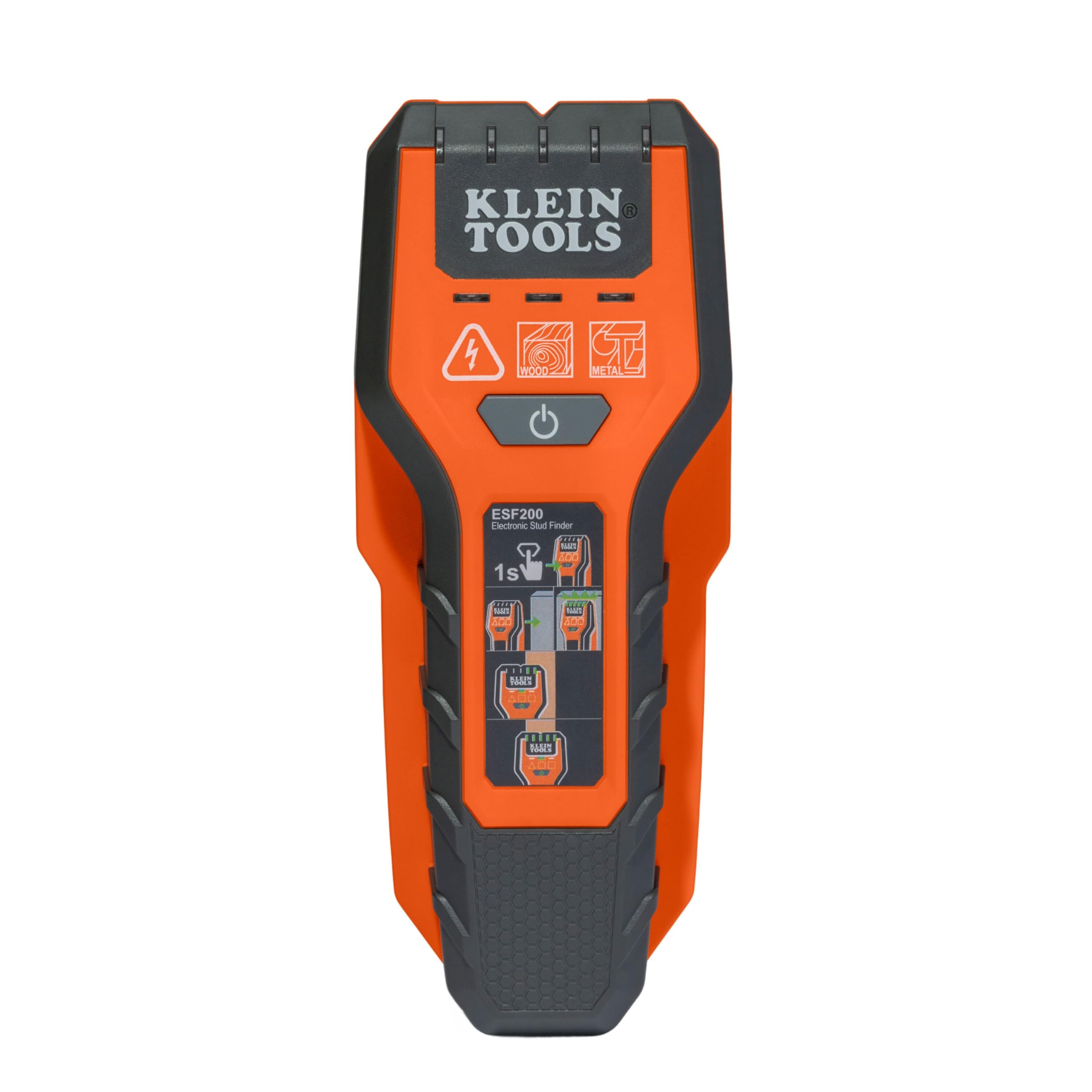
A five-ounce body that slips into a tool pouch and protects the wall you are scanning.
Klein Tools built this to go into a bag and stay there. At 5 ounces and 6.74 inches long it is a compact body; the FNIRSI above weighs 9.3 ounces. Two details make it kind to finished walls: a finger guard keeps your knuckles off the surface, and a protective felt backing stops the body from scuffing paint while you slide it around.
One-touch operation is the other smart touch. A backlit power button glows green when switched on, and the tool stays powered without you holding the button down — a genuine difference on a ladder, where a continuous-hold design is fiddly. Depth figures are honest for standard work: wood to 3/4 in, ferrous metal to 1-1/2 in, and AC voltage to 2 in. It detects live AC wires, wood, and metal without you switching modes between materials, and calibration is automatic when you move wall to wall.
Buyers rate its one-touch functionality and build quality highest, with detection right behind. Accuracy is the fair caveat — some scans hit the mark, others do not, which is the usual story with automatic-calibration finders that can be fooled by dense wall material. Treat a first scan as information, not gospel, and confirm with a second pass a few inches over.
Why a compact body helps
- 5 ounces and 6.74 inches — fits in a tool pouch
- Backlit button stays on without continuous holding
- Finger guard and felt backing protect the wall
- Detects wood, metal, and live AC without mode switching
The trade-offs to weigh
- Wood depth tops out at 3/4 in
- Automatic calibration can be fooled by dense material
- Accuracy reports split between good and off-target
Pick this for: tight jobs on finished walls where a compact, wall-safe tool matters more than deep reach.
Skip if: you need to read through tile or layered drywall, where 3/4 in of wood depth will not get you there.
5. Zircon® MultiScanner™ A200 Stud Finder with Metal & Live Wire Detection
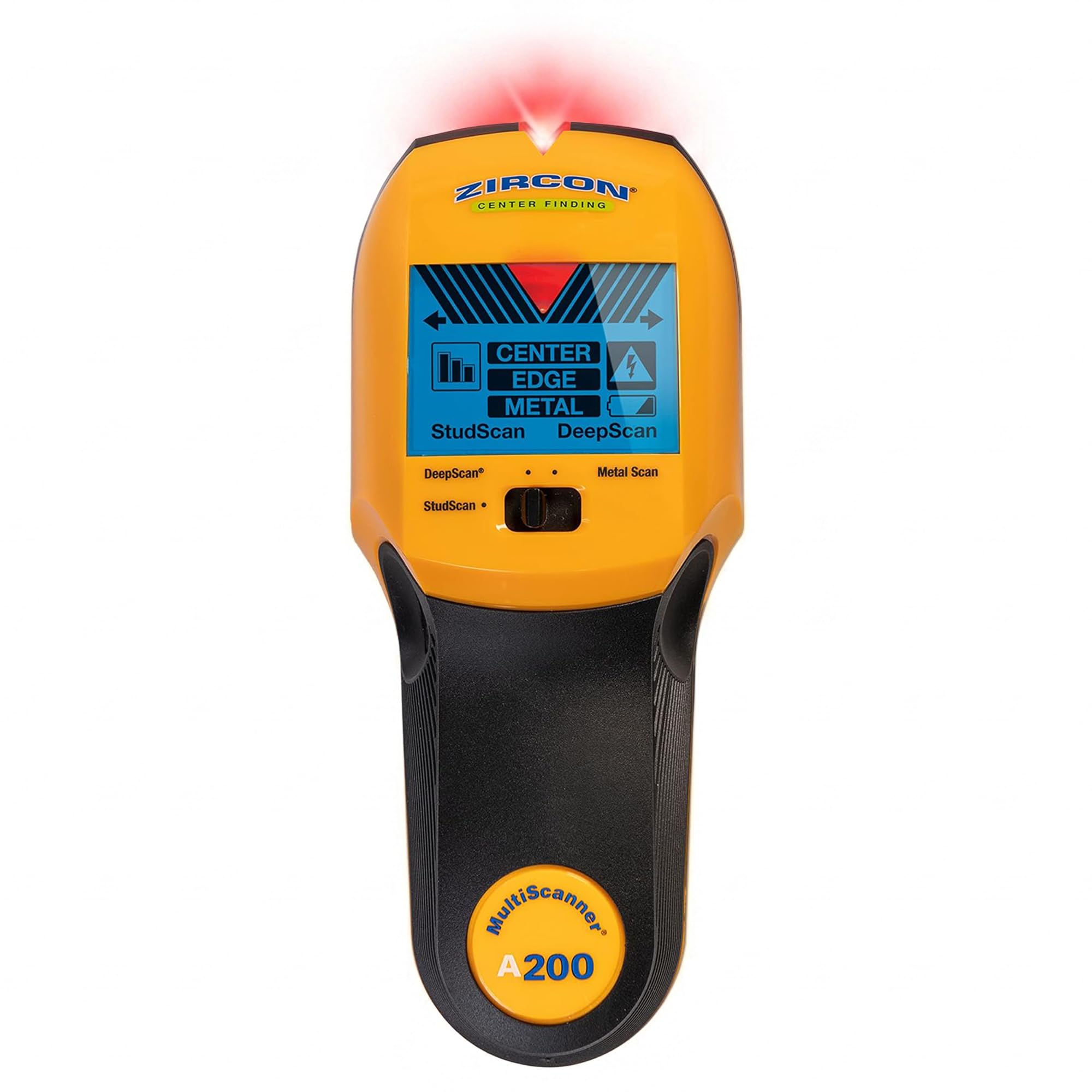
Three scan modes, a wire alert, and a spot pointer that puts a dot exactly where you drill.
Hanging a TV is where a stud finder earns or loses your trust, and the A200 is set up for that job. StudScan finds wood or metal stud edges and centers to 3/4 in deep, DeepScan pushes through thicker surfaces to 1 1/2 in, and Metal Scan locates metal behind the wall before the bit goes in. Better still, it reports stud direction, not just position, so you know which way the framing runs.
The safety layer is the part worth paying attention to. WireWarning detection alerts you to hot electrical wires behind the wall, and the SpotLite pointer marks the stud edge and center with a visible spot — no more sliding a pencil off the edge of the housing. The LCD, audio tone, and pointer work together, and a low battery indicator warns you before power drops low enough to skew a reading. It runs on a 9V alkaline battery, not included.
Buyers like its one-button operation most, and the backlit ColorTrip readout stays legible even in dim rooms. Calibration is the step that decides your result: lay it flat, hold the power button, wait one to two seconds for the short calibration beep, and do not move until it finishes. Slide slowly and the readings hold together. Rush that step and accuracy turns patchy, which is the fair caveat here. The IP54 rating (dust protection plus splash resistance) and limited lifetime warranty round out the package.
The mounting-day value: three modes plus WireWarning, SpotLite marking, and a low-battery alert — a sensible kit for wall-hanging jobs.
Where it can wobble: accuracy is only as good as your calibration pause, so give that beep its full second or two.
Match for you if: your next project is a TV, shelf, or mirror going onto drywall and you want a wire alert in the mix.
Better elsewhere if: you want precise center-finding through thicker wall stacks rather than a 3/4 in wood read.
6. Stud Finder Wall Scanner 3IN1 Stud Detector Beam Detector Laser Rangefinder

A stud scanner, laser measure, and protractor sharing one body — for the buyer who wants fewer tools in the bag.
This 3-in-1 unit is the odd one out on this list, and deliberately so. It packs a stud scanner, a laser rangefinder, and a protractor into one housing, and the measuring side is a serious instrument in its own right: a 60-meter range with ±1.5 mm accuracy, 50 sets of data storage, and 12 test modes. If you also fit cabinets or lay out rooms, the tape measure and angle gauge are already in your hand.
The scanning side covers the basics: stud scan to find the center, deep scan to detect the width of larger objects like pipes and wires, and metal scan for plumbing behind the wall. An angle sensor refreshes in real time at ±0.1° accuracy, and a backlit LCD shows the center, edge, and position of detected studs alongside battery status. Unusual at any price, the tool reads results out loud through real-time audio broadcast, so you can keep your eyes on the wall in low light.
The catch is focus. This is a multi-tool first and a dedicated stud finder second, so do not expect the single-purpose precision of the Franklin Sensors models. It also carries an IP65 rating (dust-tight and protected against water jets) and runs on a Lithium battery. If you already own a good finder, this is a second tool. If you are starting from nothing and want one gadget to cover measuring and finding, the combination makes sense.
Good match for: remodelers who want a laser measure, level, and stud scanner in a single grab-and-go unit.
Not the pick if: stud detection is your only job and you want the tightest accuracy for that task alone.
7. Zircon® MultiScanner™ A250c Stud Finder for Wood & Metal, Enhanced Display
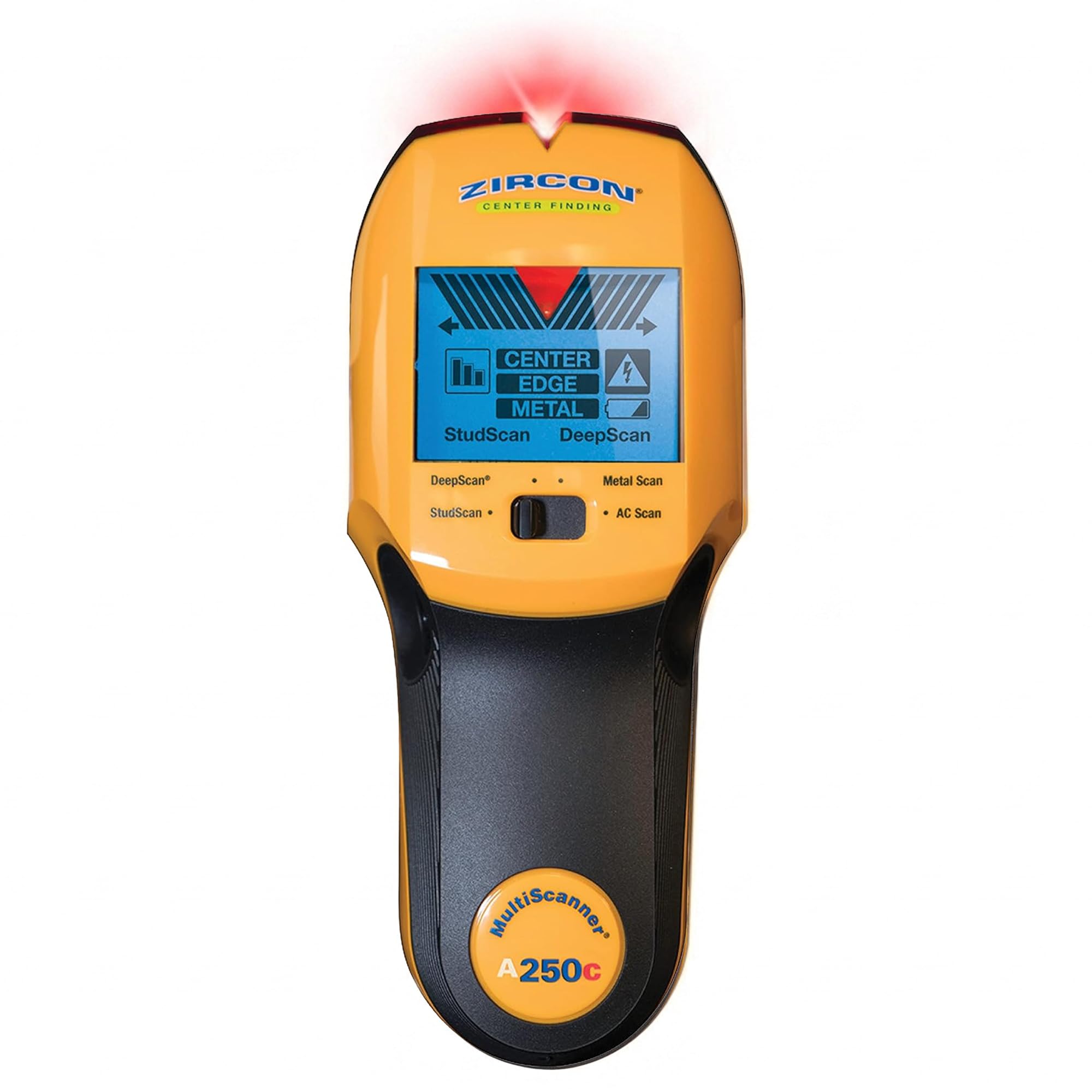
The screen tells you what you are looking at by colour — green studs, blue metal, red wiring.
Reading a stud finder in a dim basement or under a cabinet is half the battle, and the A250c solves it with colour. Its ColorTrip backlit display shifts hue by mode — green for studs, blue for metal, red for AC wiring — so you know the target type at a glance without decoding a legend. SpotLite pointer, audio alerts, and on-screen indicators back that up.
Depth is the strongest in the Zircon lineup here. StudScan reads wood and metal studs to 3/4 in, DeepScan reaches 1 1/2 in, Metal Scan finds rebar up to 3 in and copper pipe up to 1 1/2 in, and AC Scan picks up live unshielded wires up to 2 in deep. WireWarning alerts in both stud and metal modes. ACT Auto Correcting Technology recalibrates automatically as conditions change, and signal strength indicators confirm what you have found before you commit a bit to the wall.
Buyers single out build quality and wire tracking — the unit feels solid and finds wiring dependably. The caveat sits with center-finding on thicker or denser walls, where some scans land off-target and a second pass is wise. It also needs a 9V alkaline battery, sold separately. Power it up, calibrate flat on bare wall, and it is a strong choice for hanging shelving and artwork.
Why the display wins: colour-coded modes plus ACT auto-correcting and a 3 in rebar depth make dense-wall work clearer.
Worth knowing: center-finding on thick walls can drift, so verify with a follow-up scan before drilling.
Right for you if: you want a readable, colour-coded screen and the deepest metal and pipe reach in this Zircon range.
Consider a rival if: repeatable center accuracy on thick walls is your top priority over display clarity.
8. Bosch Professional GMS 120-27 Detector (2 x AA Batteries, Max. Detection Depth Non-Magnetic Metal/Magnetic Metal/Voltage-Conducting Cable/Wood: 120/100/50/30 mm, Protective Bag)
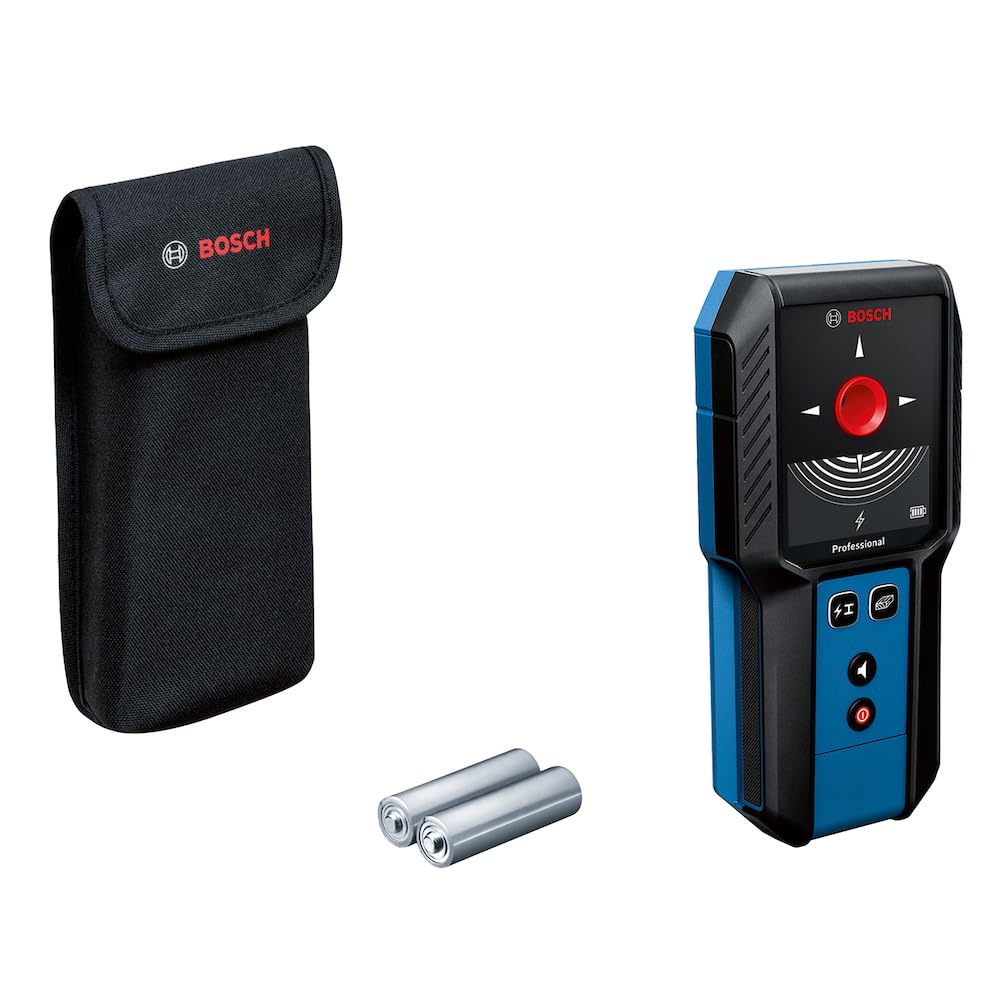
Built to survive a construction site, with a detection menu that tells you exactly what material you hit.
Four depth figures tell you what this Bosch can do, and they are stated per material: non-magnetic metal to 120 mm, magnetic metal to 100 mm, voltage-conducting cable to 50 mm, and wood to 30 mm. The tool reads out not just that something is there, but whether it is magnetic or non-magnetic metal, a live line, or non-metallic material — a distinction that helps you decide between cutting and backing off.
The interface follows the same logic. A tri-colour LED ring around the marking opening glows red when an object is detected, yellow as you approach one, and green when nothing is found, while a center display shows where the target sits. Mode selection is simplified, and a material identification readout keeps you from confusing a pipe with a stud. Two AA alkaline batteries come in the box, along with a protective bag.
Toughness is where this one separates itself for site work. A shock-absorbing rubber housing and an IP54 rating (dust protection plus splash resistance) mean a knock or a wet day will not end the job. The figure to watch is wood — 30 mm covers standard drywall over framing but not much more, so plan a deep-scan rival if your walls are thick. On solid walls, though, this is a professional tool with a professional’s instinct for telling you what you are about to hit.
The contractor’s pairing: a rubber-armoured, IP54 body for dusty or damp job sites, with a bag included for transport.
Not for you if: your work involves deep walls, since the 30 mm wood rating will not see far enough.
9. Franklin Sensors ProSensor MAX 13-Sensor Stud Finder, 2.5-in Deep Detection
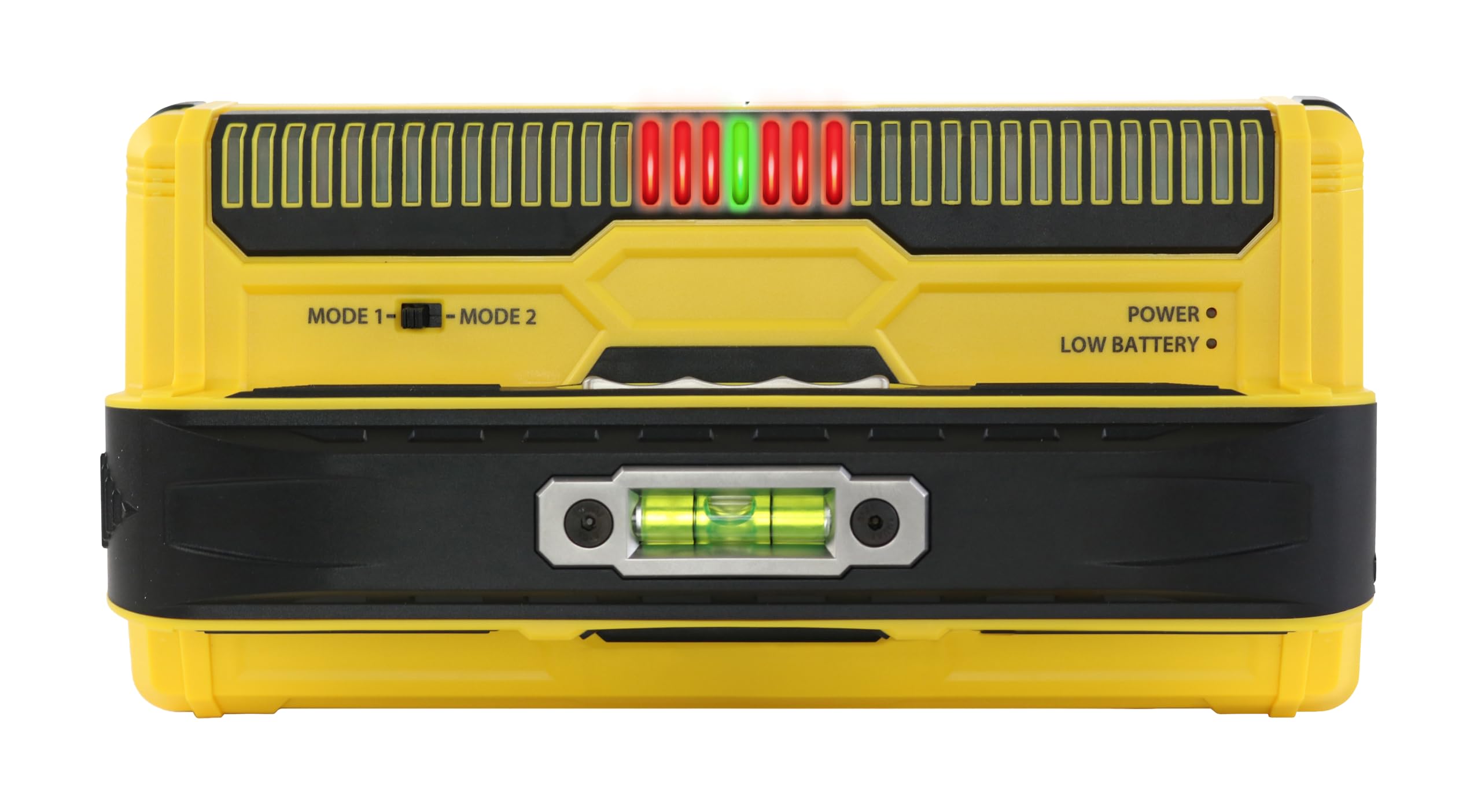
Thirteen larger sensors and a 2.5-inch reach — for walls that have stacked up thick.
The figure to start with is 2.5 in, the maximum detection depth this MAX model reaches. That is what lets it scan through two or more layers of drywall, plaster, OSB, plywood, MDF, and large tile. If your hobby room sits behind a layer of garage OSB or your bathroom is tiled, a shallow finder will simply misread the wall. This one keeps its composure.
The sensor design follows the same formula that made the 710+ the list leader, scaled up: 13 larger sensors light across the full width of studs rather than a single edge. The middle LED turns green to mark the stud center, and the precision LED display shows single or double studs. Two modes split the work — mode 1 behaves like a normal drywall finder, and mode 2 switches gears for deep scanning through thick or tough walls. No calibration is required; press and hold, scan anywhere, even over a stud.
The one thing buyers push back on is size — the 13-sensor body is big and heavy in the hand. That extra material is exactly what carries the larger sensor array and the 2.5 in reach, so the bulk is the price of the depth. For thick-wall work, most folks will tell you it is worth it. It also carries a limited lifetime warranty and runs on 3 volts of battery power.
What the MAX brings to thick walls
- 2.5 in max detection depth through layered drywall, plaster, OSB, and tile
- 13 larger sensors show full stud width and center
- Two modes, no calibration, start anywhere
- Limited lifetime warranty
What to accept for that depth
- Bulky and heavy in the hand
- Overkill for plain half-inch drywall walls
- Larger body than any compact finder here
Buy this when: thick, layered, or tiled walls have beaten your old finder and you need the deepest read available.
Steer past if: you only scan standard drywall — the extra depth comes with extra bulk you do not need.
Understanding the Specs
Sensor count and array width
The number of sensors is the clearest signal of how much wall a finder reads in a single press. One or two sensors give a single point of contact, which is why basic finders only report one edge. An array of 13, like the Franklin Sensors models, spans a wider face and lights across the whole stud — so you see both edges and the center without repositioning the tool. That matters most on double studs and irregular framing, where a single sensor has no way to tell you the stud is wider than normal.
Detection depth per material
Depths are quoted by material because walls are not one thing. Wood studs typically read shallowest, live AC wiring sits mid-range, and metal objects read deepest. A figure like 1 3/5 in of max depth covers standard drywall framing. Deep-scan modes stretch that to 1 1/2 in or 2.5 in depending on the model. Match the deepest number to your actual wall build — layered drywall, plaster, tile, or OSB — or expect the finder to read the surface rather than the framing behind it.
Calibration and setup
Auto-calibration sets a baseline for the wall you are scanning. Held flat on bare wall and left still, the tool locks onto the wall’s quiet background, so a stud then stands out as a change. Held over a stud or a wire, the baseline becomes that target and everything after reads wrong. On models that require it, press the button, wait for the tone, then slide slowly. On the no-calibration Franklin Sensors designs, the tool is designed to start anywhere, even over a stud.
Display and alerts
How you read the result changes how fast you work. LED bars are quick and bright, good for general scanning. Colour-coded LCDs tell you what material you have hit by colour, which helps when you are deciding between a stud and a pipe. WireWarning or AC alerts add a warning layer before you drill. Audio tones and spot pointers put the mark on the wall without a second tool, which pays off on overhead or dim jobs.
FAQ
How does a 13-sensor stud finder differ from a single-sensor one?
Why does my stud finder give false readings near a corner or a wire?
Will a stud finder detect a copper pipe behind drywall?
How deep does a stud finder need to reach for a tiled bathroom wall?
Do these stud finders take rechargeable batteries?
Can an advanced stud finder detect live electrical wiring?
Is a laser rangefinder stud finder worth choosing over a dedicated one?
How do I know whether I have hit the edge or the center of a stud?
What does the IP rating on a stud finder actually mean?
Can a stud finder locate studs through plaster and lath walls?
Final Thoughts: The Verdict
The strongest answer here is the Franklin Sensors ProSensor 710+ — 13 sensors, no calibration step, and a full stud width in one press. Buyers cite its reliability more than any other quality, and that record across a very large owner base earns it the top spot for most drywall jobs. If your walls are thicker or layered, the ProSensor MAX adds 2.5 in of deep reach and a second scanning mode, at the cost of a bigger, heavier body. And for anyone mounting a TV or shelf on a budget, the HANMATEK 5-in-one gives you five scan modes and a live-wire alarm without stretching the wallet. Whichever you pick, calibrate on a clean patch of wall first — that one habit separates a finder that works from one that sends your drill into a pipe.
How We Picked
We do not accept paid placement. Every pick is matched to a real buyer and a real use-case; we do not hands-on test units.
Sources & Methodology
Specifications: manufacturer listings and product documentation. Review insights: verified customer reviews, as of November 2026. Pricing: not shown on this page (it changes often); check the current price via the retailer link.
As an Amazon Associate, Gadgets Feed earns from qualifying purchases. This does not affect which products we feature.