
A camera bag that fails you on a trail isn’t just an inconvenience—it’s a liability for thousands of dollars in gear. The challenge with an adventure camera bag isn’t just finding one that holds a body and a lens; it’s finding a pack that balances on uneven terrain, distributes a heavy kit across your hips and shoulders, and seals out a sudden downpour while still giving you quick access to a shot without unpacking everything.
I’m Min — the co-founder and writer behind Gadgets Feed. I’ve spent hundreds of hours dissecting the technical specs, real-world user complaints, and internal volume metrics of more than 50 photography packs to isolate the handful that genuinely work for serious outdoor shoots.
What follows is a ground-up evaluation of the current market, built around padded dividers, roll-top waterproofing, suspension systems, and expandable payload bays. If you’re hunting for a genuine adventure camera bag, this is the only deep-dive you need.
How To Choose The Best Adventure Camera Bag
Selecting an adventure camera bag means weighing internal layout flexibility against external weather protection and load-carrying comfort. You need a bag that protects expensive glass while letting you move fast on unpredictable terrain. Below are the three factors that separate a serious field pack from an office commuter bag with a padded insert.
Internal Partition System and Expandable Volume
The best adventure packs use a split-chamber or full clam-shell design with configurable padded dividers. Look for a 50:50 gear-to-personal split as a baseline; a 20:80 expandable chamber is better for days when you need to carry a drone or a jacket. Roll-top extensions that add 5L to 8L of volume let you scale up without a second bag. If the dividers are permanently stitched, you’ll never fit a large telephoto or a gimbal.
Weather Sealing and Load Suspension
Water-resistance starts with the shell fabric—PU-coated tarpaulin or high-denier nylon with taped seams is the baseline. An included rain cover is insurance for heavy storms, but the zipper type matters even more: YKK water-resistant zippers seal out mist and light rain better than standard coil zippers. For suspension, look for a ventilated air-mesh back panel, an ActiveZone or S-shaped shoulder strap, and a removable waist belt that transfers at least 60 percent of the weight off your shoulders. Without a proper hip belt, a 25-lb kit will wreck your lower back by mile six.
Access Method and Tripod Attachment
Side-access doors and rear-panel openings are the two dominant access patterns. Side access lets you grab a body without taking the pack off—critical when you’re belayed on a ridge. Rear/jack-knife access forces you to swing the pack around but provides a wider opening for reconfiguring gear and doubles as an anti-theft feature in crowded areas. Tripod mounts should use reinforced compression straps with rubberized grip pads, not flimsy bungee cords that let a carbon-fiber tripod wobble against your water bottle.
Quick Comparison
On smaller screens, swipe sideways to see the full table.
| Model | Category | Best For | Key Spec | Amazon |
|---|---|---|---|---|
| PGYTECH OneMo 2 35L-45L | Premium | Expedition / Full Kit | 45L expandable, 17” laptop, clamshell | Amazon |
| Thule Aspect DSLR Bag | Premium | Hiking & Travel | Detachable hip belt, 15.6” laptop | Amazon |
| PGYTECH OneMo 2 25L-33L | Premium | Mid-Range Kit / Travel | 33L expandable, 16” laptop, gimbal pocket | Amazon |
| Lowepro Flipside Trek BP 250 AW | Mid-Range | Day Hikes / Light Gear | ActiveZone suspension, 9” tablet sleeve | Amazon |
| K&F CONCEPT Professional 25L | Mid-Range | Large Kit on a Budget | 25L expandable, 16” laptop, side access | Amazon |
| Besnfoto Waterproof Rolltop | Budget-Friendly | Wet Conditions / Value | Roll-top +5-7L, YKK zippers, 16” laptop | Amazon |
| Lowepro Truckee BP 250 LX | Budget-Friendly | Compact Mirrorless / EDC | 50:50 split, 15” laptop, 1.5 lbs | Amazon |
In‑Depth Reviews
1. PGYTECH OneMo 2 35L-45L Camera Backpack
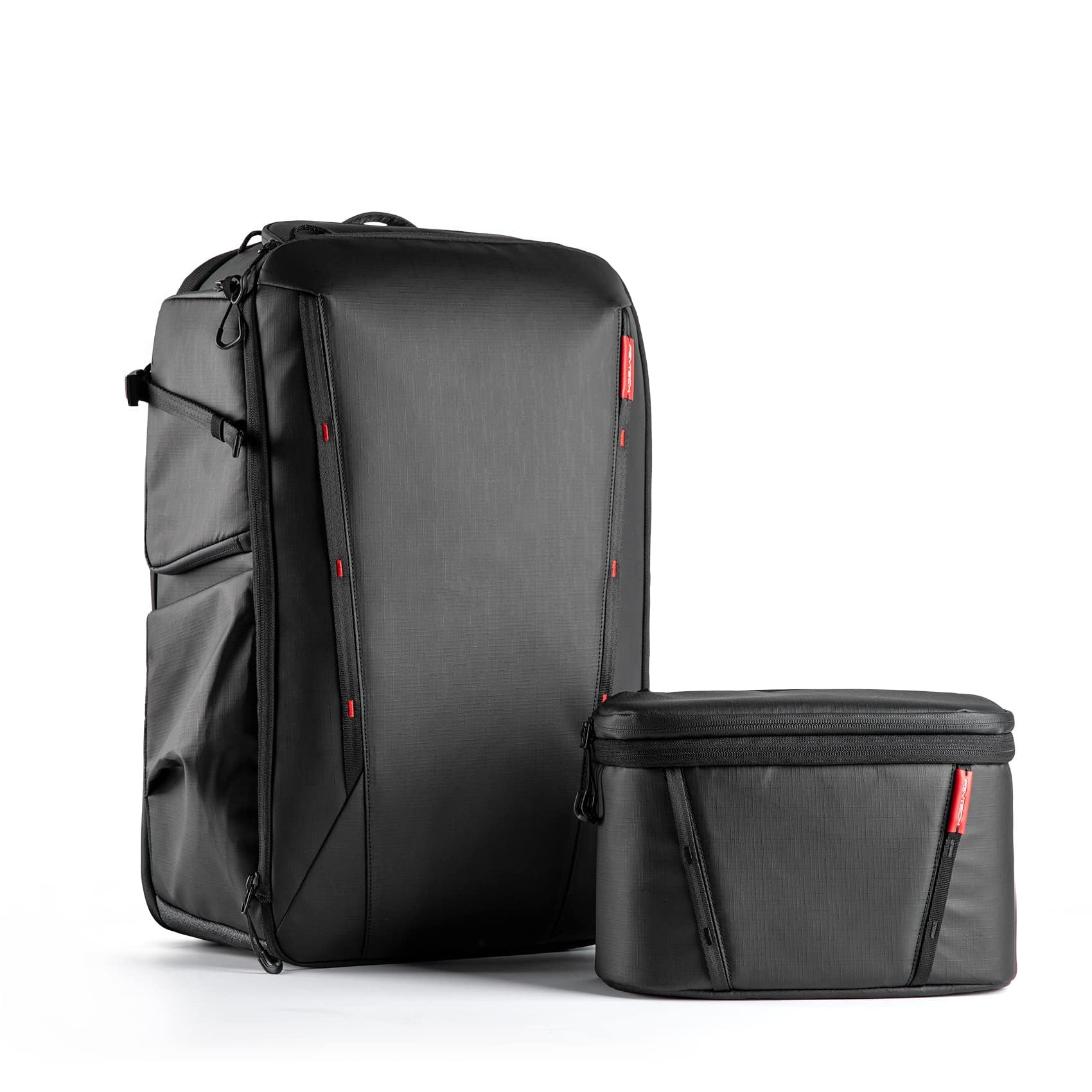
The PGYTECH OneMo 2 35L-45L is the most thoughtfully engineered adventure camera bag I’ve evaluated. It doesn’t just hold gear—it scales. The main chamber expands from 35L to 45L via a V-shaped or H-shaped zipper, so you can stuff a down jacket and extra water bladder on a long summit push without leaving your camera kit behind. The clamshell opening reveals a massive customizable interior with Velcro dividers that lock firmly into place, and the detachable inner “child bag” (3.5L) doubles as a standalone shoulder bag for quick side-trips from base camp.
The external fabric uses a high-performance PU anti-splash coating that’s genuinely waterproof in sustained rain, not just splash-resistant. YKK zippers with authenticity tags run across every opening, and the included rain cover adds another layer for biblical downpours. The back panel system is the real standout here: an ergonomic arc-shaped frame with EVA foam, scuba-knit fabric ventilation channels, and an S-shaped shoulder strap that distributes a 38-lb load without digging into your collarbone. Travelers who have taken this pack through 40-hour flight itineraries and multi-week treks report it still looks brand new after seven months of hard use.
The downsides are minor but worth noting. The laptop retention hook inside the main compartment is flimsy and can come undone—some owners have sewn on an additional button to fix it. The bag also screams “camera inside” with its surface-mount MOLLE loops and prominent PGYTECH branding, which could attract unwanted attention in urban environments. But for raw capacity, weather sealing, and carry comfort, this is the expedition-grade pack that sets the benchmark.
Why it’s great
- True 45L maximum volume with dual expansion modes for bulky personal gear like a jacket or sleeping bag
- Clamshell opening plus top and side access points let you grab a body without dropping the pack on muddy ground
- Included 3.5L detachable inner bag works as a standalone daypack for scouting or quick hikes
Good to know
- Laptop compartment retention hook is under-designed and may need a DIY reinforcement stitch
- Exterior design and branding make the bag look like expensive camera gear—lower-profile options exist for sensitive travel
- Weight hits 5.3 lbs with dividers, which is heavy for minimalist ultralight backpackers
2. Thule Aspect DSLR Camera Bag Backpack

The Thule Aspect is built for the photographer who values protective engineering over flashy features. The 100% nylon shell resists abrasion against rock faces and branches, and the customizable padded compartment easily swallows a DSLR body plus a DJI Mavic Pro drone (up to 260mm x 240mm x 130mm) alongside three or four additional lenses. The top compartment is generously sized for personal items like a wallet, passport, sunscreen, and a cardigan—so it works as a hybrid photo-and-travel daypack.
What sets the Aspect apart is its suspension architecture. The removable padded hip belt transfers significant weight off your shoulders, and the air-mesh back panel combined with S-shaped shoulder straps keeps your back dry and comfortable during long ascents. Build quality is excellent: YKK zippers glide smoothly, and the interior Velcro dividers are wide enough to allow four separate lens compartments. Owners have carried a Sony A7III with five lenses, an A6000 with two lenses, a tripod, and a monopod without feeling overloaded. The laptop compartment cradles up to a 15.6-inch laptop plus an iPad completely isolated from the camera section.
The biggest compromise is side-access usability. The side flap is narrow and requires some fiddling to extract a body quickly—it’s not as intuitive as a true side-zip system. The camera compartment itself can be tricky to reconfigure because the opening is tight when the bag is fully loaded. But if you prioritize bulletproof construction and a discreet black profile that doesn’t scream “camera bag,” the Thule Aspect rewards you with years of reliable field performance.
Why it’s great
- Top-tier 100% nylon shell with taped seams offers excellent abrasion resistance against rock and branch scrapes
- Detachable padded hip belt and air-mesh back panel provide all-day carry comfort that reduces shoulder fatigue
- Laptop compartment fully isolates a 15.6” machine and an iPad from dust and gear impact
Good to know
- Side-access flap is narrow and requires practice to retrieve a body quickly on the move
- Camera compartment opening is tight when loaded, making divider reconfiguration finicky
- Upper personal compartment lacks dedicated organizational pockets for small items like SD cards or pens
3. PGYTECH OneMo 2 25L-33L Camera Backpack

The 25L-33L version of PGYTECH’s OneMo 2 offers the same advanced back panel and weather sealing as its larger sibling but in a more manageable carry-on-friendly footprint. The main chamber holds a full-frame body with a 70-200mm attached, plus two to three additional lenses and a speedlight, while the expandable front gimbal pocket zips out to accommodate a DJI RS series stabilizer without forcing you to compress the interior dividers. Side-access panels on both sides let you grab a body or a lens without rotating the pack off your shoulders—a genuine advantage when you’re shooting on uneven scree or in a tight canyon.
The internal organization is exceptional. Dead-versus-charged battery sliders, dedicated card slots, and a mesh pocket for filters mean you rarely have to rummage. The built-in MOLLE loops let you attach a tripod cup, a pouch, or a carabiner for trekking poles. Owners who have run this bag through weddings and multi-week trips report that the YKK zippers feel smoother than any other bag they’ve owned, and the PU anti-splash coating holds up to real rain without needing the rain cover. The detachable waist strap is comfortable enough for a full day’s carry, and the sternum strap with a stabilizer buckle prevents the load from swaying during fast descents.
On the downside, the bag is undeniably a camera bag in appearance—the multiple expansion zippers and external straps give it a tactical look that may not suit every style. A few users note that the interior dividers, while highly customizable, don’t include small zippered pouches for loose tools or bolts. But for photographers who need a mid-size adventure pack that doesn’t compromise on access speed or weather protection, the 25L-33L OneMo 2 hits an exceptional balance of volume, weight, and cost.
Why it’s great
- Expandable front pocket specifically designed to hold a gimbal stabilizer without wasting main compartment volume
- Dual side-access panels for quick body retrieval from either shoulder side on the trail
- Dead/charged battery sliders and dedicated card slots keep critical small items organized without a separate pouch
Good to know
- External expansion zippers and MOLLE loops give the pack a tactical look that attracts attention
- Interior dividers lack small zippered pouches for loose hardware like tripod quick-release plates or tools
- Weight climbs to 4.65 lbs with dividers—noticeably heavier than a simple compartment book-bag
4. Lowepro Flipside Trek BP 250 AW

The Lowepro Flipside Trek BP 250 AW is a masterclass in the rear-access format. The entire back panel unzips to expose the camera compartment, which means you never have to set the bag down on wet ground or dirty snow to get at your gear. The internal cavity holds two mirrorless bodies (or one DSLR) with a 70-200mm f/2.8 attached, plus three additional lenses and a flash. The upper half is an open personal compartment that can absorb a light jacket, snacks, and a filter pouch. Externally, the side compression straps are designed to lash a water bottle or a compact tripod, though the bottle pocket’s tapered shape struggles with anything taller than 20 oz.
ActiveZone suspension is the real selling point here. The harness uses ventilated air-mesh padding and a waist belt that wraps securely around your hips, shifting the load off your shoulders. At around 3 lbs empty, the Flipside is one of the lighter packs in this lineup—a welcome detail for day hikers who want to minimize base weight. The included All Weather AW rain cover tucks into a hidden pocket at the base and deploys quickly when the sky opens up. Owners who have tested this pack on day hikes with a Fuji XT-3 and a handful of primes report that the comfort level is excellent for its size, and the discreet hiking-pack aesthetic won’t broadcast that you’re carrying thousands in glass.
The downsides are mostly about space constraints. The camera cavity is relatively shallow and won’t comfortably hold a full-frame body with an L-bracket and a vertical grip. The front accessory pocket has a raised hump in the middle that makes it nearly impossible to lay a tablet flat. And the bottle pockets are notoriously narrow at the base—a standard 500ml Nalgene will not seat properly. It’s a bag best suited for a compact kit rather than a full expedition loadout.
Why it’s great
- Rear-panel access lets you retrieve gear without setting the bag on wet ground—critical for muddy or snowy conditions
- ActiveZone air-mesh suspension and waist belt provide excellent load distribution for a 13L camera compartment pack
- Included AW rain cover deploys from a dedicated base pocket for instant weather protection
Good to know
- Side water bottle pockets are tapered and won’t accept bottles taller than 20 oz without wobbling
- Front pocket has a central hump that prevents a tablet from sitting flat—smaller gadgets only
- Camera compartment is shallow; a DSLR with a battery grip or an L-bracket is a very tight squeeze
5. K&F CONCEPT Professional Camera Backpack 25L

The K&F CONCEPT Professional Camera Backpack punches far above its price tier. The stand-out feature is the “Magic Chamber” internal system—a full-height padded divider that can shift from a 50:50 gear-to-personal split to a 20:80 configuration by unzipping a partition and pushing it back. This flexible architecture lets you carry a massive photo load one day (Canon C70, three lenses, monitor, V-mount battery) and then reconfigure for a hiking day with a jacket, lunch, and a small mirrorless kit the next. The main compartment includes a dedicated padded sleeve that fits a 16-inch laptop fully isolated from the camera section.
The external material is a coated polyester weave that resists light rain well, and the bag ships with a full rain cover for deluges. The quick-access side zipper lets you reach the camera without taking the pack off, though the opening is positioned toward the top and works best for a body with a standard zoom attached. The tripod mounting system uses twin compression straps and a lower pocket that secures a full-size travel tripod without flopping. Early owners report that after two years of frequent use, the bag shows no rips or tears—a testament to the build quality for the price.
The most common complaint centers on the Velcro dividers: the hook-and-loop strips don’t adhere with enough grip inside the nylon-lined chamber, causing dividers to shift when the bag is heavily loaded and jostled. The water bottle holder works well for wide bottles but struggles with tall, thin bottles that tip sideways. And at 1.78 kg empty, it’s slightly heavier than its direct competitors. Still, for photographers who need a large-capacity pack that converts between photo-hauler and travel bag, the K&F CONCEPT is the best value proposition in this list.
Why it’s great
- Magic Chamber divider system converts from a 50:50 to an 20:80 split, adapting to photo-heavy or personal-heavy loads
- Rain cover included and external coated polyester resists light rain without needing the cover
- Side-access zipper allows quick body retrieval without dropping the pack to the ground
Good to know
- Velcro dividers slip inside the nylon chamber—they don’t lock down firmly enough for demanding terrain
- Water bottle pocket fits wide bottles well but lets tall/narrow bottles tip when the bag is leaned over
- Empty weight of 1.78 kg is on the heavy side for a 25L nominal bag
6. Besnfoto Waterproof Camera Backpack
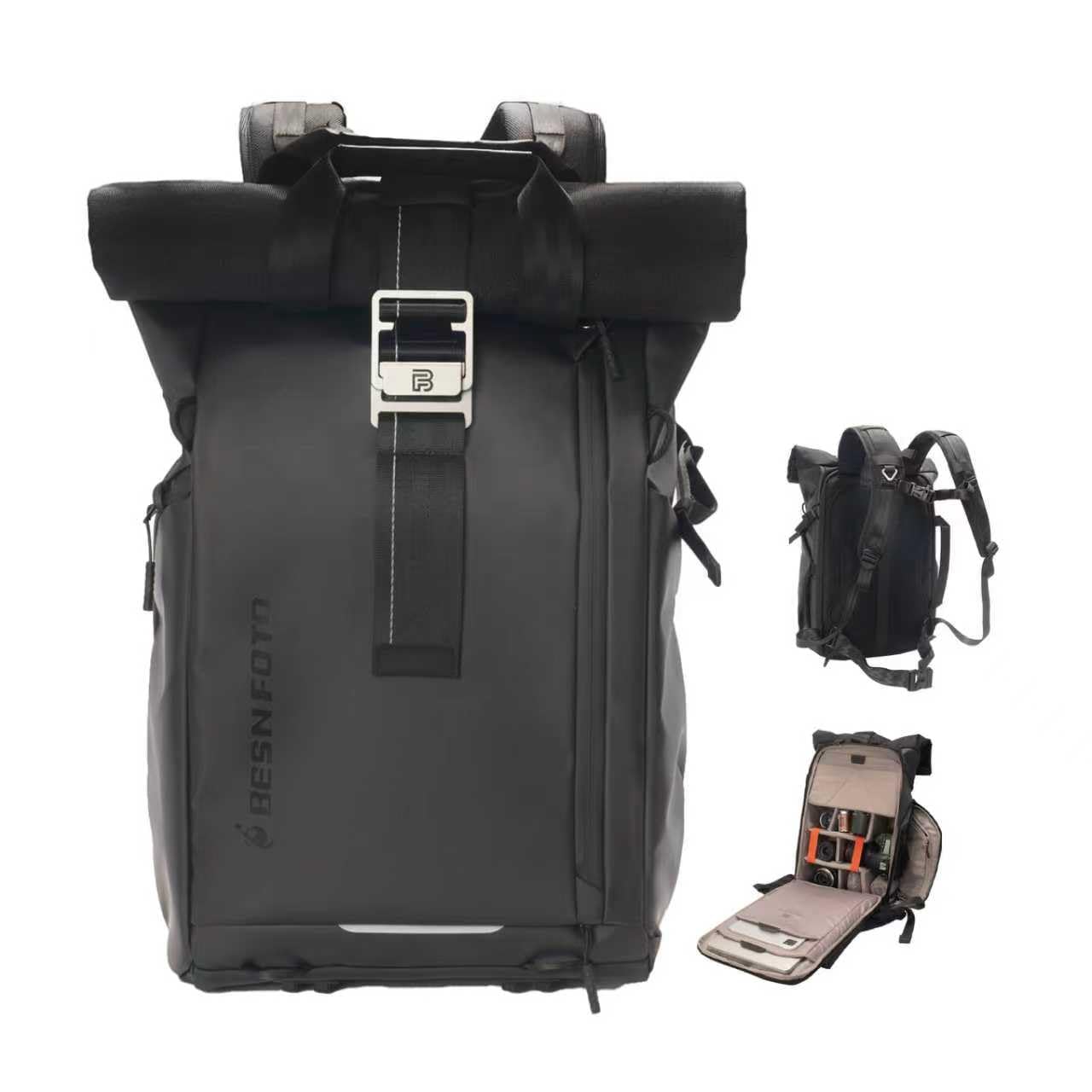
The Besnfoto Waterproof Camera Backpack brings a roll-top lid and genuine weather sealing to the budget-friendly tier. The main body is constructed from high-density waterproof tarpaulin—the same material used in dry bags—and paired with YKK water-resistant zippers. The roll-top closure adds a 5L to 7L expansion zone on top of the base capacity, so you can seal in a soaked rain shell or a packed lunch without letting moisture inside the camera compartment. In sustained rain and even submersion tests, the interior has stayed bone-dry without requiring the included rain cover.
Inside, seven removable padded dividers let you configure the space for two DSLR bodies, four to five lenses, and a DJI drone. The rear-opening panel reveals the full layout at once and doubles as an anti-theft measure in crowded transit hubs. The side-access door is positioned for quick camera retrieval—users report that a Canon 60D with a battery grip and a 100-400mm lens fits through the side zipper opening. The laptop sleeve accommodates up to a 16-inch MacBook Pro in a thick padded pocket, and external compression straps can secure a tripod, a yoga mat, or even a small foldable chair. The suspension includes breathable air-mesh shoulder straps and a waist belt that helps distribute the 3.5–5 lb load during long treks.
Downsides are centered on build longevity. After extended use—specifically 5,000+ miles of bike commuting or heavy daily abuse—some owners report that the outer fabric loses some rigidity and the magnetic roll-top closure loses its grip. The included rain cover is undersized when the bag is in expanded mode and won’t cover the full roll-top extension. And while the interior camera compartment is deep, it relies on filler pieces that waste vertical space for shorter lenses. But for the price, you get a bag that performs like a dry bag and offers a level of weather resistance that many packs at twice the cost can’t match.
Why it’s great
- High-density waterproof tarpaulin body with YKK water-resistant zippers keeps gear dry in heavy rain without a rain cover
- Roll-top lid adds 5-7L of expandable weather-sealed storage for wet personal items or a jacket
- Rear-panel opening provides full interior visibility and doubles as an anti-theft feature in crowded spaces
Good to know
- Roll-top magnetic closure loses hold after months of heavy use, and the included rain cover doesn’t fit the expanded bag
- Interior camera compartment is deep and requires filler pads, wasting headroom for short kit
- Fabric loses some rigidity with sustained abuse, though it remains functional
7. Lowepro Truckee BP 250 LX

The Lowepro Truckee BP 250 LX is the lightest and most compact entry in this roundup at just 1.5 lbs—a legitimate ultralight option for adventure photographers who prioritize minimal base weight. The 50:50 split chamber dedicates the lower section to camera gear and the upper section to personal items, making it a practical day pack for a mirrorless kit with two extra lenses. A padded pocket at the rear swallows a 15-inch laptop, and the padded main compartment is secured with a toggle-locking zipper for basic theft deterrence. The exterior side pocket includes a tripod strap that lashs a lightweight travel tripod without destabilizing the pack.
Despite its tiny footprint, the truckee holds more than you’d expect. Verified owners have packed a Sony A7RII with a 12-24mm lens, a Nikon P1000 in the front pocket, plus a 15-inch MacBook Pro and an 11-inch iPad Pro. The ventilated wicking mesh back panel and sternum strap help manage the load over short-to-moderate hikes, though the shoulder straps are thin and can dig in when the pack is fully loaded with heavy glass. The discreet design looks like an ordinary daypack, which is a genuine advantage for street photography and low-visibility travel.
The trade-offs come from its size and strap comfort. The shoulder straps lack sufficient padding for loads exceeding 10 lbs, and the belt is absent entirely—there’s no waist strap to transfer weight. The color options are limited to light grey and white, which show dirt quickly on dusty trails. And there’s no dedicated tablet or pen pocket, just a single flat internal sleeve. The Truckee is best viewed as an ultralight mirrorless day pack rather than a primary expedition bag. For photographers who run small kits and want to keep pack weight under 2 lbs, it’s a smart purchase.
Why it’s great
- Extremely light at 1.5 lbs—one of the lightest camera backpacks available, ideal for fast-and-light missions
- Discreet, non-camera aesthetic blends in on city streets or casual trails without advertising gear inside
- 50:50 split offers a balanced layout for a mirrorless body, two extra lenses, and a 15-inch laptop
Good to know
- Shoulder straps are thin and become uncomfortable with heavy loads exceeding 10 lbs—no waist strap provided
- Limited to light grey/white color options that pick up trail dust and dirt quickly
- Not a primary expedition bag—best suited for compact mirrorless kits and short daily excursions
FAQ
Can I fit a full-frame DSLR with a battery grip in any of these bags?
How do I know if a rain cover will actually keep my gear dry?
What internal volume do I need for a two-body, four-lens kit plus a drone?
Is a waist belt necessary for an adventure camera bag?
Final Thoughts: The Verdict
For most users, the best adventure camera bag winner is the PGYTECH OneMo 2 35L-45L because its expandable 45L capacity, clamshell opening, and arc-shaped suspension system handle everything from a weekend summit to a two-week expedition without compromise. If you need a lighter, more discreet pack for day hikes with a compact kit, grab the Lowepro Flipside Trek BP 250 AW. And for wet-weather reliability without breaking the bank, nothing beats the Besnfoto Waterproof Rolltop.