
Our readers keep the lights on and my morning glass full of iced black tea. As an Amazon Associate, I earn from qualifying purchases.
Specs are compiled from manufacturer listings and verified buyer reviews and can change over time — please confirm the key details on the product page before buying.
You buy an adventure camera to survive the trip and come back with the shot. The problem is that most people pick one for resolution alone, then find the battery dies mid-climb or the lens fogs up just as a wave hits. This guide breaks down seven rugged, waterproof, and field-ready options so you know which one fits your type of chaos.
I’m Min — the founder and writer behind Gadgets Feed. This guide is built by comparing the manufacturers’ published specifications and the patterns across verified customer reviews, so you get each pick’s real strengths and trade-offs instead of marketing spin.
Whether you are diving with sharks, skiing through a blizzard, or filming your kid’s soccer game in a downpour, the adventure camera you pick has to handle grit, drops, and darkness without flinching.
Quick Picks
- DJI Osmo Action 5 Pro Adventure Combo — Best Overall
- DJI Osmo Action 6 Essential Combo — Premium Pick
- Insta360 X5 Essentials Bundle — Most Creative
- Pro Action Camera by Xtra Edge — Best Value
- OM System Olympus Tough TG-7 — Rugged King
- GoPro Hero12 Black E-Commerce Package — Top Performer
- Kodak PIXPRO WPZ2 Rugged Waterproof Bundle — Budget Champion
How To Choose The Best Adventure Camera
Picking an adventure camera means deciding how much punishment it has to take. A 4K action cam for mountain biking needs completely different priorities than a rugged point-and-shoot for deep-sea snorkeling. Here is what to look for before you buy.
Waterproof Without a Case vs Just Water-Resistant
The biggest selling point in this category is whether a camera can go underwater with no extra housing. Some models like the Pro Action Camera are rated to 65ft (20m) straight from the start, while others need a separate case. If you plan on snorkeling or diving without lugging gear, make sure the spec says “waterproof to” a depth you trust — not just splash-proof.
Battery Life — The Silent Dealbreaker
An adventure camera that dies in 70 minutes during a 4-hour hike is useless. Look at battery average life in minutes, not marketing promises. For example, the Pro Action Camera claims 240 minutes per charge, while a standard GoPro Hero12 Black gets 70 minutes at high-res recording. If you are off-grid all day, a camera with a cold-resistant battery or a high-capacity cell (like the 1950mAh battery in some DJI models) is worth the extra upfront cost.
Stabilization Physics vs Marketing Names
Every action camera brags about stabilization, but the real test is whether it handles 360° rotation without a gimbal. Features like “Horizon Lock” or “RockSteady” keep your footage level even when the camera spins fully around. The big differentiator is whether the camera can stabilize while also keeping the horizon flat — that is the spec that separates pro footage from seasick footage.
Sensor Size and Still Resolution
For still photos grabbed from video, effective still resolution matters. A 40 MP sensor (like the DJI Osmo Action 5 Pro) gives you 48% more detail than a 27 MP sensor (like the GoPro Hero12 Black), which matters if you plan to crop or print. The sensor physical size — 1/1.3″ vs 1/1.9″ — determines how well the camera handles dusk and shadowy forests, not just bright sunny slopes.
Quick Comparison
| Model | Best For | Waterproof Depth | Battery Life | Resolution | Amazon |
|---|---|---|---|---|---|
| Kodak PIXPRO WPZ2 | Budget snorkeling & family trips | 49ft (15m) | — | 16MP + 1080p Video | Amazon |
| Pro Action Camera | All-day POV vlogging & diving | 65ft (20m) | 240 min | 4K/60fps | Amazon |
| GoPro Hero12 Black | Pro-level stabilization & editing | 33ft (10m) | 70 min | 5.3K60 + 27MP | Amazon |
| DJI Osmo Action 5 Pro | Night shooting & extended trips | 65ft (20m) IP68 | 4 hrs per battery | 4K/120fps + 40MP | Amazon |
| DJI Osmo Action 6 | 8K premium cinema & cold climates | Waterproof | 4 hrs | 8K + 38MP | Amazon |
| Insta360 X5 | 360° rich & creative angles | 49ft (15m) | 208 min | 8K30 + 72MP | Amazon |
| OM System Tough TG-7 | True macro & extreme conditions | 50ft (15m) | — | 4K + 12MP | Amazon |
In‑Depth Reviews
1. DJI Osmo Action 5 Pro Adventure Combo

The action cam that shoots crisp footage at dusk and still has battery left for breakfast.
The DJI Osmo Action 5 Pro is the camera that gets the shot when the light is fading. Its large 2.4 µm pixels (a measure of each pixel’s light-catching area) on a 1/1.3″ sensor pull detail out of dim scenes that most action cameras would turn into noise. With a 13.5-stop dynamic range — the range from the darkest shadow to the brightest highlight — you get highlights that don’t blow out and shadows that stay visible. One reviewer noted it keeps your horizon perfectly level even through a full 360° roll.
Battery life is the headline here, and it lives up to it. You get up to 4 hours of recording on a single charge, so you can hike or snorkel a full day without hunting for a power bank. At the same time, its 40 MP effective still resolution beats the 27 MP on the GoPro Hero12 Black by a sizable margin — 48% more detail if you crop photos from your video frames.
The Adventure Combo sweetens the deal with three Extreme Batteries (1950 mAh each — milliampere-hours, the standard measure of charge capacity), a multifunctional battery case, and a 1.5m extension rod. With an IP68 rating (a dust-tight seal that also withstands continuous underwater immersion) to 20m, this is the pick if you want one camera that handles night, day, and everything in between.
What Makes It Stand Out
- Large 1/1.3″ sensor with 2.4 µm pixels captures sharp low-light footage other action cams miss
- 40 MP still resolution — significantly sharper than the 27 MP on the GoPro Hero12 Black
- Up to 4 hours of recording thanks to the 1950mAh Extreme Battery
- IP68 rated to 20m underwater without a housing
One Thing to Know
- Does not shoot 8K video; tops out at 4K/120fps, so if you need 8K, step up to the DJI Osmo Action 6
Reach for this if: you shoot in varied light — dusk trails, underwater caves, cloudy passes — and need a battery that lasts a full outing.
Look elsewhere if: you absolutely need 8K resolution for professional post-production; the Action 5 Pro stays at 4K.
2. DJI Osmo Action 6 Essential Combo
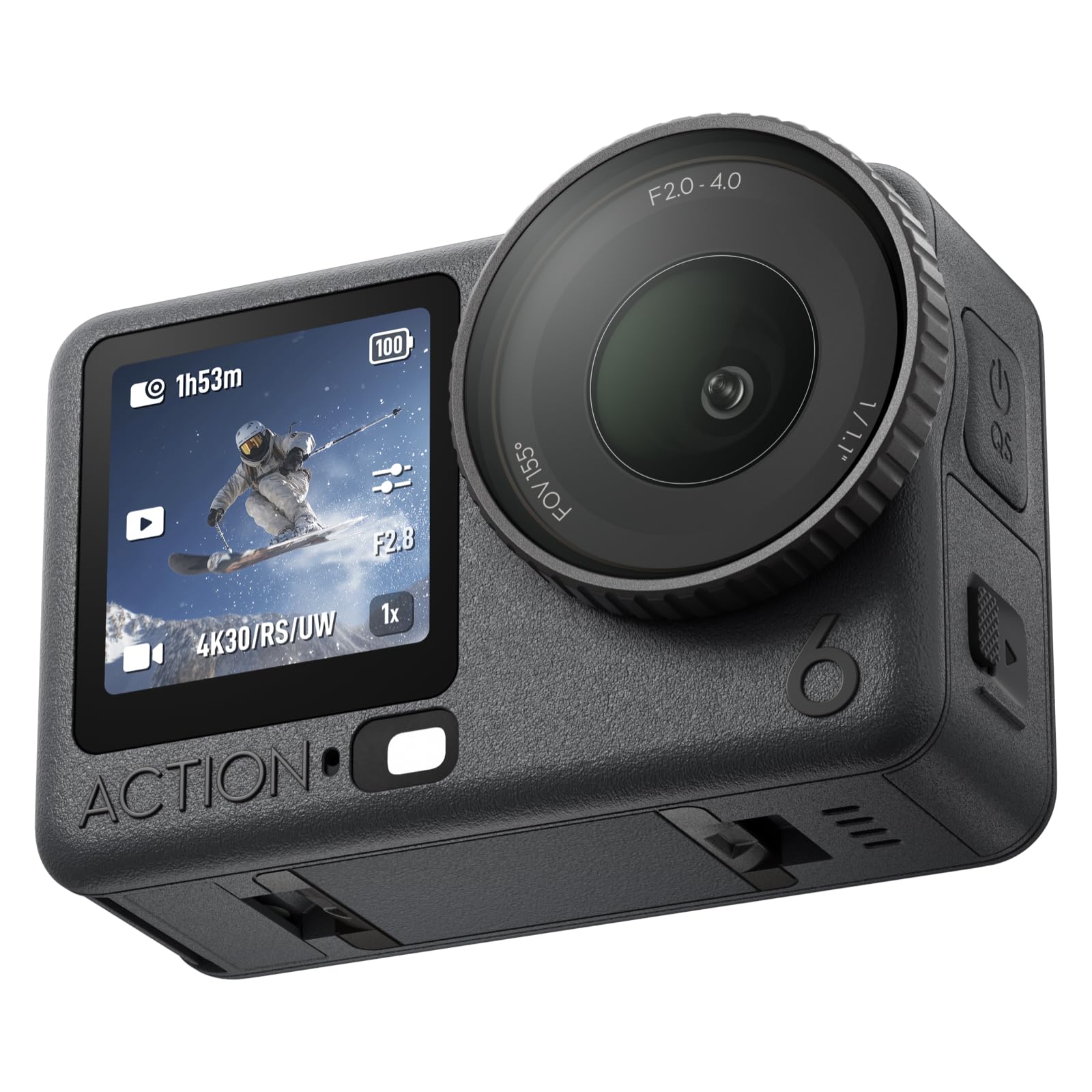
The first action camera with a real variable aperture and 8K resolution squeezed into a rugged body.
The DJI Osmo Action 6 is for the creator who wants cinema-quality 8K footage from a camera that can take a beating. Its 1/1.1″ square sensor is physically larger than the Action 5 Pro’s 1/1.3″ sensor. The variable aperture of f/2.0–f/4.0 (the opening that controls how much light enters the lens) is a first for this class — you can control depth of field and exposure without ND filters (neutral density filters that reduce light evenly). This matters for vloggers who want a blurred background in bright sun.
Battery life holds steady at 4 hours. The cold-resistant design — built to keep recording at low temperatures — means skiers and mountaineers won’t see a premature shutdown. HorizonSteady handles tilts up to 360°, while RockSteady 3.0 keeps motion smooth without that artificial floating look.
One buyer mentioned that the dual-microphone transmitters (two at once, no receiver) make interview-style vlogging easy — clean audio with zero extra gear. At 38 MP stills, it is slightly behind the Action 5 Pro’s 40 MP count, but the 8K video resolution (7680 pixels effective) is a massive step up for anyone who crops heavily in post.
The Big Upgrade: 8K video at 7680 pixels effective resolution and a variable aperture f/2.0–f/4.0 lens give you professional-grade exposure control that no competing action camera offers.
The Trade-off: Still resolution is 38 MP vs 40 MP on the Action 5 Pro, and the Essential Combo skips the multi-battery case.
Buy it for: 8K workflows, cold-weather shoots, and the flexibility of a variable aperture lens — this is the most versatile image-capture tool in the action cam world.
skip it if: you do not need 8K and prefer the slightly higher still resolution and deeper waterproof rating of the Action 5 Pro.
3. Insta360 X5 Essentials Bundle

Captures everything around you so you never miss the angle you forgot to frame.
The Insta360 X5 is built for people who hate decision paralysis in the moment. With dual 1/1.28″ sensors, it shoots 8K 360° video at 30fps, meaning you record everything in every direction and choose your framing later on your phone. The invisible selfie stick effect makes it look like a drone or a buddy is following you — a signature trick no standard action camera can pull off.
Battery life hits 208 minutes, and fast charging gets you to 80% in 20 minutes. It is waterproof to 49ft (15m) without a housing. The lenses are now replaceable — a first for 360° cameras, which used to be disposable if you scratched a lens. The new 4-mic array with a dedicated Wind Guard keeps dialogue clear even in a strong breeze.
The triple AI chip design handles noise reduction in dim scenes. FlowState Stabilization plus 360° Horizon Lock means you never need a gimbal. If you want to reframe after the fact without losing quality, the 72 MP effective still resolution gives you enough data to export tight crops that still look sharp.
The Creative Edge: 360° capture + invisible selfie stick is impossible to replicate with any other camera on this list; perfect for POV action where you want to see yourself in the frame.
The Reality Check: You need the Insta360 app to reframe footage — there is a learning curve, and the raw 360° files are large.
Get this if: you want the most dynamic perspective options — biking, skiing, surfing — where you reframe the shot after the fact rather than while riding.
Pass if: you prefer a traditional forward-facing lens and an instant clip; the X5 demands post-processing.
4. Pro Action Camera by Xtra Edge
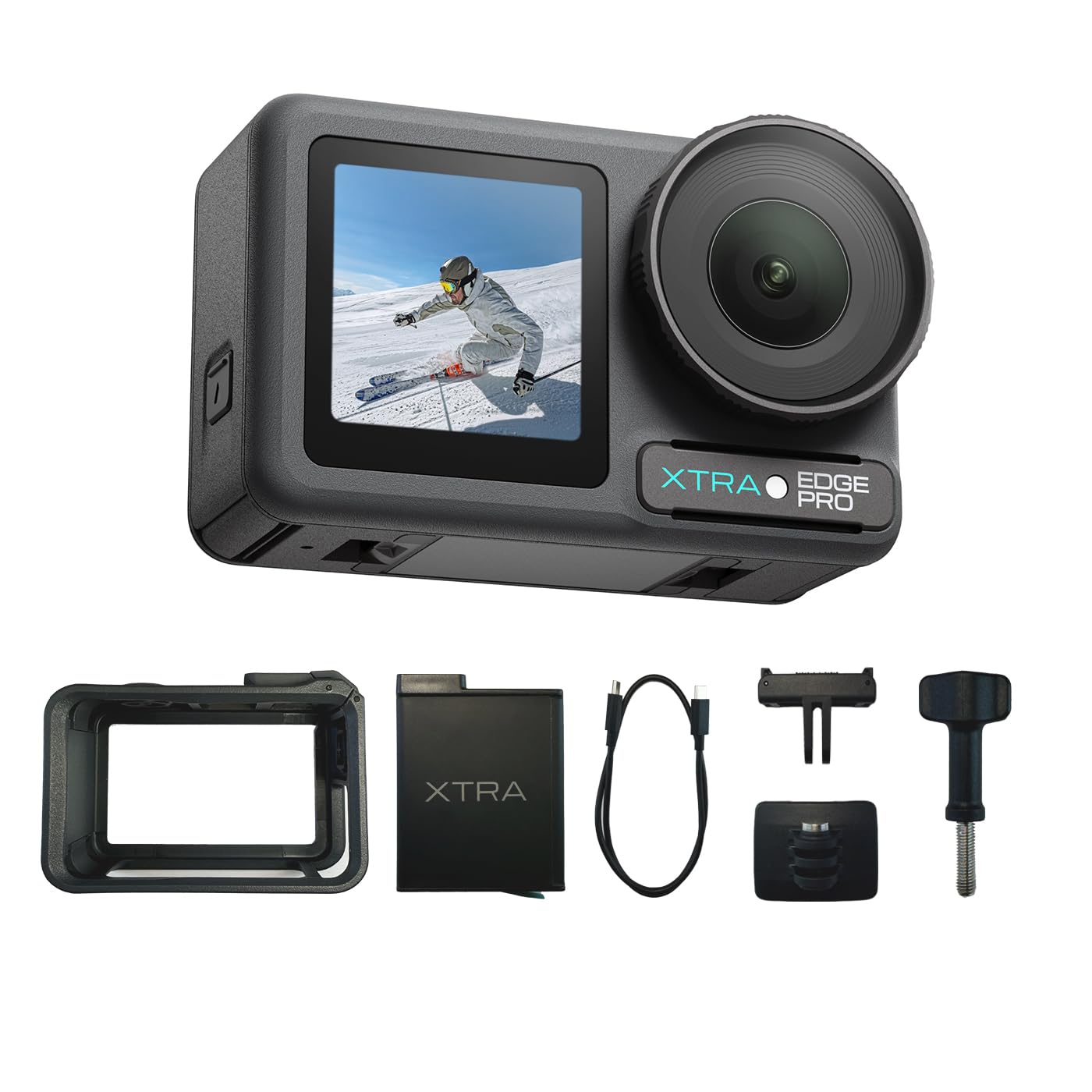
A massive 240-minute battery and 65ft waterproof rating at a mid-range price that undercuts the big names.
The Xtra Edge Pro Action Camera solves the two problems that kill adventure cameras: power and depth. With a battery average life of 240 minutes, it lasts 3.4 times longer than the GoPro Hero12 Black (70 minutes), so you can spend a full day on the water without swapping cells. It is also waterproof to 65ft (20m) without a housing — deeper than the GoPro’s 33ft and plenty for recreational scuba.
The large 1/1.3″ sensor is the same size class as the DJI Action 5 Pro, which means its 4K/60fps footage handles twilight and forest canopy better than smaller-sensor cameras. Night View Mode brightens low-light scenes for campouts or evening walks. Stabilization uses three systems — 360 Lock, TiltGuard, and MotionMaster — to keep your POV footage smooth.
The bundle includes a cold-resistant battery and a dual-orientation protective frame. Video resolution maxes out at UHD (2160 pixels, shorthand for 4K ultra high-definition), and the camera shoots 32x slow motion. If you want the best straight-to-water action cam without paying a premium for a brand name, this is the dark horse winner.
The Specs That Win
- 240-minute battery average life races past the 70-minute GoPro Hero12 Black — a 3.4x gap for all-day recording
- Waterproof to 65ft (20m) without a case — deeper than the GoPro at 33ft and the Insta360 at 49ft
- Large 1/1.3″ sensor for good low-light performance at a fraction of premium-brand prices
The Catch
- Not as polished on stabilization as the DJI or GoPro systems, and the brand lacks a large app ecosystem for editing
Perfect for: the budget-conscious adventurer who needs huge battery life and deep waterproofing without paying DJI or GoPro prices.
Not for: creators who rely on sturdy editing apps or want the absolute smoothest stabilization — the premium picks handle that better.
5. OM System Olympus Tough TG-7

The tank of the group — crushproof, freezeproof, and shockproof in a proper camera body.
The OM System Tough TG-7 is not an action camera; it is a proper compact camera built to survive things that would shatter a GoPro. It is waterproof to 50ft (15m), dustproof, shockproof to a drop of 7ft (2.1m), crushproof to 220 pound-force, and freezeproof to -10°C (14°F). It is the only camera here that explicitly withstands being stepped on or frozen. If your adventure involves heavy equipment, ice falls, or rock climbing, this is the safest bet.
Image quality benefits from a real f/2.0 lens and a 4x optical zoom (27-108mm equivalent), giving you reach the fixed-lens action cams cannot match. The variable macro system is unique: you can get as close as 1 centimeter from the end of the lens for true macro shots of insects, ice crystals, or reef details. It includes 5 underwater modes, including an underwater microscope mode and underwater HDR — designed for divers who want marine life close-ups.
Video maxes out at 4K at 30fps with 120fps slow-motion, and it supports vertical video mode for social clips. The 9 autofocus points are contrast-detection based (which hunts for edges to find focus, and is slower than phase-detection), but for the durability trade-off, most outdoor shooters accept it.
Built Different: Crushproof to 100 kgf (220 lbf) and freezeproof to -10°C — no other camera in this lineup survives a car running over it or a night in a freezer.
The Trade-off: Video resolution tops out at 4K and stills at 12MP; it prioritizes toughness and macro capability over pure pixel count.
Choose this for: expeditions where the camera might get crushed, frozen, or completely submerged — plus serious underwater macro photography.
Avoid it if: you want high-resolution stills and cinematic 8K video; this is a tough little point-and-shoot, not a cinema machine.
6. GoPro Hero12 Black E-Commerce Package

The Emmy-winning stabilizer that makes shaky handheld footage look like a gimbal shot.
The GoPro Hero12 Black is the benchmark for stabilization in this category. HyperSmooth 6.0 (GoPro’s digital image stabilization) won an Emmy for in-camera stabilization, and it shows. You can record mountain biking through roots and rocks and the footage comes out smooth enough to post unedited. The 360° Horizon Lock keeps the horizon flat even if the camera spins fully around, something that used to require a physical gimbal (a motorized handle that counteracts movement).
Video resolution goes to 5.3K at 60fps, which gives you 91% more pixels than 4K. You can extract 24.7MP stills from video using the GoPro Quik app. HDR video and photo mode handles bright sky and dark tree shadows simultaneously, preserving detail in both. The Extra-Large Field of View is the widest ever on a HERO camera for rich POV shots.
Battery life is its weakest link. At 70 minutes continuous recording at 5.3K60, it has the shortest runtime of any camera on this list. The 1720mAh Enduro battery is an improvement over older models, but compared to the 240 minutes of the Xtra Edge Pro or 4 hours of the DJI Action 5 Pro, you will need a spare for a half-day shoot. It uses a GP2 processor and supports Bluetooth audio connectivity for external mics.
What It Masters
- HyperSmooth 6.0 with 360° Horizon Lock — the best stabilization in the category, backed by an Emmy award
- 5.3K60 video resolution with 91% more pixels than standard 4K
- Large ecosystem of mounts, mods, and accessories
Where It Falls Short
- 70-minute battery average life is the shortest here — 3.4x less than the Xtra Edge Pro Action Camera
- 27 MP still resolution trails the DJI Action 5 Pro (40 MP) by a 48% gap
Pick it for: the smoothest possible action footage with minimal post-processing — GoPro’s stabilization is genuinely class-leading.
Pack a spare battery if: you plan to shoot for more than an hour; the 70-minute run time will not cover a full hike.
7. Kodak PIXPRO WPZ2 Rugged Waterproof Bundle

A rugged point-and-shoot that floats, holds a zoom lens, and leaves room in your budget for the trip itself.
The Kodak PIXPRO WPZ2 is not going to compete with the DJIs and GoPros on video quality or stabilization. But it is waterproof to 49ft (15m), shockproof to a 6.56ft drop, and dustproof — all for a fraction of the price. It also includes a real 4x optical zoom lens (27-108mm equivalent), which is something no action camera offers. For snorkelers who want to zoom in on a turtle 20 feet away, that is a practical advantage.
Still resolution is 16 megapixels, and video peaks at 1080p Full HD — blocky by 2024 standards, but fine for casual social media clips. The bundle includes a floating strap (so the camera does not sink if you drop it), a point-and-shoot case, a lens pen, a monopod, a USB card reader, a screen protector, and a cleaning cloth. It is a grab-and-go kit for family beach vacations.
One owner reported that the camera is easy to operate with wet hands and the button layout makes sense underwater. The built-in flash works for close-range shots. If your goal is to survive a splash, record memories, and not cry when a rogue wave knocks it off a rock, the WPZ2 is the frugal choice.
The Real Draw: A 4x optical zoom in a waterproof body — no action camera gives you that reach, and the floating strap means you cannot lose it in the water.
The Compromise: 1080p video and 16MP stills are entry-level specs; this is a memory maker, not a cinema tool.
Great for: casual family snorkeling, pool days, and travelers who want a tough camera they can hand to the kids without fear.
Not for: anyone who needs 4K or higher video, stabilization, or professional image quality.
Understanding the Specs
Sensor Size & Imaging
The physical size of the sensor — measured in fractions of an inch like 1/1.3″ or 1/1.9″ — determines how much light your camera can collect. A larger sensor (1/1.3″ vs 1/1.9″) gives you less noise in low light, better color at dusk, and more dynamic range. Paired with pixel size (measured in µm, like 2.4 µm), this is the spec that decides if your ski footage at sunset looks usable or garbage. Effective still resolution in megapixels matters if you plan to crop or share photos, but bigger is not always better — a 27 MP image from a smaller sensor can look worse than 16 MP from a larger one if the light is bad.
Waterproof Depth & Impact Resistance
Two different numbers matter here: the maximum depth the camera can handle underwater (measured in feet or meters) and whether it requires a separate housing. Some cameras listed go to 65ft (20m) without a case, while others like the GoPro Hero12 Black are rated to 33ft (10m) — plenty for snorkeling but not for deep diving. For impact resistance, look for “shockproof” drop height and “crushproof” force ratings (like 100 kgf — kilogram-force, a unit of pressure). A camera that can survive a 7ft drop is different from one that can handle 220 pounds of weight on top of it, so match the number to your risk tolerance.
Battery Average Life vs Shooting Conditions
Battery life in minutes is usually measured at a specific resolution — a camera that claims 70 minutes at 5.3K60 will last much longer if you drop to 1080p. Cold-resistant batteries (rated to -20°C or -4°F) are critical for skiers and winter hikers because cold temperatures drain standard lithium cells fast. Look for cameras that include multiple batteries in the bundle or a fast-charging case, since swapping a battery is faster than waiting for one to recharge in the field.
Stabilization Systems & Horizon Lock
Every action camera has some form of electronic image stabilization (EIS — software that smooths out motion), but the key difference is whether it can maintain a level horizon during a 360° roll. “HorizonSteady” or “Horizon Lock” features keep your footage flat even when the camera spins, which is essential for POV shots on a bike, snowboard, or motorcycle where the camera often flips. Without horizon lock, you get that nauseating tilt effect. Standard stabilization (like HyperSmooth or RockSteady) smooths out bumps but does not necessarily correct the horizon if the camera rotates.
FAQ
Do I need a separate housing to take an adventure camera underwater?
Why does the GoPro Hero12 Black have such a short battery life?
What is the difference between an action camera and a rugged point-and-shoot like the TG-7?
How deep can I take a 360° camera like the Insta360 X5?
Will a cold-resistant battery really help in freezing weather?
Is 8K video worth it for an adventure camera?
What microSD card speed do I need for 4K or 8K video?
Can I use an adventure camera as a webcam?
How important is optical zoom for an adventure camera?
What does “effective still resolution” mean on a video-focused camera?
Final Thoughts: The Verdict
For most people, the adventure camera winner is the DJI Osmo Action 5 Pro because it balances top-tier battery life, a large 1/1.3″ sensor for low light, deep 20m waterproofing, and 40 MP stills — all in a package that handles the full day without stopping. If you want 8K resolution and a variable aperture, grab the DJI Osmo Action 6. And for the creative shooter who wants impossible third-person angles, the standout is the Insta360 X5.
How We Picked
We do not accept paid placement. Every pick is matched to a real buyer and a real use-case; we do not hands-on test units.
Sources & Methodology
Specifications: manufacturer listings and product documentation. Review insights: verified customer reviews, as of July 2026. Pricing: not shown on this page (it changes often); check the current price via the retailer link.
As an Amazon Associate, Gadgets Feed earns from qualifying purchases. This does not affect which products we feature.