
The compacted soil in your lawn chokes out new grass before it can germinate, creating a cycle of thin turf and frustrated weekends. An effective aerator-and-seeder combo breaks that cycle by physically opening the earth and delivering seed directly into the channels where moisture and nutrients can reach the root zone.
I’m Min — the co-founder and writer behind Gadgets Feed. I’ve spent countless hours cross-referencing plug depth measurements, tine configurations, hopper capacities, weight tray limits, and real-world user reports to separate the machines that actually pull clean cores from the ones that just scratch the surface.
The market offers everything from 40-inch tow-behind pluggers to compact manual rollers, so finding the right aerator and seeder requires matching your lot size, soil type, and tow vehicle to a unit that can punch deep without bending a tine on the first pass.
How To Choose The Best Aerator And Seeder
Selecting the right machine comes down to three variables: your yard’s soil composition, the size of the area you need to cover, and the horsepower of your towing vehicle. Ignore any of these and you risk either insufficient penetration or a machine that your lawn tractor can’t pull without bogging down.
Plug vs. Spike Aeration
Plug aerators extract a core of soil roughly two to three inches long, physically removing material to create a void. Spike aerators simply push tines into the ground, which can further compact the soil around the hole. For overseeding, plug aeration is almost always preferred because the open channel gives seed direct access to the loosened soil below.
Weight Capacity and Soil Penetration
Hard, clay-heavy soil requires significantly more downward force than sandy loam. A weight tray that can hold 100 to 200 pounds of ballast — typically cinder blocks or sand tubes — determines whether your aerator actually pulls plugs or just skips across the surface. Units with a stamped steel frame often flex under load, while reinforced side plates and solid axles maintain consistent depth.
Tine Configuration and Material
Heat-treated or galvanized steel tines resist bending when hitting roots or rocks. The number of tines (16 to 32 on most tow-behind models) affects the hole spacing pattern. More tines mean denser aeration per pass but also increase drag on the tow vehicle. For combination units that include a spreader, the agitator design inside the hopper determines whether seed flows evenly or clumps mid-pass.
Quick Comparison
On smaller screens, swipe sideways to see the full table.
| Model | Category | Best For | Key Spec | Amazon |
|---|---|---|---|---|
| Brinly PA-482BH-A2 | Plug Aerator | Heavy clay soil, large lots | 32 heat-treated spoons, 3-in plug depth | Amazon |
| Brinly AS2-40BH-P | Combo Aerator/Spreader | Single-pass seeding and aeration | 132 tine tips, 100-lb steel hopper | Amazon |
| Agri-Fab 45-0299 | Plug Aerator | 48-in coverage, deep root aeration | 32 self-sharpening knives, 175-lb tray | Amazon |
| Agri-Fab 45-05431 | Combo Aerator/Spreader | Spike aeration with seed/fertilizer | 8 spike disks, 100-lb hopper | Amazon |
| Craftsman CMXGZBF7124213 | Plug Aerator | Medium yards, budget-friendly value | 24 galvanized points, 140-lb tray | Amazon |
| Suchtale LTA-005A | Plug Aerator | Entry-level tow-behind, small lots | 24 coring plugs, 125-lb weight tray | Amazon |
| Suchtale B0F4XNZD38 | Combo Aerator/Spreader | Spike aeration with broadcast spreader | 9 star-shaped tines, 100-lb hopper | Amazon |
| LawnVigor LV-RLA-Orange | Manual Push Aerator | Small lawns, no tractor needed | 6 hollow tines, sand-weighted drum | Amazon |
| AVVA Rolling Coring Aerator | Manual Push Aerator | Manual coring, low cost | Deep 2–3 in hollow tines | Amazon |
In‑Depth Reviews
1. Brinly PA-482BH-A2 Tow Behind Plug Aerator
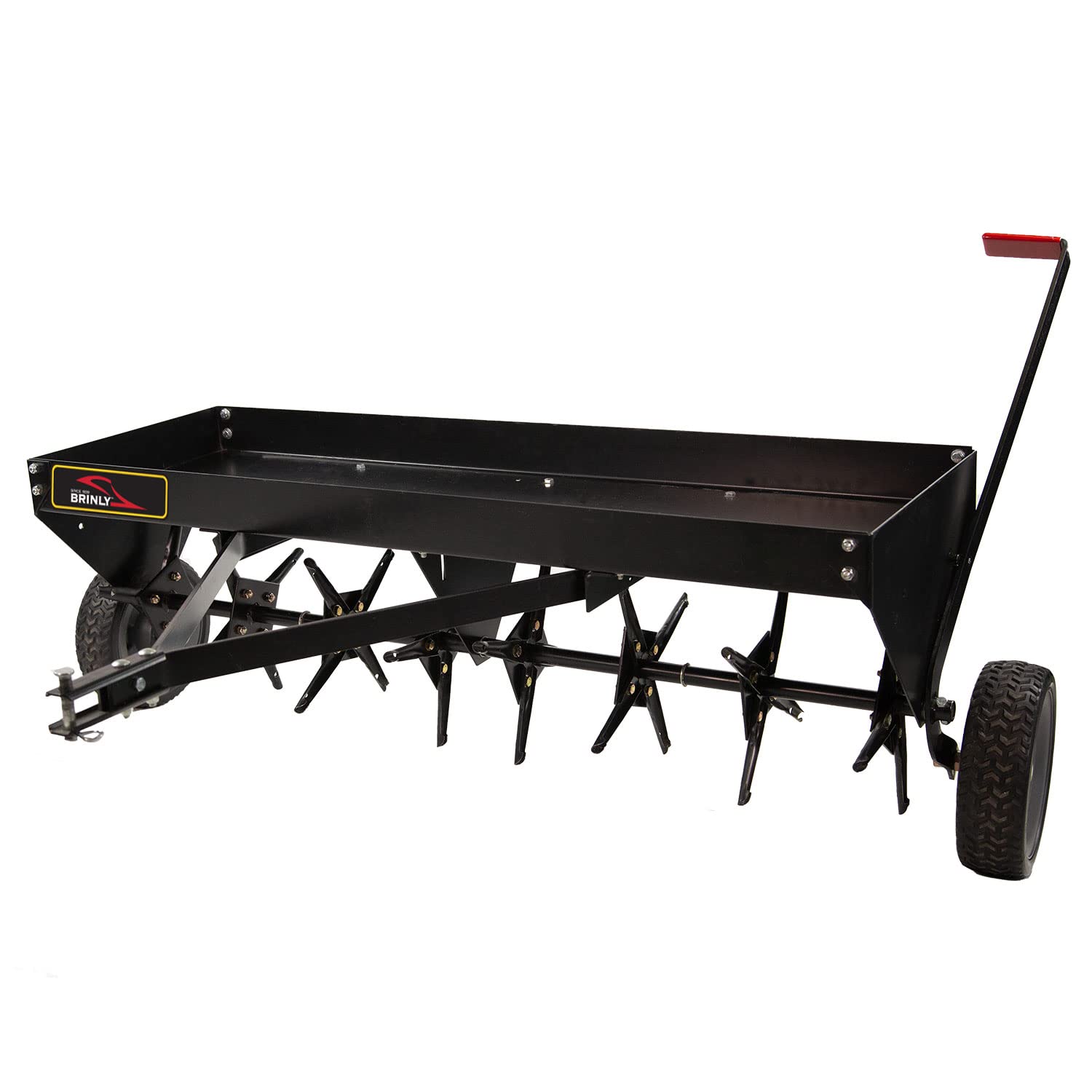
The Brinly PA-482BH-A2 is built around 32 heat-treated, 16-gauge steel plugging spoons that are narrower and sharper than standard designs, which reduces the amount of ballast required to achieve full three-inch penetration. The fully enclosed weight tray can hold up to 200 pounds of cinder blocks or sand tubes, giving you the leverage needed to punch through hard-packed clay without flexing the frame.
Four independently rotating welded tine sections track across uneven terrain without gouging during turns, and the single-lever transport mode engages 10-inch semi-pneumatic tires for crossing driveways without dragging the spoons. Owners report assembly taking around one to two hours with a socket set, and the universal hitch pin fits most lawn tractors and ZTR mowers without adapters.
The trade-off is that the transport lever and handle require some force to engage, and the wheel bracket has been noted to bend if you back up without lifting the tines. On damp soil, six cinder blocks produce consistent cores, and the cost is roughly a tenth of what a three-point hitch unit would run — making this a legitimate premium pick for anyone serious about annual aeration.
Why it’s great
- Narrow, sharpened spoons penetrate tough soil with less weight
- 200-lb weight tray handles standard cinder blocks easily
- Four independent tine sections minimize turf damage on turns
Good to know
- Transport lever requires significant effort to move
- Wheel bracket can bend if backing up without lifting tines
2. Brinly AS2-40BH-P Combination Aerator Spreader

The Brinly AS2-40BH-P merges a spike aerator with a drop spreader, allowing you to perforate the soil and drop seed or fertilizer in a single pass. The 100-pound all-steel hopper resists twisting and flexing far better than polypropylene units, and the calibrated flow control includes an adjustable stop for precise spread patterns that minimize waste.
The eight-inch diameter steel stars feature Patent-Pending 3-D tines with 132 total tips that perforate up to two inches deep, providing enough soil access for seed-to-soil contact without the drag of a full plugging unit. The included rigid weight tray holds up to 75 pounds of ballast for harder terrain, and the 10-inch pneumatic transport wheels engage via a single lever to cross pavement without scraping the tines.
Some owners report that the top adjustment lever moves too freely, requiring hand contact during operation to maintain consistent flow, and the hardware can be prone to snapping if overtightened. Still, the 30-minute assembly time and genuine 2-in-1 capability make this the most efficient option for anyone who wants to seed and aerate without dedicating separate weekends to each task.
Why it’s great
- Drop spreader and spike aerator in one machine cuts labor in half
- All-steel hopper resists flexing better than plastic alternatives
- Pneumatic transport wheels make pavement crossing effortless
Good to know
- Flow adjustment lever can drift during operation
- Hardware may snap if bolts are overtightened
3. Agri-Fab 45-0299 48-Inch Tow Behind Plug Aerator

Agri-Fab’s 48-inch aerator uses 32 galvanized self-sharpening knives that pull plugs up to three inches deep, making it one of the widest consumer-grade pluggers on the market. The cantilever transport handle lets you raise and lower the tine bank from the tractor seat without dismounting, and the flat-free tires eliminate the risk of a puncture mid-job.
The weight tray supports up to 175 pounds of ballast — enough to drive the knives into dry, compacted soil where lighter units would bounce. Owners consistently note that the heavy-duty steel frame and thick side plates resist bending even when dragging over roots, and the universal hitch fits most lawn tractors without modification.
Assembly is the biggest hurdle: the instructions are confusing, stamped parts may have sharp burrs that require deburring before handling, and the unit is nearly useless without added weight — four bags of tube sand are the minimum for decent penetration. The 48-inch width also means it cannot fit through a standard 48-inch gate, so factor in storage and access before buying.
Why it’s great
- 48-inch coverage cuts large lawns in fewer passes
- Self-sharpening knives maintain cutting edge over time
- Cantilever lift handle is convenient from the tractor seat
Good to know
- Sharp burrs on stamped parts require sanding before assembly
- Useless without 100+ lbs of added weight on hard soil
4. Agri-Fab 45-05431 Tow Behind Spiker Seeder

This Agri-Fab unit combines a drop spreader with a spike aerator, offering a 100-pound polypropylene hopper and eight galvanized steel spike disks that penetrate the soil to improve seed-to-soil contact. The 32-inch working width covers up to 17,500 square feet per fill, making it a solid choice for mid-sized lawns that need a single-pass seeding solution.
The adjustable steel lift handle allows precise height control, and the 10-inch flat-free tires roll smoothly across the turf without leaving ruts. The galvanized steel agitator inside the hopper keeps seed flowing consistently, and the poly body won’t rust even when left with residual fertilizer inside.
The biggest complaint is the assembly experience — all parts arrive in a single unlabeled bag with unclear instructions that can take two people and several hours to sort out. Only one star wheel drives the shaft, which can cause inconsistent spread patterns when the unit bounces over uneven ground. Owners recommend adding weights to the top frame for better spike penetration in compacted soil.
Why it’s great
- Large hopper capacity reduces mid-job refills
- Flat-free tires eliminate puncture maintenance
- Rust-proof poly construction for longevity
Good to know
- Assembly is time-consuming with poorly organized parts
- Single drive wheel can cause uneven seed distribution on bumps
5. Craftsman CMXGZBF7124213 40-Inch Tow Plug Aerator

The Craftsman 40-inch plug aerator is built by Agri-Fab in Sullivan, Illinois, and carries a three-year limited warranty that underscores its build quality. Twenty-four galvanized steel coring points pull plugs up to three inches deep, and the wide weight tray accepts up to 140 pounds of ballast — enough to handle medium-hard clay in most residential lawns.
The lift-handle release system allows easier transport and the unit stores vertically against a wall to save garage space, a thoughtful design touch that many competitors overlook. Flat-free tires provide reliable maneuverability, and the reinforced side plates and solid steel axle resist flexing under load. Owners report assembly takes roughly two hours with clear instructions, and the unit tows smoothly behind standard lawn tractors.
The main limitation is the 24-point configuration, which produces fewer holes per pass compared to the 32-point units above. For a one-acre lawn, you will need more passes to achieve the same hole density. Some owners also note that the coring knives arrive uninstalled — a safety choice — but the final assembly step is straightforward.
Why it’s great
- Three-year warranty provides long-term peace of mind
- Vertical storage design saves garage floor space
- Flat-free tires eliminate flat-tire downtime
Good to know
- 24 tines require more passes for dense hole coverage
- Assembly involves handling sharp uninstalled knives
6. Suchtale 40-Inch Tow Behind Plug Aerator (LTA-005A)

The Suchtale 40-inch plug aerator offers a cost-effective entry point for homeowners who want real plug aeration without spending at the premium tier. It uses 24 heat-treated plugs that penetrate compacted soil up to two inches deep, and the all-steel weight tray can hold up to 125 pounds of cinder blocks for added penetration.
The two-piece steel draw bar with a universal hitch pin connects to most lawn tractors and ATVs, and the transport handle allows you to raise and lower the plug bank for crossing driveways. The 6 mm thick adjust handle is thicker than the common 4 mm found on budget units, reducing the risk of bending under load. Owners describe the assembly as manageable in one to two hours, with hardware that is bagged and labeled clearly.
The 48-inch total width (including wheels) means it will not fit through a standard 48-inch gate without disassembly, and some units have reported minor wheel alignment issues that require adding washers to reduce play. On sandy loam or topsoil, a few bricks in the tray produce excellent plugs, but hard clay will require the full 125-pound capacity to avoid skipping.
Why it’s great
- Thicker 6 mm handle resists bending better than budget alternatives
- Bagged and labeled hardware simplifies assembly
- Compact upright storage saves garage space
Good to know
- 48-inch wheel width won’t fit through a standard gate
- Minor wheel play may need washer shims to correct
7. Suchtale Upgrade 40-Inch Tow Behind Spiker Seeder (B0F4XNZD38)
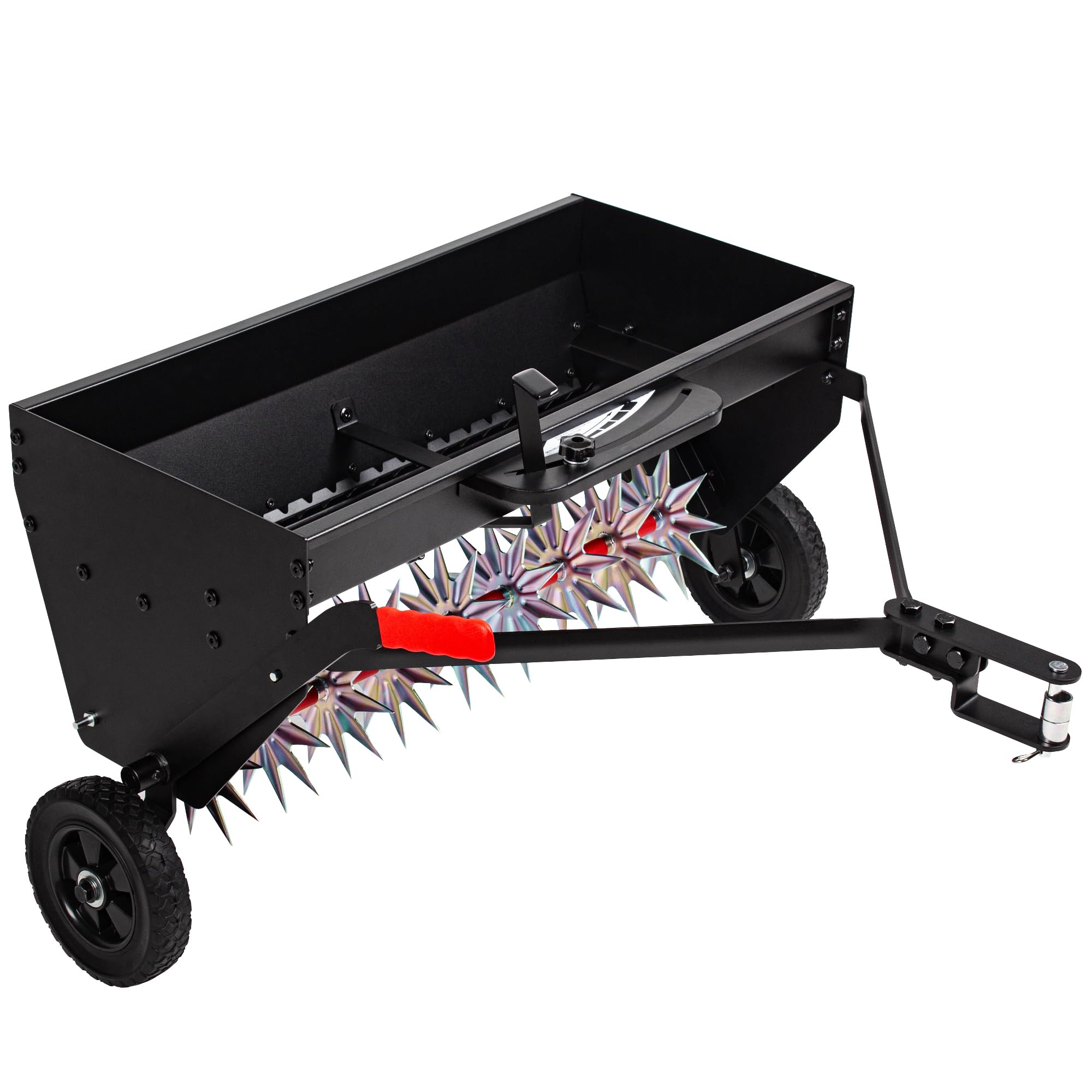
This Suchtale combination unit pairs a broadcast spreader with a spike aerator, featuring nine three-dimensional star-shaped tines that each carry ten curved spikes for 90 total penetration points. The high-quality steel agitator stirs seed and fertilizer continuously to prevent clumping, and the flow control plate includes an infinitely adjustable stop for precise spreading across the 32-inch working width.
The all-steel hopper holds over 100 pounds without twisting or flexing, and the tines rotate independently to maintain consistent depth on uneven ground. The upgraded parts kit separates screws and bolts by size for faster assembly, and the corrosion-resistant finish helps the unit survive multiple seasons of outdoor storage.
Assembly remains the biggest friction point — owners report two to three hours of labor, and some have had to enlarge bolt holes with a drill to get parts aligned. The chain that drives the spreader mechanism can fall off when hitting bumps, though the aerator function works independently of the chain. The spreader adjustment travel is also reported as insufficient to fully shut off the seed flow in some units, requiring a manual workaround.
Why it’s great
- 90 total spike points provide excellent soil perforation
- Steel hopper resists flexing under heavy loads
- Independent rotating tines track uneven terrain well
Good to know
- Assembly can require drilling to enlarge misaligned holes
- Spreader chain may disengage on rough ground
8. LawnVigor Rolling Core Aerator (LV-RLA-Orange)
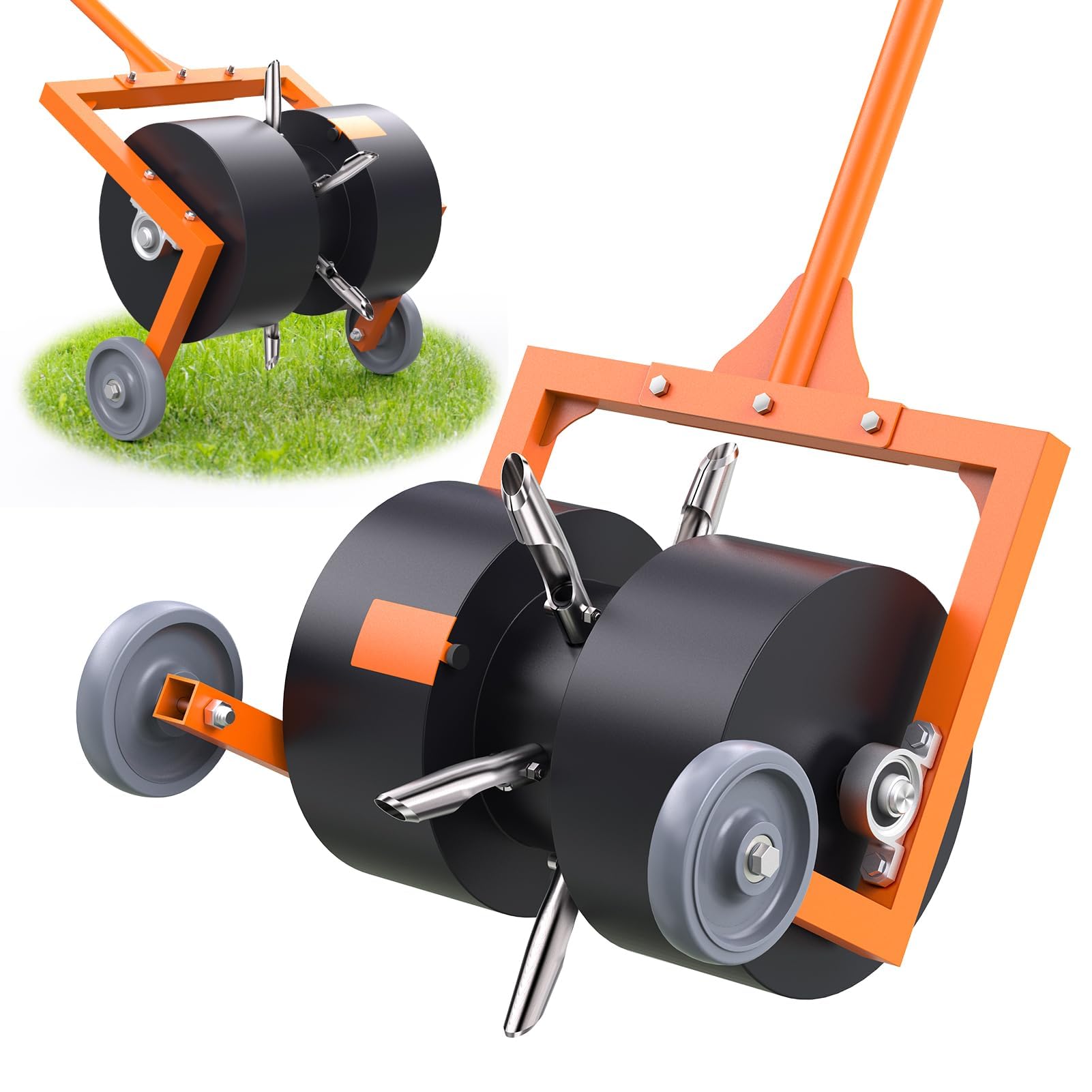
The LawnVigor rolling core aerator is a manual push unit that uses six non-clogging hollow tines to extract soil plugs, making it ideal for small to medium lawns where a tow-behind machine is overkill. The drum can be filled with dry sand using the included funnel to add weight for deeper penetration, and the integrated transport wheels allow you to roll the unit across pavement without dragging the tines.
The powder-coated steel frame resists rust and the replaceable hollow tines are designed to pull clean plugs rather than just poking holes. Without added sand, the unit is light enough to maneuver easily but may not penetrate compacted soil. Owners report that with proper sand filling, the aerator pulls two- to three-inch plugs effectively on moist ground.
The tines are attached to the drum with a hollow nub that can shear off under angled stress if you hit tough soil or roots — three of six tines breaking within 45 minutes is a common failure pattern reported on hard ground. The connection point between the tine and the drum appears to be the weak link, so this unit works best on loamy soil that has been watered the day before.
Why it’s great
- Non-clogging hollow tines pull real plugs
- Transport wheels protect tines on pavement
- Funnel included for easy sand filling
Good to know
- Tine attachment nubs can shear off in tough soil
- Requires pre-watering for effective core depth
9. AVVA Vision Rolling Lawn Coring Aerator (KD-0003)
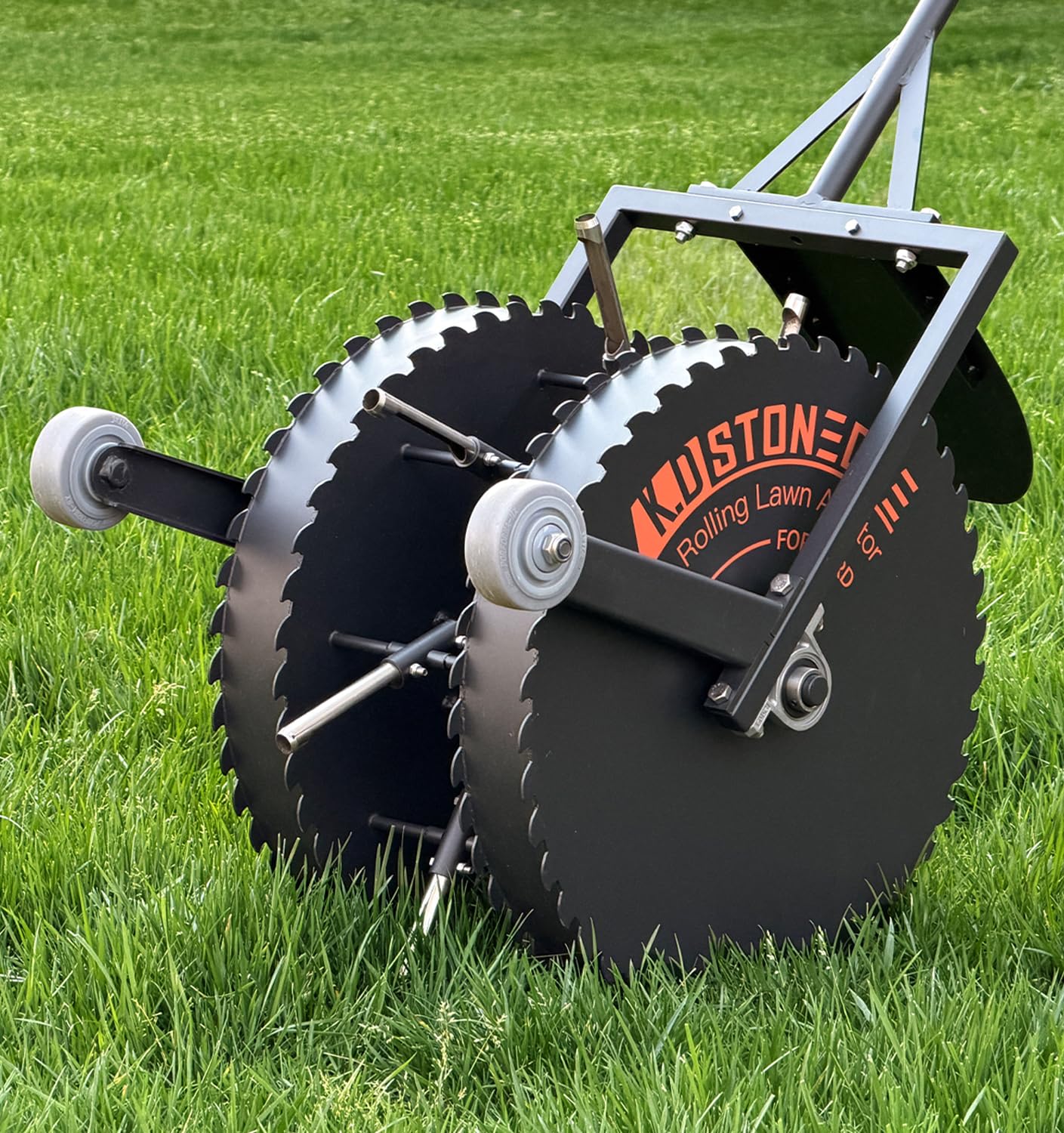
This manually pushed rolling aerator from AVVA Vision uses hollow tines to extract soil plugs up to three inches deep, providing genuine coring action without a tow vehicle. The rolling mechanism reduces the effort needed compared to stand-on aerators, and the drum can be filled with sand via small fill holes to add the weight necessary for deep penetration.
Owners praise the value proposition: at roughly the cost of two rental sessions, this unit pays for itself quickly for anyone with a quarter-acre or smaller lot. The tines do not clog even in moist soil, and the 38.9-pound empty weight becomes roughly 80 pounds when filled with 40 pounds of sand — substantial enough for decent cores on all but the hardest clay.
The biggest downsides are the awkward sand-filling process and the weak axle attachment. The fill holes are positioned at an angle that makes pouring sand difficult without a funnel, and the allen screws that secure the wheels can loosen during use. A single row of tines means you will need multiple overlapping passes for full coverage, and turning the unit on concrete requires lifting it to avoid damaging the tines.
Why it’s great
- Pays for itself after two uses compared to rental fees
- Hollow tines pull real plugs without clogging
- Good coring depth on moist, loamy soil
Good to know
- Sand filling is awkward and requires a separate funnel
- Wheel axle attachment screws can loosen during operation
FAQ
How deep should the plugs be for effective overseeding?
Can I use a spike aerator for seeding, or do I need a plug aerator?
How much weight do I need to add for clay soil?
Will a tow-behind aerator fit through a standard yard gate?
Final Thoughts: The Verdict
For most users, the aerator and seeder winner is the Brinly PA-482BH-A2 because its 32 sharpened spoons and 200-pound weight tray deliver consistent three-inch plugs in the toughest clay without breaking the bank. If you want to seed and aerate in a single pass, grab the Brinly AS2-40BH-P combo. And for small lawns where a tractor isn’t available, nothing beats the LawnVigor rolling core aerator for manual plug pulling at a fraction of rental cost.