
Nothing kills the joy of cutting the cord like losing a stable signal every time the wind shifts or a cloud rolls in. The real fix isn’t a bigger antenna or a higher amplifier—it’s the ability to physically aim your aerial at the exact broadcast tower you need in real time. A quality rotator is the only way to lock in every channel in your area without descending into a routine of manual tweaks and frustration.
I’m Min — the co-founder and writer behind Gadgets Feed. I’ve spent countless hours analyzing the technical specs and long-term reliability data of antenna rotators, mounting hardware, and signal optimization gear to deliver a guide grounded in real-world performance metrics and user-reported durability.
Whether you are dealing with dense tree coverage, distant towers, or multiple broadcast directions, this guide breaks down everything you need to find the right best aerial antenna rotator solution for your specific signal environment.
How To Choose The Best Aerial Antenna Rotator
Choosing the correct rotator setup is less about wattage and more about physical geometry and mechanical reliability. The three pillars are rotation mechanism quality, mast compatibility, and the structural integrity of the mounting base. Ignore any of these and you will be back on the roof before the next storm season.
Motor Reliability and Rotation Mechanism
The motor is the heart of any rotator. Look for a unit that uses a geared DC motor housed in a weather-sealed enclosure. Plastic gears are common in entry-level units and tend to strip under wind load; metal or reinforced nylon gearing is preferable for any installation above 10 feet. The remote control range and responsiveness also matter—an infrared remote with a line-of-sight range under 10 feet severely limits your placement options.
Mast Diameter and Material Gauge
The mast is the unsung hero of signal stability. A 2-inch outside diameter mast made from 18-gauge or 16-gauge galvanized steel is the baseline for any serious outdoor installation. Thinner masts flex in sustained winds above 40 mph, causing micro-movements that degrade signal quality. Heavier gauge steel adds only incremental cost but dramatically improves long-term alignment stability.
Mounting Base and Roof Integration
A tripod base must have adjustable feet to accommodate roof pitch. Fixed 90-degree brackets will force you to bend them in a vise or accept a wobbly mount. Look for bases with multiple mounting holes per leg—at least six—so you can secure the tripod to rafters rather than just sheathing. This is the difference between surviving a storm and watching your antenna tumble.
Quick Comparison
On smaller screens, swipe sideways to see the full table.
| Model | Category | Best For | Key Spec | Amazon |
|---|---|---|---|---|
| Easy-Up 33′ Telescoping Mast | Telescoping Mast | Maximum height and wind survivability | 33 ft height, 18-gauge steel sections | Amazon |
| Diamond Antenna D3000N Super Discone | Wideband Discone | Ham radio and multi-band reception | 50 Ohm impedance, 33 inch length | Amazon |
| Skywalker 5′ Heavy Duty Tripod | Roof Tripod Base | Starlink and heavy antenna mounting | 5 ft height, accommodates 2″ mast | Amazon |
| Five Star Outdoor Antenna (360° Rotator) | Motorized Yagi | Long-range HDTV with remote rotation | 200 mile range, 360° motorized rotation | Amazon |
| Five Star Digital Amplified HDTV Antenna | Motorized Yagi | Multi-room TV distribution | 200 mile range, supports 5 TVs | Amazon |
| Skywalker Heavy Duty Tripod Base | Roof Tripod Base | Budget-friendly solid mounting | 28″ mast included, 10.5 lbs weight | Amazon |
| Volteck ANGI-360 Rotating Antenna | Motorized Yagi | Entry-level 360° TV reception | 20.7 kg weight, 82 channels | Amazon |
In‑Depth Reviews
1. Easy-Up 33′ Telescoping Mast
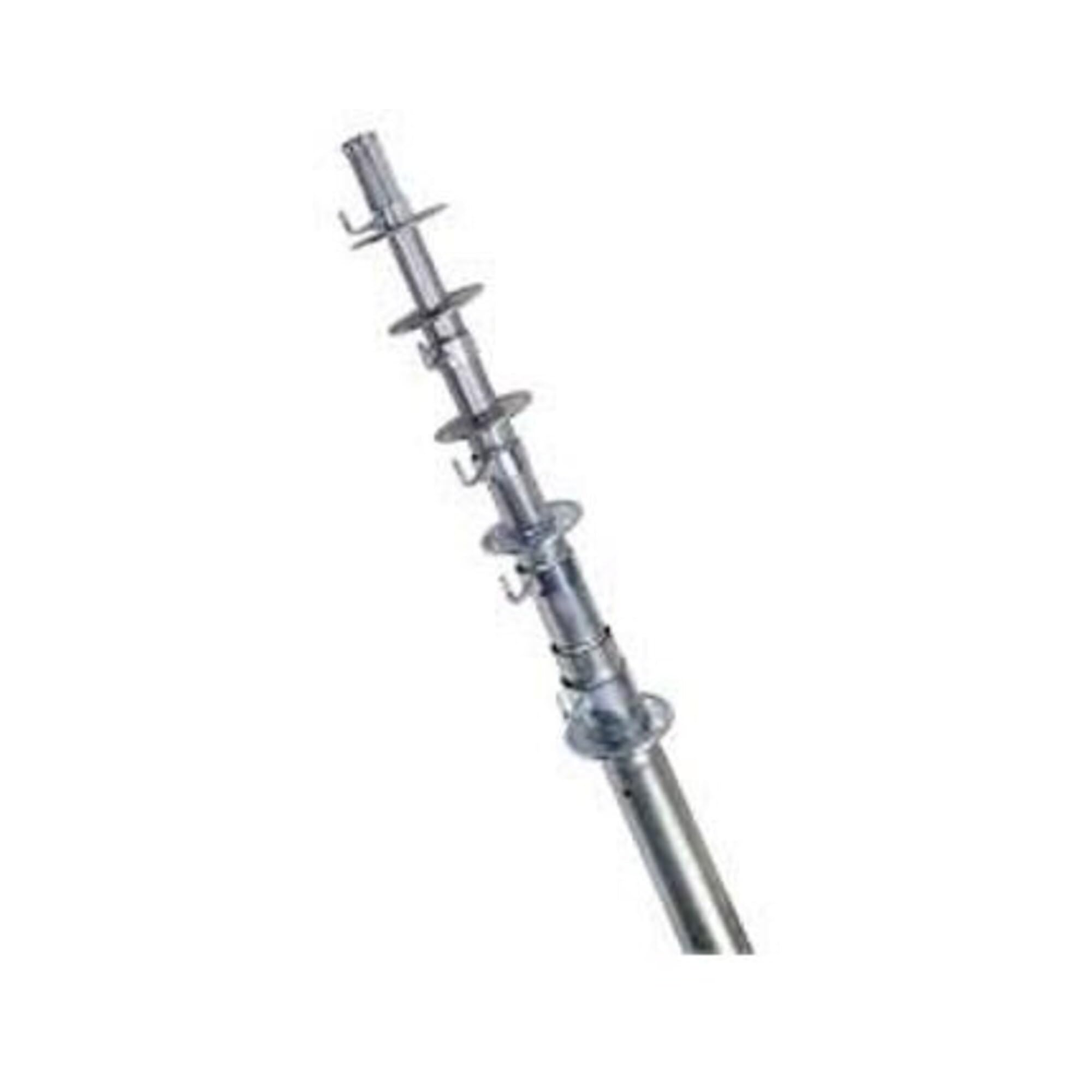
The Easy-Up 33′ mast is not a rotator in the traditional sense—it is the structural backbone that makes every rotator work better. Each section is 18-gauge galvanized steel tapering from 2-1/4 inches at the bottom to 1-1/4 inches at the top, and the rotating guy rings allow you to tension the mast without twisting your antenna feed line. At 45 pounds assembled, this is the kind of mast that stays planted when your rotator is doing its job in high wind.
A critical detail is the thumbscrew and collar system that lets you set the mast height without tools. The bottom section is 74 inches, and each subsequent section extends progressively longer, reaching the full 33 feet. This design makes it possible to clear roof lines and tree canopies that would otherwise block line-of-sight to distant towers. The 2-inch largest diameter also means compatibility with most tripod bases that accept masts up to 2 inches O.D.
For anyone who has watched a lighter mast wobble in a 40 mph gust, this is the solution. The mast has survived 99+ mph winds at 85 percent extension in documented installations. It requires professional-level anchoring—guy wires or a concrete base—but for permanent installations where signal height is the limiting factor, this is the definitive choice.
Why it’s great
- Five-section telescoping design reaches 33 ft for maximum tower clearance
- Heavy-duty thumbscrew and collar system allows tool-free height adjustment
- Proven wind survivability above 99 mph in real field installations
Good to know
- Requires guy wires or bracketing—not a free-standing mast
- Installation should be handled by an experienced professional
- Cotter pins are recommended for lower sections over thumb screws for heavier loads
2. Diamond Antenna D3000N Super Discone
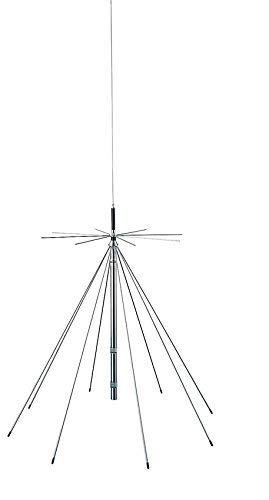
The Diamond D3000N is not a motorized rotator either, but it is the antenna that serious amateur radio operators pair with rotators for multi-band scanning. Its super discone design covers everything from CB frequencies up through 23 cm amateur bands, all with a 50-ohm impedance that mates directly to standard coax and rotator feed-throughs. The corrosion-resistant construction is built to survive coastal and high-humidity environments where lesser antennas would develop surface rust within a season.
What sets this antenna apart is the radial configuration and the mechanical build quality. The discone elements are thick enough that they do not resonate in the wind, which means less noise entering your receiver. The included mounting hardware works with standard 1.5-inch to 2-inch masts, making it a drop-in match for any rotator system that uses those diameters. Users report excellent reception on 6 meters, 2 meters, 70 centimeters, 33 centimeters, and 23 centimeters when paired with a quality rotator.
The reported issue of missing radials on delivery is an anomaly that Diamond resolves quickly with replacement parts. For ham radio operators who want a single antenna that covers virtually every band they monitor, this discone eliminates the need for a multi-antenna array, simplifying the rotator setup to a single unit.
Why it’s great
- Covers CB, amateur, scanner, and emergency communication bands in one antenna
- All-weather corrosion-resistant construction for long outdoor life
- Easy compatibility with standard rotator masts and 50-ohm feed lines
Good to know
- Some units have shipped with missing radials; verify upon arrival
- Not a motorized unit—requires a separate rotator for directional use
- Impressive reception performance is limited to receive for some bands
3. Skywalker 5′ Heavy Duty Antenna Tripod

The Skywalker 5′ tripod is the mount you pair with a rotator when you want to never think about it again. The legs are double-braced galvanized steel, spaced 36 inches apart at the base, which gives you a wide footprint that resists torsional forces from a rotating antenna. The top plate accepts masts up to 2 inches outside diameter, which covers nearly every standard mast on the market, including the Easy-Up telescoping mast.
Real-world installations have used this tripod with Starlink dishes, 17-foot vertical ham antennas, and large multi-element TV antennas. In one documented case, a 19-20 ft fiberglass vertical antenna on a 10 ft mast survived 55 mph winds with the tripod completely unaffected—the antenna itself bent but the mount held. The legs are pre-drilled with multiple holes so you can anchor into roof rafters rather than just decking, which is the difference between a mount that shifts and one that stays locked.
The aluminum rivets used at the hinge points are the only weak link. Users consistently recommend replacing them with 1/4-inch Grade 5 bolts for installations that will face sustained wind loads. Once that modification is made, this tripod becomes one of the most reliable roof mounts available at its price point.
Why it’s great
- Double-braced steel legs with 36-inch spacing for maximum torsional stability
- Accepts masts up to 2 inches O.D. for broad compatibility
- Proven wind survivability at 55 mph with heavy antenna loads
Good to know
- Aluminum rivets at hinge points should be replaced with bolts for long-term durability
- Pitch pads and lag bolts are not included—must be purchased separately
- Legs are not spaced on standard 24-inch rafter centers without modification
4. Five Star Outdoor HD TV Antenna (360° Rotator)
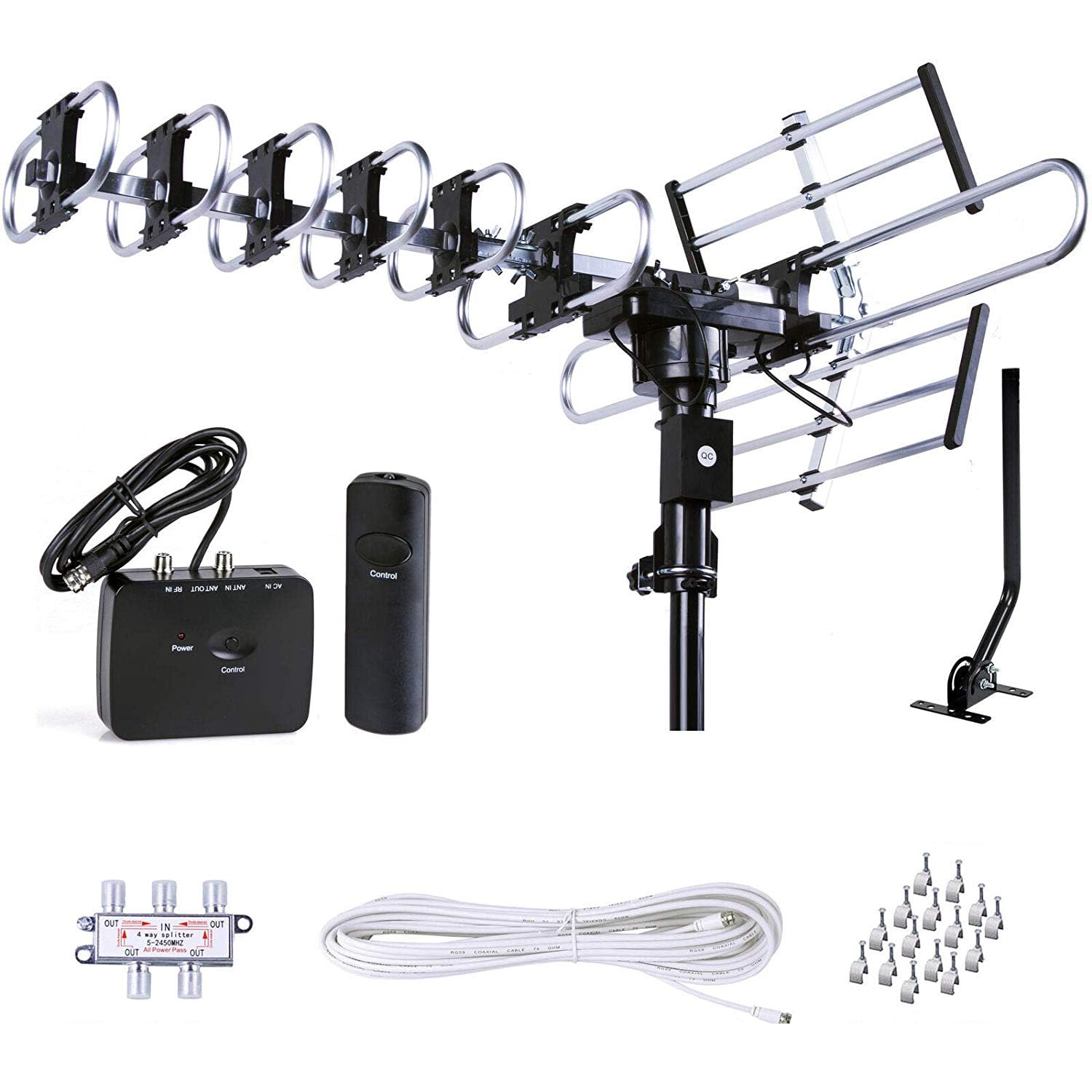
The Five Star FSA-3806-J is the best execution of a motorized rotator antenna in this tier because it integrates the rotation mechanism directly into the antenna assembly rather than requiring a separate rotator motor. The 360-degree rotation is controlled via an infrared remote, and the built-in auto gain control chip adjusts the signal amplification between 15 and 35 db depending on incoming signal strength. This is the kind of adaptive design that saves you from over-amplifying strong local channels while still pulling in distant stations.
The antenna architecture uses six reflector elements for UHF, which yields roughly 25 percent better image quality than the four-element designs common at this price. The VHF elements are 50 percent larger than standard, addressing the common pain point of weak VHF reception in areas with terrain interference. The included installation kit has 40 feet of RG6 coax, a 4-way splitter, cable clips, and a J-pole mount—everything you need for a single-roof run to a TV distribution panel.
Durability is the main concern here. The plastic housing and support arm bracket feel less substantial than the metal-heavy designs. Some users report the control box failing after a few weeks, and the coax cable may not deliver enough power to the rotator motor over longer runs. If you can test the rotator function immediately and have a backup plan for adjustment, this antenna delivers excellent reception value for suburban and exurban environments.
Why it’s great
- Integrated 360° motorized rotation with infrared remote control
- Six UHF reflector elements for 25% better image quality over four-element designs
- Complete installation kit included with 40 ft RG6 coax, splitter, clips, and J-pole
Good to know
- Plastic housing and support bracket may not survive long-term UV exposure
- Control box failure reported in some units shortly after installation
- Rotator power delivery may be insufficient with the included 40 ft coax run
5. Five Star Digital Amplified HDTV Antenna (360° Rotator)
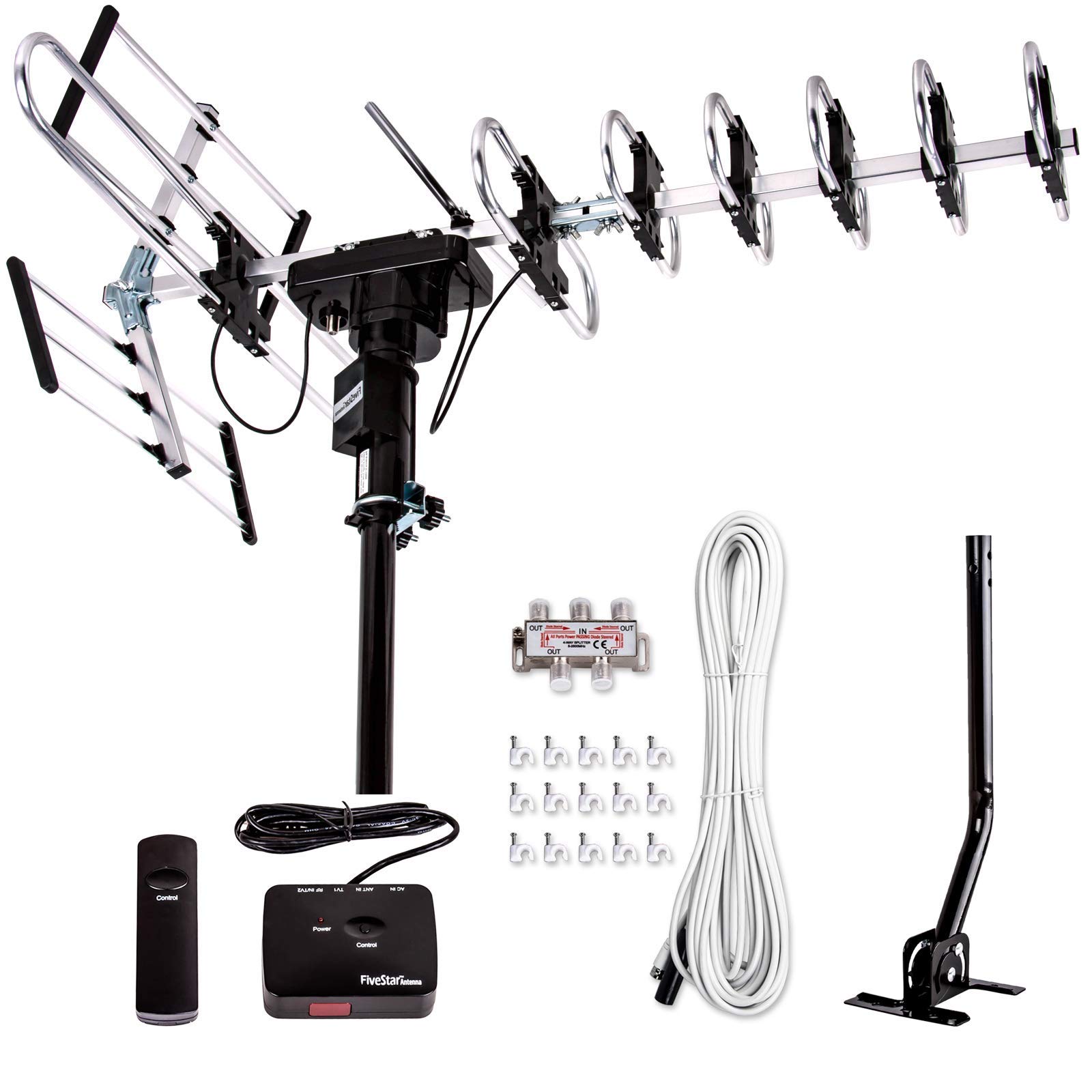
The second Five Star model in this lineup splits the difference between the entry-level rotator and a full multi-room distribution system. The 360-degree rotation mechanism is identical to the FSA-3806-J, but this version includes a 4-way splitter and supports up to five televisions simultaneously. The antenna uses six reflector elements and larger VHF components to improve weak-signal reception, and the auto gain control chip works across the 15-35 db range to balance strong and weak channels.
Where this model differs from its sibling is the inclusion of a dedicated mounting pole (J-pole) and the specific coax routing needed to support five TV outputs. The 40-foot RG6 cable is pre-terminated, and the splitter is a standard 4-way unit. This is a turnkey solution for households that want one roof antenna feeding every room without additional signal distribution hardware. Users report that the rotator function can be jerky and lacks a direction indicator, making fine-tuning more guesswork than precision.
The construction quality mirrors the other Five Star model: lightweight aluminum elements and plastic brackets that feel less durable than the tripod-and-mast solutions. The motor has been reported as dead on arrival in some units, and the remote control often requires near line-of-sight to function. If you are willing to gamble on QC and prefer the all-in-one convenience, this antenna is a functional choice for suburban installations where the rotator sees occasional use rather than constant adjustments.
Why it’s great
- Supports up to five TVs simultaneously with included 4-way splitter
- Six UHF reflector elements and larger VHF elements for improved weak-signal capture
- All-in-one kit includes antenna, rotator, coax, splitter, clips, and J-pole
Good to know
- Rotator motor can be jerky and lacks a direction indicator for precise aiming
- Motor failure reported in some units on delivery
- Lightweight aluminum elements and plastic feel less durable than metal tripod setups
6. Skywalker Heavy Duty Tripod Base (28″ Mast)

This Skywalker tripod is the budget entry point for anyone who wants a secure roof mount without the complexity of a full rotator system. The 3-foot closed length expands to a 7.5-foot leg span, and the included 28-inch mast is a 1.66-inch O.D. unit that supports antennas and satellite dishes up to roughly 10 pounds. The tripod legs have multiple mounting holes, allowing you to anchor into rafters rather than just decking for better wind resistance.
The 90-degree bracket design is the main limitation—users report needing to bend the feet in a bench vise to match non-flat roof pitches. For flat roofs or deck installations, the tripod works without modification. The included bolts are 5/16-inch Grade 5 hardware, which is adequate for antennas up to 17 feet tall when properly secured. One user reported that a 17-foot vertical antenna on a 10-foot mast survived 55 mph winds with the tripod unaffected—the antenna bent but the mount held.
This is not a rotator system itself; it is the mounting platform you pair with a separate rotator unit or a manually adjustable antenna. For the price, it offers the best structural foundation for a budget antenna setup that needs a permanent home on the roof. The weight of 10.5 pounds makes it manageable for a single installer, and the silver galvanized finish resists rust in coastal environments.
Why it’s great
- Includes both the tripod base and a 28-inch mast for immediate installation
- Multiple mounting holes per leg for secure rafter anchoring
- Proven wind survivability at 55 mph with moderate antenna loads
Good to know
- 90-degree bracket feet must be custom bent for non-flat roof pitches
- Not a motorized rotator—requires separate rotator unit
- Maximum mast compatibility is 2 inches O.D., limiting larger mast options
7. Volteck ANGI-360 Rotating Antenna

The Volteck ANGI-360 is the entry-level option for those who want a motorized rotator antenna at the lowest possible cost. The unit delivers 360-degree rotation via remote control, and users report receiving up to 60 channels in favorable locations. The built-in signal amplifier has a toggle switch that lets you compare amplified versus non-amplified reception, which is a useful diagnostic feature for troubleshooting signal issues.
The construction is where this antenna shows its price point. The materials are lightweight and feel fragile during assembly—the instruction manual is sparse and largely pictorial, leading to confusion during setup. The infrared remote has a range of less than one meter, meaning you must be standing directly in front of the control box to change the antenna direction. The coaxial cable is a fixed length, limiting placement options for the decoder unit.
Durability is mixed. The motor has proven to be reliable through three months of outdoor exposure including rain and wind, but the antenna elements bend easily during handling. The decoder unit has two TV outputs, but some units ship with a loose coaxial connector that can degrade signal quality. If you need a rotator for occasional fine-tuning and have a line-of-sight installation, the ANGI-360 works—but the limitations in remote range and build quality make it a starter unit rather than a permanent solution.
Why it’s great
- Motorized 360° rotation at the lowest entry cost
- Built-in signal amplifier with on/off toggle for signal comparison
- Two TV outputs from the decoder unit for dual-room distribution
Good to know
- Remote control range is less than one meter, requiring proximity to the decoder
- Parts are fragile and assembly instructions lack detail
- Fixed-length coax cable limits placement flexibility of the decoder
FAQ
Can I use a motorized rotator with any antenna?
How much wind can a telescoping mast survive?
Do I need a rotator for TV reception in a major city?
Final Thoughts: The Verdict
For most users, the best aerial antenna rotator winner is the Five Star Outdoor HD TV Antenna (FSA-3806-J) because it combines a 360-degree motorized rotator with a capable antenna in one package, making it the most practical turnkey solution for cutting the cord without constant manual aiming. If you want maximum height and wind survivability, grab the Easy-Up 33′ Telescoping Mast. And for ham radio operators who need wideband multi-frequency reception, nothing beats the Diamond Antenna D3000N Super Discone paired with a separate heavy-duty rotator.