
Our readers keep the lights on and my morning glass full of iced black tea. As an Amazon Associate, I earn from qualifying purchases.
Specs are compiled from manufacturer listings and verified buyer reviews and can change over time — please confirm the key details on the product page before buying.
Slapping on a set of clip-on aero bars can shave noticeable time off a flat stretch, but the wrong pair leaves you fighting a wobbly armrest or a snapped bracket at 25 miles per hour (mph). The real trick is picking the one that locks onto your handlebars without compromise, adjusts to your torso length, and survives the season without a single bolt backing out.
I’m Min — the founder and writer behind Gadgets Feed. This guide is built by comparing the manufacturers’ published specifications and the patterns across verified customer reviews, so you get each pick’s real strengths and trade-offs instead of marketing spin.
If you are training for your first triathlon or just want a more aerodynamic tuck on weekend group rides, this roundup of the best aero bars for road bike setups will help you find a fit that actually stays put and feels right on a long day in the saddle.
Our Picks at a Glance

How To Choose The Best Aero Bars For Road Bike
Clip-on aero bars bolt to your existing handlebars, letting you slide into a tucked position without buying a whole new cockpit. But the features that make one pair a joy and another a headache come down to three things: how they mount, how they fit, and what they are made of.
Handlebar Diameter and Clamp Design
Most road bikes use a 31.8mm handlebar clamp area, but some older or compact bars measure 26.0mm. Check your bar diameter before ordering — most aero bars ship with a 31.8mm clamp and need a separate shim kit (a small adapter) for 26.0mm bars. A quick-release clamp lets you pop the bars off for climbs and reattach them without tools, while a fixed clamp is simpler and usually lighter.
Extension Length and Armrest Adjustability
Shorter extensions (around 230mm) suit tighter torso positions, while longer ones (up to 270mm) give you room to stretch out. Armrests that move fore-aft (forward and backward) and side-to-side let you dial in elbow width and reach, which is critical for avoiding neck strain on a 50-mile time trial. If you are tall (over 6 feet), look for bars that explicitly allow width and riser adjustments.
Material and Weight
Aluminum is the standard for clip-on bars — it keeps the price reasonable and the structure stiff enough to handle your weight without flexing. Weight can range from about 450g (light and racy) up to 2 pounds (heavier but often more adjustable). The trade-off is straightforward: more aluminum in the clamp and armrest brackets usually means better durability at the cost of a few extra ounces.
Quick Comparison
| Model | Best For | Weight | Extension Range | Handlebar Clamp | Amazon |
|---|---|---|---|---|---|
| Profile Design Legacy II★ Best Overall | Proven reliability | 450g | Adjustable armrests | 31.8mm / 26.0mm w/ shim | $102.89Amazon |
| REDSHIFT Quick-ReleaseAlso Great | On-the-fly switching | 2.02 Pounds | Fixed (choose L or S bend) | 31.8mm / 26.0mm w/ shim | $219.99Amazon |
| Profile Design Airstryke V2 | Raised, comfortable armrests | 1.7 Pounds | Adjustable reach | 31.8mm clip | $169.35$199.00Amazon |
| BBB Cycling AeroComfort | Budget-friendly comfort | 540 Grams | Adjustable length/width | 22.2/25.4/31.8mm | $82.87$88.00Amazon |
| FSA Vision Team Clip-On | Minimalist alloy build | 1.4 Pounds | 230–270mm | 31.8mm | $78.46Amazon |
In‑Depth Reviews
1. Profile Design Legacy II Aerobars
Our pick — over 4★ from 950+ verified ratings; the strongest balance of quality and price.
The proven 450g workhorse that has earned 978 ratings and a 4.3-star average.
The Legacy II has been on the market long enough to stack up nearly a thousand ratings — and the consensus is that it is light, easy to install, and stays put mile after mile. Reviewers point out it is “easy install, light, sturdy, no shifting” after 150 miles on a road bike, and the Venturi-style armrests (shaped to allow multiple hand positions) offer options to reduce fatigue. At 450g it is the lightest bar in this lineup, which matters when you are already counting grams on a race bike. The forged 6061-T6 aluminum construction (a high-strength aluminum alloy) gives it the durability to last two years and still look good, per one owner.
It fits 31.8mm handlebars and adapts to 26.0mm bars with a sold-separate shim kit. The armrests are width-adjustable and rotationally adjustable, letting you fine-tune elbow angle. One common quirk: the included bolts are a bit short — after adjusting, a few owners swapped them with M6 20mm bolts (a standard metric size) for a more secure fit. Another reviewer noted the “pads feel cheap” but said 40-mile comfort is fine for the price. Compared to the BBB Cycling AeroComfort below, which costs less but is “too short and narrow for 6’2″ rider,” the Legacy II offers broader adjustability that fits a wider range of torsos.
The long-haul pick: Proven design, light weight, and solid construction make this the rational choice for anyone who wants aero bars that just work without fuss.
One real trade-off: The armrest pads are basic foam — if you want plush, plan to add gel covers or thicker pads later.
Who it fits: Triathletes and long-distance riders who value low weight, proven durability, and the widest compatibility with handlebar diameters.
Consider something else if: You need a quick-release function or flip-up armrests — the Legacy II uses a fixed clamp.
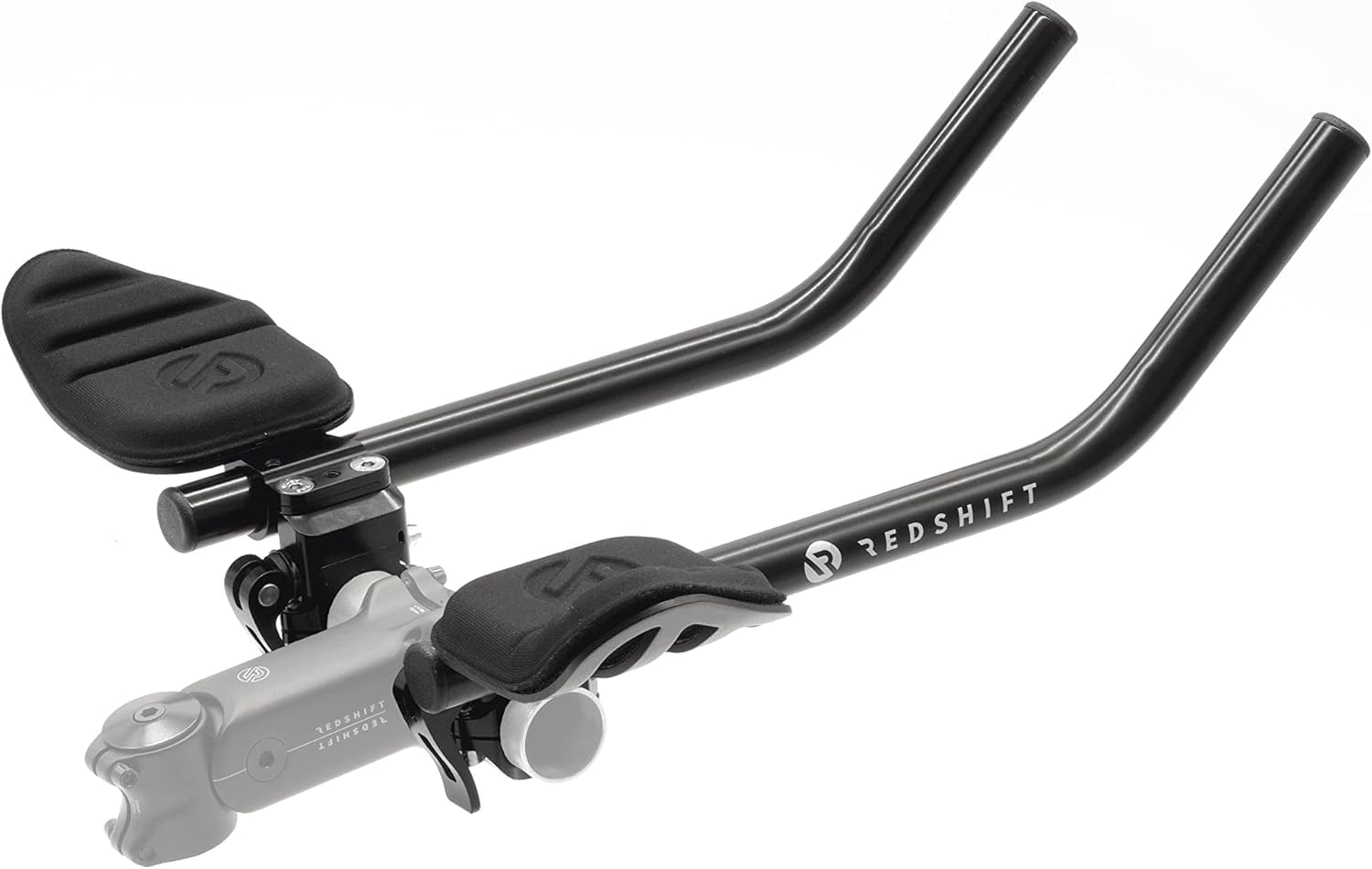
2. REDSHIFT Quick-Release Clip-On Bike Aero Bars
The only aero bar that pops off mid-ride and snaps back to the exact same setup without tools.
The quick-release mechanism is the headline here — you can switch between road and aero positions on-the-fly during your ride, The quick-release mechanism lets you switch between road and aero positions mid-ride without tools.. The aluminum extensions come in L-Bend or S-Bend, and the arm pads offer a wide range of adjustability: extension length, arm pad fore-aft (forward and backward), arm pad width, and height (though the extension riser is sold separately). At 2.02 Pounds, this is the heaviest bar in the lineup, but buyers report it feels “nice and stable, no wobble at all.” Unlike the lighter FSA Vision Team bars below, which weigh only 1.4 Pounds but had a buyer report of a snapped armrest, the Redshift’s beefier clamp and lock rods trade a few ounces for confidence — owners mention the quick release clamps tightly with no creaks or rattles.
It fits 31.8mm handlebars from the start, and a 26.0mm shim (a small adapter — sold separately) makes it work with older bars. One owner mentioned they “added one layer of electrical tape under the clamp to avoid scratching the bars,” an easy precaution. The catch: the price sits at the premium end of the spectrum, and the included pads sit low enough on a road bike that taller riders may want the optional risers to avoid neck strain after long miles.
Why riders love it
- Patented quick-release: attach or remove in seconds with no tools
- Huge adjustability — fore-aft, width, height (with sold-separate riser)
- Stable clamp: no creaks or rattles even on rough pavement
A few compromises
- Heaviest pick here at 2.02 Pounds
- Risers not included at this price point
- Lock rods are anodized aluminum (not stainless steel) — sweat can wear the finish
Reach for this if: you ride varied terrain and want the freedom to ditch aero bars on the fly without losing your setup.
Look elsewhere if: weight is your number-one priority and you never need to remove the bars mid-ride.
3. Profile Design Airstryke V2 Aluminum Clip-on Aerobars

Flip-up armrests that lift your elbows off the bar so you can still reach the drops underneath.
The Airstryke V2 is built around a raised armrest design that creates a higher elbow platform — this means you can slide into an aero tuck without having to remove your hands from the drop bars entirely. The package includes the extension, flip-up brackets, ergo armrests, and 10mm ergo armrest pads. At 1.7 Pounds it sits between the featherlight FSA Vision Team and the heavier Redshift, and customers note it provides “very comfortable pads with ample adjustments.” The one oddity: there is no crossbar for a computer mount; one reviewer taped a PVC pipe to the extensions as a workaround.
The spring-loaded flip-up mechanism addresses a known weak point — the reviewer who has “broken many of the springs, and the hinge body and arms” on older Profile flip-up bars says this V2 “seems to be a more solid design” with higher spring force so the arms don’t rattle in the up position. It takes up a decent amount of space on the handlebar, but buyers riding indoors say they can still “use the front of the drop handlebars still if I feel like it.” For the price, you are paying for a smarter hinge and the raised armrest comfort, but a few owners note the missing crossbar clip is a minor annoyance that requires a DIY fix.
What makes it unique
- Raised flip-up armrests let you use the drops below when not in aero
- V2 hinge is stronger, with less rattle than older Profile flip-up bars
- Comes with 10mm ergo pads and ample fore-aft/height adjustment
Worth noting
- No computer mount crossbar — buyers have to improvise
- One buyer received a unit missing the retaining clip
- Premium price point for an aluminum bar
Best for: riders who want the flexibility of flip-up armrests that stay stowed quietly and still let them grab the drops mid-sprint.
skip it if: you need a built-in computer mount or want the lightest possible extension.
4. BBB Cycling Aero Bars Aluminium Tri Bars AeroComfort BHB-59

A wallet-friendly two-piece aero bar with EVA foam sleeves that curve inward to spare your bar tape.
The AeroComfort BHB-59 takes the sting out of the price by using a two-piece aluminum construction with foam padding (EVA — a soft, cushioning foam material) on the handlebars and foam sleeves around the steerer tubes. The 35mm rise is built into the design, creating a comfortable lift without needing a separate riser kit. Shoppers say the curve toward the stem means you “didn’t have to redo the handlebar tape” — a nice installation shortcut. The clamp fits 22.2mm, 25.4mm, and 31.8mm handlebars, making it the most diameter-flexible bar in this list.
At 540 Grams, it is heavier than the Profile Design Legacy II (450g) but lighter than the Redshift (2.02 Pounds). Reviewers call it “very comfortable on long rides” and say it “increases average speed” with no wrist tension. The catch: the length and width adjustments are more limited than premium bars. A 6’2″ buyer explicitly said the bars are “too short and narrow,” with no riser adjustment possible, and regretted not spending a bit more on Profile Design bars. For smaller to average-sized riders (under about 5’10”), the foam padding and forgiving shape make this a genuinely comfortable upgrade at a mid-range price.
Smart value angle: For the price, you get a comfortable foam-padded aero bar that fits three handlebar diameters and installs without disturbing existing bar tape.
Know before you buy: The compact dimensions and lack of riser adjustment make it a poor fit for taller riders. Measure your torso reach before pulling the trigger.
Ideal for: Riders under 5’10” looking for an easy, comfortable aero upgrade that won’t break the bank.
Pass if you’re tall: The limited length and width adjustments won’t accommodate a longer reach. Look at the Profile Design Legacy II instead.
5. Full Speed Ahead Vision Team Clip-On Aero Bars 31.8mm Alloy 230-270mm

The lightest clip-on at 1.4 Pounds with a 230–270mm adjustable extension, but buyer reports raise durability questions.
At 1.4 Pounds, the FSA Vision Team is the lightest aero bar in this comparison, which is a meaningful number if you are counting every gram for a hill-climb time trial. The J-bend extensions give a natural wrist angle, and the bead-blasted anodized black finish (a textured, matte black surface treatment) looks sharp on a modern road bike. The 80mm center-to-center armrest width is standard, and the replaceable armrest pads add a bit of long-ride comfort. Some buyers found them “easy to install with lock-tight bolts” (bolts with adhesive to prevent loosening) and say they are “comparable to Profile and Scott bars.”
But the review pattern reveals a real reliability gap. One reviewer noted the “left arm rest snapped after 15 minutes, causing crash on busy road” and returned the bar. Another noted the left pad coming apart and the right elbow rest “snapped underneath” after 200 indoor miles. A third called the quality “less than expected” and said “Profile bars on my other bike are much better.” Pitted directly against the Profile Design Legacy II — which has no structural failure reports across nearly 1,000 ratings — the FSA Vision Team’s aluminum clamp seems less forgiving. The adjustable extension from 230mm to 270mm is a useful fit feature, but the safety concerns make this a hard recommendation for outdoor riding.
The upside
- Lightest bar here at 1.4 Pounds
- Adjustable extension range (230–270mm) for custom reach
- Easy installation with lock-tight bolts included
Safety red flags
- Multiple buyers report armrests snapping during first ride or after short indoor use
- One crash report on a busy road due to bracket failure
- Pads described as less comfortable than Profile bars
Consider only if: You need the lightest possible extension for a weight-weenie build and are willing to inspect the brackets before every ride.
Safer alternatives: The Profile Design Legacy II is the same class of bar with zero structural failure reports in nearly 1,000 reviews — the confidence is worth the small weight penalty.
Understanding the Specs
Clip-On vs Integrated Aero Bars
Clip-on aero bars attach to your existing drop handlebars using a clamp around the stem area. They let you convert a standard road bike into a time-trial setup without buying a dedicated aero cockpit. Integrated aero bars (found on triathlon-specific bikes) are molded into the frame or stem and cannot be removed. For most road cyclists, clip-ons are the practical upgrade because they can be swapped between bikes or removed for group rides where aero positioning is less useful.
Extension Length and Reach
Extension length is the distance from the clamp area to the end of the bar — typically measured in millimeters (e.g., 230mm, 270mm, or adjustable between the two). A longer extension puts your hands farther forward, which lowers your torso and reduces frontal area but may require more core flexibility. If the bar is too short, you will feel cramped and may bang your knees on the armrests when climbing out of the saddle. The best approach is to measure your current stem length plus the reach you want, then pick a bar that falls within that range.
Armrest Adjustability (Width, Fore-Aft, Height)
The armrest platform is where your forearms rest. Width adjustability lets you move the pads closer together or farther apart to match your shoulder width. Fore-aft (forward and backward) adjustment lets you slide the entire armrest forward or backward so your elbows sit at the correct angle (about 90 degrees when you are in the aero tuck). Height adjustment, often done with riser blocks or shims, controls how much your torso tilts down — more rise is more comfortable but less aero. Bars with all three adjustments are the easiest to dial in for a long ride.
Handlebar Diameter Compatibility
Nearly all modern road bikes use a 31.8mm handlebar diameter at the stem clamp area. Some older or compact bars measure 26.0mm, and the narrowest (22.2mm) is rare on adult road bikes. Check your bar diameter before buying: most aero bars include a 31.8mm clamp and need a separate shim kit (a small adapter) for smaller diameters. The wrong clamp diameter will not secure the bar safely — a loose aero bar can shift under your weight mid-ride, which is dangerous in a pack or at speed.
FAQ
Will aero bars fit any road bike handlebar?
How do I measure the right extension length for my aero bars?
Are clip-on aero bars safe for group rides?
Can I install aero bars without removing my handlebar tape?
Will aero bars make a big difference in my average speed?
How tight should the clamp be on my aero bars?
Do I need risers for my aero bars?
Are heavier aero bars always more durable?
Final Thoughts: The Verdict
For most buyers, the best aero bars for road bike is the Profile Design Legacy II because it combines a proven 4.3-star rating across nearly 1,000 reviews, a light 450g weight, and zero structural failure reports — a safety record that matters when you are tucked into aero at 25 mph. If you want the flexibility to remove and reattach bars mid-ride, grab the REDSHIFT Quick-Release for its tool-free clamp. And for a comfortable aero upgrade that fits three handlebar sizes while staying affordable, the BBB Cycling AeroComfort delivers a well-padded ride — just make sure you are under 6 feet tall before buying.
How We Picked
We do not accept paid placement. Every pick is matched to a real buyer and a real use-case; we do not hands-on test units.
Sources & Methodology
Specifications: manufacturer listings and product documentation. Review insights: verified customer reviews, as of July 2026. Pricing: not shown on this page (it changes often); check the current price via the retailer link.
As an Amazon Associate, Gadgets Feed earns from qualifying purchases. This does not affect which products we feature.
Related Guides
Product prices and availability are accurate as of the date/time indicated and are subject to change. Any price and availability information displayed on Amazon at the time of purchase will apply to the purchase of this product. As an Amazon Associate I earn from qualifying purchases.
CERTAIN CONTENT THAT APPEARS ON THIS SITE COMES FROM AMAZON. THIS CONTENT IS PROVIDED "AS IS" AND IS SUBJECT TO CHANGE OR REMOVAL AT ANY TIME.
Amazon and the Amazon logo are trademarks of Amazon.com, Inc. or its affiliates.