
That camera on your feed isn’t just a tool — it’s a statement. Whether it’s the retro lines of a hybrid instant or the minimalist box of a compact prime, the right camera shapes how you see and how others see you. But chasing a vibe without understanding the specs behind the design usually leads to regret, not great photos.
I’m Min — the co-founder and writer behind Gadgets Feed. I cross-reference sensor sizes, lens focal lengths, filter ecosystems, and build materials to separate cameras that truly deliver a distinct look from those that just mimic one.
This guide breaks down nine carefully chosen models to help you find the best aesthetic digital cameras for your personal style, workflow, and budget.
How To Choose The Best Aesthetic Digital Cameras
An aesthetic camera is more than a pretty shell. You are paying for a specific viewing experience, often shaped by the lens, the sensor, and the in-camera color science. Knowing what to prioritize makes the difference between a prop and a tool you actually shoot with every day.
Sensor Size and Image Character
A larger sensor — APS-C or full-frame — produces shallower depth of field and better low-light performance, which directly contributes to that “professional” look many people find aesthetically pleasing. Smaller sensors, like those in instant or budget digicams, offer a different, more nostalgic grain and texture that some creators prefer. Know which look you are chasing before buying.
Lens Focal Length and Field of View
The lens determines your visual perspective. A wide-angle (24mm-28mm equivalent) captures context and environment, ideal for travel and interior shots. A “normal” lens (35mm-50mm equivalent) mimics the human eye, creating intimate, documentary-style images. A telephoto zoom (70mm+) compresses perspective and isolates subjects. Your lens choice directly defines your camera’s aesthetic output.
Quick Comparison
On smaller screens, swipe sideways to see the full table.
| Model | Category | Best For | Key Spec | Amazon |
|---|---|---|---|---|
| Ricoh GR IIIx | Compact Prime | Everyday carry with a 40mm look | 24.2MP APS-C sensor | Amazon |
| Sony a6400 | Mirrorless | Fast hybrid shooting with a versatile zoom | 0.02 sec AF & 425 phase-detection points | Amazon |
| Canon EOS RP Kit | Full-Frame Mirrorless | Entry-level full-frame with a versatile walk-around zoom | 26.2MP full-frame CMOS | Amazon |
| Nikon Z50 II Kit | Mirrorless | In-camera color presets and dual-lens travel kit | 20.9MP APS-C sensor | Amazon |
| Sony a7 III Kit | Full-Frame Mirrorless | Professional image quality and battery life | 24.2MP full-frame BSI sensor | Amazon |
| Panasonic LUMIX ZS99 | Compact Superzoom | Concerts and travel with long reach | 30x optical zoom (24-720mm) | Amazon |
| Fujifilm Instax Mini EVO Hybrid | Hybrid Instant | Instant prints with digital preview and filters | 10 lens & 10 film effects | Amazon |
| LOUM 88MP Digital Camera | Budget Digicam | Entry-level point-and-shoot with a retro design | 16x digital zoom | Amazon |
In‑Depth Reviews
1. Ricoh GR IIIx, Black

The Ricoh GR IIIx is the definitive aesthetic compact camera for photographers who value pocketability and a unique focal length. The 40mm equivalent lens (in full-frame terms) sits right between a classic 35mm and a portrait 50mm, offering a natural perspective that feels incredibly intimate for street and everyday photography. The 24.2MP APS-C sensor and GR Engine 6 produce sharp, detailed images with Ricoh’s renowned color science.
With a startup time of roughly 0.8 seconds, this camera is built for capturing the moment before you even raise it to your eye. The reliable hybrid AF and in-body image stabilization (IBIS) keep handheld shots steady, even in challenging light. It also records images in 14-bit raw, giving you maximum flexibility for post-processing.
The minimalist black magnesium-alloy body is lightweight and slips into a jacket pocket without looking bulky. The absence of a built-in flash and less-than-stellar video quality are notable compromises, but for pure still photography with an iconic look, the GR IIIx remains unmatched in its size class.
Why it’s great
- Pocketable body with a professional-grade APS-C sensor.
- The 40mm lens offers a visually distinct, non-phonelike perspective.
- Extensive in-camera film simulation and editing options.
Good to know
- Battery life is short; plan to carry spares.
- No built-in flash and no 4K video recording.
- Lacks weather sealing, making it sensitive to dust.
2. Sony a6400 with 18-135mm Lens

The Sony a6400 is a mirrorless workhorse that balances speed, image quality, and a robust lens ecosystem. Its 24.2MP APS-C sensor, paired with Sony’s Real-Time Eye AF and object tracking, locks onto subjects with the fastest 0.02-second autofocus in its class. The tilting 180-degree screen makes it a capable tool for vlogging and self-portraits without sacrificing stills performance.
The included 18-135mm f/3.5-5.6 OSS lens provides a versatile zoom range, from wide-angle landscapes to decent telephoto reach for travel shooting. With 425 phase-detection points covering 84% of the sensor, you can confidently track moving subjects at up to 11fps. The camera also shoots 4K video with no record limit, a major plus for content creators.
Its compact design, while not the most beautiful in the traditional sense, is functional and durable. The menu system can feel cluttered initially, but the fast AF performance and excellent image quality for its tier make the a6400 a premium choice that delivers exceptional value for hybrid shooters.
Why it’s great
- Industry-leading real-time autofocus with subject tracking.
- Versatile 18-135mm kit lens covers many shooting scenarios.
- 4K video recording without a time limit.
Good to know
- The menu system can be deep and confusing for beginners.
- Internal microphone quality is mediocre.
- Battery life drains faster when using large zoom lenses.
3. Canon EOS RP with RF24-105mm Lens Kit

For those wanting a full-frame sensor without paying premium prices, the Canon EOS RP makes it accessible. Paired with the RF 24-105mm f/4-7.1 IS STM lens, you get a lightweight, travel-ready kit that delivers the shallow depth of field and low-light capability that smaller-sensor cameras simply cannot match. The 26.2MP CMOS sensor produces vibrant, punchy colors straight out of the camera.
The camera supports Dual Pixel CMOS AF, offering smooth and accurate focus tracking for video and stills. The vari-angle touchscreen is ideal for shooting from creative angles. The body is notably compact for a full-frame interchangeable lens camera, making it less intimidating for beginners upgrading from a smartphone or entry-level DSLR.
While the 4K video mode involves a crop factor and the kit lens is not the sharpest wide open, the overall package provides an excellent entry point into the full-frame ecosystem. It is a fantastic choice for travel, portraits, and lifestyle photography where a clean, professional aesthetic is desired.
Why it’s great
- Entry price into full-frame photography with excellent color science.
- Lightweight and compact body for a full-frame system.
- Vari-angle touchscreen and Dual Pixel AF for easy operation.
Good to know
- 4K video has a significant crop factor.
- Kit lens can be soft at the edges and wide apertures.
- Battery life is average for the category.
4. Nikon Z50 II with Two Lens Kit

Nikon’s Z50 II is engineered to appeal directly to creators seeking an in-camera look. With 31 built-in Picture Control presets and the ability to download bespoke Cloud Picture Controls, you can shoot JPEGs that look like they’ve already been color-graded. This feature is a huge draw for those who prioritize a specific “vibe” right out of the camera.
The 20.9MP APS-C CMOS sensor is a proven performer, offering lifelike color and impressive dynamic range. The dual-lens kit covers a massive range: a 16-50mm f/3.5-6.3 VR for everyday walk-around shots and a 50-250mm f/4.5-6.3 VR for telephoto reach. The autofocus system is advanced, with nine subject-detect modes including dedicated bird and airplane modes.
It shoots 4K UHD at 60p and supports in-camera 120p slow motion in Full HD. The built-in electronic VR helps stabilize handheld video. While the menu system requires some commitment to learn, the compact travel kit and the powerful aesthetic presets make it a standout for social content and storytelling.
Why it’s great
- Dedicated Picture Control button for instant in-camera style changes.
- Two-lens kit provides extreme versatility (16mm to 250mm).
- Excellent subject-detection autofocus for people and animals.
Good to know
- Menu system can be complex for new users.
- Kit lenses have variable apertures, limiting low-light performance.
- Video features are good but not class-leading for pro users.
5. Sony a7 III with 28-70mm Lens

The Sony a7 III redefined what an entry-level full-frame mirrorless camera could be, and it remains a benchmark for image quality and battery life. Its 24.2MP back-illuminated Exmor R CMOS sensor and BIONZ X processor deliver 15 stops of dynamic range, allowing you to recover detail in shadows and highlights like never before. The camera is capable of up to 10fps continuous shooting with silent or mechanical shutter.
The 693 phase-detection and 425 contrast-detection AF points cover 93% of the image area, providing reliable and fast tracking. The included 28-70mm f/3.5-5.6 OSS lens is a competent starter, but many users will upgrade to prime lenses to fully exploit the sensor’s potential. The battery life is exceptional, often exceeding 700 shots per charge, making it perfect for long shoots or travel.
While the body is not the most compact full-frame option, its robust build and weather sealing offer longevity. The menu system is dense, but the raw image quality and video capabilities (4K HDR) are top-tier. It is a serious tool that delivers a professional-looking portfolio from day one.
Why it’s great
- Exceptional dynamic range and low-light performance.
- Incredible battery life (~710 shots per charge).
- Fast and reliable hybrid autofocus system.
Good to know
- Menu system is complex and non-intuitive.
- Kit lens is decent but not optically outstanding for the sensor.
- Body is larger than other compact mirrorless options.
6. Panasonic LUMIX ZS99 (TZ99)

The Panasonic LUMIX ZS99 (also known as the TZ99) is the ultimate pocket superzoom. Its 30x Leica DC Vario-Elmar lens (24-720mm equivalent) provides incredible reach, making it an ideal companion for concerts, wildlife in parks, or vacations where you cannot carry heavy gear. The 20.3MP BSI CMOS sensor and Venus Engine deliver sharp, vibrant images in good light.
The 1,840k-dot tiltable touchscreen allows for flexible framing, and the built-in Bluetooth v5.0 with a dedicated Send Image button makes sharing seamless. It records 4K video at 30p and supports 4K PHOTO mode for extracting high-resolution stills from your video clips. The 5-axis HYBRID O.I.S. Plus helps keep long telephoto shots steady.
This camera excels in its specific niche: giving you a powerful zoom that no phone can match. The trade-off includes a smaller sensor that struggles in low light compared to larger APS-C or full-frame cameras, and the autofocus can hunt in dark conditions. If reach is your priority, the ZS99 is the clear winner.
Why it’s great
- 30x optical zoom in a pocketable body.
- Tiltable touchscreen for creative shooting angles.
- Easy wireless sharing via Bluetooth and app.
Good to know
- Small sensor means mediocre image quality in low light.
- Autofocus can be slow and hunt in dim conditions.
- 4K video is limited to 15-minute clips.
7. Fujifilm Instax Mini EVO Hybrid Black

Fujifilm’s Instax Mini EVO offers a modern twist on the instant camera experience. Instead of firing blindly, you can preview your shot on the LCD screen, apply one of 100 combinations of 10 lens effects and 10 film effects, and only print the ones you love. This saves you money on film while still delivering physical prints at 600 DPI.
The hybrid nature means you can also use the EVO as a smartphone printer via the free app, turning your phone’s digital library into physical keepsakes. The camera itself is stylish with a classic black retro design, and it feels substantial without being heavy. Print quality is excellent with rich colors and sharp details.
The 2.7-inch LCD is clear, and the battery life is generous for an instant camera. The built-in battery is not replaceable, which is a concern for long-term use, but for parties, travel, and daily memory-making, the Instax Mini EVO is the most flexible and satisfying instant camera on the market.
Why it’s great
- Digital preview eliminates wasted instant film prints.
- 100 creative effect combos for a unique aesthetic.
- Functions as a high-quality smartphone printer.
Good to know
- Built-in battery is non-replaceable.
- Film is an ongoing cost.
- Print size is small (credit card size).
8. LOUM 88MP Digital Camera, White
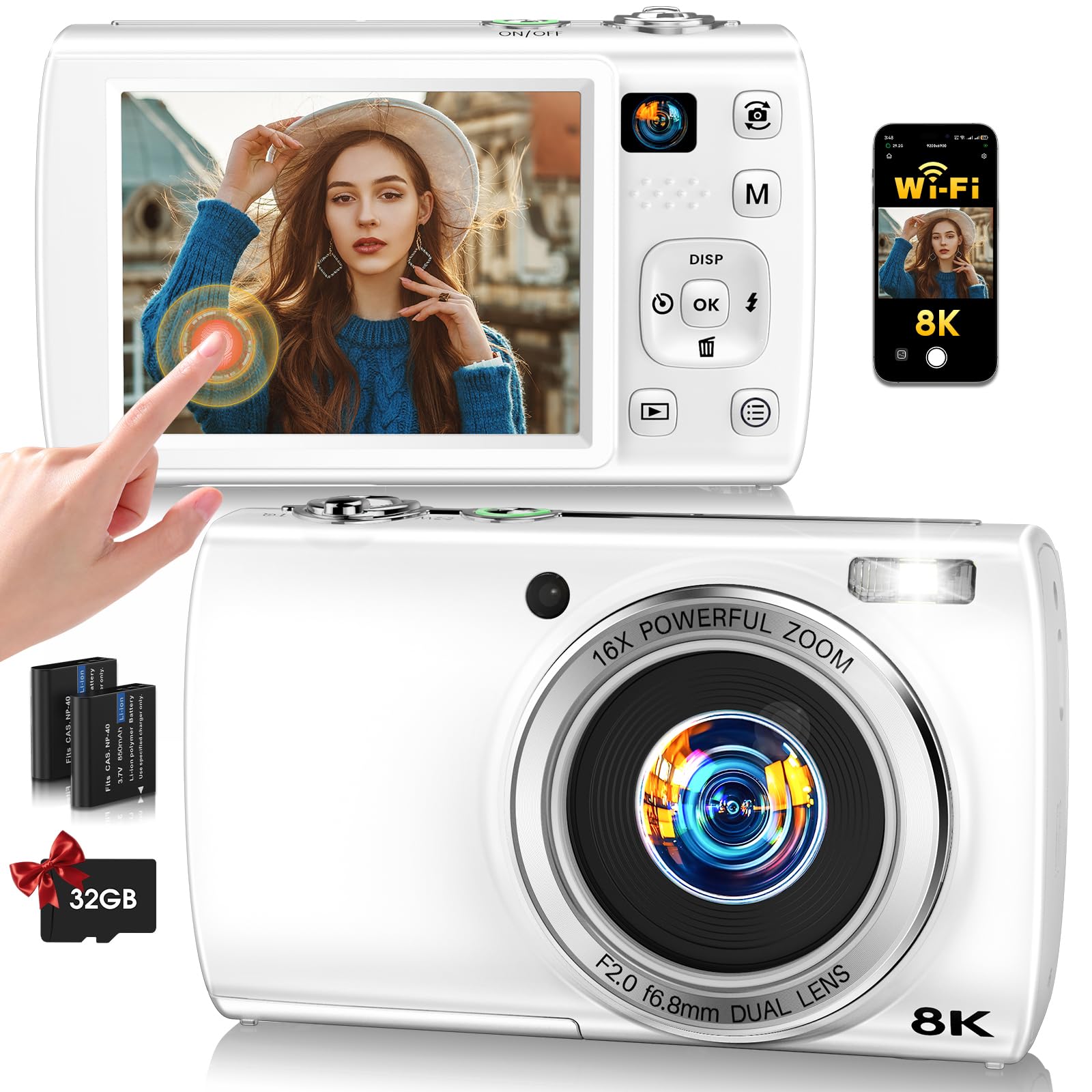
The LOUM 88MP is a budget-friendly digital camera that apes the retro digicam aesthetic many younger creators crave. It shoots at high interpolated resolutions (88MP stills and 8K video at 15fps) and features a clean white body with dual front and rear lenses, making it perfect for selfies and vlogging. The included 32GB memory card and two batteries make it a complete out-of-box solution.
The 2.8-inch IPS touchscreen is responsive, and the built-in WiFi allows for quick wireless sharing. It features 16x digital zoom, support for 4:3, 16:9, and 1:1 aspect ratios, and several shooting modes like timer, burst, and time-lapse. The autofocus with 5-axis anti-shake provides decent results for casual daytime shooting.
Image quality falls short in low light, and digital zoom is not a substitute for optical zoom. However, for someone looking for a simple, stylish point-and-shoot to experiment with photography, the LOUM camera delivers a surprisingly capable package at an entry-level cost. It is a perfect starter camera for teens or as a unique gift.
Why it’s great
- Complete kit with memory card, batteries, and bag.
- Stylish retro design in an attractive white finish.
- Dual lens design for easy selfies and vlogging.
Good to know
- High resolutions are interpolated, not native.
- Digital zoom reduces image quality significantly.
- Low-light performance is poor.
FAQ
Can an aesthetic camera replace my smartphone for daily photos?
What does “interpolated” resolution mean in a budget camera?
What is the advantage of a mirrorless camera over a traditional DSLR for aesthetics?
Are built-in film simulations (like on Ricoh or Nikon) as good as editing later?
Final Thoughts: The Verdict
For most users, the best aesthetic digital cameras winner is the Ricoh GR IIIx because of its unparalleled blend of portability, a unique 40mm lens, and professional-grade image quality. If you want the fastest autofocus and a versatile mirrorless system, grab the Sony a6400. And for a fun, creative hybrid that delivers physical prints, nothing beats the Fujifilm Instax Mini EVO.