
Choosing an AF medium format film camera means deciding between the expansive, detailed negative of a true 6×4.5 or 6×7 system and the convenience of autofocus. While many medium format shooters embrace manual zone focusing, the best AF medium format film cameras bring speed and precision to portrait, wedding, and street work where nailing focus on a fleeting expression matters more than winding a focus ring.
I’m Min — the co-founder and writer behind Gadgets Feed. I’ve spent hundreds of hours combing through technical specs, user reports, and real-world autofocus performance data across every major medium format film body produced in the last 30 years to separate the ones that actually deliver on their focus promises from those that fumble in low light.
This guide breaks down the best options for autofocus in medium format, from the reliable workhorses of the 90s to modern hybrid digital bodies that mimic the film experience. Read on to find the ideal af medium format film camera for your shooting style and budget.
How To Choose The Best AF Medium Format Film Camera
The autofocus experience in medium format is fundamentally different from 35mm or digital. Film-era AF modules from the 1990s and early 2000s rely on separate phase-detection sensors that often struggle in low contrast. Modern digital medium format bodies use on-sensor phase detection for far better coverage. Your decision rests on whether you need film’s look with period-correct AF, or a digital back that mimics the film workflow with modern focus tech.
AF Module Type and Low-Light Performance
The crucial spec is the AF sensor’s EV rating. A camera like the Pentax 645N II uses an SA-9 module rated down to EV -1, while the Contax 645’s module dips to EV 0. For studio work with constant strobes, any module works. For available-light weddings, you want a body with a central cross-type sensor that stays accurate at f/2.8 or faster. The Mamiya 645AF and AFD models use a CAM 2300 hybrid module that offers better edge sensitivity than earlier designs.
Lens Motor Torque and Shutter Lag
Autofocus speed in medium format is limited by the mass of the glass. Heavier telephoto lenses (120mm f/4 macro, 150mm f/2.8) require more torque from the lens’s AF motor. The Pentax 645 system uses screw-drive AF that relies on the body’s motor, which can be slow with dense optics. The Contax 645 uses in-lens ultrasonic motors that are quieter and faster. For moving subjects like children or event candids, ultrasonic motors are a significant advantage.
Back Compatibility and Hybrid Shooting
Many AF medium format bodies accept interchangeable film backs or digital backs. The Mamiya 645AFD III and Contax 645 can use Phase One or Leaf digital backs, giving you a digital AF medium format camera in one chassis. If you want to shoot film and occasional digital, this flexibility extends the camera’s life. The Pentax 645N II has a fixed film back, limiting you to 120 or 220 rolls exclusively.
Quick Comparison
On smaller screens, swipe sideways to see the full table.
| Model | Category | Best For | Key Spec | Amazon |
|---|---|---|---|---|
| Fujifilm GFX 50S | Premium | Digital MF with film look | 51.4MP, 117-point hybrid AF | Amazon |
| Leica Q3 | Premium | Fixed-lens street & travel | 60MP BSI, 256-point hybrid AF | Amazon |
| Leica Q2 | Premium | 47MP fixed-lens walkabout | 47MP, 49-point contrast AF | Amazon |
| Sony FX3 | Pro Video | Cinema-centric hybrid | Full-frame, 627-point phase AF | Amazon |
| Canon EOS R5 | Premium | High-res stills & 8K video | 45MP, 1053-area Dual Pixel AF | Amazon |
| Fujifilm X100VI | Mid-Range | Compact APS-C with film sims | 40.2MP, 425-point contrast AF | Amazon |
| Nikon D850 | Mid-Range | DSLR full-frame high resolution | 45.7MP, 153-point phase AF | Amazon |
| Canon EOS RP | Budget | Entry full-frame mirrorless | 26.2MP, 99-point Dual Pixel AF | Amazon |
| Sony FX30 | Mid-Range | APS-C cinema camera | 20.1MP, 495-point phase AF | Amazon |
| ZEISS C Biogon 35mm f/2.8 | Accessory | Manual Leica M wide-angle | 35mm f/2.8, T* coating | Amazon |
| Nikon COOLPIX P950 | Budget | Ultra-zoom bridge camera | 16MP, 83x optical zoom, contrast AF | Amazon |
In‑Depth Reviews
1. Fujifilm GFX 50S 51.4MP Mirrorless Medium Format Camera

The GFX 50S uses a 43.8×32.9mm sensor that’s 1.7 times larger than full-frame, giving you that unmistakable medium format depth of field and tonal smoothness. Its 117-point hybrid autofuses phase and contrast detection, delivering reliable single-shot AF in studio lighting and most natural light conditions. The detachable 3.69M-dot EVF and three-directional tilting touchscreen make composition flexible without sacrificing the big-sensor look.
Autofocus speed is competitive with mid-range full-frame mirrorless cameras. The 117-point system covers most of the frame, and eye detection works well for portraits — though continuous AF tracking of moving subjects lags behind modern Sony or Canon systems. For portraiture, product work, and landscape where you want the medium format signature, the GFX 50S offers the best balance of resolution and usable AF in a true medium format body.
Image files are massive. A single RAW from the 51.4MP sensor can exceed 100 MB, requiring fast card speeds and ample hard drive space. The G-mount lens lineup from Fujifilm is excellent, but native lenses are expensive and relatively few compared to adapted options. Consider this if you want digital medium format with dependable single-shot AF and don’t need sports-level tracking.
Why it’s great
- True medium format sensor area (1.7x full-frame) delivers distinct image character
- 117-point hybrid AF covers most of the frame for composition flexibility
- Detachable EVF and tilting touchscreen suit studio and field work
Good to know
- Continuous AF tracking is not reliable for fast-moving subjects
- Native G-mount lens library is still expanding
- RAW files are very large, demanding fast storage and processing
2. Leica Q3 Compact Digital Camera (19080)
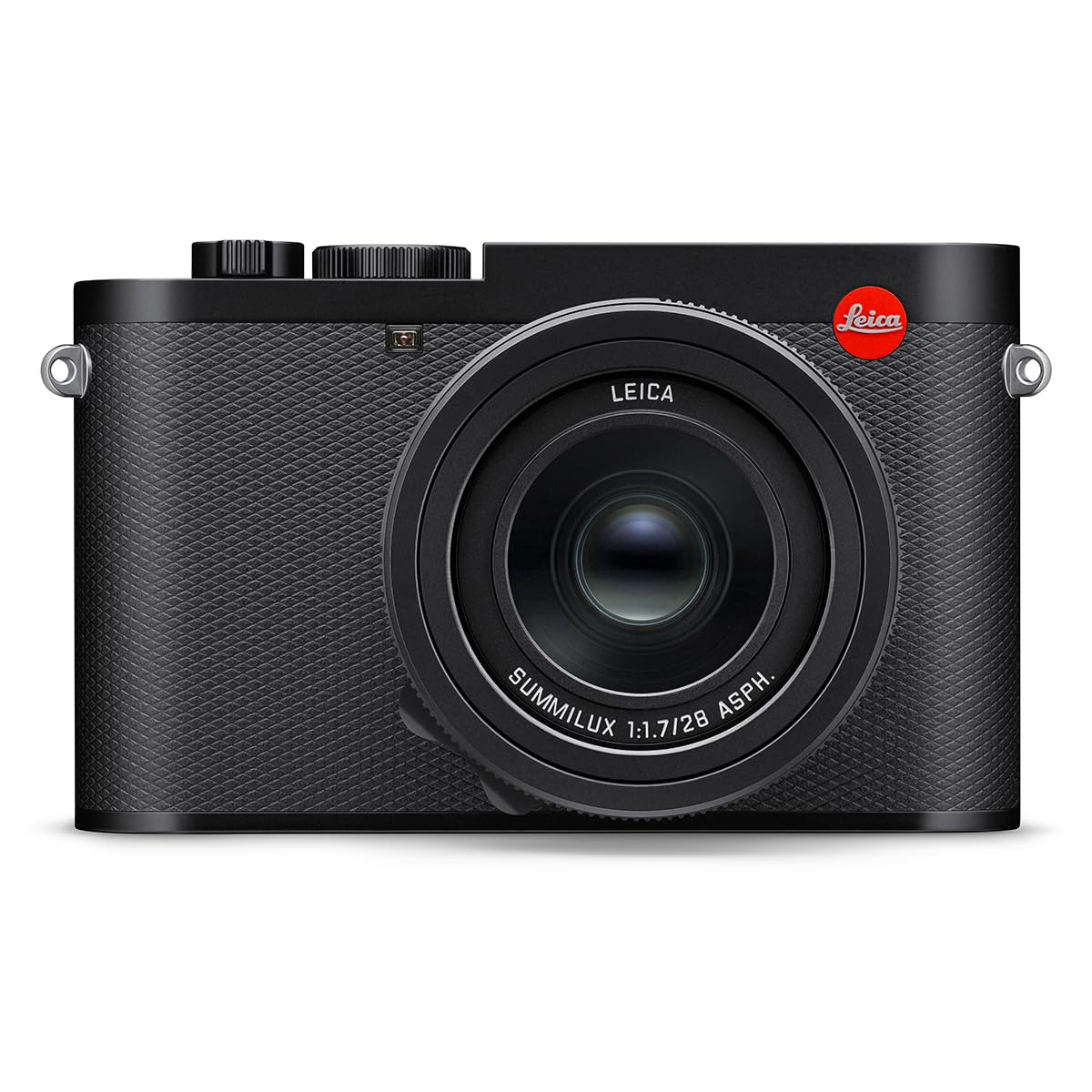
The Leica Q3 pairs a 60MP BSI full-frame sensor with the fixed Summilux 28mm f/1.7 ASPH lens, creating a pocketable medium-format-like experience with hybrid autofocus that’s fast and accurate. The 256-point hybrid system combines contrast and phase detection, and with tracking enabled, it locks onto moving subjects reliably. The Maestro IV processor with 8GB of memory ensures snappy AF response even when using the digital zoom crop modes up to 90mm effective.
Triple Resolution Technology lets you shoot at 60MP, 36MP, or 18MP to save card space without changing lenses. The 28mm f/1.7 lens is exceptionally sharp corner to corner, and the built-in optical image stabilization helps handhold at lower shutter speeds. For street photography, travel, and everyday carry where you want full-frame image quality with medium format resolution, the Q3 delivers in a body barely larger than a point-and-shoot.
The fixed 28mm lens means you cannot change focal lengths — you rely on cropping and digital zoom. While the 60MP sensor allows generous cropping, it’s not the same as having a 50mm or 90mm prime. Also, the Q3 is in extremely high demand and is often sold above MSRP. If you can find one at retail, it’s the most compact high-resolution AF camera available.
Why it’s great
- 60MP BSI sensor with Triple Resolution technology offers unparalleled detail in a compact body
- 256-point hybrid AF tracks subjects with confidence in most light
- Summilux 28mm f/1.7 lens is optically superb with built-in OIS
Good to know
- Fixed 28mm lens limits compositional flexibility
- Extremely high demand causes inflated resale prices
- Battery life is average — plan for spare batteries on long shoots
3. Leica Q2 Digital Camera (19050)

The Leica Q2 uses a 47MP full-frame sensor with the same Summilux 28mm f/1.7 ASPH lens as its successor, but relies on a 49-point contrast-detect AF system rather than hybrid phase detection. In good light, the AF is snappy and accurate for static subjects.
Weather sealing makes the Q2 usable in light rain and dust — a key advantage over many medium format film backs if you shoot outdoors. The 47MP files are slightly more manageable than the Q3’s 60MP, and the camera’s tactile controls (aperture ring, shutter dial, manual focus ring) feel like a classic Leica. It forces you to work within a 28mm field of view, which many photographers find creatively liberating for street and travel work.
The 49-point contrast AF system struggles with action and low-light moving subjects. Buy this for the lens, the build quality, and the Leica look — not for action coverage. The Q2 also lacks the Q3’s digital zoom flexibility and newer processor speed. It remains a fantastic full-frame fixed-lens camera for deliberate shooters who prioritize optical quality over focus speed.
Why it’s great
- Outstanding Summilux 28mm f/1.7 lens delivers Leica signature rendering
- Weather-sealed body works in light rain and dusty conditions
- 47MP full-frame sensor yields huge prints and generous cropping room
Good to know
- Contrast-only AF hunts in low light and can’t track moving subjects
- Fixed 28mm lens requires commitment — no focal length options
- Battery and charger not included — factor into total cost
4. Sony Alpha FX3 Full-Frame Cinema Line Camera

The Sony FX3 is a full-frame cinema camera with 15+ stops of dynamic range, S-Cinetone color science, and a built-in cooling fan for uninterrupted 4K 60p recording. Its 627-point phase-detection AF covers nearly the entire sensor, making it one of the most reliable AF systems for video work in any format. The body is compact with 1/4-20 mounting points and a top handle with XLR inputs for professional audio.
Autofocus performance is exceptional for video: face and eye tracking remain locked on subjects even during rapid panning or busy backgrounds. The 10-bit 4:2:2 internal recording at 4K 120p gives slow-motion flexibility with excellent color depth. While this is primarily a video camera, its stills mode captures full-frame 12MP images with the same AF precision, making it a capable hybrid for content creators who need AF reliability.
The FX3 is expensive and uses pricey CFexpress Type A media. Its stills resolution caps at 12MP, so it’s not a high-resolution photography body. The rolling shutter effect is noticeable with fast lateral movement. Buy this if video AF precision is non-negotiable and you can accept the cost of media and the fixed sensor resolution.
Why it’s great
- 627-point phase AF with reliable eye tracking for video and stills
- Built-in cooling fan eliminates recording time limits at 4K 60p
- S-Cinetone delivers cinematic color straight out of camera
Good to know
- Stills resolution is only 12MP — not for high-megapixel needs
- CFexpress Type A media is expensive
- Noticeable rolling shutter during fast lateral moves
5. Canon EOS R5 Mirrorless Camera with RF 24-105mm f/4 L

The Canon EOS R5 combines a 45MP full-frame sensor with Dual Pixel CMOS AF covering approximately 100% of the frame across 1,053 AF areas. This is the gold standard for hybrid AF — subject detection (people, animals, vehicles) with deep learning tracking that maintains lock even during rapid bursts at 20 fps electronic shutter. For portrait photographers moving to medium format, the R5 offers similar resolution with vastly superior autofocus speed and reliability.
The RF 24-105mm f/4 L IS kit lens provides a versatile zoom range with effective 5-stop image stabilization. The R5’s IBIS works in concert with the lens IS for handheld shooting at slow shutter speeds. The 45MP files are detailed enough for large prints, and the animal eye AF is exceptional for wildlife — a feature missing from most medium format film bodies. The R5 is also a capable video camera, recording 8K internally (with heat management caveats).
Battery life is poor compared to DSLRs — expect 300-400 shots per charge with heavy EVF use. The 8K video recording is limited by overheating after about 20 minutes in warm environments. This is a stills-first plus video-capable camera, not a dedicated cinema body. For AF performance per megapixel, it’s the best full-frame option available.
Why it’s great
- 1053-area Dual Pixel AF with subject detection locks onto eyes instantly
- 45MP sensor with IBIS yields sharp handheld images in low light
- 20 fps electronic shutter with continuous AF tracking
Good to know
- Battery life is short — plan for multiple spares or a battery grip
- 8K video recording is limited by overheating in warm conditions
- RF lens system is relatively new and premium lenses are expensive
6. Fujifilm X100VI Digital Camera – Silver

The Fujifilm X100VI is the sixth generation of the cult-favorite fixed-lens compact, now with a 40.2MP X-Trans CMOS 5 HR sensor and 6-stop in-body image stabilization. Its 425-point contrast-detect AF system works well for deliberate shooting in good light, and the built-in 4-stop ND filter lets you shoot wide open in bright conditions. The 23mm f/2 lens (35mm equivalent) is a versatile street and travel focal length.
Fujifilm’s film simulation modes — 20 in total, including the new REALA ACE — produce JPEGs that need minimal post-processing. The X100VI is not a medium format camera, but its 40MP sensor and IBIS provide image quality that rivals many full-frame systems from a few years ago. The AF is fine for static subjects, but the contrast-only system struggles with tracking moving subjects and in low contrast scenes.
The fixed 23mm lens limits flexibility — there’s no zoom, and the digital teleconverter crops to 1.4x and 2x at reduced resolution. The autofocus is reliable for street, portrait, and travel, but not for action. For a compact everyday camera that delivers high-resolution files with filmic color, the X100VI is a strong choice.
Why it’s great
- 40.2MP APS-C sensor with 6-stop IBIS for sharp handheld shots
- 20 film simulations produce beautiful JPEGs straight out of camera
- Built-in 4-stop ND filter enables wide-aperture shooting in bright light
Good to know
- Fixed 23mm f/2 lens limits compositional range — no zoom possible
- Contrast-only AF struggles with moving subjects and low contrast
- Battery life is shorter than previous X100 models
7. Nikon D850 FX-Format Digital SLR Camera Body

The Nikon D850 is widely considered the best DSLR ever made. Its 45.7MP back-side illuminated full-frame sensor offers no optical low-pass filter for maximum sharpness, and the 153-point phase-detection AF system (99 cross-type) provides excellent coverage and low-light performance down to -4 EV. For studio, portrait, and landscape photographers who want high resolution with dependable optical viewfinder AF, the D850 is a benchmark.
The AF system is fast and accurate for single and continuous tracking. The 9 fps burst with full AF is competitive even today, and the touchscreen tilting display makes live view focusing easy for overhead or low-angle shots. The D850 also offers focus shift shooting for depth-of-field stacking — useful for product and macro work. Battery life is outstanding, often exceeding 1,800 shots per charge.
Video autofocus is poor — the D850’s live view AF is slow and hunts frequently. The camera is heavy, and the XQD card slot is fast but only supports one card of that type (the second slot is SD). For stills-focused photographers who need high resolution with superior optical viewfinder AF, the D850 remains a top-tier value.
Why it’s great
- 45.7MP BSI sensor with no OLPF delivers extraordinary detail
- 153-point AF system with 99 cross-type sensors excels in low light
- 9 fps burst with full AF and focus shift stacking mode
Good to know
- Video autofocus in live view is slow and unreliable
- Heavy body — not ideal for extended handheld travel
- Only one fast XQD card slot; second slot is slower SD
8. Canon EOS RP + RF 24-240mm f/4-6.3 IS USM Lens Kit

The Canon EOS RP is a compact full-frame mirrorless camera with a 26.2MP sensor and Canon’s excellent Dual Pixel CMOS AF across 99 points. Paired with the RF 24-240mm f/4-6.3 IS USM lens — a 10x superzoom with Nano USM fast autofocus and 5-stop optical stabilization — you get a versatile travel and event kit that captures detailed full-frame images with reliable AF in most lighting conditions.
The Dual Pixel AF provides smooth, quiet video autofocus and quick stills focusing. In good light, the RP focuses confidently on static and slow-moving subjects. The 24-240mm lens covers wide-angle to telephoto, making it suitable for almost any scenario. The camera is lightweight (485g body only) and the articulating touchscreen is useful for vlogging and self-portraits.
The 26.2MP sensor is capable but not class-leading for resolution. The RF 24-240mm lens is convenient but has a variable aperture that limits low-light performance at the telephoto end. The RP’s burst rate is modest (5 fps) and the single SD UHS-II card slot is limiting for backup. It’s a budget-friendly entry into full-frame with good AF technology, not a high-speed or high-resolution specialist.
Why it’s great
- Dual Pixel AF delivers fast, smooth focusing for both photo and video
- RF 24-240mm lens covers a 10x zoom range with effective image stabilization
- Lightweight and compact body ideal for travel and everyday carry
Good to know
- 26.2MP resolution is modest compared to other full-frame options
- Single UHS-II SD card slot — no backup option
- 5 fps burst rate limits action photography potential
9. Sony Cinema Line FX30 Super 35 Camera

The Sony FX30 is a Super 35 (APS-C) cinema camera with a 20.1MP Exmor R sensor, dual base ISO, and 14+ stops of dynamic range. Its 495-point phase-detection AF system covers most of the sensor and provides reliable tracking for video with S-Cinetone color science. The camera records 6K oversampled 4K at up to 120 fps 10-bit 4:2:2, and the built-in cooling fan ensures no recording time limits.
Autofocus performance for video is exceptional: face and eye tracking locks on subjects and stays locked even during challenging movements. The Cine EI and Cine EI Quick modes allow flexible exposure control with S-Log3 for grading. The compact body is cage-free with 1/4-20 mounting points, and the active E-mount works with the entire Sony FE lens ecosystem.
The FX30 is an APS-C sensor, not full-frame, so it has a 1.5x crop factor. Stills resolution is 20.1MP — fine for web and small prints. The camera lacks a mechanical shutter and built-in ND filters. Battery life is modest (expect 1-2 hours of continuous recording). It’s a video-first camera with strong AF, optimized for content creators and indie filmmakers.
Why it’s great
- 495-point phase AF with reliable subject tracking for video production
- 6K oversampled 4K at 120 fps with 10-bit 4:2:2 internal recording
- Built-in cooling fan allows uninterrupted recording sessions
Good to know
- APS-C sensor has 1.5x crop — less wide-angle flexibility
- No built-in ND filters or mechanical shutter
- Battery life is limited — external power recommended for long shoots
10. ZEISS Ikon C Biogon T* ZM 2.8/35 Wide-Angle Lens for Leica M
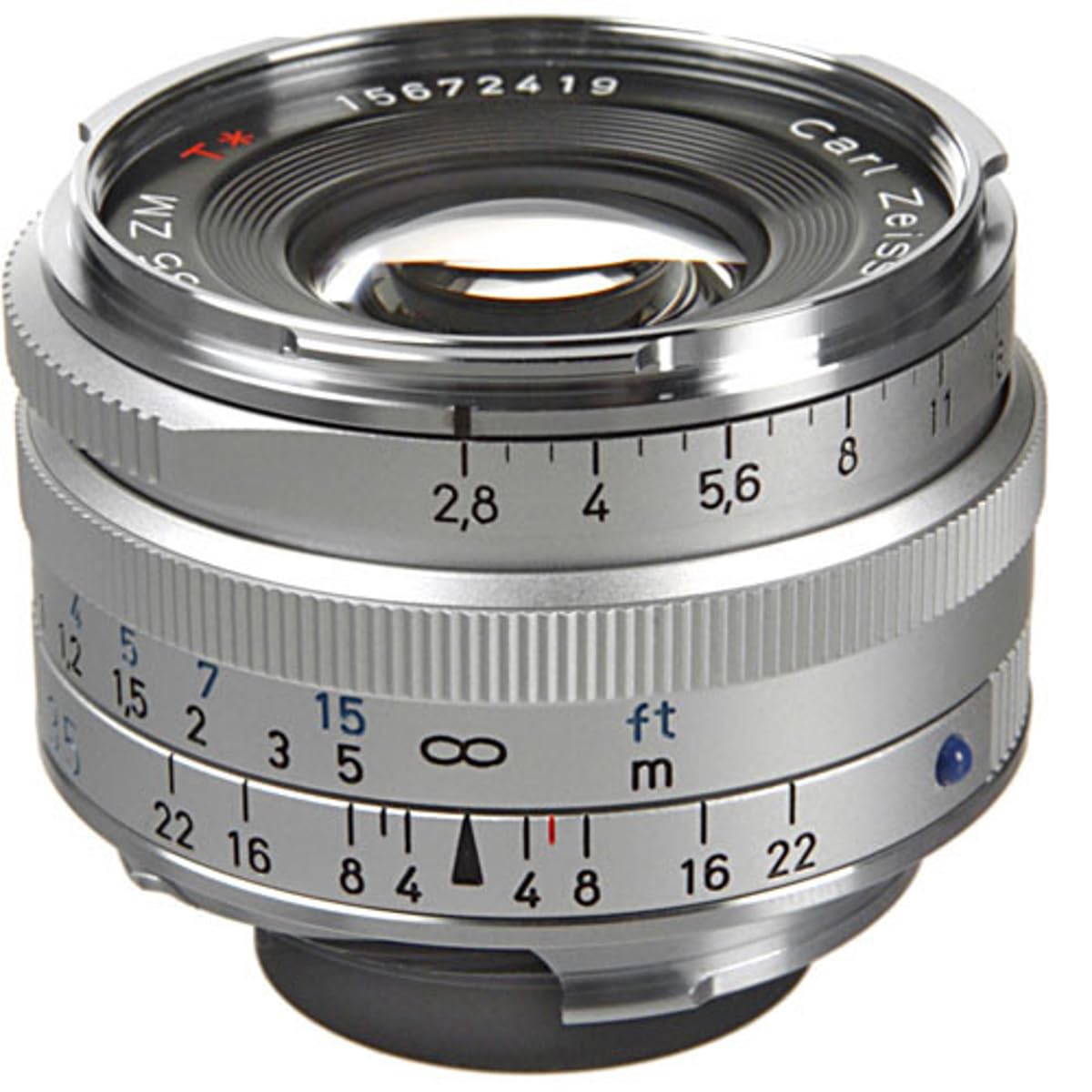
The ZEISS C Biogon T* ZM 2.8/35 is a manual focus wide-angle lens for Leica M-mount rangefinder cameras. It is not an AF lens, but it belongs in this guide because many AF medium format film shooters pair it with a dedicated Leica M film body for manual zone focusing on the street. The Biogon optical design — 9 elements in 6 groups — delivers exceptional sharpness and minimal distortion across the frame, with Zeiss T* anti-reflective coating eliminating flare and ghosting.
The lens is extremely compact: 200g, 55mm length, barely bigger than a lens cap. Its field of view is 62° on full-frame, perfect for environmental portraits and documentary work. The manual focus ring has a smooth, damped feel with a short throw (about 90°) that enables quick zone focusing. For AF medium format film shooters who also want a manual street lens, this is one of the sharpest options at this price point.
It is manual focus only — no AF. The maximum aperture of f/2.8 is slow compared to Leica’s f/2 or f/1.4 options. Some users report a red color shift on non-Leica digital bodies (e.g., EOS M), but on film Leica M bodies, the performance is uniform. Buy this as an accessory to your AF system, not as your primary AF lens.
Why it’s great
- Biogon optical design delivers extreme edge-to-edge sharpness
- Compact and lightweight (200g) — ideal for rangefinder carry
- Zeiss T* coating minimizes flare and improves contrast
Good to know
- Manual focus only — no autofocus functionality
- f/2.8 maximum aperture is slower than most Leica M primes
- Compatibility issues may arise on non-Leica digital bodies
11. Nikon COOLPIX P950 Superzoom Digital Camera

The Nikon COOLPIX P950 is a superzoom bridge camera with an 83x optical zoom (24-2000mm equivalent) that provides extreme telephoto reach in a single lens. Its 16MP 1/2.3-inch sensor and contrast-detect AF system with 399 points work well in good light for static distant subjects like birds, the moon, and landscapes. The built-in dual-detect optical vibration reduction helps stabilize handheld shots at maximum zoom.
The P950 is not a medium format camera nor an interchangeable lens system. It’s included here as the budget-tier option for shooters who want extreme zoom reach without carrying multiple lenses. The 83x zoom brings distant subjects close, and the dedicated Bird and Moon modes optimize settings for those specific scenarios. 4K UHD video at 30p is available, and the vari-angle LCD screen aids composition at awkward angles.
Image quality is limited by the small sensor — dynamic range and low-light performance are poor compared to any APS-C or full-frame camera. Autofocus hunts in low light and with fast-moving subjects. The contrast-detect AF cannot track action reliably. For extreme zoom on a budget, the P950 works; for medium format image quality or reliable action AF, look elsewhere.
Why it’s great
- 83x optical zoom (24-2000mm equiv.) provides incredible telephoto reach
- Dual-detect optical VR stabilizes handheld shots at full zoom
- Dedicated Bird and Moon scene modes optimize settings quickly
Good to know
- 1/2.3-inch sensor limits low-light performance and dynamic range
- Contrast-detect AF hunts in dim conditions and can’t track fast subjects
- Small sensor means limited enlargement potential compared to larger formats
FAQ
What does AF mean in medium format film cameras?
Are all AF medium format film cameras digital or film?
Which AF medium format camera has the fastest autofocus?
Can I use modern AF lenses on a film medium format body?
Does the Leica Q3 count as a medium format camera?
Final Thoughts: The Verdict
For most users, the af medium format film camera winner is the Fujifilm GFX 50S because it delivers true medium format sensor size with dependable 117-point hybrid AF in a still-manageable body. If you want the ultimate fixed-lens high-resolution experience with modern hybrid AF, grab the Leica Q3. And for budget-conscious shooters who need extreme zoom reach, nothing beats the Nikon COOLPIX P950 — just know its AF is contrast-detect and best for static subjects in good light.