
Our readers keep the lights on and my morning glass full of iced black tea. As an Amazon Associate, I earn from qualifying purchases.
Specs are compiled from manufacturer listings and verified buyer reviews and can change over time — please confirm the key details on the product page before buying.
The picks below range from compact 5,000 BTU units for a bedroom to inverter models that quietly sip power all night. Every one of them is a real, currently sold machine, and each write-up tells you the honest trade-off so you can match the unit to your room instead of guessing.
I’m Min — the founder and writer behind Gadgets Feed. This guide is built by comparing the manufacturers’ published specifications and the patterns across verified customer reviews, so you get each pick’s real strengths and trade-offs instead of marketing spin.
Start with your room size, then check the BTU rating, the window width, and the noise figure before anything else. Everything that follows is chosen to make those three numbers easy to match to your own space, and this guide to the best affordable air conditioner keeps every pick honest and easy to compare.
Our Picks at a Glance


How To Choose The Best Affordable Air Conditioner
Buying an air conditioner is mostly arithmetic, not brand loyalty. Get the cooling power and the window measurements right, and almost any unit on this list will do the job quietly. Get them wrong, and you will either freeze one corner of the room or run a machine that never catches up on the hottest afternoon.
Match BTU to the room, not to the price
BTU (British Thermal Unit) is simply how much heat the unit can pull out of a room. A 5,000 BTU window unit handles a small bedroom, while a 12,000 BTU machine is built for a large living space or a master bedroom. Bigger is not automatically better — an oversized unit cools the air fast, shuts off before it has pulled the humidity out, and leaves the room clammy.
Measure your window before you measure anything else
Window units install into the frame itself, so the opening width and minimum height decide what fits. Manufacturers list a window width range and a minimum height, and a unit that misses either number by an inch will not mount safely. Portable units skip this problem entirely because they sit on the floor and vent out through a hose kit, which makes them the pick for sliding or awkward windows.
Decide how much noise you can live with
Noise is measured in decibels (dB), and the lower the number, the quieter the machine. Standard window units tend to land somewhere around 50 to 53 dB on their lowest fan setting, which most people describe as a steady fan hum. Inverter models can drop far lower, which is why they are the choice for bedrooms and night-shift sleepers.
Quick Comparison
| Model | Best For | Cooling Power | Room Coverage | Type | Amazon |
|---|---|---|---|---|---|
| BLACK+DECKER 12,000 BTU Window AC (BD12WT6)★ Best Overall | Large bedrooms and living rooms | 12000 BTU | 550 sq ft | Window | Amazon |
| Midea 5,000 BTU Window ACBudget Champion | Tight budgets and small bedrooms | 5000 BTU | 150 sq ft | Window | Amazon |
| LG LW5023 5,000 BTU Window ACCompact Pick | Narrow and short window frames | 5000 BTU | 150 sq ft | Window | Amazon |
| Honeywell 6,000 BTU Digital Window AC | Bedrooms that need a thermostat | 6000 BTU | 250 sq ft | Window | Amazon |
| DELLA 6,000 BTU Smart Window AC | App and voice control | 6000 BTU | 250 sq ft | Window | Amazon |
| LG 8,000 BTU Window AC | Medium rooms up to 350 sq ft | 8000 BTU | 350 sq ft | Window | Amazon |
| BLACK+DECKER 8,500 BTU Portable AC (BPACT05SM) | Sliding windows and rentals | 8500 BTU | 350 sq ft | Portable | Amazon |
| Frigidaire 10,000 BTU Window AC | Living rooms up to 450 sq ft | 10000 BTU | 450 sq ft | Window | Amazon |
| Midea 8,000 BTU U-Shaped Smart Inverter | Quietest possible window install | 8000 BTU | 350 sq ft | Window | Amazon |
| GE Profile ClearView 12,200 BTU Inverter | Keeping the full window view | 12200 BTU | 550 sq ft | Window | Amazon |
| ZAFRO 14,000 BTU Smart Inverter Portable | Big open areas with no window | 14000 BTU | 700 sq ft | Portable | Amazon |
In‑Depth Reviews
1. BLACK+DECKER Window Air Conditioner 12000 BTU, BD12WT6, White
Our pick — over 4★ from 300+ verified ratings; the strongest balance of quality and price.
The 12,000 BTU workhorse that turns a hot master bedroom cold and keeps it there.
If a single window unit has to carry a whole floor, this is the one to start with. At 12,000 BTU it is rated for rooms up to 550 square feet — master bedrooms, home offices, open-plan living rooms — and it runs at four levels: auto, low, medium and high. That spread matters, because you can drop it to low fan and eco mode once the room is down to temperature, which is exactly how buyers report running it. As one buyer summed it up: the unit “cools 12×12 ft room to 68°F on cool/low fan/eco in 90°F+ heat.”
This unit earns its spot with raw cooling power: 12,000 BTU (British Thermal Units, a measure of cooling strength) versus the 5,000 BTU machines further down this list — more than double the capacity. That means it can cool a 550 square-foot space to a genuinely cold room, while a 5,000 BTU unit barely holds a 150 square-foot bedroom. Buyers also use it as a cheaper alternative to a big HVAC job — one owner reports cooling a 1,000 square foot first floor and a 1,000 square foot basement on one unit by keeping the furnace fan running to circulate the air.
The honest catch is installation flexibility and electricity draw. It needs a standard double-hung window (one that slides up and down) measuring 23 to 36 inches wide and at least 15.5 inches tall, so it will not fit a side-slide or up-and-down slider. It also pulls real amps (electrical current), and one owner on older wiring flagged that as something to check before you plug it in. On the positive side, the R32 refrigerant (a coolant formula) is ozone-friendly, the accordion side panels make the install a one-person job, and the remote handles sleep mode, energy saver and the 24-hour timer without you getting out of bed. The annual energy figure sits at 783.88 kWh per year (kilowatt-hours, the unit on your electric bill), and the washable HEPA filter (a high-efficiency filter that traps fine particles) catches dust and pollen between cleanings.
What earns it the top slot
- 12,000 BTU over 550 sq ft — enough muscle to cold-soak a full living room, not just a bedroom.
- Four fan levels plus sleep, energy saver and a 24-hour timer give you real control over the power draw.
- Accordion side panels fit standard double-hung windows from 23″ to 36″ wide.
- R32 refrigerant and a washable HEPA filter keep running costs and maintenance chores down.
Where it asks something back
- No side-slide window support — measure your frame width and height before ordering.
- It draws high amps, so an older circuit is worth checking first.
- Noise splits opinion; some find the compressor noticeable at night.
Buy this if: you have a standard double-hung window and a room that genuinely fights the summer.
Look at the smaller units instead: if your window opening is under 23 inches wide or you are only trying to cool a single small bedroom.
2. Midea 5,000 BTU Window Air Conditioner with Easy-to-Use Reusable Filter
The entry-level Midea that cools one small bedroom for the price of a round of takeout.
Three modes in one compact box: it cools, it circulates air on a three-speed fan, and it pulls humidity out of the room in dehumidifier mode. At 5,000 BTU it is rated for spaces up to 150 square feet, and it runs as low as 52 dB on its low setting — roughly the sound of a quiet conversation. The intuitive LED display and included remote (batteries included) let you set the temperature, timer and mode from bed, and the removable, reusable filter catches dust and pet hair so you are not buying replacements.
Owners mostly put it to work as a spot-cooler rather than a whole-home solution, and it is very good at that job. Owners mention using it in a 127 square foot guest room that already had HVAC, and installing and removing it again in about ten minutes. Others run a small floor fan to push the cool air down a hallway into two nearby rooms, which is a smart way to stretch 150 square feet of rated coverage further than the spec sheet suggests.
Here is the trade-off you should weigh honestly: cooling performance on this unit is genuinely mixed, and some buyers find it never truly chills a room in peak heat. The airflow is also side-to-side only, with no upward adjustment, and the accordion side wings are the flimsiest part of the package — at least one owner swapped them out for plywood and foam weatherstrip to get a tight seal. Fit is forgiving though: it drops into an existing window frame with all mounting accessories included, and you only need a screwdriver. If you want reliable whole-room cooling rather than a small-room assist, step up to the Honeywell or the LG 8,000 BTU instead.
Who this unit is really for: a bedroom, dorm, or home office where you want cool air on the cheap and you are fine leaning on a fan to move it around.
The catch worth knowing: the dehumidifier mode, Eco mode and EasyTimer scheduling are genuinely useful, but the 150 square-foot ceiling is firm — this is not the machine for a large living room.
The value play: the cheapest way onto this list that still comes from a well-known air-treatment brand.
Step up if: you need a room bigger than 150 square feet brought down properly.
3. LG 5000 BTU Window Air Conditioner LW5023
Built for the awkward little window nobody else wants to cool.
This LG is the pick when your window opening is genuinely short. It has a fixed chassis that mounts in a double-hung window sized W 21″ to 35″ and only H 12″, which is smaller than most window units on this list can handle — buyers in mobile homes report it sliding right in where full-size units would not go. At 5,000 BTU it covers 150 square feet, and it runs as low as 50 dB (decibels, a measure of sound) on its low setting, which is about as quiet as a standard window unit gets.
The feature people keep coming back to is the airflow direction. The vents sit on top and push cold air upward instead of straight out at the bed or couch, which stops the icy blast hitting you directly. As one owner put it, “I love that it does not blow straight out. It blows upward.” That same buyer called the temperature knob “neat, very vintage/old school feeling,” and they are not wrong — this is a mechanical-control unit with two cooling modes and two fan speeds, not a digital display. There is an Energy Save function for lower bills and R32 refrigerant inside, and the slide-out washable filter is easy to pull and rinse. The whole install is handled by the included EZ Mount kit.
Two things to accept before you buy. First, noise is mixed here — some owners call it quiet, others find it noticeable at night, so if you are a light sleeper lean toward the inverter units. Second, this model ships in a couple of configurations, and a few buyers have received the digital, remote-controlled version instead of the basic mechanical one, which is fine unless you specifically wanted the knobs. Either way, installation runs about five minutes for the main body, with only the side flaps proving fussy. Coverage tops out at 150 square feet, so treat it as a one-room machine.
Why it earns its place: a 21″ to 35″ width and 12″ height window opening is a genuinely hard size to shop for, and this is one of the few 5,000 BTU units built to fit it cleanly.
Plan around this: the fixed chassis and mechanical-only controls mean no thermostat automation — you set the knob and live with it.
Made for you if: your window is small, short, or an odd size that has already foiled one purchase.
Skip the trip if: you want app control, a digital thermostat, or coverage past 150 square feet.
4. Honeywell 6,000 BTU Digital Window Air Conditioner with Remote

A precise thermostat, a real remote, and a body small enough for a tight frame.
Six thousand BTU is the balance for a single bedroom or a large living room of about 250 square feet, and Honeywell pairs it with a genuine digital thermostat that holds anywhere from 61°F to 88°F. That number range is the whole point: instead of a knob and guesswork, you set a target temperature and the unit works to hold it. It draws 450W (watts, a measure of power use) at 115V/60Hz (standard household voltage and frequency), and you get four modes — Auto, Cool, Fan and Dry — plus a 24-hour timer, sleep mode and eco energy saving mode.
The compact footprint is what buyers highlight most, with owners specifically reporting it fitting perfectly into a 22-inch-wide window frame. Setup is straightforward with the full installation kit included, and the adjustable side panels stretch to cover a window up to 34 inches wide, though you need a minimum opening height of 14.5 inches. Owners have run this in RVs and even on a 44-foot sailboat, where it managed to cool the whole cabin layout on its own. Two summers in a master bedroom window is the kind of service life customers note without complaint.
The one thing to plan for is what the timer can and cannot do. It handles an off-timer from 30 minutes up to a couple of hours, but there is no programmable on-timer, so you cannot set it to greet you with cold air at a specific hour. A rare unit also fails to get a room as cold as its owner expects — not common, but it happens. Annual consumption is listed at 401 kWh per year, the lowest figure on this list, and the lifted vent design pushes air up and around the room rather than into one spot. The washable filter slides out and rinses clean, and it needs to be dry before going back in.
Standout strengths
- Real digital thermostat spanning 61°F to 88°F — no dial-guessing needed.
- Compact enough for narrow frames, with owners confirming a clean fit in 22″ windows.
- Lowest annual energy figure here at 401 kWh per year.
- Auto restart brings it back on by itself after a power cut.
Honest limitations
- Off-timer only — no programmable on-timer to pre-cool the room.
- Needs a minimum 14.5″ window opening height to mount.
- Noise and value both land mixed among owners.
Reach for this if: you want set-and-hold temperature control in one room without paying for a bigger machine.
Think twice if: you need scheduling that turns the unit on before you get home.
5. DELLA 6000 BTU Window Air Conditioner with WiFi Smart Controls
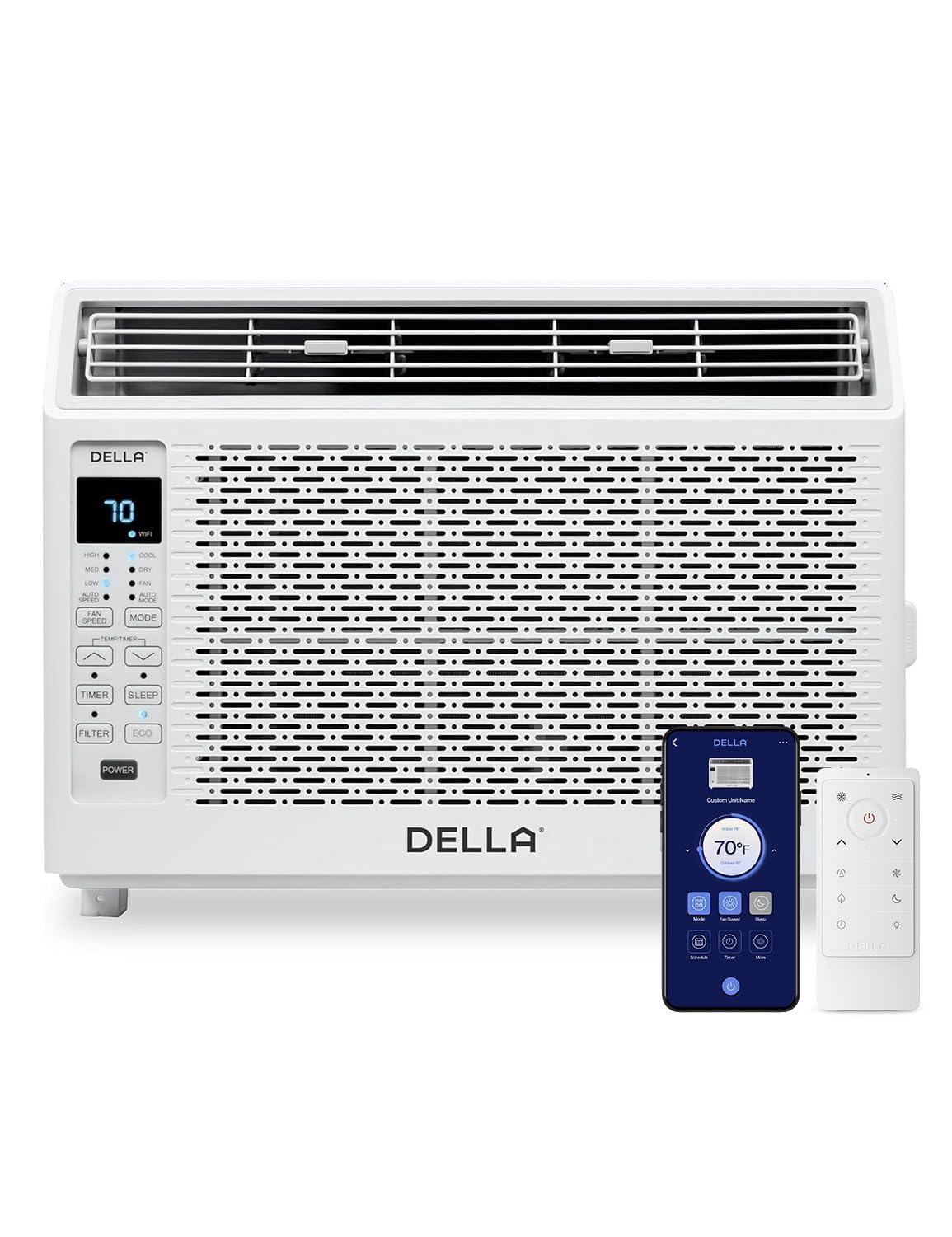
Six thousand BTU with an app, Alexa voice control, and a 38.6-pound body you can lift alone.
If you like the idea of pinging your air conditioner from the driveway so the bedroom is already cold when you walk in, this is the unit for it. The DELLA+ app controls the machine from anywhere, and Alexa and Google voice commands work too, alongside the bundled remote and the LED control panel. Behind the smart layer it is a straightforward 6,000 BTU unit rated for 250 square feet, running at 61°F to 88°F with three fan speeds and Auto, Cool, Fan and Dry modes, plus a 24-hour timer, sleep mode and eco energy saving mode.
The install numbers are friendly. At 38.6 pounds it is one of the lighter units here, and the body measures 15.2″D x 15.98″W x 12.52″H — small enough that owners describe mounting it without major window-frame changes. It fits windows 23 to 34 inches wide with a 14.5-inch minimum height, and all installation accessories come in the box. The combined energy efficiency rate of 11.0 is a real number to weigh against the LG’s efficiency rating, and the reusable filter rinses rather than replaces. Owners in hot climates report it holding a bedroom comfortably even when it is 110°F outside, and one Florida user replaced central air with window units and watched a summer electric bill drop to roughly half.
Two honest notes. Setup instructions are widely called terrible, and buyers who already know their way around a smart-home app have a much easier time of it. The second is longevity: a small number of units have died inside their first season, though far more reviewers point out no problems. Noise is the other split — plenty call it quiet with no rattling or vibration, others find it loud. Weigh that against the price point and the smart controls, and this is a strong fit for someone who wants app convenience in a medium room.
Why it stands out: you get app, voice and remote control on a 6,000 BTU unit without jumping to premium pricing.
Be ready for: a thin manual — the app setup is not beginner-friendly, so allow extra time on install day.
Your pick if: you want to control the temperature from your phone and you are comfortable with smart-home setup.
Consider the Honeywell instead if: you would rather set it once by hand and never touch an app.
6. LG 8,000 BTU Window Air Conditioner, 115V, 350 Sq.Ft.
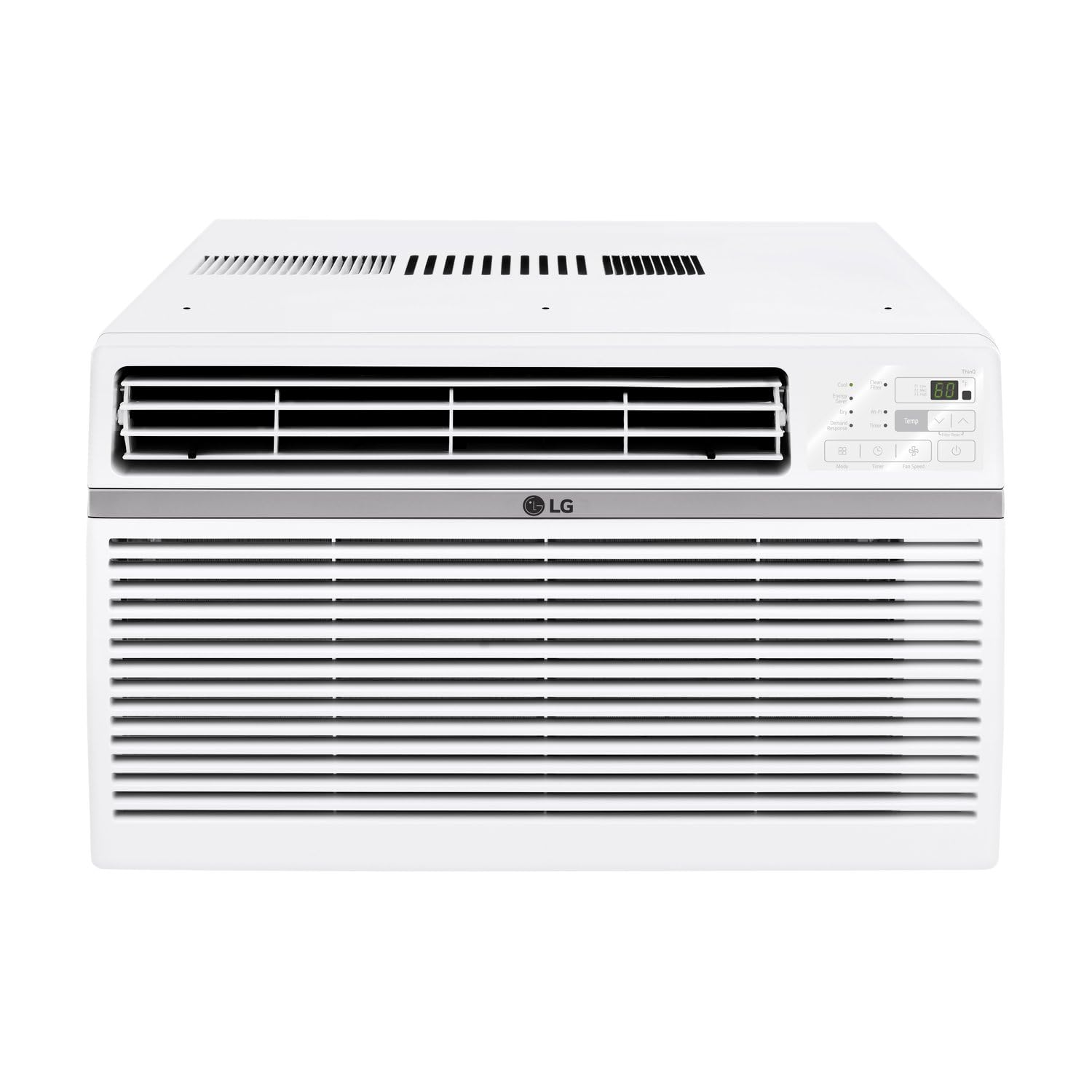
Eight thousand BTU aimed at the awkward middle ground between a bedroom and a full living room.
When 5,000 BTU is too little and 12,000 is overkill, this is the size that fits. LG rates it for rooms up to 350 square feet — about a 14′ x 25′ space — which covers a good-sized bedroom, a living room, or an apartment main area. It runs three cooling and fan speeds plus an Auto Cool mode, sits as low as 53 dB on its low setting, and carries a washable filter with a light reminder for when it needs rinsing. Auto Restart is the quiet hero feature: after a power cut, it powers itself back on instead of leaving you to reset it.
Owners push this unit hard and it keeps up. A landlord running five of them in 100°F Georgia heat reports it holding a 1,000 square foot mobile home in the mid-70s, and cooling a 1,250 square foot mobile home plus a 24×12 shed. Another owner watched a 300 square foot room drop from 81°F to 73°F in under an hour at the 70°F setting, with the room holding steady around 71°F afterward. That is meaningful headroom over the smaller LG above — 8,000 BTU covering 350 square feet against 5,000 BTU covering 150.
What you should know before ordering: it is heavy, and buyers consistently say the printed instructions are unclear enough that a support brace bar is a worthwhile add-on. Some units also show up with minor dents from shipping, and the “clean filter” reminder can trigger after a couple of months of heavy use in dusty rooms. Noise divides owners, but the majority who call it noisy-sounding still report it as tolerable, and several say it runs quiet despite the reviews warning otherwise. Annual energy consumption is listed at 660 kWh per year.
Why owners keep it
- 350 sq ft of coverage lands it squarely between the small bedroom units and the 12,000 BTU giants.
- Auto Restart means a power blip does not leave you sweating until you notice.
- Three fan speeds plus Auto Cool, with a filter light so maintenance is never forgotten.
Before you order
- It is heavy to lift into a window — plan for a second person or a brace bar.
- Instructions are unclear and a few units arrive with shipping dents.
- Noise is a genuine split among owners.
The right fit: a medium room where you want noticeably more cooling than a 5,000 BTU unit without jumping to a heavy 12,000 BTU install.
Not for you if: you are mounting it solo in a high window or you need dead-silent operation in a bedroom.
7. BLACK+DECKER Portable Air Conditioner, 8,500 BTU, BPACT05SM

Rolls in, vents out a hose, and never asks you to own the window.
For sliding windows, casement frames, or a rental where you cannot permanently mount anything, a portable is the only real answer — and this one is rated at 8,500 BTU (5,100 BTU under the SACC standard, a different way of measuring the same machine) for rooms up to 350 square feet. It is a three-in-one: air conditioner, dehumidifier (removes moisture from the air) and fan in a single cabinet. The top-mounted control panel has an LED display, the remote handles every setting from across the room, and the whole unit sits on wheels, which is why portability is what owners praise first.
The cooling is real when you treat it like a spot cooler. Shoppers say it taking a 315 square foot room above a hot garage from 84°F down to 75°F in about 15 minutes, and one buyer described it spanning a 350+ square foot space with the window kit sealed up with tape. The dehumidifier pulls moisture out through the exhaust vent rather than asking you to empty a tank, and the sleep mode holds temperature overnight. The fan-only mode works without any hose attached at all, which is a handy secondary use in shoulder season.
Now the honest part. Performance is the trade-off with any single-hose portable, and this unit is slow to cool a genuinely large room — owners say it gets there eventually rather than fast. Noise is described as consistent, like a loud box fan, with no rattling, so it is a steady hum you can work or watch TV through rather than a rattle you cannot ignore. The window kit is also smaller than some buyers expect, and the accordion wings are the weak point of the kit. There is a durability tail here too: most units run for years, but a few have stopped cooling inside the first season, and buyer support experiences vary. The unit weighs about 50 pounds and rolls, which makes it far easier to move than a window model.
The case for a portable: no permanent install, no window measurements to obsess over, and you can roll it from room to room.
The honest trade-off: it is slower to chill a big space than a window unit of similar BTU, and the included window kit may need weatherstrip or a custom panel to seal tightly.
Ideal for: renters, sliding-window homes, and anyone who needs cooling they can move rather than mount.
Wrong pick if: you want a large room cold fast — a window unit will always beat a portable at that.
8. Frigidaire 10,000 BTU Window Air Conditioner with Remote Control

Ten thousand BTU and six-way airflow so the cold air actually reaches the far corner.
Most window units blow air in one direction and hope the room evens out. This Frigidaire moves the vents six different ways, which is why it suits living rooms up to 450 square feet where the couch is not sitting directly in front of the machine. It runs at just 53 dBA, carries three fan speeds, and gives you a full 24-hour on/off timer plus Sleep Mode, which slowly raises the temperature overnight instead of blasting cold air until morning.
Owners consistently report quick, satisfying drops. One buyer watched it take a room from 78°F to 72°F in about an hour on the Low setting. Another swapped out an older 10,000 BTU Frigidaire of the same dimensions and found the install was a straight replacement. A third reports it cooling roughly 420 square feet of house on its own. The filter angle is handled with Clean Filter alerts that tell you when the washable dust filter needs rinsing, and Dry Mode pulls excess moisture out of the air so the room does not feel damp.
One behavior worth knowing: the unit defaults back into Eco Mode after you switch it off and on, so you will occasionally have to nudge it back to your preferred setting. Noise is mostly fine — plenty of owners call it loud but not too loud — though light sleepers should still weigh it. A small number of failures are reported over long ownership, which is the risk with any appliance. Efficiency is listed at 10.9, which is competitive for this capacity, and the included remote makes midnight adjustments easy without leaving the bed.
The draw: six-way directional airflow is unusually flexible for a window unit, and the 450 square-foot rating covers most open living areas.
Keep in mind: Eco Mode re-engages every time the unit powers up, so expect to reset your preferred mode occasionally.
Built for: living rooms and open spaces where you need airflow aimed, not just emitted.
Overkill if: you only need one bedroom cooled and the 5,000 BTU units would do.
9. Midea 8,000 BTU U-Shaped Smart Inverter Window AC

The U-shaped inverter that uses your own window glass to muffle the compressor.
At 32 dBA, this Midea is the quietest unit on the list — the U-shape design parks the compressor outside the window so the glass itself muffles the sound. The inverter system builds on that with smooth, stepped power delivery instead of the hard on-off cycling that standard units produce, and the result, according to the manufacturer, is operation as low as 32 dBA. It is also ENERGY STAR certified — the brand says it is the first window AC to earn that rating — and it covers rooms up to 350 square feet.
This is the unit for shift workers, light sleepers, and anyone who has ever had to turn the TV up over an air conditioner. Owners repeatedly call it quiet even on the high setting, and several note the U-shape leaves more of the window uncovered, so you keep daylight and your view. Because the window can stay partly open, you can let fresh air in without uninstalling anything, and the Anti-Theft Mechanism locks it closed when you are not using it. The quick-snap bracket installs on single-hung or double-hung windows 22″ to 36″ wide with a minimum height of 13.75″.
The catches are worth stating plainly. This unit has a known drainage issue on some units: the drain plug can retain water, and at least one owner reported a mold problem severe enough to end in a refund after a fight. That is not the common experience, but it is real, and it is why you should check the drain area during the season. The remote is described as awkward, and buyers report the app is the better way to control it. Long-term owners mention units still running strong years later, and one notes it pulls less than 300Wh in use. The bracket kit also requires a sill that is reasonably level, so an uneven ledge may need adjusting.
The wins
- 32 dBA operation — the quietest design on this list by a wide margin.
- ENERGY STAR certified with an inverter compressor that avoids hard start-stop cycling.
- U-shape keeps more window glass visible and lets the window open with the unit installed.
- Anti-Theft Mechanism locks the window when closed.
Watch-outs
- Some units drain poorly and can pool water near the plug — check and clear it regularly.
- The included remote is awkward; the app is the better control path.
- Needs a level windowsill for the bracket to seat properly.
Go here for: the quietest possible window install, especially in a bedroom used during daylight hours.
Look elsewhere if: you are not willing to keep an eye on the drain area through the season.
10. GE Profile ClearView Inverter Window Air Conditioner, 12,200 BTU

Twelve thousand two hundred BTU that leaves your window looking almost untouched.
The whole point of the ClearView is that you barely see it. The 12,200 BTU unit is built to sit low in the frame so the window can still open and close freely after installation, letting natural light through and preserving your view instead of blocking it. It is rated for 550 square feet and reaches as low as 40 dB, and the inverter compressor runs in smooth, varying steps rather than snapping on and off. The flex-depth design is the other trick — it expands to accommodate walls between 4.5″ and 13.75″ thick, so it seats securely on deep sills. Built-in WiFi runs it through the SmartHQ app with Amazon Alexa and Google Assistant support.
When it works, owners describe excellent results. One buyer in 100°F-plus southeast Texas heat reports the unit cooling so effectively that the household could not run it on high without reaching for a blanket. They also note it is quiet enough not to disturb, that the smart WiFi let them activate it remotely, and that the install took about 15 minutes with two people. The manufacturer rates the inverter compressor 34% more efficient than a comparable unit, and the flex-depth frame expands to fit walls 4.5″ to 13.75″ thick. It works on windows 20″ to 40″ wide with a 13″ minimum opening height and 10″ minimum height from the floor.
The honesty here is important, because this unit has a genuinely divided track record. Customers note a substantial list of concerns: vibration when the compressor kicks in, a loud water pump that partially defeats the quiet design, and a real rate of units that arrive with manufacturing faults or fail outright. The unit is also roughly 85 pounds, and buyers describe it as noticeably heavier and more awkward to lift than rival models. The foam that ships with it can arrive crimped and not seal properly. Rare it is not, so go in knowing that if you get a good unit you get a very good unit, and if you do not, you will be dealing with support — which owners describe as slow. Weigh that against the fact that this is one of the very few ways to cool a large room without giving up your window.
What makes it unique: the flex-depth frame and low-profile placement keep the window functional and visible, which no standard window unit on this list does.
The reliability caveat: the vibration and pump noise are the most consistent complaints, and a meaningful number of units arrive defective — factor in a return window.
Pick this if: your window view or daylight actually matters to you and you can handle the 85-pound install.
The safer bet is elsewhere if: you want the maximum chance of a trouble-free unit straight from the start.
11. ZAFRO Smart Inverter Portable Air Conditioner, 14,000 BTU (10,000 BTU SACC)
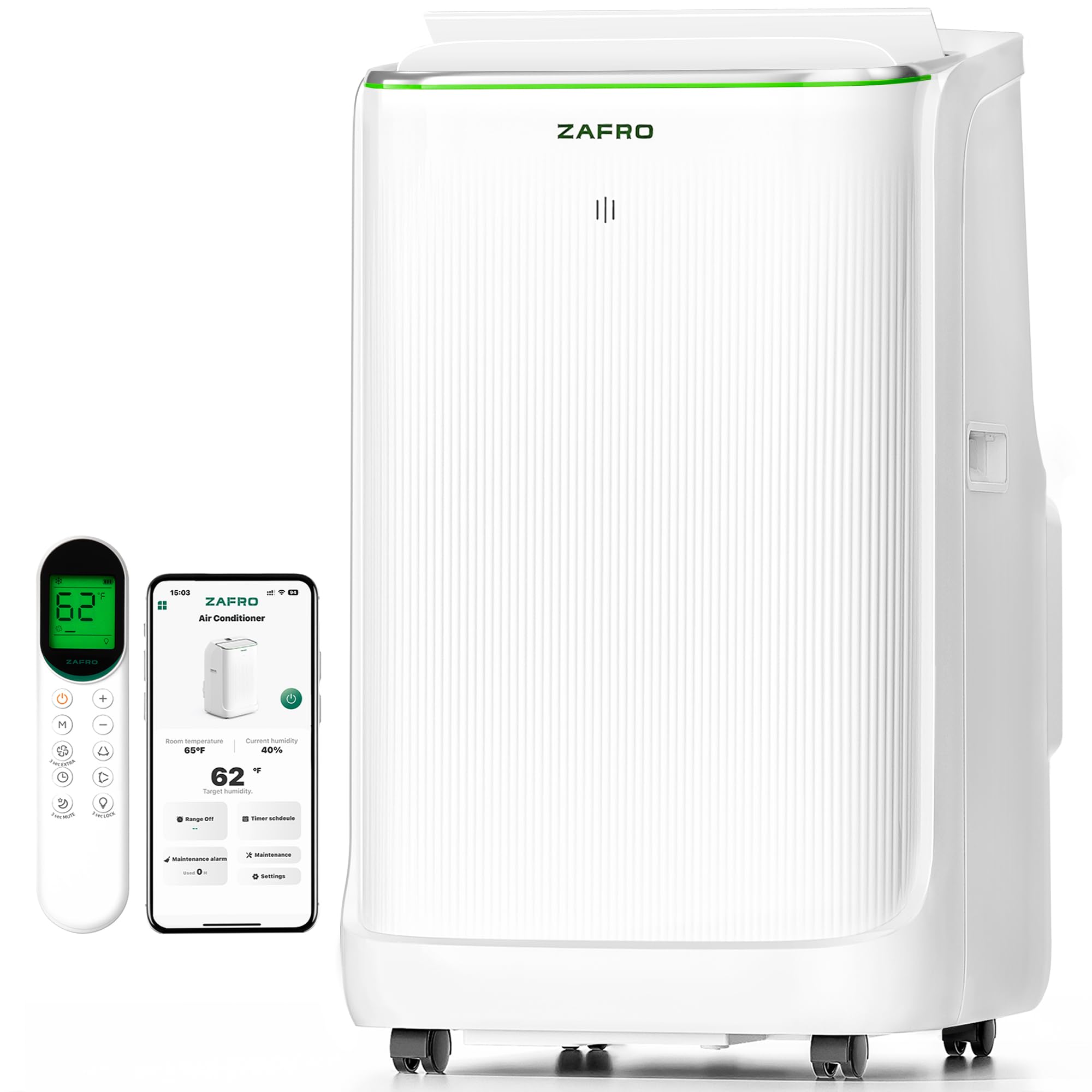
Fourteen thousand BTU on wheels with two hoses, built for the space no window unit can reach.
Dual hose is the detail that sets this portable apart from every single-hose machine in this category. Instead of pulling cooled air out of the room and dumping it outside, the two-hose system takes air in from one hose and exhausts through the other, which keeps the compressor (the part that does the cooling) running against room air rather than fighting itself. Paired with an inverter compressor (a variable-speed type that adjusts output), it delivers a high airflow of 390 cubic meters per hour and is rated for spaces up to 700 square feet — the largest coverage figure on this list. It also has an Extra Mode that locks the temperature at 61°F and runs at full power for immediate relief during a heat spike.
The energy story is where the inverter earns its place. The manufacturer rates it at a CEER (Combined Energy Efficiency Rate — one number combining cooling output and power draw) of 12.8, well above the 7.83 standard. In practice, that means the compressor adjusts frequency and speed to hold a temperature rather than cycling on and off constantly, which cuts the wasted power. The self-evaporating condensate system is the other quality-of-life feature: moisture gets thrown onto the condenser and evaporates, so in environments under 90% humidity it runs drainage-free for 72 hours. Above that, you attach the supplied drain hose. Owners running it 12 hours a day for weeks report never touching a drain pan.
Noise is the surprise here. The unit runs as low as 42 dB (decibels, a measure of sound), and owners consistently describe it as very quiet for a portable — a steady, non-annoying sound you can work or sleep through, with no rattling from the compressor. Setup is quick and the instructions are clear, and the ZAFRO app handles temperature, modes and schedules, with a 24-hour timer for pre-cooling before you get home. The physical footprint is the trade-off any portable carries: it needs floor space and a window or door for the hose panel, and it will not match a window unit for pure chill speed in a large open room. Six modes — Cool, Dry, Fan, Sleep, Extra and Eco — plus four-way oscillation cover most situations, and the included kit bundles two exhaust hoses, a drainage hose, window panels and sealing foam. At 14,000 BTU it also tops the 12,200 BTU GE Profile above on raw cooling power, though the two aim at very different installs.
Where it wins: the dual hose and inverter pairing is the most efficient portable setup on this list, rated for 700 square feet with 42 dB operation and 72-hour drainage-free running.
What to give up: it takes up floor space and needs a venting route, and no portable matches a window unit for how fast it knocks down heat in a big room.
Your match if: you have a large space, no usable window frame, and you want efficient cooling that does not need draining every day.
Go window instead if: your room has a standard double-hung window and you want the fastest chill possible.
Understanding the Specs
BTU (British Thermal Unit)
BTU measures how much heat the machine can pull out of a room, and it is the first number to match to your space. A 5,000 BTU unit handles a small bedroom, 8,000 to 10,000 BTU covers a medium living area, and 12,000 BTU and up is built for large rooms. Going far bigger than your room needs sounds tempting, but an oversized unit shuts off before it has removed the humidity, leaving the room damp. Match the rating to the square footage and let the fan speed handle the rest.
Decibels (dB) and Inverter Compressors
Decibels measure how loud the unit runs, and lower is quieter — most standard window units land in the low 50s on their quietest setting, while inverter models can run far below that. An inverter compressor is the reason: instead of switching fully on and fully off, it varies its speed to hold a temperature, which cuts both noise and wasted power. If the unit sits in a bedroom or you sleep during the day, an inverter model is worth the search. If it lives in a garage or laundry room, the standard compressor is fine.
FAQ
What size air conditioner do I need for my room?
Will a window air conditioner fit my window?
Is an inverter air conditioner worth it over a standard one?
How often should I clean the air filter?
Do I need to drain a portable air conditioner?
How loud are window air conditioners in a bedroom?
Can a window air conditioner handle a room larger than its rating?
Do window air conditioners need a special circuit?
What is the difference between BTU and SACC ratings?
Should I buy a window or portable air conditioner?
Final Thoughts: The Verdict
For the majority of shoppers, the affordable air conditioner winner is the BLACK+DECKER Window Air Conditioner 12000 BTU because it covers 550 square feet with the raw cooling power to actually drag a large room down to temperature, and it does it with a remote, a 24-hour timer, and an ozone-friendly R32 refrigerant. If you want the quietest possible install, grab the Midea 8,000 BTU U-Shaped Smart Inverter — its 32 dB operation is the closest thing to silent cooling on this list. And for a large space with no usable window frame, the ZAFRO 14,000 BTU Smart Inverter Portable is the one to reach for, thanks to its dual hose system and 700 square-foot rating. Whatever you pick, measure your window and match the BTU to your room before you order — those two numbers decide whether you get cold air or a summer of regret.
How We Picked
We do not accept paid placement. Every pick is matched to a real buyer and a real use-case; we do not hands-on test units.
Sources & Methodology
Specifications: manufacturer listings and product documentation. Review insights: verified customer reviews, as of September 2026. Pricing: not shown on this page (it changes often); check the current price via the retailer link.
As an Amazon Associate, Gadgets Feed earns from qualifying purchases. This does not affect which products we feature.