
Every affordable camcorder on the shelf claims 4K, but the gap between “records at 4K” and “looks good in 4K” is a canyon filled with tiny sensors, weak bitrates, and digital zoom artifacts. You are shopping for a tool that must deliver stable, sharp footage for family events, YouTube uploads, or live streaming without draining your savings.
I’m Min — the co-founder and writer behind Gadgets Feed. I’ve spent many hours cross-referencing sensor sizes, stabilization methods, and real-world bitrate performance to separate the truly capable video cameras from the spec-sheet mirages in this value-focused segment.
Whether you need reliable autofocus for a church service or pocket-friendly gimbal stabilization for daily vlogging, this guide breaks down the data that matters inside the best affordable camcorder category available today on Amazon.
How To Choose The Best Affordable Camcorder
Choosing an affordable camcorder isn’t just about the lowest sticker price — it’s about knowing which corners are worth cutting and which specs directly impact your final video quality. A few key decisions will set a capable, long-lasting tool apart from a camera that frustrates you within the first week.
Sensor Size: The Foundation of Image Quality
A 1‑inch type CMOS sensor captures significantly more light than the 1/2.3‑inch or 1/2.8‑inch sensors found in most entry-level and mid-range camcorders. More light means cleaner shadows, less noise in indoor settings, and richer color depth. If you plan to shoot in anything other than bright daylight, prioritize a 1‑inch sensor even if it means fewer bundled accessories.
Stabilization Type: Gimbal vs. Electronic vs. Optical
Three‑axis mechanical gimbal stabilization (found in pocket cameras like the DJI Osmo Pocket 3) physically counteracts hand-shake and delivers buttery walking shots. Optical SteadyShot inside larger camcorders like the Sony FDR-AX43 is excellent for handheld pans. Pure digital stabilization crops the frame and introduces jitter — avoid it as your primary stabilization method if you shoot a lot of movement.
Zoom: Optical Power vs. Digital Tricks
Optical zoom uses the lens to magnify light without losing resolution. A 20X optical zoom lens can frame a speaker at the back of a room while keeping full HD or 4K detail. Digital zoom (anything above 100X) crops the sensor and quickly becomes a pixelated mess. For events, sports, or wildlife, look for at least 10X to 20X optical zoom; budget that shows 800X digital zoom is marketing noise.
Audio Input: The Overlooked Dealbreaker
On‑board microphones on most affordable camcorders record thin, echoey audio. A 3.5mm external microphone jack lets you plug in a lapel mic or a shotgun mic, instantly improving spoken-word clarity for interviews, sermons, or vlogs. If the camcorder lacks a mic input, you are locked into the internal mic’s quality forever.
Outputs and Connectivity: Livestreaming and Monitoring
HDMI output allows you to monitor on an external screen or feed a live switcher. UVC (USB Video Class) support lets the camcorder act as a webcam for streaming platforms like OBS or vMix without extra hardware. A camcorder with both HDMI and UVC is far more versatile than one limited to Wi‑Fi transfer only.
Quick Comparison
On smaller screens, swipe sideways to see the full table.
| Model | Category | Best For | Key Spec | Amazon |
|---|---|---|---|---|
| DJI Osmo Pocket 3 | Pocket Gimbal | Active vlogging with smooth walking shots | 1” CMOS + 3‑Axis Gimbal | Amazon |
| Xtra Muse | Pocket Gimbal | Cinematic 4K/120 on a budget | 1” CMOS + 4K/120fps | Amazon |
| ORDRO M5 | Compact Handheld | One‑hand grip with built‑in gimbal | 3‑Axis Gimbal + 5K Sensor | Amazon |
| OPRKQEE 6K Camcorder | Kit Starter | First‑time vlogger with full accessory bundle | 18X Digital Zoom + 4500mAh | Amazon |
| iuZee PTZ Camera | PTZ Streamer | Fixed‑room live streaming (church/events) | 20X Optical Zoom + PoE | Amazon |
| Sony FDR-AX43 | Handheld Camcorder | Traditional family event recording | 20X Optical Zoom + BOSS | Amazon |
| Canon VIXIA HF G70 | Prosumer Camcorder | Professional 4K with timecode and livestreaming | 20X Optical + DIGIC DV6 | Amazon |
In‑Depth Reviews
1. DJI Osmo Pocket 3
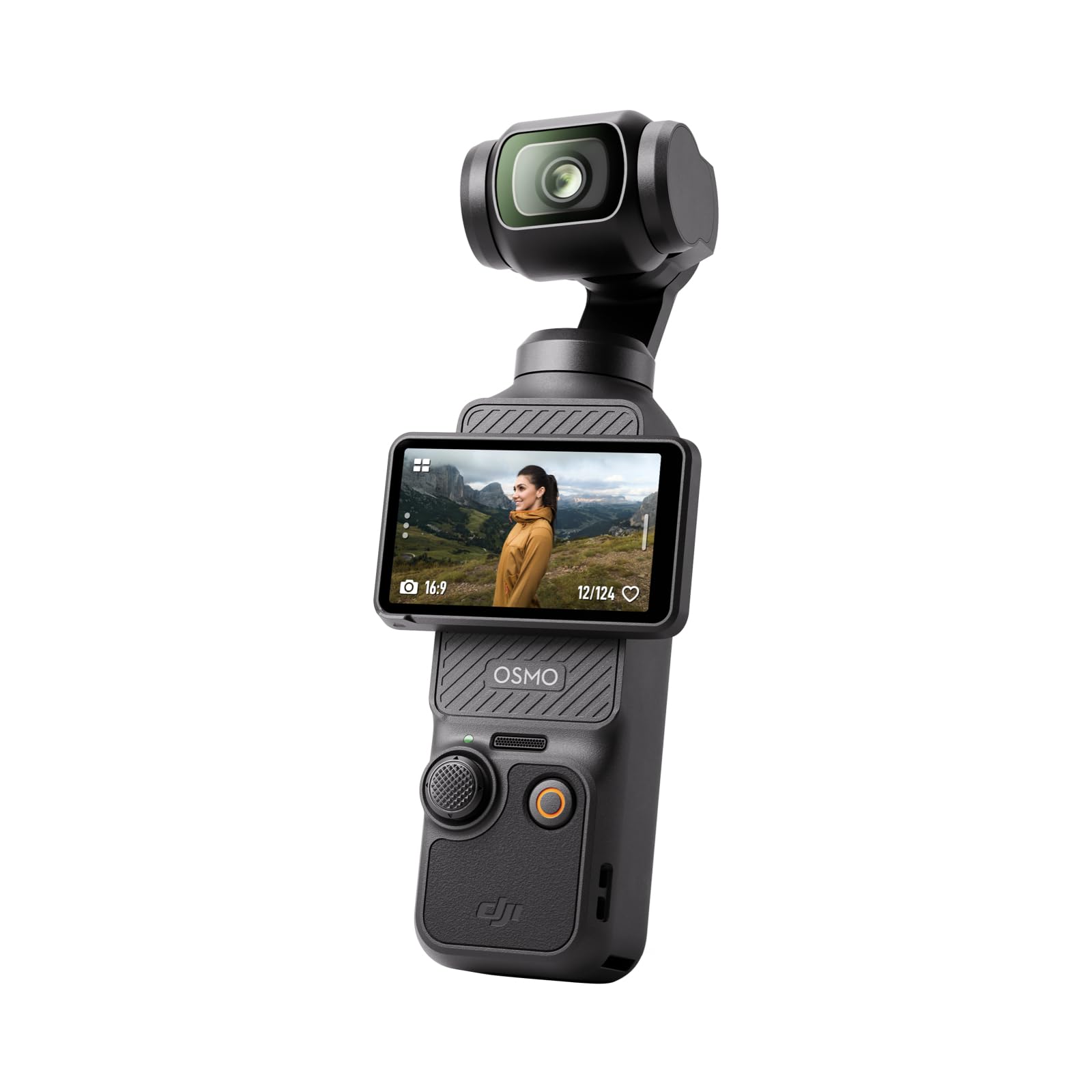
The DJI Osmo Pocket 3 packs a 1‑inch type CMOS sensor and a 3‑axis mechanical gimbal into a body that fits in a jacket pocket. Its 4K/120fps recording is genuinely usable, with clean detail and smooth slow-motion. The 2‑inch rotating touchscreen flips between horizontal and vertical framing without menu diving, a boon for cross-platform content creators.
ActiveTrack 6.0 locks onto a subject and keeps it center-frame even when you spin, walk, or dance — the gimbal motors compensate instantly. The fast autofocus system uses phase detection on the sensor, and in practice it snaps to eyes without hunting. Battery life sits around 166 minutes of continuous recording, and USB‑C charging tops it back up quickly with a PD adapter.
Audio is handled by stereo mics that are acceptable for casual vlogging, but the direct connection to DJI Mic 2 transmitters via OsmoAudio is a standout pro feature. The protective cover and 1/4‑inch threaded handle make tripod mounting seamless. This is the reference point for portable, gimbal-stabilized video that doesn’t break the bank.
Why it’s great
- 1‑inch sensor delivers professional low‑light performance
- 3‑axis gimbal enables smooth walking shots with no crop
- ActiveTrack 6.0 locks onto moving subjects reliably
- USB‑C PD fast charging for quick turnaround
Good to know
- Battery is internal and not user‑swappable
- No built‑in optical zoom; relies on digital zoom
- Charger sold separately (DJI 30W USB‑C charger recommended)
2. Xtra Muse with Mini Tripod Combo
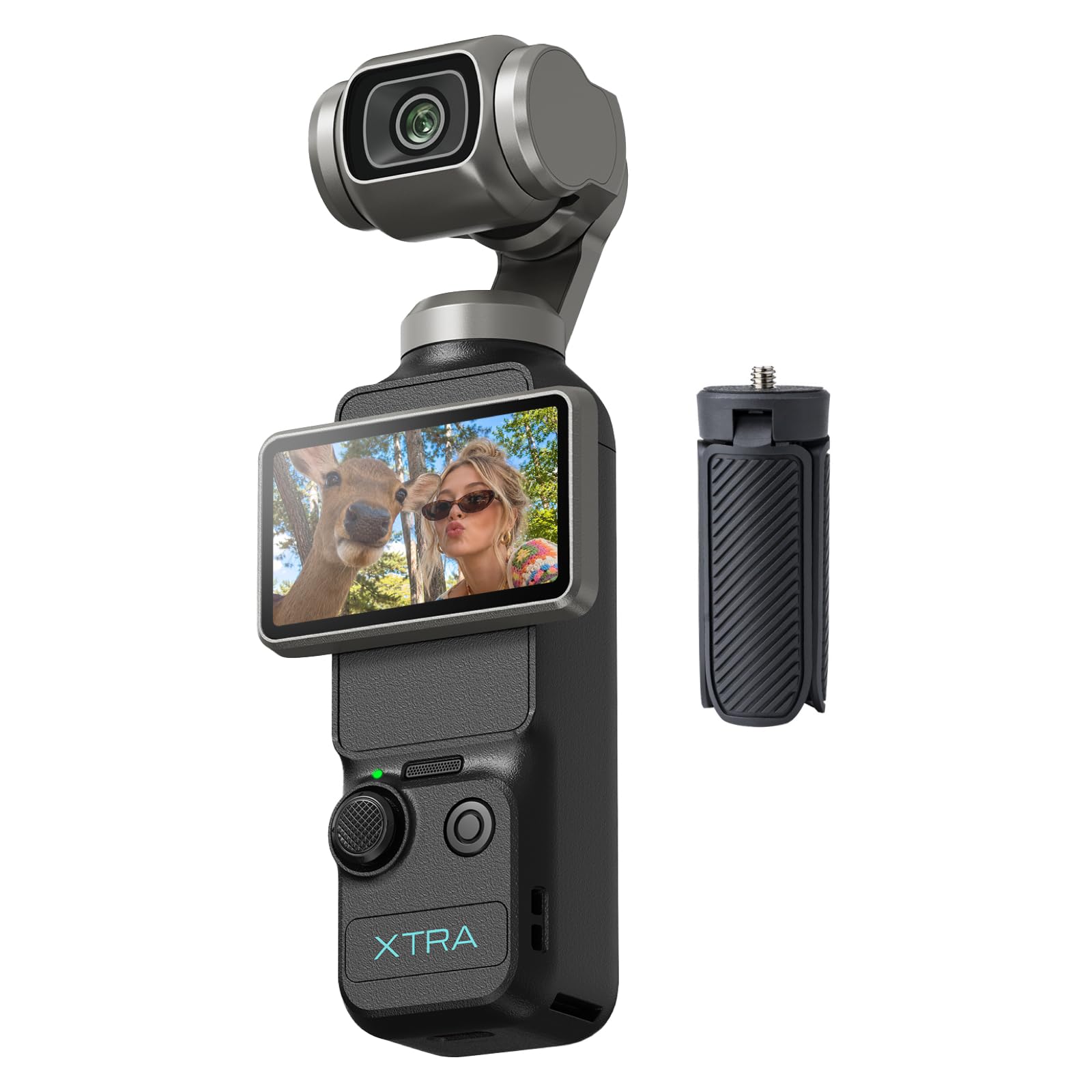
The Xtra Muse directly challenges the DJI Pocket 3 by offering the same 1‑inch CMOS sensor and 4K/120fps video capture at a lower entry point. Its built‑in 3‑axis gimbal stabilizer smooths out walking and running footage effectively. The Master Follow mode keeps you centered in the frame when the camera is mounted on a tripod, similar to ActiveTrack.
Where the Muse distinguishes itself is the X‑Log 10‑bit color mode, which records over one billion colors for more flexible grading in post. The 2‑inch touchscreen is responsive and flips orientation for vertical content. The bundle includes a carrying bag, wrist strap, and a handle with 1/4‑inch thread — enough to start shooting out of the box.
Battery life runs about two hours of continuous 4K recording, which is typical for this form factor. The USB‑C PD port allows external battery packs to extend runtime. Autofocus is fast for static and slow-moving subjects, but tracking can lose lock on erratic, fast motion. For its price tier, the Xtra Muse delivers a sensor and stabilization package that rivals camcorders costing twice as much.
Why it’s great
- 1‑inch sensor for clean low‑light footage
- 10‑bit X‑Log color space for advanced grading
- 3‑axis gimbal provides near‑Pocket 3 stabilization
- Includes tripod, bag, and handle in the box
Good to know
- Micro‑SD card not included
- No native DJI Mic connectivity
- User interface can feel less refined than DJI’s
3. Sony FDR-AX43 UHD 4K Handycam Camcorder

The Sony FDR-AX43 occupies a different lane than pocket gimbals — it is a traditional handycam with a 1/2.5‑inch Exmor R CMOS sensor and Balanced Optical SteadyShot (BOSS), a built‑in gimbal mechanism that floats the sensor assembly. The result is smooth handheld footage without clipping the field of view, even at full optical zoom reach of 20X (30X Clear Image Zoom in 4K, 40X in HD).
Fast Intelligent AF tracks subjects with reliable contrast detection, and the ZEISS Vario-Sonnar T wide-angle lens starts at 26.8mm, making it room-friendly for indoor event shooting. The Sony supports Wi‑Fi and NFC for smartphone control, plus a micro‑HDMI output for external monitoring. Highlight Movie Maker automatically creates short clips from scene transitions.
Battery life is generous — the included NP‑FV70A can record well over two hours of 4K. An external microphone input is present on the Multi Interface Shoe. The main tradeoff is size: this is a larger body with the battery protruding from the back, making it less pocketable but more capable as a dedicated camcorder with optical reach.
Why it’s great
- 20X optical zoom with steady image stabilization
- Built‑in gimbal mechanism preserves field of view
- Long battery life from NP‑FV70A pack
- ZÉISS Vario-Sonnar T lens for corner‑to‑corner sharpness
Good to know
- Battery protrudes from the rear body
- No internal storage; requires a memory card
- Sensor is smaller than 1‑inch alternatives
4. ORDRO M5 Handheld Camera 5K
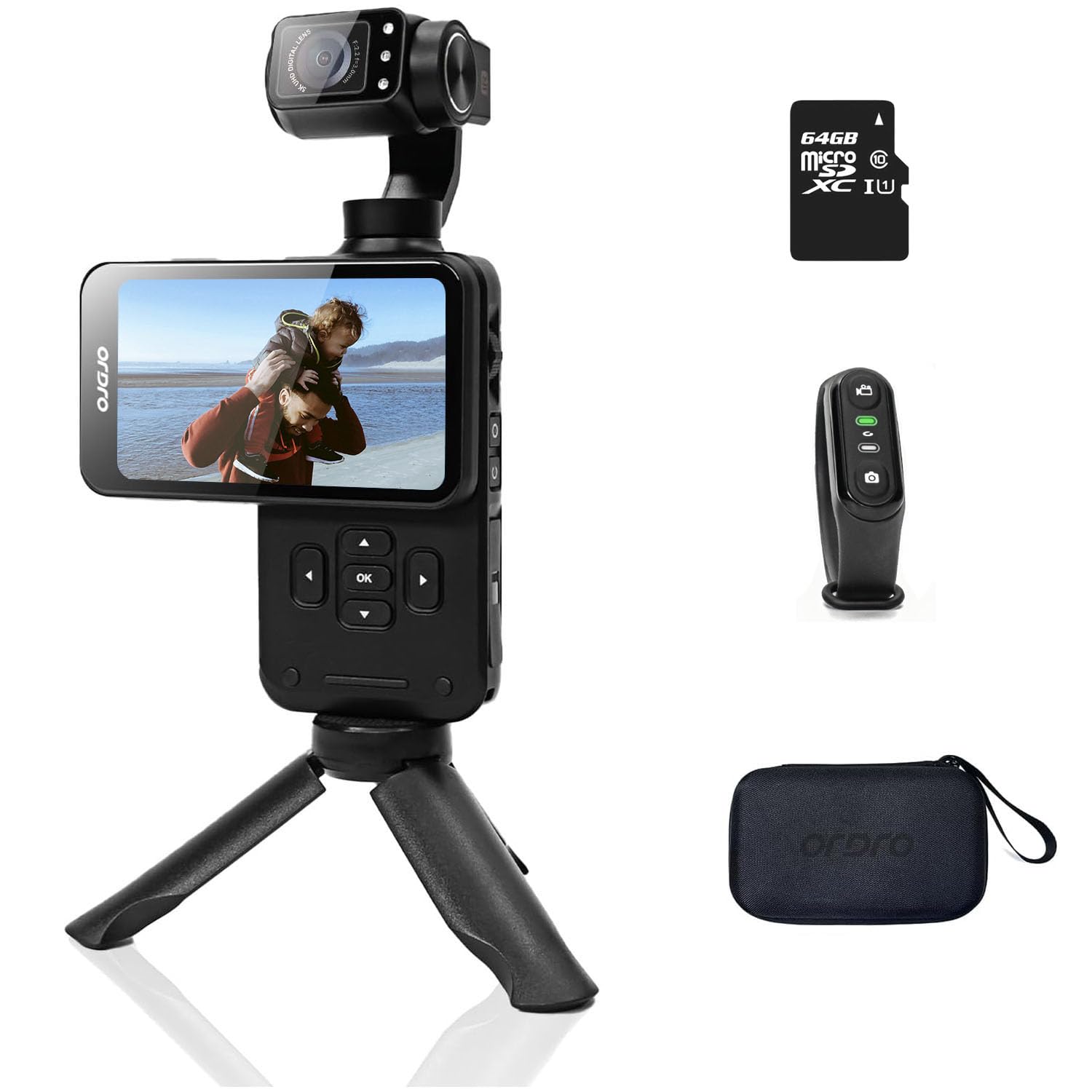
The ORDRO M5 is an ultra‑compact camera that houses a 3‑axis gimbal in a body measuring 6.2 x 2.2 x 1.8 inches — small enough to grip in one hand. It records at 5K/30fps and 4K/60fps from a 1/2.5‑inch CMOS sensor, with a 120‑degree wide‑angle lens and a 180‑degree rotating head for multiple framing angles.
Integrated IR night vision lets it capture black-and-white footage in near‑darkness. Face tracking keeps the subject centered, and PTZ mode allows configurable gimbal speed for different shooting scenarios. Wi‑Fi via the “OD Cam” app enables remote preview and file transfers. The included 64GB card and mini tripod provide a complete starter package.
Audio quality from the internal mic is adequate in quiet settings but benefits from the external microphone input for louder environments. The gimbal stabilization is effective but not as sophisticated as DJI’s — small micro‑jitter can appear in fast pans. For the price, the M5 offers a built‑in gimbal, night vision, and a compact form that fits in a soft‑shell bag easily.
Why it’s great
- Integrated 3‑axis gimbal in a packable body
- 5K/30fps resolution headroom for cropping
- IR night vision for dark venue recording
- 120‑degree wide-angle lens for selfies
Good to know
- Gimbal can show micro‑jitter at high pan speeds
- Audio quality benefits from an external mic
- Software image quality is soft in very low light
5. iuZee AI Auto Tracking PTZ Camera

The iuZee PTZ camera is a different beast — it is a fixed‑installation camera with pan‑tilt‑zoom motors designed for event livestreaming and conferencing. It features a 1/2.8‑inch sensor with 20X optical zoom and 8X digital zoom, outputting 1080p/60fps via HDMI, 3G‑SDI, USB 3.0, and Ethernet with PoE support. The 69.5‑degree horizontal wide-angle lens captures a room in a single frame.
AI auto‑tracking uses image recognition to follow a moving presenter smoothly without manual head movement. Up to 255 presets can be programmed for different stage angles or speaker positions. It works flawlessly with vMix and OBS for streamers who need a dedicated camera that won’t drift. PoE means a single Ethernet cable carries video, power, and control.
Low‑light performance is solid for a 1/2.8‑inch sensor, aided by 2D/3D noise reduction. The camera ships with a USB 3.0 cable, wall mount, and IR remote. The only caveat is that the tracking AI prefers a human subject in clear view — heavy occlusion or fast movement can break lock. For churches, classrooms, and town‑hall meetings, this is a powerful tool at a mid‑range price.
Why it’s great
- 20X optical zoom for large venue framing
- AI auto‑tracking follows presenters automatically
- PoE simplifies cabling with single Ethernet
- Three‑year limited warranty and remote assistance
Good to know
- Fixed installation — not a mobile camcorder
- Maximum video output is 1080p, not 4K
- IR remote receiver could be more visible from the side
6. Canon VIXIA HF G70 Camcorder

The Canon VIXIA HF G70 is a prosumer 4K camcorder built around a 1/2.3‑inch CMOS sensor and the DIGIC DV6 image processor. It records 4K UHD at 30fps with a 20X optical zoom lens (800X digital zoom, rarely used). An 8‑blade aperture creates cinema‑style bokeh — unusual at this price level. The Hybrid AF system with face detection delivers fast focusing in most lighting conditions.
UVC livestreaming allows direct HD streaming to a PC or Mac without a capture card. On‑Screen Display (OSD) time stamp recording embeds date, time, timecode, and user text into the original files — a requirement for event documentation and depositions. Dual SD card slots enable relay recording or simultaneous backup, crucial for long ceremonies.
The adjustable focusing speeds and manual control rings give experienced videographers granular control. Low‑light performance is the weakest point — gain increases beyond 6 dB introduce visible noise, and at 10 dB the image turns soft. The camera requires strong lighting for indoor use. Outside in good light, the G70’s video is crisp, stable, and professional.
Why it’s great
- 8‑blade aperture for bokeh background blur
- UVC livestreaming and OSD time stamp embedded
- Dual SD card slots for relay backup
- Fast Hybrid AF with face detection
Good to know
- Low‑light quality degrades above 6 dB gain
- HDMI and UVC output limited to 1080p, not 4K
- Heavy reliance on external lighting for indoor shoots
7. OPRKQEE 6K 64MP Camcorder

The OPRKQEE 6K camcorder is the most value‑packed entry in this guide, bundling a 4‑inch touchscreen, 4500mAh battery, 64GB SD card, IR night vision, external microphone, remote control, and a handheld stabilizer into one box. Its 6K (5760×3240) capability is interpolated — real detail hovers near 4K — but at typical YouTube and social media resolutions the footage looks sharp for a camera in this price tier.
The 18X digital zoom is functional at 2X to 4X, but beyond that it introduces visible pixelation. Where the camera shines is run‑time: the 4500mAh battery claims up to 4.5 hours of 6K recording, and the ability to record while charging eliminates mid-session anxiety. IR night vision works for pitch‑dark scenes using its built‑in IR LEDs.
Build quality is plastic but the camera is lightweight at 1.4 kg. Wi‑Fi via the “Hello Cam” app gives basic remote control and file download, though the app interface is basic. For absolute beginners who need a full kit — mic, card, battery, bag, and stabilizer — without adding costs, this is the most complete starter package.
Why it’s great
- Complete kit: battery, SD card, mic, stabilizer, bag
- 4500mAh battery lasts through full‑day events
- IR night vision captures in absolute darkness
- 4‑inch touchscreen for easy framing
Good to know
- 6K resolution is interpolated, not native
- Digital zoom beyond 4X is heavily pixelated
- Wi‑Fi app is basic and limited in range
FAQ
Is a 1‑inch sensor worth the extra cost in an affordable camcorder?
Why does my budget camcorder look soft when I zoom in all the way?
Can I use a pocket gimbal camera like the DJI Osmo Pocket 3 for live streams?
What is the most common mistake people make when buying an affordable camcorder?
Final Thoughts: The Verdict
For most users, the best affordable camcorder winner is the DJI Osmo Pocket 3 because its 1‑inch sensor and 3‑axis gimbal deliver professional stabilization and low‑light quality in a pocketable form. If you want the same sensor quality at a lower price, grab the Xtra Muse. And for traditional optical zoom reach in a dedicated handycam body, nothing beats the Sony FDR-AX43.