
Our readers keep the lights on and my morning glass full of iced black tea. As an Amazon Associate, I earn from qualifying purchases.
Specs are compiled from manufacturer listings and verified buyer reviews and can change over time — please confirm the key details on the product page before buying.
You want the sweeping landscape, the family reunion from a bird’s-eye view, and the thrill of flight — without burning a hole in your pocket. The real challenge is finding a drone that stays steady in the air, gets you usable video, and does not fly away on its own, all for a price that makes sense. This guide sorts six options by what truly matters: flight time, camera stability, and real-world usability, based on published specs and patterns from verified customer reviews.
I’m Min — the founder and writer behind Gadgets Feed. This guide is built by comparing the manufacturers’ published specifications and the patterns across verified customer reviews, so you get each pick’s real strengths and trade-offs instead of marketing spin.
Today’s affordable camera drones pack GPS smarts, 4K resolution (video that is roughly 4,000 pixels wide), and flight times over thirty minutes into lightweight frames under 249 grams. That weight is key: under 249 grams (about 0.55 pounds), you typically skip FAA registration if you fly for fun.
Quick Picks
- DJI Mini 3 — Best Overall
- Ruko Drone 4K UHD — Longest Flight Bundle
- Bwine F7MINI 4K Video 8K Photo — Built-In Screen
- Bwine F7GB2 Pro — High-Altitude Performer
- Potensic ATOM LT GPS Drone — Best Budget Value
- REDRIE HK33 GPS Drone — Entry-Level Price
How To Choose The Best Affordable Camera Drones
Buying your first camera drone is exciting, but the spec sheets can be a minefield. Here are the three numbers and features that separate a fun flyer from a frustrating purchase.
Weight & FAA Registration: The 249g Border
A drone weighing under 249 grams (roughly 0.55 pounds) is typically exempt from FAA registration and Remote ID requirements if you fly for recreation. That means less paperwork and a lighter, more portable drone you can toss in a daypack. Most affordable camera drones now hover right at this limit, so you get the legal freedom without sacrificing features. Stay above that weight and you will need to register with the FAA and add a Remote ID module (a small transmitter that broadcasts your drone’s location).
Flight Time vs Real Battery Life
The advertised flight time is usually measured in a hover at ideal conditions. In the real world — with wind, video recording, and camera movement — you lose about 20-30% of that number. A drone claiming 38 minutes of flight will realistically give you 25-28 minutes of usable shooting time. Extra batteries are the real answer here. A bundle with two or three batteries gives you over an hour of total airtime, which is far more practical for a day out.
Camera Quality: Gimbal is King
A 4K label on the box means little if the footage wobbles. Electronic image stabilization (EIS — a software fix that crops the frame to smooth it out) can create a jello effect in fast moves. A dedicated 3-axis mechanical gimbal (small motors that physically hold the camera level) delivers smooth, professional-looking shots even in a breeze. If you care about the final video looking smooth, prioritize the gimbal over the megapixel count.
Quick Comparison
On smaller screens, swipe sideways to see the full table.
| Model | Best For | Camera Resolution | Total Flight Time | Weight | Amazon |
|---|---|---|---|---|---|
| DJI Mini 3 | Best Overall Image Quality | 4K HDR / 48 MP | 38 min | Under 249 g | Amazon |
| Ruko Drone 4K UHD | Longest Flight Bundle | 4K / 48 MP | 96 min | 248 g | $1,099.99Amazon |
| Bwine F7MINI | Built-In Screen Convenience | 4K / 48 MP | 96 min | 249 g | $399.99$479.99Amazon |
| Bwine F7GB2 Pro | High Wind & Altitude | 4K / 12 MP | 75 min | 550 g | $339.90$434.99Ends inAmazon |
| Potensic ATOM LT | Best Budget Value | 2.5K / 3.68 MP | 80 min | 249 g | $209.99Amazon |
| REDRIE HK33 | Entry-Level Price | 4K (4096x3072P) | 45 min | 249 g | $159.99Amazon |
In‑Depth Reviews
1. DJI Mini 3

The benchmark for image quality that every other sub- drone tries to match — and fails.
The DJI Mini 3 gives you real cinematic footage without a pro budget. It uses a 3-axis mechanical gimbal (tiny motors that physically counteract every tilt and wobble), so your footage looks like it was shot from a tripod, not a toy. The camera captures 4K HDR video with Dual Native ISO Fusion, meaning you get crisp details in bright skies and shadowy trees in the same frame — something cheap sensors cannot pull off. That 48-megapixel stills capability is 48 MP versus 3.68 MP on the Potensic ATOM LT below.
You get 38 minutes of advertised flight time; buyers report the real usable time is closer to 25-30 minutes, but the battery is compatible with the Mini 4 Pro if you upgrade later. One reviewer noted the “controller screen is bright and easy” but the phone screen is “hard in sunlight.” It folds down compactly (14.25″L x 9.88″W x 2.83″H) versus the REDRIE HK33’s 11 x 7.5 x 3 inches, yet still stays under the 249-gram registration-free limit. The biggest trade-off is the lack of obstacle avoidance sensors; you must fly with your eyes on the drone, especially in tight spaces.
Why It Earns the Top Spot
- Professional-grade 4K HDR video with a true 3-axis gimbal
- 10 km (32,800 ft) HD video transmission range
- True Vertical Shooting for social-media-ready clips without cropping
The Catch You Should Know
- No obstacle avoidance — you must pilot carefully
- Propeller guards push it over 249 g, requiring FAA registration
- Owners mention the plastic body feels a bit thin
Stick with this if: you value video quality above all else and want the most trusted brand in consumer drones with the best resale value.
Look elsewhere if: you need built-in obstacle avoidance or want a bundle with multiple batteries at a lower initial price.
2. Ruko Drone 4K UHD
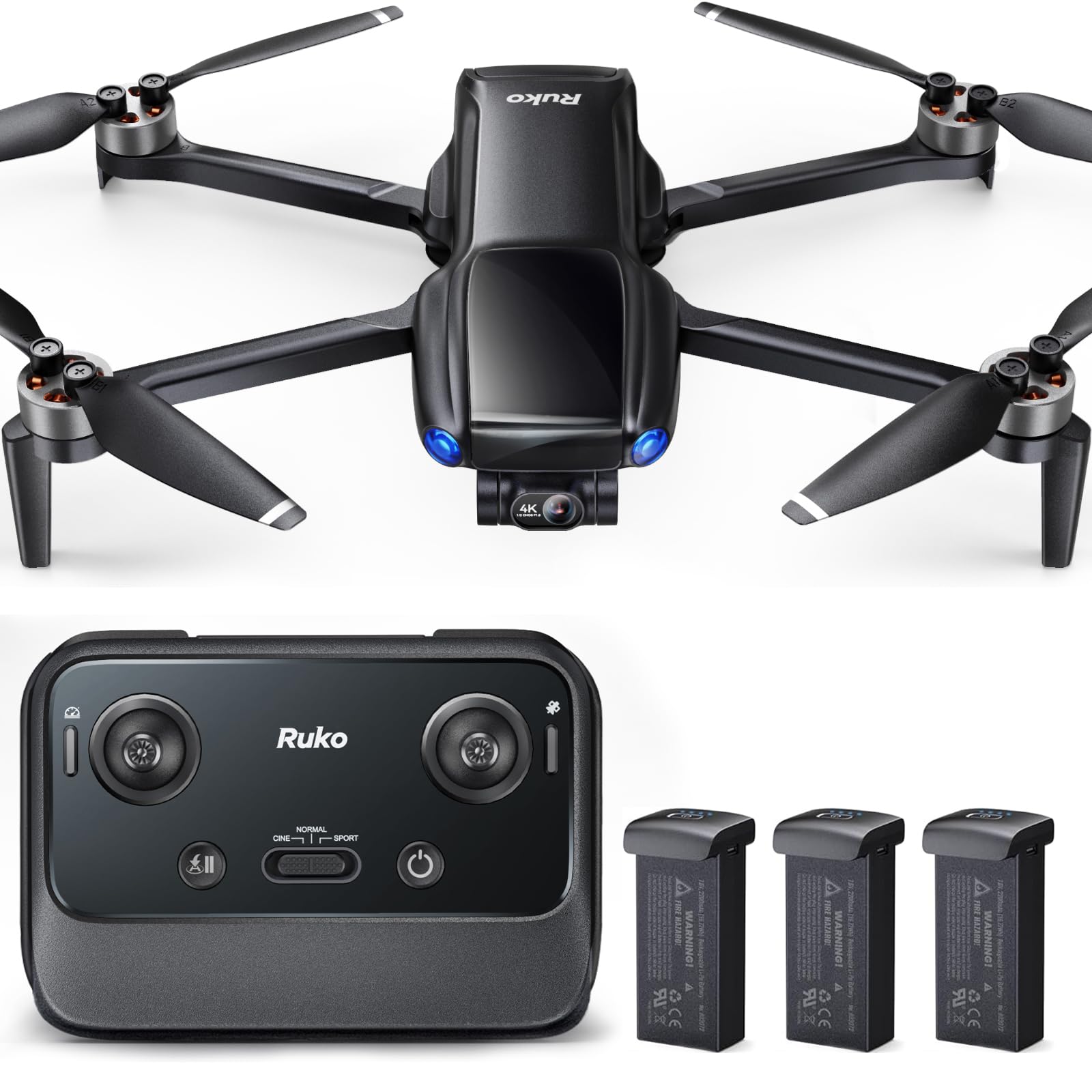
Three batteries give you nearly two hours of airtime for those long road trip shoots.
The single biggest frustration with affordable drones is running out of juice after one location. This Ruko solves that by packing three intelligent batteries (2200mAh each) into the box for a total claimed flight time of 96 minutes. It pairs that airtime with a 3-axis brushless gimbal plus electronic image stabilization (EIS) for rock-steady 4K video at 30 frames per second from a 48-megapixel 1/2-inch CMOS sensor (a common image sensor size that captures good light). The transmission range stretches to 20,000 feet using a proprietary digital system, avoiding the interference that plagues standard Wi-Fi connections.
At just 248 grams, it stays under the FAA registration threshold, and the foldable design (12.6″L x 7.56″W x 2.28″H) slides into the included hard carrying case. Customers note that the joysticks are a bit sensitive from the start, so beginners should use the lower sensitivity mode at first. It also packs a built-in beeper to help locate the drone if it lands out of sight. The catch? Reviewers noted that one unit arrived with two defective batteries, though the customer service team quickly replaced them. This is a solid pick if you want to shoot all afternoon without swapping and recharging at the car.
What You Get Extra
- 3 batteries for 96 total minutes of flight
- 20,000 ft digital transmission, no Wi-Fi interference
- AI takeoff/landing with quadruple GPS positioning
What to Watch For
- Joystick sensitivity can feel twitchy on first flight
- Battery defects reported in a minority of units (resolved by warranty)
- No built-in screen — you rely on your phone
Reach for this if: you plan long travel days and want uninterrupted flight without carrying a charger between locations.
skip it if: you prefer a dedicated controller screen so you don’t drain your phone battery.
3. Bwine F7MINI 4K Video 8K Photo
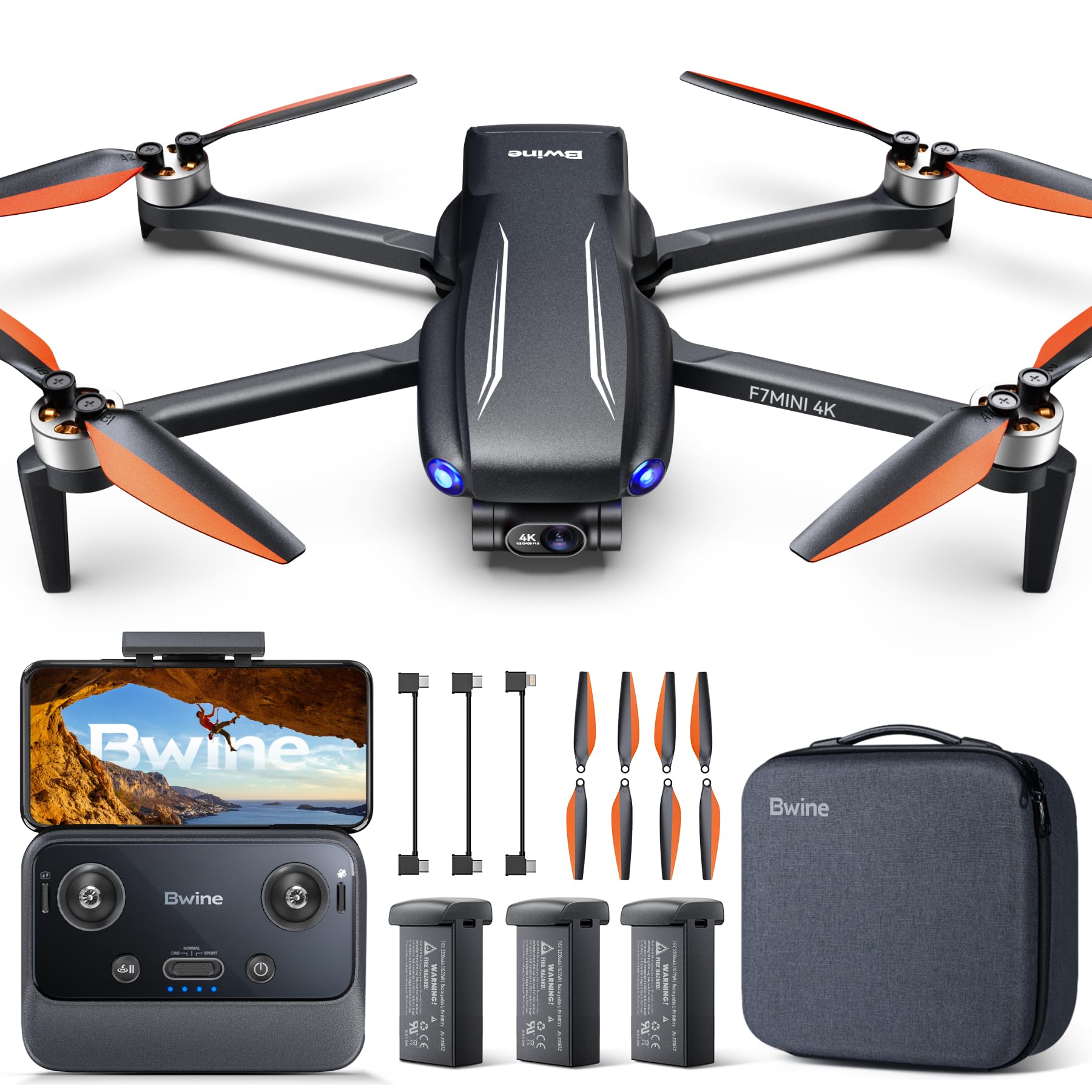
The controller screen means you never fumble with a phone mount or washout in bright sunlight.
Most drones in this price range force you to clamp your phone into the remote and hope the screen is bright enough to see. The F7MINI solves that with a built-in 5.5-inch display on the controller that stays readable even under direct sun — a feature you normally find on models costing twice as much. It shoots 4K video at 30 fps (frames per second, meaning smooth motion) and 48-megapixel stills from a 1/2-inch CMOS sensor with an F1.8 aperture (a wide lens opening that lets in more light). The 3-axis gimbal keeps the frame steady in level-5 wind conditions (breezes up to about 19-24 mph). The claimed total flight time is 96 minutes across its three 2200mAh batteries (32 minutes each), with support for PD 3.0 fast charging to cut downtime.
It stays under the 249-gram limit, so you skip FAA registration. The controller includes a 120dB locator buzzer that helps you find the drone if it lands in tall grass. Reviewers point out the remote screen is “clear, responsive” and the drone is “stable in wind.” The transmission system reaches over 6 km (about 3.7 miles), giving you plenty of room to explore a beach or mountain ridge. The optical flow positioning (a downward-facing sensor that tracks movement on the ground) lets it hover indoors when GPS is unavailable. The main limitation is the same as all sub-250g models: no obstacle avoidance, so you must fly line-of-sight and stay alert.
The Big Advantage
- Built-in 5.5″ controller screen — no phone required, visible in sunlight
- 3 batteries for 96-min total flight time with fast-charge support
- Under 249 g with FAA-exempt status
One Limitation
- No obstacle avoidance sensors
- Photo download from controller to phone is slow; use a computer
- Some buyers wanted higher than 4K video resolution
Choose this when: you hate the phone-mount struggle and want a dedicated bright screen for composing shots on sunny days.
Pass if: you already own a bright tablet or phone you prefer as your FPV screen.
4. Bwine F7GB2 Pro

Built for mountain flyers who need altitude tolerance and serious wind resistance.
Most affordable drones struggle above a few hundred feet, but the F7GB2 Pro handles takeoffs at 2,000 meters (about 6,500 feet) and level-6 wind conditions (gusts up to about 31-38 mph) thanks to its 1806 brushless motors and a built-in barometer (a sensor that measures air pressure to maintain altitude). That makes it a genuine option for people who live near hills, mountains, or open plains where the breeze picks up. It carries a 4K camera with a 120-degree FOV (field of view, meaning how wide the shot is) lens on a 3-axis mechanical gimbal plus 5x digital zoom, so you can pull in distant subjects without losing framing stability. The three 2600mAh batteries provide a total of 75 minutes of flight time, and each battery complies with UL 2054 safety testing.
The major physical difference from the others is weight: at 550 grams, it is significantly heavier than the 249-gram models, so you must register it with the FAA and install a Remote ID module (the drone comes FAA-compliant with a QR code on the arm). Its dimensions are larger but the included hard-shell carrying case keeps everything organized. Shoppers say the GPS return-to-home lands “within a few feet” of the takeoff point and the drone handles 10 mph winds comfortably. The remote’s screen can be hard to read in bright sunlight, and the camera distorts slightly on fast turns — a common trade-off at this price level for a 3-axis gimbal. It is the best pick here for anyone who needs to fly high or in blustery conditions, but be ready for the registration paperwork.
Standout Strengths
- Certified for 2,000-meter altitude takeoff and level-6 wind resistance
- 3-axis mechanical gimbal for smooth 4K footage
- FAA-compliant Remote ID pre-installed
Trade-Offs
- 550 g weight requires FAA registration and Remote ID
- Camera distorts on fast turns; remote screen hard to see in sunlight
- SD card compatibility can be picky — Samsung 128GB EVO recommended by users
Pick this if: you fly in open, windy, or elevated terrain where lighter drones get pushed around or fail to gain altitude.
pass on it if: you want a grab-and-go drone without any registration paperwork.
5. Potensic ATOM LT GPS Drone

Entry-level pricing with surprisingly long legs — 80 minutes of flight across two batteries.
The ATOM LT is for budget-focused beginners who still want GPS smarts and decent video. It uses a Sony sensor to capture 2.5K HD video at 30 fps and 2560×1440 stills, with the ShakeVanish 2.0 stabilization system smoothing out the footage. The real story is the battery capacity: two 3000mAh intelligent batteries give a total of 80 minutes of flight time (40 minutes each) versus the REDRIE HK33’s 1800mAh cells and 45 minutes total flight time. The PixSync 2.0 transmission system pushes a live HD feed up to 4 km (13,123 feet), which is excellent range at this price point.
It folds down to 3.5 x 5.6 x 2.3 inches, slips into a pocket, and weighs 249 grams, so there is no FAA registration needed. The drone uses four satellite systems (GPS, GLONASS, Galileo, BeiDou) for precise positioning, enabling auto return, follow-me, waypoint, and circle fly modes. Buyers report the camera is “good but not true 4K” and that it takes a while to grab GPS satellites, especially near buildings or trees — losing satellite lock can cause crashes, so always let it find enough satellites before taking off. The lack of a TOF chip (a downward-facing time-of-flight sensor that measures distance to the ground) means it struggles with stability in low light. For the price, you get a capable flyer with outstanding battery life, but you are trading ultimate camera sharpness and low-light confidence for that value.
Why It’s a Steal
- 80 minutes total flight time on two 3000mAh batteries
- 4 km HD video transmission with PixSync 2.0
- 4 GNSS satellite systems for accurate GPS positioning
Where It Cuts Corners
- 2.5K camera, not true 4K — video is softer than the gimbal-equipped models
- Slow GPS satellite acquisition; risk of lock loss near obstacles
- No TOF sensor — avoid low-light flying
Ideal for: the budget-conscious first-time flyer who wants long flight times and GPS safety features more than 4K video.
Not for: anyone who needs crisp 4K footage or plans to fly in low light or under heavy tree cover.
6. REDRIE HK33 GPS Drone
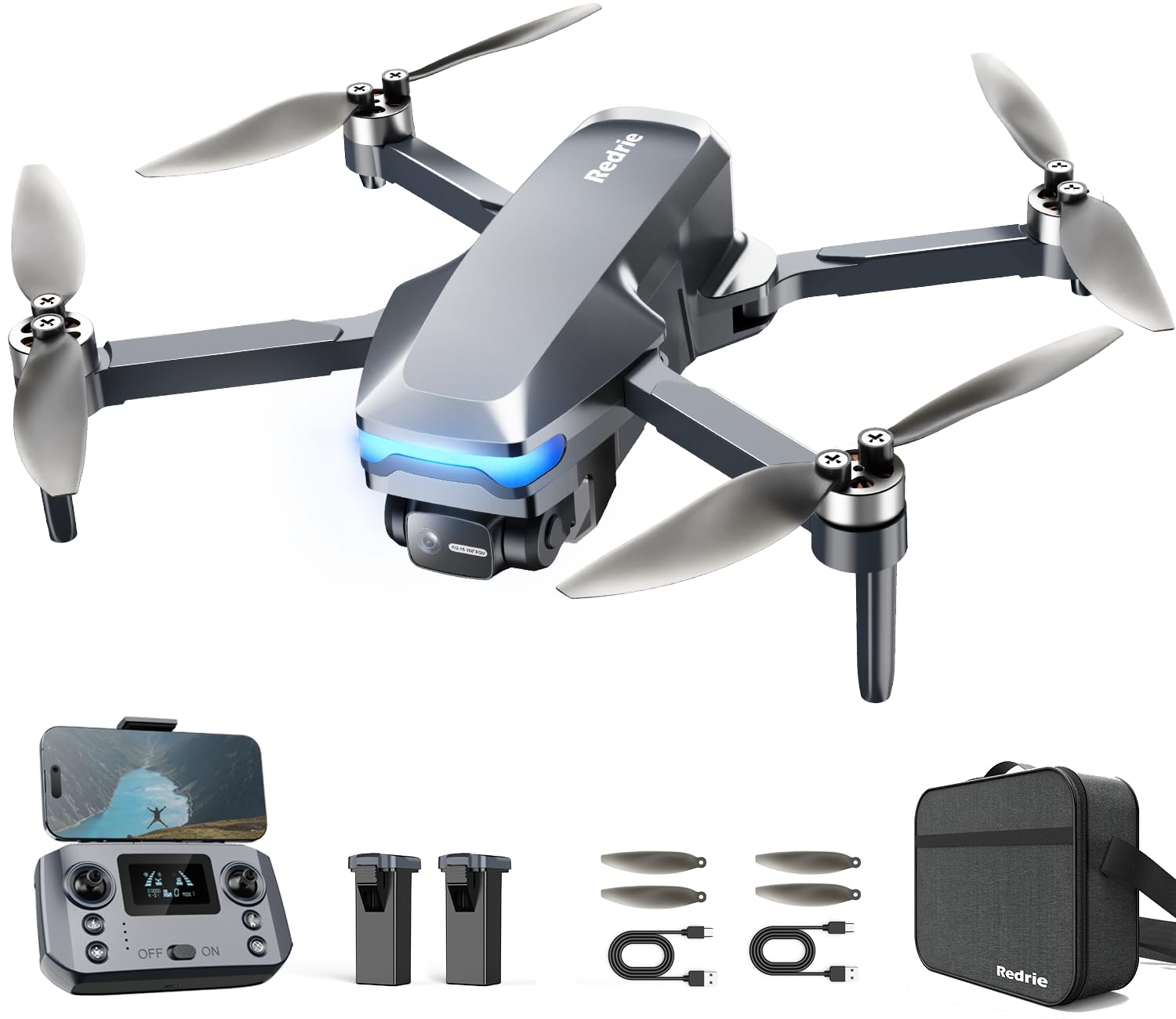
The lowest barrier to entry into GPS-assisted camera flight, with a surprisingly capable feature set.
If you are not sure drone flying is for you and want the cheapest way to try GPS features without risking much cash, the HK33 is your starting line. It shoots at 4096x3072P for stills and 2048x1088P for video through an F2.15 110-degree wide-angle lens with physical vibration reduction (not a full gimbal — the camera is fixed but the mount absorbs some shake). It connects via upgraded 5G Wi-Fi for a live video feed up to 985 feet, and the remote controller’s built-in repeater extends the range to 1,640 feet. Two 1800mAh batteries keep it in the air for a total of 45 minutes — a solid figure at this entry price.
Brushless motors give it level-5 wind resistance, which is impressive at this price, and the GPS module handles auto return, follow-me, route planning, and fly-around modes. It folds down to 11 x 7.5 x 3 inches and weighs 249 grams, keeping you off the FAA registration radar. Owners mention it is “durable” and “survives multiple crashes,” making it a good trainer, but they also note the “video quality and stabilization poor” compared to pricier models and the “camera quality mediocre but functional.” The cell phone holder on the remote is weak, and there is no mechanical gimbal, so expect some wobble in the footage. At this price tier, the HK33 is a wonderful learning tool — just do not expect the final video to look like a DJI shot.
What Impresses at the Price
- GPS auto return, follow-me, and route planning at an entry-level cost
- Brushless motors with level-5 wind resistance
- Includes carrying case, extra battery, and spare blades
What You Compromise
- No 3-axis gimbal — video is noticeably less stable than mid-range picks
- Camera resolution is decent but colors and sharpness lag behind 4K models
- Weak phone holder on the remote
Start here if: you want to learn drone flying with GPS safety nets, crash without crying, and upgrade later when you know the hobby is for you.
Move up if: stable, shareable video footage is the main reason you are buying a camera drone.
Understanding the Specs
Gimbal vs EIS: The Stability Decoder
A 3-axis mechanical gimbal uses tiny motors to physically hold the camera steady as the drone tilts, yaws, or rolls — the same technology Hollywood uses on movie sets. Electronic Image Stabilization (EIS) is a software fix that crops into the video and shifts the frame to cancel out wobble. A gimbal always gives smoother results, but EIS works well enough for casual clips and keeps the drone lighter and cheaper.
Transmission Range: What the Number Really Means
The advertised range (like 10 km or 20,000 ft) is the maximum distance in perfect, unobstructed conditions with zero interference. In the real world — with trees, buildings, hills, or other Wi-Fi signals — you will get roughly 40-60% of that number. Focus on the transmission technology: dedicated digital systems (like PixSync on the Potensic or R2 on the Ruko) resist interference better than standard Wi-Fi. Always plan to fly well within the advertised range to maintain a strong video feed and control link.
FAQ
Do I need FAA registration for an affordable camera drone?
What is the difference between a 3-axis gimbal and electronic image stabilization in a drone?
How long does a drone battery actually last during real flying?
Can affordable camera drones shoot true 4K video?
What is the “follow me” mode and does it work on budget drones?
Is a drone under 249 grams as stable as a heavier one?
Do I need a separate controller screen or can I use my phone?
What is the real-world transmission range of an affordable camera drone?
How important is obstacle avoidance on an affordable drone?
Can I fly an affordable drone indoors?
Final Thoughts: The Verdict
For the majority of shoppers, the affordable camera drones winner is the DJI Mini 3 because it delivers the best video quality with a true 3-axis gimbal, excellent transmission range, and the confidence that comes from DJI’s ecosystem and resale value. If you want the longest flight time per dollar and a stable gimbal, grab the Ruko 4K UHD with its three batteries. And for the best entry-level value that fits in a pocket and avoids FAA paperwork, the standout is the Potensic ATOM LT for learning to fly on a budget.
How We Picked
We do not accept paid placement, and we did not hands-on test every unit. Instead, we match each pick to a real buyer and use-case by comparing the manufacturers’ published specifications against the patterns in verified customer reviews — so you get each pick’s real strengths and trade-offs instead of marketing copy.
Sources & Methodology
Specifications: manufacturer listings and product documentation. Review insights: verified customer reviews, as of July 2026. Pricing: not shown on this page (it changes often); check the current price via the retailer link.
As an Amazon Associate, Gadgets Feed earns from qualifying purchases. This does not affect which products we feature.
Product prices and availability are accurate as of the date/time indicated and are subject to change. Any price and availability information displayed on Amazon at the time of purchase will apply to the purchase of this product. As an Amazon Associate I earn from qualifying purchases.
CERTAIN CONTENT THAT APPEARS ON THIS SITE COMES FROM AMAZON. THIS CONTENT IS PROVIDED "AS IS" AND IS SUBJECT TO CHANGE OR REMOVAL AT ANY TIME.
Amazon and the Amazon logo are trademarks of Amazon.com, Inc. or its affiliates.