
Our readers keep the lights on and my morning glass full of iced black tea. As an Amazon Associate, I earn from qualifying purchases.
Specs are compiled from manufacturer listings and verified buyer reviews and can change over time — please confirm the key details on the product page before buying.
Most backyard flocks are lost to the same three things: wire that bends open, a base that shifts, and a roof that sags after one wet season. If you want an affordable chicken coop that survives those three, the short answer is to buy a steel walk-in run with a waterproof cover and then reinforce the base yourself — and the CAMMOO 13.1 x 9.8 x 6.6ft run is the one that gets the closest to that from the start.
I’m Min — the founder and writer behind Gadgets Feed. This guide is built by comparing the manufacturers’ published specifications and the patterns across verified customer reviews, so you get each pick’s real strengths and trade-offs instead of marketing spin.
Below you will find nine coops sorted by what they actually do well — walk-in runs for big flocks, small wooden hutches for two or three hens, and wheeled models you can drag onto fresh grass. Wooden or metal, walk-in or movable: this is the honest breakdown of the affordable chicken coop options that hold up best once the weather and the local wildlife get involved.
Our Picks at a Glance


How To Choose The Best Affordable Chicken Coop
An affordable coop is not a smaller version of an expensive one. It is usually a lighter steel frame or a thinner fir wood build, with a cover instead of a shingled roof. That is fine — as long as you know which part you are expected to upgrade yourself. Almost every budget coop asks you to add one thing: predator reinforcement at the base.
Walk-in height versus hutch height
A walk-in run is tall enough for an adult to step inside — the ones here list heights around 6.4 to 6.6 feet, or 73 to 79 inches. That matters because cleaning, refilling water, and catching a hen all happen on your feet instead of on your knees. A low hutch tops out near 3 to 4 feet, which is fine for two or three birds but means bending every single day.
Predator gaps, not predator words
Mesh keeps chickens in. It does not automatically keep predators out. Two specifications decide that: the gap size between the wires and how well the panel is fixed to the frame. Several coops here ship with zip ties or steel ties rather than welded seams, so the base line is where you weigh things down with planks or stones. Look for a lockable door as a starting point, then plan on a skirt.
Wood or steel
Steel frames with galvanizing are made to shrug off rain and rust. Wood is quieter, warms less in direct sun, and looks better in a garden — the trade-off is that fir and pine can split, and assembly usually takes two people. Neither material is automatically better; your climate decides.
Flock numbers you can trust
Capacity claims are generous. A coop marketed for 10–20 chickens is a big run, but a hen house marketed for 2–4 birds leaves almost no room to move. Pick one size up from your current flock if you plan to add birds, and check the nesting box count independently of the bird count.
Quick Comparison
| Model | Best For | Footprint (L x W x H) | Stated Capacity | Frame Material | Amazon |
|---|---|---|---|---|---|
| CAMMOO Walk in Chicken Coop★ Best Overall | Large flocks, easiest build | 157″L x 117.7″W x 78.6″H | 10–20 chickens | Metal, Plastic, PE | Amazon |
| Metal Chicken Coop 7×6.6x6ftSmallest Footprint | Tight yards, small flocks | 84″L x 79″W x 73″H | 5–10 chickens | Metal | Amazon |
| 10 x 13.2 x 6.4 FT Metal CoopBest Big-Run Value | Big run on a mid budget | 158.4″L x 119.4″W x 78.4″H | All breed sizes | Metal | Amazon |
| PawHut 77″ Wooden Coop | Garden looks, 2 ducks | 77.25″L x 30″W x 38.25″H | Not stated | Alloy Steel, Pine | Amazon |
| NUGRIART Spire-Roof Walk-In | Most-reviewed walk-in | 157.5″L x 118″W x 79″H | 6–8 hens | Alloy Steel | Amazon |
| GOJOOASIS Wooden Coop | Small breeds, low cost | 80.7″L x 26″W x 44.5″H | 2–4 chickens | Fir | Amazon |
| MEDEHOO Mobile Coop | Rotating onto fresh grass | 82.4″L x 25.8″W x 44.1″H | 4–6 chickens | Fir | Amazon |
| Aivituvin Mobile Coop | Small flock, movable hutch | 73.38″L x 27.9″W x 43.2″H | 2–4 chickens | Fir | Amazon |
| Rupzen 9.9×13.2 FT Metal Coop | Two-room run, roosting ladder | 157″L x 118″W x 78″H | All breed sizes | Metal | Amazon |
In‑Depth Reviews
1. CAMMOO Walk in Chicken Coop, 13.1×9.8×6.6ft Chicken Run for Yard with Cover
Our pick — 4.5+★ from 250+ verified ratings; the strongest balance of quality and price.
A 13-foot run that two people can click together like oversized blocks before the hens arrive.
The number that decides whether this coop works for you is 13.1 feet — that is the length of the run, matched to a 9.8-foot width and a 6.6-foot height. In plain terms, that is a walk-in enclosure for a 10-to-20 bird flock where you stand upright to rake and refill. The door opening of 5.4 feet by 2.0 feet is wide enough to carry a waterer through without turning sideways. For scale, the PawHut wooden hutch listed further down measures 77.25″L x 30″W x 38.25″H — this run is the bigger enclosure by a wide margin in every direction.
What wins people over is how the frame goes together: 49 positive mentions centre on assembly, and the parts arrive pre-sorted with just one screw type, a pair of pliers, two wrenches and two pairs of work gloves in the box. The tubes are 0.8mm thick with reinforcement at the joints. The plastic mesh is rated for 1000+ bends at both -4°F and 176°F, so it stays taut in frost instead of sagging like thin wire. Buyers report it standing up well in wind, and one long stretch of thunderstorms did not take it down. The double-lock door is the other useful detail — the stainless steel ties hold the main frame while the plastic ties on the front door keep your forearms clear of sharp edges.
The roof is a waterproof PE tarp (polyethylene, the same material as a heavy-duty tarpaulin), and it is sun-protective, so the inside stays shaded rather than baking. The honest catch is the mesh itself: CAMMOO states plainly that it is not fully predator-proof and that you should weigh down the base with planks or stones. Material and predator resistance both land as mixed themes in the feedback, and the mesh ships as a roll you cut to size, so you will spend an afternoon on that. Treat the base skirt as part of the build, not an optional extra.
tall walk-in clearance
- 13.1ft x 9.8ft x 6.6ft walk-in space sized for 10–20 chickens
- Assembly is the most-praised thing about it — one screw type, tools included
- Mesh rated for 1000+ bends from -4°F to 176°F, so it stays taut in frost
- Double-lock door plus stainless steel frame ties
assembly takes hours
- Mesh is not predator-proof as shipped — planks or stones at the base are on you
- Mesh comes as a roll and needs cutting to size
- At 66 pounds it is a two-person build, not a solo afternoon
roomy flock fit: you keep a real flock and want to walk in upright rather than crouch over a hutch.
check door latch: budget a morning for cutting mesh and weighting the base — that reinforcement is not in the box.
2. Metal Chicken Coop 7×6.6x6ft Walk-in Poultry Cage for 5-10 Chickens
The one for a small suburban yard where a 13-foot run simply will not fit between the fence and the shed.
This is the compact end of the walk-in family — a 7 x 6.6 x 6ft cage that the maker rates for 5 to 10 chickens. Set against the CAMMOO above it is the smaller enclosure, and the capacity figure reflects that, but it hits the same 6.56-foot internal height. That height is the point: an adult can walk in and out without stooping, which is the difference between a coop you clean weekly and one you avoid.
The structure is a galvanized steel pipe frame (galvanizing is a zinc coating that resists rust), and the roof cover is UV- and water-resistant with a slope so rain, debris and light snow run off instead of pooling. The walls use PVC-coated hexagonal wire mesh — a six-sided wire pattern with a plastic skin over the metal — and the small gaps between the wires help keep chickens in and most crawling predators out. Assembly comes in as the loudest positive theme by a clear margin, with quality close behind, and the instruction sheet holds up well enough that two people can get it square. The review pages sum it up simply: it keeps chickens in and hawks out.
Here is the part to plan around. The zip ties in the box are not nearly enough to finish the job comfortably, so buy a bag of UV-rated ties before you start. Wire strength itself draws split opinions, so if you have heavy raccoon or fox pressure, layer hardware cloth over the lower two feet. And if you keep ducks, this works — it is repeatedly called ideal for chickens and ducks — but the run is shallow enough that a big flock will outgrow it fast.
extra headroom inside: 6 feet of standing room in a 7-foot footprint is the whole sell — it fits a small yard without turning coop care into a chore done on your knees.
thin roof panels: the included zip-tie count. It is a small annoyance, not a structural problem, but it means a second trip to the hardware store.
small coops work: five to ten hens on a tight lot where access height matters more than floor area.
flimsy in wind: your flock will grow past ten birds, because this run has no room to expand.
3. 10 x 13.2 x 6.4 FT Metal Chicken Coop, Chicken Run with Cover
Almost the same floor space as the top pick, for a flock that needs room to scratch and nothing more.
The overall dimensions here are 158.4″L x 119.4″W x 78.4″H, which puts it in the same big-run class as the CAMMOO rather than the small 7-foot cage above it. This is the one to look at if you want walk-in dimensions without paying for the heaviest frame in the lineup. It carries a reinforced metal latch on the door rather than a double-lock, and the roof is a removable PE cover — peel it off in a heat wave for airflow, tie it back down when the rain arrives.
The steel frame is high-strength and galvanized, and the walls are PVC-coated hexagonal mesh with tight, evenly sized gaps. In practice that means decent ventilation and a barrier that keeps foxes and raccoons from simply pushing through. What buyers keep coming back to is how it looks — the appearance theme is the most-praised thing here, with assembly and value right behind it. As owners put it, the chicks take to it straight away. Two people are needed for setup, and all instructions and hardware are included, so there is no mystery bag of bolts to decode.
A few things narrow the fit. The feedback pool on this one is thinner than on the big names, so you are buying on published specs more than on a long track record. The manufacturer leans on heavy-duty zip ties for extra predator protection — good, but zip ties age in sunlight, so re-check them each season. Beyond chickens, the maker lists rabbits, ducks and cats, and even a protective greenhouse for tender plants, which is a genuinely useful second life if the flock ever goes.
flat ground pick: a buyer who wants maximum run for the outlay and does not need a frame rated for the heaviest weather.
verify pipe gauge: the removable PE roof is a seasonal job — expect to re-tie it a couple of times a year.
4. PawHut 77″ Wooden Chicken Coop with Nesting Box
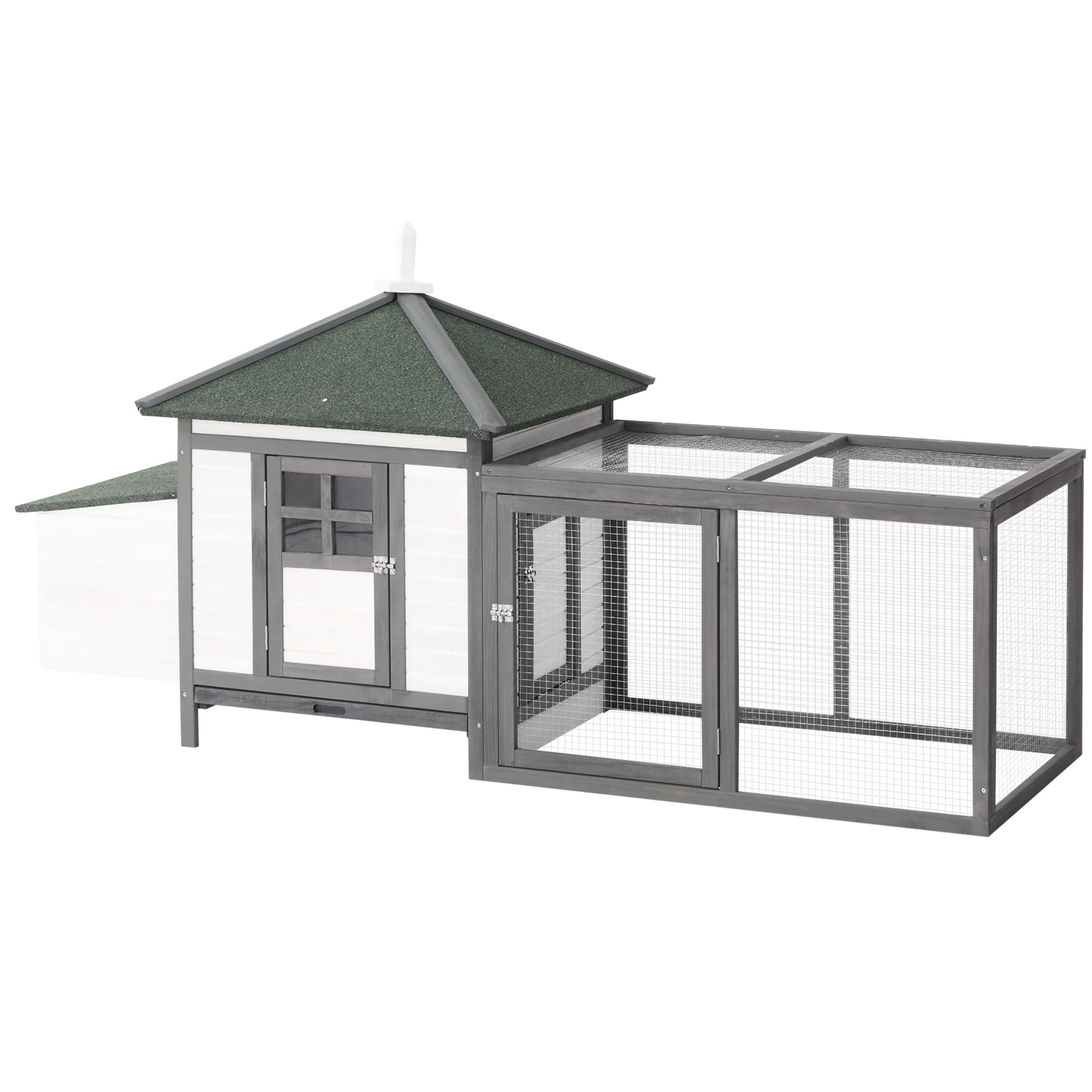
A pine hutch that looks like garden furniture, sized honestly for two ducks rather than a laying flock.
This is the pick where the number to read is not the bird count but the overall dimensions: 77.25″L x 30″W x 38.25″H, on a 55-pound frame of fir wood and alloy steel. Compare that to the CAMMOO’s 158.4-inch length and the difference is obvious — this is a hutch with an attached run, not a walk-in. It works beautifully for a pair of ducks, which is exactly how owners describe using it. It is also the pick for someone who wants the coop to disappear into a flowerbed instead of dominating the lawn.
The feature set is built around daily handling. A hinged-top nesting box lets you lift the lid and collect eggs without stepping inside. A ramp with a screened window handles access and airflow, and the asphalt roof plus painted fir walls shed rainwater. The slide-out tray collects droppings so cleaning is a two-minute job. Three lockable doors give you a way into the nest box, the coop and the run separately. Appearance is what owners praise most, and functionality sits right behind it — it is a good-looking piece of outdoor furniture that happens to house birds.
Go in with clear eyes on scale. Size is the most-discussed theme in the feedback and it breaks negative, so measure your birds before you buy — this is a two-to-three-bird home, not a flock solution. Build quality and sturdiness split opinion, with some units arriving with split wood, and assembling the roof is easier with two people. None of that makes it a bad buy; it makes it the wrong buy for six hens. For a pair of ducks or a small bantam trio in a visible garden spot, it is the prettiest thing on this list.
nesting box included: hinged nest box, sliding tray and three separate lockable doors mean you never wrestle the whole unit open to grab an egg.
wood needs sealing: 77.25 inches long sounds generous until you picture two full-grown hens in it. Keep the flock small and it is a delight.
backyard starter: a two-duck or small-bantam household that wants a coop guests compliment.
paint it early: a laying flock of five or more — the run simply will not hold them comfortably.
5. NUGRIART Large Metal Chicken Coop Walk-in Poultry Cage with Spire Roof

The spire-shaped roof is the tell — this is the walk-in run that does not let snow sit on top of it.
At 157.5″L x 118″W x 79″H, this NUGRIART run is virtually the same footprint as the CAMMOO, and it is the most reviewed product on this list — 4.0+ stars across 500+ ratings. If you want the reassurance of a large, established feedback pool behind a big metal run, that is a legitimate reason to start here rather than with the top pick.
The design choice that separates it is the spire roof. The canopy frame peaks so rain, snow and debris slide off instead of collecting in a sagging pocket — a real difference over a winter if you live anywhere that gets load. The cover is sunscreen and waterproof PE, and the frame is stainless and galvanized steel for rust resistance. Assembly is the single most-praised aspect by an enormous margin, and the pieces click together rather than needing a bolt-by-bolt build. Owners describe it as perfect for 6 to 8 hens, with enough room left over for a large water source, and it handles ducks, geese and rabbits as readily as chickens.
The wire is where you should slow down. Wire quality is the loudest negative theme in the feedback — it is described as thin — and durability, zip ties and predator resistance all land as mixed. Translation: the frame is the strong part, the mesh is the part to upgrade. If you have serious night-time predator pressure, run hardware cloth around the base yourself. Do that and you keep the easy build, the big footprint and the drainage, and lose the only weak link.
spire roof sheds rain: a roof that drains instead of pools — the difference between a cover that lasts seasons and one that sags and tears.
weak wire mesh: the frame will outlast the mesh, so budget for a hardware-cloth skirt from day one.
rainy climate pick: you want a large walk-in run with a proven assembly experience and a roof built to shed weather.
reinforce the mesh: you want predator protection straight from the start — this needs your own wire reinforcement.
6. GOJOOASIS Wooden Chicken Coop for 2-5 Chickens

An improve fir hutch with a ramp and a slide-out tray — the entry point into chicken keeping.
Reading the specs, the overall build is 80.7″L x 26″W x 44.5″H, holding up to 2 to 4 chickens on a 56-pound fir frame. The main house sits improve, which keeps the sleeping area up off wet ground — that is the single best thing this design does, and it is why beginners gravitate to it. The roof is green asphalt on a slope, so rain runs off the painted fir rather than soaking in.
Daily use is sorted. A sliding door and ramp get birds into the raised housing, and the ramp has timber ridges so nobody slides backward on the climb. A removable bottom tray slides out for cleaning, and there is an attached wire enclosure for daytime scratching. Heavy-duty galvanized wire fencing handles ventilation and the predator barrier at the same time. What owners like most is how it looks, with assembly close behind — it goes together without much drama against the manual.
This is the honest part of the list. Sturdiness and build quality are the loudest themes here and neither reads positive, with the size theme joining them. Some units report the wood splitting, and there are the usual complaints about value at this tier. For a small-breed trio in a sheltered backyard this is a fine, low-cost way in — but it is a starter coop, not a permanent structure. If your winters are hard or your predator pressure is high, spend the extra on a metal run instead of asking this hutch to do a job it was not built for.
two hen setup: a first-time keeper with two or three small-breed birds and a sheltered yard.
count your birds: fir this thin is a starter material — do not count on it as a decade-long build.
7. MEDEHOO Mobile Chicken Coop with Wheels for 4-6 Chickens
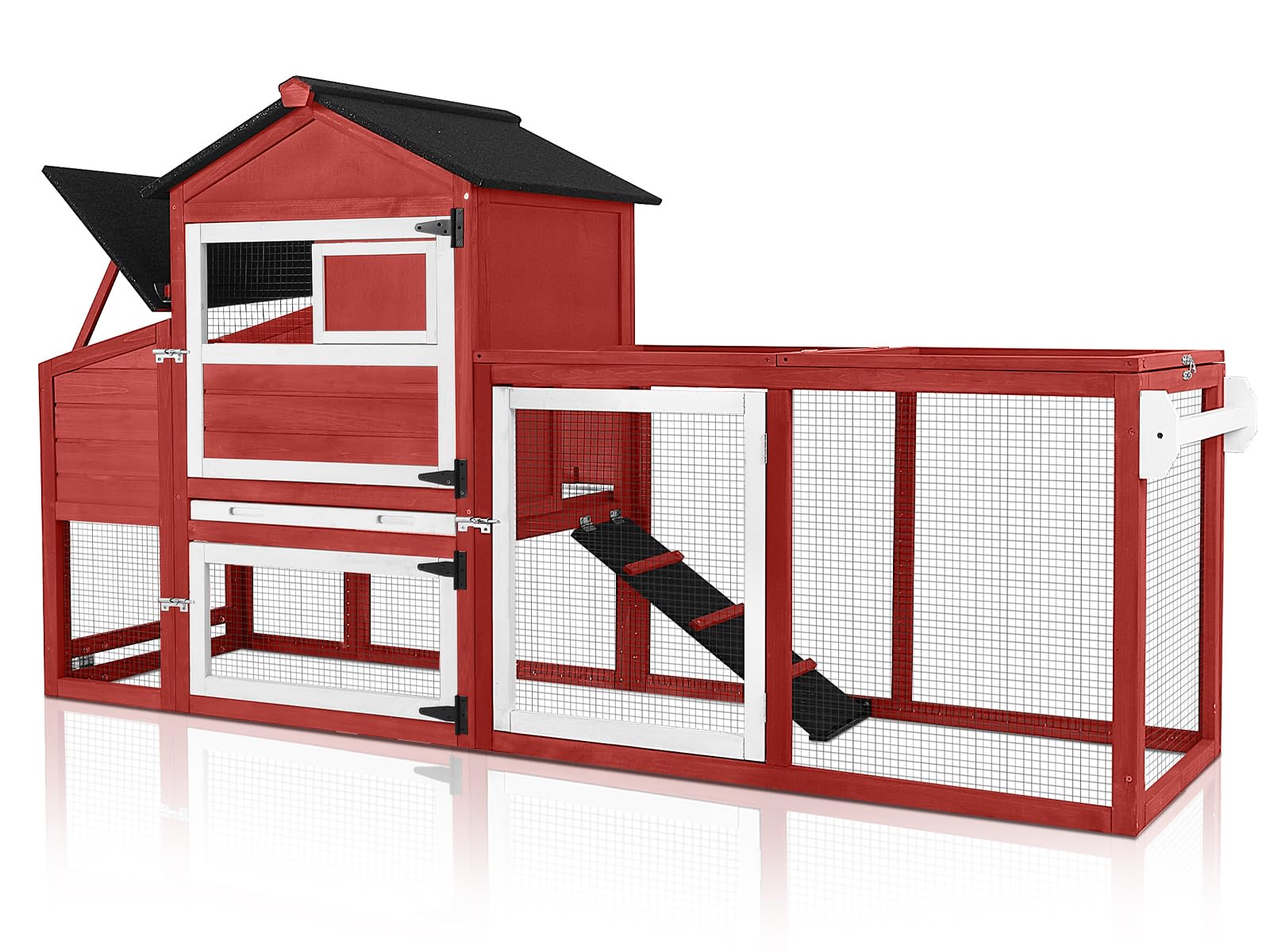
Two wheels and a handle, so the coop follows the grass instead of wearing a bare patch into it.
If you have ever watched a fixed coop turn its run into mud, this is the answer. Two durable wheels and a side handle let you roll the thing onto fresh grass, into shade during a heat wave, or under shelter before a storm. Rolling onto fresh grass beats any spec on the sheet for keeping birds healthy. The size is 82.4″L x 25.8″W x 44.1″H for 4 to 6 adult chickens, and the frame is FSC-certified wood — a certification that the timber comes from responsibly managed forests.
Around that mobility sits a genuinely useful set of details. The nesting box gets a predator-proof lock plus an extra-large guard underneath, which blocks raccoons and foxes from reaching in from below. The roof is fully waterproof with reinforced PVC covers, and three screened ventilation windows in the sleeping area keep airflow moving and odour down. Removable sliding trays empty in seconds, and pre-drilled holes mean the build is rated under 45 minutes. Assembly is what people like most about it, and it reads as good value for what you get.
Size and durability both draw split opinions, and durability is the theme that skews negative — some units start coming apart, and sturdiness is questioned against serious predators. So treat this as a movable daytime home in a fenced yard rather than a fortress. The wheels are the reason to buy it; if you never plan to move your coop, a fixed run gives you more structure for the same outlay.
rotating pasture use: you want the flock on rotating fresh grass and a build you can finish in under 45 minutes.
firm soil only: a yard with heavy fox pressure and no fencing — the guard helps, but the frame is not a fortress.
8. Aivituvin Chicken Coop Mobile Chicken House on Wheels (Grey)

The small grey hutch that rolls on two wheels and doubles as a rabbit or duck home.
Everything on this one is sized around a small flock: 73.38″L x 27.9″W x 43.2″H, which the maker lists as great for 2 to 4 chickens, rabbits, ducks and other small animals. Build quality is what wins people over here — it is the most-praised aspect by a wide gap, with assembly and value close behind. For the footprint, it feels more solid than the price tier suggests, and the fir frame with pre-drilled holes makes the build straightforward.
The weather gear is better than you would expect at this level. A waterproof asphalt roof pairs with a 100% UV-proof panel over the run area, so birds get sunlight without the burn. Inside, two round-edge perches sit above the tray for roosting, and the pull-out tray slides from front and back, which means you can clean from whichever side is easier on the day. Three big front doors plus heavy-duty galvanized wire mesh and a predator-resistant spring latch cover access and security together.
The honest limits are scale and stiffness. Size is the most-discussed theme in the feedback and it splits — fine for 2 or 3 full-grown chickens, tight beyond that. Sturdiness and durability also split, with most units holding up and a minority arriving less rigid than hoped. If you want a movable hutch for a handful of birds and you like the idea of a coop that also houses a rabbit, this is a sensible match. For a larger flock, look at the metal walk-ins higher up this list.
lawn rotation plan: a two-to-three-bird household that wants a movable wooden hutch with proper UV protection over the run.
upgrade for more: you keep four full-grown hens or more, where the run gets cramped fast.
9. Rupzen 9.9×13.2 FT Metal Chicken Coop, Walk-in Poultry Run Enclosure

The only run on this list that ships with a five-tier ladder, so birds climb instead of huddle on the ground.
Most metal runs give you a frame and a cover and call it done. This one adds a 55″L x 40″W metal chicken perch with a five-tier design — chickens climb, rest and exercise on it, which keeps them up off the ground and makes cleaning underneath simpler. Around it sits a 157″L x 118″W x 78″H welded steel frame with galvanized rust protection and PVC-coated hexagonal wire mesh, laid out as a two-room run.
The roof uses 210D waterproof and UV-resistant Oxford cloth. The “D” is a denier count — a fabric weight measure — and 210D is a mid-weight outdoor cloth rather than a thin tarp. The shed frame peaks in a spire so rain and snow drain instead of pooling. Assembly is the most-praised thing here by a wide margin, with size close behind — this is a run people find straightforward to put up and roomy once it is standing. Functionality and value both land positive as well.
Now the caveat that matters most on a big steel run: the frame and the wire are not the same quality story. Durability draws split feedback, with welds reported breaking on some units, and chicken-wire quality splits between praise for the quantity supplied and notes that it is weak. The wire is the part to inspect and reinforce at the base before winter. Judge it as a well-priced, easy-to-build two-room enclosure with a roosting ladder thrown in — and set aside one afternoon to beef up the mesh.
two connected rooms
- Five-tier 55″L x 40″W roosting ladder keeps birds off the ground
- 157″L x 118″W x 78″H steel frame split into two rooms
- 210D Oxford cover with a spire roof that drains rain and snow
- Assembly is the standout theme — this goes up without a fight
door gaps noted
- Wire quality is inconsistent — some find it weak for predator duty
- Welds have been reported breaking on a minority of units
- You will want hardware cloth at the base before the first cold snap
split flock layout: a bigger flock and a keeper who likes the idea of birds exercising on a ladder rather than pacing dirt.
seal the gaps: one afternoon of wire reinforcement before precipitation season — the frame is the strong part of the package.
Understanding the Specs
Mesh, wire and predator gaps
Hexagonal mesh is a six-sided wire pattern, and PVC-coated means each wire is sealed inside a plastic skin that slows rust. The gap between wires decides what can walk in: smaller gaps keep out more predators, larger gaps let in more air. A lockable door is a start, but the base line is where most coops fail — buried hardware cloth or a plank-and-stone skirt is the actual barrier. Several coops here ship with zip or steel ties instead of welded seams, so check those ties each season.
Flock capacity vs. footprint
Capacity claims are written for the best case. A run listed for 10–20 chickens is genuinely large; a hutch listed for 2–4 birds is a small home. The number to compare is floor length by width, not the bird count. Walking height matters just as much — 6.4 to 6.6 feet lets an adult stand inside, while a 38-inch hutch means bending for every feed and clean. If you plan to add birds later, buy one size up now.
Roof materials and weather
PE tarp (polyethylene) is a light waterproof cover — quick to fit, removable in heat, but it ages in sun. Asphalt over fir or pine is heavier and sheds rain well, though the wood beneath can split over time. Oxford cloth with a denier rating is a woven outdoor fabric; a spire or sloped frame drains water rather than letting it pool and sag. In snow country, drainage shape matters more than the material itself.
Wood versus galvanized steel
Galvanizing is a zinc coating that resists rust, and steel frames generally shrug off rain longer than thin fir. Wood is quieter, cooler in direct sun, and blends into a garden. Fir and pine are both softwoods that can split, especially with over-tightened screws. Neither material wins outright — steel for exposed, wet, windy sites; wood for sheltered backyards where looks count.
Mobility: wheels and handles
A mobile coop carries two wheels and a handle so you can roll it onto fresh grass. That prevents the bare, muddy patch a fixed run creates. The trade-off is structure: a wheeled wooden hutch is generally lighter built than a fixed steel run, so it suits fenced yards and daytime use rather than heavy predator pressure. Pre-drilled holes make these faster to assemble than the big walk-ins.
Roosting and nesting features
A roosting perch keeps birds off the ground at night, and a nesting box with a hinged lid lets you collect eggs without stepping in. A slide-out or pull-out tray collects droppings for quick cleaning. A ramp needs ridges so birds do not slip backward on the climb, and an improve house keeps the sleeping area off wet ground. These small parts decide whether the coop is a pleasure or a chore to maintain.
FAQ
Is a metal chicken coop or a wooden hutch better for a backyard flock?
How many chickens will a coop listed for 10 to 20 birds actually hold comfortably?
Do I need to add my own predator protection to an affordable coop?
How long does the PVC-coated wire mesh on these coops last?
Can I use a chicken coop for ducks or rabbits instead?
What does walk-in height actually mean for a coop?
Is a mobile coop on wheels worth it compared with a fixed run?
How long does assembly take on these coops?
Do thesecoops need a covered run, or is a roof enough?
Will a small wooden hutch survive winter in a cold climate?
Final Thoughts: The Verdict
For most backyard keepers, the affordable chicken coop winner is the CAMMOO Walk in Chicken Coop, because 13.1ft x 9.8ft x 6.6ft gives you genuine walk-in room for 10 to 20 birds and the easiest build on the list — one screw type, tools in the box, and 4.5+ stars across 200+ ratings. If you want a large run with proven drainage and a big feedback pool, grab the NUGRIART Spire-Roof Walk-In. And for a small flock you want to roll onto fresh grass, the MEDEHOO Mobile Coop is the one to reach for, with its two wheels and FSC-certified wood frame.
Whichever you pick, the same rule holds: an affordable coop is a frame and a cover, and the predator protection is the part you finish yourself. Spend one afternoon on a hardware-cloth skirt at the base and you convert a budget enclosure into one that lasts.
How We Picked
We do not accept paid placement. Every pick is matched to a real buyer and a real use-case; we do not hands-on test units.
Sources & Methodology
Specifications: manufacturer listings and product documentation. Review insights: verified customer reviews, as of November 2026. Pricing: not shown on this page (it changes often); check the current price via the retailer link.
As an Amazon Associate, Gadgets Feed earns from qualifying purchases. This does not affect which products we feature.