
Every generation of smartphones pushes computational photography further, yet none can replicate the optical reach of a dedicated zoom lens or the tactile feedback of a physical shutter button. When your subject is 100 feet away at a concert, a wildlife trail, or a sporting event, the digital crop on a phone sensor simply dissolves into noise. That gap is exactly where a purpose-built compact camera steps in — delivering real optical magnification, a larger sensor, and dedicated controls that put you in command of the final image rather than an algorithm.
I’m Min — the co-founder and writer behind Gadgets Feed. I’ve spent hundreds of hours cross-referencing sensor sizes, zoom ratios, stabilization systems, and autofocus architectures across the current compact camera landscape to separate genuinely capable hardware from dated marketing specs.
This guide breaks down nine seriously capable options to help you find the best affordable compact digital cameras for your specific shooting style, whether you prioritize reach, video, or portability.
How To Choose The Best Affordable Compact Digital Camera
The compact camera market splits sharply along the axis of zoom range versus sensor quality. A superzoom with a 24-1200mm equivalent lens is the only way to photograph a distant eagle without a tripod, but that reach uses a tiny 1/2.3-inch sensor that struggles in dusk light. A 1-inch sensor camera with a shorter 24-70mm zoom delivers vastly better image quality in low light but can’t reach across a stadium. Your decision lives at the intersection of these two trade-offs.
Optical Zoom Range and Reach
Ignore digital zoom entirely — it is just cropping the image. The optical zoom number tells you the magnification factor. Look for the 35mm-equivalent focal range. A 24-720mm lens (30x zoom) can bring a performer on stage into tight portrait framing, while a 20-1200mm lens (60x zoom) reaches wildlife and lunar detail. Wider starting points like 20mm or 24mm also capture expansive landscapes before you zoom in.
Sensor Size and Low-Light Capability
The physical area of the sensor dictates photon collection. A 1-inch sensor (used in the Sony ZV-1F) gathers roughly four times more light than a 1/2.3-inch sensor common in superzoom compacts. That translates directly to cleaner files at ISO 1600 and above. For indoor shooting, evening events, or handheld dusk shots, prioritize larger sensors. For bright daylight or well-lit concerts, the smaller sensor in a superzoom delivers acceptable results paired with its stabilization system.
Stabilization at Maximum Zoom
A 1200mm equivalent lens magnifies every tremor in your hands into noticeable blur. Optical Image Stabilization (OIS) physically shifts lens elements to counteract shake. The best implementations, like Panasonic’s POWER O.I.S. or hybrid 5-axis systems, allow sharp handheld shots at full telephoto where unstabilized cameras would require a monopod. Test the stabilization rating in stops — higher stop counts mean more forgiveness in low light and long zoom.
Quick Comparison
On smaller screens, swipe sideways to see the full table.
| Model | Category | Best For | Key Spec | Amazon |
|---|---|---|---|---|
| Kodak PIXPRO AZ528 | Superzoom | Extreme telephoto on a budget | 52x Optical Zoom (24-1248mm) | Amazon |
| Panasonic LUMIX FZ80D | Superzoom Bridge | 4K video with 60x zoom reach | 60x Optical Zoom (20-1200mm) | Amazon |
| Canon EOS Rebel T7 Kit | DSLR | Learning photography with optical viewfinder | 24.1MP APS-C Sensor | Amazon |
| Sony ZV-1F | Vlogging Compact | Content creation with 1-inch sensor | 1-inch Sensor, 20mm F2 Lens | Amazon |
| Canon EOS R100 Kit | Mirrorless | Entry-level interchangeable lens system | 24.1MP APS-C RF Mount | Amazon |
| Panasonic LUMIX TZ/ZS99 (White) | Pocket Superzoom | Travel moments in 4K | 30x Optical Zoom (24-720mm) | Amazon |
| Panasonic LUMIX TZ/ZS99 (Black) | Pocket Superzoom | Pocket-sized reach for concerts | 30x Optical Zoom, Leica Lens | Amazon |
| Panasonic LUMIX ZS99 | Pocket Superzoom | Concert and travel versatility | 30x Zoom, 5-Axis OIS+ | Amazon |
| Nikon Z 30 Kit | Mirrorless Vlogger | All-day 4K creation with interchangeable lenses | 20.9MP APS-C, Unlimited 4K | Amazon |
In‑Depth Reviews
1. Sony ZV-1F Vlog Camera

The ZV-1F uses a 1-inch Exmor RS CMOS sensor paired with a fixed 20mm F2.0 lens, giving it a decisive low-light advantage over superzoom compacts with 1/2.3-inch sensors. The 425-point phase-detection autofocus with Real-time Eye AF locks onto human eyes and pets, holding focus reliably during vlogging walks or product showcases. The built-in directional 3-capsule microphone with a windscreen accessory captures clean voice audio without the deadening effect of an external dead cat.
This camera is built for video-first creators. Its side-articulating touchscreen faces forward for selfie monitoring, and the red tally light confirms recording at a glance. The Product Showcase mode transitions focus smoothly from face to object when you hold an item up — eliminating the manual focus pull needed on most compacts. 4K recording uses the full sensor width without cropping, and the S-Log/HLG gamma profiles provide color grading headroom that budget compacts rarely offer.
Battery endurance is the real constraint here. The NP-BX1 battery delivers roughly 45 minutes of continuous 4K recording, so a second battery is essential for a full day of shooting. There is no built-in flash and no hotshoe for triggering external strobes, which limits its versatility for still photography in dim venues. The electronic stabilization does reduce crop in active mode, but heavy walking causes noticeable micro-jitter compared to gimbal-assisted footage.
Why it’s great
- Large 1-inch sensor delivers excellent low-light performance and natural background defocus
- Reliable 425-point phase-detection autofocus with Eye-AF for humans and animals
- Built-in directional microphone with windscreen produces clean audio without external gear
Good to know
- Battery life is tight — plan to carry spares for all-day video projects
- Body lacks a flash and a hotshoe, reducing flexibility for still photography
- Fixed 20mm lens means no optical zoom — it is a wide-angle only camera
2. Kodak PIXPRO Astro Zoom AZ528
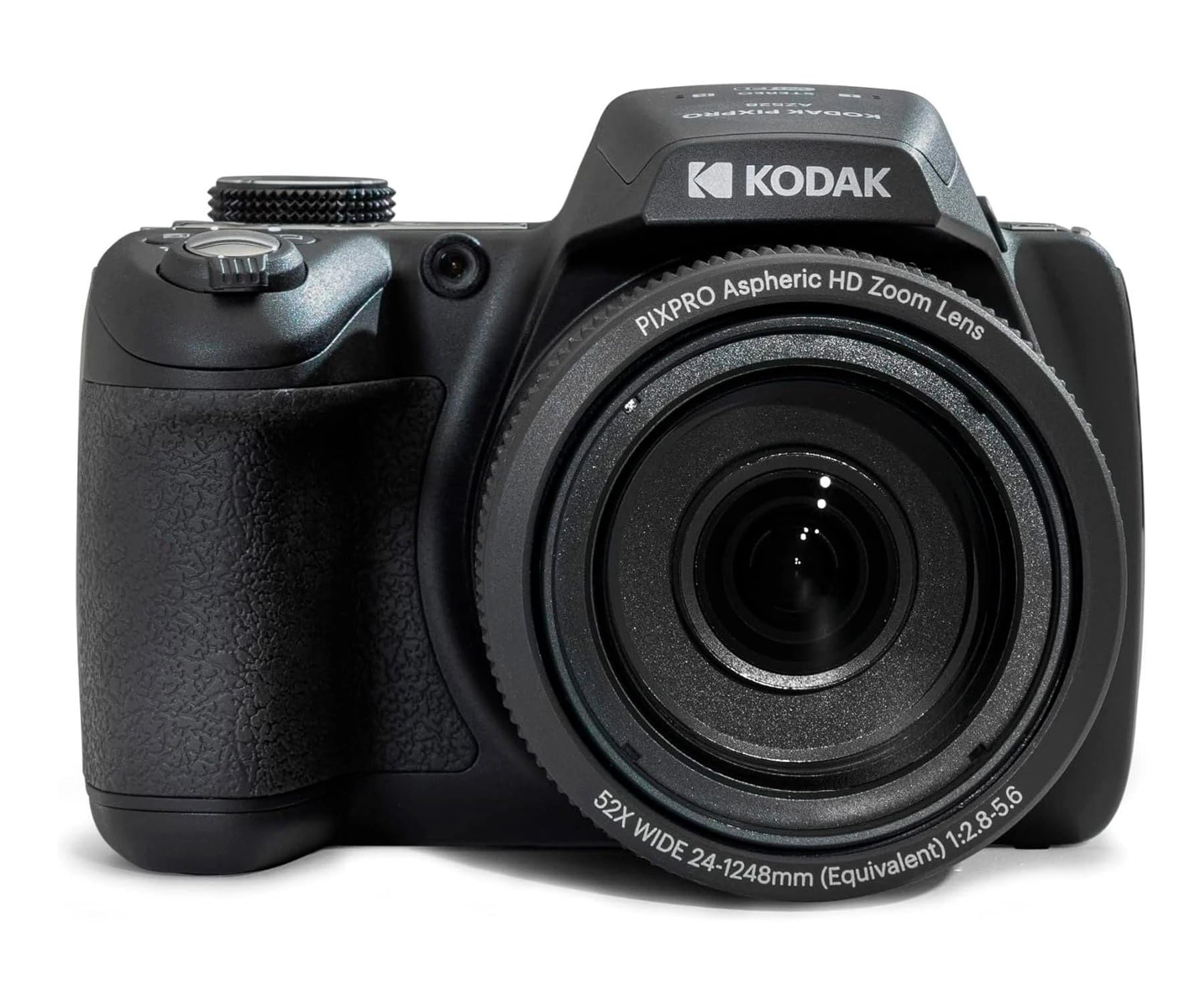
The AZ528 packs a 52x optical zoom covering a 24-1248mm equivalent range, making it the strongest telephoto value in this roundup. At a fraction of the cost of Nikon’s P1000, you get framed close-ups of birds, distant wildlife, and lunar craters that would be unrecognizable blobs on a smartphone crop. The built-in optical image stabilization compensates for hand shake even at 1248mm, though consistent sharpness at maximum zoom still demands a bracing technique or a lightweight travel tripod.
The 16-megapixel BSI CMOS sensor is a backside-illuminated design, which pulls more light into each pixel than front-illuminated sensors of the same generation. In practice, this means ISO 800 and ISO 1600 remain usable for social media sharing and small prints. The 6 fps burst mode captures fast sequences of moving subjects, and the 1080p Full HD video records at 30 fps — adequate for memories but short of the 4K standard found on pricier competitors. The 3-inch LCD screen is fixed, so composing low-angle or overhead shots is less comfortable than with a tiltable display.
Wi-Fi connectivity enables wireless transfer to a smartphone and remote control via the Kodak app, a convenience absent from several lower-priced superzooms. Battery life supports a full day of intermittent shooting, and the camera accepts SD cards up to 512 GB for thousands of photos. The body’s plastic build is lightweight but scuffs easily — a soft case is a practical accessory if you plan to carry it on dusty trails or in a camera bag alongside other gear.
Why it’s great
- 52x optical zoom delivers genuine telephoto reach that phones cannot match
- BSI CMOS sensor improves low-light signal capture for its class
- Built-in Wi-Fi enables phone transfer and remote control
Good to know
- Maximum video resolution is 1080p — no 4K recording
- Fixed LCD screen limits precise framing for low or high angles
- Stabilization is helpful but hand shake still softens extreme zoom shots
3. Panasonic LUMIX FZ80D

The FZ80D steps beyond the AZ528 with a 60x optical zoom covering 20-1200mm equivalent and the ability to record 4K video at 30p. The 20mm wide end is wider than the typical 24mm starting point, meaning group selfies, expansive landscapes, and architectural interiors fit into the frame without stepping backward. Panasonic’s POWER O.I.S. optical stabilization includes an enhanced tele-end mode that specifically targets the 1200mm maximum reach, reducing blur from subtle hand sway that plagues long-zoom handheld shooting.
The 4K Photo mode — a hallmark of Panasonic’s Lumix line — captures 8-megapixel stills by extracting single frames from a 4K video burst at 30 fps. This is invaluable for unpredictable subjects like birds in flight or a soccer goal, where pressing the shutter at the exact moment is unreliable. The 0.39-inch 2,360K-dot Live View Finder provides a high-resolution electronic eye-level view that is usable even in bright sunlight, which overpowers most rear LCD screens on other budget compacts. Contrast-detect autofocus with 49-area coverage is competent in good light but hunts noticeably in dim interiors.
The camera lacks built-in Wi-Fi and NFC, so transferring photos requires a separate card reader or USB cable. The menu system is dense — Panasonic packs a lot of features into this bridge body, and navigating the submenus without dedicated buttons for every parameter takes practice. Low-light performance at ISO 3200 and above becomes grainy, consistent with the small 1/2.3-inch sensor. The experience works best as an all-in-one travel and wildlife companion where reach and 4K matter more than ultimate image quality in the dark.
Why it’s great
- 60x optical zoom from 20mm wide to 1200mm telephoto provides incredible versatility
- 4K video and 4K Photo burst mode capture fast moments with high flexibility
- High-resolution electronic viewfinder aids composition in bright outdoor conditions
Good to know
- No built-in Wi-Fi for glueless wireless file transfers
- Complex menu system has a steep learning curve
- Image quality degrades noticeably above ISO 1600 in low light
4. Canon EOS Rebel T7 DSLR Kit

The Rebel T7 is a DSLR, meaning it uses an optical viewfinder that shows a direct-through-the-lens scene with zero lag or pixelation. The 24.1-megapixel APS-C sensor is physically massive compared to any compact camera sensor — roughly 13 times the area of a 1/2.3-inch sensor — translating to far better highlight retention, dynamic range, and noise control up to ISO 6400. The kit lens, a Canon EF-S 18-55mm f/3.5-5.6 IS II, covers a standard zoom range suitable for daily photography, and its built-in image stabilizer reduces blur from handheld shooting.
The 9-point autofocus system is simple and effective for still subjects in good light, but it feels dated compared to the 425-point phase-detection systems on modern mirrorless cameras. Live View autofocus, which uses contrast detection on the rear screen, is slow and prefers static subjects. The optical viewfinder bypasses this limitation for photography, but video recording relies entirely on Live View, which makes the T7 a poor choice for video-focused buyers. There is no 4K video — the maximum is 1080p at 30 fps.
Battery life is a strong point: a single LP-E10 charge sustains around 500 shots via the optical viewfinder, outlasting most mirrorless bodies by a significant margin. The 3-inch LCD has a fixed position with 920K dots, which is serviceable for review but not for selfie framing or high-angle work. The Guide Mode built into the menus helps beginners understand aperture, shutter speed, and ISO interactions step by step, making this the strongest option for someone who explicitly wants to learn photography fundamentals through a traditional DSLR workflow.
Why it’s great
- Large APS-C sensor delivers superior dynamic range and low-light performance
- Optical viewfinder provides zero-lag composition and excellent battery life
- Guide Mode teaches photography basics directly within the camera interface
Good to know
- No 4K video and slow Live View autofocus limit video capabilities
- 9-point AF system feels rudimentary compared to modern mirrorless options
- Non-touch screen and fixed LCD reduce composing flexibility
5. Canon EOS R100 Mirrorless Kit

The EOS R100 is the smallest and lightest body in Canon’s RF mirrorless line, weighing about 356 grams with the kit lens attached. It uses a 24.1-megapixel APS-C sensor paired with the DIGIC 8 image processor, the same core found in the pricier M50 Mark II. The Dual Pixel CMOS AF covers approximately 88% of the frame width with 143 AF zones and includes human face and eye detection, plus animal and vehicle tracking modes. This autofocus system is dramatically faster and more accurate in Live View than the T7’s contrast-detect approach.
4K video records at 24p with a 1.5x crop factor, meaning the kit lens gives an effective field of view closer to 27-67.5mm in 4K. Full HD video at up to 60 fps and HD 120 fps slow motion provide flexibility for casual videography. The RF-S 18-45mm kit lens includes optical image stabilization rated at 4 stops, which smoothes handheld footage and keeps stills sharp at slower shutter speeds. The 3-inch LCD has a fixed position with 1.04-million dots, adequate for playback but limiting for selfie-monitoring or video framing from awkward angles.
The R100 lacks a hotshoe, which prevents attaching an external microphone or flash — a meaningful omission if you plan to grow beyond the built-in stereo mic. The body does not include in-body image stabilization, so all stabilization relies on the lens. Continuous shooting reaches 6.5 fps with One-Shot AF or 3.5 fps with continuous tracking. Battery life is rated at approximately 300 shots per charge via the EVF or 400 via the LCD, which is average for mirrorless bodies. For a first interchangeable-lens camera that offers modern autofocus, 4K capability, and RF lens compatibility, the R100 provides a strong base at a compelling entry point to Canon’s mirrorless ecosystem.
Why it’s great
- Dual Pixel CMOS AF with eye detection locks focus reliably on people and animals
- Compact and lightweight body is easy to carry for everyday photography
- RF-S lens compatibility gives access to Canon’s growing mirrorless lens lineup
Good to know
- No hotshoe for external microphone or flash upgrades
- 4K video has a 1.5x crop factor that reduces wide-angle coverage
- Fixed LCD limits flexibility for selfie and overhead video work
6. Panasonic LUMIX TZ/ZS99 (White)

The ZS99 folds a 30x Leica DC Vario-Elmar zoom covering 24-720mm equivalent into a body small enough to slip into a jeans pocket. A pocked-sized camera with this reach is the defining reason to buy a compact over a phone — the 720mm telephoto frames facial expressions from across a concert venue or captures wildlife at a distance that an iPhone digital crop turns into a pixelated smudge. The Leica lens is noticeably sharp in the center at wide and mid zoom ranges, and Panasonic’s 5-Axis HYBRID O.I.S. keeps framing steady at full 720mm extension.
The 1,840K-dot tiltable LCD touchscreen differentiates this ZS99 from the earlier ZS80, providing easy low-angle and overhead composition. The touchscreen also allows touch-to-focus and touch-shutter, helpful for quick composition when using the rear display. 4K video records at 30p, and the 4K PHOTO mode extracts 8-megapixel stills from a 30 fps burst — useful for capturing the exact peak action moment in a scene with fast movement. USB Type-C charging is a practical upgrade over older micro-USB compacts, letting you share chargers with modern phones and laptops.
The contrast-detect autofocus is competent in bright scenes but can hunt in low-contrast or dim conditions, similar to other pocket superzooms. The built-in electronic viewfinder is a 0.2-inch 1,166K-dot unit, usable for framing in bright sunlight but less detailed than the FZ80D’s larger finder. Battery life averages around 350 shots per charge, which covers a full day of travel shooting. The white color option is visually distinct and runs cooler under direct sun than darker cameras, though it shows dust and wear more readily over time.
Why it’s great
- 30x Leica zoom in a genuinely pocketable body is the core value proposition
- Tiltable touchscreen and 4K Photo burst mode add flexibility for creative framing
- USB-C charging simplifies travel charging alongside modern devices
Good to know
- AF contrast detection struggles in dim light and low-contrast scenes
- Small electronic viewfinder is serviceable but not as sharp as larger bridge finders
- Image sensor is 1/2.3-inch, limiting low-light performance compared to larger compacts
7. Panasonic LUMIX TZ/ZS99 (Black)

The black ZS99 variant shares the same optical formula — 30x Leica zoom with a 24-720mm equivalent range — as the white model, but the black finish is less conspicuous in venues where a white camera might draw attention from security staff or look out of place in a crowd. The 720mm telephoto end is the decisive advantage for concert-goers: from the back of a general admission section or the middle of an arena floor, it pulls the performer into a tight chest-to-head crop that phone cameras cannot physically achieve. The 5-Axis Hybrid O.I.S. maintains decent handheld sharpness at full zoom, especially in decent stage lighting.
The built-in Bluetooth 5.0 paired with the Panasonic Image App allows automatic image transfer to a smartphone in the background, a feature that is particularly useful when you want to share shots during intermission without manually transferring each file. The dedicated Send Image button on the camera starts the transfer of a preselected batch with one press. The tiltable LCD screen supports tilted composition when holding the camera above a crowd, and the 4K PHOTO burst mode helps capture single frames from rapid movement — the split second a dancer lands a jump or a guitarist strikes a pose.
Same caveats apply as the white variant: autofocus hunts in low light typical of many indoor venues, and the 1/2.3-inch sensor produces noise above ISO 1600 that becomes visible in larger prints or crops. The black finish is fingerprint-prone on glossy sections but otherwise blends in better than white for urban street photography and events. Overall battery life is comparable to the white model at roughly 350 shots, enough for a full concert but not for multi-day trips without recharging.
Why it’s great
- 720mm telephoto zoom pulls distant stage performers into tight framing
- Bluetooth 5.0 with Send Image button enables rapid photo transfers to your phone
- Black body is discreet for events and concerts
Good to know
- Contrast-detect AF struggles in dim indoor lighting and fast-changing scenes
- Small 1/2.3-inch sensor shows noise at ISO 1600 and above
- Black finish shows fingerprints on glossy sections of the body
8. Panasonic LUMIX ZS99

The ZS99 is functionally identical in optics and core hardware to the TZ/ZS99 models above, but this specific SKU is the broader retailer-facing version often found at discount during seasonal sales. The key differentiator is its 5-Axis HYBRID O.I.S.+ system, which Panasonic integrates at the firmware and sensor-shift level to provide stabilization that is slightly more aggressive in combating yaw and pitch at maximum 720mm extension than the optical-only stabilization in earlier ZS-series iterations. In real-world use, this translates to a higher keeper rate when shooting one-handed at full zoom in decent daylight.
The 121-area contrast-detect autofocus system found in this version sample suggests a small AF point density increase compared to the 1-area or 49-area implementations on earlier Panasonic pocket zooms, though the core DFD (Depth from Defocus) technology remains consistent. The ZS99 supports 4K 30p video and 4K PHOTO burst, and the tiltable 1,840K-dot touchscreen allows composition from angles that bring a fresh perspective to travel photographs. The USB-C port supports direct charging from power banks, an essential feature for multi-day trips where wall outlets are limited.
Like its siblings, the ZS99 struggles with very low-light scenes — indoors without a flash or on night streets, the sensor’s 1/2.3-inch size leads to muted colors and visible grain. The electronic shutter can introduce rolling shutter distortion on fast-moving subjects like passing cars or running children. The build quality feels solid but not weather-sealed, so a rain cover is prudent for trips with uncertain forecasts. For the buyer who prioritizes pocket portability and optical reach above all else, the ZS99 delivers the same core experience as the TZ/ZS99 series at a price that can vary significantly depending on the current listing.
Why it’s great
- 5-Axis HYBRID O.I.S.+ provides robust stabilization for handheld telephoto shots
- Pocketable body fits in jeans or small bag while delivering 30x zoom
- USB-C charging via power banks keeps the camera powered on multi-day trips
Good to know
- Small sensor and electronic shutter limit low-light performance and fast-moving subjects
- Not weather-sealed — avoid heavy rain or dusty conditions without protection
- Autofocus can still hunt in dim conditions despite the area count increase
9. Nikon Z 30 Kit

The Nikon Z 30 is built from the ground up for video creation. Its 20.9-megapixel APS-C sensor with a hybrid phase-detection autofocus system uses 209 focus points and supports Eye-Detection AF for humans and animals in both stills and video. The camera has no mechanical shutter (it uses an electronic shutter for stills), which eliminates shutter shake entirely but introduces rolling shutter on fast-panning shots. The Z 30 records unlimited 4K 30p video (no 30-minute record limit), making it one of the few compacts in this price range that can serve as a continuous recording camera for livestreaming.
The same camera can plug directly into a computer via USB-C and function as a Full HD 60p webcam without additional capture cards or software configuration. The 3-inch flip-out touchscreen rotates forward for selfie monitoring and includes a red REC tally light. The stereo microphone has adjustable sensitivity levels (Auto, Manual, and Voice Priority), and the hotshoe accepts Nikon’s optional external microphone. The 16-50mm retractable kit lens covers a standard zoom range equivalent to 24-75mm on full-frame, with 4-stop Vibration Reduction that is effective for handheld walking shots without a gimbal.
The absence of an optical or electronic viewfinder means all composition and playback happens on the rear LCD — this works for video but can be awkward for still photography in bright sunlight. The 6.5 fps continuous shooting in both mechanical and silent modes is adequate for casual motion capture, with a buffer depth of roughly 20 raw frames before the rate slows. Battery life is about 320 shots per charge (CIPA standard), and the USB-C port supports in-camera charging. For content creators, vloggers, and streamers who want a mirrorless step up from the Sony ZV-1F with the flexibility of interchangeable lenses, the Z 30 delivers modern video features in a compact body that is easy to grow into.
Why it’s great
- Unlimited 4K 30p recording with no time limit is ideal for long-form creation
- USB-C plug-and-play webcam works without capture cards
- Interchangeable Z-mount lenses provide a path for upgrading image quality
Good to know
- No viewfinder (EVF or OVF) makes bright-sun still photography difficult
- 6.5 fps burst with limited buffer depth is not ideal for rapid action sequences
- Electronic rolling shutter can distort fast panning motion in video
FAQ
Why would I choose a compact camera over a newer smartphone for everyday photography?
Is a 1-inch sensor noticeably better than a 1/2.3-inch sensor in real-world photos?
What are the most important specs to check for a concert or event compact camera?
Does a mirrorless camera like the Canon EOS R100 or Nikon Z 30 offer better image quality than a superzoom compact?
Final Thoughts: The Verdict
For most users, the best affordable compact digital cameras winner is the Sony ZV-1F because its 1-inch sensor and reliable phase-detection autofocus provide the strongest image quality and video features in a compact body. If you want massive optical reach for wildlife or distant action, grab the Kodak PIXPRO AZ528. And for all-day 4K vlogging with interchangeable lenses, nothing beats the Nikon Z 30 Kit.