
Our readers keep the lights on and my morning glass full of iced black tea. As an Amazon Associate, I earn from qualifying purchases.
Specs are compiled from manufacturer listings and verified buyer reviews and can change over time — please confirm the key details on the product page before buying.
Before you buy an affordable condenser microphone, decide where it will live: USB mics plug straight into your computer for streaming, while XLR mics need a separate audio interface (a box that converts the mic signal for your PC) for home studio recording. The entry-level price tier is packed with solid choices, so your real task is matching the mic to your setup and room, not compromising on sound.
I’m Min — the founder and writer behind Gadgets Feed. This guide is built by comparing the manufacturers’ published specifications and the patterns across verified customer reviews, so you get each pick’s real strengths and trade-offs instead of marketing spin.
For streaming, podcasting, or home guitar tracking, an affordable condenser mic delivers broadcast-ready clarity without the studio price tag.
Our Picks at a Glance


How To Choose The Best Affordable Condenser Microphone
Before you scroll through specs, decide where the mic will live. If it sits on a desk for Discord, podcasts, and game chat, a USB model with a built-in stand is the simplest path. If you are miking an acoustic guitar or recording vocals into a DAW, an XLR condenser paired with an audio interface gives you more headroom to grow.
Check the polar pattern first
The polar pattern is the mic’s listening shape. A cardioid pattern picks up sound mainly from the front and rejects noise from the sides and back, which is why it is the default for untreated rooms. Supercardioid tightens that focus even further, but it also catches a sliver of sound from directly behind, so you need to face the mic correctly. Omnidirectional hears everything around it, which is only useful in a quiet, treated space.
USB or XLR changes your whole signal chain
A USB condenser converts sound to digital inside the mic, so you plug it straight into a PC, Mac, or console and it works. An XLR condenser sends an analog signal that needs an audio interface or mixer to convert it, and most condensers demand +48V phantom power from that interface to operate at all. If you already own an interface, XLR mics open up more future-proofing. If not, USB removes the extra gear cost entirely.
Look for the accessories that stop noise
Condensers are sensitive by design, so handling bumps and desk thumps become audible. A built-in shock mount or elastically suspended capsule absorbs those vibrations before they reach the recording. A pop filter blocks the burst of air from plosive sounds like “p” and “b” from hitting the capsule. Many affordable mics include one or both, which saves you from buying them separately.
Quick Comparison
| Model | Best For | Connection | Polar Pattern | Frequency Response | Amazon |
|---|---|---|---|---|---|
| HyperX QuadCast★ Best Overall | Streaming & Podcasts | USB | 4 Selectable | 20 Hz – 20 kHz | Amazon |
| Razer Seiren V2 XBest Value | Gaming & Dictation | USB | Supercardioid | 20 kHz | Amazon |
| AKG Perception 170Top Performer | Acoustic Instruments | XLR | Cardioid | 20 Hz – 20 kHz | Amazon |
| beyerdynamic FOX | Studio Recording | USB | Cardioid | 96 kHz | Amazon |
| MXL 990/991 Bundle | Versatile Home Studio | XLR | Cardioid | 20 Hz – 20 kHz | Amazon |
| Blue Blackout Spark SL | Broadcast Vocals | XLR | Cardioid | — | Amazon |
| LEWITT LCT 240 Pro | Polished Vocal Recording | XLR | Cardioid | 20 Hz | Amazon |
| Samson C02 Pair | Stereo Instrument Capture | XLR | Cardioid | 20 Hz – 20 kHz | Amazon |
| Audio-Technica AT2020USB-X | Reliable USB Vocals | USB | Cardioid | 20 Hz | Amazon |
In‑Depth Reviews
1. HyperX QuadCast
Our pick — over 4.5★ from 35,500+ verified ratings; the strongest balance of quality and price.
A USB mic with four switchable polar patterns that adapts to solo streams, group chats, and duets.
The QuadCast is the most versatile USB option here because it gives you four polar patterns you can actually switch between: stereo, omnidirectional, cardioid, and bidirectional. Flipping to cardioid rejects room sound for solo streaming, then switching to omnidirectional lets a whole roundtable podcast be heard. It connects to PC, PS5, PS4, or Mac with a single USB cable, so no drivers or audio interface are required.
It ships with an elastic-rope shock mount that isolates the capsule from desk bumps, and the internal pop filter tames plosive “p” and “b” blasts. The tap-to-mute sensor is the feature people rely on most — the red LED ring glows when you are live and switches off when muted, so you always know your status. There is also a gain dial on the bottom to trim sensitivity and a headphone jack for zero-latency monitoring so you can hear yourself as you speak.
Buyers praise the build quality, noting the heavy, stable metal stand has survived over a year of daily use in many setups. One honest gap: the built-in pop filter (a foam screen that blocks plosive ‘p’ and ‘b’ sounds) is not enough for close-up vocals, so several owners add an external one for cleaner takes, and the bright red LED cannot be dimmed or turned off if it bothers you at night.
What Makes It The One
- Four switchable polar patterns cover solo streams, group chats, and duets
- Anti-vibration shock mount keeps desk thumps out of your audio
- Tap-to-mute with a clear red LED status indicator prevents broadcast accidents
Know Before You Buy
- Internal pop filter is thin, so an external one helps for close-up vocals
- Red LED stays bright and cannot be dimmed or switched off
Reach for this if: you want one USB mic that handles streaming, podcasting, and Discord without extra gear.
The honest caveat: it is not studio-grade, and the always-on red glow will not suit every bedroom setup.
2. Razer Seiren V2 X
A compact USB mic with a supercardioid focus that silences typing and mouse clicks.
The Seiren V2 X is built around a supercardioid pickup pattern, which is a tighter focus than standard cardioid. It suppresses noise from the back and sides so aggressively that mechanical keyboard clatter and mouse clicks stay out of your stream, making it a strong choice for noisy gaming desks. It captures spoken voice cleanly, and for dictation it is a known standout — buyers report it “works perfectly with Mac dictation” and can pick up a whisper from about 18 inches away.
An integrated digital limiter automatically prevents clipping and peaking, so you do not have to babysit levels when you get excited mid-stream. The built-in shock absorber dampens accidental knocks, and on the front of the body you get easy-access volume, mic gain, and mute buttons. It connects over USB-C, and owners mention it even pairs with a Steam Deck for portable game chat.
What buyers rave about is the build — this mic has survived multiple concrete drops and still works, which is remarkable for plastic at this tier. The recurring gripe is the companion software, which some owners call bloatware that causes Windows errors, so the advice is to set levels on the mic itself and skip the app entirely. It is not meant for studio or broadcast work, and console gamers should note that PS5 and Xbox Series X compatibility gets mixed reports.
Desk-tested durability: Owners describe it as a “set and forget” mic that handles drops and daily chaos without losing clarity.
Who it suits: gamers and remote workers who need background-noise rejection and refuse to install extra software.
Look elsewhere if: you are on PS5 or Xbox and need guaranteed console support, or you want a broadcast-grade mic.
3. AKG Perception 170
A small-diaphragm XLR condenser that captures acoustic guitar and percussion with studio-grade transient detail.
The Perception 170 is a small-diaphragm condenser, a different breed from the large-diaphragm vocal mics above. Its lightweight 1/2-inch capsule delivers fast transient response, which is exactly what captures the attack of a guitar string or the crack of a snare drum. Buyers consistently say it “sounds equal to many SDCs costing much more,” which is high praise for a budget XLR mic.
It is built to handle loud sources without distortion, thanks to a switchable attenuation pad that handles sound pressure levels up to 155 dB SPL. That rating is far beyond voice — it means you can point this at a cranked guitar amp or a drum kit and it will not choke. The rugged all-metal body survives the tough day-to-day of a home studio, and its slim 1.57 x 1.57 x 7.09-inch profile lets you position it in tight spots a bulky vocal mic cannot reach.
Owners agree this is a dedicated instrument mic first: it excels on acoustic guitars, mandolins, strings, and percussion, but vocals are not its strength — several owners pair it with a dynamic mic for voice and use the AKG purely for instruments. It connects over XLR, so you will need an audio interface that supplies phantom power (48V sent to the mic), and being a condenser in an untreated room means it will pick up ambient noise that needs editing afterward.
The value read: Owners praise it as a budget home-studio workhorse whose quality plateaus well above its price point, especially for acoustic instruments.
Pick it up for: recording acoustic guitar, strings, and percussion with clarity that rivals pricier small-diaphragm condensers.
skip it if: you need a primary vocal mic or you do not already own an XLR audio interface.
4. beyerdynamic FOX

A USB mic with 24-bit/96 kHz resolution and zero-latency monitoring for home studio recording.
The FOX delivers 24-bit 96 kHz studio-grade resolution, the same sample rate used in professional recording studios, which means your stream or track captures more detail and headroom than basic 48 kHz mics. It uses a large-diaphragm condenser capsule for accurate signal conversion, and buyers describe the sound as audio-engineer approved straight from the start. For musicians recording at home, this is frequently the pick that gets the nod.
It connects over USB and works with any USB-C to 2.0 cable, which owners note gives flexibility if you misplace the original. The headphone output offers zero-latency monitoring, so you hear your own voice in real time with no delay that would throw off your timing. A mute button sits on the body, and a gain switch lets you dial in louder instruments without distortion.
The praise centers on sound quality and value, but there are two quirks to know. The always-on power LED flashes when muted and there is no off switch, which some buyers find annoying in a dark room. And reliability has mixed reports — a few owners needed a replacement unit to get the performance they expected, and the mic requires a USB 2.0 connection rather than USB-C 3.0, so check your port before buying.
Why It Justifies The Upgrade
- 24-bit 96 kHz resolution captures clear, natural sound for music and voice
- Zero-latency headphone monitoring keeps you in time while recording
- Large-diaphragm capsule delivers warm, pro-level vocal tone
Two Quirks To Expect
- Bright power LED stays on and only flashes when muted, with no off switch
- Needs a USB 2.0 connection, not USB-C 3.0, to work properly
Best suited to: musicians and home recordists who want studio sample rates without buying an XLR interface.
The trade-off: a small number of units arrive defective and need replacement, and the always-on LED will annoy light-sensitive users.
5. MXL 990/991 Bundle

Two mics, a shock mount, a pop filter, and a 20-foot cable — a full kit in one box.
The MXL bundle is the rare affordable package that gives you everything to start recording immediately: the MXL 990 large-diaphragm condenser, the MXL 991 small-diaphragm pencil mic, a shock mount, a pop filter, and a 20-foot XLR cable. It is a genuine workhorse kit, and customers note using their first set for two decades before replacing it. The 990’s 6-micron gold-sputtered diaphragm and FET design deliver the silky high end that makes vocals and voiceovers sound polished.
The two mics cover different jobs. The 990 large-diaphragm is your vocal and podcasting mic with a smooth midrange, while the 991 pencil mic excels on instruments like piano, guitars, and drums. Owners describe the pair as extremely sensitive, recording clean audio even at near-zero volume from 12 to 20 inches away. The bundle covers a frequency response of 20 Hz – 20 kHz on the 990, which suits both male and female vocalists.
One important catch: these require +48V phantom power from an audio interface or mixer, so this is not a plug-and-play USB setup. The large-diaphragm 990 can sound muddy or bassy on some sources until you apply a bit of EQ, though the pencil mic stays clear and detailed. Owners note the 990’s cardioid pattern rejects side and rear noise, so you hear more of your voice and less of the room.
Long-haul value: Owners call it a luxury value for the money, with some still using their first set after 20 years — a durability claim few budget bundles can match.
Grab this kit if: you are building a first home studio and want vocal and instrument coverage plus the accessories, all in one purchase.
Not the right fit if: you have no XLR interface yet, or you want a single USB mic you can plug into a laptop and go.
6. Blue Blackout Spark SL

A broadcast-style XLR condenser that adds rich harmonics to voice and streaming.
The Spark SL uses Blue’s custom large-diaphragm condenser capsule to deliver the warm, detailed broadcast vocal sound the brand is known for. Owners describe it as adding color and harmonics to the voice, with a focused, transparent quality that improve podcasts, gaming streams, and YouTube videos beyond typical webcam audio. This is the XLR mic to reach for when you want professional vocal character in your recordings.
It comes with a custom shock mount and a wooden storage box, giving you the vibration isolation and presentation you usually pay extra for. A 100Hz high-pass filter cuts low-end rumble from your room or desk, and a -20dB pad reduces distortion when you record louder sources. The Class-A JFET electronics provide studio-quality sound with rich harmonic content, and the precise cardioid pattern keeps the focus on your voice. Weighing just 11.52 ounces, it is compact and easy to position on a boom arm.
The catch is that this is an XLR microphone, so it needs an audio interface with +48V phantom power to operate — it will not plug into a USB port. Build quality and reliability draw mixed feedback, with most owners praising the premium metal feel while a small number report units that do not work at all, so buying with a return-friendly seller matters. Owners who bought it at a discount called it an insane deal for the sound quality.
The sound signature: Buyers consistently describe “warm,” “rich” vocals with superb clarity that make it a favorite for voiceover and streaming — when the unit arrives working.
Choose this for: podcasting, streaming, and voiceover where you want a broadcast-grade vocal color from an XLR setup.
Think twice if: you lack an audio interface with phantom power, or you want the guaranteed reliability of a USB plug-and-play model.
7. LEWITT LCT 240 Pro

An XLR condenser with a near-silent noise floor that delivers clean, mix-ready vocals.
The LCT 240 Pro’s defining trait is an exceptionally low noise floor, and owners describe hearing zero noise at normal recording levels. This matters because it means your recordings start clean, with no hiss to scrub out later. Buyers who upgraded from the Audio-Technica AT2020 call it a night-and-day difference, saying the LEWITT sounds clear and clean and is very easy to mix and master off of right in the track.
It is a high-performance large-diaphragm condenser housed in stainless steel, built for anyone ready to take the next step in professional recording. The cardioid pattern keeps the focus on your voice and away from room reflections. LEWITT added a boost for airy frequencies, which adds a sense of openness and detail to vocals that makes them sit nicely in a mix. At 1.5 pounds, it has a solid, reassuring heft on a stand or boom.
Performance feedback is overwhelmingly positive, with owners saying it significantly enhanced their content production workflow and sounds comparable to mics at twice the price. The honest notes: the capsule leans bright, so a touch of EQ (equalizer, to adjust tone) tames the high end if you find it too crisp, and several buyers are surprised by how small the mic body is compared to bulky broadcast-style condensers. It requires an XLR interface with phantom power.
Why It Justifies The Upgrade
- Near-silent noise floor means zero hiss at normal recording levels
- Clean, bright tone that is easy to mix and master without heavy processing
- Reviewers point out clear, detailed vocals that rival mics costing twice as much
Two Quirks To Expect
- Bright high end may need a little EQ if you find it too crisp
- Physically small for a large-diaphragm mic, which surprises some buyers
Buy it for: home studio vocalists who want a clean, mix-ready XLR track without investing in high-end gear.
The single real limitation: it is a bright-sounding mic, so it rewards a treated room and a touch of EQ rather than raw plug-in-and-go use.
8. SAMSON C02 Pair
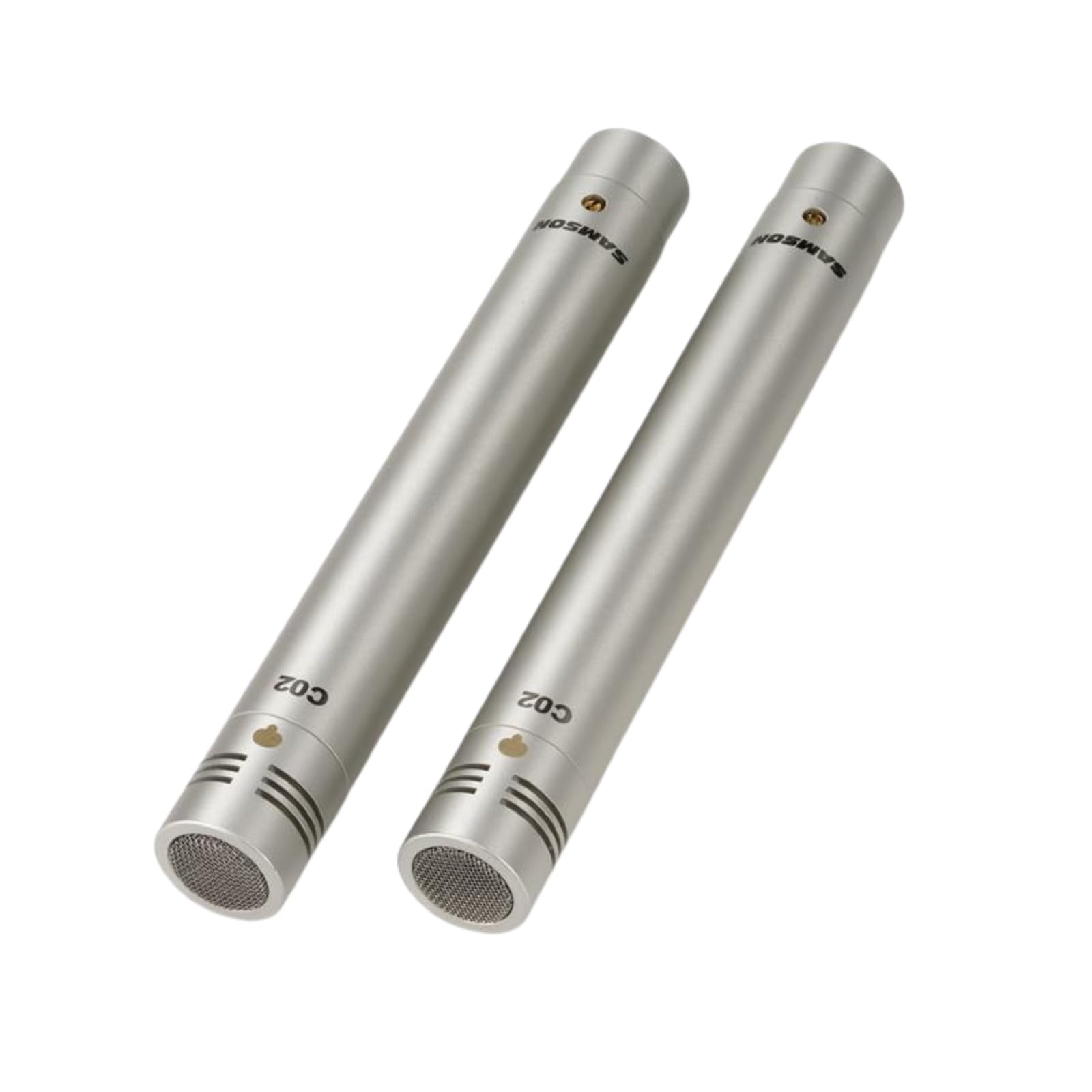
Two matched pencil mics that capture wide, detailed stereo images of instruments and choirs.
The C02 set is a matched stereo pair, meaning the two mics are tuned within ±0.5dB sensitivity of each other so your left and right channels balance perfectly. That precision is what makes this pair so good at capturing acoustic guitar in stereo, drum overheads, piano, choirs, and theater performances. Owners describe crisp sound with a wide frequency response that picks up each note beautifully, and several recorded a full drum kit using only these as overheads plus a kick mic.
It ships complete with a protective carry case, two shock-mounted mic clips, and two foam windscreens — everything you need to deploy both mics right away. The small-diaphragm pencil design handles sound pressure levels up to 134 dB SPL, so loud cymbals and brass will not distort. Gold-plated XLR connectors resist corrosion for a clean signal over years of use. The cardioid pickup pattern keeps each mic focused on its target, which helps minimize room bleed in a home studio.
Sensitivity gets mixed feedback — these are very responsive condensers, so breath noise and room ambiance need pop filters and quiet recording spaces. They require XLR cables and phantom power from an interface, not a 1/4-inch plug, so check your gear before buying.
What the reviews keep circling back to: buyers call this the go-to budget matched pair for stereo acoustic guitar and drum overheads, with a hard case and clips included for real portability.
Reach for the pair if: you record acoustic instruments in stereo, need drum overheads, or capture live performances with wide, natural detail.
Look past it if: you need a single vocal mic or lack an XLR interface — these are sensitive instruments mics, not USB voice mics.
9. Audio-Technica AT2020USB-X

A USB mic from Audio-Technica with a cardioid pattern and driver-free plug-and-play setup.
The AT2020USB-X brings Audio-Technica’s respected studio lineage into a USB format that works on PC, Mac, laptop, or gaming console with no drivers. It records at 24-bit / 96 kHz, the same high-resolution sampling used in pro studios, and buyers describe very good voice pickup with clear, natural sound that handles a loud electric guitar without loss. The cardioid pattern minimizes background noise so your voice stays forward in the mix.
A built-in headphone jack lets you monitor your own voice directly from the mic with zero extra gear, which is essential for podcasting and voiceover timing. The soft-touch capacitive mute button on the body silences audio instantly, and the two-state LED ring glows blue when powered and red when muted so your status is always visible. It ships with a custom desk stand and a USB-C to USB-A cable, plus a USB-A to USB-C adapter for flexibility across devices.
Buyers praise the sturdy, heavy build and smooth Mac integration. The honest trade-off is sensitivity: it picks up ambient sounds like furnace fans, PC fans, and even rustling, so it performs best in a quiet room — and several owners recommend a noise-suppression filter like Discord Krisp for noisier spaces. Reliability has mixed reports, with a number of owners saying their unit stopped working within a year, which is worth weighing against the premium price tier.
The Brand-Name Strengths
- Clear, natural 24-bit / 96 kHz USB audio with zero driver setup
- Soft-touch mute with a blue-to-red LED status ring for instant feedback
- Solid, heavy build with a custom desk stand and adapter included
The Sensitivity Catch
- Picks up ambient room noise easily, so it demands a quiet space
- Reliability has mixed reports, with some units failing within a year
Best for: podcasters and streamers who trust the Audio-Technica name and want a clean USB mic in a quiet room.
The honest caveat: noisy environments will expose its sensitivity, and the premium price is harder to justify given the mixed long-term reliability reports.
Understanding the Specs
Polar Pattern
The polar pattern is the microphone’s direction of hearing. Cardioid hears mostly from the front and rejects side and rear noise, which is why it is the standard for home recording. Supercardioid narrows that focus even more for noisy rooms, while omnidirectional hears equally in all directions and only suits treated spaces. Choose your pattern based on how much background noise your room throws at you.
Phantom Power (+48V)
Phantom power is the 48 volts an audio interface sends down an XLR cable to power a condenser microphone’s internal electronics. Unlike USB mics that draw power from your computer, most XLR condensers simply will not produce sound without this voltage. If your mic has an XLR connection, verify your interface or mixer has a +48V switch before you buy.
Frequency Response
Frequency response describes the range of pitches a microphone can capture, measured in hertz (Hz) and kilohertz (kHz). Human hearing spans roughly 20 Hz to 20 kHz, so a mic covering that full range captures the complete picture of your voice or instrument. A response that drops off early will make recordings sound dull or thin, while a full-range mic preserves sparkle and depth.
Noise Floor
The noise floor is the low-level hiss a microphone produces on its own, usually measured in decibels (dB) of self-noise. A lower number means a quieter, cleaner recording that needs less cleanup in editing. High self-noise matters most for quiet sources like soft vocals or fingerpicked guitar, where the hiss becomes audible in the gaps between notes.
FAQ
Is a USB condenser mic better than an XLR one for beginners?
Will an affordable condenser mic pick up my keyboard and room noise?
What is the difference between a large-diaphragm and small-diaphragm condenser mic?
Why does my XLR condenser mic make no sound until I flip a switch on my interface?
How close should I sit to a condenser microphone?
Can I plug a condenser mic directly into my computer?
Do I need a pop filter if my mic has one built in?
Why does my condenser mic sound good on guitar but not on my voice?
How long does an affordable condenser microphone last?
Final Thoughts: The Verdict
For most streamers and podcasters, the affordable condenser microphone winner is the HyperX QuadCast because its four switchable polar patterns (pickup directions), built-in shock mount, and tap-to-mute sensor cover every USB use case with sound quality that satisfies tens of thousands of owners. If you want tighter background-noise rejection for a gaming desk, grab the Razer Seiren V2 X. And when a home studio is the goal, the MXL 990/991 Bundle gives you vocal and instrument mics plus the accessories to start recording today.
How We Picked
We do not accept paid placement. Every pick is matched to a real buyer and a real use-case; we do not hands-on test units.
Sources & Methodology
Specifications: manufacturer listings and product documentation. Review insights: verified customer reviews, as of September 2026. Pricing: not shown on this page (it changes often); check the current price via the retailer link.
As an Amazon Associate, Gadgets Feed earns from qualifying purchases. This does not affect which products we feature.