
Chasing that specific late-90s color cast or the soft-glow flash of a disposable camera usually means buying expired film or hunting through thrift stores for dead batteries. Today’s sensor technology and lens coatings make it possible to skip the chemical process entirely and land the exact same moody, desaturated look straight out of the camera body.
I’m Min — the co-founder and writer behind Gadgets Feed. I’ve spent hundreds of hours researching sensor sizes, white-balance quirks, and film-simulation engines to separate genuine vintage character from cheap digital noise.
This guide breaks down the differences in ISO handling, lens character, and built-in color profiles so you can confidently pick the best affordable digital camera for vintage look that matches your shooting style without blowing your budget on impractical gear.
How To Choose The Best Affordable Digital Camera For Vintage Look
Not every camera labeled “retro” delivers genuine vintage character. Many modern sensors are too clean and too sharp, stripping away the grain and color shifts that define film-era photography. The goal is finding a body whose sensor, lens, or internal processing introduces the subtle imperfections you want — not ones you have to fix in Lightroom.
Sensor Size and Character
A 1-inch sensor or an APS-C sensor offers the best balance between image quality and the organic look you’re chasing. Larger sensors (like full-frame) can look too clinical unless paired with vintage glass, while tiny phone-sized sensors often produce excessive noise that ruins the charm rather than adding it. Look for sensors in the 1-inch to APS-C range for authentic grain structure at moderate ISOs.
Built-in Film Simulations
Fujifilm leads this category with its proprietary film-simulation modes — Classic Chrome, Acros, and Velvia replicate specific film stocks with remarkable accuracy. Some modern point-and-shoots and screenless cameras also include color filters and white-balance presets that mimic expired film or cross-processed negatives. Cameras without these profiles force you to edit every raw file, which defeats the “straight out of camera” vintage workflow.
Lens Character vs. Lens Sharpness
Vintage look is as much about the glass as the sensor. A lens that is too sharp reveals every texture and kills the soft, dreamy quality typical of 35mm compacts from the 90s. Look for prime or zoom lenses with moderate maximum apertures (f/2.0–f/3.5) and known optical softness at the edges. Interchangeable-lens systems let you mount actual vintage FD or F-mount glass for a truly authentic rendering.
Shooting Workflow and Screenless Options
Some of the most convincing vintage experiences come from cameras that remove the rear screen entirely — forcing you to compose through an optical viewfinder and wait until you transfer the files to see the result. This “shoot and forget” workflow mimics film’s delay and removes the impulse to chimp every shot. If you prefer instant feedback, a tiltable LCD with retro-inspired menus works too, but the screenless approach delivers the most authentic ritual.
Quick Comparison
On smaller screens, swipe sideways to see the full table.
| Model | Category | Best For | Key Spec | Amazon |
|---|---|---|---|---|
| Fujifilm X Half | Premium Compact | Authentic 35mm simulation with tactile controls | 1-inch sensor, 26 film filters | Amazon |
| Nikon Z fc | Premium Mirrorless | Interchangeable Z-mount with analog dials | 20.9 MP APS-C sensor, 4K UHD | Amazon |
| Panasonic LUMIX ZS99 | Premium Zoom | Travel zoom with Leica glass | 30x optical zoom, 24-720mm | Amazon |
| Sony RX100 II | Premium Compact | 1-inch sensor in a pocket body | 20.2 MP Exmor R, f/1.8 lens | Amazon |
| Canon AE-1 Renewed | Film SLR | True analog 35mm film experience | 35mm film, FD lens mount | Amazon |
| Fujifilm Instax Mini EVO | Hybrid Instant | Hybrid digital/instant prints with filters | 100 creative combos, Instax Mini film | Amazon |
| Minolta Retro Digital | Mid-Range Compact | High-resolution body with selfie screen | 48 MP sensor, 16x digital zoom | Amazon |
| CAPPY Screenless | Screenless | Digital detox with film-like delay | 20 MP sensor, no rear screen | Amazon |
| Kodak PIXPRO FZ55 | Entry-Level | Budget-friendly point-and-shoot | 16 MP CMOS, 5x optical zoom | Amazon |
In‑Depth Reviews
1. FUJIFILM X Half Premium Compact Camera

The FUJIFILM X Half is designed around a 1-inch sensor and 26 analog-inspired film and filter options, making it one of the most purpose-built cameras for achieving a vintage look straight out of the box. The unique 2-in-1 mode combines stills and video in a single frame, mimicking the half-frame film format from 35mm cameras of the 60s and 70s. At only 15.68 ounces, it slips into a jacket pocket without compromising on the tactile experience of physical dials for ISO and exposure control.
Users consistently praise its solid build and the “Film Camera mode” that removes the ability to preview shots — forcing you to use the thumb lever advance like a real rangefinder. JPEGs come out sharp with vibrant color reproduction, especially using Classic Chrome or Acros simulations. The lens delivers good detail at ISO 1600, and the 18 MP effective resolution is more than enough for prints and social sharing without the clinical sharpness of high-end full-frame sensors.
The X Half does have its quirks. The viewfinder is slightly off-center, the winding lever lacks the satisfying tension of a mechanical film camera, and the app integration is about 80% functional for transferring images. This camera is not for pixel peepers or professional editors — it is for shooters who want the ritual and texture of film without the recurring cost of processing and chemicals.
Why it’s great
- Authentic half-frame shooting experience with 26 film simulations
- Pocketable size with full manual dial controls
- Prints directly to compatible Instax printers
Good to know
- Off-center viewfinder takes adjustment
- Winding lever lacks mechanical feedback
- JPEG-only output with no raw option
2. Nikon Z fc Retro-Inspired Mirrorless Camera

The Nikon Z fc marries a 20.9 MP APS-C CMOS sensor with a body that replicates the mechanical dials of the classic Nikon FM from the 1970s. Dedicated dials for shutter speed, ISO, and exposure compensation sit on top, while the vari-angle LCD flips out for vlogging and self-framing. The EXPEED 6 processor ensures fast autofocus with 209 phase-detection points and eye detection for both stills and 4K UHD video.
Real-world users highlight the sheer pleasure of shooting with the Z fc — the tactile controls and small footprint encourage deliberate composition rather than spray-and-pray. The SnapBridge app transfers images to your phone instantly, and the camera is compatible with both native Z lenses and older F-mount glass (via the FTZ adapter). Many reviewers pair it with a vintage Nikkor 50mm f/1.8 lens to achieve that character-filled, slightly soft rendering that modern zooms lack.
One persistent complaint is that the top-plate f-stop indicator is essentially decorative — it only works with certain Z lenses. Some users also report that the 20.9 MP resolution, while excellent for general use, can feel limiting for heavy cropping. The camera leans toward the heavier side of compact mirrorless bodies, but the build quality justifies the weight for anyone who values analog design language.
Why it’s great
- Authentic analog dials for shutter, ISO, and exposure comp
- Interchangeable Z-mount with access to vintage F-glass
- 4K video with excellent eye-detection autofocus
Good to know
- F-stop dial is merely decorative with most lenses
- No in-body stabilization
- HEAVIER than some other APS-C mirrorless options
3. Panasonic LUMIX ZS99 Compact Travel Camera

The Panasonic LUMIX ZS99 (TZ99 outside the US) packs a 30x optical zoom Leica lens covering 24–720mm into a body that slides into a jeans pocket. The 1,840k-dot tiltable touchscreen and USB Type-C charging make it a road-ready companion for capturing both sweeping landscapes and distant stage performers. It records 4K video at 30p and supports 4K PHOTO burst capture at 30 fps for grabbing the perfect frame from a sequence.
Users love the versatility of the Leica glass — even at maximum zoom, images retain good color accuracy and contrast, especially when using the camera’s Auto mode. The built-in Bluetooth v5.0 and dedicated Send Image button make transfer to a smartphone seamless via the Panasonic Image App. For concert photography or wildlife on the go, the 60x Intelligent Zoom extends range without excessive pixelation.
Low-light performance is the primary trade-off at this price tier. The f/3.3–6.4 aperture range struggles when the sun dips, and handheld shots at full zoom can produce soft results unless you brace against a solid surface. Some users also report that the LCD is difficult to read in direct sunlight, requiring use of the camera’s EVF (which is not included in every regional variant). For bright-day travel shots, this camera delivers strong value.
Why it’s great
- Incredible 30x zoom range with genuine Leica optics
- Pocket-sized body with tiltable touchscreen
- USB-C charging and fast Bluetooth image transfer
Good to know
- Narrow aperture range limits low-light use
- LCD can be hard to see in bright sunlight
- Image quality trails smartphone flagships in standard lighting
4. Sony RX100 II Premium Compact Camera

The Sony RX100 II remains a legend in the premium compact space thanks to its 20.2 MP 1-inch Exmor R sensor and bright f/1.8 Carl Zeiss Vario-Sonnar T lens with 3.6x optical zoom (28–100mm equivalent). The tilting LCD screen, Wi-Fi/NFC connectivity, and full manual control in a body small enough for any coat pocket make it a top choice for street photographers who want discrete shooting with serious image quality.
Experienced users consistently praise the RX100 II for its low-light performance — the 1-inch sensor delivers clean images up to ISO 3200 and usable results at 6400, which is remarkable for a camera of this size. The ability to shoot raw and the customizable front control ring give you editing flexibility for dialing in vintage grades later. Video recording at 1080 60p/24p with full exposure control is solid, though it lacks 4K.
Owners note that the RX100 II demands some post-processing to achieve a film-like look because it lacks built-in vintage filters — its strength is providing a clean base file that responds well to grading. The battery is decent but not exceptional, and the lack of a built-in viewfinder (the optional one is pricey) can be limiting in bright outdoor conditions. For shooters comfortable with editing, this is the most capable pocket camera in its class.
Why it’s great
- Exceptional low-light performance from the 1-inch sensor
- Bright f/1.8 Zeiss glass for shallow depth of field
- Raw shooting capability for customized vintage grading
Good to know
- No built-in viewfinder — add-on is expensive
- No 4K video recording
- Requires editing for a film-like look
5. Vintage Canon AE-1 35mm SLR Camera (Renewed)

The Canon AE-1 is arguably the most iconic 35mm SLR ever produced, and this renewed unit brings it back to like-new condition. The camera features a TTL metering system for accurate exposures, a shutter speed range from 1/1000 to 2 seconds plus Bulb mode, and a robust metal body that defined the look of 1970s and 80s photography. It ships with a 50mm f/1.8 lens, neck strap, and lens cover.
Buyers consistently report that these renewed units arrive in outstanding condition — clean, functional, and often indistinguishable from a camera that just left a department store in 1978. The mechanical shutter and manual-control workflow force you to slow down and consider each shot, which is the entire philosophy behind the vintage look. The AE-1’s center-weighted metering remains remarkably reliable for indoor and outdoor scenarios.
This is not a digital camera — you need 35mm film, which brings ongoing costs of roughly – per roll plus development. The AE-1 also lacks modern conveniences like auto-bracketing or burst mode. If your goal is the most authentic vintage look possible (chemical grain, color negative shifts, and the anticipation of developing a roll), this is the real thing. Just factor in the recurring consumable expenses.
Why it’s great
- 100% authentic 35mm film experience with proven reliability
- Classic metal body design that is still a style icon
- FD mount opens access to decades of vintage glass
Good to know
- Requires ongoing film and development costs
- No digital convenience — no review, no quick sharing
- Battery (4LR44) may need replacement after periods of storage
6. Fujifilm Instax Mini EVO Hybrid Instant Camera Bundle
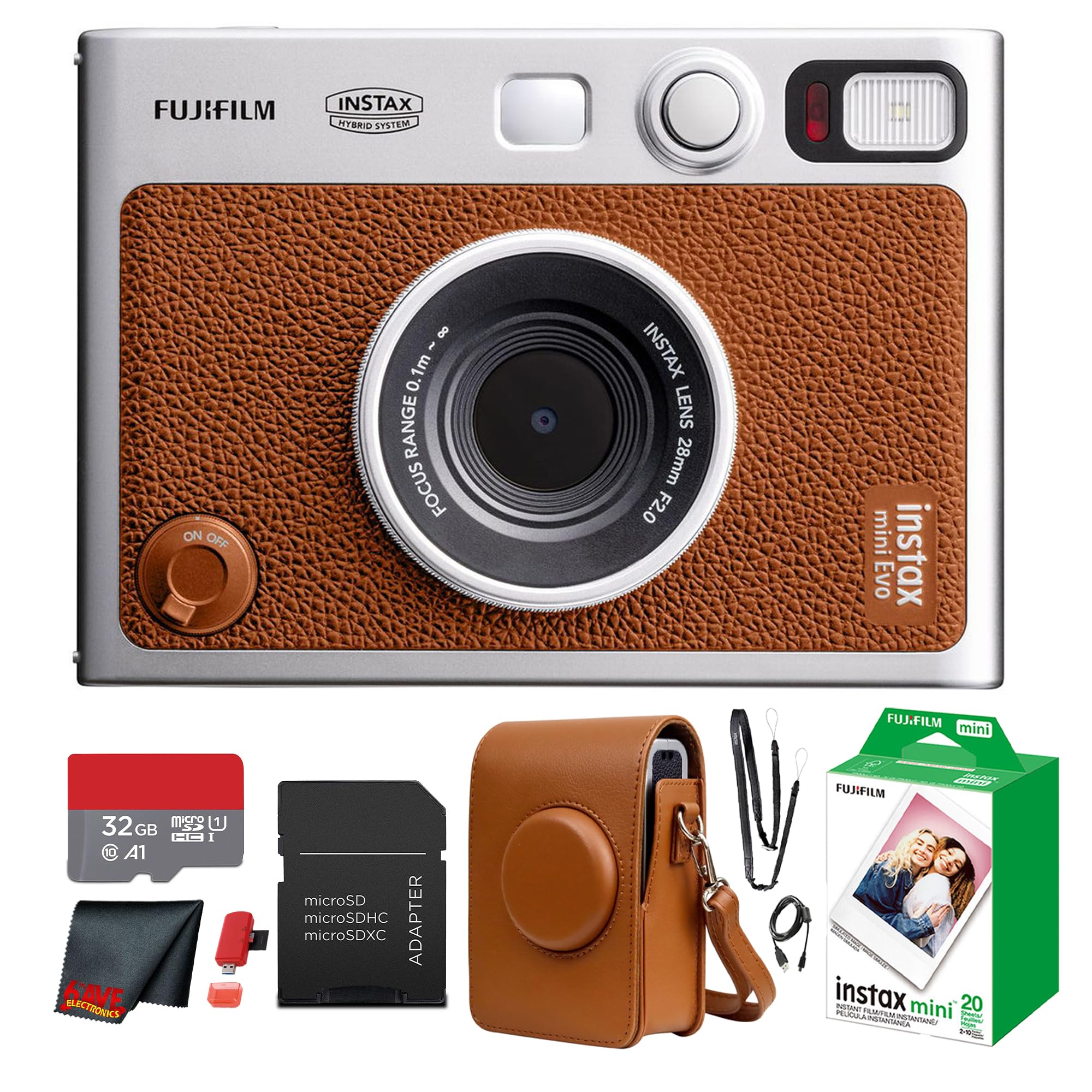
The Fujifilm Instax Mini EVO is a hybrid instant camera that lets you shoot digitally and selectively print to Instax Mini film. Ten lens effects and ten film effects combine for 100 unique looks, including vivid color, soft focus, and classic monochrome. The fixed 28mm-equivalent f/2 lens is suitable for low-light scenes, and the 3-inch LCD screen lets you choose exactly which frames to print before committing to film.
Users love the ability to use the companion app to print photos from their smartphone with the same instax frame and filter effects. The bundle includes 20 sheets of Instax Mini film, a 32GB memory card, a vintage brown case, and a cleaning cloth — everything you need to shoot immediately. The built-in selfie mirror and dual shutter buttons (portrait and landscape) make it easy to frame group shots and personal portraits.
The biggest drawback is the per-print cost of Instax Mini film, which runs roughly – per shot. The EVO does not store images as high-resolution files — the effective resolution is about 600 DPI, suitable for prints but not for large digital crops. The camera is also bulkier than a typical point-and-shoot, but the fun factor and instant physical output offset the size for social occasions and journaling.
Why it’s great
- 100 creative lens and film effect combinations
- Selectively print only the frames you love
- App integration for printing phone photos with instax frames
Good to know
- Film costs add up quickly over time
- Bulkier than typical point-and-shoot cameras
- Lower digital resolution limits cropping flexibility
7. Minolta Retro Digital Camera – 48MP Compact

The Minolta Retro Digital Camera combines a 48 MP CMOS sensor with a gold retro aesthetic that screams 1970s luxury. It offers 5K Ultra HD video, a 16x digital zoom, a 2.8-inch LCD screen, and a rear selfie lens for framing shots from both sides. Built-in color filters and creative tools like time lapse and slow motion give users plenty of creative options without needing a computer.
Some early adopters appreciate the 2004 digital camera aesthetic that comes through when zoomed in — the soft, pixelated character that modern smartphone computational photography aggressively removes. The complete package includes a 32GB memory card and a rechargeable lithium-ion battery, so you can start shooting immediately. WiFi connectivity allows direct smartphone sharing of your favorite shots.
Reviews are sharply divided. Several users report disappointing indoor picture quality, with colors that feel flat and detail that trails today’s premium smartphones. The digital zoom degrades image quality noticeably, and some units have experienced power inconsistencies and issues with the SD card slot. The camera appeals most to shooters who want a specific early-digital aesthetic rather than true film-like character.
Why it’s great
- High 48 MP resolution for detailed digital captures
- Retro gold design with built-in color filters
- Rear selfie lens and WiFi sharing included
Good to know
- Indoor image quality can be disappointing
- Digital zoom degrades sharpness quickly
- Reports of power and card slot reliability issues
8. CAPPY Screenless Camera for Digital Detox
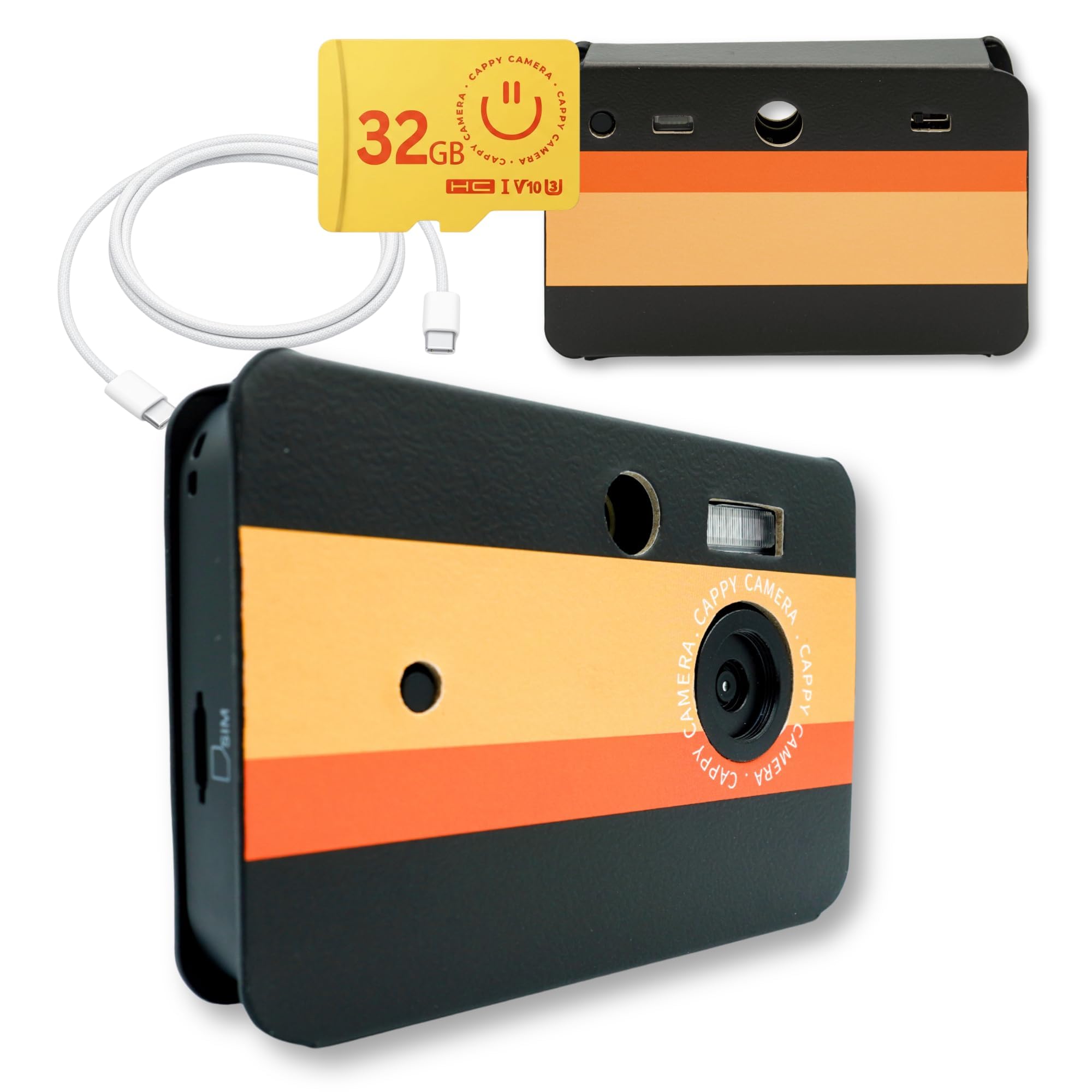
The CAPPY Screenless Camera is built around a radical idea — remove the rear screen so you can’t review, chimp, or retouch in the moment. The 20 MP sensor captures images with authentic vintage textures and warm tones, while the included 32GB SD card and USB-C port handle storage and transfer. The camera supports interchangeable lens cases for wide-angle and fisheye effects, and the built-in flash delivers that classic high-contrast retro look for nighttime shooting.
Users who understand the concept love the lightweight, portable form factor and the way the screenless design forces intentional composition. The two-button interface is simple enough that a child can operate it, yet the resulting photos often carry a unique, unfiltered character that screen-based cameras and phones can’t replicate. The USB-C charging is a welcome modern convenience that uses the same cable as most smartphones.
Critics point out that the build quality feels flimsy for the price — the body is primarily plastic, and the viewfinder is essentially a hole with no optical correction or information overlay. Daytime images can appear washed out and pale compared to more sophisticated cameras, and the low resolution (which creates the old-school feel) may frustrate users expecting sharp prints. The CAPPY is best suited for those who value the ritual over the raw technical output.
Why it’s great
- Authentic screenless shooting experience that mimics film delay
- Compact and lightweight with USB-C charging
- Interchangeable lens cases for wide and fish-eye perspectives
Good to know
- Plastic build feels less premium than price suggests
- Daylight images can appear washed out
- Viewfinder is simply a hole with no optics
9. Kodak PIXPRO FZ55-BK 16MP Digital Camera

The Kodak PIXPRO FZ55 is an entry-level point-and-shoot that delivers exactly what the price promises — a compact, lightweight body with a 16 MP CMOS sensor and 5x optical zoom (28–140mm equivalent). The 2.7-inch LCD screen, rechargeable li-ion battery, and 1080p Full HD video recording cover the basics for casual daily snapping, travel documentation, and simple vlogging. It accepts SD, SDHC, and SDXC cards up to 512 GB.
User reviews consistently highlight the camera’s ease of use — it is smaller than most smartphones, making it easy to slip into a bag for hikes and vacations. The optical zoom provides noticeably better reach than a phone’s digital crop, and the image stabilization reduces blur in handheld situations. Several buyers specifically mention using it to disconnect from their phone while still capturing decent memories, and the nostalgic “early digital camera” vibe is a recurring theme among positive reviews.
The compromises are predictable at this tier. The sensor struggles in low light, producing noticeable noise above ISO 800. There are no film simulations or creative color profiles — what you see on the LCD is a clean, neutral rendering that lacks vintage character out of the box. The macro mode is useful for close-ups at 5 cm, but overall the FZ55 is a no-frills shooter best suited for bright outdoor conditions where its simplicity becomes a strength rather than a limitation.
Why it’s great
- Very compact and easy to carry anywhere
- Optical zoom outperforms digital phone zoom
- Simple operation with long battery life
Good to know
- No built-in vintage filters or film simulations
- Poor low-light performance with high noise
- No raw format — JPEG only
FAQ
Can I get a vintage look without post-editing?
Does a higher megapixel count make photos less vintage-looking?
Should I buy an actual film camera instead of a digital one?
What lens focal length gives the most vintage feel?
Final Thoughts: The Verdict
For most users, the best affordable digital camera for vintage look winner is the Fujifilm X Half because its 1-inch sensor, 26 film simulations, and half-frame shooting mode deliver the most authentic film-era ritual and image character without requiring any post-editing. If you want interchangeable lenses and full control, grab the Nikon Z fc. And for the most affordable entry into true 35mm film, nothing beats the Canon AE-1 Renewed.