
Our readers keep the lights on and my morning glass full of iced black tea. As an Amazon Associate, I earn from qualifying purchases.
Specs are compiled from manufacturer listings and verified buyer reviews and can change over time — please confirm the key details on the product page before buying.
You want a gas mower that starts without a fight and clears an overgrown yard in one pass, and you do not want to pay premium money for it. The best affordable gas lawn mowers pair a four-stroke engine (a motor that runs on gas and oil kept separate, so no mixing) with a deck that actually mulches (chops clippings fine and drops them back on the lawn). What decides whether you happily push a mower for five seasons or watch it quit in month two is almost never the brand name. It is the engine size, the deck width, and whether the height lever holds its setting.
I’m Min — the founder and writer behind Gadgets Feed. This guide is built by comparing the manufacturers’ published specifications and the patterns across verified customer reviews, so you get each pick’s real strengths and trade-offs instead of marketing spin.
Below you will find nine gas mowers sorted by what they do best, from featherweight push units to self-propelled workhorses built for bigger lots. Every pick here is gasoline powered, and the guide below is the honest way to shop affordably priced options that still start and cut the way you need. Here is the practical breakdown of the best affordable gas lawn mowers.
Our Picks at a Glance
How To Choose The Best Affordable Gas Lawn Mowers
A gas mower is the one outdoor tool you will touch every single week from spring through fall, so the small stuff adds up fast. Pick wrong and you spend your Saturdays yanking a starter rope and wrestling a machine that bogs down in wet grass. Pick right and the whole job takes one tank of fuel and one steady push. These are the five things that actually decide which one you bring home.
Engine size: cc vs torque
Engine displacement — the cc number — is the physical size of the engine inside your mower, and it tells you how much muscle you have on tap. A 144cc engine handles a normal suburban lawn fine. Step up to 170cc or 201cc and you get an engine that keeps spinning when the grass is tall, wet, or overdue. Torque, measured in ft·lb, is the turning force that actually pushes the blade through that grass, so on denser lawns the torque figure matters more than the cc badge.
Push vs self-propelled drive
Self-propelled means the mower pulls itself forward so you only steer, which saves real energy on slopes and long runs. Push mowers are lighter and give you total control, which suits flatter, smaller yards and anyone who wants the machine to stay simple. If your lot has a grade, self-propelled is worth the extra weight it adds to the machine.
Deck width and cutting-height range
Deck width is the strip of grass you cut in a single pass — a 21-inch deck covers more ground than a 20-inch one, which trims your total lap count. The cutting-height range, given in inches, decides how short or long you can leave the grass, so a wider spread lets you adapt from a low summer trim to a taller cut that protects the turf in heat.
Starter system and the first-pull test
Auto-choke engines and no-primer designs remove the fiddly ritual of choking and priming before every start. In practice, that is the difference between a mower that fires on the first pull after a winter in the shed and one that demands ten pulls and a lot of patience. This is the single most repeated compliment and the single most repeated complaint in owner feedback, so treat it as a headline feature, not a footnote.
Quick Comparison
| Model | Best For | Engine | Cutting Width | Cut Height Range | Amazon |
|---|---|---|---|---|---|
| BILT HARD 21″ Self Propelled★ Best Overall | Big yards, mulching and bagging | 201cc | 21 inches | 1.2″ – 3.75″ | Amazon |
| BILT HARD 20 inch PushBest Value Push | Flat small yards on a budget | 144cc | 20 inches | 0.7″ – 3.2″ | Amazon |
| SENIX 21 inch 2-in-1 PushBest for Mulching | Mulching and side discharge only | 144cc | 21 inches | 1.25″ – 3.75″ | Amazon |
| AMERISUN 21″ Push | Small to medium yards, easy storage | 144cc | 21 inches | 1.5″ – 3.9″ | Amazon |
| PowerSmart EasyGlide 21-Inch | Everyday reliability on a value budget | 144cc | 21 inches | 1.5″ – 3.9″ | Amazon |
| PowerSmart 22-Inch Self Propelled | Wide cuts on larger properties | 170cc | 22 inches | 1.5″ – 3″ | Amazon |
| YARDMAX YG2860 | Variable-speed walking pace | 201cc | 22 inches | Not published | Amazon |
| SENIX 21” Self Propelled | Third-acre lots, light steering | 170cc | 21 inches | 1.25″ – 3.75″ | Amazon |
| AMERISUN 21″ Self-Propelled | Medium and large yards | 170cc | 21 inches | 1.5″ – 3.9″ | Amazon |
In‑Depth Reviews
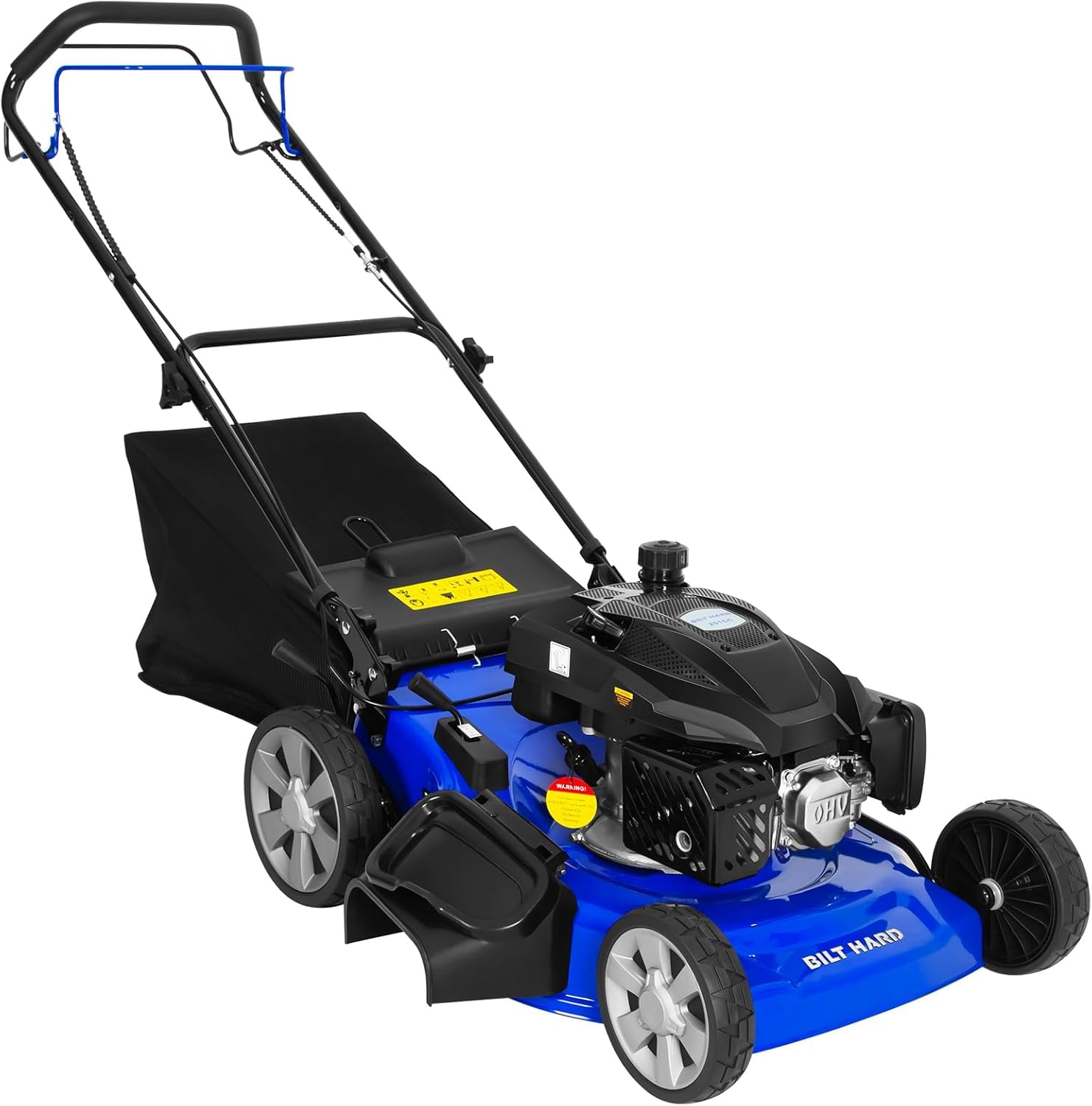
1. BILT HARD 21″ Self Propelled Gas Lawn Mower – 201cc 4-Cycle OHV
Our pick — over 4★ from 100+ verified ratings; the strongest balance of quality and price.
The 201cc engine here is the largest on this list — overkill for a postage-stamp lawn, exactly right for a real one.
This mower takes the top slot because of its 201cc four-stroke OHV engine (201cc is the engine size; OHV means overhead valve, a design that burns fuel more cleanly). It bolts to one of the widest decks on the list, so you cut a 21-inch path in a single pass and finish a big lawn in fewer trips. It pairs with 9.0 ft·lb of torque (the twisting force that keeps the blade turning through wet, leggy grass). Cutting height runs from 1.2″ to 3.75″ across 8 positions, and one lever moves all four wheels at once, so you are not crouching at each corner. The 3-in-1 deck gives you mulching, side discharge, and rear bagging, so one machine covers a tidy bag job and a fast nutrient-return mulch day.
What wins people over is the starting behavior — a no-choke, no-primer setup that fires on the first pull without the old squeeze-the-throttle ritual. The motor holds its footing in thick grass too, which is why owners who mow big, unruly lots keep coming back to it. The catch is weight: at 89.2 pounds this mower is 2.0x the mass of the SENIX 144cc push model below, and it costs you at every turn. Rear-wheel drive does the pushing on the straights so you are mostly steering, and the foam-wrapped angled handle was clearly designed for hour-long mowing sessions rather than a quick trim. That 201cc engine is what makes the 89.2 pounds worth hauling.
Where It Shines
- 201cc engine with 9.0 ft·lb of torque keeps the blade turning in thick, wet grass
- 8-position height lever moves all four wheels at once — no stooping at each corner
- 3-in-1 steel deck covers mulching, side discharge, and rear bagging from one machine
- No-choke, no-primer start fires on the first pull without fiddling
Worth Accounting For
- 89.2 pounds makes it a hard machine to pivot on tight turns
- Durability chatter around the oil seal and handles knobs is the recurring gripe — treat the fasteners as hand-tight, not gorilla-tight
- Rear-wheel drive still needs moderate effort on sloped terrain
Reach for this if: you have half an acre or more, mixed blade height, and want one machine to mulch, bag, and side-discharge on the fly.
Look elsewhere if: you have a small flat yard where eight cutting heights and 201cc is more engine than the job needs.
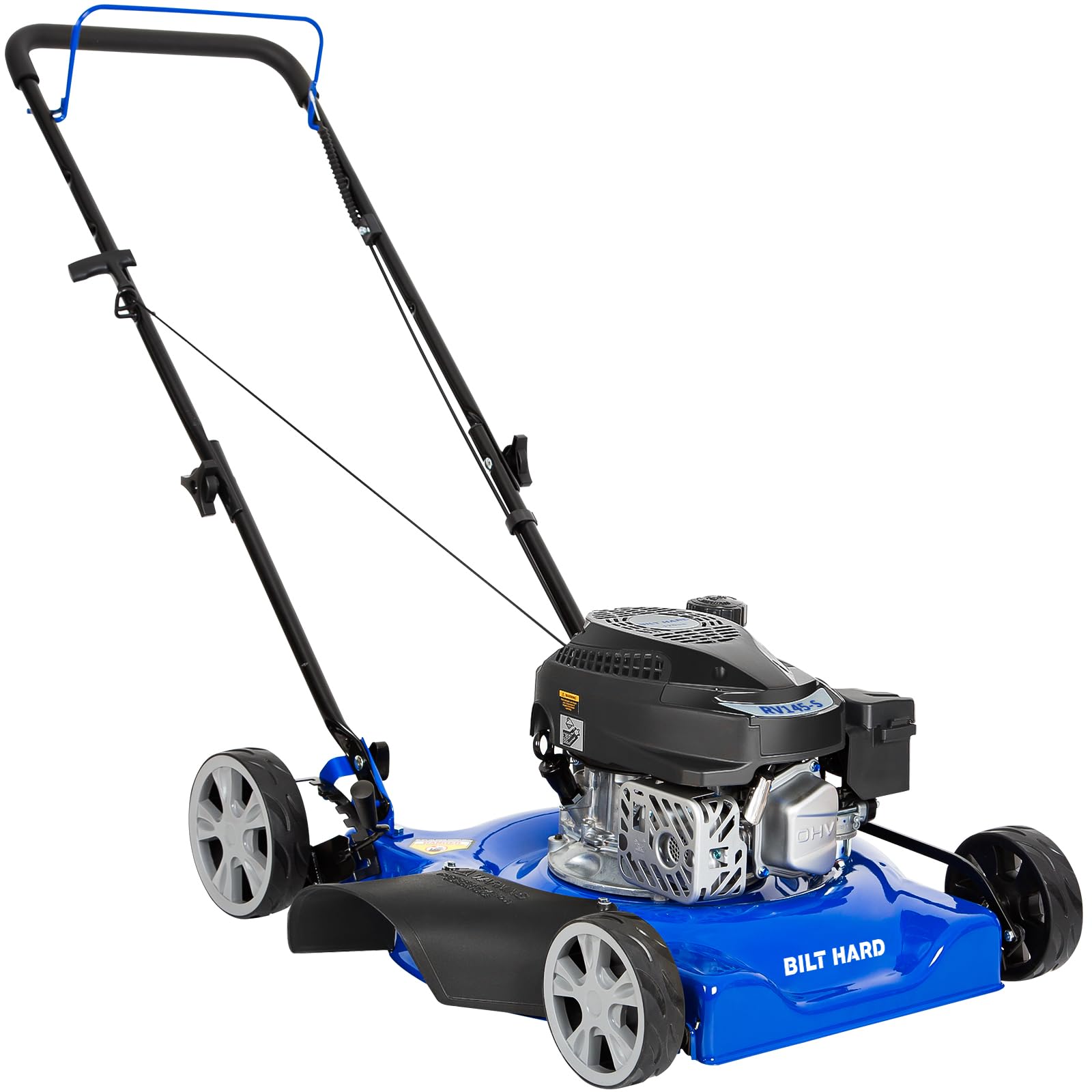
2. BILT HARD Gas Lawn Mower 20 inch, 144cc 4-Cycle OHV
Simple, honest push power — a bare-blade mower that starts easily and skips every feature you do not actually need.
Strip away the extras and this is the mower that wins the value-vs-cost argument in every push-mower buyer’s head. The 144cc 4-stroke OHV engine (144cc is the engine size; OHV means overhead valve) runs on a no-primer, no-choke start system, so you just pull and go. The deck is 20 inches, the narrowest on the list, and that is also why the whole machine is light enough for one person to lift into a truck bed. At 51 pounds it is roughly a third of the weight of the self-propelled heavyweight above. Eight height positions run from 0.7″ to 3.2″, which is a lower top cut than the SENIX 21-inch at 3.75″. That means less top height but more range pulled toward the short side, which suits people who mow weekly and want a scalp-tight summer cut.
Assembly is genuinely easy — one reviewer called it a “six-bolt assembly,” and the double ball-bearing 7-inch rear / 6-inch front wheels deliver a surprisingly smooth push for the price. Owners of small and mid-sized yards repeatedly say it starts first-pull every time, and the specialized blade leaves a clean, even cut. Staying true to value: oil is included in the box so you can fuel it and mow the same afternoon.
Honest read on longevity: the durability chatter around this mower centers on plastic parts and handle brackets, plus the availability of replacement blades once the original wears out. As owners put it: “I was very satisfied with this mower until the original blade needed replacing.” Treat it as a workhorse for the years it runs well, not a mower you leave to your grandchildren.
The right buyer: small-lot owners on a tight budget who want an easy-start, easy-lift mower that does one job cleanly.
Skip if: durability and spare-parts support matter more to you than an easy one-hand push.
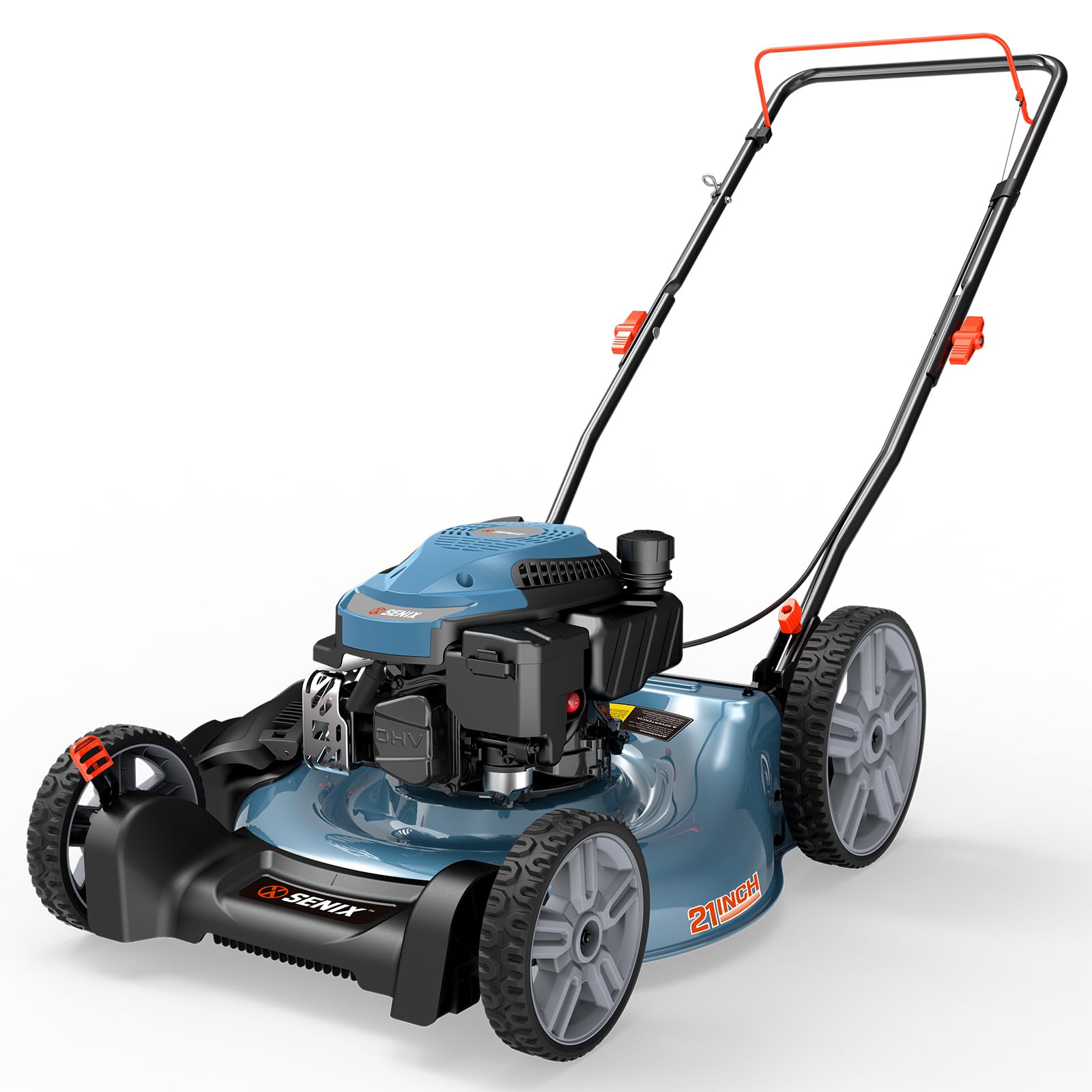
3. SENIX 144 cc Gas Lawn Mower, 21 inch 2-in-1 Push
High wheels, wide deck, zero tools — the friendly grass cutter for anyone who wants mowing done quickly without a fight.
The headline number here is the 11-inch rear wheel, matched to an 8-inch front — a big-wheel configuration that walks over uneven terrain far more gently than the flat-road push mowers. Add a 21-inch cutting deck that covers a wider strip than the 20-inch BILT HARD below, and you are trimming total lap count on tight-lawned yards. Cutting height runs from 1.25″ to 3.75″ across 6 positions, adjusted by hand at the wheel. The 144cc engine uses SENIX’s 4QL lubrication system, which means you pour straight gas — no two-stroke oil mixing, no measuring.
The 2-in-1 layout gives you mulching and side discharge, but not rear bagging — an important detail if your goal is a collection bag rather than a mulch-and-go mow. Setup takes minutes with no tools, and the deck and engine combo handles thick spring growth without straining. Owners consistently describe the cut as clean and even. The 11-inch rear wheels and light deck make it easy to pivot around flower beds.
The durability disclaimer: the recurring note here is that breakdowns can happen early, with some units reported failing on the second use. SENIX backs the platform with a 2-year manufacturer warranty, which is the practical safety net if you are unlucky with the draw. Treat it as a mower you fire up regularly rather than one you let sit for a month between cuts — these engines do not love long idleness.
Choose this one when: mulch or side-discharge is your style, big rear wheels appeal, and you want minimal setup.
Think twice if: you need a rear-bag collection system, because this deck does not offer one.
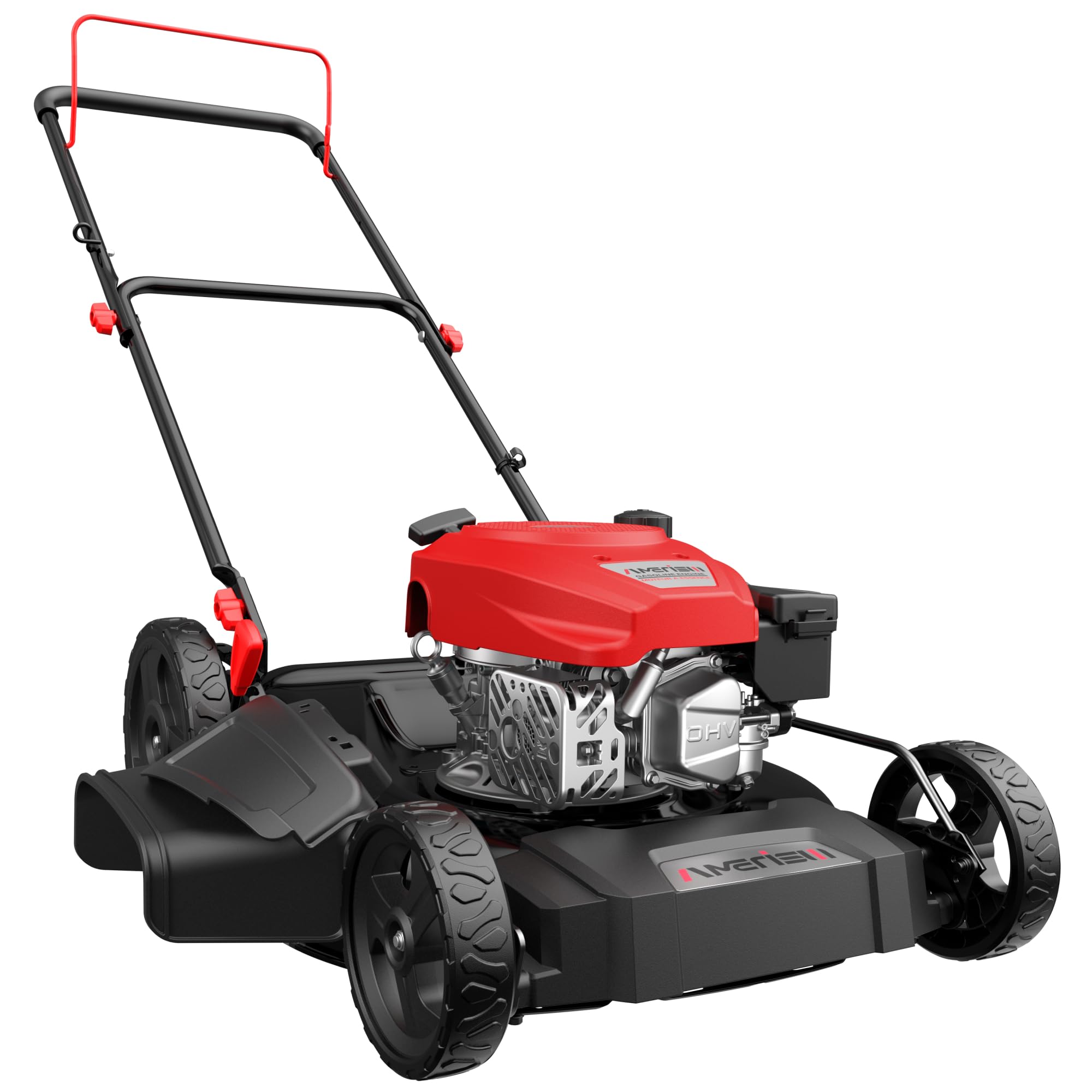
4. AMERISUN 21″ Gas Lawn Mower, 144cc 4-Cycle OHV Walk Behind Push
A 21-inch cut in a package that folds flat for a full shelf in the garage.
What makes this one stand out is the combination of a 21-inch heavy-duty steel deck and a foldable handle that lets the whole machine collapse into a garage corner or shed shelf. The deck is the same cutting width as the self-propelled SENIX above, but this mower is a walk-behind push model with a 144cc 4-cycle OHV engine on top. At 63 pounds it sits in the middle of this group — lighter than the 89.2-pound self-propelled BILT HARD, heavier than the 45-pound SENIX push. Wheels are 7-inch front and 10-inch rear, sized to roll over roots and curb edges rather than stop on them.
Cutting height runs 1.5″ to 3.9″ across 6 positions, giving the widest top cut of the push mowers here. You get mulching and side discharge — no rear bag option — so the setup suits homeowners who want clippings recycled back into the turf. Owners regularly report that it starts on the first pull and handles thick grass without bogging down. The foldable handle and 63-pound frame let it collapse onto a garage shelf.
Honest note on the deck: a 21-inch-wide deck can be overkill if your yard is broken into narrow strips between flower beds, and you will do more lifting than cutting. The foldable handle makes the door swing simple but does nothing for a tight yard layout.
Best fit: someone with one continuous lawn, a small storage footprint, and a preference for side-discharge mowing.
Not for you if: you need a rear collection bag or want the wider cutting path to also push forward on a slope.
5. PowerSmart EasyGlide 21-Inch 3-in-1 Push Gas Lawn Mower
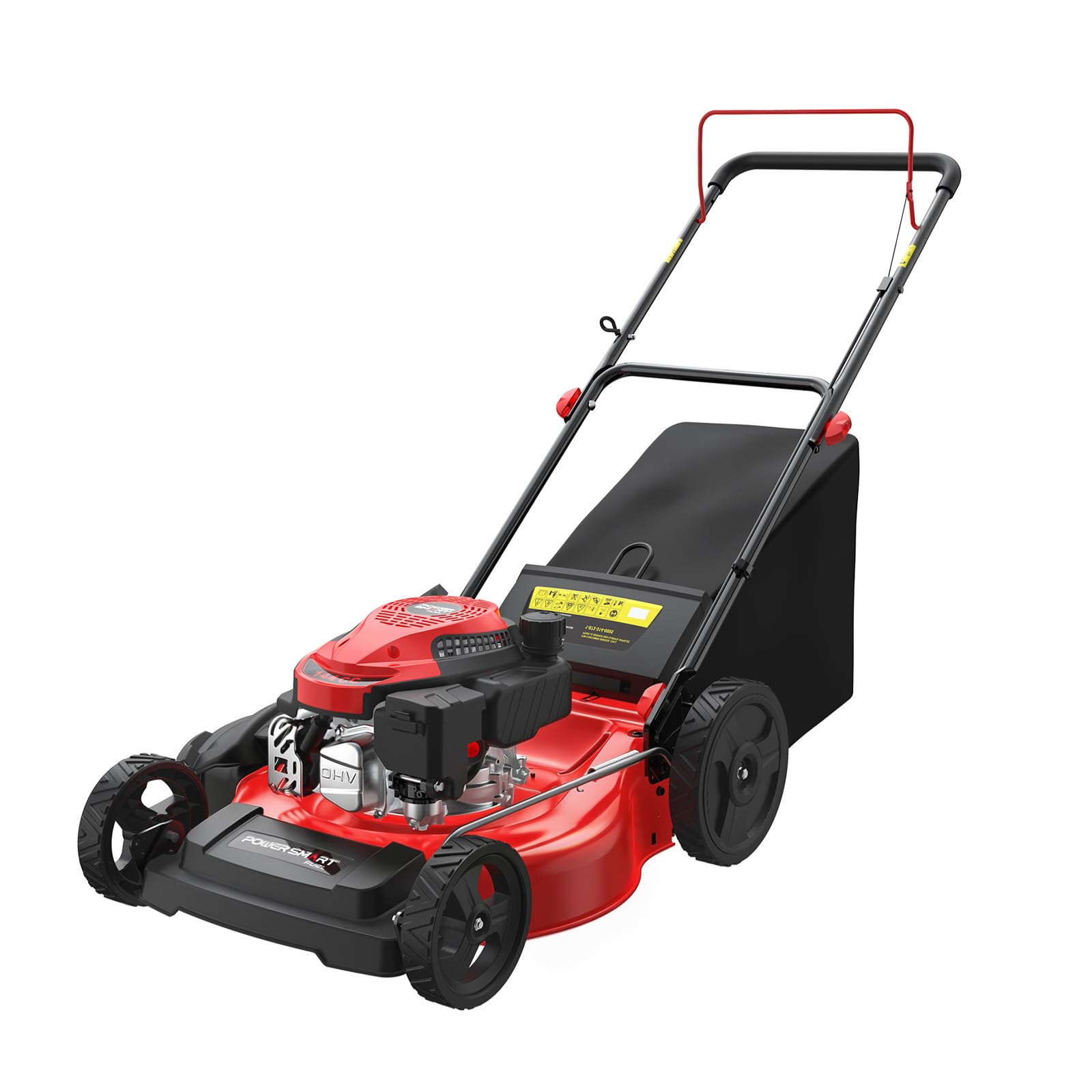
The crowd favorite of this lineup — a push mower that earned its reputation the honest way, cutting cut after cut.
If a gas mower could win by voter turnout, this is the one — 4.2 stars across 900+ ratings, the highest score and the biggest crowd on this list. There is real substance behind the popularity: a 21-inch steel deck, a 144cc 4-stroke OHV engine with an auto-choke and primer for cold starts, and a 3-in-1 layout that covers mulching, bagging, and side discharge. Height adjustment runs 1.5″ to 3.9″ across 6 positions with a single lever. The 10-inch rear and 7-inch front wheels are double ball-bearing, which smooths the push on a machine that sits at 61.6 pounds.
The thing everyone raves about is how quickly it starts on a cold engine — the auto-choke takes the guesswork out of a first pull of the season. Owners also call out how much power the 144cc puts down for a mower in this tier: it eats tall grass without slowing, and the deck leaves a clean, even cut. All-wheel height adjustment from one lever saves time between strips, and the EasyGlide design is comfortable to push for a full mow session. This is the mower the segment built its reputation on — solid power, easy start, modest weight.
Owners Keep Bringing Up
- Fires on first pull thanks to auto choke plus primer — no chore ritual
- 144cc engine handles thick and wet grass without bogging down
- 21-inch deck widens each pass and shortens total mow time
- 3-in-1 deck makes mulch, bag, or discharge a one-lever change
The Fine Print
- Small fuel tank means a mid-job refill on large yards
- Foam handle grip can arrive with shipping scuffs — inspect before assembly
- Engine note is louder than some similar-displacement competitors
Top of the shortlist if: you want a reliable starter, a wide cut, and three mowing modes with a track record to match.
Pass on it if: you have a huge lot where one fuel tank needs to last the whole job.
6. PowerSmart 22-Inch Self Propelled Gas Lawn Mower, 170cc
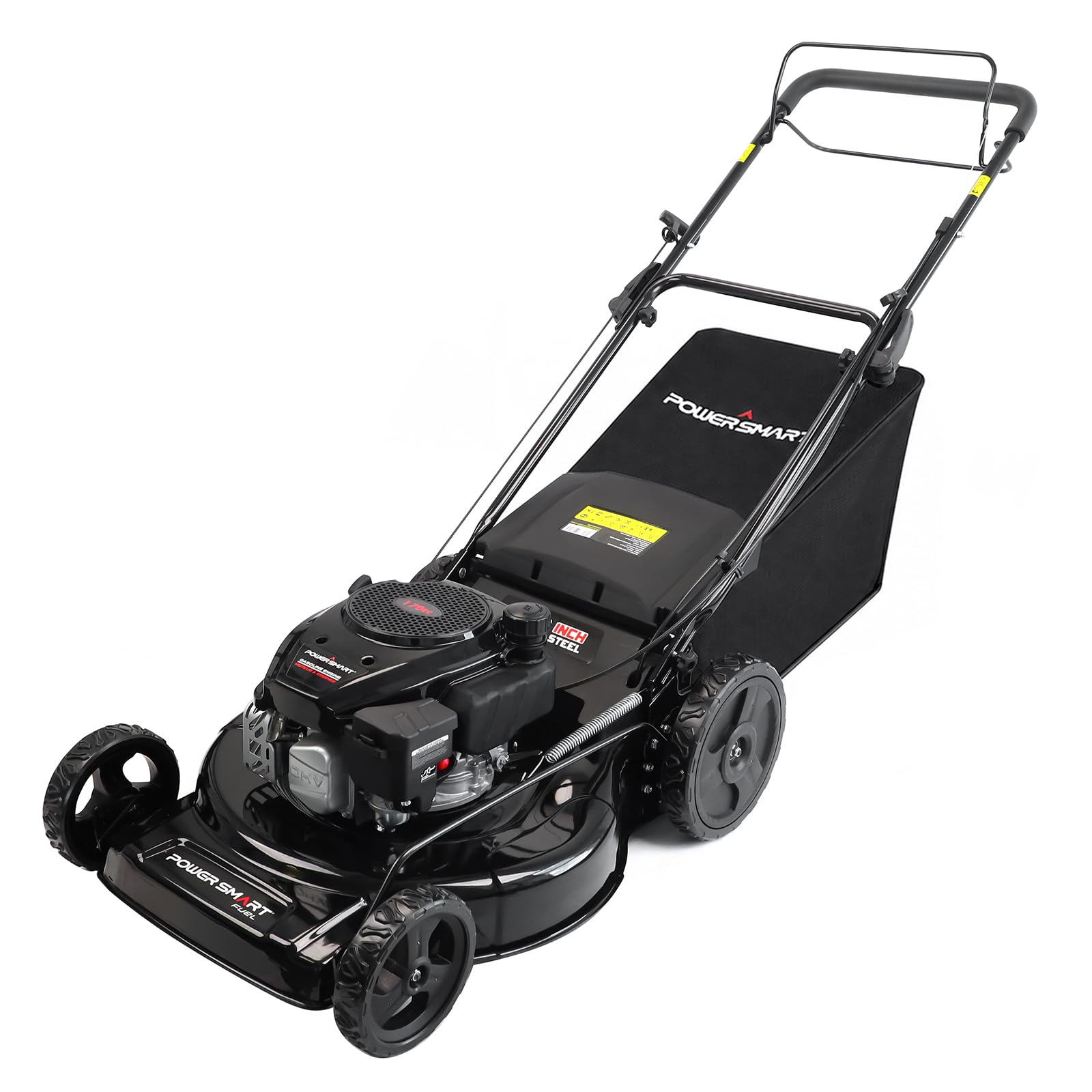
The only 22-inch deck here — one extra inch of cut across every pass, on a machine that pushes itself.
Where the EasyGlide sibling aims at the entry-tier crowd, this one is built for a bigger lot. Under that deck sits a 170cc 4-stroke OHV engine, the largest on the PowerSmart side and a step up from 144cc on the value pick. Rear-wheel drive does the pushing on grades and uneven ground, so the operator mostly steers. 6 cutting positions range from 1.5″ to 3.9″ with tool-free assembly and a folding handle.
Buyers report the 170cc engine hits the balance: enough torque to walk through thick grass without slowing, and easy-start behavior that typically fires on the first pull of the cord. Rear-wheel drive matters most on sloped yards, where front-drive push mowers stall. The 3-in-1 deck gives you mulch, rear bag, or rear discharge, and the wider deck keeps you out of the mower’s path a lot longer. If you mowed your previous yard with a 20-inch push unit, you will genuinely feel the difference in total time per session.
Watch the maneuverability question: the 22-inch deck is a big footprint to swing around flower beds and tight garden corners, and wider decks always make the pivot more awkward. If your lawn is broken up into small sections, that extra width stops being an advantage.
Great when: your yard is large, mostly open, and you want self-propelled ease plus the widest cut on this list.
Not the one if: your lawn is chopped into tight pockets where a wide deck has no room to turn.
7. YARDMAX 22 in. 201cc Select PACE 6 Speed CVT Self Propelled
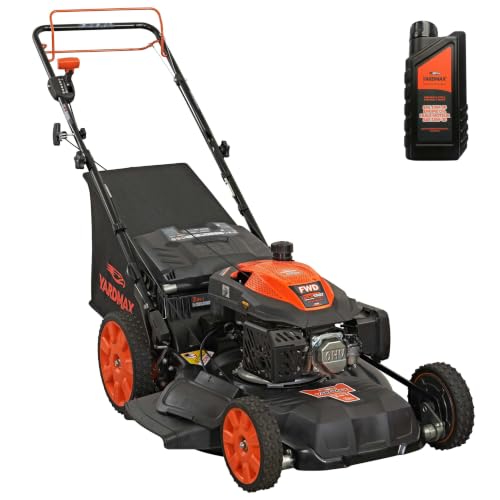
A mower that walks at whatever pace you do — six speeds, no gear-banging, just a shift lever on the handle.
That 6-speed CVT — short for continuously variable transmission — is the reason this mower gets picked by people with long yards and preferences about walking pace. Instead of one fixed self-propelled speed, you nudge a lever and the drive matches your stride, from a slow careful crawl along a flower bed edge to a full-stride push down a long stretch. The 201cc engine is tied with the BILT HARD above as the largest on the list. Spiked-tread rubber tires bite into turf and wet ground harder than the rounded tread on the value picks. There is also a deck-cleaning port, and a single-lever height adjustment for quick changes between mowing heights.
Owners consistently call out the speed variability as the reason this mower is worth the price — the CVT really does deliver its headline feature. The auto-choke system means no prime ritual before a cold start, and the 22-inch deck matches the widest cut on this list. At 84.9 pounds it carries real heft, which is what makes the self-propelled drive and spiked tires such a big deal. The CVT lets you match your walking pace instead of chasing a single fixed drive speed.
Where The Yardmax Earns Its Spot
- 6-speed CVT meter matches your walking pace with a single lever
- 201cc engine handles thick grass without hesitation
- Spiked-tread tires grip turf, slopes, and damp ground well
- Deck-wash port and single-lever height adjustment
What to Know Before Buying
- 84.9 pounds is heavy enough that a front-wheel-drive layout feels underpowered on steep slopes
- The speed-shift lever can slip out of position if the cable tension is loose from the factory
- Assembled weight with a full grass bag makes turning at bed edges harder
Well suited to: larger, mostly flat to mildly sloped yards where matching your walking speed matters more than light weight.
Consider carefully if: your yard is steep, tight, or you want the lightest machine in the shed.
8. SENIX 21” Self Propelled Gas Lawn Mower 170 cc

Built for the fourth-acre lawn — the biggest bag on the list, and a deck sized to a single mowing session.
The engine here is a 170cc 4-cycle OHV putting out 3.8 HP and 6.5 ft·lb of torque, a step above the 144cc crowd below without stretching to the 201cc machines at the top. It is designed for quieter running and lower vibration through the handle, which matters on long mowing sessions. The 21-inch steel deck handles a third-of-an-acre lot without needing a second pass approach. The 3-in-1 system covers mulching, side discharge, and rear bagging — and the rear-bagger capacity is 1.7 bushels, the largest bag on this list, so you empty it less often. Height runs 1.25″ to 3.75″ across 6 dual-lever positions, and the vortex tunnel design reduces grass buildup on the underside of the deck.
The self-propelled drive is front-wheel, which pulls rather than pushes, and owners describe it as a light lift-and-pivot setup for hopping over obstacles and turning around trees. Pre-filled oil lets you start mowing around fifteen minutes after unboxing. Owners consistently describe the mowing experience as easy and quick, with the exact-yards framing matching what they report. The front-drive design is a real difference-maker because lifting the deck slightly gets you around a tree without stalling the drive.
The one fit caveat: front-wheel drive on a self-propelled unit works best on flat-to-gentle terrain. On steep slopes and heavily uneven ground, the drive wheels get lighter and the pulling force fades, so the mower starts to feel like a push unit again. If your property is hill-heavy, consider that trade-off before committing.
Dialed in for: a flat-to-mildly-sloped yard around a third of an acre, where the big bag and light steering matter most.
Look elsewhere if: your lot has serious grades where the front-drive assist cannot keep up.
9. AMERISUN 21″ Self-Propelled Gas Lawn Mower, 170cc OHV
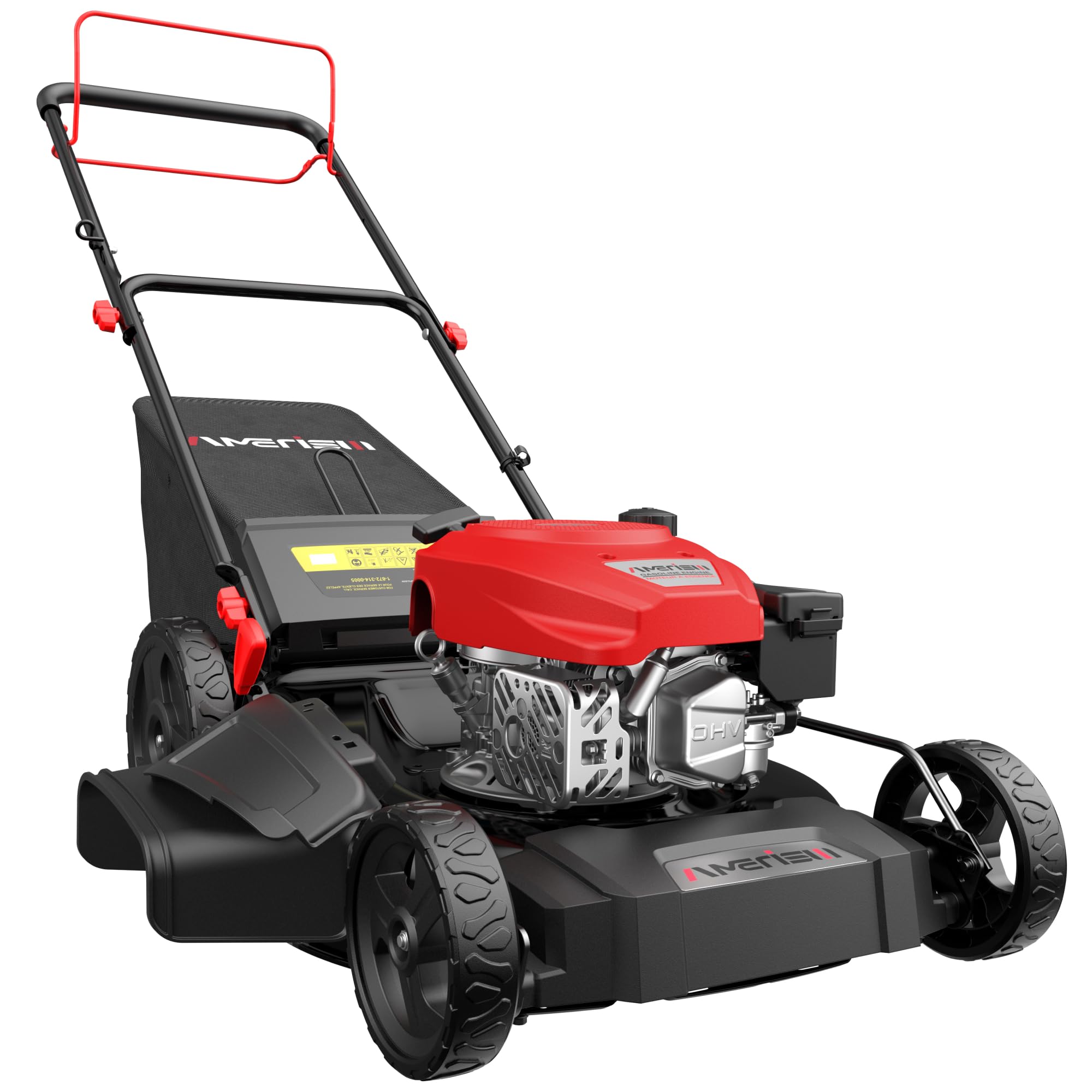
Built to handle slopes and thick grass in one pass — a self-propelled mower for the yard that fights back.
That 170cc 4-stroke OHV engine is the reason this mower handles tall, thick grass in medium and large yards without the operator having to slow the walking pace. Large 10-inch rear and 7-inch front wheels are sized for rolling over uneven terrain, hills, and slopes — a high-wheel setup that keeps the deck level through rutted ground. The 21-inch steel cutting deck runs the 3-in-1 mulching, side discharge, and rear bagging layouts, and the rear catcher holds 1.4 bushels of clippings. Height adjustment runs 1.5″ to 3.9″ across 6 positions on a single-lever. The foldable handle lets the machine stand up for compact garage or shed storage.
Owners describe the engine as powerful enough for various grass types and terrains, with the cutting quality holding up in the tall stuff. The high-wheel design is a real advantage on uneven yards — it keeps you from getting stuck on a rut or stopping to reposition. The 3-in-1 deck means you can mulch one week and bag the next without buying another mower. Mulch one week and bag the next without buying a second mower.
Where durability enters the picture: the recurring note in the review record is wheel breakage and general long-term durability — this is the trade-off that comes with a lighter-weight machine doing a job designed for heavier equipment. If you tend to mow rough terrain with roots and rocks, treat the wheels carefully and inspect the drive hardware at the start of each season.
Made for: medium-to-large yards with mild slopes, mixed blade height, and a preference for a self-propelled mower with a real rear bag.
Not ideal if: you mow on rocky, root-rutted ground where the wheels are likely to take hits.
Understanding the Specs
Engine Displacement (cc)
Engine displacement is the physical swept volume of the cylinder inside your mower’s engine, written in cc. Think of it as lung capacity — a 144cc engine breathes less air and fuel each stroke than a 170cc or 201cc one, so it produces less sustained twisting force. On a small flat lawn a 144cc is entirely sufficient. On thick, wet, or overdue grass, a 170cc or 201cc engine stays at mowing RPM where a smaller one bogs down.
Torque (ft·lb)
Torque is the turning force the engine delivers to the blade — the number that actually keeps grass cutting when the going is heavy. A mower rated at 9.0 ft·lb has meaningfully more twisting force at the blade than a mower at 5.8 ft·lb, which is why torque is the number that matters for thick grass and tall weeds. Small cc numbers can still deliver decent torque, so read the torque figure, not just the engine size.
Deck Size (inches)
The deck width is the strip of grass you cut in one pass. A 21-inch deck covers more ground than a 20-inch deck every time you push the mower forward, so wider decks slice laps off the total mowing job. The trade-off is a wider machine to maneuver into corners and along beds, so a bigger deck is not automatically better for a yard broken into small pockets.
Cutting Height Range
Cutting height is the length you leave the grass after the blade passes, measured in inches from the soil. A tall top end around 3.9″ lets you leave grass longer in summer heat so it shades its own roots, while a low bottom end near 0.7″ lets you scalp a lawn down for a fresh restart. Multiple positions between those extremes let you dial in a winter cut and a summer cut from the same mower.
Drive System (Push vs Self-Propelled)
Push mowers require you to provide the forward force; self-propelled mowers drive themselves so you only steer. Self-propelled is worth its extra weight on large yards and slopes because it saves the operator’s energy across a full session. Push mowers win on small flat lawns where the extra drive hardware is just added weight and one more thing to maintain.
Starter System (Auto-Choke, No-Primer)
The starter system controls how the engine fires from cold. A traditional start requires priming the fuel and choking the air intake. Auto-choke engines handle this automatically — you pull the cord and the engine sets its own mixture. That is why first-pull start behavior shows up so often in owner feedback: a well-tuned auto-choke engine saves real effort every single week.
Wheel Size and Tread
Larger wheels roll over small obstacles rather than getting caught on them, and taller rear wheels track straighter on slopes. A high-wheel setup with a 10-inch or 11-inch rear wheel is what lets a mower hold course across uneven ground. Aggressive tread patterns improve grip in wet grass and on grades, at the cost of slightly more pushing effort on smooth, level lawns.
Grass Bag Capacity
The bag capacity is how much clippings fit before you stop to empty it. Bushels are the unit — a 1.7-bushel bag holds more clippings than a 1.4-bushel one, so it needs fewer stops on a leaf-heavy autumn mow. For a mulching-only mower, bag capacity is irrelevant because clippings recycle into the lawn instead of collecting in the bag.
FAQ
What size engine do I actually need on a gas lawn mower?
How wide should my mower deck be for a quarter acre lawn?
Is self-propelled worth it or should I buy a push mower?
What is the difference between 2-in-1 and 3-in-1 mower decks?
Do I need to mix oil with gas on any of these mowers?
How often should I change the oil and blade on a gas mower?
Why does my mower have trouble starting after winter storage?
What cutting height should I use for a healthy lawn?
Are front-wheel-drive self-propelled mowers worse thanrear-wheel drive?
Can I use a gas mower on wet grass without damaging it?
Do these mowers come with oil in the box?
Final Thoughts: The Verdict
For most lawns, the affordable gas lawn mowers pick that gets the job done without fuss is the BILT HARD 21″ Self Propelled. It pairs the list’s largest 201cc engine with a 21-inch 3-in-1 deck and 8 height positions at a mid-range price. If horsepower-per-dollar is what you are after, the PowerSmart EasyGlide 21-Inch wins the value argument with a solid 4.2-star reputation and a proven first-pull start. And for the tightest budget with a small flat yard, the BILT HARD 20 inch Push gives you clean cutting at the lowest entry point on this list. Match engine size, deck width, and drive system to your yard, and any of these picks will last for seasons.
How We Picked
We do not accept paid placement. Every pick is matched to a real buyer and a real use-case; we do not hands-on test units.
Sources & Methodology
Specifications: manufacturer listings and product documentation. Review insights: verified customer reviews, as of September 2026. Pricing: not shown on this page (it changes often); check the current price via the retailer link.
As an Amazon Associate, Gadgets Feed earns from qualifying purchases. This does not affect which products we feature.