
Choosing a home backup generator often feels like balancing a budget against the fear of losing power during a storm. The market is flooded with noisy, fuel-hungry conventional units that shake your windows, but the real challenge is finding an inverter generator that delivers clean, stable power without draining your wallet. You need a machine that starts on the first pull, sips fuel, and won’t damage your refrigerator’s compressor or your laptop’s power supply.
I’m Min — the co-founder and writer behind Gadgets Feed. I’ve spent hundreds of hours combing through technical datasheets, analyzing THD ratings, decibel levels, and real-world run-time curves across dozens of models to separate the genuine value plays from the marketing hype in this specific price tier.
Whether you are preparing for hurricane season, equipping an RV, or just want peace of mind during a blackout, finding the best affordable generator for home requires understanding where to spend and where to save without compromising safety or reliability.
How To Choose The Best Affordable Generator For Home
The right home generator starts with a clear-eyed look at what you actually need to power. Over-buying wattage wastes fuel and cash, while under-buying leaves you in the dark with a tripped breaker. Focus on inverter technology, clean power output (THD under 3%), and realistic runtime figures rather than peak wattage claims.
Prioritize Inverter Technology Over Open-Frame
An inverter generator produces stable, sine-wave power with less than 3% total harmonic distortion. This is non-negotiable for modern electronics — compressors in fridges, microwaves, and laptop chargers all expect clean power. Open-frame models are cheaper but louder and risk damaging sensitive devices. Every generator on this list is an inverter unit, ensuring your home essentials stay safe.
Calculate Running Watts, Not Just Starting Watts
A refrigerator might need 800 running watts but 1600 starting watts. An RV air conditioner can spike to 2500 watts at startup. Add up the running watts of every device you plan to run simultaneously, then add the single highest starting watt spike. A 3500-watt running unit covers a fridge, lights, phone charging, and a small window AC comfortably. Anything above 4500 watts opens up well pumps and larger appliances.
Check Runtime and Fuel Type at 25% Load
Manufacturers advertise runtime at 25% load, not full throttle. A 1.3-gallon tank claiming 8 hours at 25% load means you get about two hours at full 3600W output. Dual-fuel models (gasoline and propane) offer flexibility and longer shelf life for fuel storage. Propane also burns cleaner and reduces maintenance frequency, making it a strong choice for infrequent emergency use.
Quick Comparison
On smaller screens, swipe sideways to see the full table.
| Model | Category | Best For | Key Spec | Amazon |
|---|---|---|---|---|
| PowerSmart 3600W | Inverter | RV AC up to 15K BTU | 26.7A output | Amazon |
| Champion 4500W | Inverter | Heavy daily use | 14 hrs at 25% load | Amazon |
| WEN 56477i | Inverter | Home backup essentials | CO Shutdown sensor | Amazon |
| Pulsar PGD40ISCO | Inverter | Budget RV power | 4000W peak / 59 dBA | Amazon |
| ERAYAK 4500W | Inverter | Clean power for electronics | THD 0.2%–1.2% | Amazon |
| WEN 56360i | Inverter | Ultra-light camping | 46 lbs | Amazon |
| Westinghouse iGen2800DFc | Inverter | Dual fuel flexibility | 52 dBA quietest | Amazon |
| Generac GP3300i | Inverter | PowerRush starting capacity | 50% more starting power | Amazon |
| Jackery Explorer 2000 v2 | Power Station | Indoor silent backup | 2042Wh / 2200W output | Amazon |
| Anker SOLIX C2000 Gen 2 | Power Station | Fast charging power station | 58 min to full charge | Amazon |
| Westinghouse 12500W | Open Frame | Whole-house backup | 12500W peak / dual fuel | Amazon |
In‑Depth Reviews
1. PowerSmart 3600-Watt Portable Inverter Generator

The PowerSmart 3600W hits a rare trifecta: clean inverter power with under 3% THD, a 30-amp RV outlet, and a 50.7-pound frame that actually feels portable. Its 149cc engine delivers 3200 rated watts, which comfortably handles a 15,000 BTU RV air conditioner, a refrigerator, and a few lights without breaking a sweat. The 1.3-gallon fuel tank provides up to 8 hours of runtime at 25% load, enough for a full night’s sleep during an outage.
Parallel capability lets you link two units for double the output, scaling up without buying a massive open-frame rig. Owners consistently praise the first-pull start and the surprisingly low noise floor — you can hold a conversation next to it. The integrated carry handle and compact 21.9 x 13.4 x 19.5-inch footprint make it easy to store in a garage corner or haul to a campsite.
For home backup, the 30-amp TT-30R receptacle is critical for direct RV hookups, and a simple adapter connects it to your home’s transfer switch. The two-year warranty adds confidence for a sub-premium investment. This is the sweet spot where wattage, weight, and noise converge for real-world emergency use.
Why it’s great
- Inverter tech keeps THD under 3% for sensitive electronics
- 30-amp RV outlet ready out of the box
- Parallel capable for future expansion
Good to know
- No electric start — recoil only
- Fuel tank capacity is moderate for extended outages
2. Champion Power Equipment 4500-Watt RV Ready Inverter Generator

The Champion 4500W is built for endurance. With a 212cc engine, it delivers 3500 running watts and a 14-hour runtime at 25% load from a 2.3-gallon tank. This is the longest runtime in its class among the inverters reviewed here, making it ideal for multi-day outages where refueling is a hassle. The 61 dBA noise rating is quieter than a traditional vacuum cleaner, so it won’t disturb the neighborhood.
A key safety feature is the CO Shield carbon monoxide auto-shutoff system, which automatically kills the engine if CO levels become dangerous inside an enclosed space. The Intelligauge display shows voltage, frequency, and operating hours, helping you track maintenance intervals. Parallel-ready capability allows pairing with another Champion inverter for up to 7000W of output.
The 92-pound weight is heavier than the PowerSmart, but the built-in wheels and handle make it easy to roll across a driveway. Customers running food trucks and construction sites report these units surviving 8+ years of daily use. The three-year warranty and lifetime technical support from Champion are best-in-class for this tier.
Why it’s great
- 14-hour runtime is class-leading for inverters
- CO Shutdown sensor adds critical safety
- Superior build quality for daily heavy use
Good to know
- Heavier than competitors at 92 lbs
- Not dual fuel — gasoline only
3. WEN 56477i 4800-Watt Portable Inverter Generator

The WEN 56477i brings 4800 surge watts and 4000 rated watts from a 224cc engine, making it the highest-rated output in the inverter group at this price point. It includes a WEN Watchdog CO Shutdown sensor that automatically turns off the generator if carbon monoxide builds up, a feature often reserved for more expensive models. Fuel shut-off technology lets you run the carburetor dry before storage, preventing gummed-up fuel lines.
Onboard wheels and a telescoping pull handle make the 72.7-pound unit easy to reposition despite its weight. The four 120V receptacles and a TT-30R RV outlet give you plenty of connection options. Customers report powering refrigerators, freezers, TVs, and Wi-Fi routers for 8 hours per tank during week-long outages, with many calling it their best purchase for hurricane season.
The three-year warranty adds peace of mind. At this wattage, you can run a well pump or a small air conditioner alongside your fridge. It is the strongest performer for homeowners who need to power multiple large appliances without stepping up to a stationary unit.
Why it’s great
- Highest rated output (4000W) in the inverter group
- Watchdog CO Sensor for safe operation
- Onboard wheels and telescoping handle
Good to know
- No parallel capability documented
- Heavier than similar-wattage competitors
4. Pulsar PGD40ISCO 4000W Portable Gas Inverter Generator

The Pulsar PGD40ISCO is the lightest 4000W–class inverter on this list at just 47.3 pounds. Its 145cc engine provides 3200 running watts and 4000 peak watts, which is enough for a 13,500 BTU RV air conditioner with a soft start. The 1-gallon fuel tank delivers 4 hours of runtime at half load, which is short compared to the WEN or Champion, but the weight savings make it a top choice for campers who move their generator frequently.
Super quiet operation at 59 dBA means you can run it at a campsite without disturbing neighbors. Parallel-ready design lets you link two units for 6400 running watts. The white color reduces heat absorption in direct sunlight, a thoughtful detail for outdoor use. Owners consistently report first-pull starts even after long storage periods.
The trade-off is a smaller fuel tank and shorter runtime. It is ideal for short-term outages or intermittent use during the day. If you need overnight coverage, you will want a larger tank or a secondary unit.
Why it’s great
- Extremely portable at 47.3 lbs
- Parallel ready for power expansion
- Quiet operation at 59 dBA
Good to know
- 1-gallon tank limits runtime to ~4 hours at half load
- No CO sensor included
5. ERAYAK 4500W Portable Inverter Generator

The ERAYAK 4500W stands out for its exceptionally clean power, with total harmonic distortion measured between 0.2% and 1.2%, well below the 3% threshold. This makes it one of the safest choices for powering CPAP machines, laptops, TVs, and gaming consoles directly without an extra surge protector. The 208cc engine delivers 3500 running watts, and ECO mode dynamically adjusts engine speed to reduce fuel consumption to just 0.21 gallons per hour at 25% load.
Weighing 54 pounds, it sits between the ultra-light Pulsar and the heavier WEN models. The compact dimensions (20 x 12.2 x 19.3 inches) make it easy to fit under a truck bed or in an RV storage compartment. Outlet selection is generous: one 30A L5-30R RV outlet, two 120V AC outlets, a 12V cigarette lighter port, and USB-A and USB-C ports for direct device charging.
Parallel-ready with a 50A output when paired, it can scale to 7000W running and 9000W peak. The electric start option is a welcome convenience over pure recoil systems. However, some users reported issues with the pull cord breaking and poor customer service, so your mileage may vary on long-term reliability.
Why it’s great
- Ultra-low THD (0.2-1.2%) for sensitive electronics
- USB-C and USB-A ports included
- ECO mode for fuel savings
Good to know
- Mixed reviews on long-term durability and support
- Electric start model may have QC inconsistencies
6. WEN 56360i 3600-Watt Portable Inverter Generator

At just 46 pounds, the WEN 56360i is the lightest generator in this review with enough punch to run a 13,000 BTU RV air conditioner. Its 149cc engine produces 2900 rated watts and 3600 surge watts, and the inverter tech keeps THD low enough for smartphones, tablets, and laptops. The fuel shut-off feature extends engine life by burning residual fuel from the carburetor before shutdown, a smart design detail often missing from budget units.
The outlet panel includes two 120V household receptacles, one TT-30R RV receptacle, a 12V DC outlet, and two 5V USB ports — everything you need for basic home backup or a weekend camping trip. Owners consistently highlight the quiet operation and reliable first-pull starting even in cold weather. The compact 17.9 x 11.6 x 19.7-inch dimensions slide into tight storage spaces.
The three-year warranty is generous for the price point. The trade-off is lower rated wattage compared to the PowerSmart or Champion, so you won’t run a large window AC alongside a well pump. It is perfect for essentials: a fridge, lights, phone charging, and a fan.
Why it’s great
- Ultra-light at 46 lbs for easy transport
- Fuel shut-off protects the carburetor during storage
- Three-year warranty provides peace of mind
Good to know
- 2900 rated watts limits heavy appliance use
- No parallel capability mentioned
7. Westinghouse iGen2800DFc Dual Fuel Inverter Generator
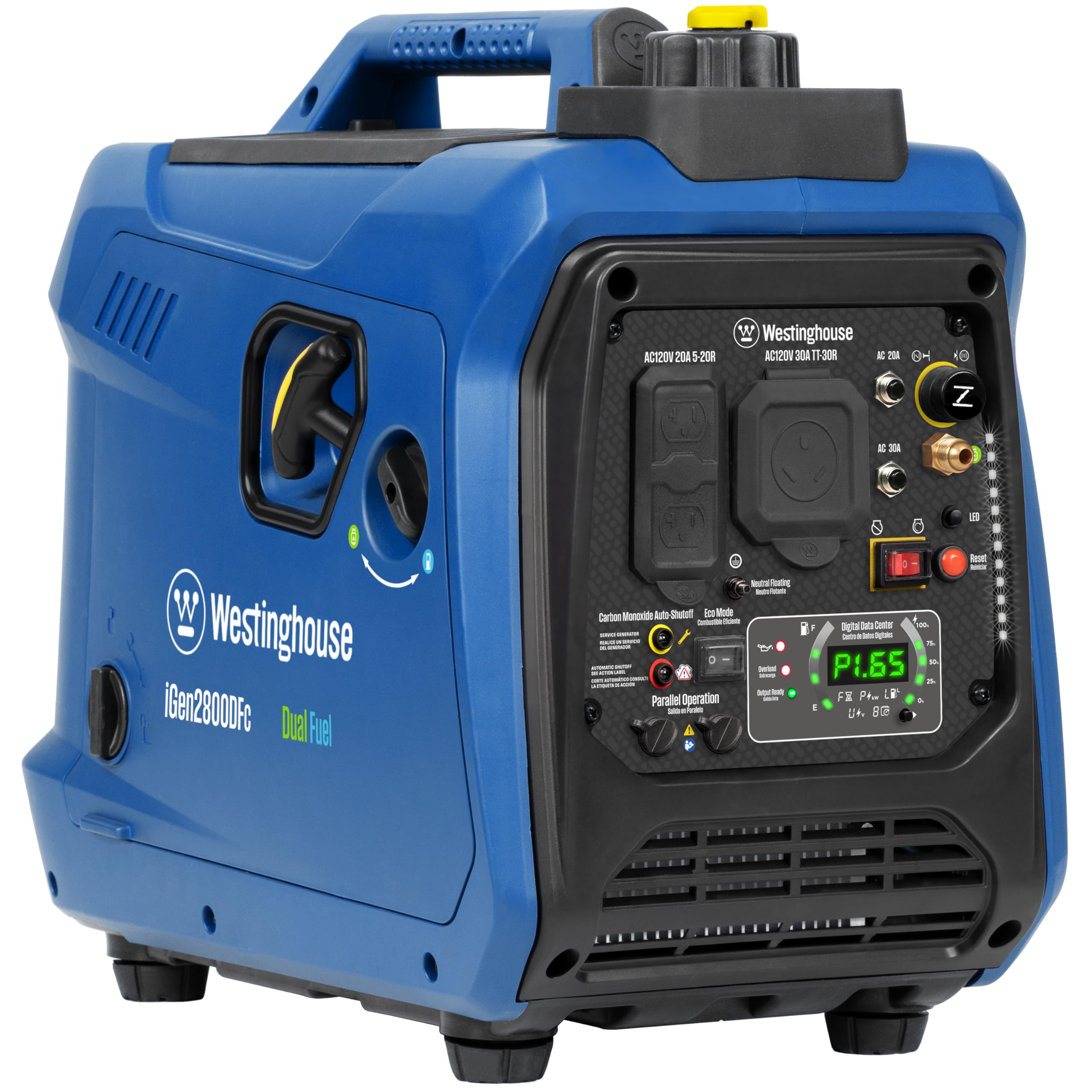
The Westinghouse iGen2800DFc is the only dual-fuel inverter on this list, running on gasoline (2800W peak/2200W running) or propane (2520W peak/1980W running). Dual-fuel flexibility means you can store propane indefinitely without worrying about fuel degradation, a major advantage for emergency kits. The unit weighs just 45 pounds and operates at a whisper-quiet 52 dBA — quiet enough for a campground or a neighborhood with strict noise ordinances.
Eco Mode adjusts engine speed to match demand, cutting fuel consumption by up to 50% compared to conventional generators. The LED panel displays fuel level and remaining runtime, a feature usually found on more expensive units. The TT-30R 30A outlet is RV-ready, and parallel capability lets you double output with a second unit.
The 2,800W peak is lower than many competitors, so this is best for powering a fridge, lights, and electronics rather than large appliances. Some customers reported difficulty ordering spare parts from Westinghouse, so factor in that potential maintenance friction.
Why it’s great
- Dual fuel (gasoline and propane) for fuel flexibility
- Quietest on the list at 52 dBA
- LED fuel gauge and runtime display
Good to know
- Lower peak wattage limits heavy appliance use
- Customer support and parts availability reported as inconsistent
8. Generac GP3300i 3,300-Watt Inverter Generator

The Generac GP3300i leverages PowerRush Advance Technology, which delivers over 50% more starting capacity than its rated 2500 running watts. This means it can kick-start a motor-driven appliance (like a refrigerator compressor or a small AC unit) that would normally trip a standard 3000W inverter. The TruePower Technology ensures clean, stable sine-wave output for electronics, and the Economy Mode adjusts RPM to reduce fuel burn.
Weighing 59.5 pounds, it is heavier than the Westinghouse but still manageable for one person. The COsense Technology automatically shuts down the engine if CO levels become dangerous, and LED indicators show low oil, overload, and ready status. Two USB ports allow direct device charging without a separate adapter.
Some owners at higher altitudes (5000+ feet) noted reduced continuous output to around 1950W, which is common for carbureted engines. Others reported early failures at 500+ hours, though most praise its quiet operation and reliable first-pull start. It is a strong pick if you prioritize starting capacity for motor-driven appliances over raw peak wattage.
Why it’s great
- PowerRush delivers 50% more starting capacity for motors
- COsense auto shutoff for safety
- Economy Mode reduces fuel consumption
Good to know
- Output drops notably at high altitudes
- Some reports of premature failures at high hours
9. Jackery Explorer 2000 v2 Portable Power Station

The Jackery Explorer 2000 v2 represents a fundamentally different approach to home backup: zero emissions, silent operation, and no fuel to store. Its 2042Wh LiFePO4 battery powers a 2200W inverter that can run a refrigerator for over 20 hours, and the CTB (Cell-to-Body) technology makes it 41% lighter and 34% smaller than typical 2kWh power stations at just 39.5 pounds. AC fast charging takes the unit from 0 to 80% in 66 minutes.
With three AC outlets, USB-C PD 100W, and a UPS mode with 20ms switching, it seamlessly takes over during a power flicker without interrupting connected devices. The silent charging mode operates below 30 dB, making it suitable for indoor use in apartments or bedrooms. Solar charging support adds off-grid flexibility without needing a gas station.
The 2200W output limits what you can power compared to gas generators — you won’t run a large AC or well pump. But for phone charging, lights, a refrigerator, and a CPAP machine, it is far more convenient and safer than running a gas engine indoors. The 10-year battery lifespan makes it a long-term investment with minimal maintenance.
Why it’s great
- Silent, emission-free indoor operation
- Fast AC charging (66 min to 80%)
- Lightweight and compact for a 2kWh unit
Good to know
- 2200W output won’t power large appliances
- Higher upfront cost than gas generators of similar wattage
10. Anker SOLIX C2000 Gen 2 Portable Power Station

The Anker SOLIX C2000 Gen 2 is the fastest-charging power station in this lineup, reaching a full 100% from a wall outlet in just 58 minutes. Its 2048Wh LiFePO4 battery feeds a 2400W inverter (4000W peak), which is enough to handle most window AC units and RV air conditioners with the surge capacity. The standby power draw is only 9W, so a dual-door fridge can run for up to 32 hours on a single charge.
Expansion capability lets you add an extra battery to reach 4kWh and double that runtime to 64 hours. The 800W alternator charging option means you can top it up from your car in about 3 hours, eight times faster than a standard 12V socket. Weighing 41.7 pounds and measuring 18.1 x 9.8 x 10.1 inches, it is 25% lighter and 29% smaller than comparable units.
Bluetooth control through the Anker app provides real-time usage tracking and remote on/off. Some users noted the lack of a printed manual and a slightly noisy fan at higher loads, but overall reliability reviews are excellent. It is the best choice if you need a power station that can recharge quickly between outages.
Why it’s great
- Full recharge in 58 minutes — fastest in class
- Expandable to 4kWh for extended backup
- 4000W peak handles most AC startup surges
Good to know
- Fan noise can be noticeable at higher loads
- No printed manual included
11. Westinghouse 12500W Dual Fuel Portable Generator

The Westinghouse 12500W is the heavy hitter of this list, delivering 12,500 peak watts on gasoline and 11,200 on propane. Powered by a 457cc OHV engine with a cast iron sleeve, it can run an entire home — well pump, water heater, refrigerator, lights, and AC simultaneously. The remote start via key fob, electric push-button, and recoil backup gives you three ways to fire it up.
Dual-fuel capability on a generator of this size is a major safety feature: propane stores indefinitely and burns cleaner than gasoline, extending engine life. The 6.6-gallon fuel tank provides up to 12 hours of runtime at 25% load. Outlets include two GFCI 120V 20A household receptacles, a 120V L14-30R transfer switch outlet, and a 120/240V 14-50R RV outlet.
At 212 pounds, this is not portable in the traditional sense — it comes with a wheel kit for driveway rolling. The CO sensor and low-oil shutdown add essential safety for a generator of this size. It is a serious investment for whole-house backup, but it replaces the need for a standby unit at a fraction of the installation cost.
Why it’s great
- Dual fuel with remote electric start via key fob
- Powers whole-home loads including well pumps
- 12-hour runtime at 25% load
Good to know
- Very heavy (212 lbs), not for frequent moving
- Open-frame design is louder than inverter units
FAQ
Is an inverter generator worth the extra cost for home backup?
Can I run a portable generator indoors or in the garage?
How often should I change the oil on a portable generator?
Should I get a dual-fuel generator or a gasoline-only model?
Final Thoughts: The Verdict
For most users, the best affordable generator for home winner is the PowerSmart 3600W because it delivers 3200 running watts, clean inverter power under 3% THD, and a 30-amp RV outlet — all in a 50.7-pound frame that won’t break your back. If you need longer runtime and a CO sensor for safer home backup, grab the Champion 4500W. And for an emission-free, silent indoor backup that can be recharged in under an hour, nothing beats the Jackery Explorer 2000 v2.