
A cheap combo amp that flubs its cleans and buzzes on every note is a fast track to seller’s remorse, especially when you just need a reliable practice partner or a grab-and-go rig for small jams. The real challenge isn’t finding an amp under a certain budget — it’s picking the one that keeps its voice articulate at bedroom volume, offers genuinely usable effects without a pedalboard, and doesn’t sound like a tin can when you crank the gain.
I’m Min — the co-founder and writer behind Gadgets Feed. I’ve spent dozens of hours cross-referencing amplifier specifications, modeling engines, speaker sizes, and user reliability data to find the handful of combos that actually deliver on their promises without sneaking in a hidden compromise that ruins your tone.
Whether you need a silent-practice headphone rig, a jam-ready workhorse, or a portable modeling marvel, this guide breaks out the genuine winners. Here is your definitive best affordable guitar amps guide built from real specs and real owner experience.
How To Choose The Best Affordable Guitar Amps
Navigating the budget amp market means ignoring marketing wattage claims and focusing on the three pillars that actually define your sound: speaker quality, preamp architecture, and connectivity. A cheap amp with a flimsy 6-inch speaker will always sound boxy, regardless of how many amp models it claims to pack. Similarly, a solid-state circuit that lacks a dedicated clean channel can turn every note into a muddy mess before you even touch the gain knob.
Speaker Size and Cabinet Construction
An 8-inch speaker is the absolute floor for bass response and headroom in a guitar amp — anything smaller struggles to reproduce low frequencies without farting out. A 10-inch speaker (like the Marshall MG30GFX’s custom driver) adds punch and projection that lifts clean chords and solos above the mix. The cabinet material matters too: wood enclosures absorb vibrations better than plastic, giving your notes a fuller, less harsh attack, while particleboard or MDF strikes a decent balance for the price.
Clean Headroom vs. Built-in Effects
A clean channel that stays articulate at higher volumes is worth more than a dozen digital effects that sound thin. Budget amps often cut corners on the preamp and throw in reverb or delay as a distraction. Look for at least a 3-band EQ (bass, mid, treble) so you can dial in your voice without relying on pedal tone shaping. Dedicated clean and overdrive channels let you toggle between glassy strums and gritty leads — a feature that turns a bedroom amp into a rehearsal tool.
Connectivity for Modern Practice
Bluetooth for backing tracks, a 3.5 mm aux input for jamming along with songs, and a headphone jack with decent speaker-emulated circuitry are non-negotiable for silent practice. Some models like the JOYO Jam Buddy II even include USB-C audio interface functionality for direct recording without extra gear — a killer feature for content creators and bedroom producers who don’t want to invest in a separate interface.
Quick Comparison
On smaller screens, swipe sideways to see the full table.
| Model | Category | Best For | Key Spec | Amazon |
|---|---|---|---|---|
| Marshall MG30GFX | Solid State | Classic rock tone | 30W, 10″ speaker | Amazon |
| Orange Crush 20RT | Solid State | Rich clean/dirty | 20W, built-in tuner | Amazon |
| Marshall MG15GFX | Solid State | Portable Marshall crunch | 15W, 8″ speaker | Amazon |
| Line 6 Spider V 20 MKII | Modeling | Versatile effects | 20W, 200+ models via app | Amazon |
| Fender Champion II 25 | Modeling | Fender clean tones | 25W, built-in effects | Amazon |
| Rockville G-AMP 30 | Solid State | Vocal + guitar combo | 30W, mic input | Amazon |
| JOYO Jam Buddy II | Modeling | Ultra-portable practice | 10W, rechargeable | Amazon |
| Fender Frontman 20G | Solid State | Simple clean/drive | 20W, 8″ speaker | Amazon |
| MOOER Hornet 15W | Modeling | 9 digital models | 15W, Bluetooth | Amazon |
In‑Depth Reviews
1. Marshall MG30GFX Combo Guitar Amplifier

The MG30GFX punches well above its class with a 10-inch custom Marshall driver and 30 watts of solid-state power — enough volume to cut through a rehearsal with a drummer while retaining clarity. Its four channels (Clean, Crunch, OD1, OD2) cover everything from shimmering cleans to saturated British distortion without needing an external pedal. The 3-band EQ is precise, letting you sculpt bass response to avoid muddiness even at higher gain settings.
Built-in digital effects include chorus, phaser, flanger, delay, and octave, plus a dedicated reverb control. The headphone output and MP3/line-in jack make silent practice straightforward, while the 10-inch speaker gives you bass extension and punch that 8-inch competitors simply cannot match. Owners report dialing in classic Marshall tones easily, with the Crunch and OD channels being especially convincing for blues-rock and hard rock riffing.
Some users note a slight learning curve with the control layout — particularly the flashing red LED indicator — but after a speaker break-in period, the MG30GFX opens up significantly. It is heavier than smaller combos at around 19 pounds, but the tonal headroom and authentic Marshall voice make it the best all-around value in this segment for players who need both clean and high-gain sounds.
Why it’s great
- 10-inch speaker delivers full bass response and projection
- Four channels cover clean to high-gain without pedals
- 3-band EQ offers precise tone shaping for any style
Good to know
- Heavier than 8-inch competitors at almost 19 lbs
- Speaker benefits significantly from a break-in period
- Limited built-in effects compared to modeling amps
2. Orange Crush 20RT 20W Combo

The Orange Crush 20RT delivers what many budget amps lack: a truly dynamic clean channel that breaks up organically when you dig in, mimicking the response of a tube amp. Its custom 8-inch Voice of the World speaker is voiced to handle both sparkling cleans and the brand’s signature gritty overdrive, which leans toward the classic Rockerverb family. The two-channel design is dead simple — clean or dirty — with a 3-band EQ that works effectively across both channels.
A built-in chromatic tuner and digital reverb streamline your setup, eliminating the need for a separate tuner pedal. The aux input and headphone out work cleanly for silent practice, and the compact cabinet (just 16 pounds) makes it easy to carry to lessons or small gigs. Players using archtop or semi-hollow guitars report that the clean channel remains transparent and dynamic, taking pedals well without turning brittle.
The digital reverb is serviceable but not deep — it won’t replace a dedicated spring reverb tank, and some owners find it lacking atmospheric depth. A small handful of users have reported speaker failure after extended use, though this appears to be the exception rather than the rule. For players who prioritize touch sensitivity and simple, effective controls over a zillion digital effects, the Orange Crush 20RT is a premium-feeling investment that rewards good technique.
Why it’s great
- Touch-responsive clean channel with organic breakup
- Built-in chromatic tuner saves pedal board space
- Lightweight at 16 lbs and easy to transport
Good to know
- Digital reverb lacks depth compared to spring tanks
- Speaker may struggle at full band rehearsal volume
- Limited to two channels — no multi-model options
3. Marshall MG15GFX Combo Guitar Amplifier

For players who want that iconic Marshall crunch in a compact, bedroom-friendly package, the MG15GFX delivers the classic British tone signature without the stack-size footprint. Its 8-inch custom 15-watt speaker produces a focused midrange that cuts through for lead lines, while the four-channel architecture (Clean, Crunch, OD1, OD2) offers surprising versatility for a single-8 combo. The 3-band EQ is responsive enough to dial in everything from glassy cleans to thick, saturated distortion.
Digital effects include chorus, phaser, flanger, delay, and octave alongside a dedicated reverb control that offers Studio and Spring voicings. The headphone output and MP3/line-in jack make silent practice effective, and the relatively compact dimensions (15.2 x 15 x 7.7 inches) mean it fits easily on a desk or nightstand. Owners consistently praise its straightforward, knob-per-function layout that requires zero app connectivity — just plug in and play.
The 8-inch speaker can sound a bit shrill at higher volumes straight out of the box, but several users report that swapping in a Celestion 8-fifteen significantly improves warmth and body. If you plan to use it primarily at low-to-moderate volumes for practice, the stock speaker performs admirably. This is not a gigging amp (15W struggles against a drummer), but for home use, it nails the Marshall DNA beautifully.
Why it’s great
- Four channels provide wide clean-to-high-gain range
- Studio and Spring reverb options add tonal variety
- Simple analog controls — no app required
Good to know
- 8-inch speaker can sound bright at higher volumes
- Too quiet for gigging with a drummer
- Limited built-in effects compared to modeling competitors
4. Line 6 Spider V 20 MKII

The Spider V 20 MKII inherits Line 6’s decades of modeling expertise, packing 16 onboard presets — each with three simultaneous effects plus independent reverb — into a 20-watt wooden cabinet. The new Classic Speaker Mode improves the overall feel and sound, making clean tones more responsive and high-gain presets less fizzy. A built-in tuner and tap-tempo function streamline practice, while the free Spider V Remote app unlocks over 200 amps and effects for deep editing.
Connectivity includes USB for recording and editing on Mac, PC, iOS, and Android devices, making this a solid choice for bedroom producers who want to capture ideas without a separate interface. The front-panel controls are easy enough for beginners to navigate, yet the app offers granular control for advanced users. Owners appreciate that it eliminates the need for a pedalboard full of effects — you get delay, reverb, chorus, and distortion in one box.
The stock speaker sounds noticeably better through headphones than through the built-in driver, which can sound boxy at higher volumes. Several users note that this is strictly a practice and jamming amp — it lacks the clean headroom and projection needed for live gigs or recording. If you value flexibility and don’t mind spending time in the app to perfect your presets, the Spider V 20 MKII offers more tonal variety than any other amp in this price range.
Why it’s great
- 200+ amps and effects via free companion app
- Classic Speaker Mode improves low-volume tone
- USB connectivity for recording and editing
Good to know
- Speaker sounds better through headphones than built-in driver
- Not suitable for live performances
- Requires app for full library access
5. Fender Champion II 25-Watt Combo
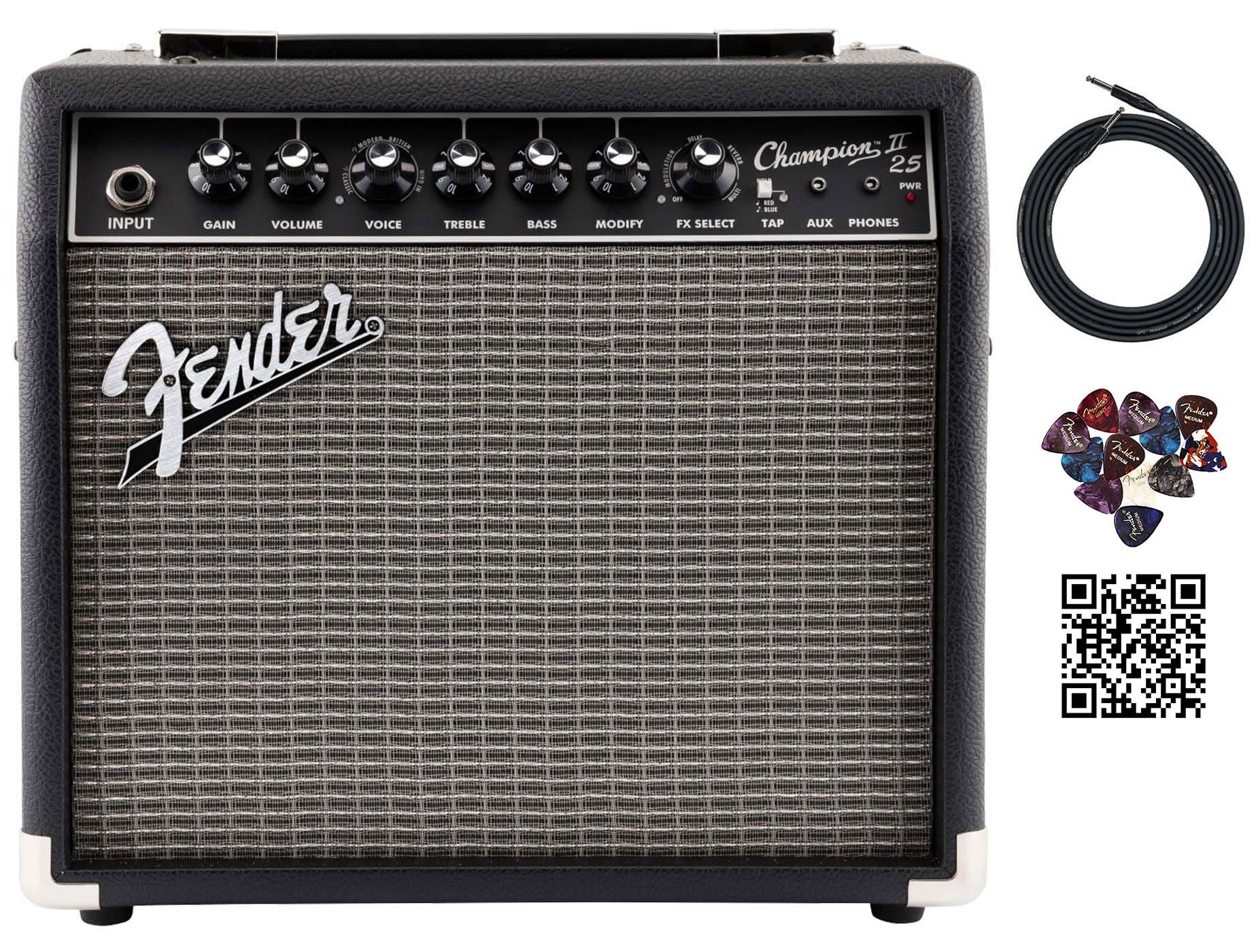
Fender’s Champion II series brings the brand’s legendary clean tone into an affordable combo, with amp voicings that model classic Fender and British amplifiers for everything from jazz to metal. The single-channel design is deceivingly versatile — the amp voice knob lets you toggle through different preamp character, effectively giving you multiple amp personalities without a second channel. Built-in effects include reverb, delay/echo, chorus, tremolo, and vibratone, with tap tempo control for delay and modulation speed.
The 8-inch Fender Special Design speaker produces a surprisingly full sound for its size, with articulate highs and enough low-end punch for blues and classic rock. The aux input and headphone output work cleanly for private practice, and the rear-panel USB port allows for firmware updates — though not direct recording. The bundle includes a cable, picks, and an instructional video, making it an attractive starter package for new players.
At 25 watts, the Champion II can fill a room and keep up with a quiet acoustic jam, but it lacks the headroom to compete with a full band. The effects are good for a practice amp but won’t fool anyone used to high-end pedal reverb or delay. Owners consistently praise its simplicity and sound quality for the price, with many calling it the best-sounding amp in its class for clean, country, and blues styles.
Why it’s great
- Amp voice knob provides multiple classic amp flavors
- Tap tempo for delay and modulation effects
- Fender clean tone is clear and articulate
Good to know
- Single channel limits quick clean/dirty switching
- Too quiet for band rehearsal with a drummer
- USB port is for updates only, not recording
6. Rockville G-AMP 30 Watt Combo

Rockville’s G-AMP 30 stands out from the crowd with a dedicated 1/4-inch microphone input featuring independent volume control, making it one of the few budget combos that works as a dual-purpose guitar-and-vocals practice rig. The 30-watt RMS output through an 8-inch speaker delivers enough volume for small jam sessions, and the clean and overdrive channels give you two distinct sonic voices. The built-in delay effect adds a touch of spatial depth without requiring an external pedal.
Bluetooth connectivity allows wireless streaming of backing tracks from your phone, and the aux input provides a wired alternative for zero-latency monitoring. The cabinet is reinforced with metal corner protectors and a carry handle, giving it a road-ready feel that belies its budget-friendly price point. Owners report that the clean channel works well with both electric and acoustic-electric guitars, and the mic input is a genuine bonus for singer-songwriter practice sessions.
The overdrive channel is functional but not inspiring — it works for basic rock tones but lacks the saturation and dynamics of dedicated drive circuits found on amps like the Orange Crush. The delay effect is limited to one simple delay, without tap tempo or subdivision control. For pure guitar practice, there are better sounding amps in this range, but the G-AMP 30’s unique mic input and Bluetooth make it a compelling all-in-one package for vocal-playing musicians.
Why it’s great
- Dedicated mic input with independent volume control
- Bluetooth for wireless backing track streaming
- Metal corner protectors and carry handle for portability
Good to know
- Overdrive channel lacks saturation and dynamics
- Delay effect is basic with no tap tempo
- Speaker size limits low-end projection
7. JOYO Jam Buddy II 10W Portable Amp
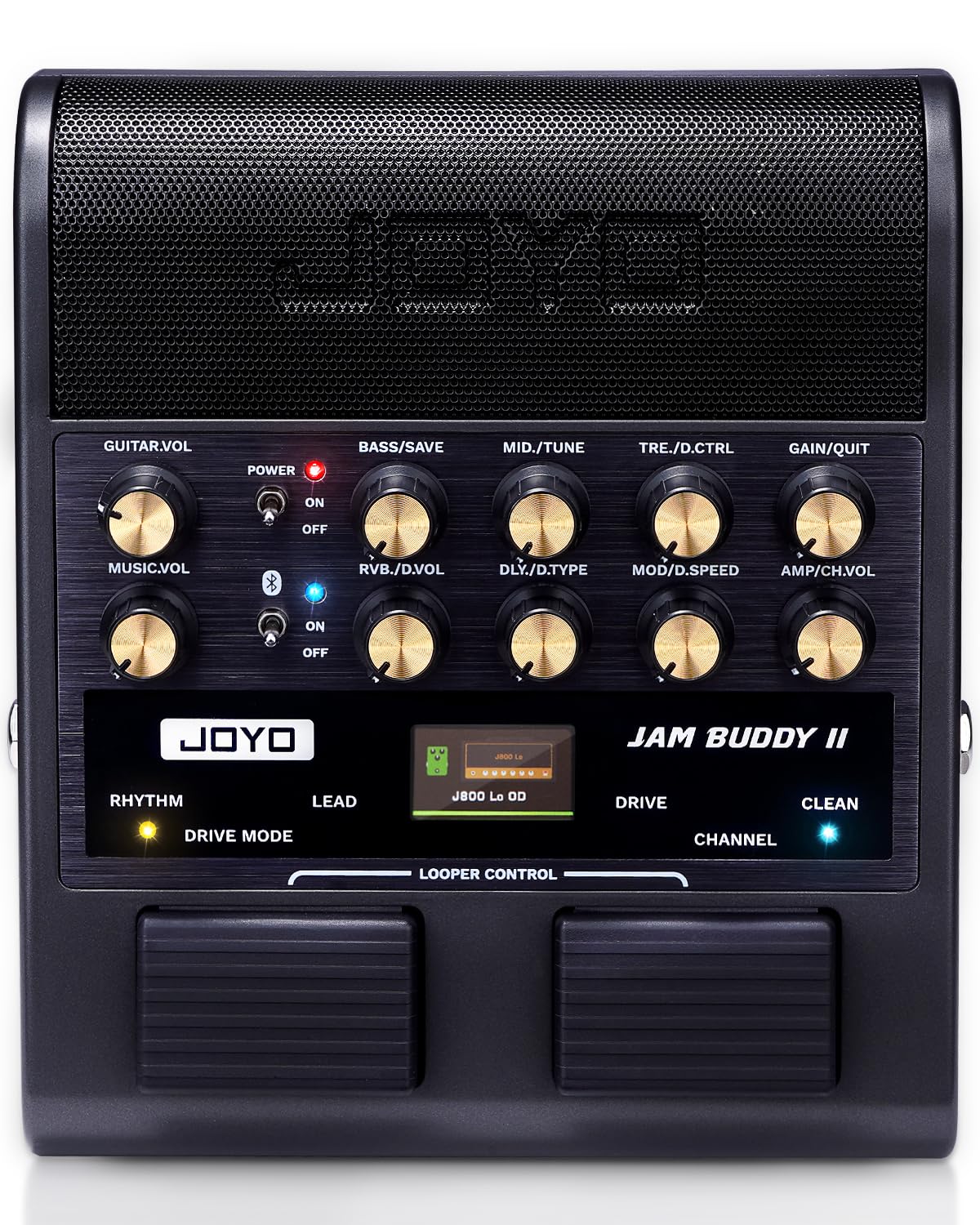
The JOYO Jam Buddy II redefines what a practice amp can be by packing 14 amp models, 9 effects, a 36-pattern drum machine, and a 30-second looper into a rechargeable, palm-sized unit weighing just under 2 pounds. Dual 2-inch full-range speakers and a bass radiator produce surprisingly balanced sound for the form factor, and the USB-C OTG audio interface allows direct recording to your phone or computer without extra gear. The built-in rechargeable battery delivers up to 5 hours of playtime on a 3-hour charge.
The new LED display and multi-function knob (press and rotate) make navigating the extensive feature set intuitive, while three independent channels (Clean, Rhythm, Lead) let you switch between saved presets instantly. A metal phone mount is included for convenient screen viewing, and the headphone output enables silent practice anywhere. Owners consistently praise the built-in drum patterns and looper for transforming practice sessions into creative jam sessions without needing a band.
The 10-watt output is strictly for headphone or small-room practice — it cannot compete with even a quiet acoustic drum kit. The dual 2-inch speakers produce adequate sound for solo practice, but the tonal balance naturally leans toward midrange emphasis. For players who want a complete practice ecosystem in their backpack — including recording, drum backing, and looping — the Jam Buddy II is a category-defining device that traditional combo amps cannot match.
Why it’s great
- 14 amp models and 36 drum patterns for creative practice
- USB-C OTG direct recording to phone or computer
- Rechargeable battery with 5 hours of playtime
Good to know
- 10W output too quiet for acoustic jam sessions
- Dual 2-inch speakers lack bass extension
- Automatic power-off after 20 minutes can interrupt sessions
8. Fender Frontman 20G 20-Watt Amp

Fender’s Frontman 20G strips away the complexity to deliver exactly what a beginner or budget-minded player needs: a clean channel that sounds genuinely good, a switchable drive channel for grit, and a 3-band EQ to shape it all. The 20-watt output through an 8-inch Fender Special Design speaker is loud enough for bedroom practice and small jam sessions, while the classic mid-60s black panel cosmetics give it timeless visual appeal. The stainless steel enclosure feels durable and road-tested.
The clean channel produces the clear, chimey tone Fender is known for, with enough headroom to stay articulate at moderate volumes. The drive channel offers a respectable crunch that works well for classic rock, blues, and pop punk. The 3.5 mm aux input and headphone jack are standard but functional, and the included 2-year warranty provides peace of mind that is rare at this price point. Owners report that the build quality exceeds expectations for the category, with solid pots and a robust chassis.
There is no built-in reverb or effects loop, which means you will need external pedals for any time-based effects. The drive channel is decent but lacks the character of more expensive Fender models — it serves its purpose for practice but won’t replace a dedicated overdrive pedal. For players who want a simple, reliable, and great-sounding foundation that takes pedals well, the Frontman 20G is a safe and satisfying choice.
Why it’s great
- Clean channel delivers classic Fender chime and clarity
- Durable stainless steel construction and 2-year warranty
- Simple controls with no learning curve
Good to know
- No built-in reverb or effects
- Drive channel is basic and lacks character
- Limited connectivity — no Bluetooth or USB
9. MOOER Hornet 15W Combo

The MOOER Hornet 15W distills the company’s acclaimed preamp modeling technology into a compact white combo that delivers 9 distinct amp voices — from clean Fender-style to high-gain modern voices — along with modulation, delay, and reverb effects that each have independent tap tempo. The 6.5-inch custom speaker is small, but the 15-watt solid-state power section drives it adequately for bedroom volumes. Up to 9 user presets can be stored and recalled, making it easy to switch between songs.
Bluetooth connectivity lets you stream backing tracks wirelessly, and the aux input provides a wired alternative. The dedicated headphone output uses speaker-emulated circuitry that sounds reasonably good, preserving the amp’s tonal character for silent practice. The built-in precision tuner is a welcome addition, saving you from needing a separate tuning pedal or clip-on tuner. Owners consistently describe it as the best value amp they have owned, with balanced sound and genuinely usable effects.
The plastic enclosure lacks the premium feel of wood or metal cabinets, and the 6.5-inch speaker cannot reproduce the low-end punch of larger drivers. The high-gain models sound decent but not exceptional — there is a noticeable digital sheen that analog enthusiasts may find lacking.
Why it’s great
- 9 digital amp models cover clean to high-gain sounds
- Bluetooth streaming and aux input for backing tracks
- Built-in tuner and 9 user presets save time
Good to know
- Plastic enclosure feels less durable than wood/metal
- 6.5-inch speaker lacks low-end projection
- High-gain models have noticeable digital artifacts
FAQ
Can I use an affordable guitar amp for recording direct into my computer?
Is 15 watts loud enough for a small live gig with a drummer?
Final Thoughts: The Verdict
For most users, the best affordable guitar amps winner is the Marshall MG30GFX because its 10-inch speaker, four-channel flexibility, and classic British tone deliver the widest usable range without requiring any external pedals or app gimmicks. If you want a practice amp with excellent touch sensitivity and a built-in tuner, grab the Orange Crush 20RT. And for a do-everything portable device that includes a drum machine, looper, and USB recording in your backpack, nothing beats the JOYO Jam Buddy II.