
A music producer’s laptop bag is a battlefield of compromises — cramped mini-keys, stiff drum pads, and sketchy bundled software that promises the world but delivers registration headaches. The right controller cuts through that noise without burning your budget.
I’m Min — the co-founder and writer behind Gadgets Feed. I’ve spent hundreds of hours researching the MIDI controller market, cross-referencing technical specifications, and analyzing real user feedback to separate the gear that unlocks creative flow from the gear that gets in your way.
This guide breaks down the top models available today so you can confidently choose the best affordable midi controller for your studio or mobile rig without wasting time on expensive mistakes.
How To Choose The Best Affordable MIDI Controller
The affordable MIDI controller market is dense with options that look similar on paper but differ drastically in feel and functionality. Focusing on three key areas will narrow your field fast.
Keybed Action and Size
The keyboard action is the single most personal spec. Mini-keys save space and are fine for triggering synth leads and basslines, but they feel cramped for two-handed piano parts. Full-size synth-action keys offer more expressive range, while semi-weighted keys add resistance that mimics an acoustic piano. If you plan to play melodies, lean toward full-size or semi-weighted. For beat production and sample triggering, mini-keys are perfectly adequate.
Pad Quality and Customizability
Drum pads vary wildly in this price tier. Expect stiff pads on entry-level units that need a break-in period before they respond consistently. RGB-backlit pads with velocity and pressure sensitivity, like those from Akai Professional, deliver a much better finger-drumming experience. Look for controllers that allow pad sensitivity adjustment through bundled editor software — this lets you dial in the response to match your playing force.
DAW Integration and Bundled Software
A controller that works out of the box with your DAW saves hours of manual mapping. Brands like Nektar and Novation have deep one-shot integration with Reason, Studio One, and Ableton Live, respectively. Bundled software is a double-edged sword — packages like Ableton Live Lite and Bitwig 8-Track are genuinely useful, but some require separate account registrations and multiple downloads. Read user reviews to see how seamless or painful the software setup actually is.
Quick Comparison
On smaller screens, swipe sideways to see the full table.
| Model | Category | Best For | Key Spec | Amazon |
|---|---|---|---|---|
| Akai MPK Mini IV | Mini Controller | All-around beat production | 25 mini-keys, 8 MPC pads, USB-C | Amazon |
| Novation Launchkey Mini 25 MK4 | Mini Controller | Ableton Live workflow | 25 mini-keys, 16 FSR pads, chord mode | Amazon |
| Arturia BeatStep | Pad/Sequencer | Step sequencing & CV control | 16 pads, 16 encoders, CV/Gate out | Amazon |
| Nektar Impact LX49+ | Full-size 49-key | Deep DAW mixer control | 49 keys, 9 faders, 8 knobs, 8 pads | Amazon |
| Akai Professional LPD8 | Pad Controller | Travel-friendly pad control | 8 RGB pads, 8 knobs, 13-inch | Amazon |
| Nektar Impact GX49 | Full-size 49-key | Simple 49-key DAW controller | 49 keys, pitch/mod wheels, sustain input | Amazon |
| midiplus AK490+ | Full-size 49-key | Budget 49-key beginner | 49 semi-weighted keys, arpeggiator | Amazon |
In‑Depth Reviews
1. Akai Professional MPK Mini IV
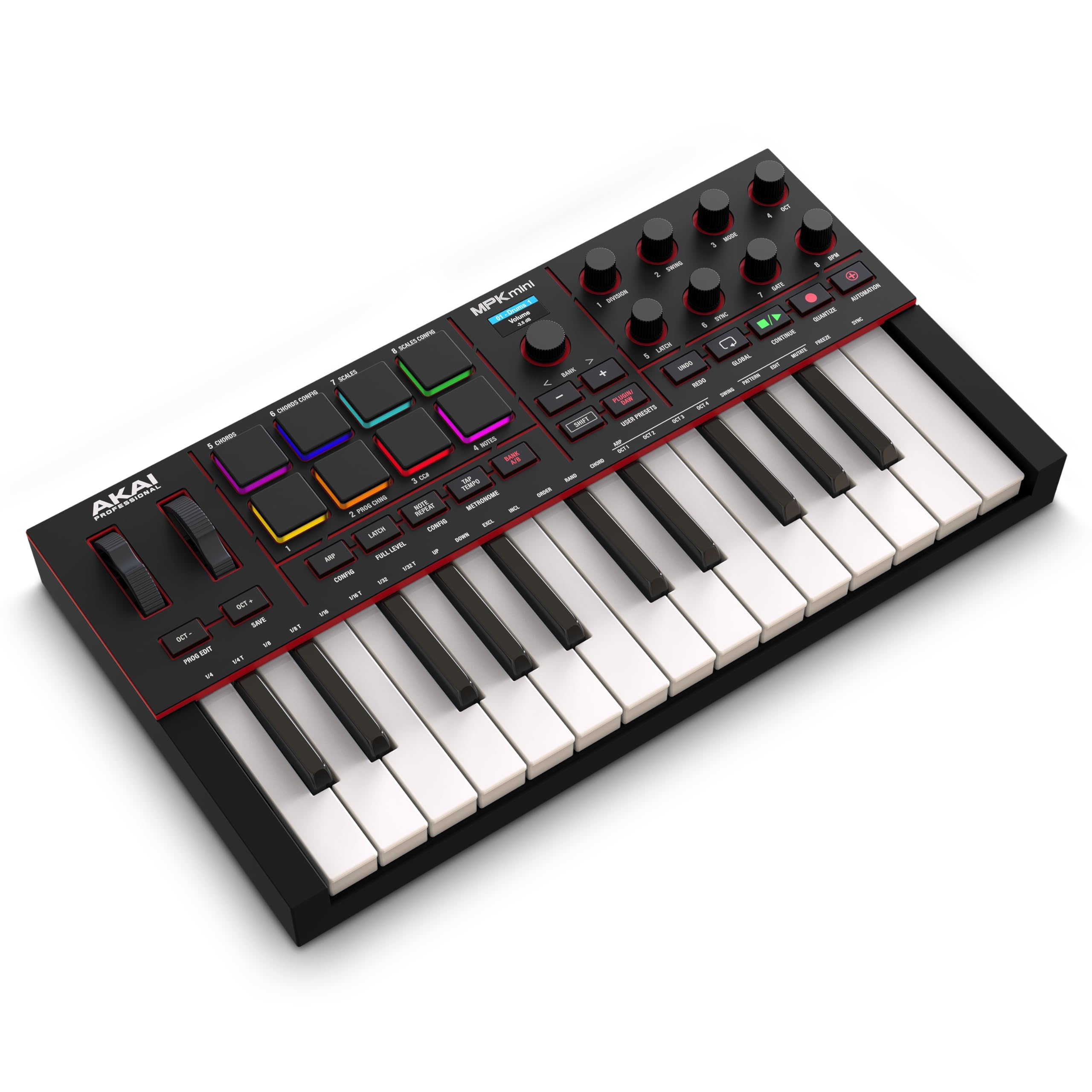
The MPK Mini IV packs a 25-note mini-keybed, eight RGB-backlit MPC drum pads, eight 360-degree assignable knobs, and a full-color screen into a chassis that weighs barely over two pounds. The keybed uses velocity-sensitive mini-keys that feel consistent across the range — not mushy in the center like some competitors. The MPC pads are responsive right out of the box, with adjustable velocity curves accessible through the onboard menu.
Akai has upgraded the connectivity to USB-C and added a full-size MIDI Out jack, which means this controller can drive external hardware synths without a separate interface. The arpeggiator includes Pattern, Freeze, and Mutate functions, plus Chord and Scale modes that turn single-note inputs into full harmonic phrases. Users report that the bundled Akai Studio Instrument package delivers surprisingly high-quality sounds, and the Melodics trial helps beginners build finger-drumming technique.
The mini-keys are not ideal for expressive two-handed piano playing, and the pad sensitivity, while good, still benefits from a break-in period. But for the price, you get a complete production hub that integrates with Ableton Live, Logic, FL Studio, and more within minutes. The MPK Mini IV is the most well-rounded budget controller on the market right now.
Why it’s great
- USB-C and full-size MIDI Out for hardware synth connectivity
- RGB MPC pads with velocity and pressure sensitivity are far more playable than generic pad banks
- Bundled Akai Studio Instrument sounds genuinely pro-grade
Good to know
- Mini-keys limit expressive piano-style playing
- Pads are stiff initially and require a break-in period
- Menu system for advanced functions takes time to learn
2. Novation Launchkey Mini 25 MK4
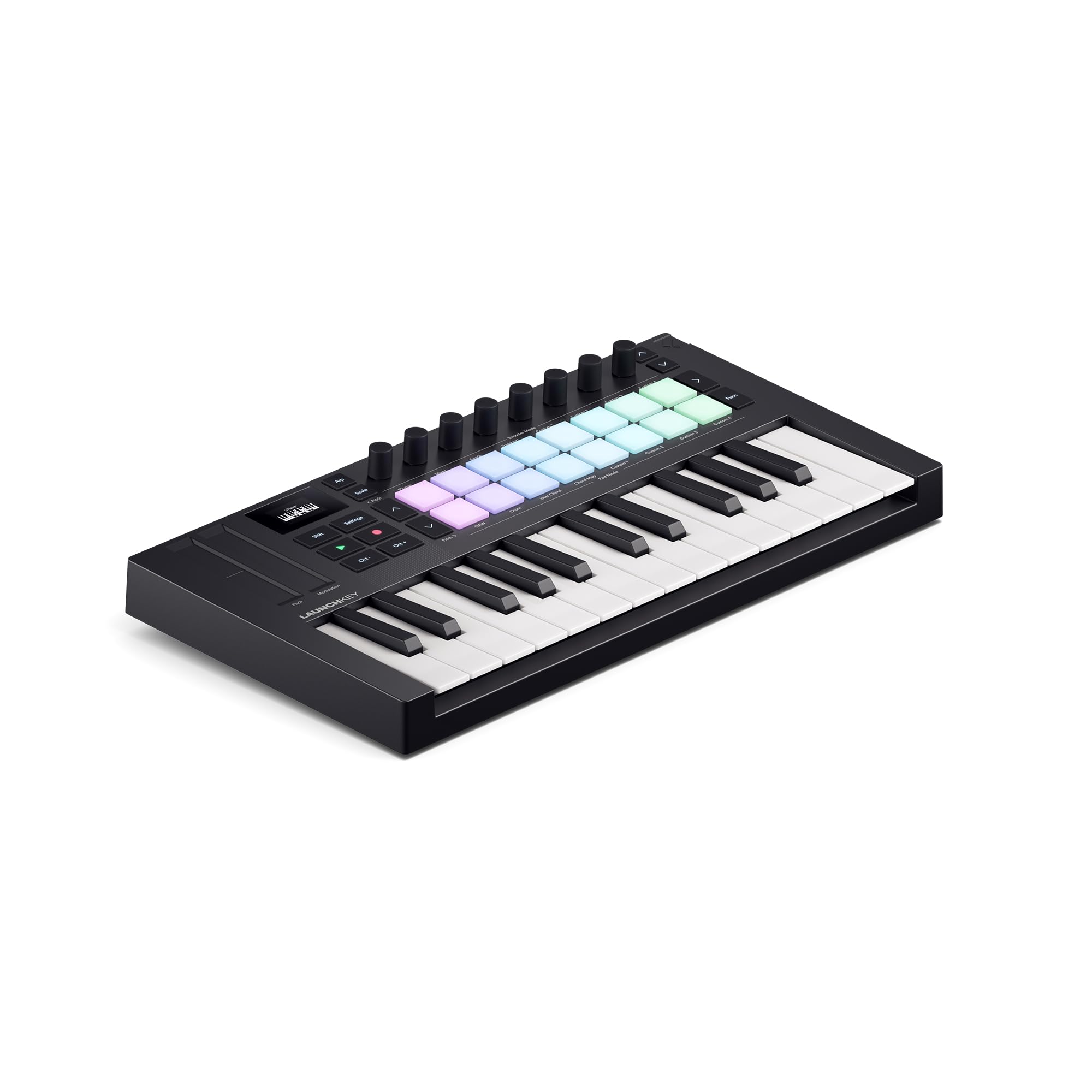
The 16 pads double as clip launchers, step sequencer triggers, and chord triggers, giving you serious flexibility in a package that slips into a backpack. The mini-keys have a snappy velocity feel that responds well to fast synth lines.
Scale Mode and Chord Mode are the headline creative tools — hit one key and you get a full chord in a chosen scale, which is a lifesaver for producers who are still learning music theory. The arpeggiator includes mutate functions that iterate through patterns automatically, sparking ideas you might not have found manually. Bundled software includes Ableton Live Lite, Cubase LE, and Novation Play, plus sound packs from GForce and Native Instruments.
DAW integration beyond Ableton is less seamless. Manual mapping of knobs and faders is required in Reason, and some users report flaky behavior with the transport controls in that environment. The mini-keys are still mini-keys, so pianist-style playing is not the intended use case. For Ableton users who want a portable, pad-rich controller with powerful chord tools, this is the best choice.
Why it’s great
- 16 FSR pads with polyphonic aftertouch — rare at this price
- Scale and Chord modes reduce music theory friction
- Excellent Ableton Live integration out of the box
Good to know
- Manual mapping needed for DAWs beyond Ableton
- Bundled software requires multiple separate account registrations
- Mini-keys are not for expressive piano performances
3. Arturia BeatStep
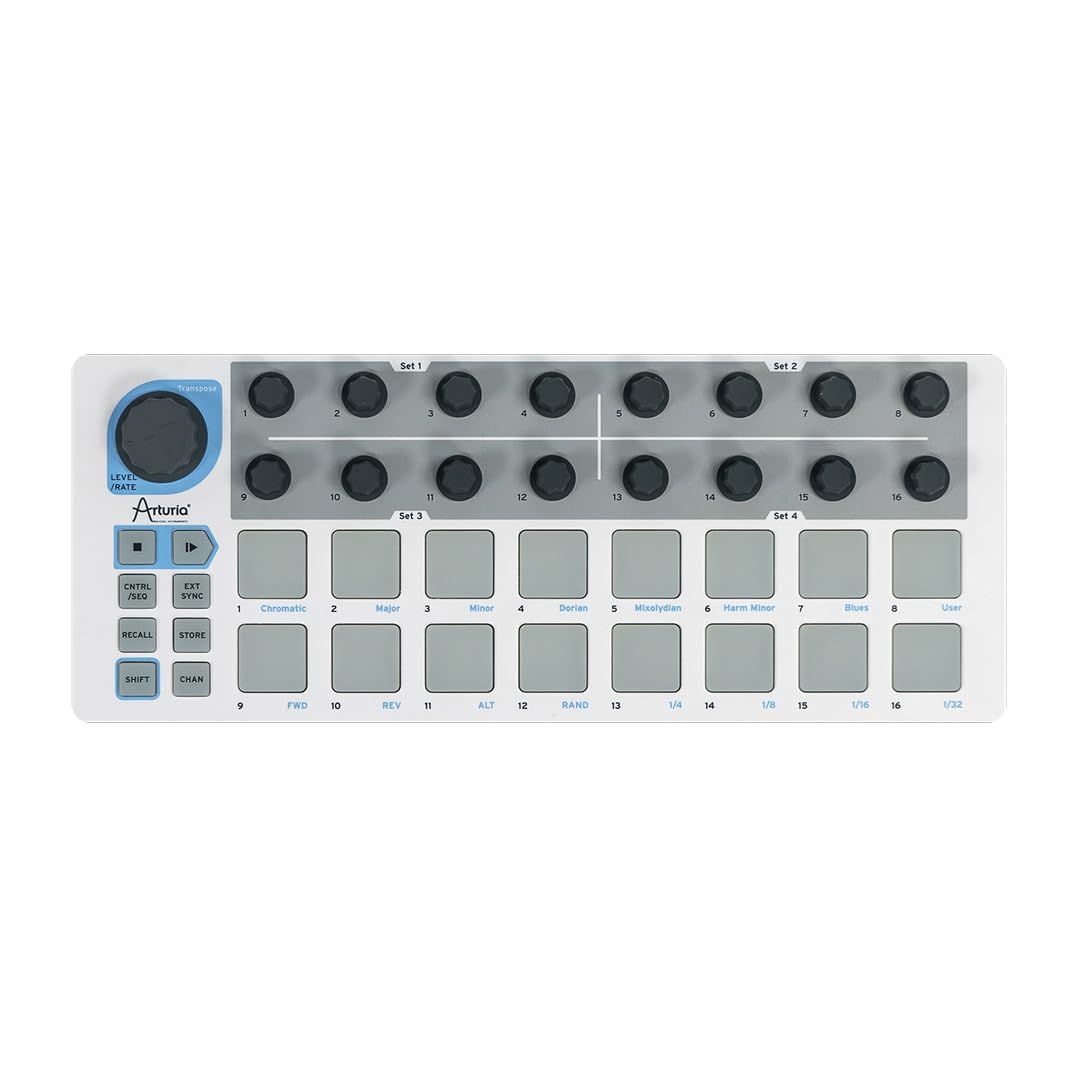
The Arturia BeatStep is not a keyboard — it is a combined pad controller and step sequencer with 16 velocity- and pressure-sensitive pads, 16 endless encoders, and a built-in 16-step sequencer. It also includes CV/Gate outputs, which means it can sequence analog synthesizers and modular gear without any additional interface. The build is tank-like, with a die-cast metal bottom panel that survives being thrown in a backpack.
In Controller mode, the pads send MIDI notes, CC messages, MMC commands, or program changes. The encoders can tweak VST parameters or DJ software effects in real time. In Sequencer mode, each encoder adjusts the pitch of its corresponding step, and the 16 memory slots allow instant pattern recall during live sets. The included Ableton Live Lite and Analog Lab Intro software provide a solid starting sound library.
The pads are famously stiff out of the box — most users report needing a firm press, and sensitivity adjustment via MIDI Control Center software is recommended. The sequencer is monophonic, so polyphonic sequencing is not possible. It also lacks an onboard display for BPM or transposition, making tempo changes less intuitive. For producers who work with hardware synths and modular gear, this is an indispensable tool that costs less than most single modules.
Why it’s great
- CV/Gate outputs for direct connection to analog and modular synths
- 16 endless encoders for real-time parameter tweaking
- Rugged metal construction that survives travel
Good to know
- Pads are very stiff and require sensitivity adjustment
- Sequencer is monophonic only
- No onboard display for BPM or step position
4. Nektar Impact LX49+

The Nektar Impact LX49+ is a full-featured 49-key MIDI controller with semi-weighted keys, 9 motor-less faders, 8 knobs, 8 backlit drum pads, and a full transport section. This is not a mini-key travel controller — it is a desktop controller designed for producers who need tactile control over mixer channels and instrument parameters. The semi-weighted keys offer more resistance than synth-action, giving a more piano-like feel without the cost of fully weighted actions.
Nektar’s DAW integration is the deepest of any brand at this price point for Studio One, Bitwig, Reaper, and Reason. The Mixer mode maps the faders to track volumes and the knobs to pan and sends, while Instrument mode assigns controls to the first eight parameters of any VST or AU plugin. The eight pads are velocity-sensitive and work fine for basic drum triggering, though they are not as responsive as Akai’s MPC pads.
The bundled Bitwig Studio 8-Track license is valuable, but user reports indicate that the software can be difficult to install and the support experience is poor. The keybed, while better than mini-keys, still has a plasticky feel compared to higher-end controllers. If you need a full-size keyboard with deep DAW integration and real fader control, this is the best option in the affordable tier.
Why it’s great
- Deep DAW integration with mixer and instrument modes for Studio One and Bitwig
- 49 semi-weighted keys with a more piano-like feel
- 9 faders give real tactile control over mixer channels
Good to know
- Bundled Bitwig Studio 8-Track has documented installation issues
- Drum pads are not as responsive as Akai MPC pads
- Keybed action feels plasticky despite being semi-weighted
5. Akai Professional LPD8

The Akai LPD8 is a 13-inch pad controller with 8 RGB-backlit MPC drum pads and 8 assignable Q-Link knobs. It strips away the keyboard entirely, focusing exclusively on finger-drumming and real-time parameter control. The pads are the same MPC design found on Akai’s standalone units — they are stiff initially but break in to become reliable and responsive. The slim-line metal and plastic chassis fits in a laptop bag easily.
Plug-and-play setup is genuinely straightforward: USB power and data, no drivers needed on Mac or PC. The 4 programmable preset slots let you switch between DAW mappings instantly. Users report compatibility with Linux and Android devices as well as Roland and Korg hardware synths. The build quality is surprisingly solid for the price — a full back and side cap with no gaps, and a weight that keeps it planted on a desk.
The major frustration is that the bundled MPC Beats software has no wired preset for the LPD8, requiring manual MIDI mapping that can be confusing for beginners. The knobs are smooth but not endless, so they snap to a default position when you load a preset. If you primarily finger-drum and do not need keyboard keys, this is the most capable pad controller for the money.
Why it’s great
- True MPC pads in a compact, travel-friendly form factor
- Genuinely plug-and-play with no driver installation on multiple operating systems
- Solid metal-backed build with good desk weight
Good to know
- No built-in keyboard — requires external keyboard for melodic parts
- Bundled MPC Beats requires manual MIDI mapping out of the box
- Knobs are not endless and snap to default positions
6. Nektar Impact GX49

The Nektar Impact GX49 is a no-frills 49-key MIDI controller with full-size synth-action keys, pitch bend and modulation wheels, octave and transpose buttons, and a sustain pedal socket. It has no drum pads, no knobs, no faders — just a keyboard and Nektar’s excellent DAW integration. The keybed offers good resistance for a synth-action controller, though the keys feel slightly spongy when fully depressed.
DAW integration is the standout feature here. Nektar’s plug-in works with Reason, Studio One, Reaper, and Bitwig out of the box, mapping transport controls and basic instrument parameters without any manual configuration. Users report zero latency at 14ms buffer sizes with ASIO drivers. The bundled Bitwig Studio 8-Track license adds real value for beginners. The controller is also iOS-compatible with a powered USB adapter.
The keybed sponginess is the main compromise at this price point — players accustomed to weighted piano actions will find it unsatisfying. The build quality is lightweight plastic, though users rank it as acceptable for a travel keyboard. If your priority is a full 49-key layout with deep DAW integration and you do not need pads or knobs, this delivers the most value per dollar.
Why it’s great
- 49 full-size keys at a price that undercuts most mini-key controllers
- Nektar DAW integration works out of the box with Reason, Studio One, and Bitwig
- Zero latency and plug-and-play simplicity
Good to know
- Keybed feels spongy when fully depressed
- No drum pads, knobs, or faders for parameter control
- Plastic build feels lightweight and less durable than metal options
7. midiplus AK490+

The midiplus AK490+ is a 49-note semi-weighted keyboard controller that targets absolute beginners who want a full-size keybed without spending much. It includes pitch and modulation wheels, octave up/down buttons, a sustain pedal input, and an arpeggiator — features often missing at this price level. The semi-weighted keys offer more resistance than typical synth-action controllers, which helps beginners build proper finger technique.
The additional control features include chord mode, tap tempo, and customizable knobs that map to DAW parameters. Users report that the unit works with FL Studio, LMMS, and Melodics learning software without issues. The arpeggiator is a surprising inclusion at this price point and adds creative value for electronic music producers. The compact footprint fits well on small desks.
The keybed is the biggest compromise. Users describe the keys as rubbery and stiff, with a short hinge that hinders fast playing. The velocity curve is difficult to control, leading many to use max velocity mode for consistent output. The included USB cable is too short for many desktop setups. This is a functional entry-level controller for learning and basic production, but experienced players will outgrow it quickly.
Why it’s great
- Semi-weighted keys at a price that is rare for this feature
- Built-in arpeggiator and chord mode for creative production
- Compact footprint fits cramped desk spaces
Good to know
- Keybed has rubbery, spongy feel that hinders fast playing
- Velocity control is imprecise; users often resort to max velocity mode
- Included USB cable is too short for standard desktop setups
FAQ
How many keys do I need on an affordable MIDI controller?
Can I connect an affordable MIDI controller to an iPad or iPhone?
What is the difference between synth-action and semi-weighted keys?
Do I really need drum pads on my first MIDI controller?
Final Thoughts: The Verdict
For most users, the best affordable midi controller winner is the Akai MPK Mini IV because it combines a responsive 25-key mini-keybed, excellent MPC drum pads, USB-C connectivity, and a full suite of creative tools like the arpeggiator and chord modes — all at a price that undercuts premium mini controllers. If you want deep Ableton Live integration and the most expressive FSR drum pads in the budget tier, grab the Novation Launchkey Mini 25 MK4. And for producers who need a full 49-key layout with real fader control for mixing, nothing beats the Nektar Impact LX49+.