
Our readers keep the lights on and my morning glass full of iced black tea. As an Amazon Associate, I earn from qualifying purchases.
Specs are compiled from manufacturer listings and verified buyer reviews and can change over time — please confirm the key details on the product page before buying.
If you are trimming baseboards, framing a fence, or building picture frames, the first question is always the same: do I have to spend a fortune to get a cut that fits? The honest answer is no. The best affordable miter saws on this list deliver clean, repeatable angles and enough motor to chew through standard lumber without the premium price tag.
I’m Min — the founder and writer behind Gadgets Feed. This guide is built by comparing the manufacturers’ published specifications and the patterns across verified customer reviews, so you get each pick’s real strengths and trade-offs instead of marketing spin.
From a top-rated value pick to a sliding model that handles wide stock, these are the best options for finding an affordable miter saw that fits your shop without emptying your wallet.
Our Picks at a Glance

How To Choose The Best Affordable Miter Saw
Choosing a miter saw is about matching the tool to the thickness of the wood you actually cut. A basic saw with a 10-inch blade handles trim and 2x4s with ease. A sliding version adds rails so the blade can pull forward, letting you cut wider boards in a single pass.
Motor Power and Speed
The motor is the heart of the saw. A 15-Amp motor is the standard for this class, giving you the torque to push through hardwood without bogging down. No-load speed, measured in RPM, tells you how fast the blade spins before it touches the wood. Speeds around 5,000 RPM are common; faster spin means smoother cuts through softer materials.
Bevel vs. Sliding
A single bevel saw tilts the blade in one direction, usually left, for angled cuts through the thickness of the board. A sliding saw adds rails that let the blade move forward and backward, dramatically increasing the width of material you can cut. If you only cut trim and small framing, a compound saw is enough. If you cut wide baseboards or shelving, a sliding model is the smarter pick.
Blade and Cutting Capacity
The blade dictates the quality of the finish. A 24-tooth blade is a fast, rough cut. A 40-tooth or 60-tooth carbide blade leaves a finer edge but cuts slower. Also check the cutting capacity—the maximum height and width of a board the saw can handle at a given angle. This number tells you if a 2×12 or a piece of wide shelving will fit under the blade guard.
Quick Comparison
| Model | Best For | Motor | Blade Type | Weight | Amazon |
|---|---|---|---|---|---|
| Metabo HPT C10FCG2★ Best Overall | Overall Value & Trim Work | 15-Amp, 5,000 RPM | 40-Tooth TCT | 24.2 lbs | Amazon |
| MarvTool JS-1017C3Budget Champion | Budget Cuts on 4x4s | 15-Amp, 5,000 RPM | 36-Tooth TCT | 20.5 lbs | Amazon |
| Genesis GMS1015LCPrecision Pick | Laser-Guided Accuracy | 15-Amp | 60-Tooth Carbide | 16 oz (saw head) | Amazon |
| DOVAMAN DMS01A | Wide Cuts & Multi-Material | 15-Amp, 5,000/3,200 RPM | 3 x TCT (40T, 40T, 48T) | 37.5 lbs | Amazon |
| Ryobi TS1346 | Beginner DIY & LED Cutline | 14-Amp, 5,500 RPM | 24-Tooth Carbide | — | Amazon |
| NOVORIK 1009xqj00101 | Sliding Cuts & Laser Guide | 15-Amp / 1800W, 4,000 RPM | 40-Tooth TCT | — | Amazon |
| VEVOR J1G-ZP33-K255D | Double Bevel & Wide Stock | 15-Amp, 5,000 RPM | 60-Tooth Carbide | 39.7 lbs | Amazon |
| Delta S26-263L | Trusted Brand Sliding Saw | 15-Amp, 5,500 RPM | 24-Tooth Carbide | 30 lbs | Amazon |
In‑Depth Reviews
1. Metabo HPT C10FCG2
Our pick — over 4.5★ from 600+ verified ratings; the strongest balance of quality and price.
The lightweight champ that turns 2x4s into clean, square cuts without breaking a sweat.
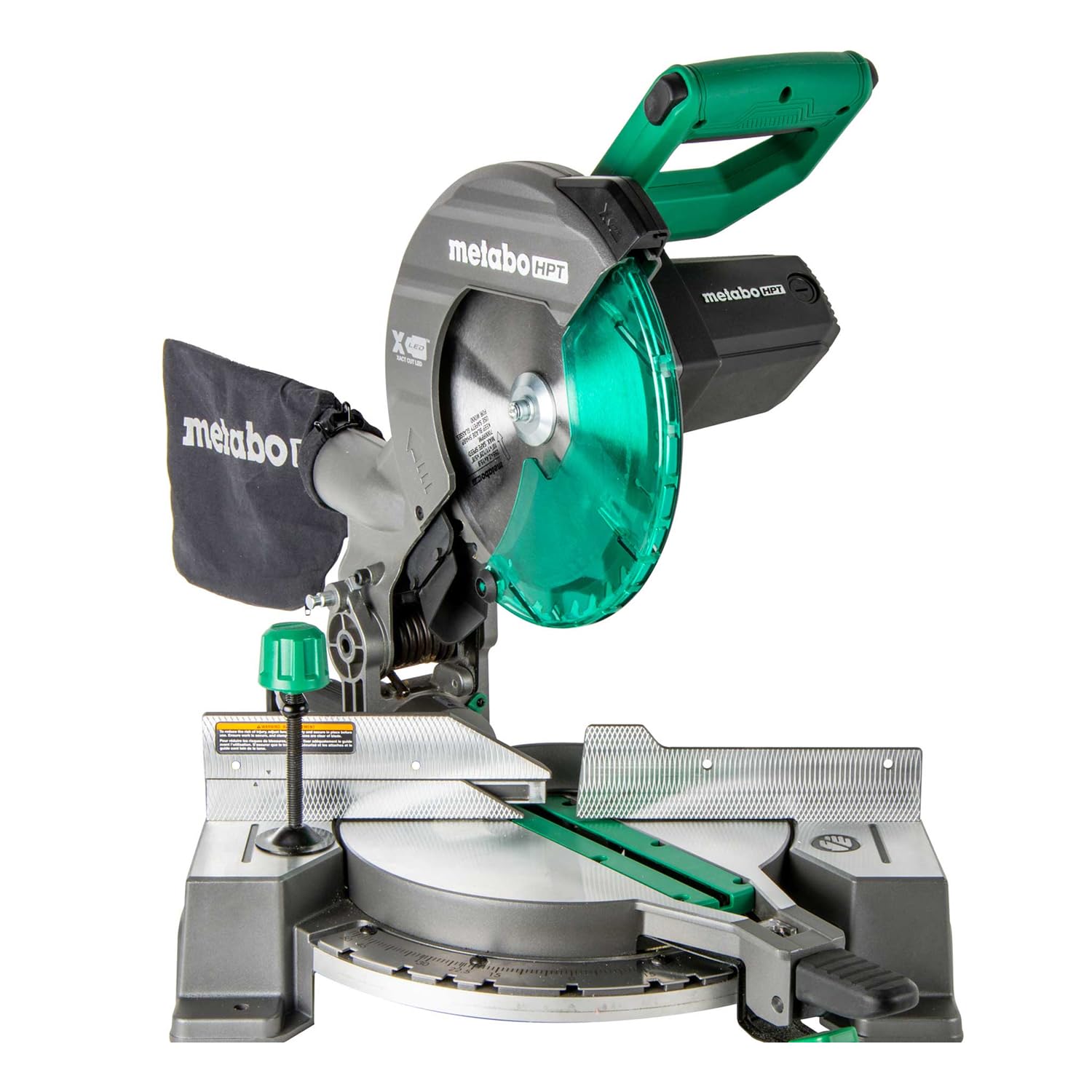
The Metabo HPT is the crowd favorite for a simple reason: it nails the basics flawlessly. A 15-Amp motor spins up to 5,000 RPM, and buyers report the power handles 2x4s, 2x6s, and trim smoothly. It is remarkably light at 24.2 pounds, so hauling it to a job site or up a ladder feels far less like a workout.
The Xact Cut Shadow Line projects a shadow of the blade onto the work, so you line up cuts without a laser. It also cuts a 0-52° miter angle left and right, with a bevel range of 0-45° left for compound cuts. What wins people over is the quality—over 120 owners single out build quality and precision, and many note it is the best saw they have owned.
The only recurring gripe is the arbor nut can get stuck, and the dust collection is weak but typical for this class. It comes with wrench, a 40T TCT blade, and a 5-year warranty. For a first-timer, the setup is quick and the calibration is accurate from the start.
corded power punch
- Lightweight 24.2-lb design makes portability easy
- 15-Amp motor powers through 2x4s and 2x6s cleanly
- Positive detents and electric brake for quick, safe stops
blade depth fuss
- Arbor nut occasionally sticks, making blade changes tricky
- Dust collection is on the weak side—expect some cleanup
pros on a budget: you want a proven, accurate saw for trim, baseboards, and framing that is easy to carry around.
need laser guide: you need to cut wide boards—this is a compound saw, not a slider, so crosscut width is limited.
2. MarvTool JS-1017C3
A featherweight 20.5-lb saw that punches far above its price on a 4×4.
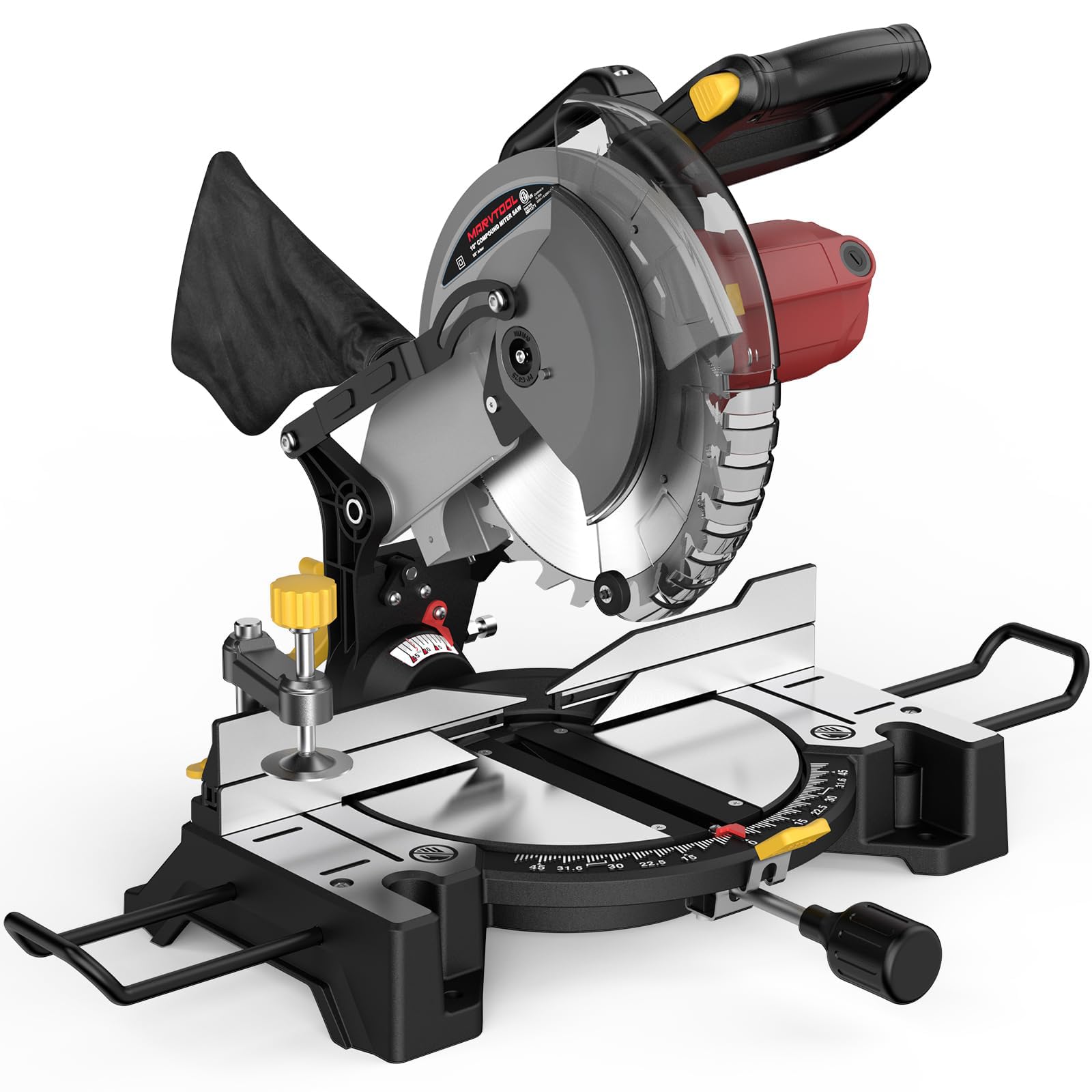
The MarvTool is proof you do not need to spend big to get serious cutting power. Its 15-Amp motor spins to 5,000 RPM, and owners mention it cuts 2×4 to 4×4, plus hardwood 2×4, easily. It is the lightest full-size option here at 20.5 pounds, so it stores on a shelf and travels in a trunk without complaint.
Where it shines is versatility. It includes two extension tables for supporting longer boards, a vise clamp for securing work, and a dust collection bag. The miter range is 0-45° left with a bevel of 0-45° on both sides. It cuts smooth 4×4 posts, which is a task that surprises many owners given the price.
It is not without quirks: some note a slight startup kick and the acute angle rotation needs the knob loosened first. The depth stop is flimsy but functional. For a first miter saw on a DIY budget, buyers call it an excellent value that beats the big-box store equivalent.
tight spaces: you are a beginner who wants to cut everything from trim to fence posts without spending much.
heavy ripping: you demand fine-tuned adjustments from the start—this one needs a little fiddling to dial in.
3. Genesis GMS1015LC
The laser-guided workhorse that shows you exactly where the blade will land.
The Genesis is all about making the cut obvious before you pull the trigger. Its integrated laser guide projects the cut line onto the wood, and the 9 positive miter stops lock firmly at commonly used angles for fast, repeatable setups. This is a huge time-saver for crown molding and picture frames where every angle has to match.
A 15-Amp motor powers a 60T carbide-tipped blade that is included, delivering clean cuts on 2x4s and 4x4s. The electric brake stops the blade in seconds, and the arbor lock makes blade changes quick. It also includes a hold-down clamp, dust bag, two extension wings, and two AAA batteries for the laser.
Owners highlight sheer value—over 60 single out value for money—and note it is easy to set up and use for home projects. The honest limits: it is very loud, needs ear protection, and it is not for metal, as the heat melts plastic components. One owner noted a small trim piece kicked out from vibration, so eye protection is essential.
occasional DIY: a beginner who wants a laser to guide every trim and baseboard cut accurately.
daily framing: you plan to cut anything other than wood—plastic components make metal cutting a bad idea.
4. DOVAMAN DMS01A

A sliding saw with a 13-inch rail that turns 4×13-inch stock into one clean pass.
The DOVAMAN takes the sliding concept seriously, adding a 13-inch sliding rail and extendable side tables for a cutting range up to 4 x 13 inches. Customers note cutting composite 1/2 x 12 facia with success, and the result is a saw that handles large trim and shelving that fixed-head saws simply cannot.
It is also a multi-material machine, with a dual-speed motor: 5,000 RPM for wood and 3,200 RPM for PVC and soft metals. You get three TCT blades—two 40-tooth and one 48-tooth—so you can switch tasks without buying extras. The ambidextrous design works for left- and right-handed operators alike, and a built-in laser guide keeps cuts on target.
The trade-off is the spin-up time, which takes a while, and some report alignment issues from the start that need a backplate adjustment. It is not small, so it demands real bench space. Owners praise the quality and value, though a few note it struggles with thick hardwood despite the power.
small workshops: you routinely cut wide stock like large trim boards and want a single saw for wood, PVC, and soft metals.
dust-free cuts: you need instant startup power or work in a tiny shop—this one needs space and patience to spin up.
5. Ryobi TS1346

A home-focused saw with a bright LED cutline that makes first cuts feel easy.
The Ryobi is built for the DIY beginner who wants a straightforward tool without learning curves. Its heavy-duty 14-Amp motor spins up to 5,500 RPM, and reviewers point out the factory-set 45-degree angle is perfect from the start. That calibration saves you from fiddling with detents before your first project.
The standout feature is the LED Cutline Indicator, which lights up the cut path for higher accuracy. It also has a 1-1/4 inch dust port to hook up a shop vac, plus a 24-tooth carbide-tipped blade included for general cutting. It comes with a blade wrench, dust bag, work clamp, and operator’s manual for a complete start.
Owners call it a “bang for your buck” and highly recommend it for DIY beginners. Its 24-tooth blade is a fast, rough cut, so if you need a fine finish on picture frames, plan to swap in a higher-tooth blade. The trade-off is the included blade is basic, but the saw itself is dependable and easy to use.
stationary use: a first-time buyer who wants a reliable, easy-to-set-up saw with a helpful LED cutline for home projects.
mobile jobs: you need fine finish cuts immediately—the 24-tooth blade is for rough framing, not delicate trim.
6. NOVORIK 1009xqj00101

A smooth-gliding slider with dual side tubes that cuts wide lumber with confidence.
The NOVORIK stands out for owners who replaced an aging saw and noticed the difference. It uses two side tubes for the sliding mechanism, which shoppers say makes it simple to use and very smooth. A 15-Amp / 1800W motor spins at 4,000 RPM, enough for wood, plastic, and soft metal.
The miter bench tilts -45°/0°/+45° with positive stops at 0°, 15°, 22.5°, 30°, and 45° in both directions. The bevel range is 0-45° for compound cuts. A laser guide tracks the real-time position so you know exactly where the blade lands before you cut. It comes with a 10-inch TCT blade, clamping device, hex key, and two side supports.
Buyers report it easily handles very wide thicknesses of lumber, and one owner mounted it on a Dewalt stand with wheels for a mobile setup. Performance and value are the most-praised aspects. The occasional issue: one dust bag arrived ripped, and the angled gauge takes some getting used to, but the smooth cut and slide win people over.
first-time buyers: you want a smooth-sliding saw for wide lumber and appreciate a laser guide for accuracy.
low-maintenance unboxing: you buy this—an occasional dust bag arrives damaged in transit.
7. VEVOR J1G-ZP33-K255D
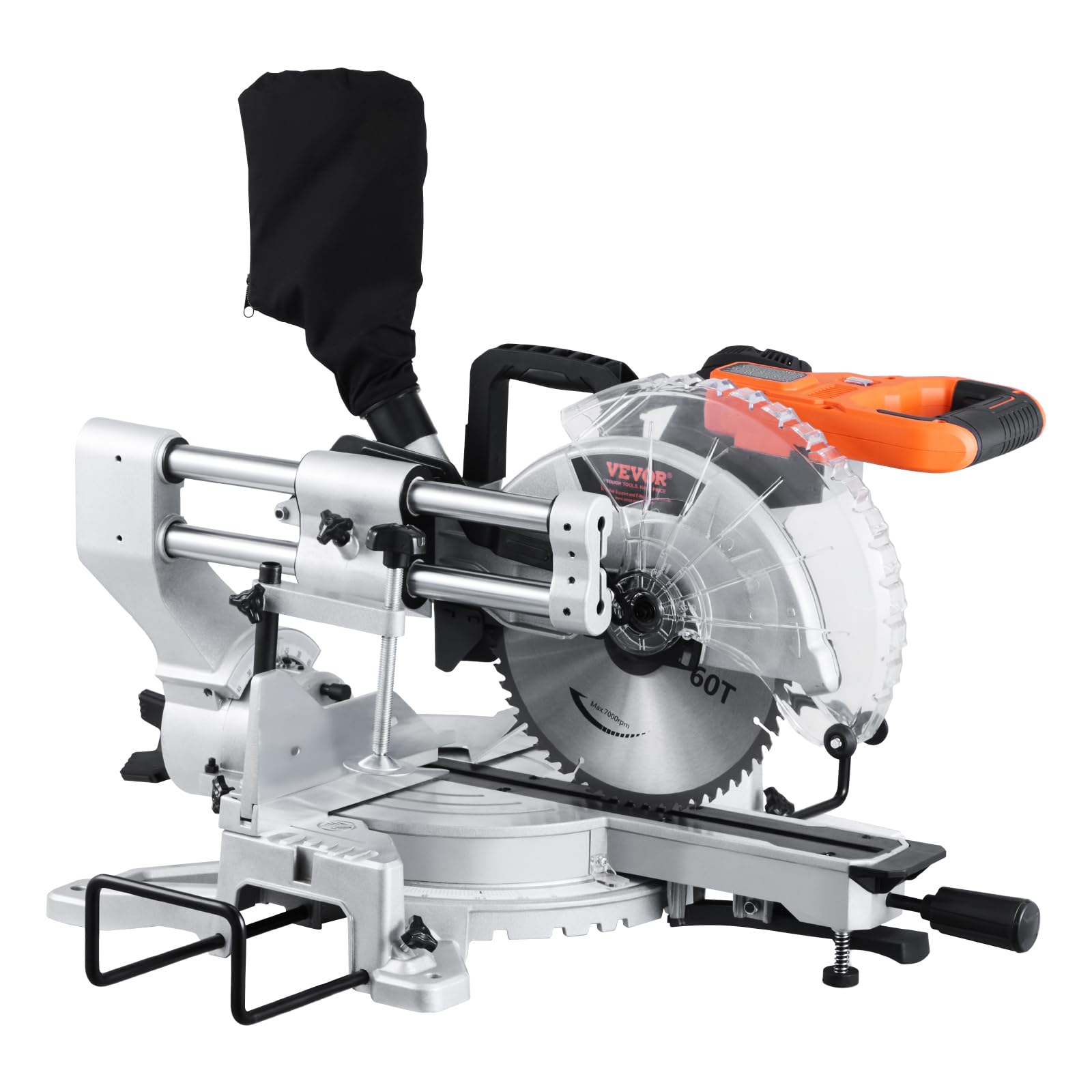
A double-bevel slider that cuts both directions and glides through composite decking.
The VEVOR is the pick when you want the flexibility of a double bevel—the head tilts both left and right, so you cut compound angles without flipping the board. It pairs that with a sliding rail and a 60-tooth blade included, which owners say delivers smooth performance on wood, composite decking, and laminates.
Power is serious: 2300W straight-cut and 2800W bevel-cut, spinning at 5,000 RPM. The advanced LED guide projects crisp cut lines, and the integrated precision scales let you lock preferred angles quickly. The axial sliding system slides forward and back for wider crosscuts, and the upgraded aluminum base is lighter than cast iron for better mobility.
It is heavy at 39.7 pounds, so it is more of a shop fixture than a carry-around tool. Owners note the blade install can be tricky and the dust bag is small. But as a “2 for 1,” one buyer points out it replaces both a miter and a table saw for a fraction of a name-brand price. The tight turntable arm earns praise for accuracy.
large stock: a hobbyist who wants double-bevel flexibility and the cutting width of a slider for decking and furniture projects.
quick setup: the weight—at 39.7 lbs, it stays on a bench rather than moving job to job.
8. Delta S26-263L

A trusted-name slider that cuts 2x12s at full bevel and moves room to room with ease.
The Delta is the pick for buyers who want a familiar brand name and the cutting capacity of a slider. It bevels left from 0-45° and cuts a nominal 2 in. x 12 in. at full bevel, making it a serious tool for wide trim and shelving. The 15-Amp motor spins at 5,500 RPM—on the faster end of this class—for quick, clean cuts.
It is lighter than most sliders at 30 pounds, and the cord exits out the rear of the slide bar to protect it from the blade. The spindle lock holds the spindle securely while you loosen the blade nut, so blade changes are simple. Owners call it lightweight, easy to set up, and accurate from the start, with a smooth slider and a clamp that works well.
The honest feedback: the included 24-tooth blade is good but basic—one owner upgraded to a 60-tooth for oak. The laser is weak, and the dust bag is ineffective, so a shop vac is the better route. For a weekend warrior, the deep throat and accuracy on 2-inch pine earn consistent praise as good value.
clean finish: a trusted brand with real sliding capacity on wide boards, especially if you upgrade the blade for fine work.
dust-free shop: the dust bag is weak and the laser is dim, so invest in better dust collection.
Understanding the Specs
Amps and RPM
You want a motor that powers through hardwood without tripping your home’s breaker. Most of these saws use a 15-Amp motor, which handles that job well. The blade speed, measured in RPM (revolutions per minute), affects your cut quality. A 5,500 RPM saw cuts faster but can leave rougher edges on soft wood, while a 4,000 RPM saw cuts slower but might be smoother on dense material.
Bevel vs. Compound
A single bevel saw tilts the blade one direction for angled cuts through a board’s thickness. A compound saw adds the ability to combine a miter angle with a bevel angle for complex cuts like crown molding. A double bevel tilts both ways, so you never flip the board. A sliding saw adds rails to cut wider stock in one pass.
Positive Stops and Detents
Positive stops are preset locking points at common angles like 15°, 22.5°, 30°, and 45°. They let you snap the saw to a standard angle without measuring each time. More stops mean faster setup for repetitive trim work. A saw with 9 positive miter stops covers most home projects with zero guesswork.
Cutting Capacity
This is the maximum height and width of a board the saw can cut at a given angle. It is listed like “2 in. x 12 in. at full bevel,” meaning you can cut a 2-inch-thick board that is 12 inches wide. If you cut crown molding or wide shelving, check this number before buying—it is the difference between a saw that fits your work and one that does not.
FAQ
What is the difference between a miter saw and a sliding miter saw?
Can a 10-inch miter saw cut a 2×12 board?
Does a single bevel saw work for crown molding?
What blade should I use for fine finish cuts?
Is a laser guide worth it on a miter saw?
How much power do I need to cut hardwood?
Can a miter saw cut metal or plastic?
Do I need a stand for a miter saw?
Final Thoughts: The Verdict
For most people, the affordable miter saw worth starting with is the Metabo HPT C10FCG2 because it pairs a proven 15-Amp motor with a lightweight frame and a precision shadow line for clean trim cuts. If you want a sliding saw to handle wider boards, the DOVAMAN DMS01A delivers a 13-inch rail and multi-material capability. And for a budget-first buyer who still needs power on a 4×4, the MarvTool JS-1017C3 is the crowd-pleasing value pick.
How We Picked
We do not accept paid placement. Every pick is matched to a real buyer and a real use-case; we do not hands-on test units.
Sources & Methodology
Specifications: manufacturer listings and product documentation. Review insights: verified customer reviews, as of August 2026. Pricing: not shown on this page (it changes often); check the current price via the retailer link.
As an Amazon Associate, Gadgets Feed earns from qualifying purchases. This does not affect which products we feature.