
Our readers keep the lights on and my morning glass full of iced black tea. As an Amazon Associate, I earn from qualifying purchases.
Specs are compiled from manufacturer listings and verified buyer reviews and can change over time — please confirm the key details on the product page before buying.
You need an outboard motor that starts every time you pull the cord, pushes your jon boat or inflatable onto plane, and does not cost as much as the boat itself. The problem is that the budget market is full of cheap two-strokes that die after one season. The real trick is finding a motor in the 12 HP or 18 HP class (the horsepower balance for boats under 20 feet) that delivers reliable power without a big brand’s price tag. This guide covers five models that fit that bill.
I’m Min — the founder and writer behind Gadgets Feed. This guide is built by comparing the manufacturers’ published specifications and the patterns across verified customer reviews, so you get each pick’s real strengths and trade-offs instead of marketing spin.
After digging through dozens of customer experiences and spec sheets, these five models stand out as the strongest contenders for anyone searching for the best affordable outboard motors you can actually trust on the water.
Our Picks at a Glance

How To Choose The Best Affordable Outboard Motor
Buying an outboard motor for a small boat is a different game than picking one for a cabin cruiser. You are trading power against weight, and shaft length against your transom height. For a jon boat or an inflatable under twenty feet, a 12 HP or 18 HP two-stroke is the balance—enough grunt to plane a loaded hull but light enough for one person to wrestle onto the transom.
Match the Shaft Length to Your Boat’s Transom
A short shaft (usually around 16 inches or 40 cm) fits most flat-bottom jon boats, small inflatables, and aluminum fishing skiffs. If your transom is taller or your boat has a deep V, you need a long shaft so the propeller stays submerged in rough water. A shaft that is too short causes cavitation (the propeller sucks air instead of water) and you lose forward thrust.
Read the Real Horsepower, Not the Label
Several buyers in our research noted that a claimed 18 HP motor actually feels closer to 15 HP when you run it. Engine displacement (measured in cubic centimeters or cc) is a more reliable indicator of torque than the marketing number on the listing. In this class, a 169 cc motor typically outputs a true 9-12 HP, while a 246 cc motor delivers more like 15-18 HP.
Check the Warranty and Seller Reputation
Affordable outboard motors are often imported by smaller brands. Some sellers (like COFECO) have a track record of replacing failed units quickly; others offer no warranty at all. Before you click buy, scan recent negative reviews for how the seller handled problems—that tells you more than the star rating alone.
Quick Comparison
| Model | Best For | Engine Displacement | Item Weight | Shaft Length | Amazon |
|---|---|---|---|---|---|
| Hangkai 12HP COFECO★ Best Overall | First-Time Outboard Buyer | 169 cc | 75.84 lb | Short (16 in) | Amazon |
| TBVECHI 12HPBest Bang for the Buck | Best Value/Proven Track | 169 cc | 26 kg (57.3 lb) | Short | Amazon |
| BJTDLLX 12HP Short Shaft | Abuse-Prone Fishing | 169 cc | 27 kg (59.5 lb) | Short | Amazon |
| BJTDLLX 18HP Short Shaft | More Power to Plane | 246 cc | 38.6 kg (85.1 lb) | Short (40 cm) | Amazon |
| BJTDLLX 18HP Long Shaft | Deeper V-Hulls & Rough Water | 246 cc | 28 kg (61.7 lb) | Long | Amazon |
In‑Depth Reviews
1. Hangkai 12HP COFECO Outboard Motor (2 Stroke 169cc)
The seller (COFECO) proved they replace failed units overnight — that track record matters more than the 12 HP 169 cc spec for a cautious first-time buyer.
The COFECO store version of the Hangkai 12 HP stands apart from the crowd because of the seller, not just the specs. When one buyer’s first outboard failed, the seller shipped a replacement immediately — that kind of responsiveness is rare in the budget outboard space, where many brands simply disappear after the sale. The motor itself is the familiar 169 cc two-stroke short shaft that powers this entire class, with a 6.34-gallon (24-liter) external fuel tank for long days on the water without refueling.
One owner reported that after correcting the spark plug gap from.020 to the manual-specified.035 inches, the motor pushed a 1432 aluminum jon boat to 17 mph with zero issues. Another noted 30 hours of runtime on a 1436 flat bottom at 20 mph. The silencer reduces noise noticeably compared to unbaffled two-strokes, and the clamping device adjusts easily for different transom heights up to 19.69 feet of boat length. The key prep step — filling the lower unit with gear oil before the first start — is stressed by experienced owners; skip it and you risk cooking the lower end within minutes.
At 75.84 pounds (34.4 kg), this is the heaviest 12 HP in the group — 9.5 kg heavier than the TBVECHI and BJTDLLX 12 HP models. You feel that extra weight every time you lift it onto the transom. But for the buyer who values seller support over marginal weight savings, the COFECO track record justifies the extra mass.
Peace-of-Mind Perks
- COFECO seller has a documented history of instant replacement on defective units
- Proven 17-20 mph speeds on multiple jon boat sizes
- Quieter operation than unbaffled two-strokes thanks to silencer
The Weight Trade
- At 75.84 lb, it is nearly 20 lb heavier than the lightest 12 HP in this list
- 90-day warranty is shorter than the 1-year offered by TBVECHI
First outboard, no regrets: The COFECO seller support removes the biggest risk of buying a budget motor — being stuck with a lemon. This is the pick for the cautious first-timer.
Not for the weight-conscious: If you have to muscle your motor on and off the boat solo every trip, the 26 kg TBVECHI or BJTDLLX 12 HP will spare your back.
2. TBVECHI 12HP Outboard Motor (2 Stroke 169cc)
A 1-year warranty and a 57.3 lb weight that beats the Hangkai COFECO by nearly 20 lb — this 169 cc motor is the best-value 12 HP for buyers on a strict budget.
This motor hits the balance for the value-conscious angler. Its 169 cc engine delivers a verified 15 mph with two 200 lb adults aboard a 14-foot jon boat and 20 mph solo — a speed that buyers report beats their old 6 HP Hangkai by a meaningful margin. The three-blade propeller and streamlined lower unit cut water resistance, so the engine does not have to scream to keep you on plane.
At 26 kilograms (57.3 lb), it is the lightest 12 HP option in this lineup — the same as the BJTDLLX 12HP and noticeably easier to lift onto a transom than the 75.84 lb Hangkai. Unlike most budget outboards that ship with a 90-day warranty, this one carries a full 1-year manufacturer warranty, which is a meaningful safety net for a first-time outboard buyer. One reviewer noted that installation was straightforward on a 10-foot inflatable, and the motor started on the third pull after the two-hour break-in at quarter throttle.
The catch? The TBVECHI brand (sold by Ethedeal) is less established than COFECO, so you rely on that 1-year warranty rather than a proven customer-service track record. If you are nervous about getting a lemon, the COFECO Hangkai offers better seller support, but the TBVECHI gives you a longer warranty window from the start.
The Engine Room
- 1-year manufacturer warranty (best in this affordable class)
- Lightest 12 HP pick at 26 kg; easy for one person to carry
- Proven 20 mph solo speed on a 1436 aluminum flat bottom
Reality Check
- Brand less known than COFECO for customer support
- Returns reported as complicated — one buyer had to pay for return shipping even with Prime
The smart money pick: This motor is for the buyer who wants the longest warranty protection in the 12 HP class and a light, proven engine that has real-world speed numbers to back it up.
Who should look elsewhere: If you prefer a seller with a documented history of overnight replacements for defective units, the COFECO Hangkai is a safer bet despite the shorter warranty.
3. BJTDLLX 18HP Long Shaft Outboard Motor

The longest shaft in the review (20 inches or more) keeps the prop submerged on deep V-hulls, and one owner says it survived 300+ hours of storms without a single broken part.
This is the most powerful engine in the list (246 cc, 4500-5500 rpm), built for heavier boats or deeper waters where a short shaft causes cavitation. The 6.34-gallon fuel tank — identical to the 24-liter capacity on the short-shaft 18 HP — gives you the same range, but the long shaft design keeps the propeller submerged when the boat rocks in choppy conditions. One buyer mentioned a top speed of 24 mph on a 9-foot RIB inflatable, and that every start was a first-pull affair.
Owners mention that the motor planes a 16-foot aluminum boat well after break-in, and one owner logged over 300 hours with zero part failures, including surviving storms that would sink a less sturdy engine. The 20-inch anti-slip tiller handle gives you better leverage at speed than the standard-length handles on the 12 HP models.
The honest trade-off: several experienced buyers feel this engine is closer to 15 real HP than the advertised 18 HP. It still pushes a 16-footer onto plane, but you will not get blinding acceleration. Also, there is no manufacturer warranty listed, so you rely fully on the seller’s goodwill if something breaks.
Why Go Long
- Long shaft prevents cavitation on deeper V-hulls and in rough water
- Weighs only 28 kg — lighter than the short-shaft 18 HP by over 10 kg
- Proven 300+ hour lifespan in one owner’s experience with zero failures
Before You Buy
- No manufacturer warranty — you are trusting the seller for support
- Real-world output feels closer to 15 HP than 18 HP, per long-term owners
Best for deep water: The long shaft and 246 cc displacement make this the pick for a 16- to 19-foot boat where a standard short shaft would suck air in a swell.
skip it if: Your transom height is 16 inches or less — you need the short-shaft version to avoid the propeller hitting the bottom of the boat.
4. BJTDLLX 12HP Short Shaft Outboard Motor (2 Stroke 169cc)

One owner beat this 12 HP 169 cc motor through weeds, stumps, and sudden stops for a full year — that toughness is the real spec to care about.
This 12 HP short shaft earns its place not because it is flashy, but because it is tough. One owner reported surviving a year of “extreme abuse” on a 14-foot flat bottom running the White River — including sudden stops, weed entanglements, and hitting stumps — with minimal maintenance beyond regular greasing. The motor starts reliably on the third or fourth pull when cold and on a half-pull when warm. That kind of durability is the real currency in the affordable outboard space, where the biggest fear is a blown powerhead after one season.
Like the other 169 cc motors here, it uses a CDI ignition and water cooling system with three gears (forward, neutral, reverse) and continuous variable throttle. At 27 kg (59.5 lb), it matches the TBVECHI for weight and is much easier to haul onto the transom than the 75.84 lb Hangkai. Buyers also appreciate the flameout switch on the tiller handle — one click kills the engine without reaching for the kill cord.
The weak point is the seller: BJTDLLX lists no manufacturer warranty, and some buyers noted slow shipping and a long break-in period that requires manual greasing and oiling. If something breaks after 30 days, you have no formal recourse. One reviewer called it a “cheap Chinese knock-off” in the same sentence where they gave it 5 stars — that tells you the durability exceeded expectations, but the buyer had low expectations to begin with.
Toughness Report
- Survived a year of stump hits and weed wraps with minimal care
- Light at 27 kg, easy solo lift for a 62-year-old owner
- Starts on 2nd-3rd pull cold; half-pull when warm
Risks to Know
- No manufacturer warranty — zero safety net after delivery
- Requires manual greasing and oiling; not a “set and forget” motor
The abuse-taker: If your boating involves running rocky rivers, shallow stumpy lakes, or thick weed beds where a nice motor would instantly die, this 12 HP will take the beating and keep starting.
Look elsewhere if: You want a warranty and seller support. The COFECO Hangkai or the TBVECHI with its 1-year coverage give you a real safety net.
5. BJTDLLX 18HP Short Shaft Outboard Motor (2 Stroke 246cc)
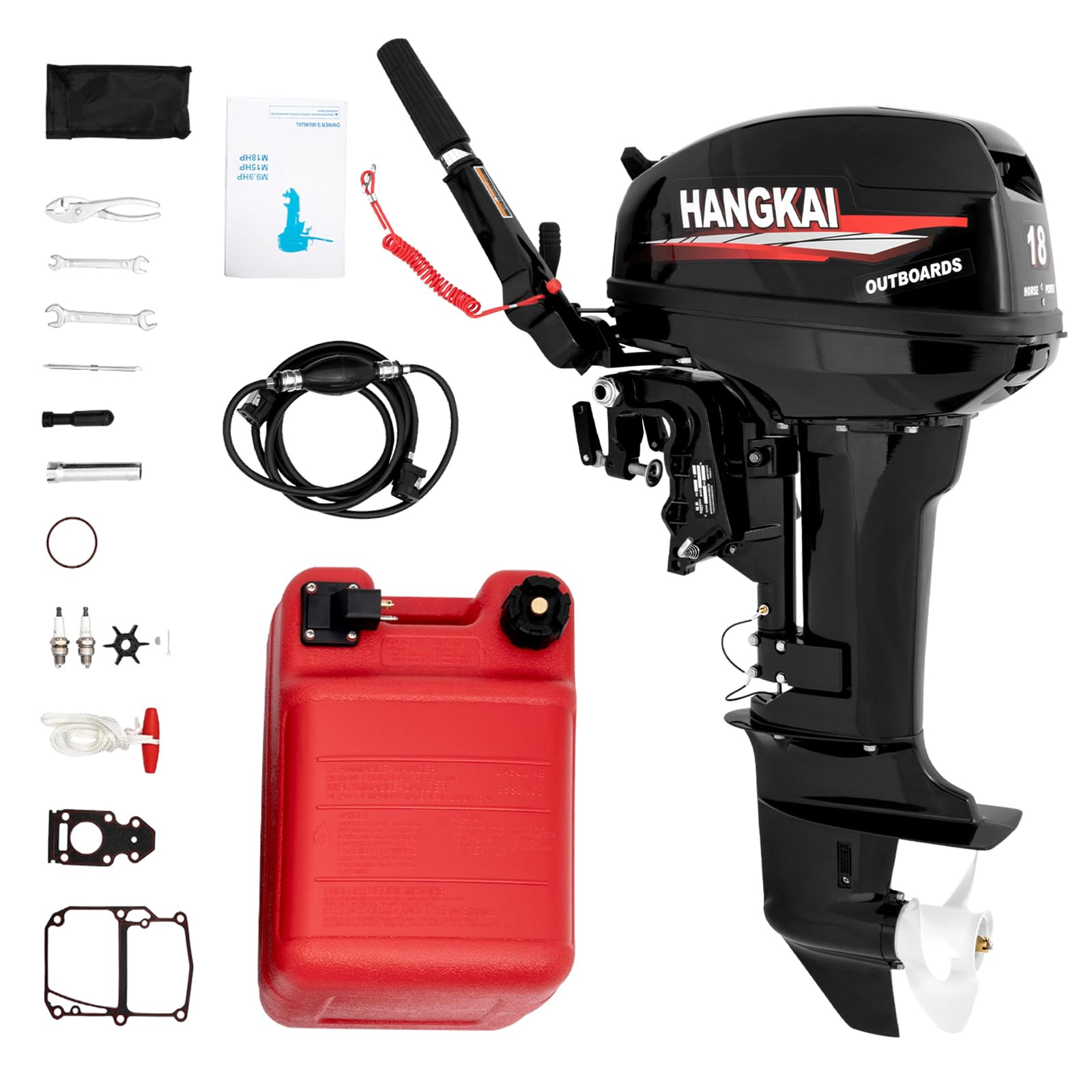
The 246 cc twin-cylinder short shaft pushes a 14-foot Monarch to 20 mph, but the 85.1 lb weight and no-warranty gamble make it a pick for the experienced only.
If raw displacement is your language, this is the motor that speaks it. With 246 cc and a maximum output of 13.2 kW, this twin-cylinder engine has a gear ratio of 2.08 (27:13), which translates to strong low-end torque for getting a heavy or loaded boat onto plane. The 24-liter fuel tank gives you the same capacity as the 12 HP models, but the 18 HP burns through it faster under full throttle — expect shorter range when you are running hard. Customers note 20 mph on a 14-foot Monarch aluminum jon boat and a one-to-two-pull start after the initial four-pull warm-up.
At 38.6 kilograms (85.1 lb), this is the heavyweight of the group — 10.6 kg heavier than the long-shaft version of the same brand and over 12 kg heavier than the 12 HP models. One customer observed the 40 cm short shaft sat slightly high on a 15.5-foot boat, requiring a jack plate to lower the prop into clean water. The motor supports 360-degree steering rotation, meaning you can reverse direction without shifting gears — a useful trick for maneuvering in tight dock spaces.
The honest downside is split across the reviews: one 1-star reviewer reported the motor blew after two months with zero help from the seller, while every other reviewer reported smooth operation. That 1-star risk is real given the “no warranty” listing. You also must add gear oil before the first run — the warning is a sticker, not in the manual, and missing it means instant lower-unit destruction.
Why the Extra Mass
- 246 cc twin-cylinder produces strong torque for planing heavy loads
- 360-degree steering lets you reverse without shifting gears
- 20 mph verified on a 14-foot jon boat with one person aboard
Heavy Considerations
- No warranty; one verified buyer had a catastrophic failure at 2 months with no seller recourse
- At 38.6 kg, it is too heavy for solo lifting onto a small boat for many users
The torque king: This motor is for the buyer who needs the most displacement and pulling power in a short-shaft package and is willing to gamble on the reliability lottery for that extra grunt.
Not for the faint of heart: If you cannot stomach the risk of a no-support failure, step down to a 12 HP with a warranty — the speed difference on a small boat is less than you think.
Understanding the Specs
Engine Displacement (cc)
This is the total volume of air and fuel the engine’s cylinders can pull in, measured in cubic centimeters (cc). For a two-stroke outboard, more displacement generally means more torque — the twisting force that gets a heavy boat up on plane. The 12 HP models here are all 169 cc, while the 18 HP models jump to 246 cc, which is about 46% more displacement. That gap matters when you are carrying a second person or a full load of gear.
Item Weight and Why It Matters
Outboard weight determines how easily you can mount and remove the motor from your boat’s transom, especially if you trailer the boat and store the engine separately. The lightest 12 HP models come in at around 26 kg (57.3 lb), while the 18 HP short shaft hits 38.6 kg (85.1 lb). If you are a solo angler who has to muscle the motor on and off every trip, those extra 12 kg can turn a quick launch into a back-straining ordeal.
Shaft Length: Short vs. Long
The shaft is the vertical leg that drops the propeller below the boat. Short shafts (typically 16 inches or 40 cm) fit jon boats, inflatables, and small fishing skiffs with a low transom. Long shafts (20 inches or longer) are for boats with a higher transom — usually V-hulls or cabin boats. Using a short shaft on a tall transom causes the propeller to break the water surface in waves, a condition called cavitation, which kills forward thrust and can damage the water pump.
CDI Ignition and Water Cooling
CDI (Capacitor Discharge Ignition) is an electronic system that delivers a stronger, more consistent spark than older points-and-condenser ignitions. It translates to easier starting, especially when the engine is cold. Water cooling circulates lake or ocean water through the engine block to carry away combustion heat. Both systems are standard on every motor in this list, but the water cooling passages can clog if you run in silty water without flushing.
FAQ
Will a 12 HP outboard push a 14-foot jon boat fast enough to plane?
How long does a cheap two-stroke outboard typically last?
Do I need to add gear oil before the first start?
Can I use a short shaft motor on a deep V-hull boat?
Is a 2-stroke outboard better than a 4-stroke for a small boat?
What fuel-oil ratio do these motors use?
Will an 18 HP motor fit on my inflatable boat?
What is the difference between a short shaft and a long shaft outboard?
Can I return a defective outboard motor to the seller?
Final Thoughts: The Verdict
For most buyers looking for the best affordable outboard motors for a small jon boat or inflatable, the clear winner is the Hangkai 12HP from COFECO, because the seller’s proven willingness to replace defective units removes the biggest anxiety of buying budget outboards. If you want the lightest 12 HP with the longest warranty, grab the TBVECHI 12HP and its 1-year coverage. And for those who need more torque to plane a heavy boat on rough water, the standout is the BJTDLLX 18HP Long Shaft — just be ready to handle any issues without a warranty safety net.
How We Picked
We do not accept paid placement. Every pick is matched to a real buyer and a real use-case; we do not hands-on test units.
Sources & Methodology
Specifications: manufacturer listings and product documentation. Review insights: verified customer reviews, as of July 2026. Pricing: not shown on this page (it changes often); check the current price via the retailer link.
As an Amazon Associate, Gadgets Feed earns from qualifying purchases. This does not affect which products we feature.