
The gap between a cheap pair of PC speakers and decent audio is often just a few smart decisions. Too many desktop setups rely on monitor speakers that muffle dialogue and flatten music, leaving you turning up the volume for clarity that never arrives. A well-chosen set of powered bookshelf speakers transforms that experience, delivering clean mids, present highs, and actual low-end weight without dominating your desk.
I’m Min — the co-founder and writer behind Gadgets Feed. I’ve spent hundreds of hours cross-referencing frequency response curves, driver sizes, amplifier ratings, and connectivity protocols to separate the genuinely capable from the marketing hype in this crowded affordable segment.
This guide cuts through the noise with real specs and verified user feedback to help you find the best affordable pc speakers that actually deliver balanced sound for music, gaming, and video calls without breaking your setup budget.
How To Choose The Best Affordable PC Speakers
Not all affordable speakers are created equal. The difference between a satisfying desktop audio experience and a muddy, fatiguing one comes down to a handful of concrete specifications. Here are the critical factors to evaluate before adding a pair to your cart.
Driver Configuration and Tweeter Presence
A single full-range driver (typically 2.75 to 3.5 inches) is the most common configuration in budget speakers. While these can produce decent mid-range, they often struggle with high-frequency detail and sparkle. Look for models that include a separate tweeter — a 0.75-inch silk dome is the standard — as this dramatically improves vocal clarity and instrument separation. The presence of a dedicated tweeter is the single biggest audible upgrade at this price tier.
Bluetooth Version and Wired Fallbacks
Bluetooth 5.3 is the current standard for affordable speakers, offering stable connections up to 33 feet with improved latency handling compared to older versions. However, relying solely on wireless is risky for gaming or video editing where sync matters. A speaker with USB, 3.5mm AUX, and RCA inputs gives you zero-latency wired options. Optical or TRS balanced inputs are a bonus for higher-end desktop setups or studio work.
Enclosure Construction and Bass Response
MDF (medium-density fiberboard) enclosures are vastly preferable to plastic at this price point. MDF reduces cabinet resonance, which translates to cleaner bass and less distortion at moderate volumes. A rear-firing bass port can extend low-end response by 10–15 Hz, but the port needs at least 4 inches of clearance from a wall to avoid boomy, one-note bass. Budget speakers with 3-inch woofers and a ported MDF cabinet can deliver satisfying bass down to roughly 60 Hz.
Quick Comparison
On smaller screens, swipe sideways to see the full table.
| Model | Category | Best For | Key Spec | Amazon |
|---|---|---|---|---|
| Edifier MR3 | Studio Monitor | Hi-Res music and production | 52Hz–40kHz, 18W×2 RMS | Amazon |
| Edifier Hecate G2000 | Gaming | E-sports and RGB immersion | 32W peak, 12 RGB effects | Amazon |
| Ortizan C7 | Studio Monitor | Near-field mixing and content creation | 3.5″ carbon fiber + TRS balanced | Amazon |
| OHAYO 60W | Multi-Purpose | Versatile home office and gaming | 30W×2, twin carbon fiber drivers | Amazon |
| Cinnkeyi C5201 | Retro Design | USB connectivity and vintage style | 40W, independent bass/treble | Amazon |
| NSY Audio 60W | Compact | Minimalist desk and Bluetooth streaming | Bluetooth 5.3, MDF enclosure | Amazon |
| RIOWOIS DS6701NP | Record Player | Vinyl playback without a receiver | 40W, Optical/TV-ARC inputs | Amazon |
In‑Depth Reviews
1. Edifier MR3 Powered Studio Monitor Speakers

The Edifier MR3 sets a new benchmark for affordable active monitors with Hi-Res Audio certification covering 52Hz to 40kHz. The 3.5-inch mid-low driver paired with a 1-inch tweeter delivers a flat, neutral response that reveals details most budget speakers mask. The 18W×2 RMS output reaches a peak SPL of 92.5dB, enough to fill a medium room without audible distortion at normal listening levels.
Connectivity is the MR3’s standout feature at this price: balanced TRS inputs allow direct hookup to audio interfaces and mixing consoles, while RCA and AUX handle consumer gear. Bluetooth 5.4 supports multi-point connection, so you can keep your phone paired alongside your desktop. The EDIFIER ConneX app adds Music, Monitor, and Custom EQ modes plus parametric adjustments for fine-tuning the response curve to your room acoustics.
The MDF cabinet effectively suppresses panel resonance, keeping the low end tight rather than boomy. Users consistently praise the zero-hiss background noise floor and the clarity at low volumes — a rare combination in this segment. The white finish and compact footprint make it a natural fit for clean, modern desktop setups where the speakers double as monitor stands.
Why it’s great
- Flat frequency response from 52Hz to 40kHz with Hi-Res certification
- Balanced TRS inputs for professional audio gear
- App-based EQ with customizable presets
Good to know
- Bluetooth volume level cannot be controlled from the source device
- Pairing mode activation can be finicky on first setup
2. Edifier Hecate RGB Gaming Speakers
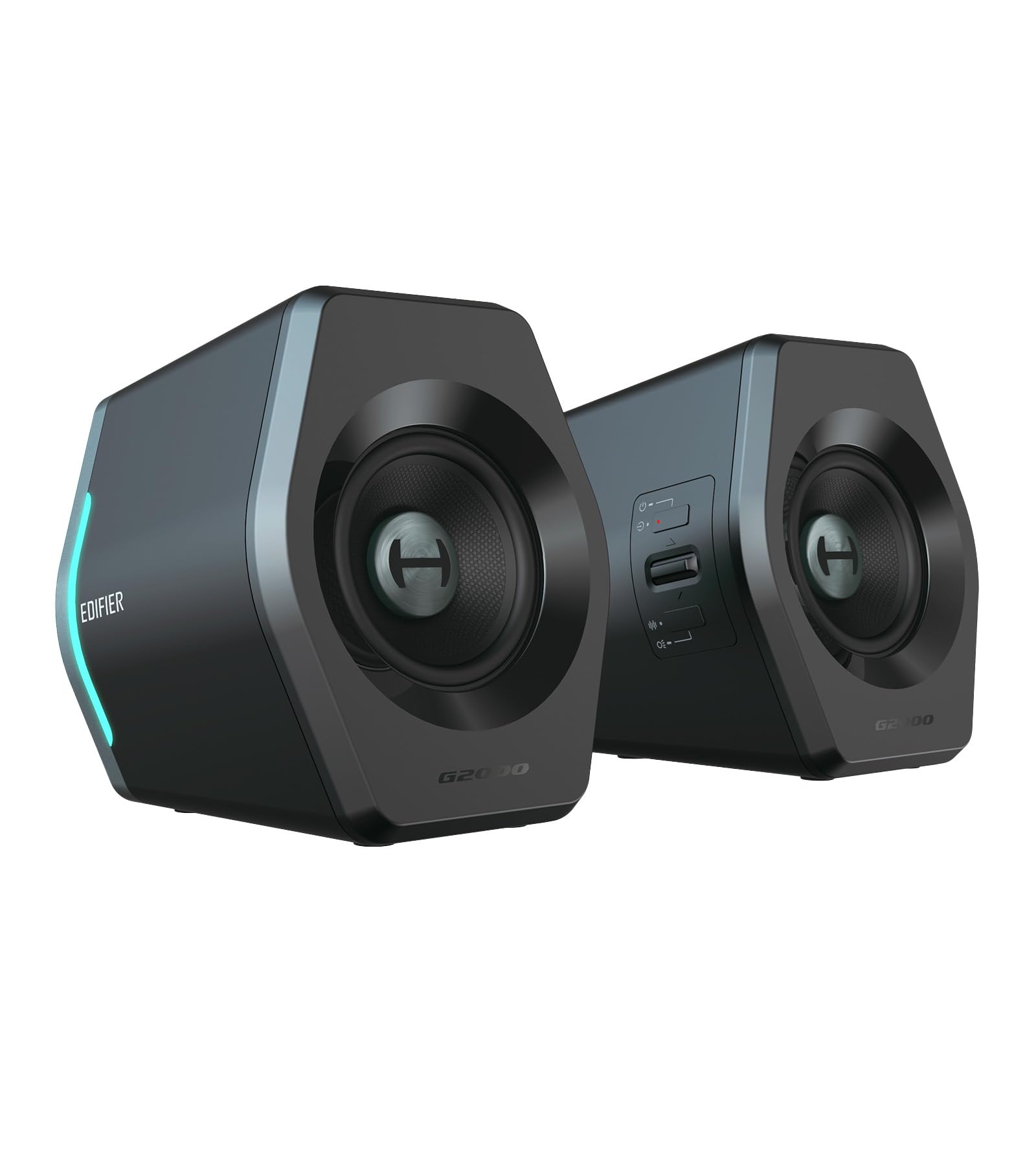
The Edifier Hecate line brings 32W peak power through 2.75-inch full-range drivers tuned for gaming audio. The 10° upward tilt aligns the drivers with your ears in a typical desktop seating position, improving spatial awareness for footsteps and directional cues in competitive shooters. Three dedicated sound modes — Game, Movie, and Music — adjust the EQ curve with one click via the front control knob.
RGB implementation here is practical rather than purely cosmetic. Twelve lighting effects can be cycled through the control knob or left static to match your peripheral ecosystem. The compact footprint (4.1×4.1×5.1 inches per speaker) fits comfortably under most monitor stands, and the anti-slip pads keep them planted during heavy bass passages. Bluetooth 5.1, USB sound card, and 3.5mm AUX inputs cover modern and legacy connections.
Build quality exceeds expectations for the price bracket with matte panels and metal laser-engraved knobs that resist wear. Owners report these speakers outperform the Creative Pebble V3 in bass weight and overall clarity. The only recurring complaint is the audible power-on/power-off jingle — a minor irritation that some users find distracting in quiet rooms.
Why it’s great
- Purpose-built gaming EQ with three presets
- 12 customizable RGB effects with hardware cycling
- Compact size with 10° upward tilt for ear-level positioning
Good to know
- Power-on chime is loud and cannot be disabled
- Bluetooth range limited to 10 meters
3. Ortizan C7 Dual-Mode 2.0 Studio Monitors

The Ortizan C7 bridges the gap between consumer desktop speakers and proper studio monitors. The 3.5-inch carbon fiber woofer combined with a 0.75-inch silk dome tweeter delivers a near-flat frequency response that reveals mix errors without flattering the source. The built-in 24-bit DAC processes USB audio directly, minimizing conversion loss that plagues analog-only budget speakers.
The connectivity suite is the most professional in this roundup: 6.35mm TRS balanced inputs accept signals from mixing consoles and audio interfaces, while front-panel AUX and headphone outputs enable quick A/B comparison. Dual-mode switching lets you toggle between a flat Monitor profile for critical listening and a Music mode with subtle warmth. The electronic 2-way crossover keeps the driver transition seamless, with bass extending to approximately 45Hz in near-field positioning.
Build construction uses an MDF cabinet reinforced with ABS panels to cut weight without sacrificing rigidity. Users familiar with monitors costing three times as much note the Ortizan C7’s vocal reproduction is “spot-on” with only a slightly honky upper-midbass region. The volume knob has stepped increments that can feel jumpy at low levels — a minor ergonomic trade-off for the otherwise excellent price-to-performance ratio.
Why it’s great
- 24-bit internal DAC for cleaner USB audio
- TRS balanced input for pro audio workflows
- Near-flat response with bass to ~45Hz
Good to know
- Volume knob has coarse jumps — fine adjustments are tricky
- No included speaker grilles for driver protection
4. OHAYO 60W Computer Speakers

The OHAYO 60W speakers pack 30 watts per channel into a dual-driver configuration — a 0.75-inch carbon fiber silk dome tweeter handles highs while a 3-inch carbon fiber driver covers mid-bass. This two-way design provides noticeably cleaner treble extension than single-driver alternatives, making vocal sibilance and cymbal crashes distinct rather than splashy. The rear bass port adds weight to kick drums and bass lines without muddying the lower mids.
Input flexibility is exceptional: Bluetooth 5.3, RCA, AUX, and USB inputs accommodate everything from a turntable to a gaming console. The front-panel volume knob doubles as a power switch and is flanked by separate treble and bass controls on the rear, giving you analog tone shaping without software. Owners report the USB input delivers superior sound quality compared to the 3.5mm AUX, which sounds slightly hollow in comparison.
The MDF cabinet construction keeps distortion low even near maximum volume. An experienced audiophile reviewer with 40+ years of listening tested these and praised the wood cabinet’s natural sound signature. The 3-inch drivers physically limit deep sub-bass extension, but for near-field desktop use, the balance is well-tuned. The speakers draw under 1 watt at full volume, making them one of the most energy-efficient options here.
Why it’s great
- Separate tweeter and mid-bass drivers for detailed sound
- Five input options including USB-C and TRS
- Very energy efficient — under 1W at full volume
Good to know
- Tone controls are on the rear panel, less convenient to adjust
- AUX input sounds audibly worse than USB
5. Cinnkeyi C5201 Active Bookshelf Speakers

The Cinnkeyi C5201 delivers vintage wood-grain aesthetics on a modern foundation. The 3.15-inch woofers push 40W of DSP-tuned power with independent bass and mid/treble controls on the front fascia — rare at this price point. The 24V power supply provides cleaner headroom than typical 12V desktop adapters, reducing distortion when you push the volume past 75%.
USB 5.4 is the primary digital input, enabling plug-and-play operation with PCs that have faulty 3.5mm jacks. Bluetooth, RCA, and AUX round out the connectivity. The USB connection automatically routes audio without drivers, and the DSP chip manages crossover and limiter functions to protect the drivers from clipping. The wood grain vinyl wrap over MDF looks convincing from arm’s length and matches vintage or mid-century desk aesthetics well.
User feedback is polarized around one design flaw: the Bluetooth connection announcement is extremely loud and cannot be muted, blasting “BLUETOOTH MODE” through the speakers regardless of the current volume setting. Some units have also developed static and humming after several weeks of use, though the majority of owners report solid performance for the cost. For the price, the sound quality is genuinely good — clean treble, present bass, and usable EQ flexibility — but the voice prompt issue is a dealbreaker for bedroom or shared-office setups.
Why it’s great
- True independent bass and treble knobs for analog tone shaping
- USB 5.4 input bypasses faulty motherboard audio jacks
- Wood-grain MDF enclosure looks stylish on a desk
Good to know
- Loud, un-mutable Bluetooth connection voice prompt
- Some units develop static or humming after extended use
6. NSY Audio 60W Bluetooth Stereo Speakers
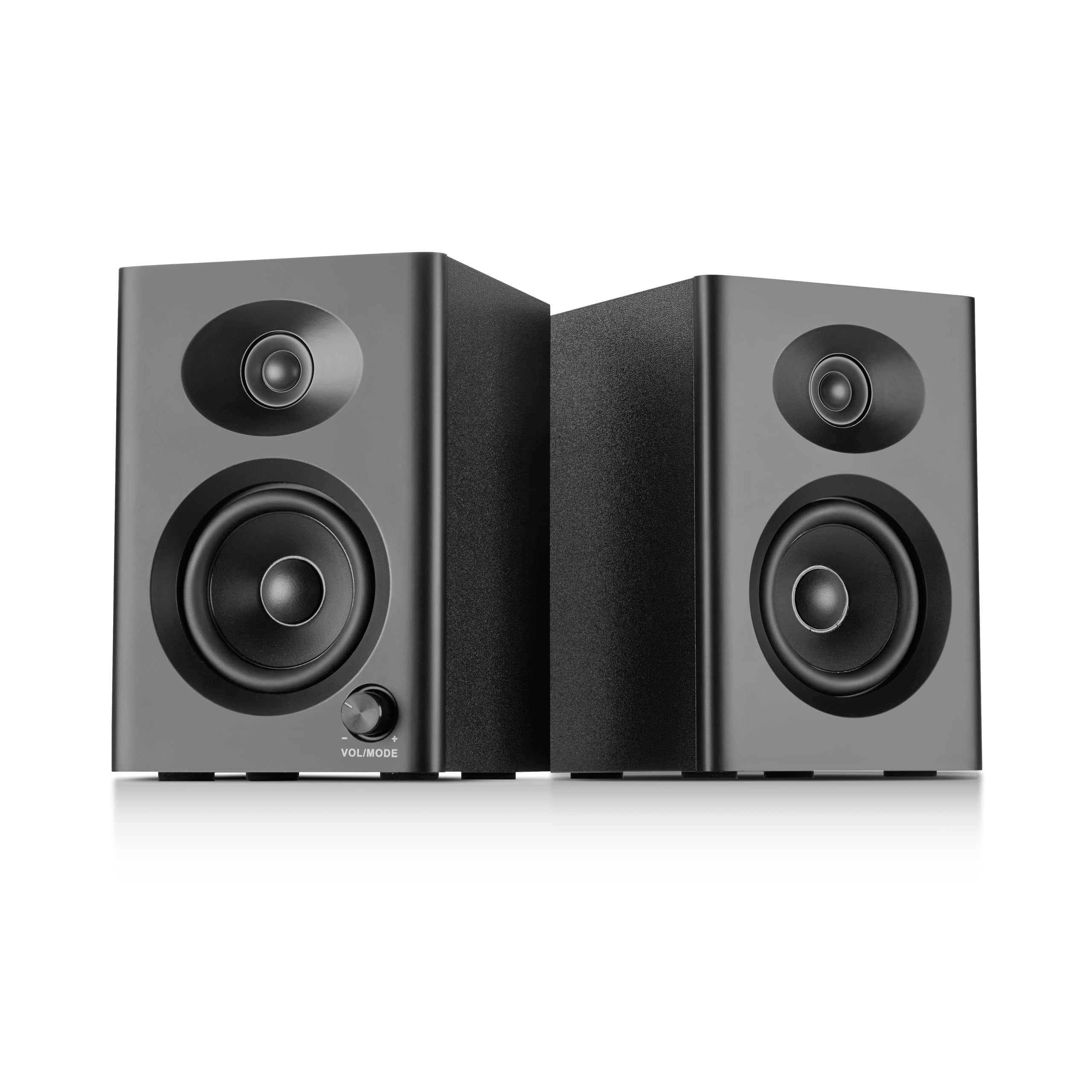
The NSY Audio 60W speakers prove you don’t need a large footprint for balanced desktop audio. At just 3 inches wide, these speakers fit on the tightest desks while still using a premium MDF wooden enclosure — a material choice typically reserved for larger models. The 2.0 stereo system delivers what multiple users describe as “crystal-clear audio with bass” that dramatically outperforms the integrated speakers on any monitor.
Bluetooth 5.3 provides stable wireless streaming with a range of 100 feet, far exceeding the typical 33-foot limit. Wired fallbacks include USB, RCA, and 3.5mm AUX, giving you options if Bluetooth latency becomes an issue. The front-panel volume knob and power switch keep operation simple, and the plug-and-play USB connection requires zero driver installation. The 4 Ohm impedance is compatible with most desktop audio outputs without additional amplification.
User reviews consistently praise the “bigger sound than the small enclosure” effect. The bass is described as balanced rather than thumping, with clear mid-range handling dialogue and vocals well. At maximum volume there is minimal distortion, though the built-in amplifier has a soft limiter that prevents true high-SPL output. The 4-foot power cord is slightly short for some arrangements, and the treble extension rolls off earlier than speakers with dedicated tweeters, but for the price, the trade-offs are minimal.
Why it’s great
- MDF wood enclosure in an ultra-compact 3-inch package
- Bluetooth 5.3 with 100-foot range
- Plug-and-play setup with USB, AUX, and RCA
Good to know
- Short 4-foot power cable limits placement options
- Treble roll-off above 16 kHz — no dedicated tweeter
7. RIOWOIS DS6701NP Bookshelf Speakers

The RIOWOIS DS6701NP is purpose-built for vinyl enthusiasts who want powered speakers without a separate amplifier or receiver. The 40W RMS output drives 2.75-inch woofers that deliver clear mid-range and surprising bass weight for the driver size. The reinforced MDF cabinet uses a classic wood grain finish with hand-polished rounded corners, giving it aesthetic compatibility with turntable setups.
Connectivity is the reason to choose these over general-purpose speakers. Optical and TV-ARC inputs allow direct connection to a television with remote volume control, while the AUX input handles turntables with built-in preamps. Bluetooth 5.3 handles wireless streaming from phones. The included remote lets you switch between three sound effects (Music, Movies, News) and disconnect Bluetooth devices with a long press. The News mode is particularly effective, sharpening vocal clarity for podcast listening.
A critical specification note: these speakers require PCM/stereo output from your source device. They are not compatible with Dolby or DTS signals, which will produce crackling or silence if sent via Optical. This is a common trap for users connecting them to game consoles. The high-pass crossover at 60Hz allows seamless subwoofer pairing via Bluetooth, and the 4 Ohm impedance keeps power demands manageable. Owners praise the “super clear vocals” and “rich sound” while noting the bass is heavy with limited adjustment range from the remote EQ.
Why it’s great
- Optical and TV-ARC inputs for direct TV connection with remote control
- Three EQ presets including a clarity-optimized News mode
- No receiver or amplifier needed for turntable setups
Good to know
- Incompatible with Dolby and DTS audio signals
- Bass adjustment range via remote is limited
FAQ
Do I need a subwoofer with affordable PC speakers?
What is the difference between a 2.0 and 2.1 speaker system for PC?
Can I use PC speakers with my TV?
Final Thoughts: The Verdict
For most users, the best affordable pc speakers winner is the Edifier MR3 because its Hi-Res Audio certification, balanced TRS inputs, and app-controlled EQ deliver performance that rivals monitors costing twice as much while staying under the mark. If you want customizable RGB immersion and gaming-specific EQ tuning, grab the Edifier Hecate G2000 for its compact 32W peak output and 12 RGB lighting effects. And for vinyl listeners building a turntable setup without a receiver, nothing beats the RIOWOIS DS6701NP with its Optical and TV-ARC connectivity that puts control right in your remote hand.