
Our readers keep the lights on and my morning glass full of iced black tea. As an Amazon Associate, I earn from qualifying purchases.
Specs are compiled from manufacturer listings and verified buyer reviews and can change over time — please confirm the key details on the product page before buying.
Your records sound thin and flat? That is the most common sign that your turntable’s built-in phono stage (the circuit that boosts and corrects the signal) is holding your vinyl back. A separate preamp fixes that, but the trick is getting clean gain and proper RIAA equalization (the standard curve that restores balanced sound) without spending more than you did on the turntable itself. This guide breaks down the affordable options that actually deliver.
I’m Min — the founder and writer behind Gadgets Feed. This guide is built by comparing the manufacturers’ published specifications and the patterns across verified customer reviews, so you get each pick’s real strengths and trade-offs instead of marketing spin.
To pick the right affordable phono preamp for your system, you need to know your cartridge type (MM or MC) and if you need basic controls like gain or a subsonic filter.
How To Choose The Best Affordable Phono Preamp
Picking the right phono preamp means matching your turntable’s cartridge type (MM or MC), knowing how much gain you need to bring the signal to line level, and deciding which extra features matter for your setup—like a subsonic filter or a simple volume knob. Here are the key specs to look at before you buy.
Cartridge Compatibility: MM vs MC
The first split is between Moving Magnet (MM) and Moving Coil (MC) cartridges. Most budget and mid-range turntables use MM cartridges because they produce a higher output voltage and don’t require as much gain. An MC cartridge, more common on higher-end turntables, outputs a much weaker signal and needs a preamp with significantly more gain and a lower noise floor. Many affordable preamps are MM-only, so if your cartridge is MC, you need a preamp that specifically supports it, like one with a selectable impedance setting.
Gain Range and Adjustability
Gain is how much the preamp amplifies the signal—measured in decibels (dB). The standard is around 40dB for MM cartridges, but adjustable gain (e.g., 6dB to 36dB) gives you much finer control over your system’s volume matching, preventing distortion from too hot a signal or noise from too weak a signal. A fixed-gain preamp is simpler, but adjustable gain lets you balance the output perfectly with your amplifier or powered speakers.
Built-in Equalization: The RIAA Standard
When a record is cut, the bass is reduced and the treble is boosted to save physical space on the groove. A phono preamp must apply the inverse curve, called RIAA equalization, to restore the original frequency balance. The accuracy of this circuit determines whether your vinyl sounds natural and detailed or dull and colored. A preamp with “high-accuracy” or “ultra high-accuracy” RIAA equalization is better at preserving what the artist intended.
Quick Comparison
| Model | Best For | Gain Range | Cartridge Support | Extra Outputs | Amazon |
|---|---|---|---|---|---|
| Fluance PA10 | Neutral, clean accuracy | Fixed (standard MM) | MM only | RCA only | Amazon |
| Douk Audio T4 Plus | Warm tube sound with VU meters | Fixed (MM/MC switch) | MM & MC | RCA, 3.5mm Headphone | Amazon |
| Fosi Audio Box X4 | Tube warmth with tone controls | Fixed (standard MM) | MM only | RCA, 3.5mm Headphone | Amazon |
| Adjustable Gain Preamp | Fine-tuning through gain range | 6dB – 36dB | MM only | RCA, 3.5mm Headphone | Amazon |
| ART DJ Pre II | Studio-style low-cut filter | Fixed with gain trim knob | MM only | RCA only | Amazon |
| Rolls VP29 | Simple, reliable budget pick | Fixed (standard MM) | MM only | RCA, 3.5mm Headphone | Amazon |
| PROZOR PRR019 | Ultra-low budget with volume control | Fixed 63dB max gain | MM only | RCA, 3.5mm Headphone | Amazon |
In‑Depth Reviews
1. Fluance PA10 High Fidelity Phono Preamp
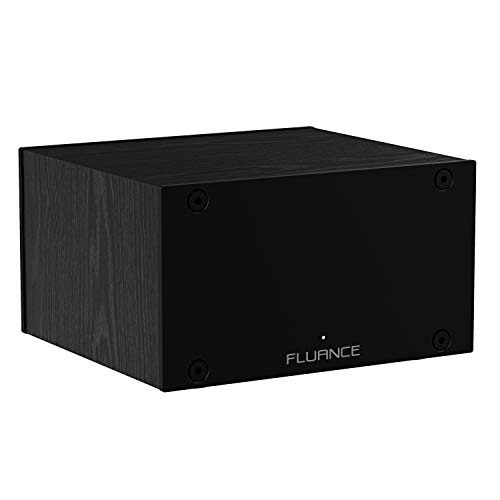
The clean, neutral backdrop that lets your records sound exactly as recorded.
If your goal is a preamp that disappears into the signal chain and adds nothing unwanted, this is it. The Fluance PA10 uses individual left and right channel OP amps (operational amplifier chips that handle the amplification for each stereo channel separately) to achieve very low crosstalk and high channel separation, which creates a vivid stereo soundstage. It also has a selectable high pass filter (a subsonic filter that gently rolls off frequencies below 20Hz) that removes turntable rumble without cutting into the audible bass, a feature that is very helpful when listening at higher volumes where subsonic feedback gets amplified.
Inside, a metal shielding enclosure blocks electromagnetic interference and electronic noise, keeping the background quiet. The PA10 offers no adjustable gain or tone controls, so it is a pure “set it and leave it” device for MM cartridges only. One reviewer who pairs it with a Fluance RT-45 turntable reported it “works perfectly,” noting they chose it after learning it has one chip per channel for separate signal paths.
At 0.72 pounds and measuring 3.6 x 4 x 2.25 inches, the PA10 is compact and sturdy, with a 2-year manufacturer’s warranty backing it up. If you want the most accurate, low-distortion signal you can get at this price range and you don’t need tone controls or MC support, the PA10 is the cleanest path from your stylus to your speakers.
What Stays True
- Very low crosstalk with separate OP amps per channel for wide separation
- Selectable high pass filter below 20Hz reduces subsonic rumble
- Internal metal shielding blocks EMI and noise for a clean signal
- 2-year manufacturer warranty
The Trade-Offs
- No adjustable gain, volume, or bass/treble controls
- Supports MM cartridges only
- Single input and single RCA output, no headphone jack
Reach for this if: you want a transparent, neutral preamp with excellent channel separation and a built-in subsonic filter, and you don’t need extra controls or MC support.
Look elsewhere if: you need adjustable gain, tone controls, or a headphone output—the PA10 is a strictly “clean signal in, clean signal out” design.
2. Douk Audio Tube Phono Preamp T4 Plus

Vintage looks with modern circuit capability: tubes, VU meter, and MM/MC support
The Douk Audio T4 Plus stands out immediately for its dual VU meters (analog volume unit meters that give you a visual readout of the signal level) and two JAN5725 vacuum tubes on top, which together create a warm, retro aesthetic that commands a spot on any shelf. But beyond the look, it is among the most versatile preamps in this price bracket: it supports both MM and MC cartridges via a selectable impedance switch (1KΩ–10Ω), unlike the Fluance PA10 which supports MM only. It also includes a 3.5mm AUX input so you can warm up the sound from a phone, tablet, or PC through the same tube circuit.
The headphone amplifier section is built around an NE5532 chip and delivers up to 150mW@32Ω, enough power to comfortably drive 32–300Ω headphones for private listening. Reviewers consistently call the sound “warm” and “smooth.” One buyer who upgraded from a Fosi Box X2 said this model has “some of the crispest highs & an impressive amount of definition,” noting that Rush’s 2112 album never sounded better on their system. The unit is 5.39 x 1.97 x 5.75 inches and weighs 1.4 pounds, with a pluggable tube socket design that lets you swap tubes (tube rolling) to tweak the sound signature later.
The flip side: this preamp has no adjustable gain or trim, so if you need to fine-tune the input sensitivity for a specific cartridge, you are stuck with the factory-set level. And while the tube glow is intentional, some users mention it adds orange LED lighting under the tubes that you may or may not like visually. Also, the included 12V DC power adapter is external, so you will have a wall wart in your power strip.
A sonic step up: The Douk T4 Plus is a genuine upgrade from most built-in preamps, offering a warmer, more detailed sound than the Fosi Box X2 it replaced for several buyers, according to reviews. The MM/MC support adds serious long-term value if you ever upgrade your turntable’s cartridge.
Choose this if: you are after a tube preamp that supports both MM and MC cartridges and want the visual appeal of a VU meter plus a headphone output for late-night listening.
skip it if: you need adjustable gain—the T4 Plus is fixed-gain—or if you find the external power supply and tube LED lighting distracting.
3. Fosi Audio Box X4 Phono Preamp

Tube warmth plus bass and treble knobs give you control your records deserve.
The Fosi Audio Box X4 is the upgraded version of their popular Box X2, and it adds a valuable pair of features that are rare at this entry-level price: dedicated bass and treble tone control knobs. This lets you compensate for a worn record, a bright-sounding cartridge, or a dull listening room without messing with your amplifier’s EQ. It uses two 5725W vacuum tubes (compatible with 6K4/6J1/6J4/GE5654/6AK5 types for easy tube rolling) to deliver the warm, detailed sound that many vinyl fans prefer.
Buyers often describe the phono preamp performance as “detailed, punchy, warm, quiet background,” and note that it “sounds great” when compared to the preamps built into Denon and Pioneer receivers. One reviewer even pointed out that the phono section outperformed those internal stages. The device is tiny at 4 x 2 x 1 inches and weighs 12.8 ounces, so it will tuck into almost any shelf or desktop setup. It includes both RCA and 3.5mm headphone output, so you can use it as a headphone amplifier as well—though several reviews mention the headphone amp section sounds “boxy, tinny, lacking bass and treble,” so it is best used as a preamp first.
A minor but recurring complaint is the fake tube lights—the tubes themselves glow orange from built-in LEDs rather than from actual tube warmth—which some buyers find “cheesy.” And there is no MC cartridge support, keeping the X4 strictly for MM turntables. There is also a small aux input that disables the phono when plugged in, which is useful for pre-warming a digital stream.
What You Get
- Bass and treble tone controls for per-record adjustment
- Interchangeable vacuum tubes (5725W/GE5654/6AK5) for DIY sound shaping
- Very compact size (4 x 2 x 1 inches)
- Headphone output for private listening
Know This
- Headphone output is weaker and less detailed than the phono stage
- No adjustable gain for cartridge matching
- Simulated tube glow, not real tube illumination
Go for this if: you want the flexibility of tone controls and a swapable tube stage at a low entry price, and you primarily listen through speakers or an external amplifier.
Think twice if: you need your headphone output to sound as good as the line output—or if you are looking for genuine tube glowing for a vintage aesthetic.
4. Adjustable Gain Phono Preamp by MANAYO
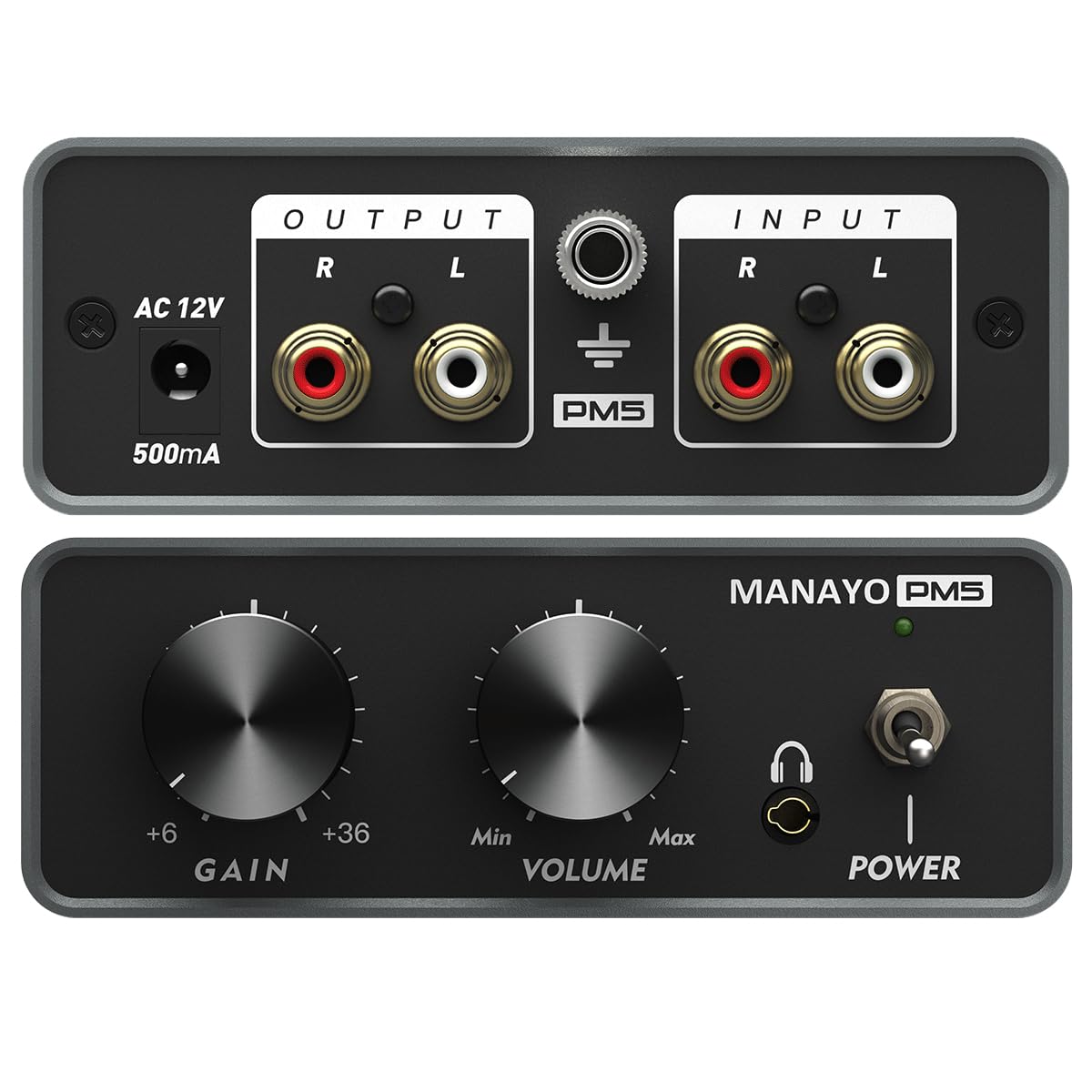
Fine-tune your gain from 6dB to 36dB to match exactly your cartridge’s output.
This MANAYO preamp solves one of the biggest frustrations with budget preamps: fixed gain that forces you to accept whatever noise floor or clipping your amplifier gives you. With an adjustable gain range spanning 6dB to 36dB, you can dial in exactly the right signal level for your specific MM cartridge and speaker system. The preamp also keeps distortion very low at ≤0.01% THD (Total Harmonic Distortion, a measure of how much the circuit alters the original sound), with a wide frequency response of 10-20KHz.
One buyer who replaced a Pyle P9999 with this preamp wrote that it “eliminated static, distortion, muffled sound” immediately. Another reviewer using a 1980 turntable through a 5.1 TV system said it “provided the best my vinyl has ever sounded,” highlighting the separate bass, treble, and volume controls as useful for per-record adjustments. The unit is 8.11 x 4.84 x 1.54 inches and weighs 1.22 pounds—at 8.11 x 4.84 x 1.54 inches, while the ART DJ Pre II is 1.9 x 4.6 x 4.5 inches, so it takes up more horizontal shelf space.
A dedicated headphone jack and volume knob add versatility, and the RCA inputs with a grounding terminal make installation straightforward. There is no MC cartridge support and no subsonic filter, however. But for someone with an older or non-standard cartridge who needs to match the output level to avoid hiss on one end or distortion on the other, this gain flexibility is a real differentiator.
The Gain Advantage
- Adjustable gain from 6dB to 36dB matches most MM cartridges
- Very low distortion (THD ≤0.01%) for clean amplification
- Separate bass, treble, and volume controls for per-record tweaks
- 3.5mm headphone output and RCA outputs
The Space Cost
- Takes up more shelf space than the ART DJ Pre II (8.11 x 4.84 inches vs 1.9 x 4.6 inches)
- No subsonic filter for turntable rumble
- MM cartridges only, no MC support
Get this if: you need to match the gain to your specific cartridge and appreciate having bass/treble tone controls at your fingertips.
Pass if: shelf space is tight or you need a subsonic filter to clean up low-end hum from loose floorboards or speaker feedback.
5. ART DJ Pre II Turntable Phono Preamplifier
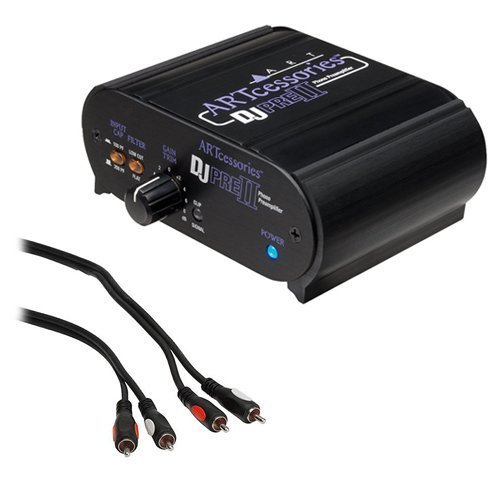
A no-nonsense preamp with a subsonic filter and studio-style gain trim.
The ART DJ Pre II is a well-regarded workhorse among DJs and home listeners who prioritize function over flash. Its most valuable feature is the low cut filter switch (a subsonic filter that cuts frequencies below a certain point to prevent low-end rumble from overloading your amplifier), a rare inclusion at this price. It also offers switchable input capacitance (100pF/200pF) which can help match certain cartridges for smoother high-frequency response, and a gain trim knob with a signal/clip LED that gives you a visual warning before the signal distorts.
At just 1.9 x 4.6 x 4.5 inches, the ART DJ Pre II is very compact and weighs 1.5 pounds, weighing 1.5 pounds, compared to the 1.22-pound Adjustable Gain Preamp—the extra heft comes from its metal chassis and internal transformer. One reviewer using an AT-LP120X turntable reported that it is a “good upgrade from the internal preamp,” and noted the subsonic filter works well. Reviewers also consistently mention the blue power LED is “blindingly bright”—so bright that several buyers report covering it with electrical tape to darken it.
This preamp does not have a volume knob, headphone output, or tone controls—it is purely a signal amplifier with filtering and capacitance switching. It also lacks an on/off switch, meaning it is powered whenever the wall adapter is plugged in. But if you need a reliable, no-frills preamp for a DJ rig or a system with noticeable turntable rumble, the subsonic filter and clip LED make it tough to top at this price.
Studio-Quality Tools
- Low cut filter switch reduces subsonic rumble effectively
- Switchable input capacitance (100pF/200pF) for cartridge matching
- Gain trim knob with signal/clip LED prevents distortion
- Compact footprint (1.9 x 4.6 x 4.5 inches)
Real-World Gotchas
- Blue power LED is extremely bright; many users cover it
- No power switch, no volume knob, no headphone output
- No MC cartridge support
Ideal for: DJs or home listeners dealing with turntable rumble or floor vibration who need a subsonic filter and a clip indicator to keep the signal clean.
Not for: anyone who wants a volume knob, headphone output, or a dark listening environment without a blinding blue LED.
6. Rolls VP29 Phono Preamp
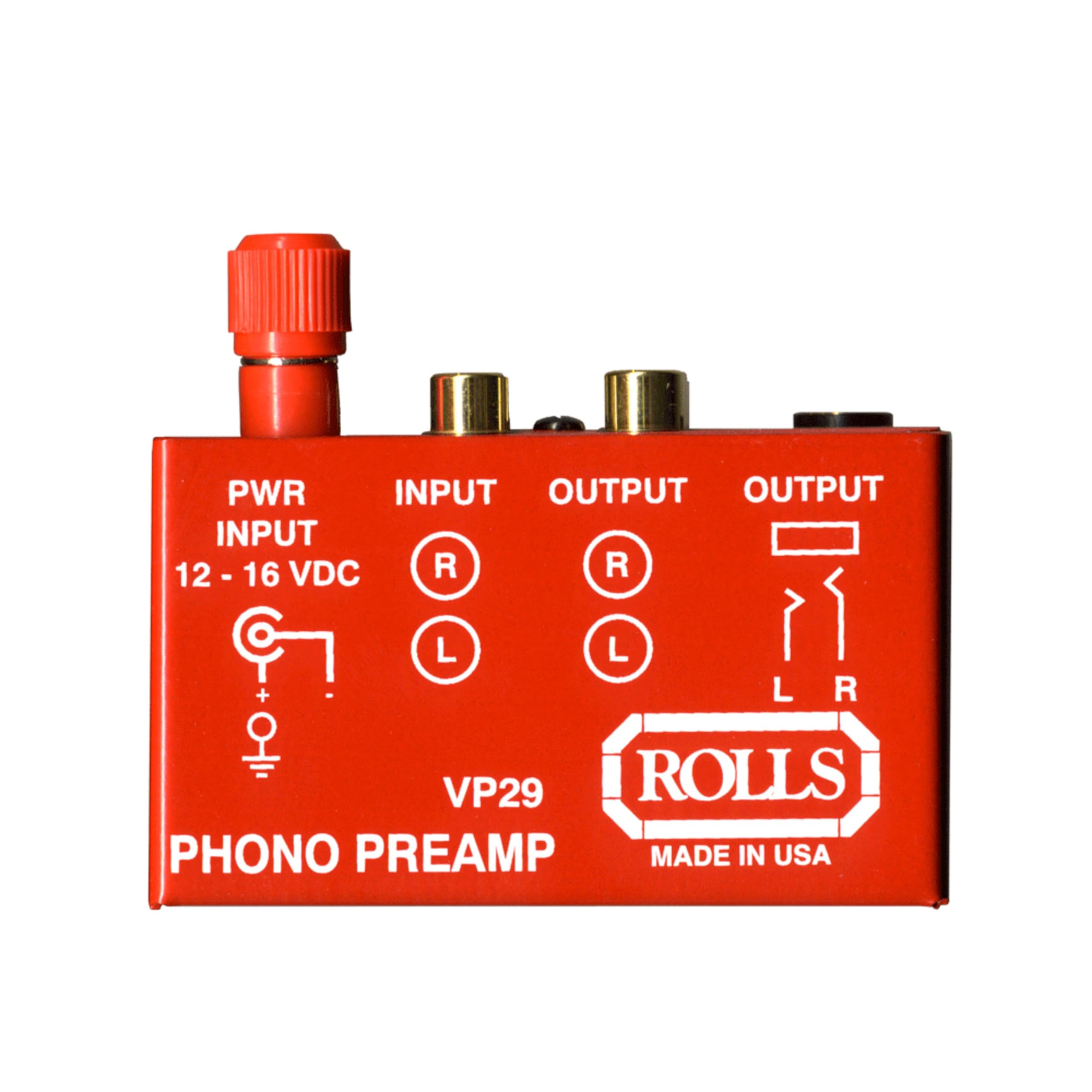
A simple, made-in-USA metal box that just works for MM turntables.
The Rolls VP29 is one of the few phono preamps in this price range that is still assembled in the USA, and its stainless steel red metal case gives it a durable, industrial feel. It’s about as simple as a preamp gets: RCA input from your turntable, a grounding post, and both RCA line output plus a 3.5mm headphone jack. There is no volume knob, no gain trim, no filter—just a straight, quiet line-level conversion. Reviewers call it “quiet, accurate” and note it “adds slight warmth” while reproducing the turntable and stylus sound faithfully.
One reviewer who had been using a turntable with a built-in preamp toggled off reported that inserting the Rolls VP29 between the turntable and powered speakers “significantly improved sound quality” and “restored audio nuance and power.” Another called it “the absolute best phono preamp under,” praising the gold-plated RCA jacks and secure ground post. The preamp’s output level is higher than many similarly priced cheap models, which helps drive amplifiers that are less sensitive.
But the VP29 is MM-only and offers no controls. If you need to adjust gain or roll off rumble, this preamp cannot help. The 3.5mm headphone jack also has no independent volume control, so headphone volume is at the mercy of your receiver’s headphone output. It’s a trade-off for the low price and solid build.
Solid Foundation
- Made in USA with a stainless steel metal case
- Gold-plated RCA jacks and secure ground terminal
- Higher output than many cheap preamps, driving amplifiers better
- Very simple setup and quiet operation
Missing Tools
- No gain adjustment, volume knob, or tone controls
- No subsonic filter for rumble reduction
- Headphone jack has no dedicated volume control
Choose this if: you want a reliable, extremely simple preamp for a basic MM turntable setup and you value US assembly and a sturdy metal case.
Look elsewhere if: you need any form of gain control, a subsonic filter, or the ability to adjust volume at the preamp.
7. PROZOR Pre Amplifier for Turntable with Volume Control

A tiny, affordable starter preamp with a volume knob and headphone out.
If you are on the tightest budget and just need to connect a turntable to powered speakers or a headphone amplifier, the PROZOR PRR019 covers the basics. It includes a volume control knob and an ON/OFF switch, two features missing from many more-expensive preamps. The preamp has a maximum gain of 63dB, which is very high—enough to boost even very weak MM signals—though at that level, the signal-to-noise ratio suffers. As one buyer put it, “the signal to noise ratio wasn’t exactly staggering, but for the price this performed beyond all expectations.”
The metal case and gold-plated RCA jacks feel decent, and the device is very compact at 4.06 x 2.52 x 1.26 inches and just 180 grams (0.4 pounds). It can output to both RCA and 3.5mm simultaneously, which is handy if you want to feed a stereo system and headphones at the same time. Some buyers had faulty units—one reported two defective units in a row—which is a risk at this entry-level price point. Others got a great unit that performs well and described it as “exactly what I needed” to bridge their turntable and a pair of speakers without a full receiver.
The preamp lacks any tone controls, gain adjustment beyond the volume knob, or a subsonic filter, so you are relying entirely on its default RIAA curve. But for someone dipping their toes into vinyl upgrades for the first time, the volume knob and headphone output add useful flexibility that the Rolls VP29 does not offer at the same low price.
Starter Kit Basics
- Includes a volume knob and an on/off switch
- Simultaneous RCA and 3.5mm headphone output
- Metal case with gold-plated connectors and anti-skid pads
- Very compact and lightweight (4.06 x 2.52 x 1.26 inches, 180g)
Budget Reality
- Signal-to-noise ratio is not outstanding at high gain
- Some owners mention receiving defective units
- No tone controls, gain trim, or subsonic filter
- No MC cartridge support
Pick this if: you absolutely need a volume knob and headphone output on a tight budget, and you are willing to accept the signal-to-noise limitations at full gain.
Avoid if: you want consistent build quality or need any advanced filtering or cartridge-matching features.
Understanding the Specs
Gain Range
Gain, measured in decibels (dB), is how much the preamp amplifies the very weak signal from your turntable’s cartridge up to a standard “line level” that your amplifier or active speakers can use. For Moving Magnet (MM) cartridges, the standard gain is around 40dB. Some preamps offer adjustable gain (like 6dB to 36dB) so you can match it perfectly to your specific cartridge and reduce background noise, while others have a fixed gain that works fine for most standard turntables but offers less flexibility.
RIAA Equalization
When a vinyl record is cut, the low frequencies (bass) are reduced and the high frequencies (treble) are boosted to fit more music into the groove. The phono preamp must apply the inverse curve, called RIAA equalization, to restore the original balanced sound. The accuracy of this circuit determines whether your records sound natural or muddy; a preamp with “ultra high-accuracy” RIAA circuitry will reproduce the original recording more faithfully, preserving detail from the bass thump to the cymbal sizzle.
Subsonic Filter
Also called a low-cut or high-pass filter, this circuit rolls off frequencies below roughly 20Hz — the range where turntable rumble, floor vibrations, and record warps produce inaudible but powerful low-frequency noise that can waste your amplifier’s power and even damage your speakers. A subsonic filter removes that noise without cutting into the audible bass, keeping your system cleaner at higher volumes and protecting your speakers from unnecessary strain.
MM vs MC Cartridge
Moving Magnet (MM) cartridges produce a higher output voltage (around 3-5mV) and are the most common type on affordable turntables. Moving Coil (MC) cartridges produce a much lower output (around 0.2-0.5mV) and require significantly more gain and a lower noise floor. Most affordable phono preamps support MM only; an MC-compatible preamp, like the Douk Audio T4 Plus, includes a switch to adjust the impedance for an MC cartridge, which is necessary for accurate signal transfer.
FAQ
Do I really need a phono preamp if my turntable has one built in?
Can I use a Moving Coil (MC) cartridge with an affordable phono preamp?
What does the gain setting actually do for my sound?
Will a tube preamp sound warmer than a solid-state one?
What is a subsonic filter and do I need one?
Can I connect my phone or computer to a phono preamp?
How do I ground my turntable to a phono preamp?
Is a phono preamp the same as a regular preamplifier?
How much shelf space does a typical phono preamp need?
What should I do if my brand new preamp has a buzzing or humming sound?
Final Thoughts: The Verdict
For the majority of shoppers, the affordable phono preamp winner is the Fluance PA10 because it delivers the cleanest, most neutral signal with excellent channel separation and a useful subsonic filter, all in a compact and well-built package at a very fair price. If you want to add tube warmth and adjust the tone with bass and treble controls, grab the Fosi Audio Box X4. And for the purest value entry point with a volume knob and headphone output, the compact PROZOR PRR019 is a solid starter choice.
How We Picked
We do not accept paid placement. Every pick is matched to a real buyer and a real use-case; we do not hands-on test units.
Sources & Methodology
Specifications: manufacturer listings and product documentation. Review insights: verified customer reviews, as of July 2026. Pricing: not shown on this page (it changes often); check the current price via the retailer link.
As an Amazon Associate, Gadgets Feed earns from qualifying purchases. This does not affect which products we feature.