
Our readers keep the lights on and my morning glass full of iced black tea. As an Amazon Associate, I earn from qualifying purchases.
Specs are compiled from manufacturer listings and verified buyer reviews and can change over time — please confirm the key details on the product page before buying.
If you want studio-style Pilates at home without paying a membership every month, the short answer is this: a reformer with a sturdy frame, smooth-gliding carriage, and enough resistance settings to grow with you is worth every bit of the space it takes up. The machines below are all foldable, all built for home use, and each one solves that problem differently — some are light enough to tip up against a wall, some carry a heavier frame that feels planted underfoot, and a few come with a jump board for cardio work. What separates a good home reformer from a frustrating one is rarely the headline feature. It is whether the carriage glides quietly, whether the springs give you a usable range of resistance, and whether the frame fits your height and weight.
I’m Min — the founder and writer behind Gadgets Feed. This guide is built by comparing the manufacturers’ published specifications and the patterns across verified customer reviews, so you get each pick’s real strengths and trade-offs instead of marketing spin.
A reformer only works when the carriage glides smoothly and the resistance matches your strength, so the picks below are ranked on exactly that. This breakdown of the best affordable pilates reformer options covers foldable frames, resistance types, and height limits.
Our Picks at a Glance
How To Choose The Best Affordable Pilates Reformer
Buying a reformer for the home means picking the machine that fits the body using it and the room it lives in. A studio reformer is bolted to the floor and built around a full class schedule, so it can afford to be bulky and heavy. A home reformer has to glide just as smoothly while folding down, rolling away, and — most importantly — matching your own height and strength.
Match the frame length to your height first
Reformer length is the single spec most buyers overlook. A shorter bed can pinch your range of motion if you are tall, so you end up cutting movements short without realizing why. Machines in this list run from a compact 74.6-inch frame up to a full 94 inches, which is why you see height guidance attached to nearly every pick. If you are around 5 feet 9 inches or taller, aim toward the longer frames; if you are petite, a compact model often feels more comfortable and easier to wheel aside.
Look at how the resistance is delivered
Resistance on a home reformer comes from springs, elastic cords, or a mix of both. Springs give a firm, linear pull that feels closest to a studio bed, while cords add a lighter, stretchier option for warm-ups and rehab-style movements. A machine that offers both lets you dial in intensity across a much wider span — the difference between a light stretch and a heavy strength set. The number of springs and their rated pull weight tell you how fine that control is.
Check carriage glide and noise before you commit
The carriage is the moving platform you lie on, and its wheels and tracks decide whether the machine feels premium or clunky. More wheels spread the load and keep the glide even. Quiet operation matters more than you might think — a reformer you can use early in the morning or late at night without waking the household is one you will actually use daily. The stronger picks here all share a carriage that slides without squeaks or scraping.
Weigh foldability against stability
A foldable reformer saves floor space, but folding and unfolding a 70- to 140-pound machine is real physical work. The best setup for most homes is a machine you can wheel to a corner, tip upright, or tuck under a bed — not one that demands unbolting every session. If you have a dedicated corner, a heavier, sturdier frame that stays set up will feel more solid underfoot. Decide how much folding you will genuinely do before you buy.
Quick Comparison
| Model | Best For | Weight Capacity | Item Weight | Resistance System | Amazon |
|---|---|---|---|---|---|
| Dpiolrcag Foldable Pilates Machine★ Best Overall | Most homes overall | 250 pounds | 70 pounds | 4 springs + 5 cords | Amazon |
| VEVOR Foldable Pilates ReformerBest for Bigger Frames | Heavier users wanting max capacity | 400 pounds | 82 pounds | 4 springs | Amazon |
| SogesPower Foldable ReformerWidest Resistance Range | Wide cord-and-spring resistance range | 400 pounds | — | 5 springs + 5 cords | Amazon |
| WNPANE Foldable Pilates Reformer | Small apartments and tight corners | 400 pounds | 67 pounds | Adjustable resistance bands | Amazon |
| PAETA 86″ Foldable Reformer | Compact folding with a jump board | 400 pounds | 80 pounds | Springs + cords | Amazon |
| AeroPilates 287 | Lightest frame, easiest to fold | 300 pounds | 56 pounds | 3 bungee cords | Amazon |
| DWKWE Foldable Reformer | Wood-look styling with a jumpboard | 110 kg | 29 kg | 4 springs + 5 latex bands | Amazon |
| AeroPilates Reformer 4420 Plus | Cardio rebound training | 300 pounds | 31.3 kg | 4 elastic cords | Amazon |
| PAETA 86″ Adjustable Heights Reformer | Taller users and families | 500 pounds | 109.3 pounds | Piano wire springs | Amazon |
| Yorkgargen 94.5″ Reformer | Studio-grade longevity and length | 350 pounds | — | 6 springs (60/40/20 lb) | Amazon |
| PAETA 92″ Wooden Reformer | Premium oak frame and finish | 500 pounds | 140 pounds | 6 wire springs | Amazon |
In‑Depth Reviews
1. Dpiolrcag Foldable Pilates Machine & Equipment
Our pick — over 4.5★ from 300+ verified ratings; the strongest balance of quality and price.
The foldable reformer that turns a spare corner into a studio and folds down to 1.83 square feet.
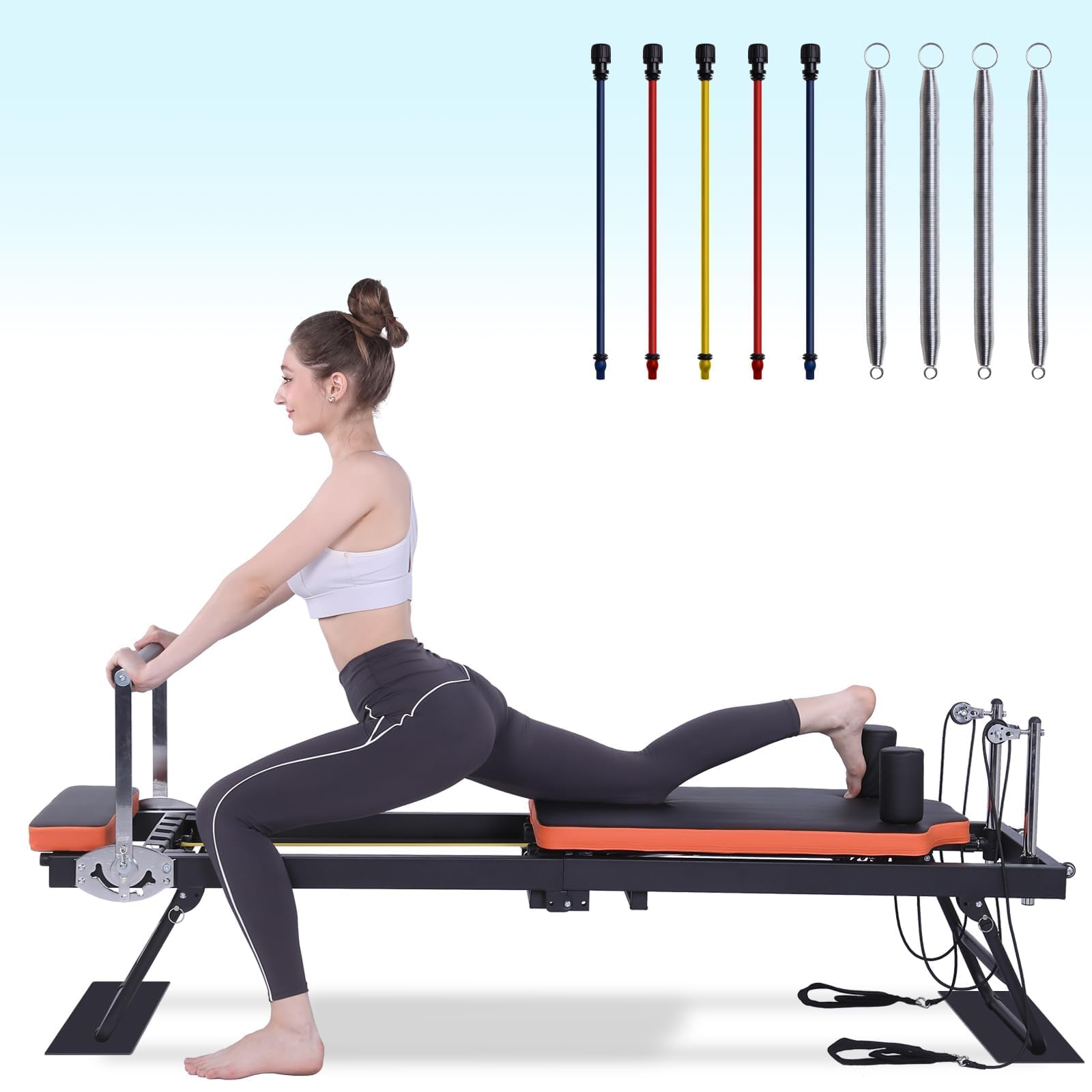
Start with what you get for your money, because it is generous. This Dpiolrcag ties together 4 springs rated at 22 pounds of resistance with 5 cords running from 15 to 27 pounds, which adds up to five levels of resistance you can shift between without buying anything extra. The footbar gives you four adjustable angles, so you can set it flat for footwork or angled for a deeper push. Pairing spring resistance (the firm, linear pull that mimics a studio bed) with cord resistance (a lighter, stretchier pull) is why it lands at the top here.
Assembly is where most home reformers lose patience, and this is the pick that avoids that trap. Roughly 90% of the parts arrive pre-assembled, so setup is a few simple steps rather than a puzzle, and the folding design drops to just 1.83 square feet for storage. The leather mat has soft foam inside for comfort through a long session, and the support system runs on 8 silent, low-friction wheels — the small rollers the carriage rides on — which keeps the glide smooth and quiet. Owners consistently describe the glide as smooth and the machine as quieter than expected, and the recurring story is how quickly it earns its place in a daily routine. That value case is reflected across the board, with a 4.7-star average across 300+ ratings.
Where the wheel meets the road — or rather the track — is fit. This bed carries a 250-pound weight capacity and is built for users from 4 feet to 5 feet 9 inches, so a taller or heavier user will want to look at the VEVOR or the PAETA adjustable-height model instead. The padded bench is comfortable, but the included guide is thin on form cues, so a beginner will learn faster from a streaming class. Buyers do flag the arm straps running long for some body types, and one owner recounts a pair of front sled wheels failing early — the seller sent replacements the next day and issued a partial refund without being asked, which tells you the support side works. The other real-world trade-off is the 70-pound lift when you fold it, so if you plan to tuck it away after every session, know that it is a two-handed job.
What wears well
- 4 springs at 22 lb plus 5 cords from 15–27 lb give five resistance levels without add-ons
- About 90% pre-assembled, so setup is minutes instead of an afternoon
- 8 silent low-friction carriage wheels keep the glide smooth and quiet
- Folds to 1.83 sq ft, ideal for a small apartment corner
Where it asks patience
- 250 lb capacity and a 4’–5’9″ height window rules out taller or heavier users
- The training guide is light on technique for true beginners
- Weighs 70 lb, so folding it away is a deliberate effort each time
Grab this one: if you are a beginner-to-intermediate user within the height and weight window who wants a quiet, quickly assembled reformer that disappears into a corner.
Think again: if you are over 5 feet 9 inches or weigh near 250 pounds — the length and capacity will pinch your range of motion.
2. VEVOR Foldable Pilates Reformer, Up to 400 LBS
The cast iron bruiser that carries 150 pounds more than the top pick and folds flat in minutes.
If the Dpiolrcag above has one hole in its armor, it is capacity — and this VEVOR patches it. That extra footprint stretches your range of motion, which matters if you are tall or broad-shouldered and keep hitting the end of a short bed. It packs 4 equally tensioned light springs for four levels of resistance and adds a jump board (a padded board for cardio-style bounding moves), a non-slip mat, adjustable soft headrest, and high-density foam shoulder pads as standard.
The folding trick works the way buyers want it to. It collapses in a few minutes and stores upright or horizontally at 54 x 24 x 12 inches, so a tight spare room stays usable. At 82 pounds it is the heavier of the two budget-frame picks, and that weight buys the sturdier feel. Owners describe it as smooth and quiet with a comfortable ride, and plenty report it is a smart buy for someone testing whether they will stick with reformer work before committing to a pricier studio-grade machine.
The honest caveat here is consistency. This is a value frame, not a studio frame, and while most of the 30 ratings land positive, more than one buyer reports loose hardware from the start — bent carriage mounts, misaligned pins, a wobbling footbar. That reflects the budget build rather than a design flaw, and if that happens the support side is slow to respond, so inspect the welds and pins the day it arrives. The other thing beginners will notice is the missing guidance: there is no pamphlet or video walking you through the spring-and-band combos, so you are left to figure out your resistance settings on your own. Buy it for the capacity, plan on learning from an app, and you will get what you paid for.
The capacity math: 400 pounds of support on a frame long and wide enough to fit body types the compact picks cannot accommodate.
The build caveat: a heavier 82-pound frame that folds in minutes, but you should not expect studio-grade welds at this price.
Buy it if: you are a heavier or taller user who needs the full 400-pound capacity and a longer bed than compact models offer.
Pass if: you want a machine that arrives with tight hardware and clear set-up guidance — this value frame needs a close inspection first.
3. SogesPower Foldable Pilates Reformer Machine
Five springs and five cords in one frame — the widest dial-it-in range on this list, if you can crack the setup.
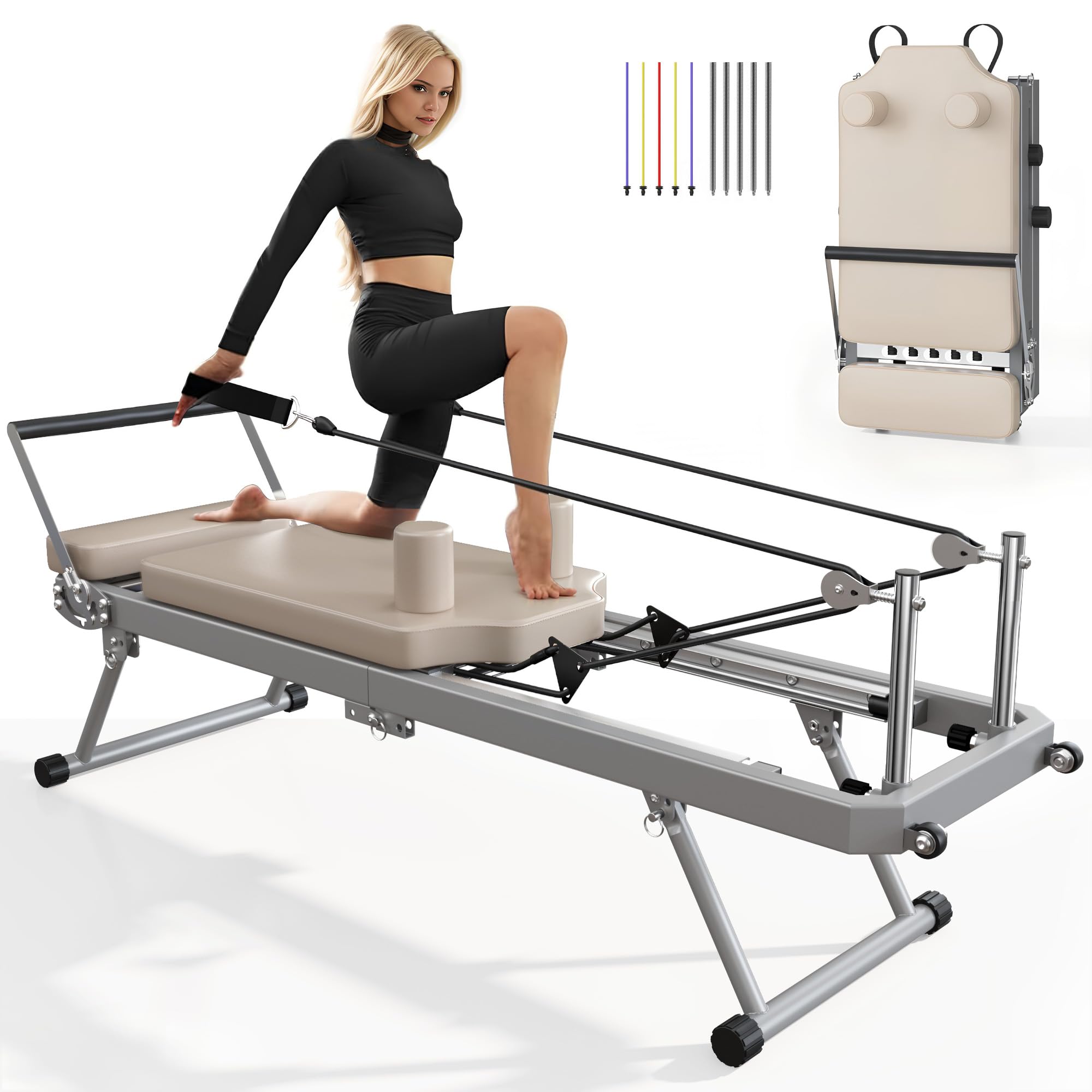
The resistance range is the headline, so let us start there. This SogesPower pairs 5 elastic cords at 15 pounds of pull each with 5 springs at 30 pounds each, and you can slot any mix of them into the five holes on the frame. Stack all the cords and you get a floor of 75 pounds; load all the springs and you hit a ceiling of 150 pounds. That spread is wider than the Dpiolrcag’s five levels and more granular than the VEVOR’s four, which makes it the pick to reach for if you want to fine-tune tension rather than jump between a few fixed settings. The surface is a superior UP leather that wipes clean and resists scratches, so it holds its looks with basic care, and the frame carries up to 400 pounds.
The parts buyers love most are the sturdiness and the glide. Owners describe it as very sturdy for a foldable and easy to use, with one buyer noting great workouts from the start. It folds for storage and rolls on built-in wheels to a corner when you are done. If you have used a studio bed and want a home machine with a genuinely adjustable pull, this is the one where the resistance dial does the most work for you.
Here is the catch, and it is an assembly one rather than a hardware one. Buyers report the instructions are hard to follow — one owner needed a second pair of hands and some intuition to work out the spring routing, and several mention the machine arrives in enough pieces that setting it up feels like a project. The springs also carry audible sound rather than a silent glide, and the whole unit is heavy enough that folding it away each time is a chore rather than a convenience. None of that touches how it performs once it is running, but it does mean you should budget an evening for setup and clear a semi-permanent spot for it.
The dial that stays interesting: 75 pounds at the light end to 150 pounds at the top, so the machine grows with you from gentle stretching to firm strength work.
The setup tax: confusing instructions mean plan on assembling with a second person and clear space to leave it standing.
Reach for this: if you want the broadest built-in resistance range here and have a spot to keep it set up.
Look elsewhere: if you are not comfortable assembling a multi-piece machine or need a genuinely quiet spring pull.
4. WNPANE Foldable Pilates Reformer Machine
A 67-pound folding frame that glides near-silently — the one to pick when your workout space doubles as your living room.
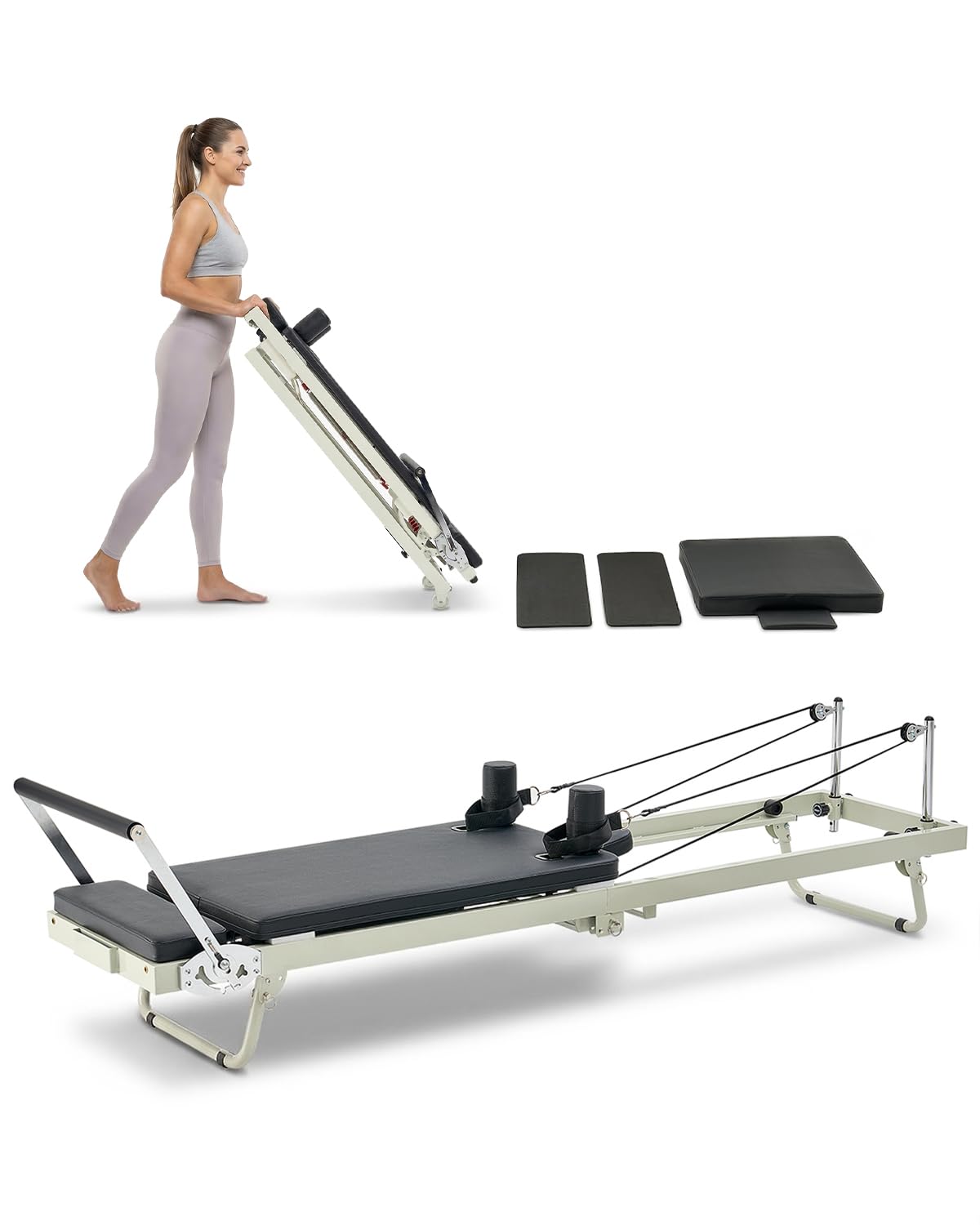
At 67 pounds and folding on a hinge, this WNPANE is the lightest genuine reformer in this lineup after the AeroPilates 287, which makes it much easier to move than the 82-pound VEVOR and the 80-pound PAETA 86″. The reinforced full-metal frame supports up to 400 pounds, so the light build does not mean it is flimsy. Resistance comes from multi-color bands clearly marked by tension level, so you can read your own intensity at a glance instead of guessing which cord you grabbed. Precision glide rails carry a non-slip base and silent rollers, which is exactly the spec you want if you work out before anyone else in the house is awake.
What makes it apartment-friendly is how quietly it behaves. An instructor trainee who bought it for home practice reports it assembles in about a minute, folds for storage, and is near-silent enough to hear a YouTube class over the carriage moving. That light frame plus quiet glide is why it ranks here despite carrying the same 400-pound rating as pricier machines.
Two things to know before you decide. The tension system tops out around 109 pounds, which is lighter than the 150-pound ceiling on the SogesPower deck, so advanced users wanting a heavy pull will find the band system runs out of road. And the details are inconsistent: owners mention the directions are confusing, shoulder pads that do not lock in place so straps pull them loose, and a front platform that is too small to stand on for some standing moves. The seller is responsive and offers refunds when issues come up, which softens the risk. Treat this as a starter machine for beginners and light-to-moderate work rather than a studio replacement for a veteran.
Why it fits small rooms: 67 pounds with a folding hinge and silent rollers, so it tucks away and runs quietly in a shared space.
Where it stops: around 109 pounds of tension, which is not enough for advanced heavy-resistance work.
Pick this: if you live in a small apartment, work out in a shared room, and want a light, quiet reformer for beginner and moderate sessions.
Skip it: if you already train at an advanced level and need a heavy resistance ceiling or rock-solid shoulder pads.
5. PAETA 86″ Foldable Reformer with Jump Board
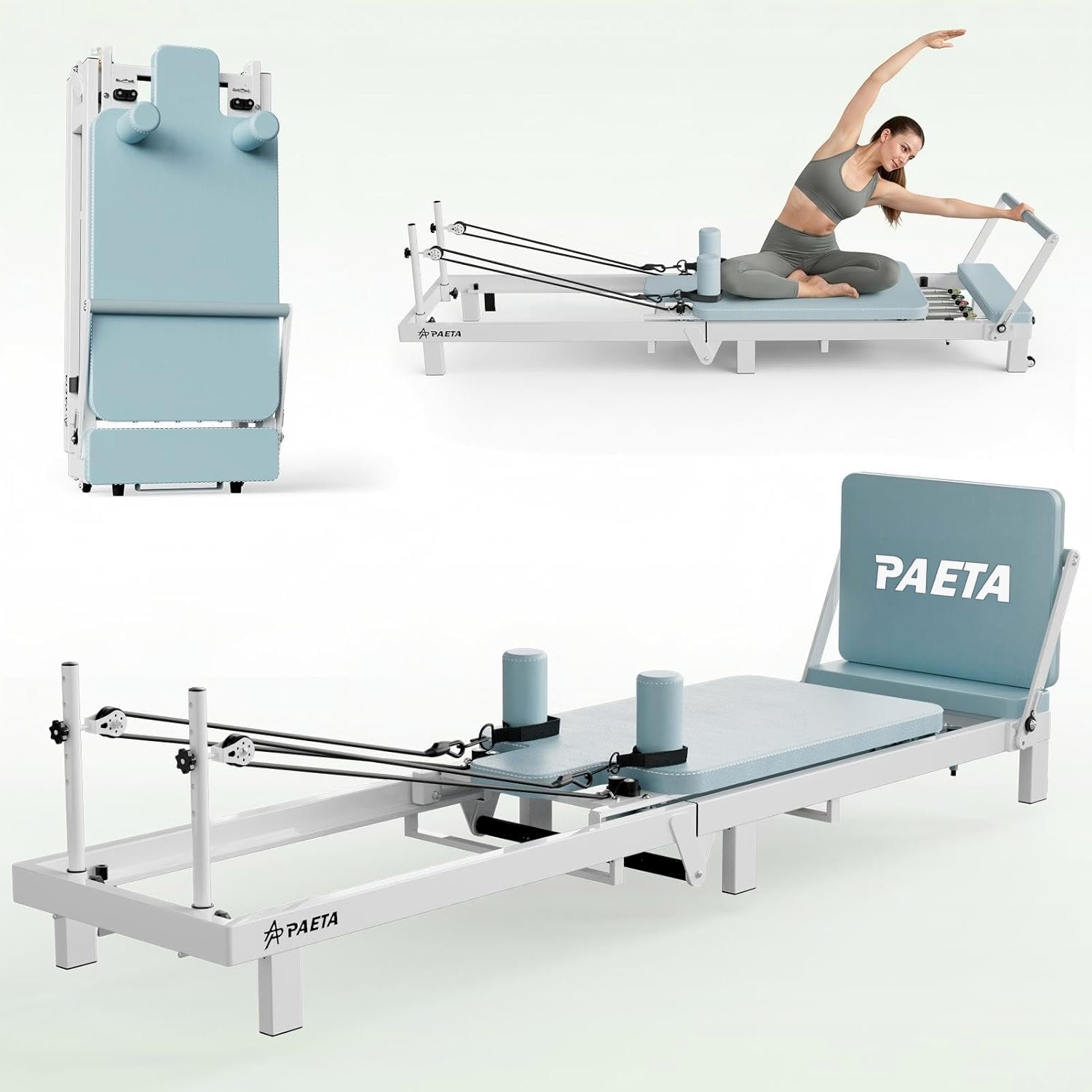
Folds down to two square feet and still brings a jump board, a 400-pound frame, and dual resistance.
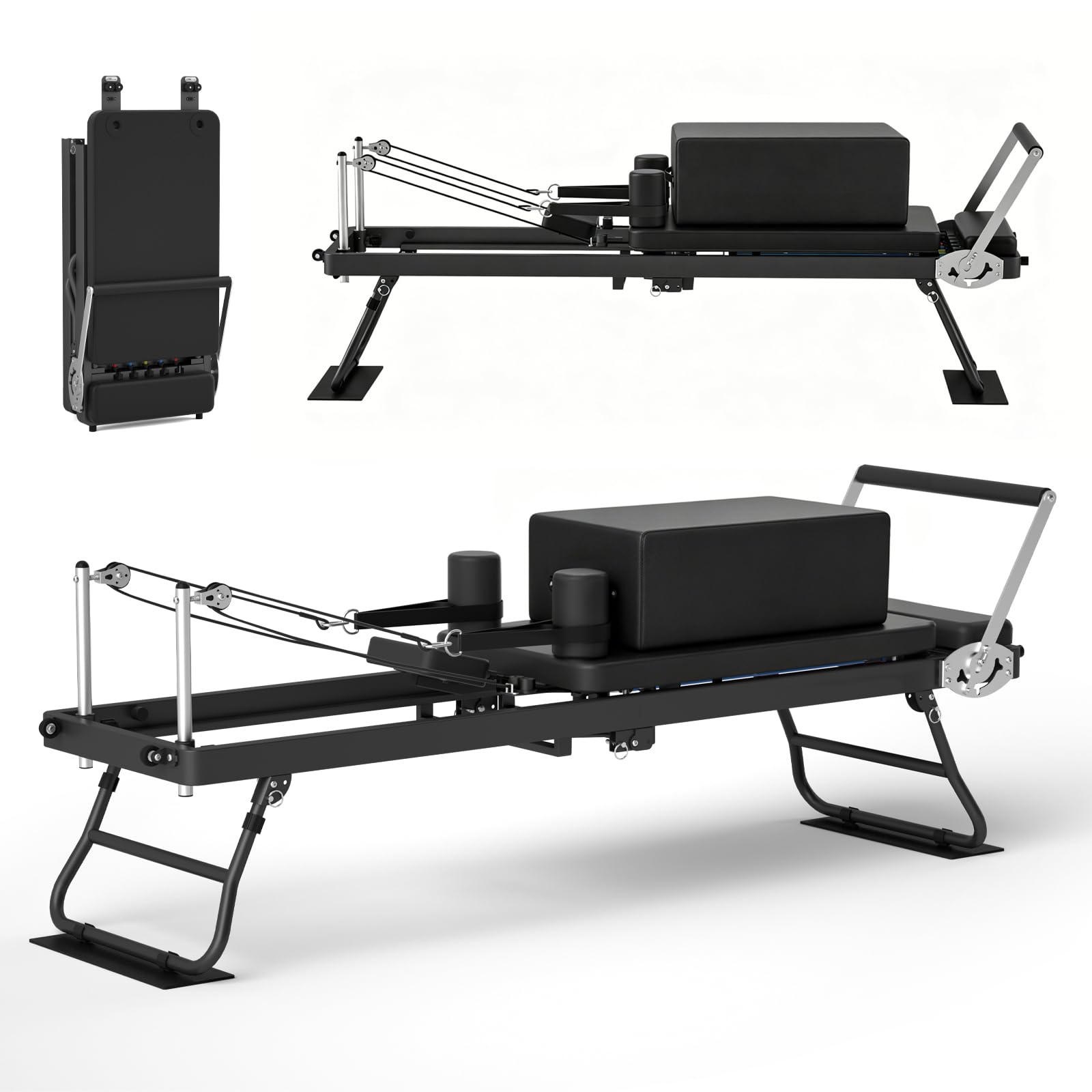
The number to hold onto here is two square feet of folded storage. That is the smallest folded footprint among these picks, and it is the reason this PAETA is the natural fit for anyone whose only workout space is a patch of floor between the couch and the wall. It accomplishes that without giving up strength: a reinforced carbon steel frame carries up to 400 pounds, and the carriage rides on 8 multi-direction wheels (the rollers under the moving platform) along smooth tracks. Dual resistance comes from springs plus cords, tested for over 10,000 uses, and a jump board is included for cardio variety.
Owners tend to rave about the same two things: quiet operation and value. People describe it folding and wheeling away easily, gliding without a squeak after a month of use, and being sturdy enough that a 225-pound user feels solid on it. One self-assembling owner reported putting it together in under 30 minutes. The adjustment range is broad, with a 4-gear foot bar, 3-height pulley risers, adjustable shoulder rests, and a rope-length adjustment system to fit different bodies.
The trade-off is size suitability, and it cuts both ways. Customers note it is not the machine for tall or very strong users — one owner is candid that it suits a 5-foot-4-inch, 120-pound user perfectly while taller bodies will feel cramped, and the adjustability gets mixed reviews for the same reason. The bed and shoulder pads also arrive on the stiff side, which softens with use but is worth knowing on day one. If you are within the height window and space is your binding constraint, the compact fold is a real advantage; if you are tall or want a firm pad from the first session, move up the list.
Why it wins the space race
- Folds to just 2 sq ft and rolls on wheels to tuck under a bed
- 400 lb capacity on a carbon steel frame with 8 multi-direction carriage wheels
- Dual resistance from springs and cords, plus a jump board for cardio
- Reviewers point out quiet, squeak-free gliding after a month of use
Where it asks for compromise
- Not sized for tall or very strong users — fit suits smaller bodies best
- Bed and shoulder pads arrive stiff and take time to soften
- Adjustability gets mixed feedback across body types
Choose this: if floor space is your biggest obstacle and you want a quiet, firm 400-pound machine that vanishes into a corner after use.
Not for you: if you are tall or want a softer landing and a broad adjustment window from day one.
6. AeroPilates 287 Pilates Reformer

At 56 pounds this is the lightest reformer here — the one you can genuinely fold and stow without a spotter.
Weight is the whole story on this AeroPilates 287, and it wins that category outright. The steel frame tips the scale at 56 pounds, which is well under the 67-pound WNPANE, the 70-pound Dpiolrcag, and the 82-pound VEVOR. If your plan is to fold the machine in half and wheel it behind a door after every session, this is the frame that makes that realistic instead of aspirational. Resistance comes from 3 heavy-duty elastic bungee cords rather than springs, the padded platform is 17.5 inches wide, and the headrest has 3 positions. Six non-skid supports — two at each end and two in the middle — keep it planted while you work. Two workout DVDs and a full-color wall chart come in the box, which helps if you are learning the movements from scratch.
Functionality is where owners pile on the praise. This machine has a huge following built on being easy to assemble and genuinely effective, with a folding frame and wheels that make it simple to store. One longtime Pilates veteran — two decades in — reportedly prefers it over a far more expensive reformer for daily home use. The value story is real too, with buyers noting it is a fraction of studio membership costs.
Know the limits before you commit. Three bungee cords means only three tension levels, so advanced users or anyone needing fine resistance control will run out of options — more than one buyer wishes there were five bands instead of three, and one notes the single arm band is heavy for anyone recovering from injury. The padded bed is narrow at 17.5 inches, the shoulder pads run hard and cannot be swapped for softer ones, and the machine does make some noise in use. It also tops out at a 300-pound capacity, below the 400-pound frames above. It is an honest starter machine that suits a normal-weight user around 5 feet 5 inches best.
The weight advantage: 56 pounds is the lightest frame here, so folding it in half and rolling it away is realistic solo work.
The pressure limit: just three bungee cords and a 300-pound capacity mean limited tension range and a firm pad you cannot soften.
Great fit for: a first-time reformer user who wants the lightest, easiest-to-stow machine and lives within the 300-pound capacity.
Not the pick: if you need five-plus resistance levels or a wide, padded carriage — the three-cord system and narrow bed will limit you.
7. DWKWE Foldable Reformer with Jumpboard
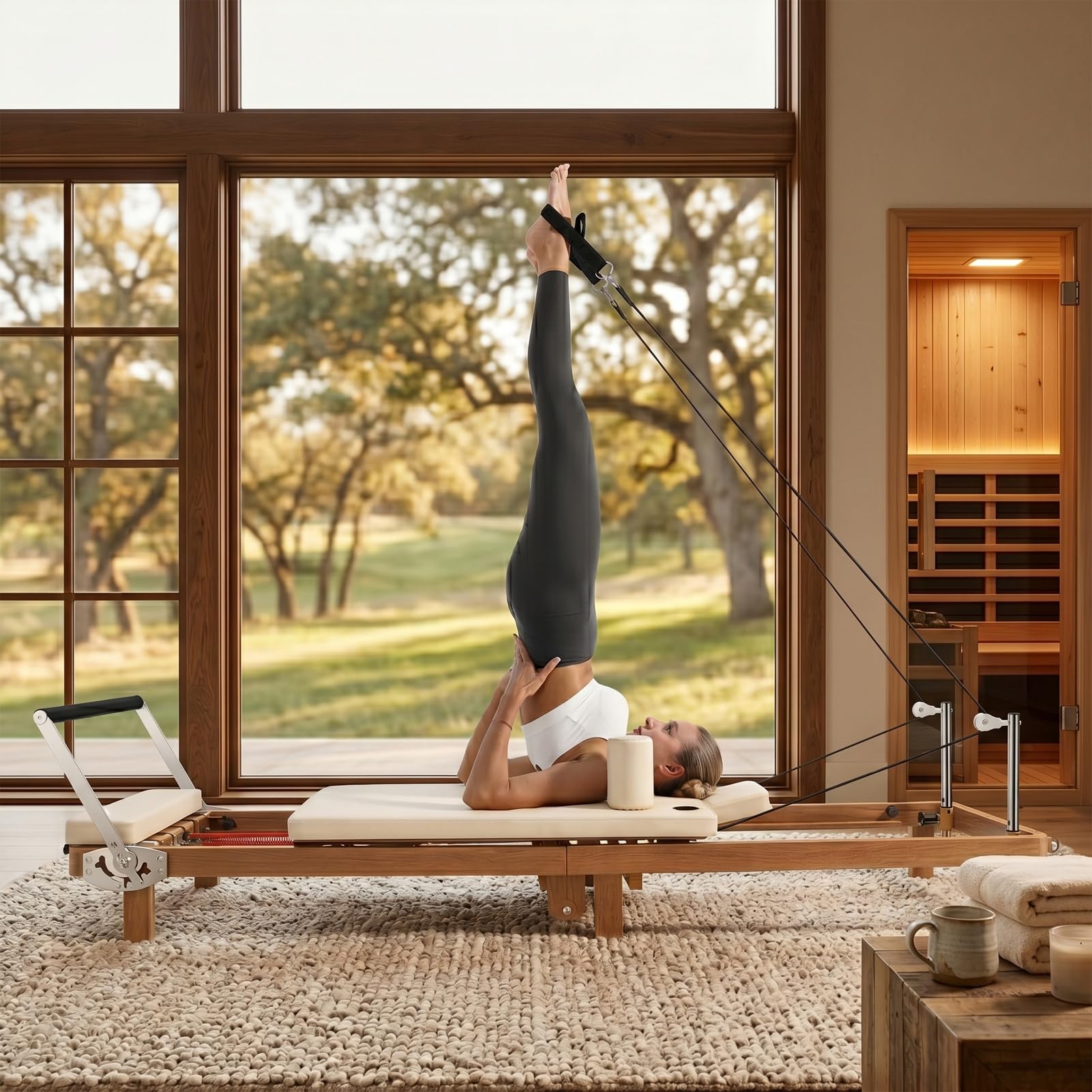
The reformer that dresses like furniture — a wood-grain metal frame with a jumpboard and dual resistance built in.
Looks matter in a living room, and this DWKWE is the one that acknowledges it. The frame wears a wood-grain finish over metal rather than solid wood, which the maker notes keeps the strength without the weight, and it resists rust while supporting up to 110 kilograms. It stretches 88 inches long and folds compactly enough to stow under a bed or in a closet. Two resistance types come standard — 4 steel springs plus 5 latex resistance bands — so you can shift between a firm spring pull and a lighter band stretch without extra purchases, and it targets core, legs, arms, back, and glutes.
The quality of the build is what buyers bring up first. Owners describe it as well-made and sturdy enough that one compares the feel directly to her studio reformer — she calls it a machine that does everything the studio model does. Assembly runs mostly pre-done, and the foldability genuinely works, with a jumpboard included for cardio and a padded carriage and adjustable headrest for longer sessions.
Two practical snags are worth flagging. The first is folding: while it does fold, at least one buyer found that folding it requires unbolting with a tool each time, which makes it a set-up-and-leave machine in practice rather than a daily stow-and-go. The second is a one-off quality miss — a buyer reports the jump board will not hold weight as intended and does not seat properly in its slot without removing the footrest cushion. The seller is responsive and has replaced machines for early buyers, and the springs are not color-coded so you have to feel your way to the right tension. If you want the wood-look aesthetic and you have a permanent corner for it, that styling is what you are paying for.
The styling edge: a wood-grain metal frame supporting up to 110 kg that looks at home in a living room, not just a garage gym.
The folding asterisk: folding requires unbolting with a tool, so plan on leaving it set up rather than tucking it away.
Suits you: if you want a reformer that looks like furniture, brings dual resistance, and can live in a permanent spot.
Look past it: if you need to fold and store the machine after each session — the unbolt-and-fold step is too slow for that routine.
8. AeroPilates Reformer 4420 Plus with Floor Mat

Swap the padded foot bar for a cardio rebounder and turn a Pilates reformer into a low-impact cardio machine.
Most reformers in this lineup are built for strength and control. This AeroPilates 4420 stands apart because it also wants you to sweat. The headline feature is an interchangeable patented cardio rebounder — a bouncy surface you swap in for the padded foot bar — so you can pivot from standard Pilates moves to higher-energy cardio without a second machine. Resistance is handled by 4 heavy-duty elastic cords in coded strengths: two black, one red for extra resistance, and one yellow for light resistance. That gives you more tension steps than the three-cord AeroPilates 287, and a streamlined pulley system makes the transitions between arm and leg work smooth. A floor mat, wall chart, and four on-demand video routines come in the box.
Owners use it hard and keep coming back. This machine has a deep following built on quality and effectiveness, with people describing it as gentle on joints during low-impact conditioning. Someone recovering from a torn ACL reportedly uses it for both cardio and resistance, and notes visible posture and stability changes after a couple of weeks. The 31.3-kilogram frame folds and rolls away on wheels, and the 300-pound capacity covers most home users.
The recurring gripes are about comfort and smoothness rather than function. Several buyers find the carriage tracks slightly bumpy, describe the hand and foot straps as uncomfortable and replace them, and note that the carriage is on the narrow side — it fits a 5-foot-8-inch user with full extension but feels tight for taller or larger bodies. One long-time instructor found the track alignment rough enough to return it. That said, the machine has a large and satisfied base and just as many shoppers say it matches a studio bed at a fraction of the cost. Treat the straps as a first upgrade and check the tracks on arrival.
The cardio differentiator: a patented rebounder swaps in for the foot bar, so this one machine covers reformer strength work and low-impact cardio.
The comfort caveat: a narrow carriage and strap set that many replace mean you should plan a small upgrade and verify the tracks glide smoothly.
Worth choosing: if you want one machine that handles both traditional Pilates and cardio rebounding in a compact folding frame.
Better to pass: if you are tall or broad and need a wide carriage, or want straps that feel good without replacing them.
9. PAETA 86″ Reformer with Adjustable Heights

A 500-pound, 86-inch bed with removable stands that drop the height for stability or raise it for access.
The adjustable-height stands are what earn this PAETA its spot. You can pull them off to run the reformer low to the floor for maximum stability — a help for beginners and anyone nervous about balancing on a taller bed — or leave them on for easier on-and-off access and a more challenging angle. An extended 86-inch frame accommodates users up to 5 feet 9 inches, and unlike standard 75-inch foldables it widens your range of motion and comfort. The frame carries a 500-pound weight capacity across six sturdy legs, and the premium piano wire springs (a thin, springy steel wire that pulls smoothly and quietly) are built for over 100,000 uses. It folds to 1.4 square feet and ships with storage bags.
Quiet, smooth operation is the praise point here. Owners with serious class time behind them — one reports 158 classes a year — describe preferring it over far pricier studio reformers for its quiet glide and easy setup, and note it is close to a club machine at a fraction of the cost. Running two people through one home bed works here too: buyers report it fits a 6-foot-2-inch husband as well as a smaller user, thanks to fully adjustable rope lengths, 5-position pulley risers, 6-position footbars, and an adjustable headrest.
The one honest caution is space and weight. At 109.3 pounds and 90.6 inches long, this is a big, heavy machine — one owner notes the 91-inch class of reformer needs real room even when folded, and asks for a second person to lift it onto the risers. There is also a known break-in niggle: owners mention the riser needs periodic tightening and the carriage can develop a scraping sound after a couple of months, though support is reportedly quick to send a fix or a replacement. If you have the floor space and want the longest, quietest glide on this list, the length is a feature rather than a flaw.
What earns it the spot
- Removable stands let you run it low for stability or high for easy access
- 86-inch frame fits users up to 5’9″ with a wide range of motion
- 500 lb capacity across six legs, with piano wire springs rated past 100,000 uses
- Class veterans report it beats pricier studio reformers on quiet, smooth glide
What you should expect
- 90.6 inches long and 109.3 pounds — it needs real floor space and a second pair of hands
- Risers can need periodic tightening and some units develop a carriage scrape
- Support resolves issues quickly, but you may need to reach out first
Right for you: if you are a taller or heavier user who wants a long, quiet, 500-pound bed with the option to lower it for stability.
Wrong for you: if your home cannot spare the footprint or you want a machine you can fold and lift alone.
10. Yorkgargen 94.5″ Reformer with 5 Springs
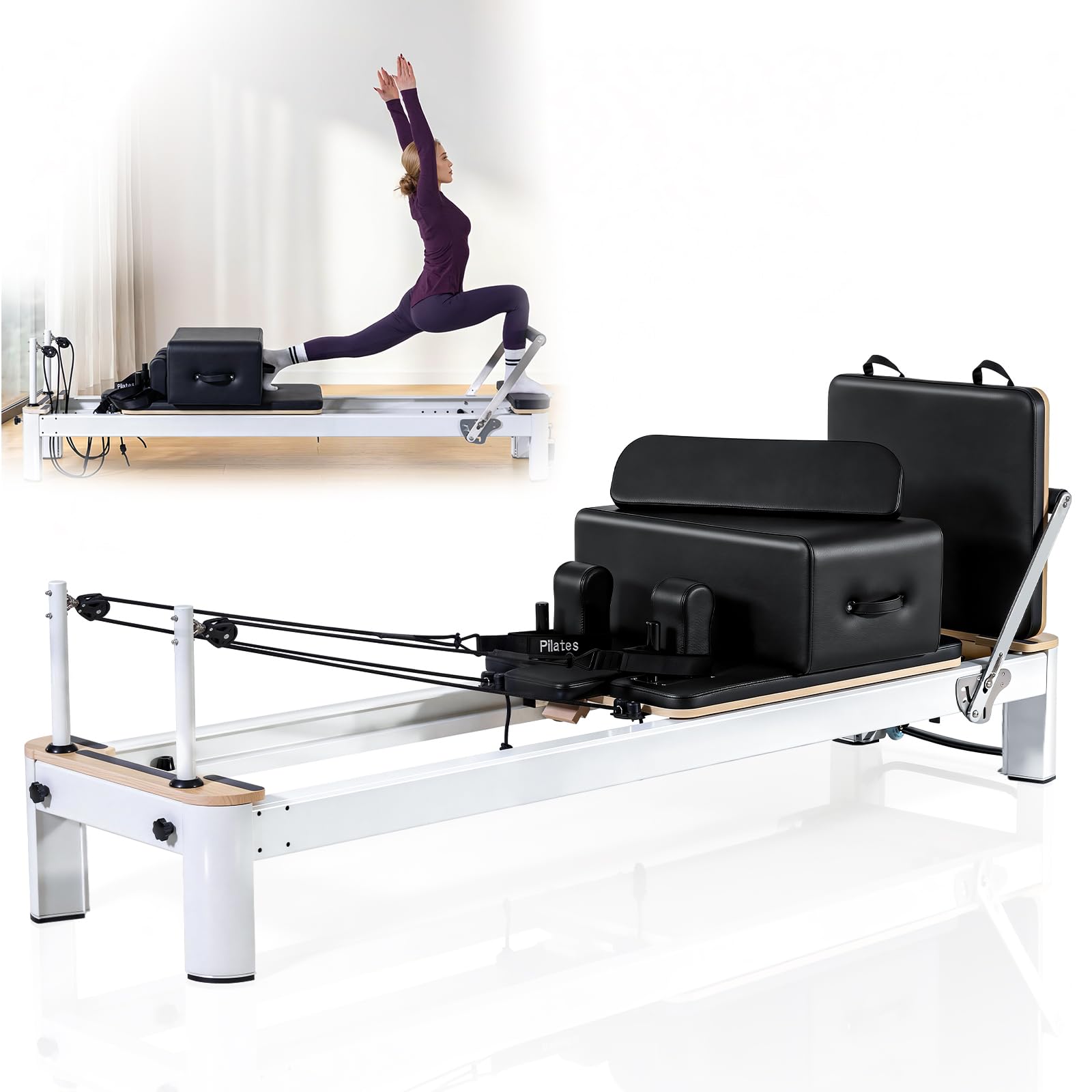
A 94.5-inch aluminum-and-maple studio build with color-coded springs that read your resistance at a glance.
Length and longevity are the two reasons this Yorkgargen tops the list on build quality. At 94.5 inches it is the longest frame here, stretching past the 90.6-inch PAETA adjustable-height model and the 86-inch PAETA foldable, and it carries a 350-pound capacity on a heavy-duty aluminum alloy frame with high-grade maple wood accents. The spring set is the most precisely graded in the lineup: 2 red heavy-duty springs at 60 pounds, 2 green medium springs at 40 pounds, and 2 yellow light springs at 20 pounds. That 60/40/20 split lets you build resistance in real steps, from gentle work up to advanced strength sets, far more precisely than a three-cord system.
The accessory kit is complete from the start. You get a sitting box, jump board, 3-level adjustable headrest, padded shoulder pads, a smooth sliding carriage, a 6-position adjustable foot bar, foot straps, hand straps, shoulder handles, and soft leather padding. Because it is 90% pre-assembled with tool-free final setup in under 20 minutes, you can be working out quickly. Owners describe it as close to the quality of a Pilates club charging a heavy monthly membership, and several note it pays for itself against studio fees. Precision aluminum slide rails keep the glide ultra-quiet and frictionless.
Two things to weigh. The capacity is 350 pounds rather than the 400 to 500 pounds some cheaper-looking picks claim, so very heavy users should look at the PAETA adjustable model or the wooden PAETA instead. And this is a non-folding design — a deliberate choice for stability, but it means you need a permanent home for a big machine.On delivery, buyers have reported a unit arriving damaged in transit, and since a machine this size ships in two separate packages, inspect both boxes before assembly. If everything arrives whole, the 94.5-inch glide and color-coded springs make this the closest thing to a studio bed you can own without a studio.
The spring ladder: 60, 40, and 20-pound springs let you build resistance in precise steps instead of guessing between a few fixed cords.
The stay-put reality: a non-folding aluminum and maple frame at 94.5 inches means you are committing a permanent footprint, and you should check both shipping boxes on arrival.
Worth it for: experienced users who want long, precise, studio-feeling resistance and have a dedicated spot to keep it set up.
Think twice: if you need folding storage or weigh near the 350-pound ceiling — a longer-folding model will serve you better.
11. PAETA 92″ Wooden Reformer with Sitting Box
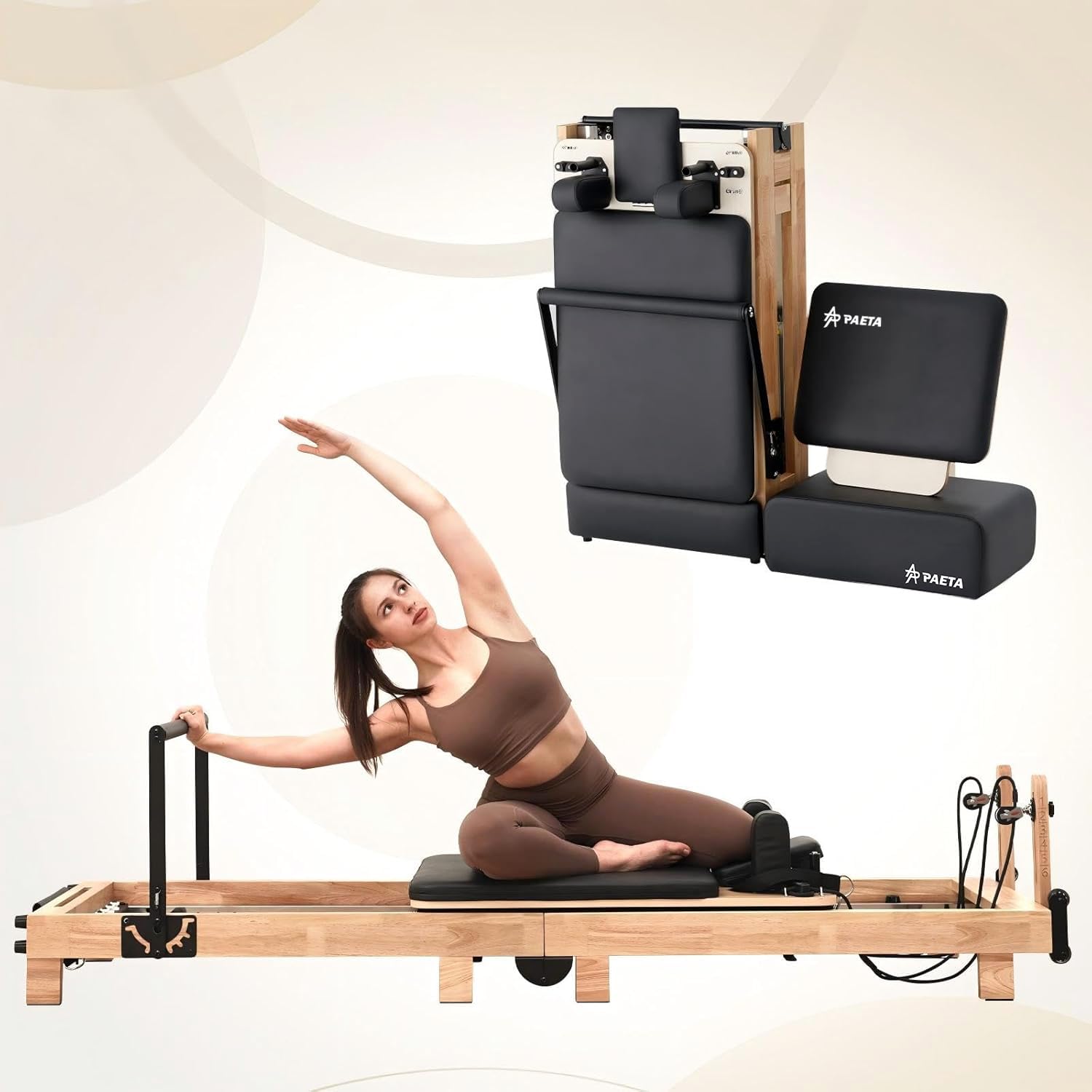
A solid oak, 500-pound reformer with 12 spring gears and a 7-gear foot bar — the one built to last.
If you want a home reformer that feels like it belongs in a studio, the solid oak frame here is the answer. It supports up to 500 pounds and measures 92 inches long with a spacious body and extended carriage, so a tall user gets a full range of motion instead of a cramped one. The resistance system is the most adjustable here: a 12-gear spring system with 6 premium wire springs and dual hook rows, giving you finely tuned pull options, and the springs are tested for durability over 60,000 cycles. It folds for storage and rolls on multi-directional wheels, and the jump board adds cardio variety. A 7-gear foot bar, 6-position pulley risers, and rope adjustment system round out the setup.
What customers praise loudest is the studio-like feel. Owners describe it as smooth and quiet, comparable to the reformers they use in class, and worth the money for that quality. Several report it is easy to adjust across very different heights — one household fits a 5-foot-3-inch user and a 6-foot user on the same bed. Assembly takes about an hour with two people, and customers note the build feels solid and grippy once it is set up. It also ships well, with customers reporting two well-packed boxes and the machine arriving in good condition.
Two honest notes. Folding is possible but the machine is heavy, so treat folding as a seasonal move rather than a daily one — several buyers find it too much to fold regularly. The manual occasionally arrives missing and the frame has been reported with scratches on arrival, though the seller emails a PDF promptly and the functionality is unaffected. The springs can be noisy at first until you position the hooks correctly, which is a fixable niggle rather than a fault. Bottom line: this is the pick for someone who wants a wooden, studio-grade machine that will hold up and does not mind spending a little more for it.
What you are paying for
- Solid oak frame with a 500 lb capacity and a spacious 92-inch body
- 12-gear spring system with 6 wire springs tested past 60,000 cycles
- Studio-like smooth, quiet glide that owners compare to class reformers
- 7-gear foot bar and 6-position pulley risers fine-tune fit across body sizes
What to plan around
- Heavy enough that folding is a two-person, occasional job
- Assembly takes about an hour and benefits from a second pair of hands
- Some units arrive with frame scratches, and springs need initial hook positioning to quiet down
The clear choice: if you want a wooden, studio-grade reformer with the broadest adjustment range and you have a semi-permanent home for it.
Not the fit: if you plan to fold and store your reformer every week — the weight makes that impractical.
Understanding the Specs
Weight capacity
This is the maximum body weight the frame is rated to hold, usually listed as something like 250, 300, 400, or 500 pounds. Think of it as the load rating on a ladder — the machine should hold that weight with a safe margin, not sit right at the edge. If you are near the top of a machine’s rating, choose a frame with headroom so the carriage and rails do not strain. A 400-pound frame is a meaningful step up from a 250-pound one for heavier users, and it usually pairs with a longer, more stable build.
Springs versus cords
Springs give a firm, steady pull that mirrors a studio bed, and they are what advanced users tend to prefer. Elastic cords give a lighter, stretchier resistance that suits warm-ups, stretching, and lower-energy sessions. The tension each one is rated for — for example a 22-pound spring or a 15-pound cord — tells you how heavy the pull is, and the number of them tells you how many resistance steps you get. A machine with both springs and cords, like the Dpiolrcag or the SogesPower, gives you the widest range to grow into.
Carriage wheels and glide
The carriage is the padded platform you lie on, and the wheels under it decide how smooth the ride feels. More wheels — like the 8 multi-direction wheels on the PAETA foldable — spread the load and keep the glide even. Smooth, quiet wheels matter because a reformer you can use early in the morning or late at night without waking the house is one you will actually use. A rough or misaligned track produces bumps and scraping, which is why checking the glide on arrival is worth doing.
Frame length and body fit
Reformer length is the spec that quietly decides whether a machine fits you. These range from a compact 74.6-inch bed up to a full 94 inches, and most listings pair a length with a recommended height — often up to 5 feet 9 inches for a longer frame. A shorter bed pinches your range of motion if you are tall, so you cut movements short without realizing it. Foldability also trades against length: a compact folding craft is easier to store but fits fewer body types, while a longer frame gives more room but needs more floor.
FAQ
How much space do I need for a foldable Pilates reformer at home?
Is a reformer with springs better than one with elastic cords?
What weight capacity should I look for in a home reformer?
Will a home Pilates reformer fit a tall user?
How heavy is a foldable reformer and can one person move it?
Do I need a jump board for cardio on a reformer?
Are entry-level home reformers noisy?
How long does a home Pilates reformer last?
Can a home reformer match a studio machine?
Final Thoughts: The Verdict
For most homes, the best affordable pilates reformer winner is the Dpiolrcag Foldable Pilates Machine, because it pairs a 4-spring plus 5-cord resistance system with a 1.83-square-foot fold, near-pre-assembled setup, and a 4.7-star average — and it does all of that without asking for a permanent corner of the room. If you need more capacity and length than the 250-pound Dpiolrcag allows, the VEVOR carries 400 pounds, while the PAETA adjustable-height model stretches the bed to 86 inches and lifts capacity to 500 pounds for taller users. And if you want a wooden, studio-grade machine built to last, the PAETA 92″ Wooden Reformer is the premium finish to reach for. Match the height window and weight capacity to your body first; the workout follows.
How We Picked
We do not accept paid placement. Every pick is matched to a real buyer and a real use-case; we do not hands-on test units.
Sources & Methodology
Specifications: manufacturer listings and product documentation. Review insights: verified customer reviews, as of September 2026. Pricing: not shown on this page (it changes often); check the current price via the retailer link.
As an Amazon Associate, Gadgets Feed earns from qualifying purchases. This does not affect which products we feature.