
A batting cage net is useless without live arms behind it, but finding someone to throw consistent strikes for hours is nearly impossible for most families and coaches. That gap between wanting better reps and having the manpower to deliver them is exactly what an affordable pitching machine solves — it replaces the unreliable human arm with a mechanical one that delivers the same fastball, every single time, without fatigue or frustration.
I’m Min — the co-founder and writer behind Gadgets Feed. I’ve spent hundreds of hours digging through consumer feedback, dissecting motor specs, wheel diameters, ball-feeder reliability, and frame build quality across dozens of models to separate the machines that actually fix a swing from the ones that just waste space in the garage.
Whether you are a little league coach on a tight budget or a parent trying to keep a 10-year-old engaged through the off-season, this guide will help you find the right best affordable pitching machine for your specific training needs.
How To Choose The Best Affordable Pitching Machine
An affordable pitching machine should not force you to trade accuracy for a lower sticker price. The key is understanding which mechanical compromises affect performance and which ones represent smart value engineering. Focus on three core areas before making a decision.
Power Source and Consistency
Foot-operated machines use a spring-loaded pedal mechanism that stores energy and releases it when you step down. These models are completely silent, require no batteries or extension cords, and are generally safer for young children because the launch timing is manual. The tradeoff is inconsistent launch height and velocity — the force of your step directly determines the pitch, so two different people will produce two different fastballs. Motorized machines use a spinning wheel or arm to launch balls at a consistent speed every time, which is critical for developing muscle memory and timing. A motorized unit with a 110V plug or rechargeable battery will deliver repeatable pitches, making it the better choice if your goal is measurable improvement rather than casual backyard fun.
Ball Compatibility and Speed Range
Not every affordable machine can handle regulation baseballs or softballs. Some are designed exclusively for dimpled plastic balls or restricted-flight lite balls to reduce wear on the throwing mechanism and protect the netting. Machines that pitch real leather baseballs require stronger motors, reinforced housing, and larger wheels — features that raise the price. For youth training (ages 7-12), a machine that delivers speeds between 30 and 45 MPH using lite balls or dimple balls is more than sufficient. For high school or adult practice, look for a unit that can reach at least 55-60 MPH with real baseballs, which typically means moving into the mid-range or premium tier of the affordable segment.
Portability and Setup Complexity
A pitching machine that takes 45 minutes to assemble or requires a dedicated storage shed will get used less. Look for models that weigh under 25 pounds, fold into a compact footprint, and include a carrying handle or optional wheel kit. The best affordable machines balance stability during use with quick breakdown for transport. Tripod-style stands offer the best stability on grass or dirt, while base-mounted designs are more compact but may shift during repeated pitches. Also consider whether the machine includes an automatic ball feeder — feeding manually every 6-10 seconds becomes exhausting after 50 pitches, making an integrated or add-on feeder a worthwhile investment for any serious training session.
Quick Comparison
On smaller screens, swipe sideways to see the full table.
| Model | Category | Best For | Key Spec | Amazon |
|---|---|---|---|---|
| Heater Slider Lite 360 | Mid-Range | Curveball practice with auto feeder | Pitches lite balls up to 80 MPH at 46 ft | Amazon |
| Heater Power Alley Pro | Mid-Range | Real baseballs up to 45 MPH | Pitches real baseballs, steel tripod stand | Amazon |
| Louisville Slugger Blue Flame Pro | Mid-Range | Multi-ball versatility, up to 58 MPH | Enhanced ball-bearing throwing arm, 20 lbs | Amazon |
| Furlihong 777BH-B Feeder | Premium | Automatic feeder for existing machines | Height-adjustable, extendable ball stacker | Amazon |
| The Designated Hitter Pro | Premium | Pitcher training dummy, 5’9″ tall | Weighted base, beveled edges, left/right batter | Amazon |
| Personal Pitcher Pro Starter | Premium | All-in-one training system | Includes tripod, WebGlov, Isolator Pad, focus balls | Amazon |
| Furlihong 691BH | Budget | Casual backyard fun, no power needed | Foot-operated, 4 adjustable gears, 2-in-1 baseball/softball | Amazon |
| IDEATRY Batting Cage | Budget | Complete backyard cage setup with machine hole | 22ft/30ft net, 12.7mm fiberglass poles, 1.25-inch mesh | Amazon |
| VEVOR Pitching Mound | Budget | Pitching practice with realistic mound feel | PP turf, 550 lbs capacity, folding design with wheels | Amazon |
In‑Depth Reviews
1. Heater Sports Slider Lite 360

The Slider Lite 360 earns the top spot because it delivers legitimate curveball training — a feature typically reserved for machines costing three times as much — by using a pivot head design that spins the ball with topspin for a sweeping break. It fires lite balls up to 80 MPH from 46 feet, which is fast enough to challenge high school hitters while keeping the ball weight low enough to protect nets and reduce injury risk. The automatic ball feeder drops balls consistently, so you can run through a 50-ball bucket without stopping to load.
Build quality is where some buyers hit friction. The plastic housing feels durable but loud during operation, especially compared to metal-framed machines like the Atec Hitting Streak that cost significantly more. The speed potentiometer has been reported to fail after extended use, though Heater Sports customer service replaces it at no cost — a worthwhile consideration if you plan to run this machine through multiple seasons with a team. Stabilizing the stand with tape on the pole tips helps reduce vibration at higher speeds.
For a family or youth coach who wants curveball variety and lite-ball safety without jumping past the mid-range price tier, this is the most feature-packed option. It works with the recommended soft yellow dimple balls — avoid the hard yellow ones, which damage the feeder wheel and net prematurely. The machine has held up for over six years in some households with heavy use across multiple children.
Why it’s great
- Pivot head produces accurate curveballs for game-like batting practice
- Auto feeder handles full buckets without manual loading between pitches
- Lite ball speeds up to 80 MPH challenge advanced hitters at a safe ball weight
Good to know
- Plastic housing transmits more noise than metal competition
- Speed potentiometer may require replacement after moderate use
- Hard yellow dimple balls damage the feeder; use soft white dimple balls
2. Heater Power Alley Pro

The Power Alley Pro is the rare affordable machine that can pitch real leather baseballs — a critical distinction if you want your hitter making contact with the same weight and seam feel they see in games. The impact-resistant nylon-fiberglass housing wraps around a steel tripod stand that stays planted on grass or dirt, and pitch height adjusts to simulate fastballs, ground balls, and pop flies for defensive drills. Reaching 45 MPH from around 40 feet creates a realistic reaction window for little league and middle school players.
Motor spool-up time between pitches is about four to five seconds, which means you cannot rapid-fire balls — the machine needs that window to regain full wheel speed. The swivel lock mechanism that controls horizontal aim has a reported tolerance issue that allows about an inch of play, translating to several inches of drift at 40 feet. Some owners have reinforced the lock with a secondary clamp or sandbags on the stand legs, which also helps dampen vibration at higher speeds.
This machine is best deployed for defensive training — grounders, pop flies, and soft toss — where absolute pitch-to-pitch strike zone accuracy is less critical than repetition volume. The stand folds for car-trunk transport, and the 15.7-pound weight is manageable for one person to carry. If your primary goal is live batting practice with real baseballs at a speed appropriate for 9- to 13-year-olds, this is the most practical gateway machine in the affordable tier.
Why it’s great
- Pitches real baseballs for authentic weight and seam feel
- Versatile height adjustment for fastballs, grounders, and pop flies
- Lightweight nylon-fiberglass housing with steel tripod for stability
Good to know
- Swivel lock has slight play that affects long-distance accuracy
- Motor needs 4-5 seconds to spool between pitches
- Vibration at higher speeds; sandbags on legs recommended for stability
3. Louisville Slugger Blue Flame Pro
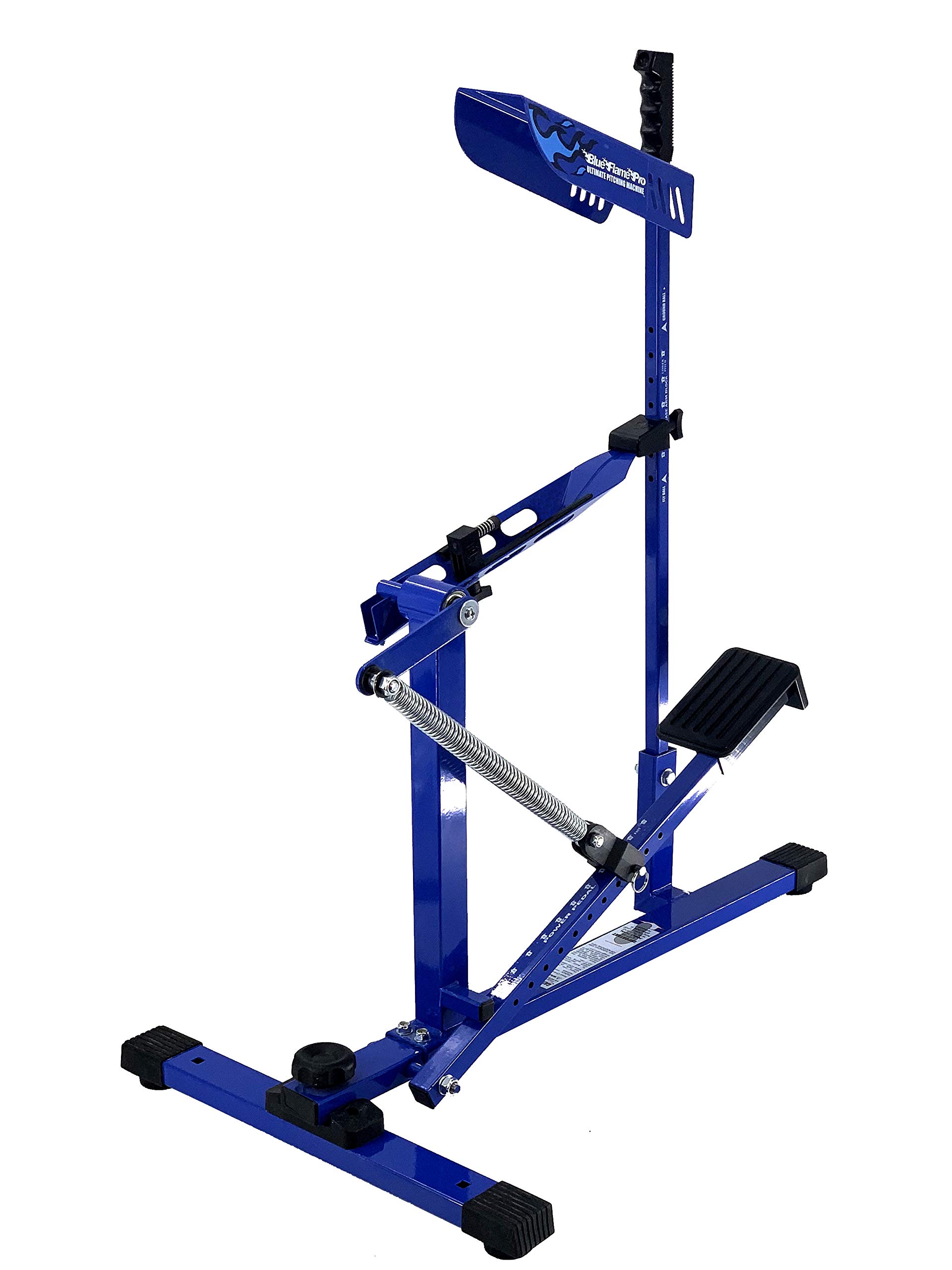
The Blue Flame Pro uses an upgraded ball-bearing throwing arm — a spring-loaded mechanical arm rather than spinning wheels — which creates a whipping motion that can launch tennis balls, dimple balls, plastic balls, softballs, and baseballs up to 58 MPH. That multi-ball versatility makes it the single machine that can serve a family with both a softball player and a baseball player. The ergonomic pedal redesign reduces the foot force required to fire, which matters when you are throwing 100 pitches in a single practice session.
Accuracy is the tradeoff for that versatility. Because the throwing arm relies on a spring and pedal mechanism, pitch-to-pitch consistency degrades as the spring fatigues, and the machine requires frequent adjustment between pitches to keep the ball in the strike zone. Some users report that orienting the ball seams in a four-seam position improves accuracy, but that is not practical during rapid-fire feeding. The steel construction adds weight (20 pounds), which improves durability but makes it less portable than the polycarbonate alternatives.
This machine is endorsed by Babe Ruth League and Pony Baseball & Softball programs, which speaks to its durability at the team level. The assembly is straightforward, and the color-coded speed settings make it easy for a coach to adjust between batters. If you need one machine that can handle multiple sports, multiple ball types, and multiple skill levels without breaking the bank, the Blue Flame Pro delivers the widest ball compatibility in its class.
Why it’s great
- Works with tennis balls, dimple balls, plastic balls, softballs, and baseballs
- Improved ergonomic pedal reduces foot fatigue during long sessions
- Endorsed by Babe Ruth League and Pony Baseball programs
Good to know
- Spring-arm mechanism requires frequent adjustment for consistent strikes
- Spring jarring can shift aim between pitches, disrupting rhythm
- 20-pound weight plus steel frame makes transport less convenient
4. Furlihong 777BH-B Automatic Feeder

The 777BH-B is not a pitching machine by itself — it is a standalone automatic ball feeder designed to attach to most professional baseball pitching machines, including the Furlihong 777BH, 747BH, BATA B1 Curveball, and Jugs BP1. The iron frame is height-adjustable, allowing you to align the drop chute with the machine’s feed wheel, and the timer-controlled mechanism releases a ball at set intervals so you can focus on coaching rather than loading. The extendable ball stacker holds multiple balls at once, reducing reload frequency.
The timer interval is not adjustable, which is the biggest limitation. Some users report the feeder occasionally skips a beat — the beep alert sounds but the ball does not drop, or the balls dump rapidly in a burst. One safety report described the feeder releasing 12 balls in rapid succession at 50 MPH, which is a hazard if a young player is standing in the box unaware. Pairing the feeder with a remote outlet gives you emergency shutoff control, which mitigates the burst risk.
At roughly a quarter of the cost of dedicated brand feeders, the 777BH-B is an excellent upgrade path if you already own a compatible pitching machine. The soft toss chute (using gravity-fed timer drops) works poorly with leather baseballs due to friction, so stick to using it strictly as a feeder for your machine. With daily use over several months, the unit holds up well mechanically — the iron frame does not flex or walk during operation.
Why it’s great
- Durable iron frame with height adjustment fits multiple machine brands
- Timer release keeps a steady rhythm for focused batting practice
- Extendable ball stacker reduces mid-session reloading stops
Good to know
- Timer interval is fixed; no adjustment for slower or faster cadence
- Occasional rapid-fire ball dump poses a safety hazard without remote shutoff
- Soft toss chute does not work well with leather baseballs due to friction
5. The Designated Hitter Pro

The Designated Hitter Pro is not a machine that throws balls — it is a life-sized batter dummy that stands in the box so pitchers can practice hitting their spots with a visual target. Standing 5 feet 9 inches tall, the dummy has a weighted base that keeps it upright even when struck by a baseball, and the beveled edges reduce pitch deflection so the ball drops near the plate rather than ricocheting unpredictably. Rotating the dummy simulates left-handed or right-handed batters, which forces pitchers to work both sides of the plate.
Construction is powder-coated steel with a weighted polyethylene base, making it heavy enough to resist tipping during a 70 MPH fastball but awkward to carry. There is no built-in wheel kit or handle, so transporting it between the garage and practice field requires two hands. The bold blue finish is high-visibility, which helps pitchers focus on release point and tunnel vision — a common training cue for developing command.
This is a specialized training tool rather than a general machine, so it pairs best with a pitching machine or live arm. If your pitcher struggles with throwing to the glove side or elevating fastballs, having a physical batter in the box creates the game-like pressure that a net or painted strike zone cannot replicate. Buyers note it holds up well after years of use in both indoor bullpen sessions and outdoor practice.
Why it’s great
- Weighted base stands firm even when struck by high-velocity fastballs
- Rotates between left- and right-handed stances for both sides of the plate
- High-visibility blue finish enhances pitcher focus on release point
Good to know
- No wheels or carrying handle; awkward to move between locations
- Not a ball-throwing machine — requires separate pitching setup
- Some buyers find the price high relative to the simple construction
6. Personal Pitcher Pro Starter Package
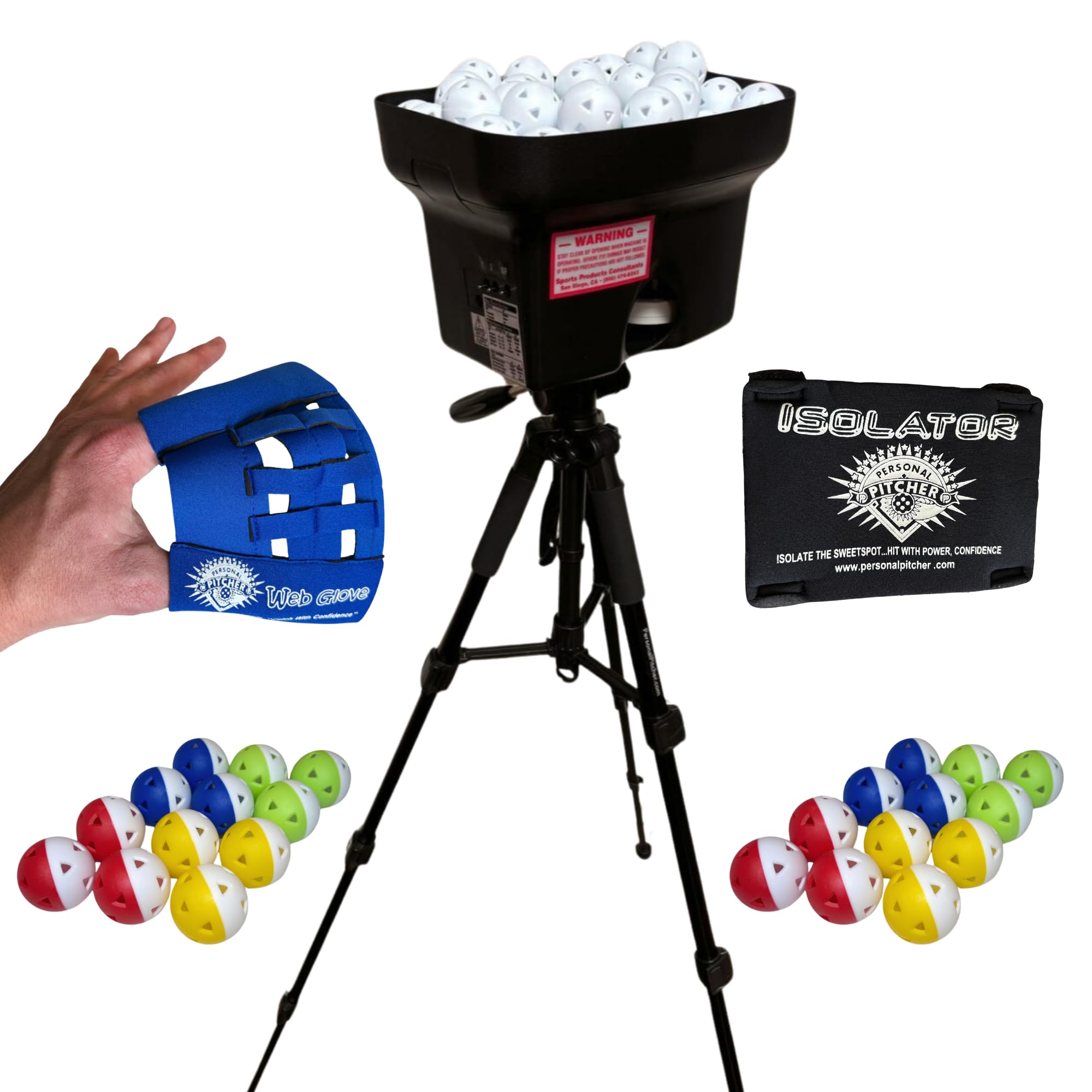
The Personal Pitcher Pro Starter Package is a complete training ecosystem rather than just a pitching machine. The kit includes the Pro machine itself, a collapsible tripod, the WebGlov (a finger-loop catching trainer), the Isolator Pad (a vibration feedback pad that straps to the sweet spot), and two dozen focus balls. The machine runs on a rechargeable battery that holds a charge for several practice sessions, and the total package weight is only 9 pounds — easily the most portable complete system in this guide.
The focus balls are small and vary in speed and location, which trains hand-eye coordination and pitch recognition in a way that full-size ball repetition cannot. The tradeoff is that the small ball size does not replicate the feel of hitting a regulation baseball, so translating those skills to game at-bats requires a separate step. The spinning feeder mechanism occasionally stalls and requires a power cycle, though the company’s customer service is responsive and sends replacement parts quickly when needed.
This package is ideal for a serious young player (10-15 years old) who wants to train independently without a parent or coach feeding balls. The WebGlov and Isolator Pad add defensive and feedback elements that most pitching machine packages completely ignore. If the goal is overall skill development — not just hitting — the Personal Pitcher Pro Starter delivers the most bang for a single purchase.
Why it’s great
- Complete training system with pitching machine, tripod, WebGlov, Isolator Pad, and focus balls
- Rechargeable battery delivers hours of practice without a power outlet
- Ultra-light 9-pound design is easiest to transport and store
Good to know
- Small focus balls do not replicate regulation baseball contact feel
- Feeder mechanism may stall and require power cycling during sessions
- Aiming is finicky; initial adjustment takes time to dial in strike zone
7. Furlihong 691BH
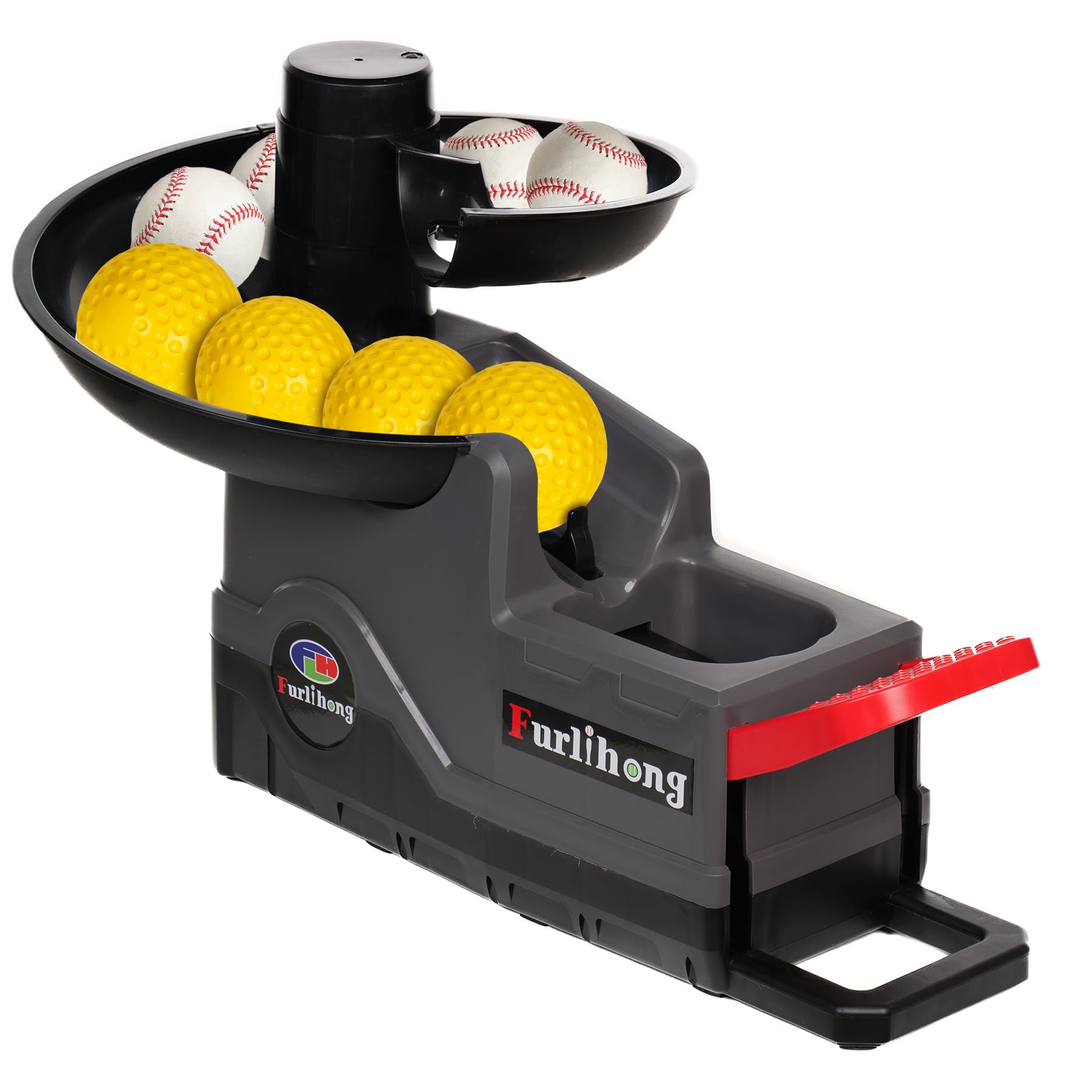
The Furlihong 691BH is a manual foot-operated toss machine that requires no batteries, no electricity, and no extension cords — you simply step on the red pedal and wait about five seconds for the ball to launch. It features four adjustable gears, with levels 1 and 2 optimized for baseball and levels 3 and 4 optimized for softball, making it genuinely useful for families with players in both sports. The package includes two ball chutes, one PU baseball, and one PU softball, so you have everything needed for the first session right out of the box.
The foot-pedal mechanism introduces unavoidable inconsistency. Customer reviews indicate that only about 25% of tosses land in a hittable zone, with the ball varying in height, distance, and direction from one toss to the next. The launch delay varies between three and six seconds depending on how cleanly the pedal engages, and some units have a pedal that sticks or fails to trigger on the first press. For foam balls, the toss height increases significantly (12+ feet), which makes them easier to hit but also highly wind-sensitive outdoors.
This machine works best for very young children (ages 4-7) who are still learning basic hand-eye coordination and just need to see the ball coming from a predictable direction, even if the exact height varies. It is not a serious training tool for competitive players. Assembly is intuitive, the plastic body is lightweight, and the 12-month warranty covers manufacturing defects. At the entry-level price point, it provides a low-commitment introduction to machine-assisted batting practice.
Why it’s great
- No power source needed — works entirely with foot-pedal pressure
- Four adjustable gears serve both baseball and softball practice
- Complete kit includes ball chutes and practice balls for immediate use
Good to know
- Inconsistent launch height, distance, and direction — only ~25% hittable
- Pedal timing varies between 3-6 seconds; pedal may occasionally fail
- Foam balls are wind-sensitive outdoors; best used in sheltered areas
8. IDEATRY Batting Cage with Pitching Machine Hole
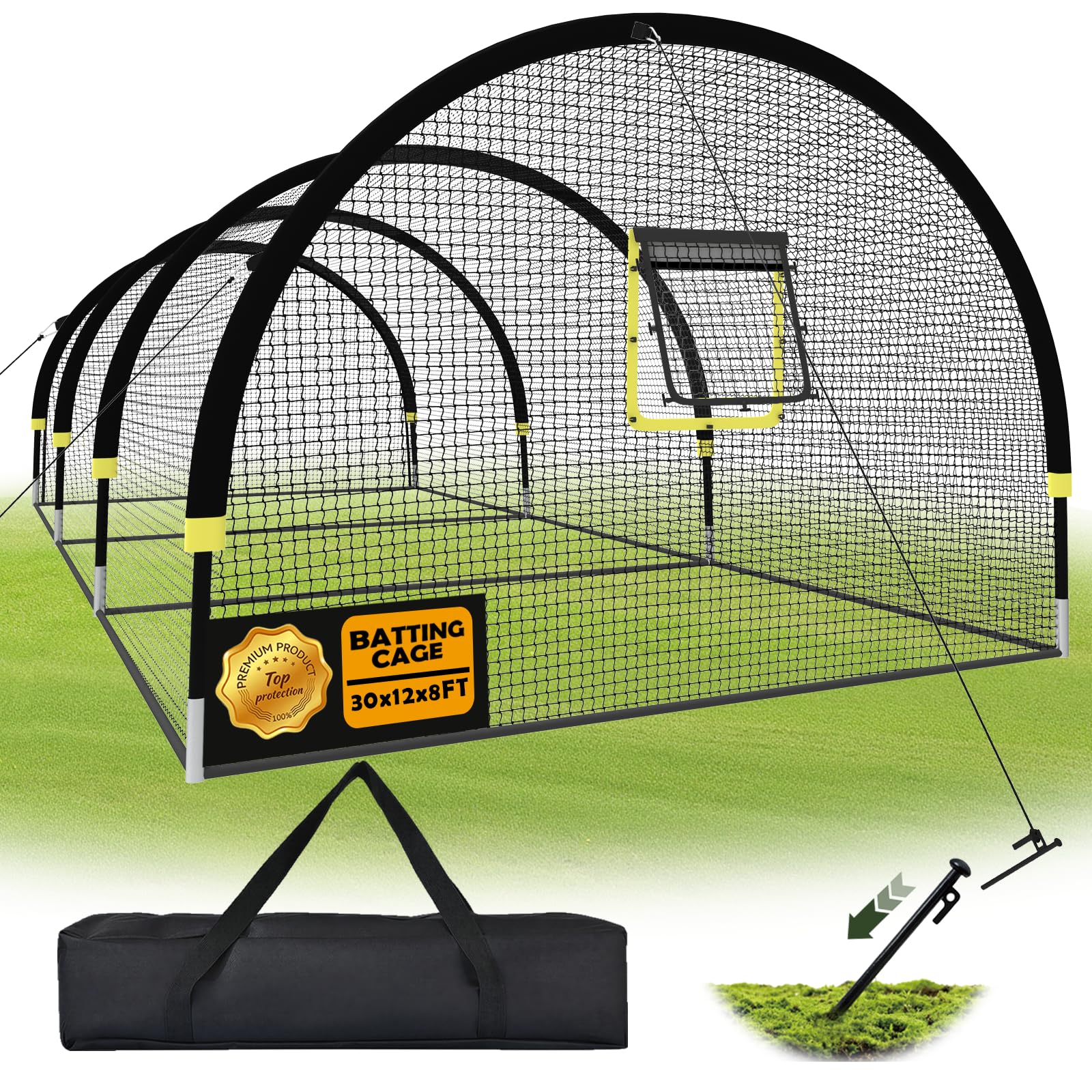
The IDEATRY cage is not a pitching machine, but it solves the second biggest problem after ball delivery: containment. The 22-foot by 12-foot by 8-foot net uses 1.25-inch mesh with four-strand high-density polyethylene that offers double the abrasion resistance of standard cage nets, and a dedicated pitching machine hole in the back lets you feed balls from the machine without cutting or damaging the netting. The 12.7mm fiberglass poles are lightweight for carrying yet stiff enough to hold the cage shape daily.
Setup requires about 30 minutes with step-by-step instructions, though two people are recommended for the pole threading step. The iron stakes replace the usual plastic ones for better ground grip, and the button-closure side panel seals fully to keep balls from escaping toward windows or neighbors. The included spare fiberglass pole is a smart touch — some users have reported the poles snapping after a week of use, particularly if the cage is set up on uneven ground or exposed to strong winds.
This cage pairs naturally with any pitching machine in the affordable range, especially the Heater or Louisvile Slugger models, because the machine hole eliminates the need to feed balls through the net. The carry bag fits everything for trunk storage, making it feasible to set up at the park, school field, or backyard. If you are building a home training station from scratch, start with the cage and add the machine on the same day — the 39-pound total weight means it stays put without additional anchoring.
Why it’s great
- Dedicated pitching machine hole prevents net damage and simplifies ball feeding
- 1.25-inch 4-strand mesh offers twice the abrasion resistance of standard nets
- Iron stakes and button-closure side keep cage secure in wind and on uneven ground
Good to know
- Fiberglass poles can snap after repeated use on uneven terrain
- Setup is easier with two people, especially threading the frame poles
- Return window is short relative to potential long-term durability issues
9. VEVOR Pitching Mound
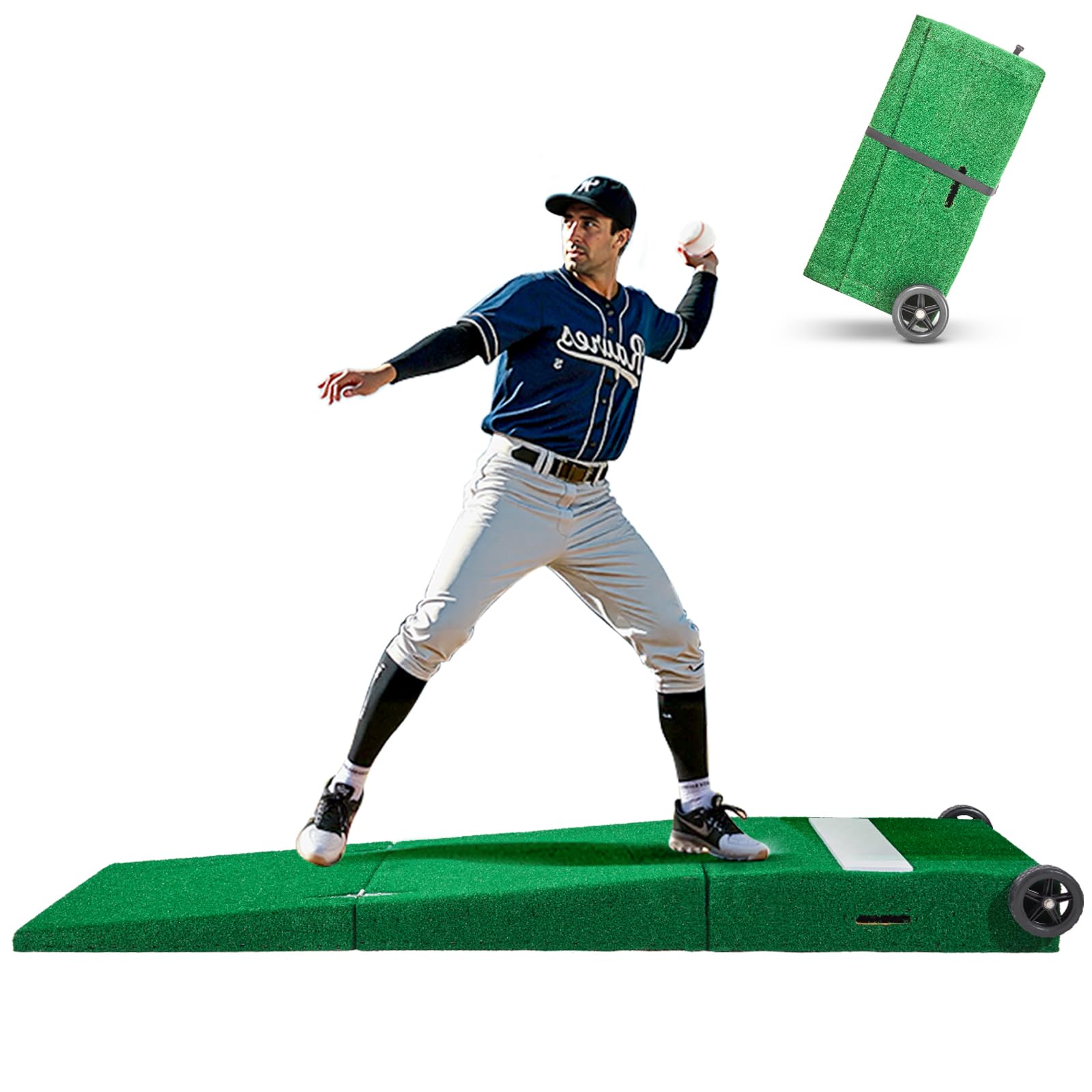
The VEVOR Pitching Mound is a portable training platform designed to replicate the feel of a regulation pitcher’s mound without requiring a dedicated field. The surface uses 10mm PP grass turf for realistic traction, and the 15mm thick wood board is coated with a damp-proof layer to resist rot from ground moisture. The cross-reinforced bottom handles up to 550 pounds, so it supports pitchers of any size during the leg drive and landing phase. Integrated wheels and a handle allow one-person rolling transport.
The folding hinge mechanism lets the mound collapse flat for storage, but some units have developed a turf bubble or separation at the seams after only a few uses. The turf is glued to the wood base, and if moisture seeps in through a seam, the adhesion fails and the surface lifts. This appears to be a batch-specific quality issue rather than a design flaw, but it is worth inspecting the seams immediately upon delivery and contacting VEVOR support if you spot any lifting.
This mound is best paired with any pitching machine that throws real balls — the Power Alley Pro or Blue Flame Pro — because the elevated slope forces the pitcher to adjust stride length and arm angle to the same mechanical constraints they face in a game. For 8- to 14-year-old pitchers transitioning from flat-ground throwing to mound work, this offers a low-cost way to practice mechanics at home without commuting to a facility with a built-in mound.
Why it’s great
- Folding design with integrated wheels for easy transport and storage
- Realistic PP grass turf and wood base mimic regulation mound feel
- Cross-reinforced bottom provides stable footing up to 550 pounds
Good to know
- Turf can bubble or separate at seams after minimal use on damp ground
- 55-pound weight is heavy; requires two people for lifting into a vehicle
- Best suited for pitchers 8-14 years old; experienced players may need a full-size mound
FAQ
Can an affordable pitching machine throw real baseballs without breaking down?
How fast should a pitching machine throw for a 10-year-old player?
Is a foot-operated pitching machine better than a motorized one for a beginner?
Final Thoughts: The Verdict
For most users, the best affordable pitching machine winner is the Heater Sports Slider Lite 360 because it combines curveball training, an automatic feeder, and lite-ball speeds up to 80 MPH at a mid-range price point that makes game-like practice accessible for families and teams. If you need real baseball compatibility for little league readiness, grab the Heater Power Alley Pro. And for the widest multi-ball versatility across baseball and softball, nothing beats the Louisville Slugger Blue Flame Pro.