
Whether it’s caked-on mud on a driveway, mildew creeping up the siding, or a crust of road salt under the car, nothing restores outdoor surfaces faster than a targeted blast of high-pressure water. But the gap between electric units that plug into a household outlet and gas-powered beasts that roar to life with a pull cord is massive — and choosing wrong means either watching your budget model bog down on a tough job or hauling a 55-pound machine you never fully needed.
I’m Min — the co-founder and writer behind Gadgets Feed. I’ve spent hundreds of hours cross-referencing motor specs, flow rates, pump durability, and real-world user reports to separate the genuine value picks from the underpowered disposables in this specific price-sensitive segment.
After analyzing PSI and GPM ratings, cord lengths, warranty terms, and thousands of verified customer reviews, I’ve built this guide to the best affordable pressure washers that actually deliver on their promises without wrecking your budget.
How To Choose The Best Affordable Pressure Washers
Every pressure washer buyer faces the same fork: electric or gas, high-pressure/low-flow or moderate-pressure/high-flow, brand-name warranty or unknown import. For the budget-conscious shopper, the smartest decision starts with understanding two numbers — PSI and GPM — and how they interact to produce actual cleaning power. Here’s what to watch for.
PSI vs GPM — The Cleaning Units (CU) Formula
PSI (pounds per square inch) measures the force of the water jet, while GPM (gallons per minute) measures the volume of water moving through the nozzle. The industry’s shorthand for real cleaning power is Cleaning Units (CU), calculated as PSI multiplied by GPM. An 1800 PSI unit delivering 1.1 GPM produces 1,980 CU, whereas a 1700 PSI unit at 1.2 GPM produces 2,040 CU — meaning the lower-PSI model may actually clean faster. Use CU as your north star, not the big PSI number on the box.
Electric vs Gas — Engine Type Trade-offs
Corded electric units (typically 13-15 amps, 1700-2300 PSI) require zero oil changes, spark plugs, or fuel stabilizer, they start instantly with a trigger pull, and they weigh half as much as comparable gas models. Their limitation is range — you’re tethered to a 35-foot power cord and a garden hose. Gas-powered units (200-3500 PSI range) operate anywhere and deliver higher flow rates (2.3-2.5 GPM), making them essential for stripping paint or cleaning large concrete areas, but they demand regular maintenance and produce noise comparable to a lawnmower. For most suburban homes, a quality electric unit covers 90% of tasks.
Hose Quality and Quick-Connect Compatibility
The hose thickness and material determine how long the unit lasts. Budget units often ship with 20-foot rubberized PVC hoses that kink and retain coil memory, limiting reach and frustrating the user. Premium electric models use 25-foot braided nylon hoses that resist abrasion and lie flat. Also verify the thread standard — M22-14 is the most common aftermarket size, but some brands use proprietary or M22-15 threads, blocking upgrades like foam cannons and surface cleaners. A 1/4-inch universal quick-connect system on the wand and nozzles adds flexibility.
Pump Type and Total Stop System (TSS)
Axial cam pumps are standard on budget and mid-range electric units. They’re compact and inexpensive but less tolerant of running dry or with low inlet water pressure. A Total Stop System (TSS) automatically shuts off the motor when the trigger is released, reducing wear and saving energy — every unit in this guide includes it. For gas models, the pump is typically belt-driven or direct-drive; direct-drive costs less but spins the pump at engine speed, whereas belt-driven lowers the pump RPM for longer life. In the affordable gas segment, expect direct-drive axial pumps, which are adequate for occasional heavy use.
Quick Comparison
On smaller screens, swipe sideways to see the full table.
| Model | Category | Best For | Key Spec | Amazon |
|---|---|---|---|---|
| Westinghouse ePX3100 | Electric | Balanced power & portability | 1900 rated PSI / 1.24 rated GPM | Amazon |
| Westinghouse WPX2300e | Electric | Induction motor longevity | 1900 rated PSI / 1.2 rated GPM | Amazon |
| Greenworks GPW1903A | Electric | Light residential cleaning | 1900 PSI / 1.2 GPM Max | Amazon |
| LawnMaster LT506-2000A | Electric | Value-oriented all-in-one kit | 2300 Max PSI / 1.4 Max GPM | Amazon |
| Ryobi RY141820VNM | Electric | Compact storage | 1800 PSI / 1.2 GPM | Amazon |
| Greenworks 5110202 | Electric | Budget-friendly entry point | 1800 PSI / 1.1 GPM | Amazon |
| Kärcher K1700B | Electric | CETA-certified performance | 1700 PSI / 1.2 GPM | Amazon |
| BILT HARD 3500 PSI | Gas | Heavy-duty concrete cleaning | 3500 PSI / 2.5 GPM | Amazon |
| Mutaomay MTPW01 | Gas | High-flow remote site cleaning | 3500 PSI / 2.3 GPM | Amazon |
In‑Depth Reviews
1. Westinghouse ePX3100

The Westinghouse ePX3100 strikes the rare balance between genuine cleaning power and a form factor that doesn’t dominate the garage. Its 1900 rated PSI and 1.24 rated GPM produce roughly 2,356 Cleaning Units — enough to strip mildew from vinyl siding and caked mud from a brick patio without the water volume overwhelming a standard garden hose. The anti-tipping four-wheel chassis with 360-degree steering is a genuine innovation for a sub- electric unit; it glides over uneven grass without the top-heavy wobble that plagues upright designs.
The included 25-foot nylon braided hose outlasts the rubberized hoses on competitors, and the pro-style steel wand paired with five quick-connect nozzles (0°, 15°, 25°, turbo, soap) covers everything from concentrated concrete etching to gentle car rinsing. The 20-ounce onboard soap tank integrates seamlessly into the body, eliminating the separate detergent bottle that other units require. Users consistently report straightforward assembly under 15 minutes and reliable operation after multiple seasons.
One area where the ePX3100 slips is the pump auto-stop — it works well, but the on-off rocker switch feels flimsy compared to the steel frame. The 35-foot GFCI cord is adequate but not generous; users with deep driveways may need an extension cord rated for 14-gauge or thicker. Still, for the blend of maneuverability, rated pressure, and hose quality, this unit outperforms everything near its price tier.
Why it’s great
- Best-in-class maneuverability with anti-tip wheels and 360° steering
- Braided 25-ft hose resists kinking and coil memory
- Five-nozzle kit covers every residential cleaning scenario
Good to know
- On/off switch feels less durable than the steel frame
- 35-ft cord may require a heavy-duty extension for larger driveways
2. Westinghouse WPX2300e
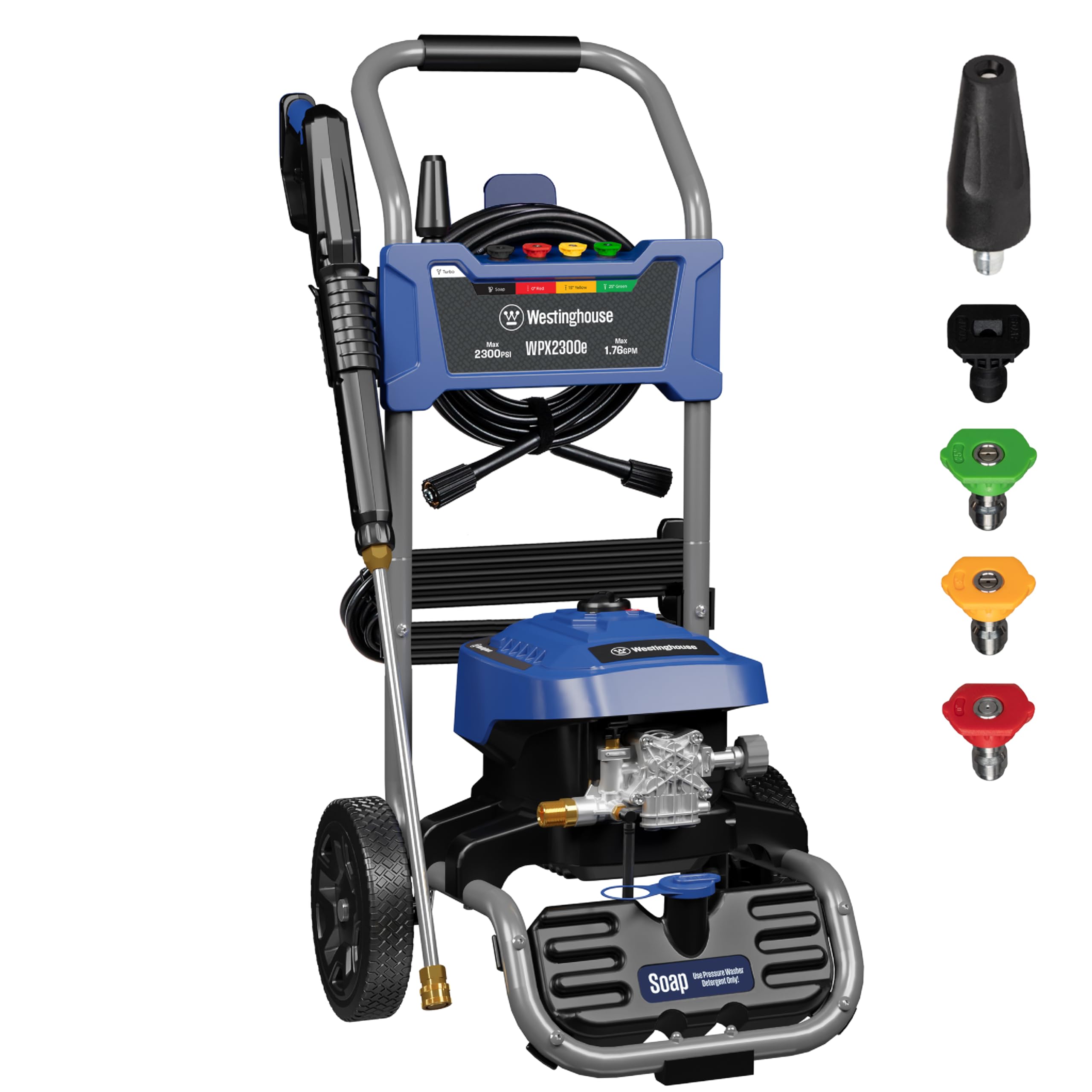
The Westinghouse WPX2300e upgrades from the universal brushed motor found in most affordable electric washers to a heavy-duty AC induction motor — a design choice that typically appears in units costing twice as much. Induction motors run cooler, last longer, and maintain torque under load, which translates to sustained 1900 rated PSI even when the inlet water pressure dips during peak summer hours. The 25-foot abrasion-resistant super-flex hose and lightweight metal spray gun further separate this from the plastic-wand competition.
At 27.5 pounds, this is the heaviest electric unit in the lineup, but the 8-inch never-flat wheels and steel frame make rolling it across gravel or grass nearly effortless. The 0.42-gallon soap tank is slightly more generous than the ePX3100’s, and the five-nozzle set (0°, 15°, 25°, soap, turbo) offers identical versatility. Multiple long-term owners report that the WPX2300e starts on the first trigger pull after winter storage — a reliability cue that the induction motor and axial pump seal well against moisture ingress.
The main drawbacks are the wand’s lack of a positive lock at the connection point — some users report the wand separates during aggressive scrubbing — and the hose’s tendency to retain twists until fully uncoiled. The soap delivery system also lacks a shutoff valve, so detergent flows until the tank empties, which makes the rinse transition messier than on units with a soap cut-off. For buyers who prioritize motor durability above all else, these are acceptable compromises.
Why it’s great
- Induction motor outlasts universal motors in similar-priced electrics
- Large wheels and steel frame handle rough terrain easily
- Onboard hose and cord storage keeps the unit tidy
Good to know
- Wand connection lacks a secure locking mechanism
- No soap shutoff — detergent runs until the tank is empty
3. Greenworks GPW1903A (1900 PSI)

Greenworks’ 1900 PSI model is the direct successor to their wildly popular 1800 PSI unit, and the 100 PSI bump combined with the same 1.2 GPM max flow rate pushes its Cleaning Units from roughly 1,980 to 2,280 — a noticeable improvement when blasting dried mud from a truck bed. The unit weighs 21.4 pounds, making it one of the lighter mid-range electrics, and the 35-foot GFCI power cord provides genuine reach without an extension cord for most two-car driveways.
The included accessory bundle — 25° general-purpose nozzle, 40° gentle nozzle, turbo nozzle, and soap applicator — gives adequate coverage for cars, patio furniture, siding, and decks. The turbo nozzle is especially effective on concrete staining, producing a rotating jet that cuts cleaning time roughly in half compared to the fixed 25° tip. Users consistently note that the unit is quieter than gas alternatives, running at a conversational volume that doesn’t require ear protection for short sessions.
Greenworks backs this unit with a 3-year limited warranty, but the 20-foot tangle-free hose is a weak point — it measures a full five feet shorter than the Westinghouse braided hoses, which forces you to move the machine more frequently when cleaning larger surfaces. The 1/4-inch quick-connect system is universal, so aftermarket hose upgrades are straightforward. For the price, the GPW1903A delivers excellent power density, but serious users should budget for a longer replacement hose.
Why it’s great
- 2,280 CU cleans faster than most 1800 PSI competitors
- Lightweight frame (21.4 lbs) makes overhead work manageable
- Turbo nozzle significantly reduces scrubbing time on concrete
Good to know
- 20-ft hose is short for larger driveways or multi-story siding
- Plastic wand feels less durable than steel alternatives
4. LawnMaster LT506-2000A

The LawnMaster LT506-2000A distinguishes itself not through raw PSI numbers but through the breadth of its accessory bundle. Beyond the standard three-nozzle set and foam bottle, it includes a dedicated hub brush for cleaning car wheels — a niche tool that detailers typically buy separately for -20. The 20-foot high-pressure hose and 35-foot power cord give a combined 55-foot radius, enough to reach around most suburban homes without moving the machine.
With a 13-amp motor delivering up to 2300 max PSI at 1.4 max GPM, the Cleaning Units peak around 3,220 — the highest of any electric unit in this roundup. That raw power translates to real-world effectiveness on moss-covered brick and stained concrete, though users report that sustained use at full pressure triggers the thermal overload protection after about 20 minutes. The CSA certification indicates it meets safety standards for the North American market, and the adjustable wand provides flexibility between high-pressure scrubbing and lower-pressure rinsing.
The most common long-term failure point reported is the hose connection to the machine body, which can separate after repeated use. Several users also note that the advertised 2300 PSI is a max figure rather than a rated figure — real-world output sits closer to 1650-1800 PSI, which is still competitive for the price but falls short of the marketing claim. For buyers who want the most accessories out of the box and don’t mind a lower-duty cycle, the LawnMaster offers unusual completeness.
Why it’s great
- Comes with a hub brush and foam bottle — no extra purchases needed
- Combined 55-ft reach (hose + cord) covers large areas
- Highest max PSI in the electric group (2300 max)
Good to know
- Hose-to-machine connection can fail after repeated use
- Rated pressure is significantly lower than the max PSI claim
5. Ryobi RY141820VNM

Ryobi’s RY141820VNM is the lightest electric pressure washer in this guide at just 16 pounds, and its dimensions (12.5 x 10 x 9 inches) make it the only unit that fits comfortably on a standard garage shelf without disassembly. The 1800 PSI and 1.2 GPM yield 2,160 Cleaning Units — enough for car detailing, patio furniture, and light siding work — but the practical limitation is the trigger handle with M22 connections, which uses a proprietary fitting that blocks the use of universal quick-connect foam cannons and surface cleaners without an adapter.
The 20-foot hose is standard length, but the wand’s straight design lacks the ergonomic curve found on more expensive units, causing wrist fatigue during extended overhead cleaning. Users consistently praise the Ryobi for its whisper-quiet operation — the brushed motor runs at a hum rather than a whine, allowing cleaning conversations without shouting.
CSA certification confirms safety compliance, and the simple trigger mechanism with M22 connections reduces internal leak points. The main complaints center on the foam cannon’s weakness — it produces a thin, watery soap layer rather than the thick foam that detailers prefer — and the turbo nozzle’s pressure drop, which loses about 20% of the rated output. For homeowners with limited storage space who need a capable light-duty unit, the Ryobi’s compactness outweighs its accessory limitations.
Why it’s great
- 16-pound weight is unmatched for portability and overhead use
- Compact footprint fits in small garages and utility closets
- Exceptionally quiet operation — no ear protection needed
Good to know
- M22 connections block some aftermarket accessories without adapters
- Only three nozzles included — fewer than competitors at the same price
6. Greenworks 5110202 (1800 PSI)

The Greenworks 5110202 — the 1800 PSI predecessor to the GPW1903A — remains the baseline for entry-level electric pressure washers. At 1800 PSI and 1.1 GPM, its 1,980 Cleaning Units are the lowest in the electric group, but the real-world performance on car washes, patio furniture, and vinyl fence cleaning is entirely adequate for owners who wash a vehicle twice a month and spot-clean the deck once a season. The 35-foot power cord with integrated GFCI is a genuine safety asset, automatically cutting power if the plug senses moisture ingress.
The unit ships with a 40° nozzle for gentle cleaning, a turbo nozzle for heavy-duty work, a soap applicator, and a 20-foot tangle-free hose. The 1/4-inch universal quick-connect system is standard, allowing easy swapping with aftermarket accessories. Multiple users report running the machine for three continuous hours without tripping the thermal protection — a testament to the axial pump’s heat dissipation. The push-button start eliminates the hassle of priming or choking, and the 3-year warranty provides a safety net at this entry price.
The most persistent issue is the hose’s tendency to retain the coil shape from packaging, which creates a spring-like resistance that tugs the wand during use. The plastic wand and trigger assembly also flex noticeably under full trigger pressure, raising durability questions for users who clean aggressively. For the absolute lowest entry point into electric pressure washing backed by a major brand warranty, the 5110202 is hard to beat — but the 1900 PSI version costs only slightly more and offers a meaningful power increase.
Why it’s great
- Excellent 3-hour continuous run time without overheating
- Integrated GFCI plug adds critical safety protection
- Push-button start is simple and reliable
Good to know
- Hose retains coil memory, creating a pull during use
- Plastic wand and trigger flex under sustained high pressure
7. Kärcher K1700B
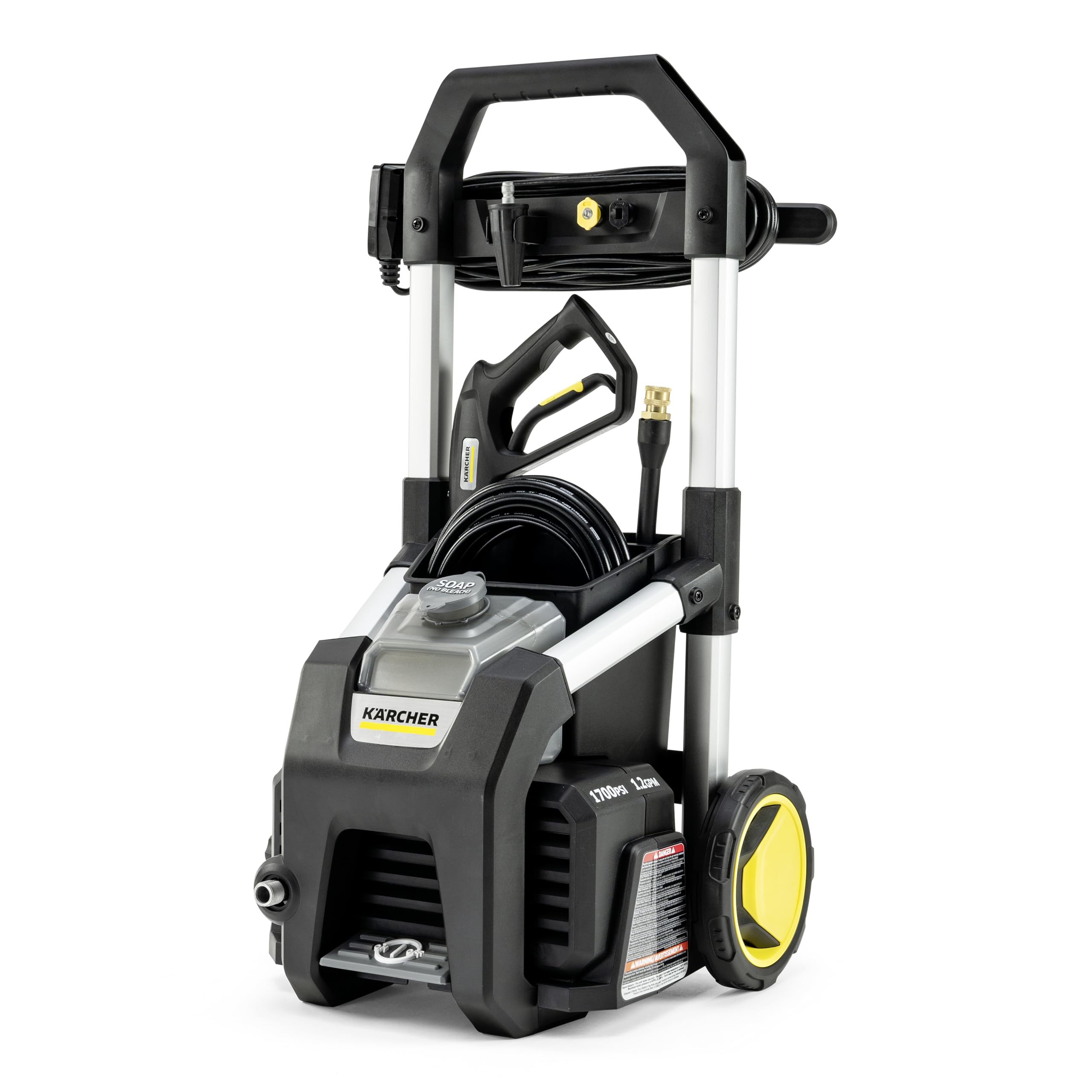
Kärcher’s K1700B carries the industry’s first CETA (Cleaning Equipment Trade Association) certification in this guide, meaning its 1700 PSI and 1.2 GPM ratings were independently verified rather than self-reported. That certification matters because unverified PSI claims in the affordable segment often inflate numbers by 20-30% — the K1700B’s advertised output is provably what you get at the nozzle. The CETA certification also requires the unit to survive a 1,000-cycle durability test, adding confidence that the axial pump won’t fail mid-season.
The 0.5-gallon detergent tank is the largest onboard soap reservoir in the electric group, reducing refill frequency during large deck or fence jobs. The three-nozzle set (15°, turbo, 65°) is unconventional — the 65° wide-angle tip is ideal for soap application and gentle rinsing, while the turbo nozzle spins at roughly 2,000 RPM for aggressive cleaning. The foot switch for on/off operation is a clever back-friendly design that avoids bending down to a body-mounted switch, though it adds a potential failure point if the cord is accidentally severed.
The 19-foot hose is the shortest of any unit in this review — likely a cost-saving measure that forces closer machine placement. Aftermarket accessory compatibility is limited by the M22-14 thread size (standard) but the specific fitting depth may require washers or adapters for some foam cannons. Users have reported a slight inlet water leak that is resolved with Teflon tape on the hose connection threads. For buyers who trust verified ratings over marketing numbers and want Kärcher’s dealer support network, the K1700B offers credible performance.
Why it’s great
- CETA certification guarantees advertised PSI and GPM are accurate
- 0.5-gallon detergent tank is the largest in the electric group
- Foot switch enables ergonomic operation without bending
Good to know
- 19-ft hose is the shortest in this guide — limits reach
- Nozzle storage is limited to three tips only
8. BILT HARD 3500 PSI Gas
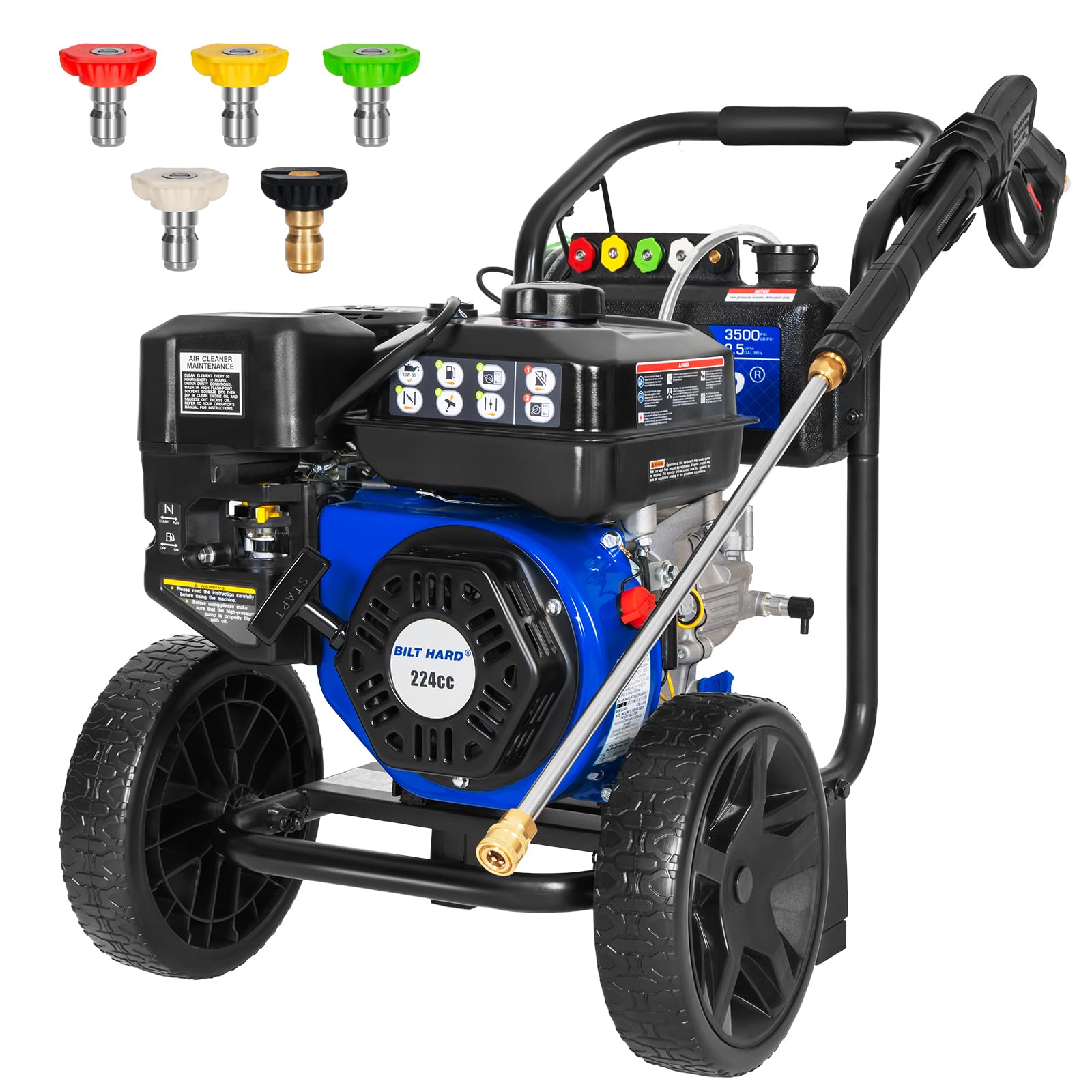
The BILT HARD 3500 PSI gas pressure washer enters the affordable segment with a 224cc 4-stroke OHV engine and a direct-drive axial cam pump that produces 3,500 PSI at 2.5 GPM — delivering 8,750 Cleaning Units, more than quadruple the output of a typical electric unit. This level of hydraulic horsepower strips heavy paint, blasts through moss-covered concrete, and cleans a 1,500-square-foot driveway in roughly 15 minutes. The 0.9-gallon fuel tank provides about 45 minutes of continuous run time at full throttle.
The steel braided 25-foot pressure hose resists kinking and abrasion far better than the rubberized hoses on lower-priced gas units, and the 10-inch never-flat wheels roll easily across gravel, grass, and uneven terrain without pneumatic tire maintenance. The five quick-connect nozzles (0°, 15°, 25°, 40°, soap) span the full residential cleaning spectrum, and the 1-gallon onboard soap tank is adequate for applying detergent to the entire house before rinsing. Users consistently report first-pull starts after the initial break-in period, once the carburetor is properly adjusted using the included tool kit.
The main concern across owner reviews is the on/off switch — a small percentage of units arrive with a flimsy toggle that fails to reliably kill the engine, requiring the user to pinch the fuel line or pull the spark plug cap. The wand uses a push-in locking mechanism rather than a true quick-connect, making nozzle changes slightly slower than expected. At 55 pounds with a wet tank, it’s not a machine you haul up stairs without serious effort. For homeowners with large concrete areas, heavy paint stripping, or fence cleaning, the BILT HARD offers gas-grade power at a price that undercuts premium gas brands by a wide margin.
Why it’s great
- 8,750 CU strips paint and heavy moss faster than any electric
- Steel braided 25-ft hose resists kinking and abrasion
- 10-in never-flat wheels provide stable gravel mobility
Good to know
- On/off switch can be unreliable — some units need a bypass
- Wand uses push-in latching instead of true quick-connect
9. Mutaomay MTPW01
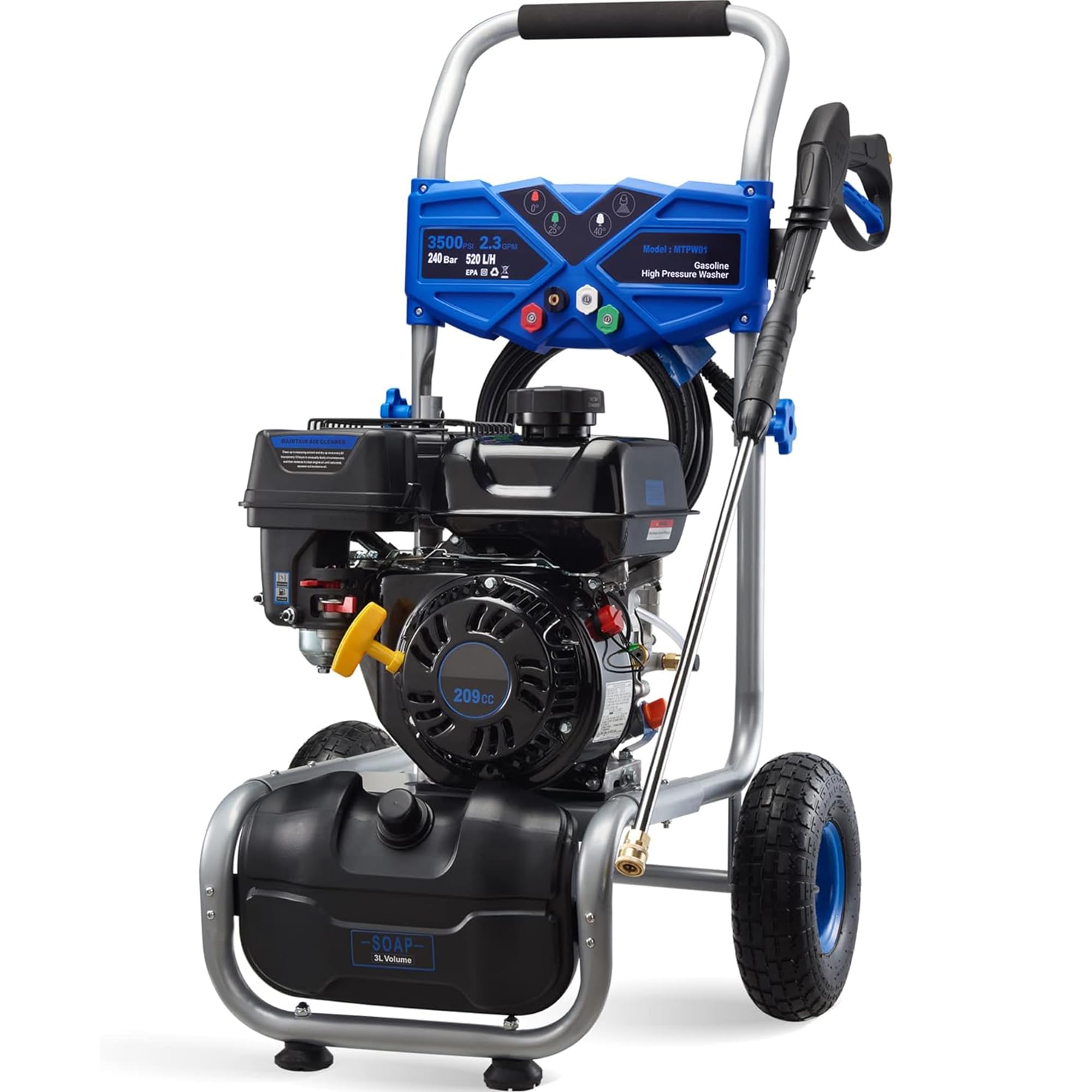
The Mutaomay MTPW01 pairs a 209cc 7HP 4-stroke OHV engine with a 2.3 GPM axial pump, producing 8,050 Cleaning Units — slightly below the BILT HARD’s 8,750 CU, but still more than triple any electric unit in this guide. The 25-foot hose, 10-inch pneumatic tires, and steel frame create a mobile platform that works on job sites without any power outlet. The CARB compliance certification means it can be sold in all 50 states, including California’s strict emissions standards.
The four-nozzle set (0°, 25°, 40°, soap) is one nozzle short of the BILT HARD’s five-tip kit, but the coverage spans the same essential use cases. The 0° nozzle produces a razor-thin jet that can etch concrete if held too close — only use it on paint stripping or heavy rust. The 25° nozzle is the workhorse for most cleaning tasks, providing a good balance of impact and surface coverage. Owners consistently report first-pull starts after adding SAE 10W-30 oil and 87+ octane gasoline, and the integrated recoil start operates smoothly even in cold weather.
At 55 pounds wet, maneuverability is limited to rolling the unit over flat or gently graded surfaces — carrying it up stairs requires two people. The fuel tank has only a 0.2-gallon capacity, which delivers roughly 20 minutes of continuous operation before refueling, so larger jobs require planned fuel stops. Some users mention a slight fuel odor from the factory-tested engine, which dissipates after the first tank of fuel. For buyers who prioritize portability and CARB compliance over raw fuel capacity, the Mutaomay is a solid entry into gas-powered cleaning.
Why it’s great
- 8,050 CU delivers gas-grade cleaning power for large concrete areas
- CARB-compliant — legal in all 50 states including California
- Pneumatic 10-in tires provide smooth rolling on uneven terrain
Good to know
- Small 0.2-gal fuel tank needs refilling every 20 minutes
- 55-pound wet weight is challenging to move up stairs
FAQ
Should I buy an electric or gas pressure washer for home use?
How do I clean a pressure washer pump that sat dry over winter?
What does PWMA or CETA certification mean for an affordable pressure washer?
Final Thoughts: The Verdict
For most users, the best affordable pressure washers winner is the Westinghouse ePX3100 because it combines genuinely certified 1900 rated PSI with anti-tip maneuverability, a braided hose, and a five-nozzle kit at a price that undercuts competitors with fewer features. If you want induction motor longevity and large-wheel stability over rough terrain, grab the Westinghouse WPX2300e. And for heavy-duty concrete cleaning that no electric unit can match, nothing beats the BILT HARD 3500 PSI gas washer for raw cleaning unit output.