
Stepping up from a smartphone or a basic point-and-shoot to a serious interchangeable-lens camera is the single biggest leap in image quality you can make. But the professional-grade camera market is a minefield of marketing jargon, with sensor sizes, lens mounts, and video codecs that can overwhelm anyone who just wants a reliable tool for sharp photos and clean 4K video. The real challenge isn’t finding a camera that *can* shoot in raw or record 4K — it’s finding one that delivers professional-level results without forcing you to remortgage your home or endure a frustrating learning curve.
I’m Min — the co-founder and writer behind Gadgets Feed. I’ve spent countless hours dissecting the technical specifications, real-world performance data, and user feedback on the current crop of cameras to isolate the ones that truly over-deliver for their asking price. My analysis focuses on the measurable specs that actually matter: sensor readout speed, autofocus point coverage, bit depth for video, and dynamic range — not just megapixel counts.
Whether you’re a budding portrait artist, a wedding shooter, or a content creator who needs reliable autofocus and robust codecs, this guide cuts through the noise to pinpoint the best affordable professional camera for your specific needs and budget.
How To Choose The Best Affordable Professional Camera
Selecting the right tool among the many capable bodies requires you to prioritize the features that directly impact your intended output. A wedding photographer needs different things than a YouTube vlogger or a nature shooter. Here are the three most critical differentiators in this category.
Sensor Size: APS-C vs. Full-Frame
The sensor is the heart of the camera. A Full-Frame sensor has roughly 1.6x the surface area of an APS-C sensor. This translates directly into better light gathering, which means lower noise at high ISO settings and shallower depth of field for that creamy background blur (bokeh). APS-C cameras are smaller, cheaper, and their lenses are generally more budget-friendly. For the best image quality under challenging light, Full-Frame wins. For the best value and portability, APS-C is often the smarter choice.
Autofocus Intelligence and Coverage
Autofocus speed is table stakes. The differentiator is *intelligence* — how well the camera tracks a subject across the frame. Phase-detection autofocus (PDAF) is faster and more reliable for moving subjects than contrast-detection (CDAF). Look for high point coverage (ideally above 80% of the frame) and real-time tracking algorithms for eyes and faces. A camera with 90% frame coverage and AI-based subject recognition will get sharp shots you’d miss with a 9-point system.
Video Capabilities and Codec Depth
If video is part of your workflow, you need more than just “records 4K.” Check if the 4K is oversampled from a higher resolution for maximum detail. Look for 10-bit internal recording, which gives you immense color grading latitude (think 64 times more color information than 8-bit). Features like log profiles (V-Log, S-Log) and 4:2:2 chroma subsampling are professional staples. Finally, check for record time limits — some budget models cap out at 30 minutes due to heat concerns.
Quick Comparison
On smaller screens, swipe sideways to see the full table.
| Model | Category | Best For | Key Spec | Amazon |
|---|---|---|---|---|
| Canon EOS R50 | Mirrorless | Content Creators & Vloggers | Oversampled 4K / 99 AF Points | Amazon |
| Canon EOS RP + 24-105mm | Full-Frame Mirrorless | Entry-Level Full-Frame Shooters | Full-Frame Sensor / 14-Bit RAW | Amazon |
| Panasonic LUMIX G100 | Mirrorless (MFT) | Compact Vlogging & Audio | 360° Audio Tracking / 5-Axis IS | Amazon |
| Canon T7 Rebel Bundle | DSLR (APS-C) | Budget Beginners | 24.1MP APS-C / 3.0 fps Burst | Amazon |
| Nikon D7500 + 18-140mm | DSLR (APS-C) | All-Round Wildlife & Action | 51-Point AF / 8 fps Burst | Amazon |
| Nikon Z50 II Kit | Mirrorless (APS-C) | Hybrid Shooters | 2-Lens Kit / 231 AF Points | Amazon |
| Sony Alpha 6700 | Mirrorless (APS-C) | Hybrid Photo & 4K Video | 6K Oversampled 4K / 759 AF Pts | Amazon |
| Sony a7 III + 28-70mm | Full-Frame Mirrorless | Versatile Low-Light Performance | 24.2MP Full-Frame / 693 AF Pts | Amazon |
| Panasonic LUMIX S5IIX + Lenses | Full-Frame Mirrorless | Professional Video & Streaming | 5.8K ProRes / Unlimited Recording | Amazon |
| Canon EOS R5 (Body) | Full-Frame Mirrorless | High-Resolution Stills & 8K Video | 45MP Sensor / 12 fps (Mech) | Amazon |
| Leica Q3 (Black) | Compact Full-Frame | Premium Street & Travel | 60MP w/ Triple Resolution | Amazon |
In‑Depth Reviews
1. Canon EOS R50 Mirrorless Camera Kit – 18-45mm Lens
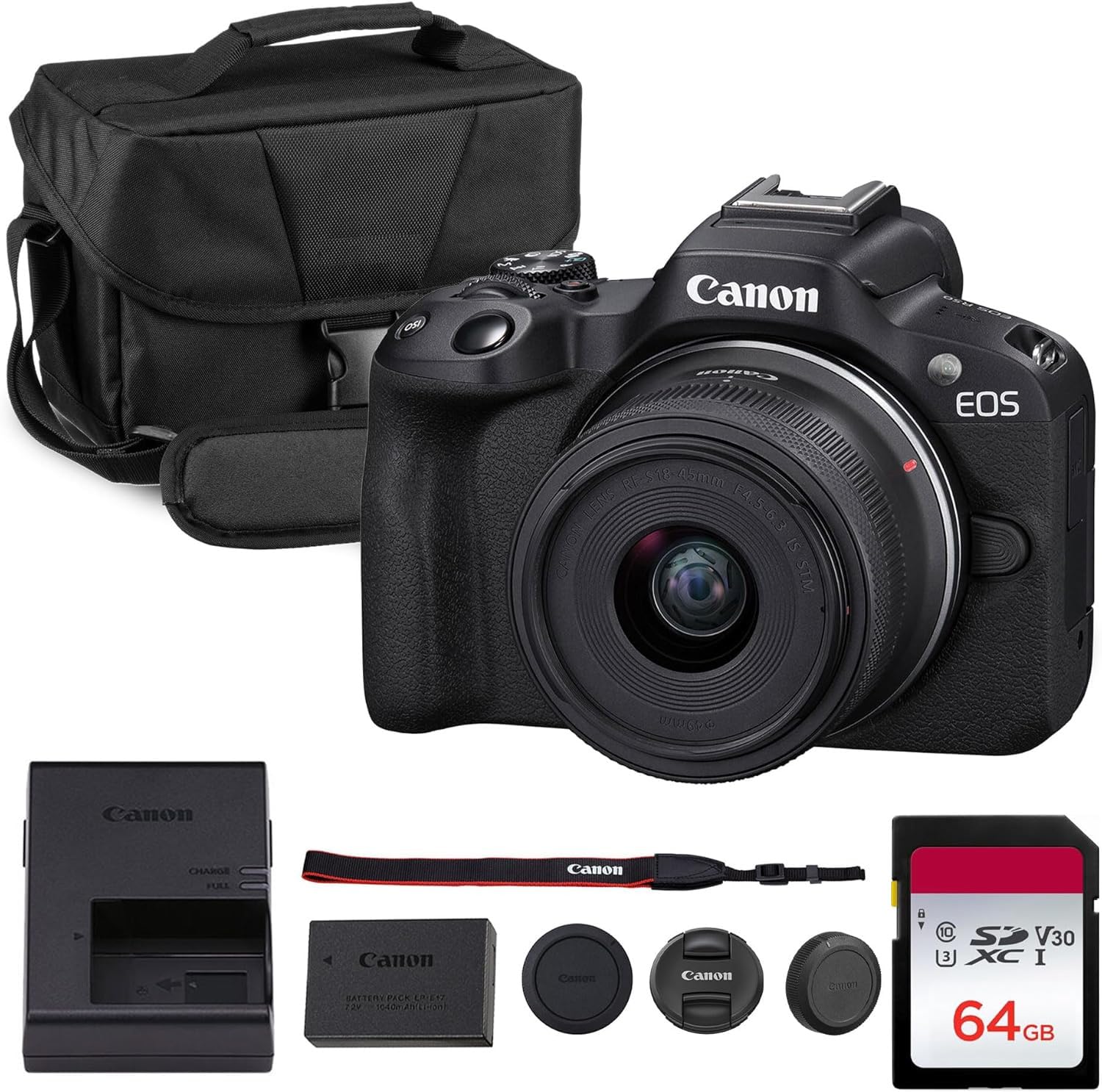
Canon’s EOS R50 hits a precision sweet spot for creators stepping into the RF mount ecosystem. It uses an APS-C sensor to deliver oversampled 4K video that is visibly sharper than the 1080p upscales you get from older budget models. The Dual Pixel CMOS AF II system, with its 99 phase-detection points, locks onto faces and subjects with a tenacity that makes it feel far more expensive than it is.
This is a camera built for vertical video, in-camera Creative Assist guides, and wireless transfers to a smartphone — which means less time editing and more time posting. The kit lens, the RF-S 18-45mm, is a compact pancake zoom that makes the whole package small enough to slide into a day bag without sacrifice. For vlogging and casual content creation, this is a near-ideal entry point.
What holds it back from being a true professional workhorse is the lack of in-body image stabilization (IBIS) and a weather-sealed body. You’ll rely on the lens stabilization, which is fine for static shots but less forgiving for handheld walking video. The plastic build also tells you where the corners were cut, but the core imaging and autofocus hardware are genuinely pro-level.
Why it’s great
- Oversampled 4K video outshines competitors in this tier
- Lightweight and intuitive for new creators
- Canon’s face/eye tracking is excellent for vloggers
Good to know
- No in-body image stabilization
- No weather sealing for outdoor shooting
- Kit lens is slow at the telephoto end (f/6.3)
2. Canon EOS RP Full-Frame + 24-105mm F4-7.1 IS STM

The Canon EOS RP was a revelation when it launched for making Full-Frame accessible. It still is. The 26.2MP sensor delivers the shallow depth of field and high-ISO cleanliness that APS-C cameras simply can’t achieve at this price. The image quality, especially for portraits and low-light landscapes, is stunningly good, with 14-bit RAW files that provide enough latitude for serious Lightroom work.
Paired with the RF 24-105mm F4-7.1 IS STM, you get a versatile zoom range equivalent to a classic 24-105mm standard zoom, complete with optical stabilization that works well for handheld video. The camera body itself is remarkably small and light for a full-frame, making it a travel-friendly partner. The vari-angle touchscreen and clean HDMI output mean you can also use it as a very high-quality webcam.
The video side is where the compromises live. 4K recording has a 1.6x crop factor, which negates the wide-angle advantage of the full-frame sensor. The 30-minute record limit and the slower F7.1 aperture at the telephoto end are also limiting for serious video work. If your primary focus is still photography, however, this is an incredible deal.
Why it’s great
- Entry-level price for a true Full-Frame sensor
- Excellent high-ISO and shallow DOF performance
- Compact and lightweight body
Good to know
- 4K video has a heavy 1.6x crop factor
- Kit lens is slow (F7.1 at 105mm)
- Single card slot and basic burst rate (5 fps)
3. Panasonic LUMIX G100 4K Mirrorless + 12-32mm Lens

The LUMIX G100 is a niche-smashing camera built not just for good video, but for *good audio*. Its built-in microphone with 360-degree tracking auto-adjusts directionality based on where the subject is, a feature normally reserved for much pricier content-creation rigs. The Micro Four Thirds sensor gives you access to the broadest lens ecosystem in mirrorless, all in a body that is incredibly compact and easy to handle one-handed.
Panasonic’s 5-Axis Hybrid I.S. is legendary, and the G100 benefits from it, providing blur-free hand-held shots even when walking. The camera includes OZO Audio for spatial sound, and the Intelligent Auto mode handles exposure so well that you can hand this to a family member and get professional-looking results without instruction. The viewfinder is also far better than what you typically find at this price point.
The Micro Four Thirds sensor does mean you’ll have more noise in low light compared to APS-C or Full-Frame rivals. And while the video is 4K, the recording time is limited (the sensor can overheat after around 30 minutes of continuous 4K capture). This is not a wedding or event camera; it is a brilliant, focused tool for content creators who prioritize audio and portability above all else.
Why it’s great
- Unique 360-degree tracking microphone solves the audio problem
- Very compact and lightweight with the kit lens
- Excellent image stabilization for handheld work
Good to know
- Smaller MFT sensor means noisier images in low light
- 4K recording is limited to about 30 minutes
- Battery life is average for a mirrorless of this size
4. Canon T7 EOS Rebel DSLR Bundle – 18-55mm & 75-300mm
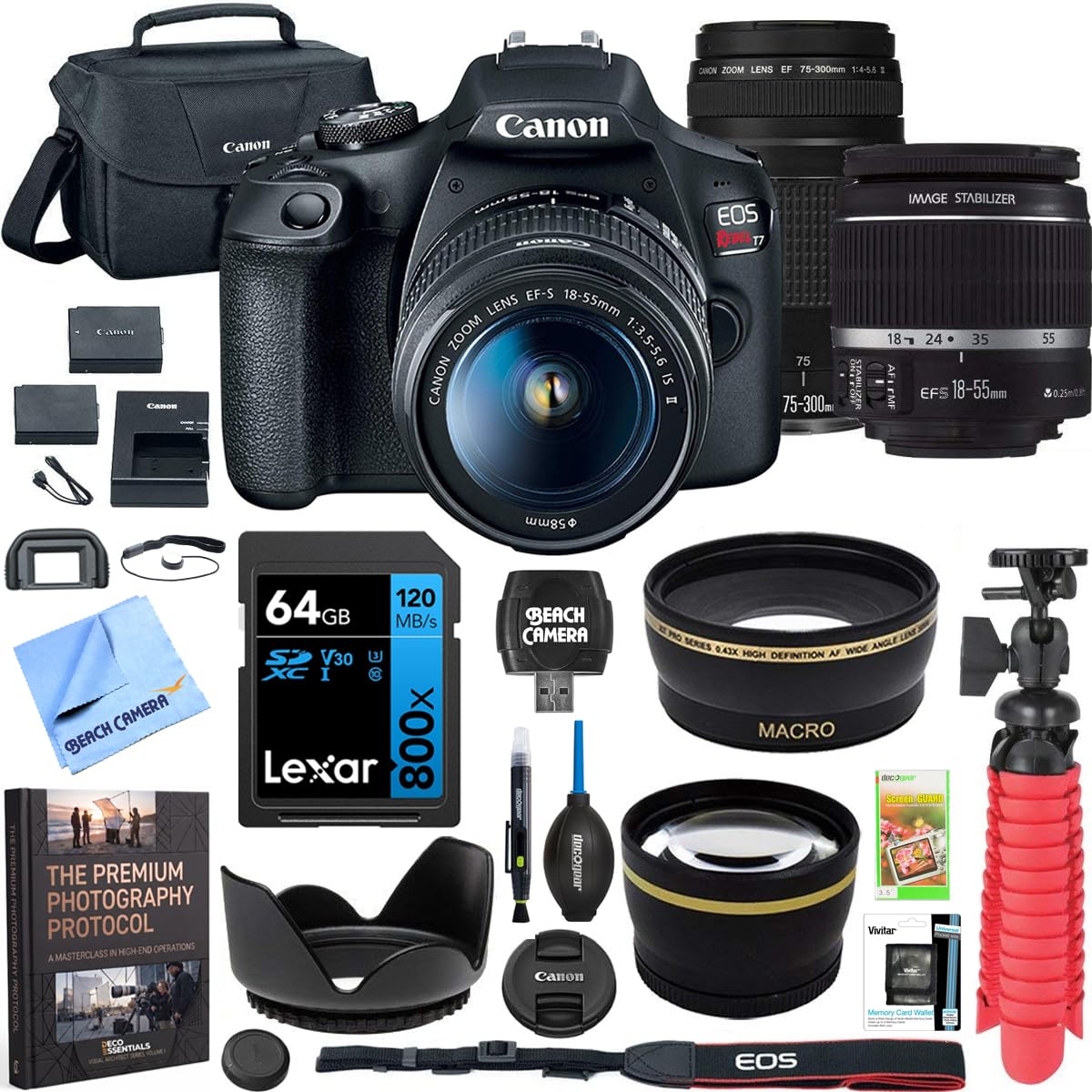
The Canon T7 Rebel is the quintessential entry-level DSLR, and this bundle takes it to the logical extreme. You get the 24.1MP APS-C camera with two lenses (the standard 18-55mm and a telephoto 75-300mm), a tripod, a bag, a cleaning kit, extra batteries, and a 64GB memory card. For someone who has never owned a camera and wants everything in one box, this eliminates decision fatigue entirely.
The T7’s 9-point autofocus system is simple and effective for single-point shooting, and the optical viewfinder provides a real-time, lag-free view of your subject. The 3 fps burst rate is slow by modern standards but sufficient for portraits and landscapes. The real value here is the education: having both a wide-angle and a telephoto lens teaches you about focal lengths without buying separate glass.
The hard truth is that this camera is a 2018 design. The DIGIC 4+ processor struggles with noise above ISO 1600, the 1080p video is not oversampled, and the continuous shooting rate is anemic. This is a fantastic learning tool and a great way to enter the Canon EF-S lens system, but its professional ceiling is low. The battery life from the included batteries also has mixed user feedback, so treat them as backups.
Why it’s great
- Complete kit for beginners — includes two lenses and many accessories
- Excellent image quality for the price when light is good
- Simple, classic DSLR operation with optical viewfinder
Good to know
- Very slow burst rate (3 fps) and basic 9-point AF
- No 4K video; 1080p is soft
- Dated processor leads to noise at higher ISOs
5. Nikon D7500 DSLR + AF-S DX 18-140mm VR

Nikon’s D7500 is a pro-sports camera in a consumer frame. It borrows the 20.9MP sensor and EXPEED 5 image processor from the flagship D500, delivering class-leading ISO performance and dynamic range. The 51-point AF system, with 15 cross-type sensors, is fast and accurate for tracking moving subjects, and the 8 fps continuous shooting speed is excellent for fast-paced action like sports or wildlife.
The included AF-S DX 18-140mm VR lens is the ideal travel companion — its 7.8x zoom range covers everything from group shots to compressed telephoto landscapes, and the Vibration Reduction (VR) helps stabilize handheld shots. The weather-sealed body and large, bright optical viewfinder make it a comfortable tool for shooting in less-than-ideal conditions. Battery life is also a standout feature, easily lasting a full day of heavy shooting.
The major compromise is the single SD card slot, which is a disappointment for professional event photographers who need instant backup. The tilting screen is fixed and not a vari-angle touchscreen, which can be awkward for video or overhead shots. While the 4K video is solid, its autofocus during video is contrast-detect and can hunt, making it much weaker for video compared to modern mirrorless rivals.
Why it’s great
- Excellent autofocus tracking and high burst rate (8 fps)
- Superb low-light performance for an APS-C DSLR
- Fantastic battery life; weather-sealed body
Good to know
- Single SD card slot is a risk for professional use
- Video autofocus is not phase-detect, can be slow
- No vari-angle screen for flexible shooting angles
6. Nikon Z50 II with Two Lenses Kit

The Nikon Z50 II is a beautifully executed modern mirrorless camera that bridges the gap between smartphone simplicity and professional control. Its 20.9MP DX-format sensor offers lifelike colors and terrific detail that is several steps beyond any phone. The standout feature is the dedicated Picture Control button which gives you instant access to 31 in-camera presets, allowing you to nail the look in-camera and reduce post-processing time.
This two-lens kit is a powerhouse for travel. The NIKKOR Z DX 16-50mm covers wide to standard views, and the 50-250mm gives you real telephoto reach for wildlife or compression. The autofocus system is capable of detecting and tracking 9 subject types (including birds and airplanes) with impressive accuracy, making it a great tool for action shooting. The built-in electronic VR and 4K/60p video are a boon for hybrid shooters.
Control-wise, the Z50 II is a step up from the entry-level, but its menu system has a learning curve. The battery life is adequate but will require a spare for a full-day shoot. The lack of in-body stabilization means you are dependent on the lens VR, which works well for the kit lenses but limits options with non-VR Z glass. For the user who wants a versatile kit that looks great out of the box, this is a top contender.
Why it’s great
- 31 in-camera color presets save editing time
- Two-lens kit covers 16-250mm, ideal for travel
- Excellent autofocus with 9 subject detection types
Good to know
- No in-body image stabilization; relies on lens VR
- Menu system is complex for new users
- Battery life is average for a mirrorless camera
7. Sony Alpha 6700 – APS-C Interchangeable Lens Camera

The Sony Alpha 6700 is arguably the most technically capable APS-C camera for hybrid shooters right now. Its 26MP Exmor R sensor, paired with the BIONZ XR processor, delivers images with outstanding dynamic range and color depth. The dedicated AI processor enhances subject tracking to a level that borders on magic — it can hold a moving bird, a car, or a person’s eye with unwavering confidence.
Video is where the a6700 shines brightest. It records 4K/60p oversampled from a 6K readout, giving you incredibly detailed footage. It also offers 4K/120p for slow motion. Internal 10-bit 4:2:2 recording with S-Log3 provides massive color grading flexibility. The compact body contains these pro video features without overheating, making it a viable B-cam for professional productions.
The quirks are classic Sony ergonomics. The menu system is confusing, though improved over older models, and the small form factor means the grip is tight for larger hands. The rolling shutter in 4K/120p is noticeable, and the in-body stabilization is decent, but not gimbal-replacing. For those willing to learn its menu, the a6700 offers a pro-level toolkit in an incredibly portable package.
Why it’s great
- Outstanding 4K/60p video oversampled from 6K
- AI-powered subject tracking is incredibly reliable
- 10-bit 4:2:2 internal recording with S-Log3
Good to know
- Sony menu system remains complex and illogical
- Small body can feel cramped for larger hands
- Noticeable rolling shutter in high frame rate modes
8. Sony a7 III Full-Frame Mirrorless + 28-70mm Lens

The Sony a7 III is a legendary milestone that, years after its launch, remains a seriously competitive camera. Its 24.2MP back-illuminated Full-Frame sensor offers 15 stops of dynamic range, meaning you can recover incredible amounts of detail from shadows and highlights in post-production. The 693 phase-detection AF points cover 93% of the image area, and the eye-tracking in both photo and video is fast and accurate.
This camera excels in low light. Its ISO range of 100-51,200 (expandable to 204,800) delivers usable images in conditions that would leave many cameras unusable. The battery life is extraordinary for a mirrorless, often lasting over 700 shots per charge. The included 28-70mm kit lens is decent for starting, but the true strength of the a7 III is in adapting to a massive library of premium E-mount lenses.
The a7 III shows its age in the video department. Its 4K does not oversample (it uses pixel binning), resulting in softer footage than newer rivals. The 8-bit internal codec limits color grading, and the screen is a low-resolution, fixed LCD. The menu system is also notoriously deep and confusing. If you are a photographer who needs high-quality stills in a Full-Frame body, this is an outstanding deal.
Why it’s great
- Best-in-class dynamic range (15 stops) for its price
- Excellent battery life for a mirrorless camera
- Reliable and fast subject tracking with 693 AF points
Good to know
- 4K video is pixel-binned, not oversampled
- 8-bit internal video codec lacks grading depth
- Fixed LCD screen and complex menu system
9. Panasonic LUMIX S5IIX Full Frame + 20-60mm & 50mm
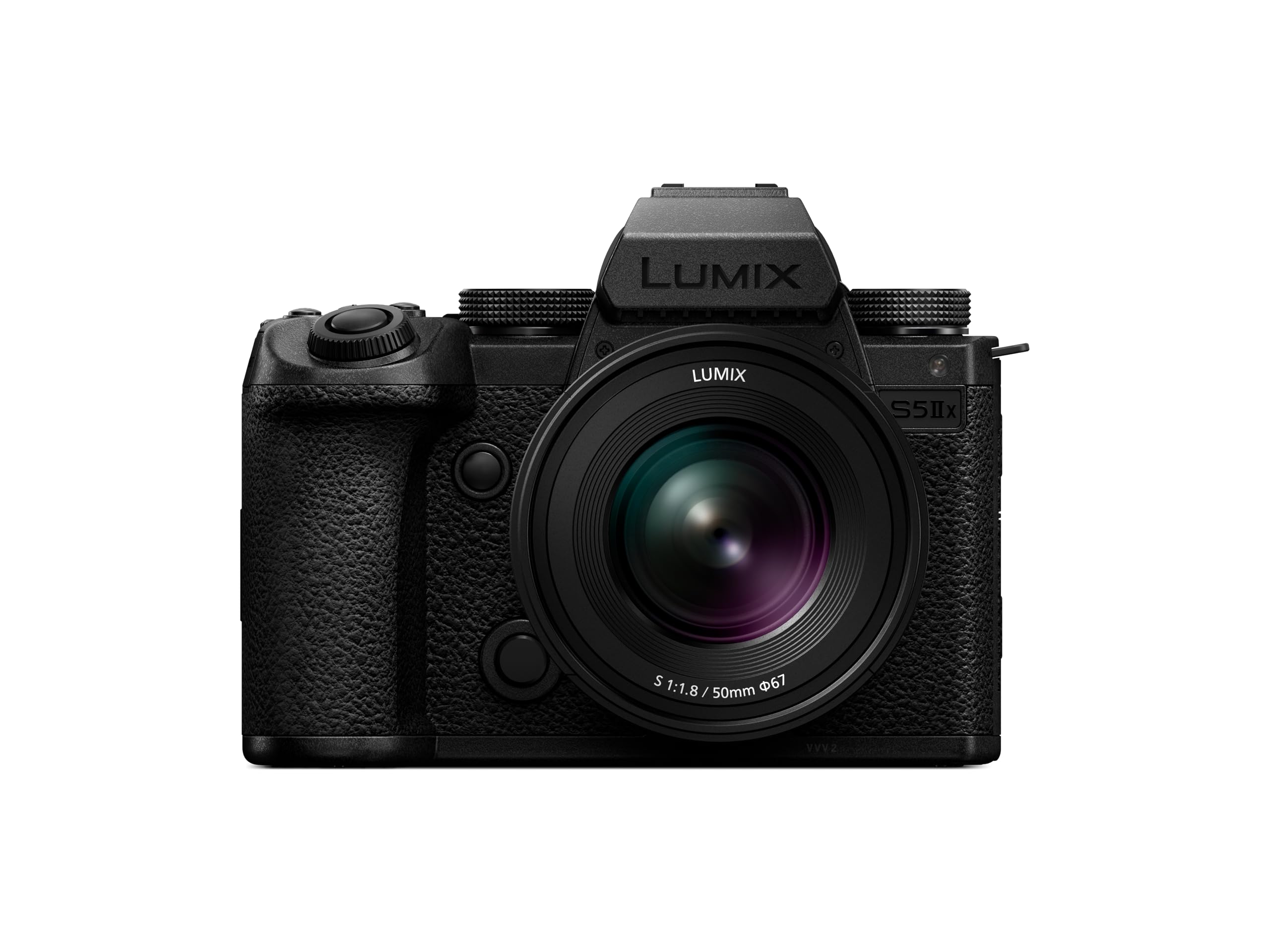
The Panasonic LUMIX S5IIX is a Full-Frame video powerhouse that finally solves the brand’s biggest weakness by adding Phase Hybrid Autofocus. It comes with two outstanding lenses: the versatile 20-60mm zoom and the fast 50mm F1.8 prime. The camera is built around unlimited recording thanks to a built-in fan and heat sink, a godsend for interviewers, live streamers, and long-form content creators.
Video specifications are staggering for the price. It records internal 5.8K ProRes, 6K open-gate, and 4K 60p in 10-bit 4:2:2. It also features a 14+ stop V-Log/V-Gamut profile, which is essentially Panasonic’s cinema camera curve, giving you immense color grading latitude. The camera also supports wired/wireless IP streaming, making it a true studio-in-a-box. The 24.2MP sensor also delivers excellent still photos.
The biggest compromise is the L-Mount lens ecosystem, which is smaller and less readily available than Sony E or Canon RF. The camera body is also one of the larger and heavier in this guide, which may be a consideration for travel. Some users also reported receiving units with signs of prior use, so buying from a reliable source is strongly advised. For video-first shooters, this is the most feature-dense camera on this list.
Why it’s great
- Internal 5.8K ProRes and 6K open-gate video recording
- Unlimited recording with active cooling system
- Phase Hybrid AF finally delivers reliable autofocus
Good to know
- L-Mount lens selection is smaller than competitors
- Larger and heavier body than most mirrorless rivals
- Some users report receiving units with light use
10. Canon EOS R5 Mirrorless Camera (Body Only)

The Canon EOS R5 is a watershed camera that combines a massive 45-megapixel Full-Frame stacked CMOS sensor with the ability to record internal 8K RAW video. For stills, this camera is a revelation. The detail is extraordinary, the dynamic range is wide, and the Dual Pixel CMOS AF II with Eye Control AF (selecting focus points by looking) is a quantum leap in photographic responsiveness.
High-speed shooting is also exceptional, with up to 12 fps mechanical and 20 fps electronic shutter. The in-body image stabilization (IBIS) is Canon’s best, providing up to 8 stops of shake correction, allowing handheld shots in near-dark conditions. The build quality is professional grade with full weather sealing, a bright OLED EVF, and dual card slots for redundancy.
The video overheating controversy was real at launch, but firmware updates have improved the situation. Still, internal 8K RAW is best for short clips or controlled shoots. The camera is also very expensive and, body-only, requires a significant investment in RF glass. The battery life is shorter than contemporaries. For the pro who needs extreme resolution and speed, the R5 is peerless.
Why it’s great
- 45MP sensor delivers phenomenal detail and DR
- Internal 8K RAW and 4K 120fps video
- Best-in-class IBIS with up to 8 stops of shake correction
Good to know
- Very expensive and requires costly RF lenses
- Overheating can limit high-res video recording
- Battery life is below average for a mirrorless of this class
11. Leica Q3 Compact Digital Camera (Black)
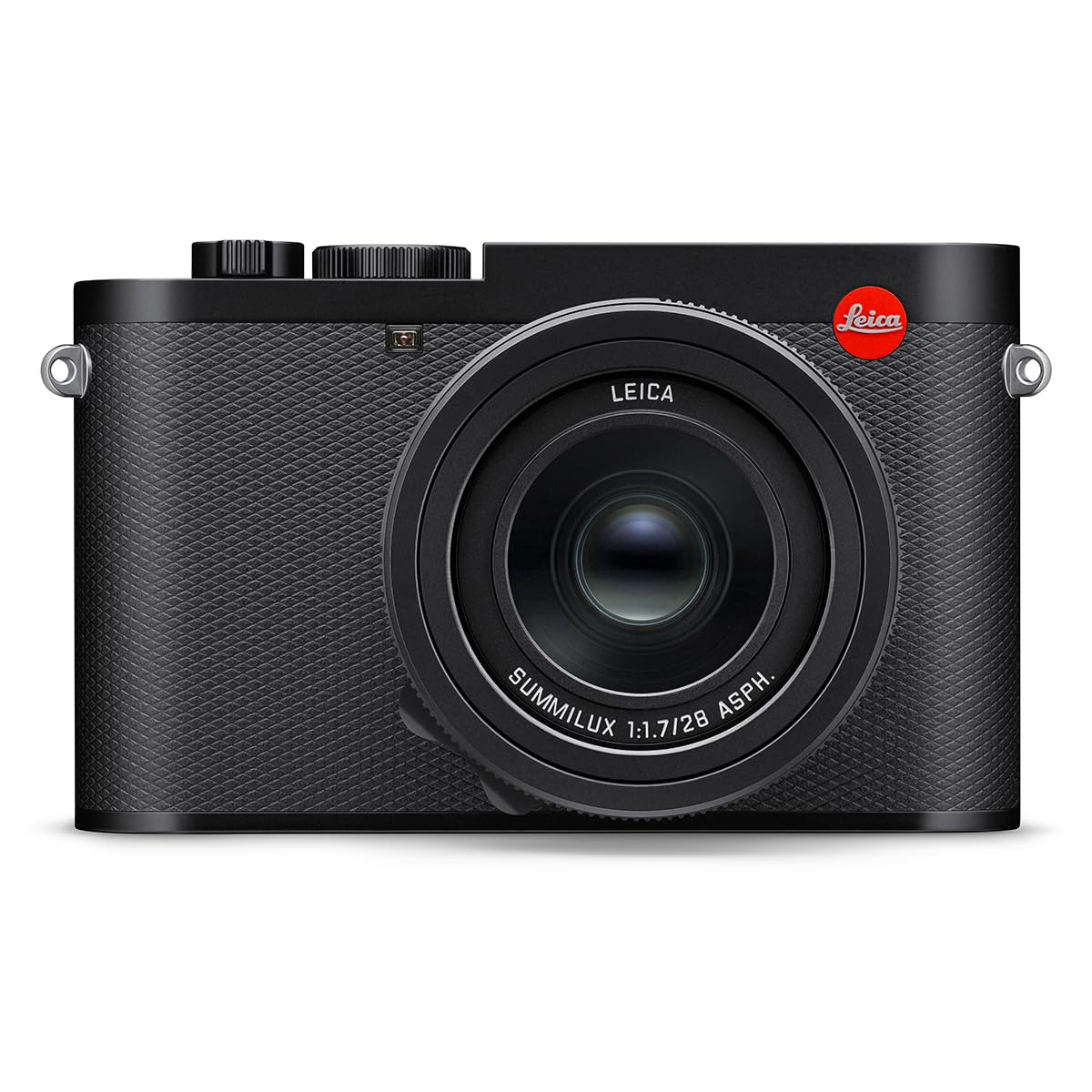
The Leica Q3 is the ultimate expression of a fixed-lens, full-frame compact camera. It marries a bespoke 60MP BSI CMOS sensor with Triple Resolution Technology (letting you shoot at 60MP, 36MP, or 18MP for faster buffer clearing) with a legendary Summilux 28mm f/1.7 ASPH lens. The lens is a masterpiece of optics — incredibly sharp wide open, with a characterful rendering that is the signature of Leica glass.
This is a camera for the connoisseur of image quality and user experience. The Maestro IV processor and 8GB of memory ensure the camera is swift and responsive. The hybrid autofocus with phase detection is fast and accurate. More than specs, the Q3 offers a workflow that is rare: a single perfect lens, a brilliant EVF, and DNG RAW files that require minimal editing to look stunning. It is a camera you carry everywhere.
The Q3 is the most expensive item on this list by a wide margin and is missing a few “professional” features. It has only one card slot, and you cannot change the lens. If the 28mm field of view doesn’t suit your shooting style, you need a different camera entirely. Supply is also highly constrained, often leading to prices above MSRP. This is not a toolbox; it is a state of mind for the photographer who values excellence in a single vision.
Why it’s great
- World-class 60MP sensor and Summilux 28mm f/1.7 lens
- Triple Resolution Technology for flexible workflow
- Stellar build quality and intuitive user experience
Good to know
- Extremely expensive; single focal length limits versatility
- Single card slot is a risk for professional events
- Supply is very limited; often sold above MSRP
FAQ
Should I buy an APS-C or Full-Frame camera as an affordable pro option?
How many autofocus points do I need for professional work?
Final Thoughts: The Verdict
For most users, the best affordable professional camera winner is the Canon EOS R50 because it offers the sharpest oversampled 4K video and Canon’s reliable Dual Pixel AF in a body that is easy to use and priced to start. If you want the ultimate low-light and depth-of-field experience, grab the Canon EOS RP to get Full-Frame without breaking the bank. And for a video-centric powerhouse with unlimited recording and pro codecs, the Panasonic LUMIX S5IIX stands alone as the best value for serious videographers.