
Our readers keep the lights on and my morning glass full of iced black tea. As an Amazon Associate, I earn from qualifying purchases.
Specs are compiled from manufacturer listings and verified buyer reviews and can change over time — please confirm the key details on the product page before buying.
You want a small camera that doesn’t force you to choose between portability and picture quality. The best picks here pack professional-grade sensors and stabilizers into bodies that slip into a jacket pocket. This guide cuts through the spec noise to show you which compact actually earns its place in your bag, from pocket gimbals to travel zooms.
I’m Min — the founder and writer behind Gadgets Feed. This guide is built by comparing the manufacturers’ published specifications and the patterns across verified customer reviews, so you get each pick’s real strengths and trade-offs instead of marketing spin.
Whether you are vlogging, traveling, or capturing family life, finding the right affordable small camera means matching sensor size, stabilization, and zoom to how you actually shoot.
Our Picks at a Glance



How To Choose The Best Affordable Small Camera
Before you buy a compact camera, focus on three specs that decide whether you get a bargain or a frustration: sensor size, stabilization, and zoom type. Sensor size (the physical chip that captures light) affects image quality in low light. Stabilization (a system that reduces shake) keeps your shots sharp. Zoom type (optical vs. digital) determines how close you can get without losing detail.
Sensor Size Decides Your Low-Light Future
The sensor is the light-catching heart of any camera, measured in inches. A larger 1-inch sensor captures more light, which means cleaner video and photos when the sun goes down or you’re indoors. A smaller sensor found in budget action cams and basic point-and-shoots will look fine in bright daylight but gets grainy and soft as light drops. If you shoot inside or at dusk, prioritize the bigger sensor.
Stabilization Keeps Your Footage Watchable
Shaky video ruins footage, so gimbal stabilization is key for smooth walking shots. Gimbal stabilization uses tiny motors on physical axes to physically counter your hand movement — this is the smoothest type, ideal for walking while filming. Digital or optical image stabilization (OIS) uses software or lens elements to reduce shake, which helps stills and mildly moving shots but can’t match a gimbal for active recording. Match the stabilization type to how much you move while shooting.
Optical Zoom vs Digital Zoom — Know the Difference
Optical zoom uses the lens glass to magnify the scene, so the image stays sharp. Digital zoom simply crops into the photo and enlarges the pixels, which degrades quality the further you push it. A camera with 25x optical zoom can bring a distant bird clearly into frame, while a camera with high digital zoom numbers will blur and pixelate at long range. For wildlife, sports, or travel, look for optical zoom numbers — they are the honest measure of reach.
Battery Type Shapes Your Daily Routine
Your power choice shapes how you shoot. Built-in rechargeable batteries charge via USB, perfect for a day in the city, but you cannot swap them when drained. Removable rechargeable packs let you carry spares for all-day shoots. AA-powered cameras let you buy batteries anywhere in an emergency, but you will replace them often. Pick built-in USB for quick clips, or removable packs for long outings.
Quick Comparison
| Model | Best For | Sensor / Resolution | Stabilization | Zoom | Amazon |
|---|---|---|---|---|---|
| DJI Osmo Pocket 3★ Best Overall | Buttery-smooth vlogging | 1″ CMOS / 9.4 MP | 3-axis gimbal | 2x Digital | Amazon |
| Xtra Muse Pocket GimbalValue Gimbal | DJI-like quality for less | 1″ CMOS / 4K120 | 3-axis gimbal | — | Amazon |
| Canon PowerShot V10Creator Favorite | Creator vlogging simplicity | 1″ CMOS / 15.2 MP | IS modes | 3x Digital | Amazon |
| Tecglem 8K Camera | Beginner value & ease | 88 MP Sensor | 6-axis | 16x Digital | Amazon |
| FlyFrost 8K Camcorder | Night vision recording | 88 MP Sensor | Stabilizer | 18x Digital | Amazon |
| KODAK PIXPRO AZ255 | Long-range optical zoom | 16 MP CMOS | OIS | 25x Optical | Amazon |
| KODAK PIXPRO AZ528 | Extreme wildlife zoom | 16 MP BSI CMOS | OIS | 52x Optical | Amazon |
| GoPro HERO Bundle | Rugged action & adventure | 12 MP / 4K30 | HyperSmooth | 2x Digital | Amazon |
| Canon EOS R100 Kit | Growing into interchangeable lenses | 24.1 MP APS-C | Lens-based IS | Lens kit optical | Amazon |
In‑Depth Reviews
1. DJI Osmo Pocket 3 Creator Combo
Our pick — 4.5★ from 6,500+ verified ratings; the strongest balance of quality and price.
The pocket gimbal that makes every walk look like a dolly shot.
The core of this camera is its 1-inch CMOS sensor, which captures 4K video at 120fps — that means buttery-smooth slow motion and clean footage even as the light fades at sunset. Its 9.4 MP effective still resolution tells only part of the story; what wins people over is the 3-axis gimbal that physically counteracts your movement. The 3-axis gimbal keeps footage steady even when you chase a pet or spin around.
Framing a TikTok clip is as easy as spinning the display: the rotating 2-inch touch screen flips for horizontal or vertical shooting. ActiveTrack 6.0 (a face-tracking feature) locks onto you and keeps you centered while you jump or dance, which solo creators will love. The Creator Combo adds the DJI Mic 2 transmitter, a battery handle, and an Osmo mini tripod — so you record crisp audio and shoot longer, with the handle extending runtime beyond the internal 166-minute average.
Buyers call it perfect for vlogging and personal content after months of use. The premium price and delicate gimbal mechanism require careful handling. Travelers who want one device that replaces both a phone and a separate stabilizer will find it genuinely useful.
What Wins People Over
- Gimbal-stabilized 4K/120fps footage that looks professionally shot
- 1-inch sensor delivers strong low-light video quality
- Included DJI Mic 2 dramatically improves audio clarity
Consider Before Buying
- Premium price — the budget picks below cost a fraction as much
- Delicate gimbal mechanism needs careful handling
- Still resolution (9.4 MP) is modest for still photography
Reach for this if: smooth, professional-looking handheld video is your priority and you want an all-in-one kit with a real microphone.
Look elsewhere if: you mostly shoot still photos or you’re on a strict budget that can’t stretch to this tier.
2. Xtra Muse Pocket Gimbal Camera
A DJI-style pocket gimbal at a friendlier price tag.
This pocket camera matches the DJI Osmo Pocket 3’s headline specs — a 1-inch CMOS sensor shooting 4K at 120fps — but at a lower price point. The 3-axis gimbal does the heavy lifting for smooth footage, and buyers describe it as near-identical to the pricier competitor at roughly half the cost. Its 161-minute average battery life keeps pace with a full day of outing.
The 2-inch touch screen flips between horizontal and vertical framing, and Master Follow tracking keeps you center-frame while you move. Its True 10-bit X-Log color mode captures up to one billion colors, giving editors room to grade footage for sunrise and sunset scenes. It also fits in a Coach purse, which is exactly the portability that earns praise.
The honest trade-off is reliability: some owners hit SD card format errors and overheating during extended 4K60 recording, so this is not the one to trust for once-in-a-lifetime events you can’t re-shoot. For everyday vlogs, travel clips, and content where you control the conditions, it’s a serious bargain. The bundle includes a carrying bag, wrist strap, and a handle with a 1/4-inch thread for tripod mounting.
Gimbal quality: Smoothness matches the premium DJI pick at a lower cost — the thing everyone raves about is how stable footage looks straight from the start.
Reliability note: Occasional overheating and card errors mean it’s best for casual shoots, not irreplaceable moments.
Pick this if: you want DJI-level gimbal smoothness without the flagship price.
Think twice if: you need rock-solid reliability for travel videos you can’t redo.
3. Canon PowerShot V10
A vlogging-first Canon that folds its own stand into the body.
Canon designed this one specifically for creators, pairing a 15.2 MP 1-inch back-illuminated CMOS sensor with a fixed 19mm wide-angle lens. That wide field of view is why the built-in stand folds from the front or back — you can set it on a table, flip the front-facing screen, and start recording hands-free. It’s small enough to drop into a fanny pack, which is exactly how owners describe carrying it.
Video is the mission here: 8-bit 4K capture at up to 30fps and Full HD at 60fps, with three image-stabilization modes (off, on, and enhanced) you can switch between in recent firmware. Audio comes from a pair of stereo microphones plus a third center mic that cancels background noise. With Wi-Fi and Bluetooth built in, you can pair a phone for wireless control and transfer.
The predictable catch is that this is a video-first tool — you can’t zoom in or out while filming, which buyers report, and the 2-hour battery average means packing a power bank for long shoots. Its still-photo capability is serviceable but not the reason to buy it. As a point-and-shoot vlogging camera that produces great video and audio in a cute, pocketable body, it’s hard to argue with.
Built for Vlogging
- Built-in folding stand and flip screen for hands-free recording
- Three stereo mics deliver clear audio and cut background noise
- Compact size fits in a pocket or fanny pack
Know This First
- No zoom while filming — a fixed wide-angle lens
- 2-hour battery average requires planning for full days
- Still photos are fine, not the main strength
Perfect for: new vloggers and streamers who want a simple, great-sounding camera with zero setup fuss.
Not for: anyone who needs zoom reach or heavy still-photo use in one device.
4. Canon EOS R100 Mirrorless Kit
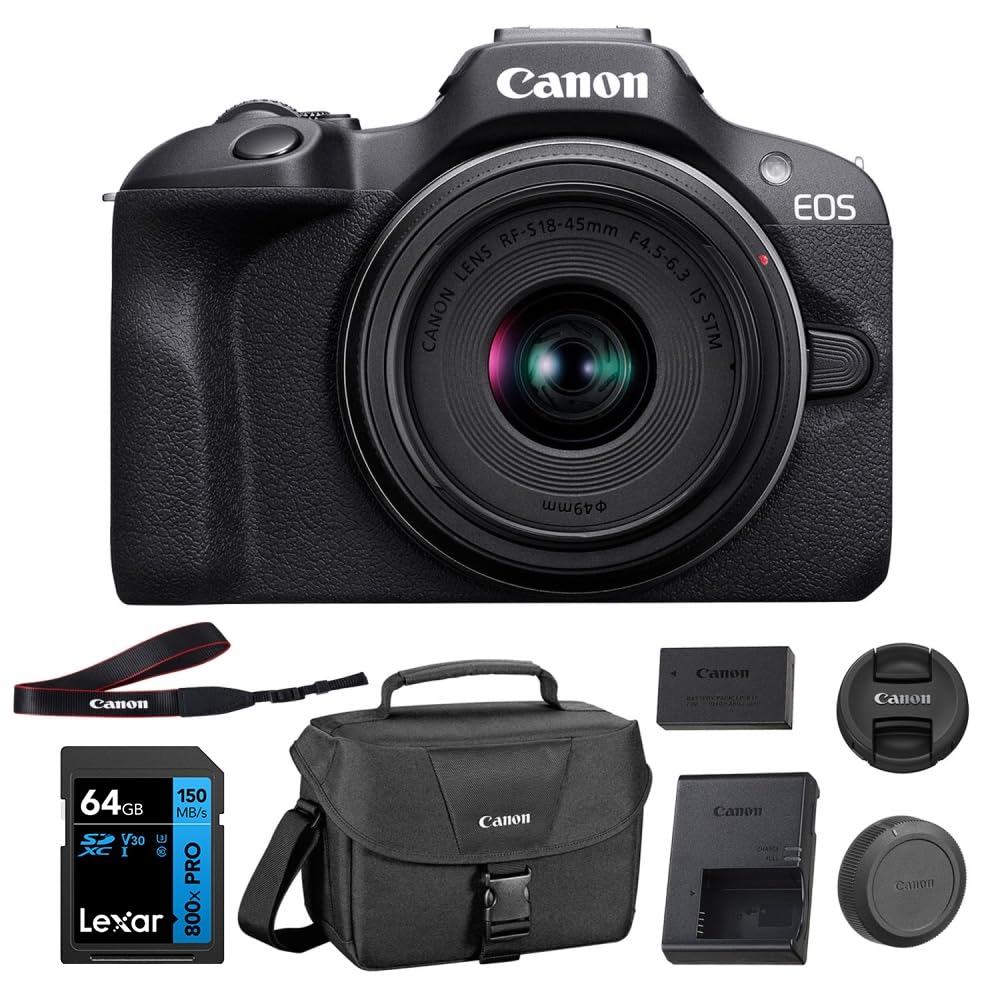
The gateway to interchangeable lenses that stays lightweight.
If you want room to grow as a photographer, the EOS R100 is the smallest and lightest body in Canon’s EOS R series, yet it packs a 24.1 MP APS-C CMOS sensor. That large sensor is why it captures natural bokeh — the soft, blurred background in portraits — and handles 4K video at up to 24fps. The bundled RF-S18-45mm lens covers everyday wide to standard shots, and the kit also includes a 64GB SD card and a Canon shoulder bag.
Autofocus is a genuine highlight for beginners: Dual Pixel CMOS AF covers a wide area up to 143 zones with human face and eye detection, plus animal and vehicle detection. You can shoot continuous bursts up to 6.5 shots per second in One-Shot AF. The DIGIC 8 processor drives all of it, and the RF mount means you can upgrade lenses later without changing the body.
This is the pick for families and students — buyers describe 11- and 17-year-olds falling in love with it in photography classes. The trade-off is that it’s a camera system, not a pocket camera, so it won’t slip into a jean pocket like the gimbal options above. But for anyone who wants real control over composition and a path to better glass, it’s the smartest long-term investment of the group.
Growth path: The RF mount lets you swap in better lenses as your skills improve, so this camera can grow with you for years.
Size reality: It’s the lightest in its series, but it’s still a system camera with a lens — not a pocket companion.
Choose this for: beginners who want to learn real photography with interchangeable lenses.
skip it if: your priority is a true pocket camera for casual vlogging.
5. KODAK PIXPRO AZ528

Fifty-two times optical zoom brings distant birds right to your lens.
This bridge camera’s defining ability is its 52x optical zoom paired with a 24mm wide-angle lens — reach that most cameras in its class simply cannot match. That means you can photograph a Carolina chickadee at a feeder without the blur that digital zoom would introduce, because the lens itself is doing the magnifying. A 16 MP backside-illuminated CMOS sensor keeps images sharp and handles low light reasonably well, while optical image stabilization compensates for hand movement even at maximum zoom.
Action shooters will appreciate the 6 frames-per-second burst mode, which lets you fire off a rapid sequence and pick the sharpest frame. Built-in Wi-Fi lets you transfer photos to your smartphone for instant social sharing, or use your phone as a remote viewfinder. It records Full HD 1080p video and accepts Class 10 SD, SDHC, or SDXC cards up to 512GB — enough for thousands of photos and hours of footage on a rechargeable Li-Ion battery.
The recurring trade-off is zoom stability: owners note that at full 52x reach, you need steady hands or the image gets blurry — camera shake is amplified at extreme focal lengths. Autofocus also draws mixed comments, so this favors patient shooters. For an entry-level camera that captures birds, wildlife, and distant sports action with genuine optical sharpness, the AZ528 is the reach king of this list.
The Reach Advantage
- 52x optical zoom captures distant subjects with real sharpness
- 6fps burst mode catches fast-moving action
- Built-in Wi-Fi for quick phone transfers
Steady-Hand Required
- Footage blurs at max zoom without steady hands
- Autofocus draws mixed reviews at long range
- Not the choice for smooth handheld video
Best for: wildlife watchers and sports fans who want extreme optical reach on a budget.
Not ideal for: vloggers who need smooth, shake-free video.
6. GoPro HERO Action Camera Bundle

A rugged 4K shooter that survives water, dust, and mountain trails.
Take this camera swimming, snorkeling, or shooting in the rain without a second thought — it is waterproof up to 33 feet with no housing needed, unlike a delicate pocket gimbal. At just 3 oz, it disappears into a pocket or clips onto a mount with its foldable prongs. This bundle adds a 50-in-1 accessory kit, a 64GB Micro SDXC card, and a microfibre cloth.
Footage quality holds up with UHD 4K30 video and 12 MP photos, plus 2.7K60 slow-motion that plays back at 2x speed for cinematic action shots. HyperSmooth stabilization automatically smooths bumps and shakes, which is why mountain bikers and horse riders use it to capture fast-moving activity. You control it hands-free with 8 voice commands in 11 languages, and built-in Wi-Fi uploads footage to the Quik app for editing and sharing.
The bundle’s value is strong, but the base battery averages just 1 hour at the highest settings — a spare battery is basically required for a day out. Some owners hit app compatibility snags with older phones, and the touchscreen menu gets mixed feedback. If your shooting happens outdoors, in the water, or strapped to moving gear, this is the tough little workhorse of the list.
Rugged build: Waterproof to 33 feet with HyperSmooth stabilization makes this the go-to for action and adventure.
Battery reality: A 1-hour average at top settings means serious shooters will want spare power.
Reach for this if: your footage happens underwater, on bikes, or strapped to moving gear.
Look elsewhere if: you need long recording sessions or a touchscreen-heavy shooting experience.
7. KODAK PIXPRO AZ255

A beginner-friendly zoom compact that runs on AA batteries anywhere.
Sometimes the smartest feature is the simplest: this camera runs on AA batteries, so when it dies you can buy power at any convenience store instead of hunting for a charger. That flexibility, plus a 25x optical zoom over a 24mm wide-angle lens, makes it a dependable travel companion. Its 16 MP CMOS sensor and optical image stabilization deliver clear, sharp photos — owners specifically praise its ability to snap the moon.
The 3-inch LCD screen makes framing easy for beginners, and the simple controls let you pick it up and shoot without reading a manual. It records 1080p Full HD video, making it a serviceable vlogging starter. The big optical zoom is clear without the distortion that plagues digital cropping, which is why it earns praise for macro and night shots.
The trade-off sits in overall quality — the highest-discussed topic is mixed, with some owners calling the build toy-like and reporting image quality that fades after months of use. AA batteries also deliver short life, so you won’t get a full day from one set. This is a capable starter, not a long-term pro tool, best for someone who wants a simple zoom camera for family outings without charging anxiety.
Traveler-Friendly
- AA batteries available anywhere — no charger needed
- 25x optical zoom is clear and distortion-free
- Simple controls ideal for first-time camera owners
Keep in Mind
- Build quality and long-term image consistency draw mixed feedback
- AA batteries drain quickly — carry spares
- Not built for heavy daily professional use
Choose this for: casual family photographers who value simple controls and universal battery access.
pass on it if: you want a camera that will hold up to rigorous daily shooting.
8. Tecglem 8K Digital Camera
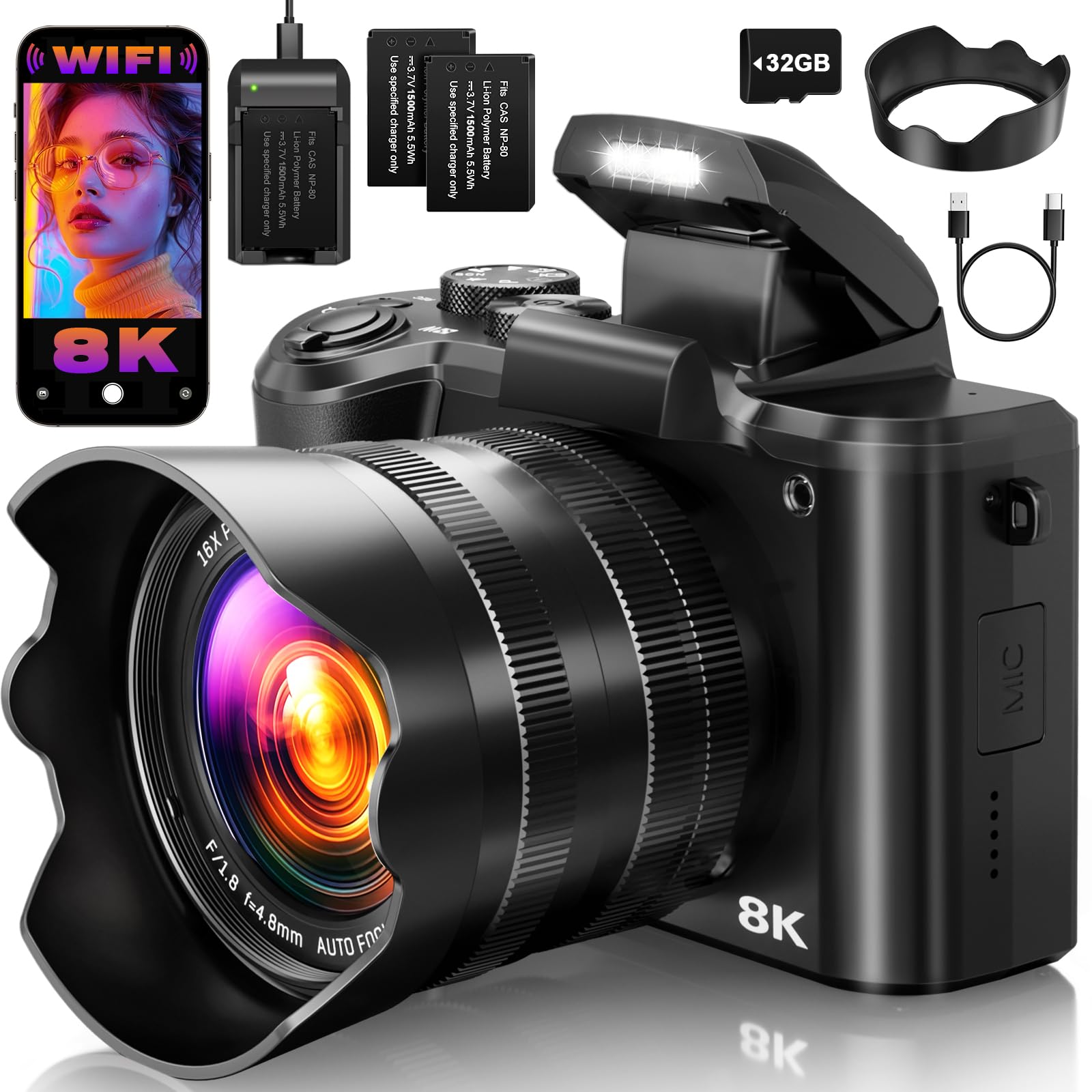
An entry-level 8K camera that bundles everything a beginner needs.
This is the most budget-friendly pick on the list, and it earns its keep by being genuinely easy to use. The 88 MP sensor captures 8K video and sharp stills in good lighting, while the quick autofocus locks focus in seconds — just press halfway and shoot, which beginners will appreciate. The package includes two batteries, a charging stand, a 32GB SD card, a lens hood, a camera bag, and more, so you’re ready to shoot the day it arrives.
The dual front-and-rear lenses make selfies and vlogging simple, and the 3.2-inch IPS touch screen lets you tap to frame, focus, and shoot. A 360° smart mode dial switches instantly between Timelapse, Portrait, Scene, Slow Motion, and more. Six-axis stabilization keeps shots steady on the move, and Wi-Fi transfers photos to your phone through the iSmart DV2 app — two batteries mean extended shooting time without a midday charge.
Buyers consistently describe it as excellent value, praising the sharp, vibrant images and easy setup for beginners and content creators. The honest limitation is that its 16x digital zoom degrades quality at long range — this is a great close-to-mid-range shooter, not a wildlife lens. For a first camera for travel, family moments, or YouTube basics, this is the smart money pick.
The Value Case
- Everything included — two batteries, stand, 32GB card, bag
- Dual lenses and touch screen simplify selfies and vlogging
- Fast autofocus well-suited to beginners
The Trade-Off
- 16x digital zoom loses quality at long range
- Image quality shines in good light, less so in dim scenes
- Entry-level build, not a professional tool
Best for: beginners and teens who want a full starter kit that works right from the start.
Not for: enthusiasts needing strong low-light performance or true optical zoom.
9. FlyFrost 8K Video Camera
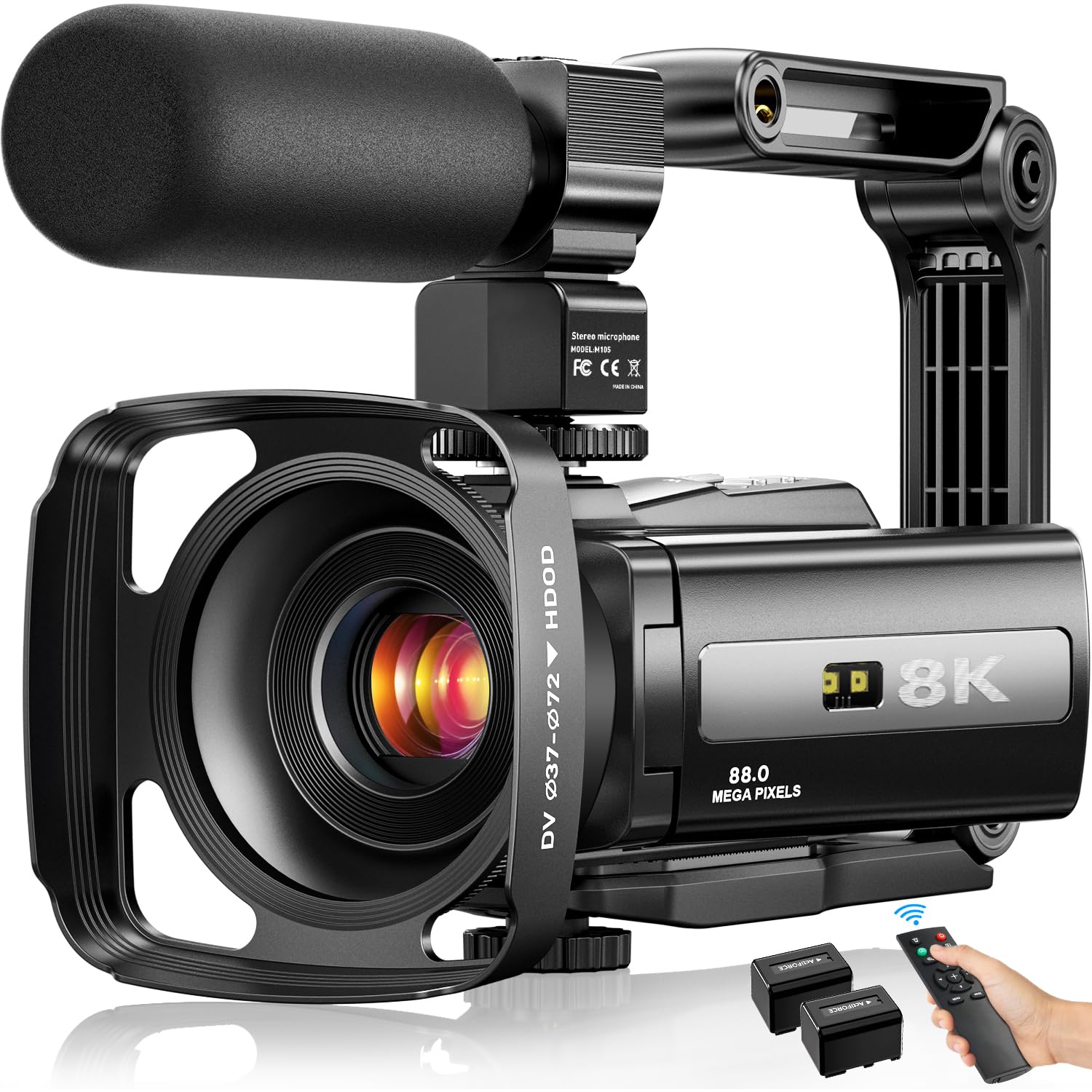
A feature-packed camcorder with infrared night vision for after-dark recording.
What sets this camera apart is its IR night vision — press the OK button and it captures black-and-white video in dimly lit or dark environments. That makes it a versatile choice for anyone recording low-light scenes, from camping trips to nighttime events, and it’s a feature none of the other budget picks offer. The 88 MP sensor delivers 8K video with its 18x digital zoom, and the 3-inch touch screen keeps control simple.
It arrives fully loaded: an external microphone reduces wind and background noise, a handheld stabilizer smooths footage, and a 2.4G wireless remote controls the camera from up to 60 feet away. The package includes two batteries, a lens hood, a camera bag, and a cleaning cloth. It also doubles as a webcam for live streaming by connecting via USB and choosing PC Camera mode.
Buyers call it excellent value for casual recording and vlogging, praising the sharp video in well-lit conditions and the convenience of the included mic and remote. The honest caveat is fixed focus — there’s no autofocus here, so sharpness depends on distance to the subject, and the 18x digital zoom will soften at long reach. For a beginner camcorder that does a bit of everything including night vision, this is a strong budget all-rounder.
Standout feature: IR night vision lets you record in the dark — a rare capability at this price.
Focus limitation: Fixed focus means you must manage distance manually for crisp shots.
Pick this for: versatile casual recording with the unique bonus of night vision.
Think twice if: you need autofocus or rely on long-range digital zoom.
Understanding the Specs
Sensor Size and Megapixels
A camera’s sensor is its light-catching heart, measured in inches or by megapixel count. A 1-inch CMOS sensor catches more light than a smaller sensor, which is why it produces cleaner video in low light. Megapixels measure resolution — 24.1 MP on a large APS-C sensor gives detail and bokeh, while an 88 MP count on a tiny sensor can still struggle in dim scenes. Bigger sensor plus good light matters more than a high megapixel number alone.
Optical vs Digital Zoom
Optical zoom uses glass to magnify the scene, keeping the image sharp at full reach — that’s why the KODAK models (25x and 52x) can photograph distant birds clearly. Digital zoom crops into the image and enlarges pixels, so quality drops as you zoom further, which is why budget cameras advertising 16x or 18x digital zoom soften at long range. When you care about distance, check the optical zoom number first.
Stabilization Types
Stabilization keeps your footage from looking shaky. Gimbal stabilization uses motors on physical axes to counter your movement — the smoothest type, found on the DJI and Xtra Muse pocket cameras. Optical image stabilization (OIS) shifts lens elements to reduce shake, helping handheld zooms stay crisp. Digital stabilization smooths footage in software, which helps but can’t fully match a gimbal for active walking shots.
Battery Life and Power
Battery life determines how long you can shoot before recharging. Built-in rechargeable batteries (like the DJI’s 166-minute average or Xtra Muse’s 161-minute average) charge via USB and suit city days. AA-powered cameras like the KODAK AZ255 let you buy batteries anywhere, though the batteries drain quickly. Removable packs (in the Tecglem and FlyFrost bundles, which include two) let you swap in a spare for all-day shoots.
FAQ
Will a 1-inch sensor camera really beat my phone for video quality?
What is the difference between optical zoom and digital zoom?
Which small camera is best for smooth walking videos?
Can I use an external microphone with these compact cameras?
How long does the battery last on these small cameras?
Is a camera with AA batteries better than one with a built-in battery?
What does stabilization actually do for my video?
Which of these cameras is best for a complete beginner?
Final Thoughts: The Verdict
If smooth, professional-looking handheld video is the goal, the affordable small camera winner is the DJI Osmo Pocket 3 — its 3-axis gimbal and 1-inch sensor make it the crowd favorite for a reason. If you want that same gimbal smoothness for less, the Xtra Muse delivers near-identical specs at a friendlier price. And for extreme optical reach on wildlife or sports, the KODAK PIXPRO AZ528 with its 52x zoom is the one to reach for.
How We Picked
We do not accept paid placement. Every pick is matched to a real buyer and a real use-case; we do not hands-on test units.
Sources & Methodology
Specifications: manufacturer listings and product documentation. Review insights: verified customer reviews, as of August 2026. Pricing: not shown on this page (it changes often); check the current price via the retailer link.
As an Amazon Associate, Gadgets Feed earns from qualifying purchases. This does not affect which products we feature.