
Our readers keep the lights on and my morning glass full of iced black tea. As an Amazon Associate, I earn from qualifying purchases.
Specs are compiled from manufacturer listings and verified buyer reviews and can change over time — please confirm the key details on the product page before buying.
You can buy a smoke detector for the price of a pizza, but will it wake you up at 3 AM or just chirp at you for years? The hard part is trusting a cheap alarm to catch real smoke without false alerts. Battery-powered, hardwired, sealed 10-year units, and models with replaceable batteries all sit on the same shelf. They protect your home very differently. This guide cuts through the spec sheets to tell you which affordable smoke detectors are actually worth installing in every bedroom and hallway.
I’m Min — the founder and writer behind Gadgets Feed. This guide is built by comparing the manufacturers’ published specifications and the patterns across verified customer reviews, so you get each pick’s real strengths and trade-offs instead of marketing spin.
If you own an older house with no pre-wired interconnects or you need a whole new set for a rental, you are about to see the hard data on sensor types, battery life, and decibel output (loudness measurement). That separates a real bargain from a dangerous dud for the best affordable smoke detectors.
Our Picks at a Glance

How To Choose The Best Affordable Smoke Detectors
When you shop on a tighter budget, every feature trade-off matters more. Smoke detectors are safety devices that sit silent for a decade—until the ten seconds they need to work perfectly. The wrong pick can mean chirping at midnight, false alarms from toast, or no detection at all during a smoldering fire. Here is what to focus on.
Power Source: Battery vs. Hardwired vs. Sealed Battery
Battery-powered detectors are the easiest to install—you screw them into the ceiling or wall and you are done. No electrician needed, no wiring. Hardwired detectors connect to your home’s 120-volt AC power and usually have a battery backup; they are required by code in many newer homes. The newest option is a sealed 10-year lithium battery that cannot be replaced; once it dies, you replace the whole unit. A sealed battery means no more low-battery chirps, but you cannot pop in fresh AAs at 2 AM if you misplace the alarm.
Sensor Type: Ionization vs. Photoelectric
Every smoke detector uses one of two sensors—or sometimes both. An ionization sensor is quicker at detecting fast, flaming fires (think a grease fire or a curtain catching a spark). A photoelectric sensor is more sensitive to slow, smoldering fires (like a lit cigarette dropped in a sofa or an overloaded extension cord smoldering behind a wall). The best practice is to have at least one of each type on every level of your home, or to buy a dual-sensor unit. For bedrooms and hallways near kitchens, photoelectric helps cut down on false alarms from cooking steam.
Sound Level and Interconnect Capability
A smoke alarm must be loud enough to wake a deep sleeper. Look for a minimum of 85 decibels—that is as loud as a power mower from a few feet away. Interconnect capability means that when one detector senses smoke, it triggers every other compatible alarm in the house so you hear the warning from anywhere. Hardwired models connect through a dedicated wire, while some wireless units use radio signals. If you are in a small apartment, a single loud standalone unit may be plenty.
Quick Comparison
| Model | Best For | Sensor Type | Power Source | Item Weight | Amazon |
|---|---|---|---|---|---|
| SITERWELL GS509A★ Best Overall | Budget-friendly photoelectric | Photoelectric | Replaceable 9V battery | 3.52 oz | Amazon |
| Kidde 10SDRSmart Value | Compact AA-powered reliability | Advanced sensing | Replaceable AA batteries (2) | 6.16 oz | Amazon |
| BRK First Alert 9120BFF | Hardwired whole-home system | Ionization | Hardwired AC + 9V backup | — | Amazon |
| First Alert SMI110 | Zero-maintenance sealed battery | Ionization | Sealed 10-year battery | 8 oz | Amazon |
| SITERWELL GS525A | Sealed 10-year battery + photoelectric | Photoelectric | Sealed 3V lithium battery (10 year) | 6.38 oz | Amazon |
| Kidde 20SDR | Larger coverage area with Hush feature | Advanced sensing | Replaceable AA batteries (2) | 0.57 lbs | Amazon |
| First Alert SMI105-AC (3-Pack) | Whole-home hardwired with 10-year backup | Precision Detection | Hardwired AC + sealed 10-year battery | 11.2 oz | Amazon |
In‑Depth Reviews
1. SITERWELL Smoke Detector, 10 Year Product Life Fire Alarm with Magnetic Fastening Kit (GS509A)
A tiny 3.93-inch photoelectric alarm that punches far above its weight in loudness.
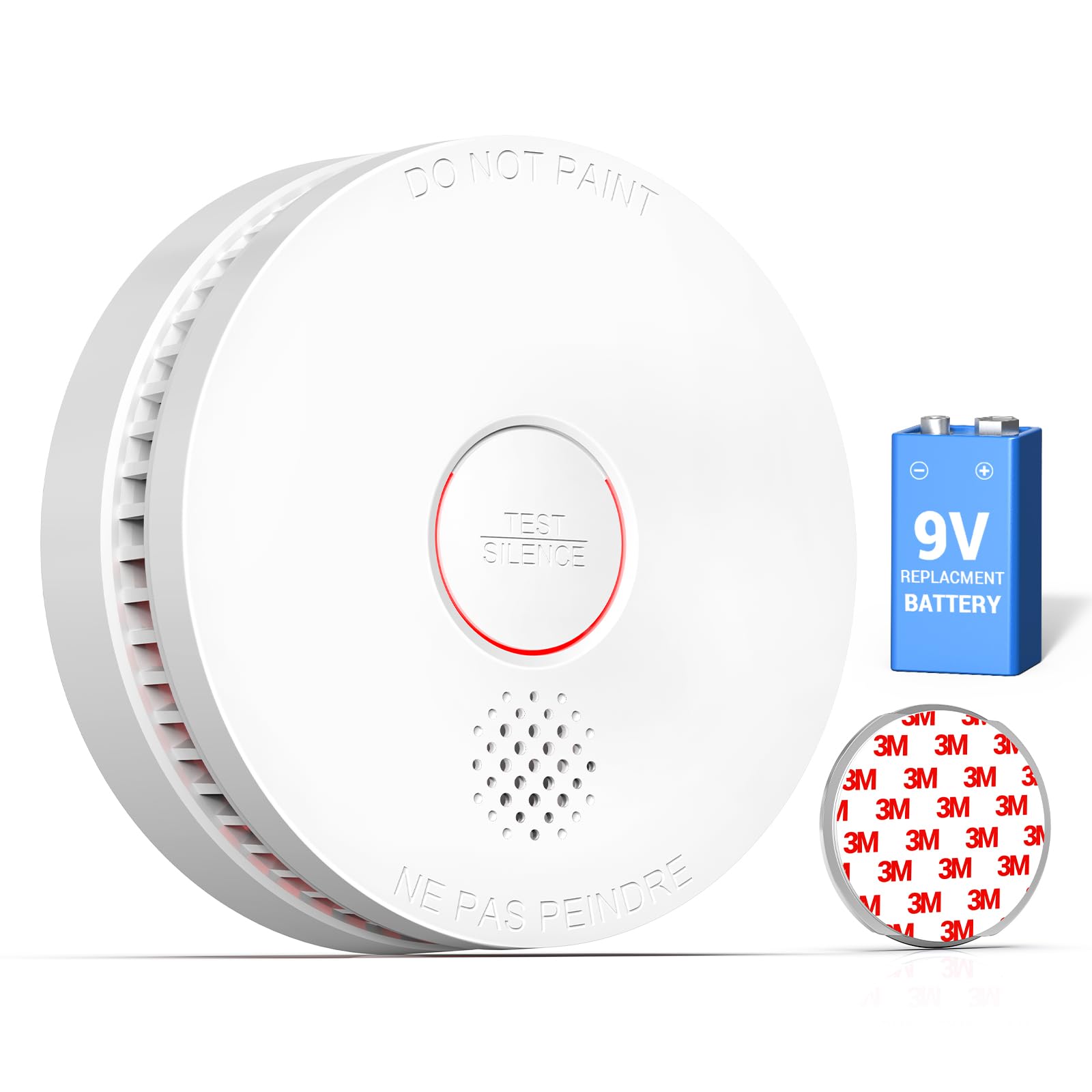
The SITERWELL GS509A is the smallest and lightest detector in this guide at 3.93 inches wide and just 3.52 ounces—nearly 2.3 times lighter than the 8-ounce First Alert SMI110. It uses a photoelectric sensor, which makes it ideal for slow-smoldering fire detection, and it runs on a replaceable 9V battery (included). The manufacturer recommends changing the battery every year and says the unit itself is designed for a 10-year product life.
One buyer reviewer sums up the surprise: “The only reason why I gave it four stars is because it’s a lot smaller than I expected. I’ve never seen a smoke detector that small when you tested. It’s loud I’ll tell you that very, very loud.” The 85-decibel alarm easily fills a bedroom. The included magnetic fastening kit means you can attach it to a metal ceiling box without drilling, or use the two screws and plastic plugs for drywall. Because it uses a standard 9V battery, you can replace the power source cheaply instead of tossing the whole unit when the battery dies.
Why the small size works
- Only 3.52 ounces—the lightest smoke detector here, barely noticeable on the ceiling.
- Photoelectric sensor is best for slow-smoldering fires like electrical shorts.
- Replaceable 9V battery means you don’t scrap the whole unit when the battery drains.
Size trade-off
- Very compact—some buyers were surprised by how small it is and expected a larger device.
- No interconnect or Hush feature; it is a basic standalone unit.
Perfect for tight spaces: small closets, RVs, dorm rooms, or anywhere you need a photoelectric detector that doesn’t stick out.
Choose a different model if: you need interconnect, a sealed battery, or a larger unit that feels more substantial in your hand.
2. Kidde Smoke Detector, AA Battery Operated, Compact Size (10SDR)
The compact Kidde that slides onto an old mount and works right from the start.
The Kidde 10SDR uses advanced sensing technology that the manufacturer claims detects smoke over 25% faster than older models. It runs on two AA batteries (included), so you never need to hire an electrician. At just 1.88 inches deep and 4 inches wide, it is noticeably more compact than the larger BRK First Alert 9120BFF, which comes in at 5.6 inches deep—a difference you feel when you are trying to place it in a tight hallway or between two bedroom doors.
Reviewers consistently call it easy to install, though a few buyers report they have only had it for a few weeks and cannot yet speak to long-term reliability. The 85-decibel alarm uses a red LED to give you a visual warning alongside the sound, so someone with hearing loss or a noisy fan overhead still gets the alert. The backing 10-year limited warranty helps bridge the trust gap for a budget pick at this price point.
Why it earns the top spot
- Over 25% faster smoke detection than older standards—critical in a real fire.
- AA battery operation means you can replace batteries yourself anywhere, anytime.
- Compact 4-inch design that fits on older Kidde mounts (buyers confirm this directly).
The honest limitation
- Standalone only—no interconnect wire to trigger other alarms in the house.
- Some users wonder about longevity; long-term reviews are still emerging.
Grab it if: you want a no-wiring, compact detector that installs in two minutes and meets modern UL 217 10th Edition standards.
Think twice if: you need hardwired interconnect between multiple rooms or a sealed battery for zero maintenance.
3. First Alert BRK Smoke Alarm, Interconnect Hardwire Detector with 10-Year Battery Backup, SMI105-AC (3-Pack)

A three-pack of hardwired units that interconnect so one alarm sets off the whole house.
The First Alert SMI105-AC comes in a 3-pack, which immediately gives you coverage for the most critical areas—each floor’s hallway and the bedrooms. It uses a Precision Detection sensor that meets new industry standards to cut down on false alarms from cooking while still providing early warning in a real fire. They hardwire into your 120-volt AC system and include a sealed 10-year battery backup, so power outages won’t leave you unprotected.
Owners mention that these units fit directly on existing First Alert mounting plates and that the interconnect feature works flawlessly—when one unit detects smoke, all three sound immediately. The major advantage here over a single unit like the Kidde 10SDR is that you get whole-home triggering without buying separate interconnecting modules. Reviewers mention missing screws in some packs, but most say installation is straightforward with their own hardware. At just over 11 ounces per unit, they feel substantial without being bulky.
Why this three-pack stands out
- Three units in one box cover the main floors at once—no piecemeal shopping.
- Hardwired interconnect means every alarm sounds when any single one detects smoke.
- 10-year sealed battery backup keeps protection running during a blackout.
Watch out for
- Hardwired installation requires some electrical comfort or a contractor.
- A few packages arrived without screws; keep a spare set handy.
Best for homeowners: who already have hardwired pre-wire in the ceiling and want whole-home interconnect without owning separate add-on modules.
skip it if: you rent or live in a home with no AC wiring in the ceiling—you will want a battery-only model instead.
4. BRK First Alert 9120BFF/ SMI100-AC Smoke Detector, Hardwired Alarm with Battery Backup

The hardwired ionization detector with an 85-decibel alarm and a 9V backup that is a contractor favorite.
The BRK First Alert 9120BFF uses an ionization sensor, which means it is especially quick to detect fast-flaming fires—think a pan of oil catching fire or a curtain touched by a candle. It hardwires into your 120-volt AC supply and includes a 9V battery backup so it keeps monitoring during a power loss. The 85-decibel alarm is loud enough to wake anyone, and the unit can interconnect with other compatible BRK and First Alert detectors so the whole house warns at once.
At 5.6 inches in diameter and 2.2 inches deep, it is larger than the Kidde 10SDR, but that extra size houses a side-load battery compartment that customers note makes changing the 9V backup much easier without removing the whole unit from the ceiling. One reviewer noted that one of their five units started beeping after only six months, then replaced the factory battery for better long-term results. The model has over 19,000 ratings at 4.7 stars, making it among the most-tested affordable hardwired detectors on the market.
Reasons this unit is a workhorse
- Ionization sensor catches fast-burning fires faster than photoelectric-only units.
- Side-load battery compartment makes swapping the 9V backup simple.
- Universal mounting bracket and tamper-resistant locking bracket included.
Few trade-offs to note
- Ionization sensor can be more prone to nuisance alarms from cooking.
- The backup 9V battery included may not last the full expected span; consider replacing it right away.
Your move if: you need a single hardwired detector for a new install or replacement and want the confidence of over 19,000 verified ratings.
Look elsewhere if: you want a sealed battery for zero maintenance, or you need a photoelectric sensor for a kitchen-adjacent location.
5. First Alert Smoke Alarm, 10-Year Sealed Battery Detector (SMI110)

A sealed-battery smoke alarm that eliminates low-battery chirps for a full decade.
The First Alert SMI110 is a battery-only smoke detector with a sealed 10-year battery—you buy it, install it, and never change a battery. That alone solves the single biggest annoyance of any smoke detector: the 2 AM chirp that always seems to start right after you fall asleep. It uses an ionization sensor with Precision Detection technology to reduce false alarms from cooking while still catching real fast-flaming fires.
At 5.6 inches wide and 2 inches tall, it uses the same footprint as the BRK hardwired models, and it fits on existing First Alert mounting bases. But reviewers point out a specific concern: one of five units arrived with a defective yellow pull-tab mechanism, and the product carries a no-return policy. That is a real risk with sealed units, since you cannot test the battery before installation. The unit is also standalone—no interconnect—so it only sounds its own alarm rather than triggering others in the house.
What makes it maintenance-free
- Sealed 10-year battery means zero battery swaps for the life of the alarm.
- Precision Detection reduces cooking nuisance alarms compared to older ionization models.
- End-of-life warning chirp tells you when the whole unit needs replacement.
The catch with sealed batteries
- No return policy if the unit is defective from the start—a real concern for some buyers.
- Standalone operation—no interconnect to alert you from other rooms.
Ideal for landlords or long-term installations: set it and don’t think about batteries for ten years.
Not for you if: you want interconnect capability or you prefer to buy from a seller that accepts returns on defective units.
6. SITERWELL Smoke Detector, 10 Year Battery with Photoelectric Sensor (GS525A)
A sealed 10-year photoelectric detector that catches smoldering fires before they burst into flames.
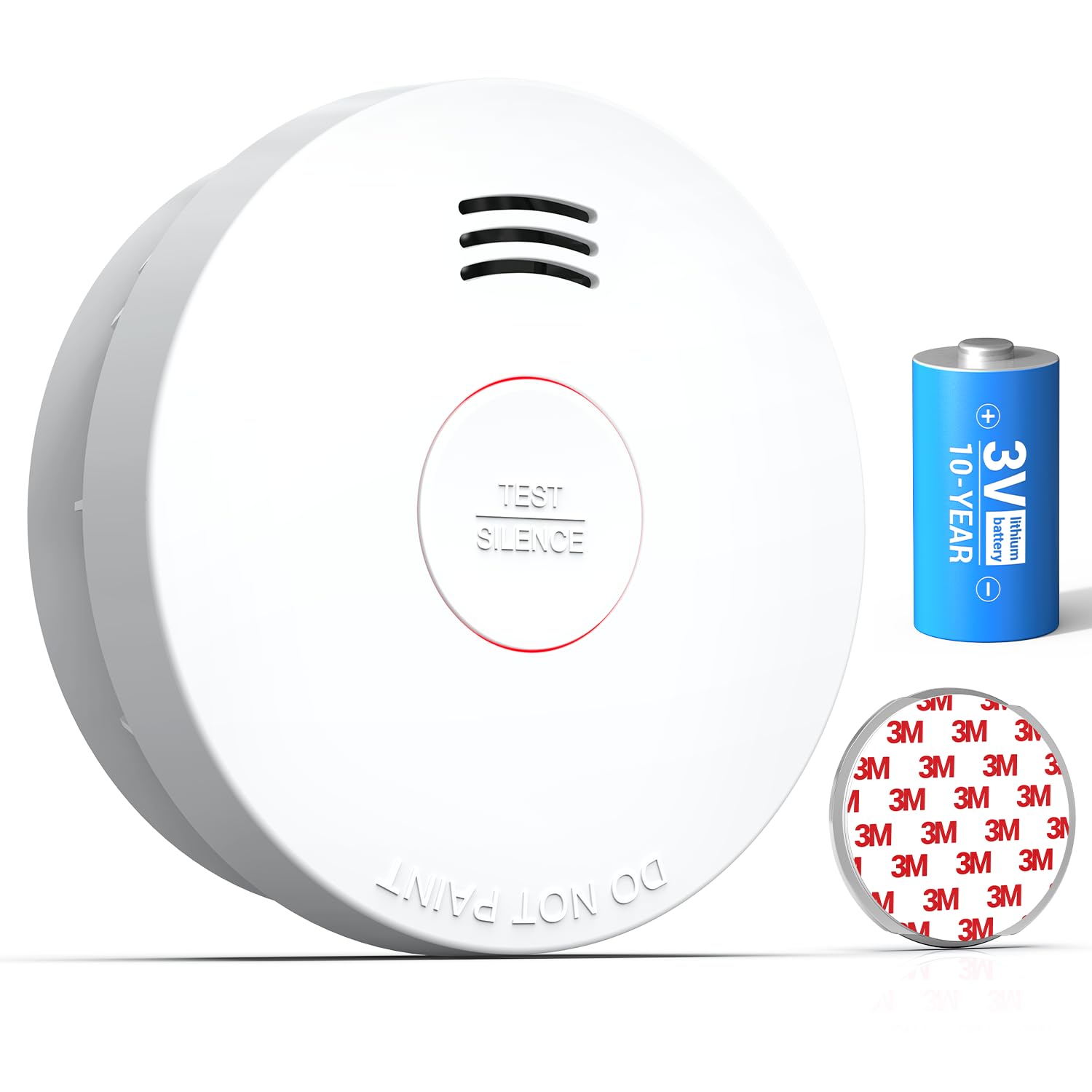
The SITERWELL GS525A uses a photoelectric sensor, so it is more sensitive to the slow, smoky fires that can smolder for hours—like an electrical cord overheating behind a couch or a cigarette dropped in a carpet. That makes it a perfect match for bedrooms or living rooms where nuisance alarms from a bathroom steamer or kitchen toaster are less likely. It runs on a built-in 3-volt lithium battery (non-replaceable) that SITERWELL says lasts ten years, and the alarm sounds at 85 decibels.
At 3.93 inches diameter and 1.38 inches deep, it is small and light (6.38 ounces) compared to the 8-ounce First Alert SMI110. Buyers praise the included magnetic fastening kit and the adhesive pads for quick installation on either a wall or ceiling. One reviewer summarized it cleanly: “Good price good quality easy to use doesn’t get any better than this for smoke detectors. We’re talking 10 years of no maintenance.” The UL 217 listing means it meets current safety standards.
Standout photoelectric features
- Photoelectric sensor excels at detecting slow, smoldering fires before they create large flames.
- Sealed 3V lithium battery provides a full 10-year run with zero battery changes.
- Magnetic fastening kit and screws let you choose the easiest mounting method.
One consideration
- Battery is non-replaceable—when it fails (even before 10 years), the whole detector must be discarded.
- No interconnect or wireless linking with other units.
Grab this for: bedrooms and hallways where slow-smoldering fire risk is highest, and you want the easier maintenance of a sealed 10-year battery.
Choose a different unit if: you need hardwired interconnect or you prefer a replaceable battery so you aren’t tossing the whole detector if the lithium cell dies early.
7. Kidde Smoke Detector, AA Battery Powered, 5-inch, LED Status Lights (20SDR)

A 5-inch Kidde with a Hush button that pauses false alarms without disabling detection.
The Kidde 20SDR is the larger sibling of the 10SDR, growing from 4 inches to 5 inches wide, which gives it a bigger sensing chamber and a more prominent 85-decibel alarm. It uses the same advanced sensing technology that the manufacturer claims offers over 25% faster detection than older models, and it runs on two AA batteries (included). The key upgrade here is the Test & Hush button: if you burn the toast and the alarm starts, one press silences the nuisance for a short period without compromising the detector’s ability to detect real smoke later.
Shoppers say that it slides directly onto older Kidde mounting brackets, making replacement a 30-second job. At 0.57 pounds, it is slightly heavier than the 10SDR (6.16 ounces), but still lightweight enough for drywall or ceiling mounts without extra support. One buyer who replaced a dying set of alarms commented that “longevity of new ones unknown,” which is honest caution—though the 10-year limited warranty covers defects from the date of purchase.
Why the Hush button matters
- Test & Hush button silences cooking false alarms without turning off the detector entirely.
- Advanced sensing technology offers over 25% faster detection than older models.
- Fits directly onto existing Kidde mounts for quick swaps.
The trade-off
- Standalone unit—no interconnect with other Kidde alarms.
- AA batteries need replacement every year or two depending on usage.
Best for kitchens or near bathrooms: the Hush button saves you from climbing up to remove the battery every time steam or a quick burn triggers the alarm.
Not the pick if: you want a sealed battery for total maintenance-free operation or you need whole-home interconnect.
Understanding the Specs
Photoelectric vs. Ionization Sensors
A photoelectric sensor uses a light beam and a photocell; when smoke particles enter the chamber, they scatter the light, triggering the alarm. This makes it more responsive to smoldering fires that produce lots of visible smoke before bursting into flames—think a sofa fire from a dropped cigarette. An ionization sensor uses a tiny amount of radioactive material to ionize the air; when smoke disrupts the current, the alarm sounds. It reacts faster to flaming, fast-moving fires like a paper fire or grease fire. Neither is “better”—they catch different fire types. Many safety experts recommend having both types somewhere in your home.
Battery Types and Product Life
Replaceable battery detectors use standard 9V or AA cells that you swap out every year or two. Sealed 10-year battery detectors integrate a lithium cell that cannot be replaced—when it dies, you throw away the whole alarm. The trade-off is simple: replaceable batteries mean ongoing low cost per year but you must remember to change them; sealed batteries mean zero maintenance for a decade, but the upfront cost is higher and a premature battery failure means the whole unit is dead. The product life of the device itself is typically 10 years from manufacture date for both types, after which the sensor degrades and the unit should be replaced entirely.
FAQ
How often should I test my smoke detector?
What does the UL 217 listing mean for an affordable smoke detector?
Can I mix different brands of smoke detectors in the same house?
How long does a sealed 10-year battery actually last?
What is the difference between an 85 dB and a 100 dB smoke alarm?
Will a hardwired smoke detector work during a power outage?
How many smoke detectors do I need for a two-story house?
Do smoke detectors expire or have a set lifespan?
Can I install a smoke detector on the wall instead of the ceiling?
Why does my smoke detector chirp even after I changed the battery?
Final Thoughts: The Verdict
For most people, the best affordable smoke detectors winner is the Kidde 10SDR because it combines advanced faster detection, simple AA battery power, and a compact 4-inch footprint at a price that works for every room. If you want hardwired whole-home interconnect with a 10-year battery backup, grab the First Alert SMI105-AC 3-Pack and cover your main floors in one box. And for photoelectric enthusiasts who prioritize smoldering-fire detection and a magnetic mounting kit, the standout is the SITERWELL GS525A for a sealed-battery no-chirp solution.
How We Picked
We do not accept paid placement. Every pick is matched to a real buyer and a real use-case; we do not hands-on test units.
Sources & Methodology
Specifications: manufacturer listings and product documentation. Review insights: verified customer reviews, as of July 2026. Pricing: not shown on this page (it changes often); check the current price via the retailer link.
As an Amazon Associate, Gadgets Feed earns from qualifying purchases. This does not affect which products we feature.